



Transfer Conveyor Systems: Design, Types, Benefits, and Automation Integration
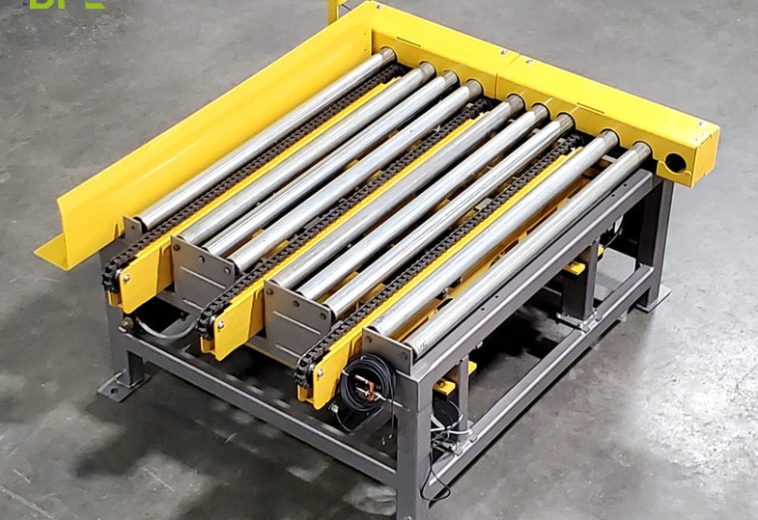
Transfer conveyors are the connective tissue of a factory’s production system — the machines that move products between process zones, change their direction, reorient them for the next operation, and connect manual assembly islands to robotic work cells. Every Malaysian factory that has automated a single production stage but left the transfer between stages manual has a transfer conveyor opportunity: product being carried by hand between filling and packaging, pushed across the floor on trolleys between welding and inspection, or stacked on pallets waiting for a forklift to move them between machining and sub-assembly. Each of these manual transfer steps costs time, introduces handling damage risk, creates a bottleneck that limits the throughput of the automated stages they connect, and represents a direct safety liability under DOSH Malaysia’s Occupational Safety and Health Act. Transfer conveyors — from right-angle pop-up roller transfers handling 2,400 cases per hour to heavy-duty chain transfers moving automotive body panels — close these gaps and complete the material flow chain. This article covers every transfer conveyor type, their specifications, and how DNC Automation engineers them for Malaysian automotive, electronics, and F&B manufacturing operations.
What Is a Transfer Conveyor?
A transfer conveyor is a material handling machine positioned at the interface between two conveyor lines, process stages, or manufacturing zones that transfers products — either by changing their direction, bridging a gap, reorienting their position, or routing them to one of multiple downstream paths — without manual intervention between conveyor sections.
Transfer conveyors differ from standard conveyor sections in that they perform a directional, positional, or routing change rather than simply transporting product in a straight line. A right-angle transfer changes the product’s direction of travel by 90°. A belt-to-belt transfer bridges the gap between two conveyor belts of slightly different heights or speeds. A chain transfer carries heavy pallet loads through sharp direction changes that belt or roller conveyors cannot navigate. A transfer shuttle moves products laterally between parallel conveyor lanes on a set of rails that travels perpendicular to the primary flow direction.
Assembly line transfer conveyors are the enabling infrastructure for continuous-flow manufacturing, where products must move from machine to machine, station to station, or zone to zone without accumulating at bottleneck points or requiring manual repositioning. DNC Automation engineers transfer conveyors as the final integration layer in automated manufacturing cells — connecting Comau robotic assembly stations, Siemens PLC-controlled process machines, and quality inspection gates into a continuous, uninterrupted production flow.
How Does a Transfer Conveyor Work?
Transfer conveyor operation varies by type, but all share the common requirement for precise synchronisation between the incoming conveyor speed, the transfer mechanism cycle time, and the outgoing conveyor speed — managed by a PLC that monitors product position via sensors and coordinates all three systems to transfer products without gaps, jams, or product damage.
Step 1 — Product Arrival and Position Detection
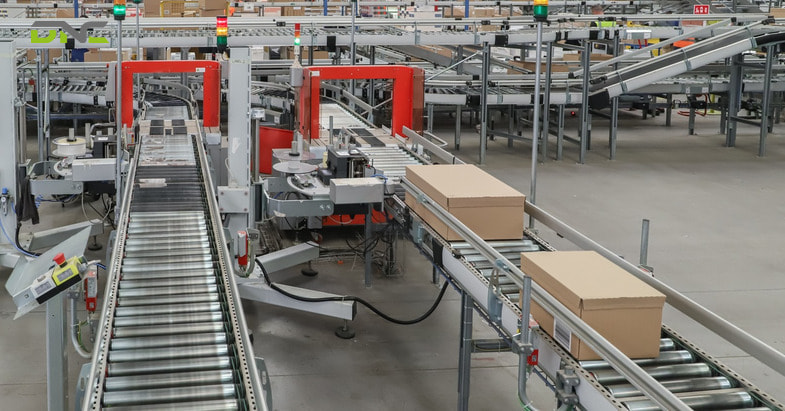
Products arriving at a transfer conveyor are detected by photoelectric sensors (for packages, bottles, and cartons) or inductive proximity sensors (for metal parts and pallets) positioned upstream of the transfer zone. The sensor signal is received by the Siemens S7 PLC, which monitors the gap between the arriving product and the preceding product to determine whether the transfer mechanism has sufficient time to complete its cycle before the next product arrives. On high-speed lines transferring 2,400 cases/hr (40 cases/minute, one case every 1.5 seconds), the PLC must execute the complete transfer cycle — actuate, transfer, return — within this 1.5-second window.
Step 2 — Transfer Mechanism Actuation
The transfer mechanism activates upon product arrival at the transfer zone. For a right-angle pop-up roller transfer, pneumatic or 24V DC actuators raise the pop-up roller modules (30–80 mm stroke) from below the primary conveyor surface to above the belt level, lifting the product off the belt and onto the pop-up rollers, which run perpendicular to the primary flow direction and propel the product out of the transfer zone at 90°. Total actuation time: 0.2–0.5 seconds for pneumatic; 0.3–0.8 seconds for 24V DC electric. For chain transfers handling automotive pallets, hydraulic lifts raise the pallet off the incoming conveyor onto transfer chains that run perpendicular, moving loads of 500–5,000 kg at 0.2–0.5 m/s.
Step 3 — Product Transport Through the Transfer Zone
Product transport through the transfer zone must be smooth enough to prevent product tipping, sliding, or impact damage. Right-angle transfers use powered pop-up rollers (or pop-up belt modules) running at controlled speed to guide the product cleanly to the outgoing conveyor. Belt-to-belt transfers use a short gap-bridger belt that matches the incoming belt speed precisely, with a nose bar (minimum radius 15 mm) at the transition point to prevent product from jamming in the belt-to-belt gap. Chain transfers for heavy automotive pallets use hardened chain with guide rails that constrain the pallet to a precise transfer path, preventing lateral drift that could cause pallet collision with machine guards or robotic work envelope boundaries.
Step 4 — Product Delivery to Downstream Conveyor or Work Cell
Product delivery to the downstream zone completes the transfer cycle. The Siemens PLC confirms product delivery via a downstream sensor and resets the transfer mechanism to its home position, ready for the next incoming product. On diverter-type transfers (where products are routed to one of two or more outgoing paths), the PLC reads the product’s identification code (barcode, RFID, or vision-based code) from a scanner positioned upstream and selects the correct routing destination before the product arrives at the transfer point. DNC Automation designs transfer conveyors with Siemens S7-1500 PLCs and PROFINET-connected sensor arrays that provide 100% product traceability through every transfer point in the line.
Step 5 — Integration with Robot Pick-and-Place Stations
Transfer conveyors delivering parts to robotic work cells must position each product within ±2–5 mm of the robot’s programmed pick position to ensure reliable robot gripper engagement. DNC Automation — as the only official Southeast Asian partner of Comau Italy — designs transfer conveyor and robot integration cells where the transfer conveyor positions parts at a fixed registration stop under a vision system that confirms part position and communicates offset corrections to the Comau robot controller. This vision-guided transfer-to-robot interface is the enabling technology for flexible robotic assembly in Malaysia’s high-mix electronics and automotive manufacturing environment.
Types of Transfer Conveyor
Transfer conveyor types are selected based on product size and weight, the direction change required, line speed and throughput, and the structural loads involved.
Right-Angle Transfer Conveyor
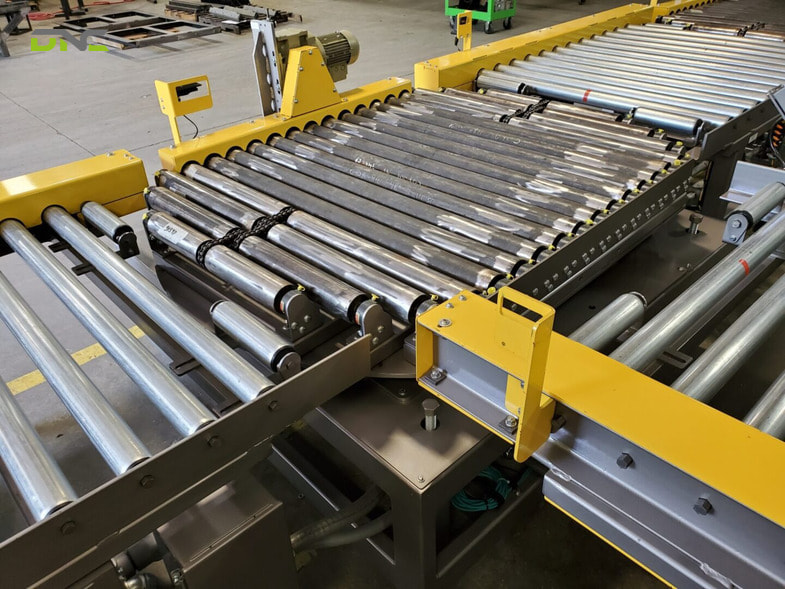
Right-angle transfer conveyors change product direction by 90° using a set of pop-up rollers or pop-up belt modules that rise through the gaps between the primary conveyor’s rollers or belt, lifting the product off the primary conveyor and propelling it onto the perpendicular outgoing conveyor. Pop-up travel is 30–80 mm. Cycle time is less than 1 second for small-to-medium products (1–50 kg). Throughput: up to 2,400 cases/hr for a well-integrated right-angle roller transfer. Actuator options: 24V DC electric (quiet, precise, easy to integrate with PLC I/O) or pneumatic (fast, high-force, requires compressed air supply). Right-angle transfers are the standard at warehouse sortation points, F&B packaging line junctions, and distribution centre case routing systems throughout Selangor and Johor.
Belt-to-Belt Transfer Conveyor
Belt-to-belt transfer conveyors bridge the gap between two conveyor belt systems — either inline (the two belts run in the same direction, at the same or slightly different heights) or merge configurations (two belts converging into one). The gap-bridge belt matches the incoming belt speed to prevent product stumbling at the transfer point. Nose bars at the incoming and outgoing belt ends reduce the effective belt-end-to-belt-end gap to 5–15 mm, enabling transfer of products as small as 50 mm in the direction of travel. Belt-to-belt transfers are used in pharmaceutical blister-pack packaging lines (Penang), confectionery packaging (Selangor), and electronic component packaging throughout Malaysia’s manufacturing sector.
Chain Transfer Conveyor
Chain transfer conveyors use hardened alloy steel chains driven by sprockets to carry heavy pallets, automotive body components, and industrial assemblies through 90° and 180° transfers that belt or roller conveyors cannot handle at these load levels. Chain transfer load capacity: 500–50,000 kg per transfer unit. Chain pitch: 50–200 mm. Transfer speed: 0.1–0.5 m/s for heavy loads; 0.5–1.5 m/s for medium loads. DNC Automation has engineered chain transfer conveyors for automotive body transfer applications for Toyota Malaysia and Inokom Malaysia — DNC clients — where painted body panels must transfer from paint line conveyors to final assembly conveyors without contact damage to the painted surface. Chain guide rails with nylon contact pads prevent metal-to-metal contact that would scratch the finish.
Transfer Cart / Shuttle Conveyor
Transfer carts (shuttle conveyors) run on floor-mounted rails perpendicular to the primary conveyor direction, carrying products, pallets, or fixtures between multiple parallel conveyor lanes, storage lanes, or workstations. Load capacity: up to 185,000 lbs (84,000 kg) for heavy industrial transfer carts. Transfer cart width: 1,000–6,000 mm. Rail span: 2–50 m. Transfer carts are used in automotive body-in-white (BIW) assembly lines connecting welding cells, inspection bays, and final assembly lanes; in die casting facilities transferring moulds between press machines; and in heavy industrial equipment assembly where bridge cranes are not appropriate for high-cycle-rate material flow. DNC Automation engineers transfer cart systems with Siemens S120 servo drive positioning for repeatable ±1 mm stopping accuracy at each transfer point.
Overhead Power-and-Free Transfer Conveyor
Overhead power-and-free (P&F) transfer conveyors use carriers hanging from an overhead track system to transport vehicle bodies, large fabricated parts, or hanging garments through a series of process zones — paint booths, drying ovens, assembly stations — on a track that can route carriers independently through different paths via power-and-free track switches. P&F conveyors are the standard transfer system in automotive paint lines globally and in Malaysia’s automotive OEM plants. The overhead routing eliminates floor obstruction from conveyor infrastructure, maximising floor space for process equipment. DNC Automation integrates P&F conveyor control systems with Siemens S7-1500 PLCs and RFID carrier tracking for full body-by-body traceability through Malaysian automotive paint operations.
Rotary / Turntable Transfer Conveyor
Rotary turntable transfer conveyors rotate the product through 90° or 180° while keeping it on the same conveyor surface, useful for reorienting cartons, pallet loads, or assembled parts before the next process step. Turntables are integrated into conveyor lines at product orientation change points — rotating a carton from landscape to portrait orientation for entry into a cartoner, or rotating a pallet 180° to face a stretch wrapper. DNC Automation supplies motorised turntable transfers for F&B and pharmaceutical packing line clients in Selangor and Penang.
Comparison Table: Transfer Conveyor Types
| Type | Load Capacity | Cycle Time | Direction Change | Best Application |
| Right-Angle Pop-Up | 5–500 kg | < 1 second | 90° | F&B sortation, warehouse |
| Belt-to-Belt | 0.1–100 kg | Continuous | Inline / merge | Packaging, pharma |
| Chain Transfer | 500–50,000 kg | 5–30 seconds | 90°, 180° | Automotive, heavy industrial |
| Transfer Cart / Shuttle | 500–84,000 kg | 15–120 seconds | Lateral (lateral lane change) | BIW, heavy assembly, dies |
| Overhead P&F | 50–5,000 kg | Continuous | Any path | Automotive paint, large fabrication |
| Rotary Turntable | 5–2,000 kg | 3–10 seconds | 90°, 180° | Packaging orientation, pallets |
Key Components of a Transfer Conveyor System
Complete transfer conveyor systems integrate mechanical transfer mechanisms, actuation systems, sensing and detection, and PLC control into a single coordinated assembly.
Pop-up roller or belt module assembly — For right-angle transfers: polyurethane-coated or steel rollers (diameter 38–63 mm) or rubber-faced belt modules mounted on a floating platform guided by linear actuators. Roller or belt surface material is selected for product traction requirement — rubber-faced for cardboard cartons; polyurethane for plastic containers; stainless steel for food-contact applications.
Pneumatic or electric actuation system — Pneumatic cylinders (50–125 mm bore) for high-force, fast-cycle applications; 24V DC electric linear actuators for clean-room, quiet, or compressed-air-free environments. Pneumatic systems use solenoid valves (Siemens/SMC) connected to the PLC digital output module; electric actuators connect via servo drive or SSI encoder feedback to the PLC for position-controlled motion profiles.
Product sensing array — Photoelectric sensors (retro-reflective for cartons and bottles; through-beam for small parts) detect product arrival, transfer completion, and downstream accumulation. Inductive proximity sensors detect metal pallet presence and position. Vision sensors (smart cameras) read barcodes or 2D codes for routing decisions. All sensors connect to Siemens S7 PLC via PROFINET or hardwired digital I/O.
Frame and guiding structure — Transfer conveyor frames are engineered for the structural load, vibration, and dynamic forces generated by the transfer cycle. Automotive chain transfer frames use heavy-gauge structural steel (RHS 100×100×5 mm minimum) anchored to the factory floor. Light-duty right-angle transfers use aluminium T-slot profile frames. All frame designs include levelling feet (± 30 mm adjustment range) for installation on non-level factory floors.
Siemens PLC control panel — DNC Automation builds all transfer conveyor control panels around Siemens S7-1200 (simple single-transfer stations) or S7-1500 (multi-transfer, multi-routing, robot-integrated cells) PLCs with SIMATIC HMI touchscreens, PROFINET device integration, safety relay modules (for emergency stop and safety gate interlocking under DOSH Malaysia requirements), and remote access capability via TIA Portal for remote commissioning support.
Applications: Where Transfer Conveyors Are Used in Malaysian Manufacturing
Transfer conveyor applications in Malaysia are most intensive in automotive assembly, electronics manufacturing, and F&B packaging — the three largest sectors in Malaysia’s manufacturing economy.
Automotive Assembly — Selangor
Selangor’s automotive manufacturing cluster — Toyota, Proton, Perodua, Inokom, and their extensive Tier-1 and Tier-2 supplier base — uses transfer conveyors throughout the production process: body-in-white (BIW) stamping to welding; welding to paint; paint to trim assembly; engine to final assembly. DNC Automation has engineered custom transfer conveyors for Toyota Malaysia and Inokom Malaysia, including chain transfer systems for painted body panels and shuttle conveyors for engine sub-assembly. The NIMP 2030 programme specifically identifies Malaysia’s automotive sector as a priority for smart factory transformation — transfer conveyors with RFID tracking and Siemens SCADA integration are the infrastructure layer that enables body-by-body digital traceability.
Electronics PCB and Device Assembly — Penang
Penang’s electronics EMS sector uses transfer conveyors — particularly belt-to-belt and right-angle roller transfers — to connect SMT (surface mount technology) reflow ovens, automated optical inspection (AOI) machines, conformal coating stations, and functional test fixtures in continuous PCB assembly lines. Penang contributes 58% of Malaysia’s E&E exports; the precision and throughput of its PCB assembly lines depends on transfer conveyor systems that can position PCBs within ±1 mm at each process entry point. DNC Automation integrates ESD-safe transfer conveyors (carbon-filled antistatic belts, earthed aluminium frames) with Comau robot pick-and-place stations for high-mix PCB assembly at Penang EMS factories.
F&B Packaging and Distribution — Selangor and Johor
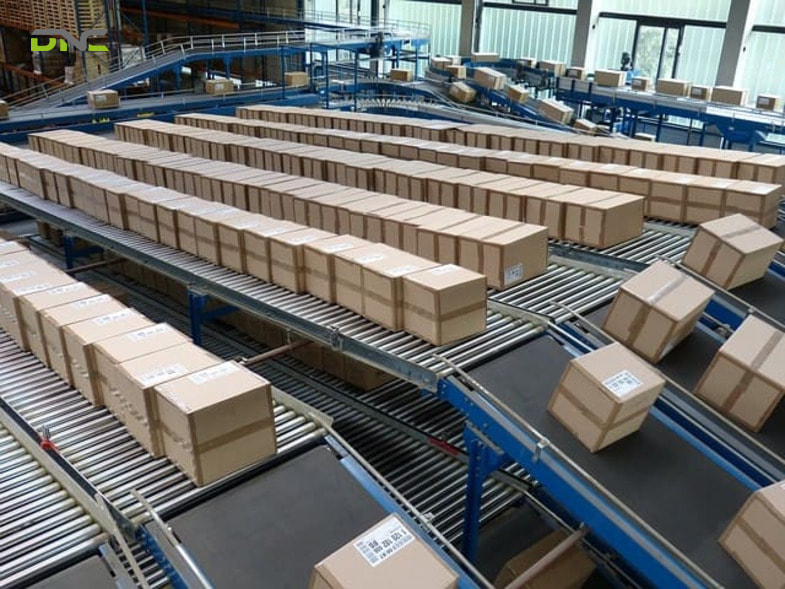
F&B packaging operations at DNC clients including F&N, Ramly Burger, and Guan Chong Berhad use right-angle transfers and belt-to-belt transfers to connect filling machines, labellers, checkweighers, case-packers, and palletisers into continuous packaging lines. A typical F&N beverage line uses 8–15 transfer points between filling and palletised output; each transfer must handle the full line throughput (20,000–40,000 bottles/hr) without creating a bottleneck. Johor’s logistics and distribution parks use right-angle sortation transfers at high density — 10–20 transfers per sortation conveyor loop — to route cartons to the correct dispatch lanes for ASEAN distribution.
Comau Robot Integration Cells — Nationwide
Comau robot integration at DNC Automation — as Comau Italy’s only official Southeast Asia partner — relies on transfer conveyors to deliver parts to Comau robot pick-and-place, welding, and assembly stations with positional accuracy that enables reliable gripper engagement. Transfer conveyors position parts at a fixed stop within the robot’s work envelope; vision guidance refines position information within ±0.5 mm. The robot’s motion program calls a transfer conveyor release command via the Siemens PLC when it is ready for the next part — creating a synchronised robot-conveyor cell that eliminates the positional uncertainty of manual part loading and achieves the 50% productivity increase that DNC Automation has demonstrated across its robot integration projects.
Benefits of Transfer Conveyors for Malaysian Factory Operations
Transfer conveyor systems deliver four categories of measurable improvement when they replace manual or semi-manual inter-zone product handling.
Throughput increase of up to 50% — Manual transfer between production zones limits line throughput to the speed of manual handling: typically 200–400 products/hr per operator. Right-angle transfer conveyors handle 2,400 cases/hr; chain transfer systems cycle every 5–30 seconds. Replacing manual transfer with automated transfer conveyors removes the bottleneck from the manual step, allowing both upstream and downstream automated stages to run at their designed throughputs.
Human error reduced by 80% — Manual product transfer introduces orientation errors (products loaded backwards), positional errors (products misaligned with downstream process fixtures), and missing product errors (products dropped, forgotten, or batched incorrectly). Transfer conveyor systems eliminate all these error sources, reducing human error by 80% as demonstrated across DNC Automation’s automation installations.
Operational cost savings of up to 50% — Eliminating manual transfer labor (1–3 operators per transfer point per shift) and the associated overhead costs (wages, supervision, HR administration) reduces operational cost by 40–60% at transfer-intensive production lines. Under Malaysia’s rising minimum wage trajectory (RM 1,500/month in 2024, likely to increase further) and labour shortage in manufacturing, the ROI calculation for transfer conveyor automation becomes compelling within 18–36 months for most applications.
Alignment with NIMP 2030 smart factory requirements — Malaysia’s NIMP 2030 programme targets smart factory transformation with RM 8.2 billion investment and identifies automated material flow, digital traceability, and connected manufacturing systems as core requirements. Transfer conveyors with Siemens PLC control, RFID product tracking, and SCADA connectivity provide the automated material flow and digital traceability that NIMP 2030 audits require. SAG Grant funding (up to RM 1 million, MIDA 70:30 matching) is directly applicable to transfer conveyor automation projects.
How to Choose the Right Transfer Conveyor for Your Factory
Selecting the correct transfer conveyor requires matching six parameters to the specific inter-zone transfer requirement: product weight and size, throughput rate, direction change angle, positional accuracy requirement, environmental conditions, and control integration level.
Product weight and size determine the mechanism type — Products below 50 kg in carton or tray form: right-angle pop-up roller or belt. Products 50–500 kg on pallets with horizontal direction change: chain transfer. Products above 500 kg: transfer cart/shuttle or overhead P&F system. Products requiring orientation change: rotary turntable.
Throughput rate determines cycle time requirement — Calculate the required transfer cycle time: Cycle Time (s) = 3,600 / Required throughput (units/hr). A transfer handling 1,200 units/hr must complete its cycle in 3 seconds. Right-angle pop-up transfers cycle in < 1 second; chain transfers cycle in 5–30 seconds depending on load. Only right-angle and belt-to-belt transfers can handle above 1,200 units/hr.
Positional accuracy requirement determines the stop and registration system — Standard warehouse sortation: ±20–50 mm acceptable. Robot integration: ±2–5 mm required, needing precision stops with registration pins or vision-guided correction. PCB assembly: ±0.5–1 mm required, using servo-driven precision positioning.
Environmental conditions drive material and protection specification — Food-grade: stainless steel frame, IP69K drive, food-grade belt surface. Electronics clean-room: aluminium ESD-safe frame, antistatic surfaces. Outdoor: IP65 minimum, corrosion-resistant frame coating.
DNC Automation’s free consultation covers all six parameters for your specific transfer requirement, delivers a conceptual design with layout drawing within 2–3 weeks, and includes a preliminary ROI calculation with SAG Grant eligibility assessment.
Frequently Asked Questions About Transfer Conveyors
What is the maximum throughput of a right-angle transfer conveyor in a Malaysian F&B packaging line?
Right-angle pop-up roller transfer conveyors achieve up to 2,400 cases/hr (one case every 1.5 seconds) for standard carton formats (250–600 mm length). For beverage bottles or cans transferred individually, throughput can reach 4,000–6,000 units/hr with smaller pop-up roller modules and faster actuation cycles. DNC Automation has installed right-angle transfer conveyors on F&N packaging lines in Selangor operating at 2,000+ bottles/hr.
How do transfer conveyors integrate with Comau robots in DNC Automation’s projects?
DNC Automation — as Comau Italy’s only official Southeast Asia partner — designs integrated transfer conveyor and Comau robot cells where the transfer conveyor positions parts at a fixed registration stop within the Comau robot’s work envelope. The Siemens S7-1500 PLC coordinates the transfer conveyor’s product release, the robot’s program selection (based on RFID or barcode product ID), and the robot’s pick confirmation signal, creating a closed-loop, zero-buffer integrated cell that achieves consistent cycle time with robot task completion rates above 99.5%.
Can a transfer conveyor handle both light and heavy products on the same line?
Yes — with the correct actuator sizing and control logic. A right-angle transfer conveyor specified for a maximum load of 50 kg operates reliably for all products between 1 kg and 50 kg by using the same actuation mechanism at the same speed. For lines handling mixed-weight products, DNC Automation specifies heavy-duty pop-up roller modules with electric actuation (which provides consistent force regardless of load within its rated range) rather than pneumatic (where air pressure must be adjusted for different loads).
What is the difference between a transfer conveyor and a diverter conveyor?
A transfer conveyor moves all incoming products in the same direction — it always transfers products from the incoming path to a specific outgoing path. A diverter conveyor uses a selective mechanism (hinged belt, pop-up roller array, or pivoting blade) to route each product to one of two or more outgoing paths based on a decision made from product identity or line balance requirements. Diverter conveyors are a specific category of transfer conveyor used at line merge/split points.
How does NIMP 2030 affect the ROI of transfer conveyor investment in Malaysia?
NIMP 2030’s RM 8.2 billion smart factory transformation budget includes specific incentives — MIDA SAG Grant, industrial automation tax incentives, and Pioneer Status for qualified automation-intensive manufacturers — that directly reduce the net capital cost of transfer conveyor automation. A transfer conveyor system costing RM 500,000 with 70:30 SAG matching reduces to an effective net cost of RM 150,000 to the manufacturer. At 50% productivity improvement and RM 150,000 labor cost savings per year from the transfer operation, payback occurs in approximately 1 year on the SAG-adjusted investment.
Does DNC Automation design complete transfer conveyor systems or only supply components?
DNC Automation (dnc-automation.com) is a full turnkey automation integrator — it designs, fabricates, installs, commissions, and services complete transfer conveyor systems, not just component supply. Every DNC transfer conveyor project includes mechanical design, control panel fabrication (Siemens PLC/HMI), sensor integration, safety system engineering (DOSH Malaysia compliant), installation, commissioning, operator training, and ongoing maintenance support. With ISO 9001:2015 certification, 35+ engineers, a 25,000 sq ft fabrication facility, and proven delivery to Toyota, Inokom, Sony, F&N, and Ramly Burger, DNC has the capability and track record to deliver transfer conveyor systems of any complexity.
What transfer conveyor system is right for connecting a CNC machining cell to a robot assembly station?
For CNC machining cell to robot assembly station transfer, DNC Automation typically specifies a belt-top or V-groove roller transfer conveyor (for prismatic machined parts in trays) or a chain pallet transfer conveyor (for precision-located pallets carrying machined parts). A registration stop pin positions the tray or pallet at the robot pick position; a Siemens S7-1500 PLC coordinates the CNC machine’s part-complete signal, the conveyor’s advance command, and the Comau robot’s pick trigger. Positional accuracy at the robot pick point: ±2 mm with mechanical registration stop; ±0.5 mm with vision-guided correction.
Conclusion
Transfer conveyors close the material flow gaps between production zones that manual handling cannot match in throughput, accuracy, or consistency — and in Malaysia’s manufacturing landscape, where labor costs are rising, skilled workers are scarce, and NIMP 2030 demands digital-ready smart factory infrastructure, every unautomated inter-zone transfer is both a productivity loss and a competitive disadvantage. From right-angle sortation transfers at Johor distribution centres to precision chain transfers in Toyota’s Selangor automotive lines and Comau-robot-integrated belt transfers in Penang’s electronics sector, transfer conveyors are where factory automation investment delivers its most direct return on productive output.
DNC Automation (dnc-automation.com) — Malaysia’s No. 1 factory automation company since 2005, the only official Comau Southeast Asia partner, ISO 9001:2015 certified with 35+ engineers — engineers complete transfer conveyor systems from conceptual design through turnkey installation and commissioning. Get a Free Consultation today and let our engineers map every transfer point in your production line, quantify the throughput gains available, and show you how the SAG Grant can fund your factory’s next automation leap.
- 25 views
- 0 Comment
Recent Comments