


FFB Conveyor: Complete Guide for Palm Oil Mills Malaysia
FFB Conveyor — The Complete Guide for Malaysian Palm Oil Mills
FFB conveyors are the circulatory system of every palm oil mill in Malaysia. From the moment Fresh Fruit Bunches are tipped off a lorry at the reception ramp to the point where sterilized fruit reaches the thresher — FFB conveyors handle every tonne of Malaysia’s 18.55 million metric tonnes of annual crude palm oil production. A failure in the FFB conveyor chain does not just stop one machine; it stops the entire mill’s throughput, costing Malaysian palm oil producers an estimated RM 50,000–200,000 per hour in lost processing capacity.
Malaysia is the world’s second-largest palm oil producer, with 450+ active palm oil mills across Pahang, Johor, Perak, Sabah, and Sarawak. Yet despite the critical role of FFB conveyors in this multi-billion-ringgit industry, comprehensive technical guidance on selecting, specifying, and maintaining FFB conveyor systems is almost entirely absent from the web. This guide fills that gap — covering every conveyor stage in the palm oil milling process, with full technical specifications, common failure modes, and how DNC Automation supports Malaysian palm oil mill operators with Siemens-controlled, locally fabricated FFB conveyor systems.
──────────────────────────────────────────────────
What Is an FFB Conveyor?
An FFB conveyor is any mechanical conveyor system used within a palm oil mill to transport Fresh Fruit Bunches (FFB) — the harvested clusters of oil palm fruit — through the initial stages of the milling process, from the reception loading ramp through sterilization preparation.
FFB (Fresh Fruit Bunch) refers to the harvested cluster of oil palm fruit. Each bunch weighs 10–30 kg and contains 800–2,000 individual fruitlets (the mesocarp of each fruitlet yields crude palm oil). FFB must be processed within 24–48 hours of harvesting to minimize free fatty acid (FFA) buildup, which degrades oil quality and value. The conveyor system that moves FFB from reception to sterilizer is therefore a time-critical, high-volume material handling challenge.
FFB conveyors are distinct from general bulk material conveyors in several important ways: they handle very heavy, irregular, thorny, and abrasive material; they operate in environments with steam, water, palm oil, and grit contamination; and they must handle peak throughput reliably because any unscheduled downtime directly delays the processing of perishable FFB already in the mill yard.
How Does an FFB Conveyor Work?
The FFB conveyor system in a palm oil mill is not a single conveyor — it is a chain of multiple conveyor types, each handling a specific stage of the process. Understanding the full processing sequence is essential for specifying, operating, and maintaining an effective FFB conveyor system.
Step 1: FFB Reception and Hopper Loading
FFB processing begins at the weighbridge, where incoming lorries are weighed (full and empty) to record the net FFB weight received. The lorry then reverses to the tipping ramp — a steel platform with a hydraulic or cable-operated tipping mechanism that tilts the truck body, dumping FFB into the reception hopper below.
The reception hopper typically holds 10–40 tonnes of FFB. Its function is to buffer the intermittent lorry arrivals and provide a consistent feed to the conveyor system below.
Step 2: FFB Scraper Conveyor No. 1 (Horizontal)
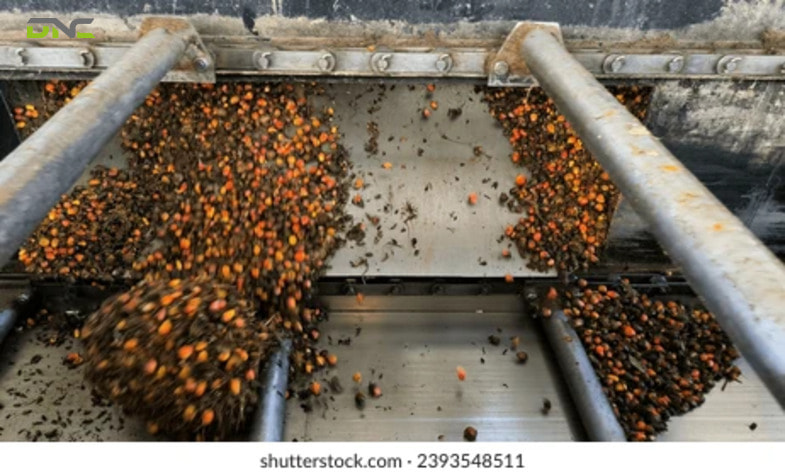
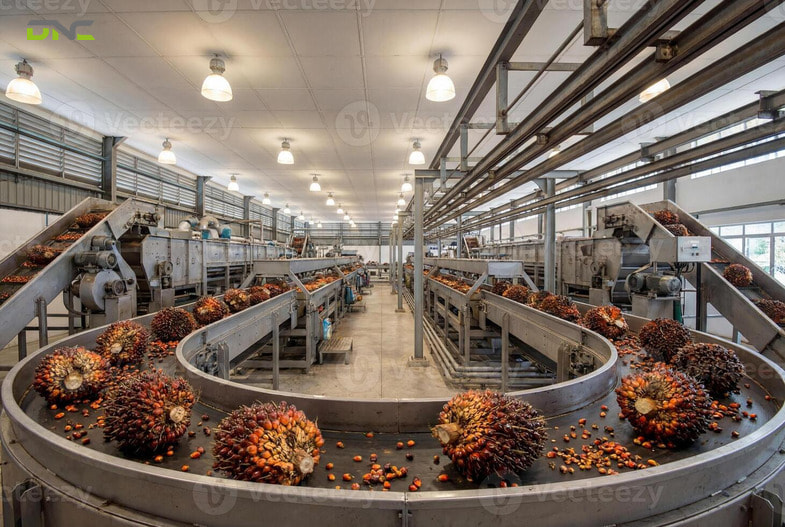
FFB falls from the hopper onto the first scraper conveyor — a horizontal (or slight-incline) double-strand chain conveyor with cross-bar scrapers that drag FFB along the trough floor. This conveyor runs at ground level, moving FFB from the hopper to the base of the incline conveyor.
Scraper Conveyor No. 1 handles raw, unsterilized FFB — the heaviest and most abrasive stage of the process. Bunches arrive with grit, stones, and soil from the field. Rock traps (grated openings in the trough floor that let stones fall through while bunches pass over) are installed upstream of the drive mechanism.
Step 3: Incline Scraper Conveyor No. 2 (Critical)
The incline scraper conveyor is the most mechanically demanding conveyor in the entire mill — and the most common source of unscheduled downtime. This conveyor lifts FFB from the reception area (ground level) up to the sterilizer loading platform, typically 8–12 metres above ground.
The incline conveyor operates at angles up to 25° against gravity, dragging bunches that weigh up to 30 kg each. The drive chain, scraper bars, and trough wear plates experience continuous heavy loading. HARDOX 400 wear-resistant steel trough lining — specified by DNC Automation for all palm oil mill conveyor builds — provides twice the service life of standard Q235B mild steel under FFB abrasion.
Step 4: Distributing Conveyor (Top Level)
At the top of the incline conveyor, a horizontal distributing conveyor receives FFB and distributes it across the inlets of multiple sterilizers. A mill with 3–6 sterilizers has a corresponding number of gate openings on the distributing conveyor; PLC-controlled gates divert FFB into whichever sterilizer is accepting a new batch.
Step 5: Sterilization (Process Context)
Sterilization is not a conveyor function, but it defines the operating environment for adjacent conveyors. Horizontal continuous sterilizers use an enclosed scraper chain conveyor operating under steam pressure (3 kg/cm², 140–145°C) to move FFB through the sterilization zone over 80–120 minutes. Vertical sterilizers use batch cages — FFB is loaded via conveyor, caged, sterilized, then discharged by gravity.
Step 6: Post-Sterilization Conveyor Handling
After sterilization, sterilized FFB is discharged to the threshing section. Loose fruit (mesocarp that has separated from the bunch during sterilization) and whole sterilized bunches travel on separate conveyors to the thresher, which strips remaining fruit from the empty bunch stalk (OPEFB).
How Does an FFB Conveyor Work?
Types of FFB Conveyors in a Palm Oil Mill
Every stage of palm oil milling uses a specific conveyor type, matched to the material characteristics, capacity requirements, and environmental conditions at that point in the process.
1. Horizontal FFB Scraper Chain Conveyor (Reception Level)
The horizontal reception-level scraper conveyor handles raw, unsterilized FFB directly from the hopper. Double-strand hardened alloy palm chain with welded cross-bar scrapers drags bunches through a Q235B steel U-trough. Rock traps prevent stone ingestion. Capacity: 60–150 TPH.
2. Incline/Steep Scraper Conveyor (Elevator Stage)
The incline conveyor is the most critical and highest-wear conveyor in the mill. Operating at up to 25°, it lifts FFB 8–12 metres to the sterilizer loading level. Trough wear plates are the primary maintenance item — DNC Automation specifies HARDOX 400 replaceable wear plate sections for 2× service intervals versus standard mild steel.
3. Distributing Conveyor (Top Level, Pre-Sterilizer)
A horizontal or slightly inclined scraper conveyor at the top of the elevator, with gate openings above each sterilizer inlet. PLC-controlled pneumatic or electric gates divert FFB into the target sterilizer on operator command or automated schedule.
4. Continuous Sterilizer Conveyor (Pressurized)
Horizontal continuous sterilizers use an enclosed, pressure-rated drag chain conveyor operating at 3 kg/cm² steam pressure and 140–145°C. This is a specialized high-temperature, high-pressure conveyor — separate from the reception system and typically supplied by the sterilizer OEM.
5. Empty Bunch (OPEFB) Belt Conveyor
After threshing, empty palm oil fruit bunches (OPEFB) — no longer containing fruit — must be transported to the boiler for biomass fuel or to the OPEFB composting area. OPEFB belt conveyors are typically long (50–200 metres), inclined, wide-belt (600–1,200mm) conveyors handling the high-volume, low-value bulk biomass stream.
6. Loose Fruit / Mesocarp Conveyor
Loose fruit separated from the bunch during sterilization and threshing travels on scraper or belt conveyors from the thresher discharge to the fruit elevator, then to the digester. These conveyors handle wet, oily, slippery material — stainless steel or oil-resistant coatings are specified.
7. Fiber and Shell Conveyor (Boiler Feed)
Pressed fiber from the screw press and palm kernel shell from the cracker/separator travel on belt conveyors to the biomass boiler. These conveyors handle hot (80–100°C), greasy, and mildly abrasive material. Capacity matches the mill’s boiler fuel consumption requirements.
Horizontal FFB Scraper Chain Conveyor (Reception Level)
Key Technical Specifications — FFB Scraper Conveyors
| Parameter | Specification |
| FFB throughput capacity | 60–150 TPH |
| Chain velocity (45 TPH mill) | 0.40 m/s (78 ft/min) |
| Chain velocity (150 TPH mill) | 0.302 m/s |
| Maximum incline angle | 25° |
| Typical horizontal section | 7.5 m |
| Incline vertical lift | 8–12 m |
| Trough material | Q235B carbon steel (standard) |
| Wear plate material | HARDOX 400 (DNC specified) |
| Chain type | Double-strand hardened alloy palm chain |
| Sprocket | P=152.4, 21 teeth, 60,000 lbf minimum |
| Drive motor | Electric gearmotor, 15–75 kW |
| Speed control | VFD (Siemens SINAMICS) |
| Bearing protection | IP65 sealed (tropical-grade) |
| Control | Siemens SIMATIC S7 PLC |
Applications: FFB Conveyors Across Malaysia’s Palm Oil Industry
Pahang — Malaysia’s Largest FFB Producing State
Pahang contributes 3.01 million metric tonnes of FFB production annually — Malaysia’s highest by state. Palm oil mills in Kuantan, Raub, Temerloh, and Jerantut operate at capacities of 30–90 MT/hr, requiring robust incline scraper conveyors that can sustain continuous operation through long harvesting cycles. DNC Automation’s Siemens-controlled conveyor systems eliminate single points of failure through redundant drive monitoring and real-time alarm integration.
Johor — High-Density Mill Cluster
Johor’s 2.97 million MT annual production is processed through a dense cluster of mills in Kluang, Mersing, and Segamat. Proximity to Singapore creates additional commercial pressure for operational efficiency — mill downtime translates directly to delayed CPO delivery commitments. FFB conveyor reliability is therefore a competitive business requirement in Johor’s palm oil sector.
Sabah and Sarawak — East Malaysia’s Expanding Palm Oil Frontier
Sabah and Sarawak are Malaysia’s fastest-growing palm oil regions and host the country’s largest single-mill capacities (up to 90 MT/hr). The remoteness of many mills in East Malaysia makes local engineering support critical — a broken incline scraper conveyor that requires spare parts from Peninsular Malaysia or overseas can mean 3–7 days of downtime. DNC Automation’s 24/7 local support commitment and stocked spare parts program specifically addresses this pain point for East Malaysia mill operators.
Perak — Established Mill Infrastructure
Perak’s 1.87 million MT production base includes many mills built in the 1980s and 1990s with aging conveyor infrastructure. Mill modernization — replacing worn mild steel troughs with HARDOX-lined conveyors, upgrading relay-based controls to Siemens PLC — is an active opportunity that DNC Automation addresses through its conveyor retrofit and upgrade services.
Common FFB Conveyor Problems and DNC Automation Solutions
FFB conveyors in Malaysian palm oil mills fail in predictable patterns. Understanding the failure modes — and designing against them — is the difference between a mill that achieves 95%+ uptime and one that suffers chronic unplanned downtime.
Chain elongation and skipping: All chain elongates with wear. At 3% elongation, the chain begins skipping on the sprocket, causing dangerous jerking loads. DNC Automation installs chain elongation monitoring sensors and includes scheduled chain replacement at defined elongation limits in its maintenance program for Malaysian palm oil mill clients.
Trough bottom wear plate failure: The trough bottom plate is the highest-wear component in an FFB scraper conveyor. Standard Q235B mild steel lasts 18–30 months under FFB abrasion. DNC specifies HARDOX 400 replaceable wear plate sections — a 400 Brinell hardness abrasion-resistant steel that extends wear plate life to 36–60 months and can be replaced in sections without full trough replacement.
Stone and foreign object ingestion: Stones, bolts, and metal debris entering with FFB from the field cause catastrophic chain and sprocket damage when trapped between the scraper bar and trough floor. DNC installs rock traps at the hopper exit — grated openings in the trough floor that pass small stones while retaining FFB — and magnetic separators for ferrous debris.
Bearing failure in tropical environment: Palm oil mills are steam-rich, wet environments. Standard open bearings fail within months. DNC specifies IP65-rated sealed bearings with high-temperature, water-resistant grease as standard across all FFB conveyor builds for Malaysian mills.
Drive motor overload due to FFB overloading: Operators attempting to maximize mill throughput sometimes overload the reception hopper, resulting in excessive chain tension and motor overload. DNC integrates ammeter-based motor load monitoring into the Siemens PLC control, with automatic feed rate reduction and alarm when motor load exceeds 90% of nameplate rating.
Common FFB Conveyor Problems and DNC Automation Solutions
Benefits of a Properly Engineered FFB Conveyor System
Mill throughput protection: An FFB conveyor failure stops the entire mill. With 60–150 TPH throughput and CPO priced at RM 3,800–4,200/MT (2025 market), every hour of downtime costs RM 228,000–630,000 in lost revenue. A properly engineered, well-maintained FFB conveyor system with predictive monitoring reduces unplanned downtime by up to 70%.
Reduced oil losses from FFB damage: Aggressively designed scraper systems that damage FFB during transport increase oil losses through bruised mesocarp. DNC Automation’s scraper geometry and chain speed specifications minimize FFB mechanical damage, reducing oil extraction rate (OER) losses.
Extended service intervals reduce maintenance cost: HARDOX 400 wear plates, IP65 bearings, and hardened palm chain specified by DNC extend service intervals by 2–3× versus standard specifications — reducing annual maintenance cost by RM 50,000–200,000 per mill depending on capacity.
SCADA integration for remote monitoring: DNC’s Siemens-based control systems provide real-time monitoring of motor current, chain speed, bearing temperature, and vibration from the mill control room — eliminating the need for operators to physically inspect running conveyors in steam-filled, high-risk environments.
Benefits of a Properly Engineered FFB Conveyor System
How to Choose the Right FFB Conveyor System for Your Palm Oil Mill
Mill capacity determines conveyor sizing: A 30 MT/hr mill needs a different incline conveyor than a 90 MT/hr mill. DNC Automation performs full throughput calculations — accounting for FFB bulk density, bunch size distribution, and peak throughput factors — to size every conveyor correctly.
Replacement vs. new installation: Many Malaysian palm oil mills have 20–30 year old conveyor infrastructure. DNC offers two pathways: (1) full conveyor replacement with new HARDOX-lined trough, new chain, and Siemens PLC control, or (2) targeted refurbishment — replace only the worn trough sections and upgrade the control system while retaining the structural frame.
Local vs. foreign OEM supply: Foreign conveyor OEMs supply FFB conveyor equipment with 4–8 week parts lead times from overseas. DNC Automation’s 25,000 sq ft Selangor fabrication facility manufactures FFB conveyor components locally, with critical spare parts stocked in Malaysia — reducing emergency repair time from weeks to days or hours.
Control system integration: Specifying Siemens PLC control as standard — rather than relay-based or basic variable speed — enables future integration with mill-wide SCADA, OEE monitoring, and predictive maintenance platforms as mill modernization proceeds under NIMP 2030 targets.
──────────────────────────────────────────────────
Frequently Asked Questions About FFB Conveyors
What is the standard capacity of an FFB scraper conveyor in Malaysia?
Malaysian palm oil mill FFB scraper conveyors typically handle 60–150 TPH (tonnes per hour) of fresh fruit bunches. Mill capacity ranges from 20 MT/hr (small estate mills) to 90 MT/hr (large commercial mills). The conveyor capacity is sized to exceed the mill’s rated processing capacity by 20–30% to accommodate peak arrival periods.
How often should FFB scraper conveyor chains be replaced?
Chain replacement interval depends on material hardness, chain quality, and maintenance practices. With standard mild steel troughs, chains typically require replacement every 18–24 months. With DNC’s HARDOX 400 trough lining and hardened alloy palm chain, replacement intervals extend to 36–48 months. Chain elongation should be measured monthly; replacement triggered at 3% elongation.
What causes the incline scraper conveyor to fail most often?
The three most common failure causes are: (1) trough bottom wear plate failure from continuous abrasion of FFB bunches, (2) chain pin wear and elongation leading to chain skipping on sprockets, and (3) bearing failure from steam and palm oil contamination. DNC Automation’s maintenance program addresses all three with scheduled inspections, HARDOX wear plates, and IP65 sealed bearings.
Can FFB conveyors be integrated with digital monitoring systems?
Yes. DNC Automation integrates FFB scraper conveyors with Siemens SIMATIC S7 PLC and WinCC SCADA for real-time monitoring of motor current (overload detection), chain speed (slip detection), bearing vibration (predictive maintenance), and hopper level. This eliminates the need for operators to physically inspect conveyors in hot, wet, high-risk mill environments.
What is the difference between a horizontal sterilizer conveyor and a scraper conveyor?
A horizontal continuous sterilizer conveyor operates inside the sterilizer vessel under steam pressure (3 kg/cm², 140–145°C) — it is a specialized pressure-rated system supplied by the sterilizer OEM. The FFB scraper conveyors (reception and incline) operate at atmospheric pressure before the sterilizer and are engineered separately for high-capacity, abrasion-resistant material handling.
Does DNC Automation fabricate FFB conveyors locally in Malaysia?
Yes. DNC Automation’s 25,000 sq ft facility in Selangor fabricates FFB scraper conveyor components to custom dimensions — trough sections, scraper bars, chain tensioning systems, and drive frames — for Malaysian palm oil mill specifications. Local fabrication eliminates foreign OEM lead times and enables rapid spare parts supply to mills in Pahang, Johor, Perak, Sabah, and Sarawak.
What government support is available for FFB conveyor upgrades?
Palm oil mill operators upgrading conveyor control systems to Siemens PLC + SCADA integration may qualify for MIDA’s Smart Automation Grant (SAG) — up to RM 1,000,000 on a 70:30 matching basis. Automation and digitalization of mill operations aligns directly with NIMP 2030’s smart manufacturing objectives. DNC Automation assists clients with SAG application documentation.
──────────────────────────────────────────────────
Conclusion
FFB conveyors are the operational backbone of Malaysia’s palm oil milling industry — and the most common source of costly unplanned downtime in mills that fail to engineer and maintain them properly. From the reception scraper conveyor to the incline elevator to the distributing conveyor above the sterilizer, every stage demands robust materials, precision engineering, and reliable control.
DNC Automation brings together 20+ years of Malaysian industrial automation experience, in-house fabrication at our 25,000 sq ft Selangor facility, Siemens-authorized control system expertise, and 24/7 local engineering support to deliver FFB conveyor systems that protect mill throughput and reduce maintenance costs. Our HARDOX 400 trough specification, IP65 bearing standards, and Siemens PLC integration are engineered specifically for Malaysian palm oil mill operating conditions.
Talk to Our Engineers — contact DNC Automation for a free FFB conveyor assessment for your palm oil mill. We serve mills across Peninsular Malaysia and East Malaysia (Sabah and Sarawak) with rapid response and locally stocked spare parts.
Explore related solutions: [Scraper Chain Conveyor](#), [Conveyor Belt Scales](#), [PLC Conveyor Control](#)
- 158 views
- 0 Comment
Recent Comments