


AGV vs Conveyor for Pallet Transport: Which Fits Your Plant
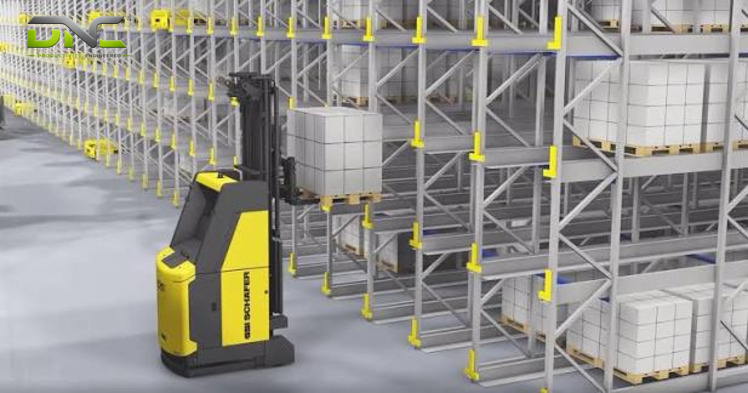
An AGV and a pallet conveyor both move finished unit loads from a production line to storage or the dock, but they pay for route length in opposite ways. A pallet conveyor pays once, in metres of frame: it carries a queue of pallets at the same time, so its hourly capacity is set by pallet spacing and speed, and a longer route only adds transit time. An AGV (automated guided vehicle) pays twice — loaded out, empty back — so each vehicle’s capacity is 3,600 seconds divided by its round trip, and every extra metre is bought back with another vehicle. The AGV vs conveyor choice for pallet transport is therefore a map of pallet rate against distance. Short, high-rate routes favour the conveyor, long or changing routes favour the AGV fleet, and long high-rate routes become a conveyor trunk with conveyor-top AGVs on the variable legs.
AGV and Pallet Conveyor: Two Ways to Move a Unit Load
An AGV and a pallet conveyor move the same unit load through two different kinds of infrastructure: the pallet conveyor is the route itself, and the AGV is a vehicle that follows a route stored in software. A pallet conveyor is a powered line of rollers or chains fixed to the floor, holding pallets in a continuous queue between set points. Its path is part of the building. Changing that path requires a new layout and a new installation, as one material-handling integrator states in its own comparison.
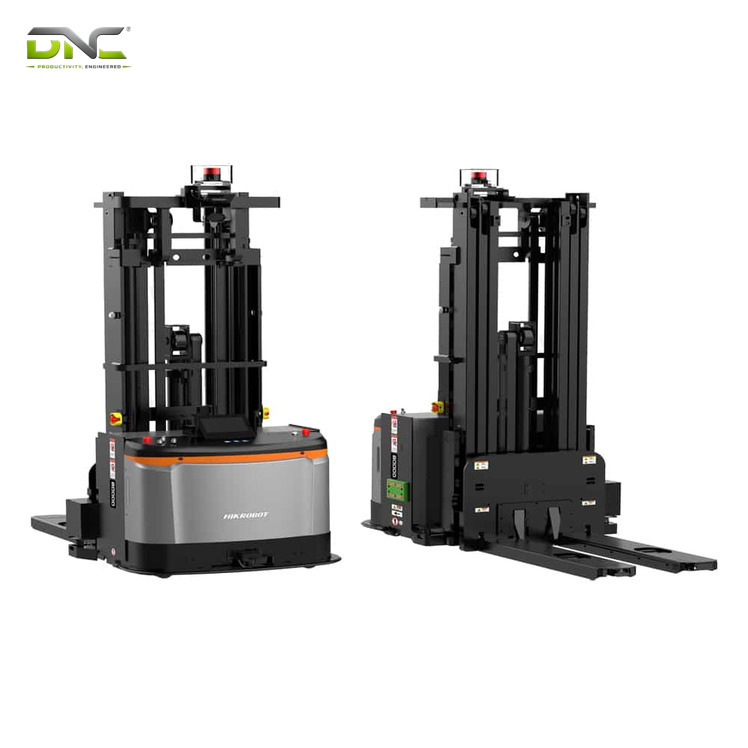
An automated guided vehicle is a driverless vehicle that collects a load at one station, follows a programmed route and sets the load down at another. Three layers make it work: navigation (magnetic tape, laser reflectors, or natural features such as walls and pillars), safety equipment (scanners, rubber bumpers and emergency stop buttons), and a fleet manager that assigns each transport order and plans the path over Wi-Fi. The pallet rides on forks, on a flat platform, or on a short conveyor built into the vehicle.
DNC Automation engineers both sides of this comparison. Its range of AGV and AMR systems positions to ±10 mm (±0.39 in) or ±5 mm (±0.20 in), stops on laser, mechanical and 3D binocular-camera anti-collision, and takes transport orders from a manufacturing execution system (MES) or warehouse management system (WMS) through a scheduling system. Its industrial conveyor systems are designed with programmable logic controller (PLC) control and robot integration as one line rather than as loose sections.
An autonomous mobile robot (AMR) differs from an AGV in one behaviour: it plans its own path around an obstacle, while a traditional AGV stops and waits for the lane to clear. For pallet transport between fixed stations, that difference matters less than the property both vehicles share and a conveyor does not. Each vehicle carries one load per trip.
Route Length and Throughput: Paid Once by a Conveyor, Twice by an AGV
Route length changes conveyor throughput and AGV throughput in opposite directions: a pallet conveyor pays for distance once and keeps its capacity, while an AGV pays for distance twice and loses capacity with every added metre. Many people assume the faster machine moves more pallets. It does not. One intralogistics integrator publishes AGV speeds of up to 1.7 m/s (102 m/min), about 3.4 times the 30 m/min upper speed of DNC’s pallet conveyor system, yet the slower conveyor still wins on a short, busy route.
The conveyor’s advantage is concurrency. A pallet conveyor holds many pallets in motion at once, so its hourly rate depends on pallet spacing and speed, not on how far each pallet travels. Stretching a route from 50 m to 200 m (164 ft to 656 ft) adds transit time — from roughly 1.7 minutes to 6.7 minutes at 30 m/min — and removes no pallets from the hourly count. An AGV carries one pallet out and drives back empty, so its hourly rate is 3,600 seconds divided by the round trip.
Integrators who build both systems describe the same effect in practice. On one AGV-navigation supplier’s panel of four integrators, a conveyor supplier explained that a quick-cycle A-to-B job went to a conveyor because each AGV would have had to return to station A, which meant more vehicles and more expense. Another panelist put the conveyor-favouring rate at around 80 pallets an hour per production line. A third judged a ground-handling job at Basel Airport — approximately 200 pallets an hour, all collected at the same time — not feasible for AGVs.
The arithmetic behind those verdicts takes three steps. At 80 pallets an hour, the line releases a pallet every 45 seconds. At 1.7 m/s, one vehicle covers at most 76.5 m (251 ft / 83.7 yd) of travel in that window, so a single AGV keeps pace only on a one-way route shorter than about 38 m (125 ft) — before any time is spent picking, dropping or waiting at a door.
The travel-only minimum fleet at 80 pallets an hour is listed in the table below; real fleets are larger because pick, drop, traffic and charging time are added to every round trip.
| One-way route | Round trip at 1.7 m/s (travel only) | Minimum AGVs at 80 pallets/h (45 s interval) |
| 38 m (125 ft) | 44.7 s | 1 |
| 50 m (164 ft) | 58.8 s | 2 |
| 100 m (328 ft) | 117.6 s | 3 |
| 200 m (656 ft) | 235.3 s | 6 |
At 200 pallets an hour the window shrinks to 18 seconds, or 30.6 m (100 ft) of travel per vehicle, which is consistent with the Basel verdict. When DNC’s engineers compare the two options for a route, this travel-only count is the first number fixed, because it shows how fast distance turns into vehicles before any supplier’s cycle data is added. Rate and distance together, not either one alone, settle conveyor vs AGV for any given route.
The Pallet Rate and Distance Map: Where Each Technology Wins
The pallet rate and distance map places every conveyor or AGV route in one of four zones, and each zone points to a pallet conveyor, an AGV fleet, or a hybrid of the two. The four zones and the published cases that fall into each are summarised in the table below.
| Zone | Pallet rate | One-way distance | Better fit | Published case |
| 1 | High | Short | Pallet conveyor | Around 80 pallets/h per production line; approximately 200 pallets/h collected at once at an airport site |
| 2 | Low to moderate | Long, across buildings or floors | AGV fleet | A packaging company with long transport routes between several buildings and floors |
| 3 | High | Long | Conveyor trunk with AGVs on the variable legs | New sites where conveyors store and retrieve material, then transfer it to AGVs at a central point |
| 4 | Low | Short | Either — plant size and cost decide | For very small plants, the conveyor is likely the cheaper system |
Route stability moves a route across these zones. A fixed conveyor serves the stations it was built for, and a new flow needs another conveyor; an AGV fleet takes new tasks through its fleet manager — raw material, packaging material, finished goods and waste on the same vehicles. One AGV customer started with 10 drop-off points to test the concept and, after an expansion spread over about three years, now serves approximately 150 drop-off points with four AGVs. A fixed line follows that kind of growth only through re-engineering.
DNC’s reading for end-of-line routes follows from the map. The leg from palletizing to wrapping carries the line’s full pallet rate over a short, fixed distance, which is zone 1. The leg from the wrapped-pallet station to storage or the dock is longer, often crosses shared aisles, and changes whenever the warehouse is re-slotted, which is zone 2 or 3. The map assumes a route is physically open to both technologies; floor space and site conditions decide whether it is.
The Pallet Rate and Distance Map: Where Each Technology Wins
Floor Space, Shared Aisles and Site Conditions
Floor space, shared aisles and site conditions divide the conveyor and the AGV a second time: a conveyor permanently occupies its path and closes it to cross-traffic, while an AGV shares the aisle but asks more of the floor. A conveyor occupies its footprint whether pallets are running or not, and it fragments the usable area around it. Conveyors cut off aisles and cannot coexist with forklifts that need to cross them, one panelist noted, and fully automated conveyor lines need physical access control around them.
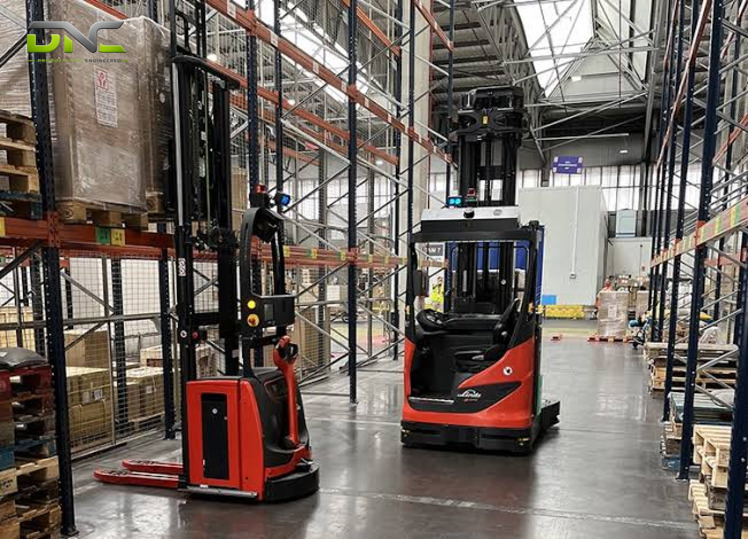
An AGV fleet shares aisles with pedestrians and manual traffic, relying on safety scanners, bumpers and emergency stops, and it frees its floor space the moment a task ends. The fleet pays for that flexibility in floor demands. Automated vehicles need smooth, relatively clean floors with limited inclines, and one integrator on the same panel added ambient temperature, direct sunlight that can dazzle a vehicle’s safety or navigation laser, floor conductivity and outdoor running to the list. One integrator’s AGV specification sets an indoor range of +5 °C to 35 °C (41 °F to 95 °F), and DNC’s SLAM (simultaneous localisation and mapping) navigation chassis is rated for floors flat to within ±10 mm.
Harsh sites reverse the choice. A site with very dusty conditions, no staff or vehicles in the same space, high capacities and pallet buffer positions outside the building was one panelist’s example of a clear conveyor fit. Multi-level work splits by task: conveyors integrate with a pick module on every level, where vehicles usually cannot, while conveyor-connection AGVs cross floors by working with freight elevators.
For Malaysian food & beverage, glove and home-appliance plants, the first site question DNC asks is whether the end-of-line aisle also carries forklift or pedestrian traffic. That answer alone rules the conveyor in or out of the dock leg. Floor preparation, aisle closures and access guarding are also cost items, and they differ between the two technologies as much as capacity does.
AGV and Conveyor Cost, Installation Time and Scalability
AGV and conveyor cost follows plant size and route shape rather than a fixed ranking: for very small plants the conveyor is likely cheaper, and for medium to larger plants the AGV becomes more cost-effective, according to one integrator who builds both. Route shape sharpens that split. For short distances and a high conveying capacity, the AGV is usually the more expensive option, because its base price only pays off with distance and functionality.
Conveyors are generally less expensive to purchase than vehicles, one material-handling integrator notes, but maintenance and spare parts matter more for them. A faulty conveyor zone can bottle up the whole flow. One AGV offline leaves the rest of the fleet moving, while the conveyor presents fewer software and controls issues than any vehicle fleet.
Installation effort runs the other way. A conveyor is designed around the customer’s site, so design, manufacture and installation take time, and later changes involve much more effort; an AGV’s vehicle design is already complete, and commissioning centres on mapping the site and programming missions. Published AGV timelines still spread widely — one integrator states 6 to 10 months from order to go-live, while a conveyor-connection AGV maker claims multiple vehicles deploy in 1 to 2 weeks — a spread that reflects how much fleet management, WMS integration and transfer-station work each figure includes.
Scalability favours the vehicle. An AGV fleet grows one vehicle at a time and charges by automatic charging, opportunity charging between tasks, or manual battery exchange, on lead-acid, NiCd or lithium-ion batteries. One AGV maker reports a payback of about 13 months under 24-hour operation — a self-reported figure — and one integrator’s specification ties AGV return on investment to three-shift operation. For Malaysian manufacturers weighing automation against labour shortages and the Industry 4.0 targets of the New Industrial Master Plan 2030 (NIMP 2030), the shift pattern is the first variable to model in either quotation. With capacity, floor and cost each examined, the two technologies can now be read side by side.
AGV and Conveyor Cost, Installation Time and Scalability
Summary: Conveyor and AGV Compared Side by Side
Compared side by side, the conveyor vs AGV decision turns on three differences: how each pays for distance, how each shares floor space, and how each fails. A pallet conveyor pays for route length once and keeps its capacity; an AGV pays twice, so its fleet grows with distance at a given pallet rate. Short, high-rate routes favour the conveyor, long or changing routes favour the AGV, and long high-rate routes become a hybrid. The conveyor occupies its path and tolerates harsh floors; the AGV shares aisles but needs a smooth, clean, level floor. Cost tracks plant size and route shape, not a fixed ranking.
The main attributes of each technology are compared in the table below.
| Attribute | Pallet conveyor | AGV |
| What sets capacity | Pallet spacing and speed | 3,600 s ÷ round trip, per vehicle |
| Longer route | More transit time, same capacity | Fewer pallets per vehicle, more vehicles |
| Published speed | 5-30 m/min (DNC pallet conveyor) | Up to 1.7 m/s (one integrator) |
| Floor and aisle | Occupies its path, closes cross-traffic | Shares aisles; needs a smooth, clean floor with limited incline |
| Route change | New layout and installation | Software change in the fleet manager |
| Buffering | Holds pallets in queue on the line | No buffer on board |
| Failure effect | One faulty zone can stop the flow | One vehicle offline, the fleet keeps moving |
| Connection to the other | Transfer station at the conveyor end | Conveyor-top or fork AGV docking at that station |
The last row of that table — how the two technologies connect — is where most real routes end up.
Hybrid Routes: Conveyor-Top AGVs and the Transfer Station
A hybrid route joins a conveyor and an AGV at a transfer station, and the vehicle that makes that join cleanest is the conveyor-top AGV. A conveyor-top AGV carries its own short roller, chain or belt conveyor. It docks at the end of a fixed line, runs its rollers to draw the pallet or box onto itself, and delivers the load to a target conveyor or to another automated machine; manufacturers build box and pallet versions and link them to the warehouse control system (WCS), WMS, MES and enterprise resource planning (ERP) software.
Load-handling suppliers mount the same roller, chain and belt modules on piggyback vehicles, and one AGV maker’s panelist used a U-shaped conveyor as the interface to integrate its vehicle with existing conveyors. Every transfer station matches three parameters between the fixed conveyor and the vehicle.
- Transfer height has to line up between the vehicle deck and the station conveyor; one load-handling supplier fits lift systems to compensate height differences at transfer stations.
- Stop position decides whether the rollers meet square, and DNC’s AGVs position to ±10 mm or ±5 mm at the station.
- The I/O handshake lets station and vehicle run their conveyors only while the vehicle is docked, the same I/O link one integrator’s AGV system uses for doors, elevators and conveyors.
On an end-of-line route, the transfer station belongs after the pallet wrapping machine, so the vehicle collects a contained unit load rather than a loose stack, and the outfeed conveyor between wrapper and pick-up holds the pallets that wait for the next vehicle. One intralogistics integrator’s published AGV layout shows the same order: a production line with a pallet wrapper, then AGV pick-up. Upstream, the slower of the robotic palletizing cell and the wrapper sets the pallet interval the whole route has to carry.
Each transfer station is an interface that one party has to own end to end. A hybrid route with one hand-over carries fewer interface risks than one with three. DNC recommends specifying the conveyor PLC and the AGV scheduling system together, as one route, rather than as two separate packages. That single-route view is also the starting point for choosing between the three options.
Hybrid Routes: Conveyor-Top AGVs and the Transfer Station
Choosing Conveyor, AGV or a Hybrid Route for Your Plant
Choosing a conveyor, an AGV or a hybrid route for your plant comes down to six questions, answered in the order below because each answer narrows the next.
- Pallet rate and one-way distance come first — divide the round trip by the pallet interval for a travel-only fleet count; a count that is already large at the required rate points to a conveyor.
- Route stability comes second, since fixed routes suit a conveyor and routes expected to grow or move suit vehicles that reroute in software.
- Aisle traffic follows: shared aisles with people or forklifts point to AGVs, and a closed, dedicated path suits a conveyor.
- Floor and environment then filter the result — dust, rough or wet floors, slopes, sunlight on laser scanners and outdoor legs push toward a conveyor.
- Capacity growth matters next, because staged growth from a few drop-off points favours adding vehicles over extending a line.
- Transfer points close the list, as every hand-over adds height, position and handshake requirements and needs one owner.
Most plants end with both technologies: a conveyor on the fixed, high-rate trunk and vehicles on the longer or changing legs. Existing buildings answer the same questions with one extra constraint. For a brownfield site, three of the four panel integrators named no clear favourite, and the fourth reported that customers automating an existing warehouse replace their current transport with AGVs rather than fit a conveyor around running operations. The integrators on that AGV-navigation supplier’s panel did not expect mobile robots to replace conveyors completely, because too many applications need a conveying capacity that vehicles cannot reach. For vehicle types, navigation methods and payload classes beyond pallet transport, the guide to automatic guided vehicles covers the wider range.
Frequently Asked Questions About AGV and Conveyor Pallet Transport
These four conveyor vs AGV questions cover connection, cost, fleet size and long-term outlook, the points that come up once a plant has narrowed its pallet route to an AGV, a conveyor or both.
Does an AGV work with a conveyor?
Yes, an AGV works with a conveyor through a transfer station: a conveyor-top AGV docks at the end of the line and draws the pallet across on its own rollers, while a fork AGV lifts the pallet from the conveyor end. Both need matched height, stop position and an I/O handshake between the station and the vehicle.
Is an AGV cheaper than a conveyor?
An AGV is not cheaper than a conveyor as a rule: the conveyor is usually cheaper for very small plants and for short routes that carry a high pallet rate, while an AGV fleet becomes more cost-effective in medium to larger plants with longer or changing routes. Shift pattern moves the result further, since published AGV payback cases rest on 24-hour or three-shift operation.
How many AGVs does it take to replace a pallet conveyor?
The minimum number of AGVs equals the round-trip time divided by the pallet interval, rounded up. At 80 pallets an hour and 1.7 m/s, travel alone needs 2 vehicles for a 50 m one-way route, 3 for 100 m and 6 for 200 m. Pick, drop, traffic and charging time raise every figure.
Will AGVs replace pallet conveyors completely?
AGVs will not replace pallet conveyors completely: integrators who build both expect the two to coexist, because conveyors handle hundreds of pallets an hour on fixed routes, while AGVs cover the flexible, shared and expanding routes that a fixed line cannot follow.
________________________________________
A pallet route is specified from three numbers — pallet rate, one-way distance and the count of hand-overs — before any vehicle or conveyor catalogue is opened. DNC’s engineers fix all three before either system is quoted, so speak with a DNC engineer to map your own end-of-line route.
- 5 views
- 0 Comment
Recent Comments