


Types of AGV by Load Handling: Tugger, Latent/Jacking, Forklift & Counterbalance
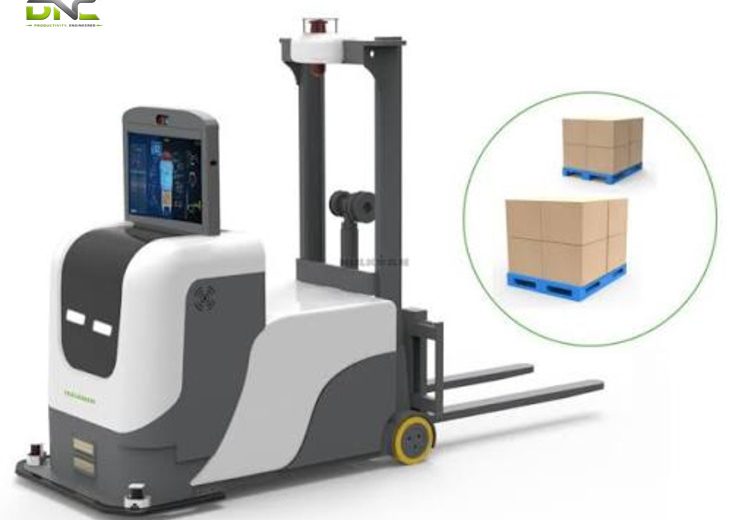
The types of automated guided vehicle, sorted by load handling, come down to three ways an AGV takes a load’s weight. A tugger AGV tows carts that keep their own wheels, so the vehicle supplies pulling force, not lifting force. A latent or jacking AGV drives under a cart or shelf, raises its top plate a few centimetres and carries the whole load inside its own wheelbase. A forklift AGV holds the load on forks ahead of its wheels. That is why it needs a counterweight behind the axle, the counterbalance design, or outrigger legs under the load.
Each weight path decides what the load carrier has to look like, how high the AGV can place it and how the vehicle steers. This guide covers the four automated guided vehicle types in that order, compares them in one table, and ends with a selection sequence. DNC Automation uses that sequence to match AGVs to trolleys, racks and pallets in Malaysian plants.
What Load Handling Means for an AGV
Load handling is the part of an automated guided vehicle that picks up, holds and sets down the load, separate from the part that finds the route. An AGV system has vehicles, a layout of pick-up and drop-off stations, a fleet manager that sends transport orders over Wi-Fi, and I/O links to doors, lifts and conveyors. The load-handling device is what meets the load at each station. It can be a tow hitch, a lifting top plate or a set of forks. Conveyor tops and roller decks also exist.
Published lists of automated guided vehicle types rarely separate these two jobs. One list of seven types puts cart, forklift and towing AGVs next to AMRs, outdoor AGVs and picking robots. Another list of six adds hybrid AGVs, which describes manual take-over, not a way of carrying anything.
Navigation and autonomy answer how the vehicle moves. Load handling answers what it carries. DNC Automation’s AGV and AMR range pairs one self-developed navigation system with different vehicles, which is why the two questions stay separate in this guide. The same navigation sits under very different load devices. Reference lists of AGV vehicle types run from light-load AGVs rated around 500 lb (about 227 kg) or less, built for small parts in tight spaces, up to pallet trucks and forklift AGVs. The load-handling question starts with where the weight goes.
Where the Load’s Weight Goes in Each AGV Type
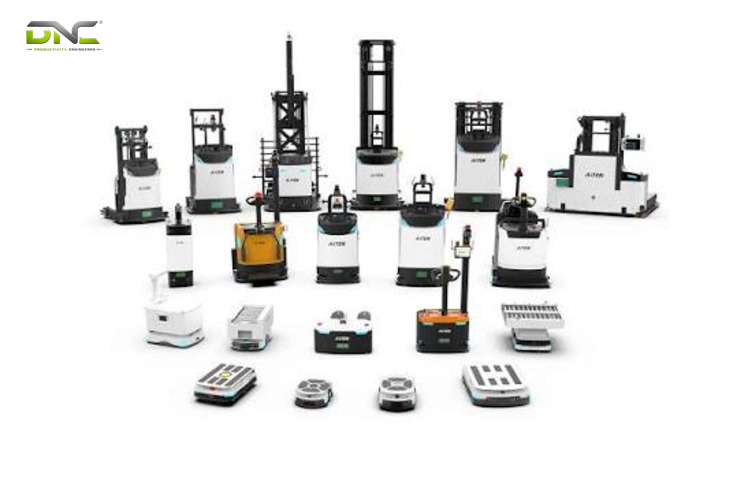
Each AGV type is defined by the path its load’s weight takes to the floor. A tugger never carries the load. A latent AGV carries it on top, between its wheels. A forklift AGV carries it in front of its wheels, where the load tries to tip the vehicle forward. Those three paths explain most of the differences in capacity, lift height and station design:
| AGV type | How the load is engaged | Where the load’s weight goes | What the vehicle must resist |
| Tugger (tow tractor) | Hitch or coupling to a cart train | Through the carts’ own wheels | Drawbar pull, cart sway in turns |
| Latent / jacking (underride) | Drives under the carrier, lifts it a short stroke | Onto the top plate, inside the AGV’s wheelbase | Vertical load only |
| Forklift with outriggers (straddle stacker) | Forks enter the pallet, legs run under or beside it | Forks ahead of the drive wheels, legs carry the reaction | Side tipping, handled by the leg span |
| Counterbalance forklift | Forks enter the pallet, no front legs | Forks ahead of the front axle | Forward tipping, handled by a rear counterweight |
The published figures follow the same order. A published tow tractor AGV moves up to 5,000 kg because it never lifts that weight. The published latent jacking AGV carries 400 kg to 2 tonnes on a 60 mm lift. A counterbalanced AGV stacker rated for 1,500 kg keeps that rating only at its stated load centre, because the same weight further out on the forks tips the truck sooner.
The table reads as a rule of thumb. The further the load sits from the vehicle’s own wheels, the more of the vehicle is spent on stability rather than on transport. For the wider picture of vehicles, controllers and lifecycle cost, DNC’s guide to automatic guided vehicles covers the AGV category as a whole. The first type, the tugger, keeps the load entirely off the vehicle.
Where the Load’s Weight Goes in Each AGV Type
Tugger AGVs: Towing Loads on Their Own Wheels
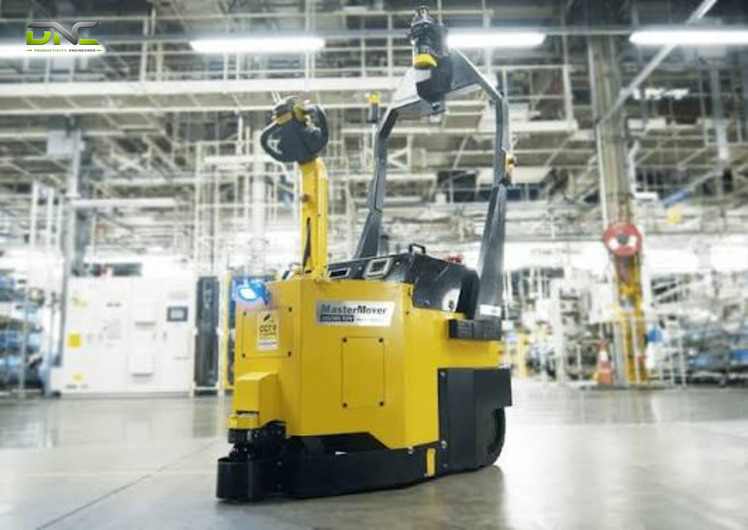
A tugger AGV is a tow tractor that pulls one cart or a train of carts, and the carts’ own wheels carry the load. Industry sources also call it a tow tractor AGV, a tractor AGV or a towing AGV. The vehicle hitches to the carts with a tow pin, hitch or coupling. Some models connect and disconnect by themselves at each station.
Since the payload rolls on its own wheels, a tugger AGV’s towing capacity reaches several tonnes. Published autonomous tow tractors, for example, move towing loads of up to 5,000 kg (about 11,000 lb).
Tuggers earn their place where many small loads travel the same route together. A typical case is delivering parts kits from a store to an assembly line in one train, rather than making one trip per cart. That is why tuggers are a standard answer for line feeding. The tugger is also the oldest AGV type. The first AGV, brought to market in the United States in the 1950s, was a tow truck that followed a wire in the floor.
Many tugger AGVs are automated versions of human-driven tow tractors. Some offer hybrid operation, so a worker can take over and drive when needed.
The limits come from the train. Carts have to be towable, with sound castors and a hitch at the right height. The station has to leave room for the whole train to stop in line. Each cart then waits to be unloaded by hand or by a separate device, since a tugger does not lift anything. The train also changes how the vehicle has to steer.
Why Tugger AGVs Need Steered-Wheel Control
A towing AGV turns with a steered drive wheel, like a three-wheeled forklift, rather than by running its two drive wheels at different speeds. Differential steering, the most common method on AGVs, lets a vehicle turn on the spot like a tank. On a tugger, that same spin would make the trailer jackknife. Steered-wheel control turns in an arc and follows the programmed path more precisely, so the carts behind track the tractor.
The practical result is a wider turning path. Aisles, corners and station approaches on a tugger route have to be drawn for the length of the full train, not the tractor alone. A latent AGV avoids the train by carrying the cart itself.
Latent and Jacking AGVs: Lifting Carts From Below
A latent AGV, also called a jacking or lifting AGV, is a low vehicle that drives underneath a cart, rack or shelf and lifts it clear of the floor to carry it. “Latent” describes how the vehicle waits hidden under the load or beside the line. “Jacking” describes the lift. One manufacturer’s description reads: the vehicle “can lurk beside the production line or at the bottom of the shelves, lift and transport goods by jacking up”.
Integrators group the same family as underride AGVs. Other names are automated guided carts, under-cart AGVs and “mouse” AGVs.
The jacking stroke is short. One published latent jacking AGV lifts a standard 60 mm (about 2.4 in), carries 400 kg to 2 tonnes depending on the option, and climbs slopes up to 5°. The same datasheet lists walking accuracy of ±10 mm and end docking accuracy of ±5 mm, on combined SLAM and QR code navigation. Some underride models connect through tow pins instead of lifting, and some act as tow tractors for a short cart train. Platform variants pick up trolleys they can drive under and carry 600, 1,000 or 1,500 kg depending on the model.
The latent AGV’s strength is that the carrier’s weight sits inside its wheelbase. The vehicle resists no tipping moment and needs no counterweight, which keeps it low, compact and able to turn in tight spaces. Integrators describe underride AGVs as low-profile and relatively low-cost compared with forked models. They are often run in large fleets, most notably in automotive production. The limits follow from the same geometry:
- Clearance under the carrier.The cart or shelf needs open space underneath and legs wide enough for the vehicle to pass. A station that cannot be driven under needs a fork vehicle instead.
- Lift height.A 60 mm class lift raises the load off the floor, not onto a rack beam or a conveyor.
- Floor quality.A low vehicle with a loaded top plate is sensitive to steps, gaps and slopes above its rated gradient.
A pallet on the floor, a conveyor end or a rack beam needs a forklift AGV.\
Latent and Jacking AGVs: Lifting Carts From Below
Forklift AGVs: Carrying Loads on Forks
A forklift AGV is an automated guided vehicle with forks that enter a pallet, lift it and place it at floor level or at height. Sources use two names that mean different things. An automated forklift, or automated guided forklift (AGF), is a manual forklift truck converted for driverless operation, so a driver can still take over. A forked AGV is designed from the ground up for automated operation only and has no manual mode. Both types handle the same loads: pallets, pallet cages and racks, moved between production, racking, docks and trucks.
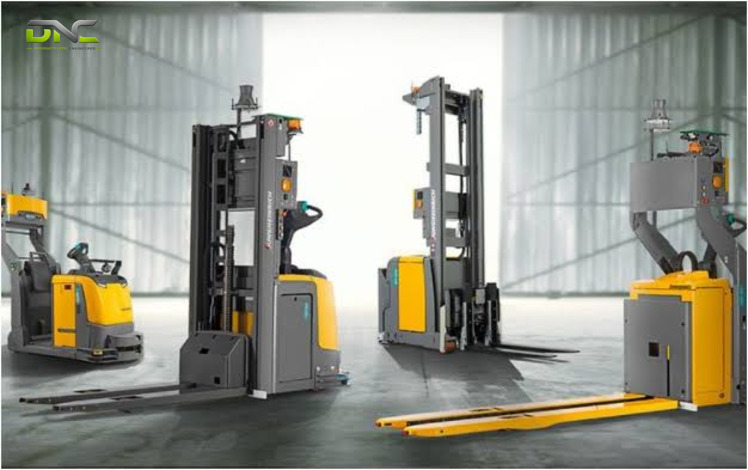
Forklift AGVs come in the same families as manual trucks. They include pallet trucks, pallet stackers, counterbalance trucks, reach trucks and very narrow aisle (VNA) trucks. Published capacities rise with the family:
| Forklift AGV family | Published example | Capacity | Lift height |
| Pallet truck AGV | Floor-to-floor pallet moves, no fixed load stands | Floor level only | Floor level |
| Pallet stacker | One compact stacker model | 1,200 kg | Up to 1.60 m (5.2 ft) |
| Heavy-duty pallet stacker | One heavy-duty stacker model | Up to 2 t | Up to 3.20 m |
| Counterbalance stacker AGV | One 1.5-tonne model | 1,500 kg | 3,000 mm (customisable) |
| Standard forklift AGV | One integrator’s range | Up to 2,500 kg (custom up to 10,000 kg) | Racks up to 8-10 m |
| Reach truck | One automated reach truck | Up to 1,600 kg | Up to 11 m |
| Very narrow aisle truck | One automated VNA truck | Up to 1,500 kg | Up to 14 m |
Forked AGVs cost significantly more than their manual equivalents, and one industry guide reports payback often within one or two years through efficiency gains.
The forks are what make these vehicles flexible. A forked vehicle picks a pallet from the floor, a conveyor or a rack beam without a special carrier, which removes the fixed load stands a latent AGV needs. The cost is stability. A pallet on the forks sits ahead of the wheels and creates a tipping moment, and each forklift AGV family answers that moment in one of two ways.
Counterbalance Versus Outrigger Forklift AGVs
A counterbalance forklift AGV balances the load with a counterweight behind its drive axle, while an outrigger forklift AGV braces it with legs that run forward under or beside the load. Both are forklift AGVs. The difference is where the stabilising force comes from, and that difference decides which pallets and stations each one can serve.
A counterbalance forklift AGV works as a lever about its front axle. The load on the forks pushes down at a distance ahead of the axle, called the load centre. The counterweight pushes down behind it. The rated capacity holds only while the load’s moment stays below the restoring moment of counterweight plus truck.
Warehouse equipment, including counterbalanced AGV stackers, usually rates capacity at a load centre of 500 mm (19.7 in). A longer or badly placed load moves the centre forward and reduces the safe weight.
Since nothing projects under the load, a counterbalance AGV approaches a conveyor end, a machine or a dock face directly. It also handles closed-bottom pallets, skids and containers that legs cannot straddle. One 1.5-tonne AGV counterbalanced stacker lists 1,500 kg, 3,000 mm lift, laser SLAM navigation, ±10 mm positioning and compatibility with closed pallets. It needs a 3,300 mm (10.8 ft) right-angle stacking aisle for a 1,000 × 1,200 mm pallet.
An outrigger, or straddle, forklift AGV puts load wheels in front legs at floor level. The legs widen the support area and resist side tipping, and they reduce the need for a heavy counterweight.
The legs also constrain what the AGV can carry. The pallet has to fit between or above them, so outrigger designs suit standard open pallets, such as block and Euro pallets, and repetitive pallet sizes. The leg wheels concentrate point loads on the slab, which matters near floor joints. Straddle pallet stackers are the common example.
A third forklift AGV design sits between the two. A cantilevered-fork stacker works without straddle legs, lifts 1,200 kg to 1.60 m, and targets transfer stations that cannot be driven under. With all four load-handling types described, they fit in one comparison.
AGV Load Handling Types Compared
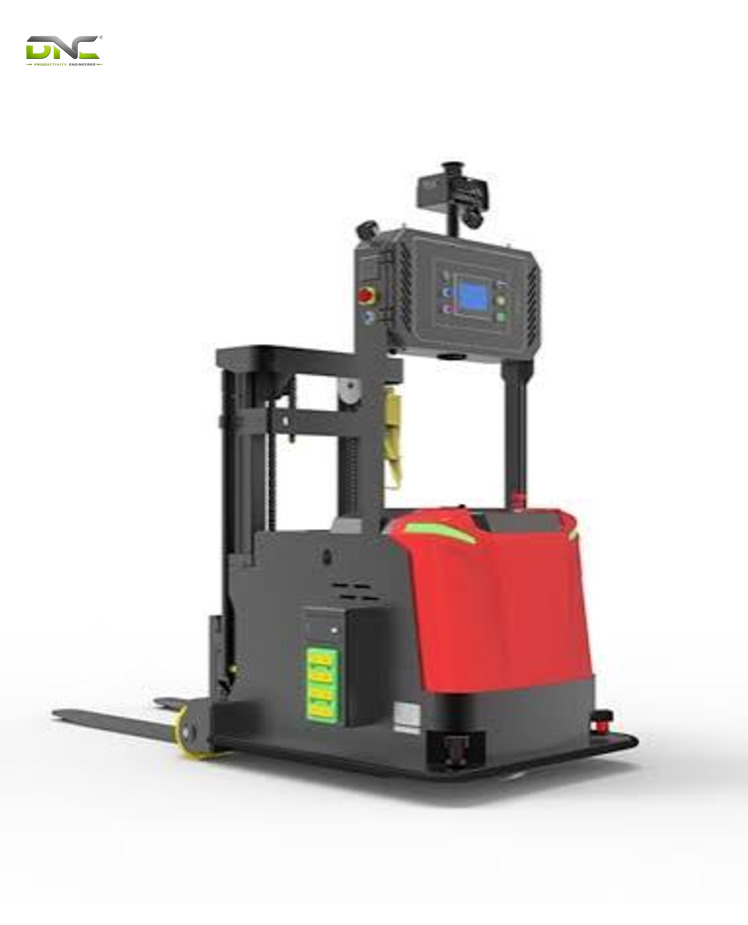
The four AGV load-handling types trade the weight the vehicle carries against the features the load carrier and station provide. The table below sets them side by side, using figures published by AGV makers and integrators.
| Tugger | Latent / jacking | Outrigger forklift | Counterbalance forklift | |
| Load carrier | Towable carts | Carts, racks or shelves with clearance underneath | Open pallets that fit the leg span | Any pallet, including closed-bottom, skids, containers |
| Weight on the AGV | None (pulling force only) | Full load, inside the wheelbase | Full load, legs take the reaction | Full load, counterweight balances it |
| Published capacity examples | Up to 5,000 kg towing | 400 kg-2 t | Varies by stacker model | 1,500 kg (stacker example) |
| Placement height | Floor (carts stay on wheels) | About 60 mm lift | Low stacking heights | 3,000 mm (stacker example) |
| Station needs | Room for the whole train | Drive-under space | Space for the legs under the load | Clear face, stacking aisle |
| Typical role | Line feeding, many small loads per trip | Shelf and cart moves, dense fleets | Floor-to-floor and low stacking | Conveyor, dock and rack interfaces |
Published travel speeds and positioning figures follow the same datasheets. The latent jacking AGV above is rated at 2 m/s and climbs 5° slopes. The 1.5-tonne counterbalanced stacker travels at 1.0 m/s loaded and 1.2 m/s unloaded. One integrator’s forklift AGV range reaches 1.7 m/s. Positioning is closer across the types.
The latent model docks to ±5 mm, while the counterbalanced stacker and DNC Automation’s unmanned forklifts position to ±10 mm (±0.39 in). Accuracy rarely separates the types. Weight path, carrier and station do.
Summary So Far
Tugger, latent and forklift AGVs differ first by where the load’s weight goes, and everything else follows from that. A tugger leaves the weight on the carts’ own wheels, so it tows several tonnes but lifts nothing and needs room for a train.
A latent AGV lifts a cart or shelf a few centimetres and carries it inside its wheelbase, so it stays compact but needs drive-under clearance. Forklift AGVs carry the load ahead of their wheels and handle pallets anywhere. That is why they need outrigger legs, which fit only open pallets, or a counterweight, which serves closed pallets and clear faces. So the selection starts with the carrier the load already sits on.
AGV Load Handling Types Compared
Choosing an AGV Type From the Load Carrier You Already Use
An AGV type is chosen from the load carrier and the stations, because the carrier fixes the weight path before the route is drawn. When DNC Automation’s engineers assess a site, they record every carrier and every pick-up and drop-off point before they look at vehicles. Five questions, in this order, narrow the choice:
- What does the load already sit on?Wheeled carts point to a tugger. Carts, racks or shelves with open space underneath point to a latent AGV. Pallets point to a forklift AGV.
- How many loads move together on one route?Several small loads per trip favour a tugger train. One load per trip favours latent or forklift vehicles.
- What height does each station need?Floor-to-floor moves suit a tugger, a latent AGV or a pallet truck. Placing loads on a conveyor, a rack beam or a truck bed needs a stacker, a counterbalance AGV or a reach truck.
- Is the pallet open or closed underneath?Closed-bottom pallets, skids and containers rule out straddle legs, which leaves the counterbalance design or a cantilevered fork.
- What does the floor carry?Outrigger wheels load the slab at points, latent AGVs dislike steps and gaps, and DNC’s own SLAM chassis is specified for floor flatness within ±10 mm.
Most plants end up with more than one type. Carts feed the line by tugger or latent AGV, and pallets leave the line by forklift AGV. When the types share one site, one fleet manager and one navigation platform keep the traffic rules in a single system. The pallet end of that split is where DNC Automation’s plants usually start.
Load Handling at the End of the Line
End-of-line pallet transport in a Malaysian factory is a forklift AGV job, because the load leaves the line as a wrapped pallet on a conveyor. Pallet handling is one of the most common AGV applications, moving pallets from the palletizer to stretch wrapping, then to storage and the shipping docks. A tugger cannot lift that pallet, and a latent AGV cannot reach it on the conveyor. The vehicle has to fork it.
The conveyor end decides which forklift AGV fits. A pallet conveyor system that ends at an open face with space below the rollers accepts a vehicle with outrigger legs. A closed conveyor frame or a closed-bottom pallet leaves nowhere for the legs, so a counterbalance design approaches the end directly.
DNC Automation’s unmanned forklift series follows the automated forklift route. Each unit is an electric forklift fitted with a control box, a self-developed navigation system for ±10 mm positioning, and laser, mechanical and photoelectric anti-collision. The AGV dispatching system connects to the plant’s MES or WMS.
For a deeper comparison of automated counterbalance and reach truck formats, DNC’s automated forklift robot guide covers the forklift family on its own. The questions below cover the points buyers raise once the load carrier is known.
Load Handling at the End of the Line
Frequently Asked Questions About Types of Automated Guided Vehicle
These questions about types of automated guided vehicle cover terminology, the latent AGV, the counterbalance design and the AGV-versus-AMR distinction, the points Malaysian buyers raise once they know which load carrier each station uses.
What are the main types of automated guided vehicle?
The main types of automated guided vehicle, sorted by load handling, are tugger (tow tractor) AGVs, latent or jacking (underride) AGVs, forklift AGVs with outrigger legs, and counterbalance forklift AGVs. Unit load AGVs with conveyor or roller tops, heavy burden carriers and light load carts are further variants. Hybrid AGVs and AMRs describe how the vehicle is driven or navigates, not how it carries the load.
Is a tugger AGV the same as a towing AGV?
A tugger AGV is the same vehicle as a towing AGV or tow tractor AGV. It hitches to one or more carts and pulls them as a train, with the load resting on the carts’ own wheels rather than on the vehicle.
What is a latent AGV?
A latent AGV is a low automated guided vehicle that drives under a cart, rack or shelf and jacks it up a short stroke, around 60 mm on one published model, to carry it. The same vehicle family is sold as a jacking AGV, lifting AGV, underride AGV or automated guided cart.
How does a counterbalance AGV differ from a pallet stacker AGV?
A counterbalance AGV balances the load with a rear counterweight and has no front legs, while a straddle pallet stacker AGV uses outrigger legs that run under or beside the load. The counterbalance design handles closed-bottom pallets and approaches conveyors directly. The outrigger design is lighter but needs open pallets that fit the leg span.
Is an AMR a type of AGV?
An AMR is a separate class of mobile robot rather than a load-handling type of AGV. The U.S. standard ANSI/RIA R15.08 separates the two by how they move through the site: an AGV follows defined guide paths and stops for blockages, while an AMR sets its own path around them. Both classes come with tow, lift or fork load handling.
- 3 views
- 0 Comment
Recent Comments