


Conveyor vs AGV: Capacity, Buffering and Failure Compared
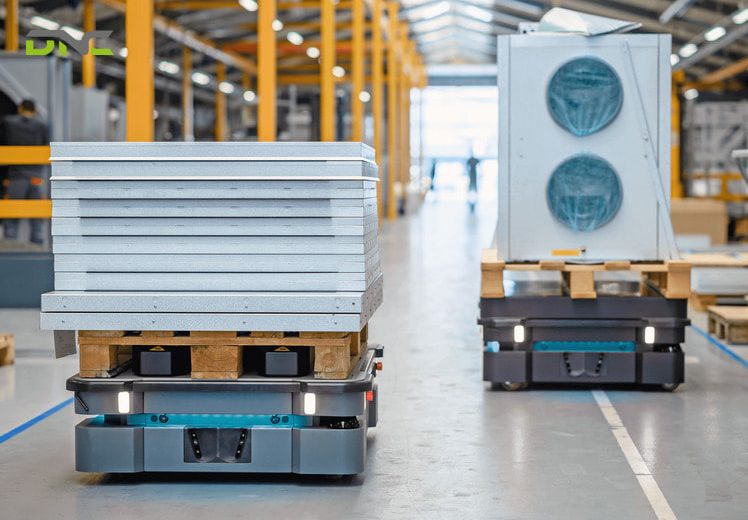
Failure behaviour follows the same structure: a conveyor stops in series, because one faulty zone halts every pallet behind it, while an AGV fleet degrades in parallel, because one vehicle out of service leaves the others moving. “If a single AGV or AMR is offline, these systems can still move product, but a faulty conveyor zone can bottle up a sortation line – or an entire operation,” one material-handling integrator writes, and for that reason maintenance and spare-parts inventory matter more for conveyors than for vehicles. Obstacles show the same split. A conveyor jams outright; a traditional AGV stops and waits for the path to clear, and every load behind it waits too, a Malaysian smart-warehouse integrator observes.
The two failure modes have different sizes. In a fleet of four vehicles, one vehicle out of service removes about a quarter of transport capacity, and a fifth vehicle held in reserve — an N+1 fleet — restores it. On a conveyor, a stopped zone cuts all flow past it; the zones upstream keep accepting pallets until they fill, so the buffer from the previous section is also the line’s failure insurance, but only on the upstream side. Downstream machines are starved from the first second.
Resilience costs each technology something different. Conveyors present the fewest software and controls issues of the options, and their failures are mechanical and local. AGVs carry heavier mechanical and guidance-system maintenance, often in debris-prone manufacturing areas, and a conveyor manufacturer argues that replacing an AGV is costly and time-consuming and that vehicles need several interfaces to different control systems. The side-by-side view below condenses these properties.
Summary: Conveyor vs AGV on Throughput, Buffering and Failure
Summarising conveyor vs AGV so far, a conveyor carries a continuous stream, stores pallets on the line and stops in series when a zone fails. An AGV fleet carries one load per vehicle-trip, stores nothing beyond the load on each deck, and loses a share of capacity when a vehicle fails instead of stopping. Route length costs the fleet capacity and costs the conveyor only transit time. Buffer tolerance on a conveyor equals positions multiplied by the pallet interval; fleet resilience comes from a spare vehicle.
The main differences between a conveyor and an AGV fleet are compared in the table below.
| Attribute | Conveyor | AGV fleet |
| Structure | One continuous path; pallets coupled | Independent vehicles; pallets decoupled |
| Throughput | Continuous flow; highest at fixed, predictable rates | One load per trip × vehicles; falls as the route lengthens |
| Buffering | Stores pallets; tolerance = positions × pallet interval | None beyond the load on each vehicle |
| Failure | One faulty zone stops flow past it (series) | One vehicle down costs ~1/N capacity (parallel) |
| Obstacle | Jams | Stops and waits; loads behind it wait |
| Resilience lever | Accumulation positions and spare parts | A spare (N+1) vehicle |
| Route change | New layout and installation | Software change |
Those structural properties of the conveyor and the AGV fleet then meet the building itself — its aisles, floors and future layout.

Summary: Conveyor vs AGV on Throughput, Buffering and Failure
Flexibility, Floor Space and Route Changes
On flexibility, floor space and route changes, a conveyor loses to the AGV fleet, because the fleet’s route lives in software while the conveyor’s route is built into the floor. Changing a conveyor’s path requires a new layout and a new installation, whereas AGV paths are programmed and change as the business changes. A Malaysian smart-warehouse integrator calls the cost of change — not the purchase price — the number that decides lifetime cost, since rerouting any fixed-path system means physically moving its guides. One AGV maker on the panel trains every customer to create or change pallet positions in the vehicle software themselves.
Floor space and traffic split the same way. Conveyors cut off aisles and cannot coexist with forklifts that need to cross them, one panelist notes, and AGVs suit routes shared with manual forklifts and pedestrians. Vehicles ask more of the floor: automated vehicles need smooth, relatively clean floors with limited inclines, while heavy-industry sites with rough, dirty floors point toward conveyors. Conveyors also integrate with a pick module on every level, where vehicles usually cannot, and AGVs load and unload full pallets at trucks, where conveyors cannot always reach.
AGV systems perform particularly well on long and variable transport routes with long cycle times, one load-handling supplier states, and existing buildings lean the same way. Three of the panel’s four integrators named no clear favourite for automating a brownfield site; the fourth reported that customers automating an existing warehouse replace their current transport with AGVs rather than fit a conveyor around running operations. For Malaysian food & beverage, glove and home-appliance plants, the first site question DNC asks is whether the route crosses an aisle that also carries forklift or pedestrian traffic, because that answer alone can rule a conveyor out. Each of these floor and layout conditions also shows up in the cost of the two systems.
Conveyor and AGV Cost Over the Life of the System
Conveyor and AGV cost depends on plant size and route shape more than on either price list: for very small plants the conveyor is likely cheaper, and for medium to larger plants the AGV becomes more cost-effective, according to one integrator who builds both. For short distances and a high conveying capacity, the AGV is usually the more expensive option, because its base price pays off only with functionality and distance covered. Conveyors are less expensive to purchase than vehicles but can carry more extensive maintenance costs, one material-handling integrator adds.
Time to install runs the other way. A conveyor is designed around the customer’s site, so design, manufacture and installation take time, and later changes involve much more effort; an AGV is designed, set up and commissioned more quickly because the vehicle design is already complete. Growth favours the fleet. One AGV customer started with 10 drop-off points to test the concept and, after an expansion over about three years, serves approximately 150 drop-off points with four AGVs.
Running cost follows the shift pattern. One AGV maker reports a payback of about 13 months in 24-hour operation, a self-reported figure, while a conveyor manufacturer counters that purchasing, charging and maintaining each vehicle is a substantial cost. For Malaysian manufacturers weighing automation against labour shortages and the Industry 4.0 targets of the New Industrial Master Plan 2030 (NIMP 2030), shift pattern and expected layout changes are the two inputs to model first. Most quotations then land on a combination of the two technologies rather than one.
Conveyor and AGV Cost Over the Life of the System
Combining s at Transfer Stations
Combining a conveyor with AGVs at transfer stations puts each where its structure pays: the conveyor where a route needs storage and a steady high rate, the AGV fleet where it needs to share aisles, change, or keep running through a vehicle failure. The join is a transfer station. A piggyback AGV with its own roller, belt or chain conveyor collects the load carrier there, and one load-handling supplier fits lift systems so the vehicle compensates height differences between stations; one AGV maker on the panel used a U-shaped conveyor as the interface to its customers’ existing conveyors.
On an end-of-line route, the storage sits on the outfeed conveyor after the pallet wrapping machine, where each position buys one pallet interval before a late vehicle stops the wrapper, and the fleet carries wrapped loads from there to storage or the dock. New sites follow the same pattern at a larger scale: conveyors store and retrieve material, then hand it to AGVs at a central point. Most warehouses, a Malaysian integrator observes, end with a conveyor on the stable trunk and mobile robots on the variable last leg.
The questions that place a route on the conveyor side, the AGV side or across both are listed below in the order they narrow the choice.
- Pallet rate and one-way distance come first, because a high rate on a short, fixed route is conveyor work and a long route multiplies vehicles.
- Storage need follows: machines that stop independently of each other need positions between them, sized as positions × pallet interval.
- Failure tolerance decides whether a stopped zone is acceptable or whether the route has to keep moving on a spare vehicle.
- Aisle traffic and floor condition then rule each technology in or out of the space.
- Expected layout changes and growth close the list, since software routes absorb change that a fixed line cannot.
For vehicle types, navigation methods and payload classes beyond this comparison, the guide to automatic guided vehicles covers the wider range.
Frequently Asked Questions About Conveyor vs AGV
These four conveyor vs AGV questions cover speed, breakdowns, purchase cost and how the two technologies connect — the points plant engineers raise once a pallet route has been narrowed to these two options.
Is a conveyor faster than an AGV?
A conveyor is faster than an AGV at moving a steady stream of pallets over a fixed route, because it carries many pallets at once while each AGV carries one load per trip and drives back empty. An integrator on one AGV-navigation supplier’s panel put the conveyor-favouring rate at around 80 pallets an hour per production line.
What happens when a conveyor breaks down compared with an AGV?
When a conveyor zone breaks down, every pallet behind it stops until the zone is repaired or its upstream positions fill. When an AGV breaks down, the rest of the fleet keeps moving at reduced capacity — about a quarter less in a four-vehicle fleet — and a spare vehicle restores the rate.
Is a conveyor cheaper than an AGV?
A conveyor is usually cheaper than an AGV system to purchase and is likely cheaper for very small plants, while an AGV fleet becomes more cost-effective in medium to larger plants with longer or changing routes. Maintenance, spare parts and the cost of every future layout change complete the comparison.
Do AGVs and conveyors work together?
Yes, AGVs and conveyors work together at transfer stations, where a piggyback AGV with its own roller or chain conveyor docks at the end of a fixed line and transfers the load across. Transfer height and the vehicle’s stop position at the station are specified together, since a lift on the vehicle compensates height differences and DNC’s AGVs stop to ±10 mm or ±5 mm.
________________________________________
A pallet route is specified from its rate, its distance, the storage it needs and the failure it can tolerate — before any conveyor or vehicle catalogue is opened. DNC’s engineers fix those four inputs before either system is quoted, so speak with a DNC engineer to map your own route.
- 3 views
- 0 Comment
Recent Comments