


AGV vs AMR: Differences in Navigation, Flexibility & Cost
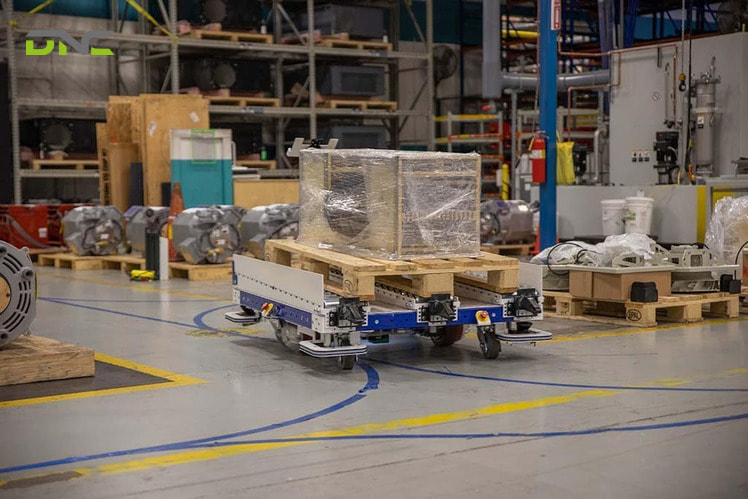
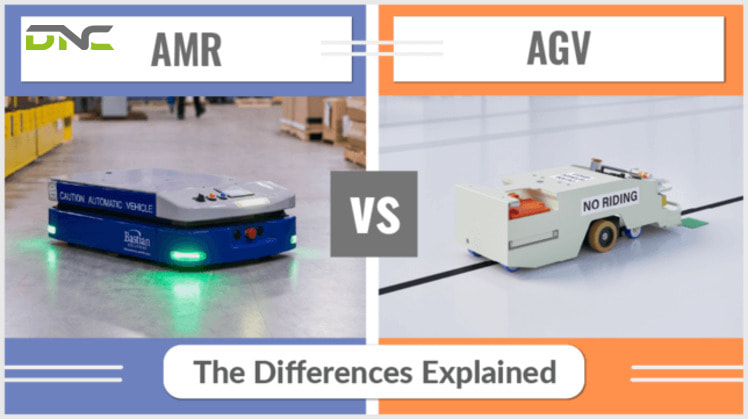
AGV vs AMR compares two kinds of driverless material transport. An automated guided vehicle (AGV) follows a route the system fixed in advance, read from magnetic tape, floor wires, QR codes or reflectors. An autonomous mobile robot (AMR) locates itself on a SLAM (simultaneous localisation and mapping) map built from lidar and camera data and plans its own path. The practical test is a blocked aisle. The AGV stops and waits; the AMR computes a way around.
That difference in route authority drives the three contrasts buyers compare: navigation decides how much of the floor must be marked, flexibility decides what a layout change costs, and cost follows both, because an AGV’s lower unit price is repaid through guidance infrastructure and recommissioning, while an AMR’s higher price buys changes made in software. DNC Automation supplies both classes to Malaysian manufacturers as turnkey integration, from EAGV guided vehicles to SLAM-based mobile platforms.
AGV vs AMR: The Two Terms Defined
AGV vs AMR sets two defined terms against each other: an AGV is an automated guided vehicle, a driverless vehicle that moves materials along a predefined route, and an AMR is an autonomous mobile robot, a driverless robot that moves materials by planning its own route through a mapped facility. In industrial settings both are floor-bound transport, and both sit inside the wider class of mobile robots. The shorthand AGVS, for automated guided vehicle system, names the whole installation — vehicles, guidance, controller and fleet software — while AGV names one vehicle.
The two words in each name carry the distinction. “Automated” describes a machine that executes defined instructions with little or no human input. “Autonomous” describes a machine that makes its own decision when it meets a situation nobody programmed. One AMR maker’s glossary draws the line exactly there, and one German AGV integrator goes further: the terms are opposites, so an “AGV robot” does not exist as a category. The four naming facts that matter for a specification are set out in the table below.
| Term | Stands for | How it moves | Who decides the route |
| AGV | Automated guided vehicle | Along a predefined path read from markers or a stored line | The system, in advance |
| AGVS | Automated guided vehicle system | Fleet of AGVs plus guidance and controller | A central controller |
| AMR | Autonomous mobile robot | Across a mapped area, path computed per trip | The AMR itself, at run time |
| Mobile robot | Umbrella term | Either of the above | Depends on the class |
The AGV is the older of the two. The first units ran in 1953 in the United States and followed a signal from wires embedded in the floor; by 1956 a vehicle in England tracked coloured tape with an optical sensor. AMRs entered industrial markets in the 2010s, according to one European intralogistics integrator, and one automated storage and retrieval system (ASRS) maker puts their track record at 10 to 20 years, against seven decades for the AGV.
Load capacity no longer separates the two either. AMRs were first used for lighter loads and AGVs for pallets, a European intralogistics integrator notes, but today their applications hardly differ; one AMR maker rates its AMRs at 250 kg (551 lb / 0.25 t), 600 kg (1,323 lb / 0.6 t) and 1,350 kg (2,976 lb / 1.35 t), and the same integrator now calls AMRs ideal for pallet transport.
DNC Automation builds on both lineages. Its AGV and AMR range includes the DNC-EAGV guided vehicles, whose self-developed navigation and positioning system places the vehicle to within ±10 mm (0.39 in / 1 cm) or ±5 mm (0.20 in / 0.5 cm), and the DNC-ESVR2 mobile platform, a chassis that navigates by SLAM laser, turns on the spot and supports intelligent charging. The definitions separate cleanly on paper. On the floor, the separation starts with how each vehicle knows where it is.
Navigation: Guidance Markers Versus Onboard Maps
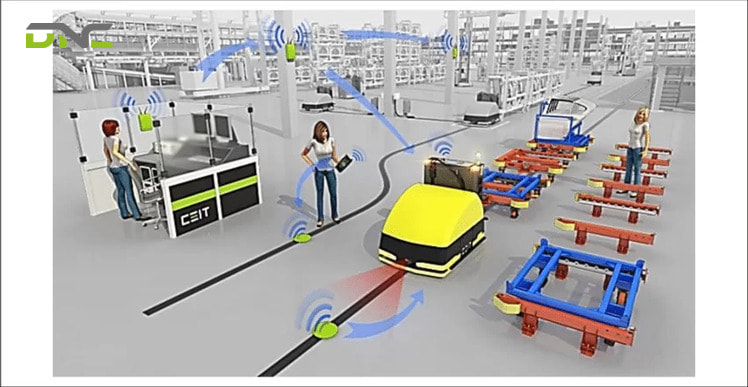
Navigation in an AGV relies on guidance markers installed in the facility, and navigation in an AMR relies on an onboard map that the AMR matches against what its sensors see. The AGV vs AMR navigation choice is an installation question before it is a software question. Every AGV guidance method puts something in or on the building, and the AMR method puts a map in the vehicle. The six navigation methods found across the crawled supplier pages are compared below.
| Navigation method | Vehicle class | What the vehicle reads | What the building needs |
| Magnetic tape or strips | AGV | Tape on the floor surface | Tape laid along every route; repaired when traffic wears it |
| Embedded wire or inductive loop | AGV | Signal from a wire in the floor | Wire set into the floor slab |
| QR codes or barcodes | AGV (some AMRs) | Codes fixed at known floor positions | A code grid over the travel area |
| Reflectors or laser targets | AGV | Laser returns from mounted reflectors | Reflectors installed along the route |
| Virtual lidar or camera path | AGV | Natural features, but along a stored line | No markers; the line is fixed in software |
| SLAM map with sensor fusion | AMR | Lidar, 3D camera, time-of-flight and ultrasonic data matched to a map | Visible fixed features such as walls and pillars |
The fifth row blurs the old boundary. One AMR maker concedes that an infrastructure-free AGV can steer by lidar or cameras and still follow a “virtual” line, stopping when that line is blocked. A US integrator adds that newer AGVs carry the same sensor technology as AMRs; the sensors warn the vehicle of an obstacle, but it cannot reroute itself. A lidar scanner on the datasheet proves nothing by itself. Automatic guided vehicles, a common alternative name for AGVs, use the guidance families in the first five rows, which are covered in more depth in our guide to automatic guided vehicles.
AMR maps have limits of their own. A SLAM-based AMR needs fixed elements it can recognise, such as pillars or walls, to anchor its position.
In a long corridor that looks the same end to end, the same US integrator notes that an AMR can lose track of whether it is 50 ft (15 m) or 200 ft (61 m) along it, and the fix is to program the AMR to behave as an AGV and follow a straight path. Both classes share one physical constraint. Each needs a smooth floor without significant inclines or gaps, and DNC specifies floor flatness within ±10 mm (0.39 in / 1 cm) for its ESVR2 platform. Since sensors no longer separate the classes, the separating question has to be behavioural.
Navigation: Guidance Markers Versus Onboard Maps
The Blocked-Route Test That Separates an AGV From an AMR
The blocked-route test separates an AGV from an AMR by asking one question: when the planned path is obstructed, does the vehicle wait for the path to clear, or does it compute a new path on its own? Every crawled supplier page agrees on the two answers. The AGV stops and waits until someone removes the obstacle. The AMR detects the obstruction and plans an alternative route to the same destination. A US integrator adds that the waiting AGV holds up the areas downstream of it, so the difference surfaces as lost throughput, not only as a stopped vehicle.
Behind that behaviour sits route authority. On an AGV system, a central control system plans routes and hands them to each vehicle as predefined instructions, a European intralogistics integrator explains, while AMRs coordinate peer to peer and adapt to the situation. The same split appears when localisation fails. One AMR maker describes an AGV that has lost its position as coming to a stop and waiting for a manual reset, and an AMR in the same state as re-verifying its location and searching for another route.
Route authority is not unlimited on either side. AMRs still run on traffic rules and preferred routes; the German AGV integrator compares them with a taxi driver who knows several roads to the same address and takes the fastest. And an integrator can lock an AMR onto a fixed line in a featureless corridor, as the previous section showed. That makes route authority a setting in fleet software, applied zone by zone, rather than a property bolted into the hardware.
This is the point most AGV vs AMR comparisons miss. The class of a vehicle is decided by what its software allows it to do at a blocked aisle, not by the sensors listed on its datasheet. Four behaviour questions settle the classification during a supplier demonstration, and they are listed below.
- Blocked path. With a pallet parked across the route, does the AGV or AMR wait or replan?
- Lost position. After a localisation failure, does it need a manual reset or does it recover itself?
- Route change. Who edits a route — the supplier, an integrator or your own team — and does the edit involve floor work?
- Misaligned load. When a pallet sits out of position at a pick-up point, does the vehicle adjust its approach or stop?
When DNC engineers review an AGV or AMR proposal for a client, the class is recorded from these four answers, and the sensor list is treated as supporting detail. The third answer is where flexibility, the second contrast in the comparison, begins.
Flexibility: Route Changes, Fleet Size and Redeployment
Flexibility in the AGV vs AMR comparison is the time, labour and floor work needed to change what the vehicles do, and it differs on three counts: route changes, fleet size and redeployment. A fourth count, tolerance of badly staged loads, follows from the same route authority. The table below sets out how each class responds to the four change events that published supplier material describes.
| Change event | AGV | AMR |
| Route change | Guidance rework — new tape, wire or reflectors; adjusted by the supplier | Map edit in the fleet software, in minutes by drag and drop |
| Adding a vehicle | New vehicle must fit the existing guidance layout | New unit working from the shared fleet map in under a day (one AMR maker’s figure) |
| Moving to another zone or plant | Equivalent to a first installation | Remapped and redeployed by site staff |
| Load staged out of position | Payload must sit precisely; out-of-spec staging needs intervention | Adjusts to a misaligned pallet or fork pocket |
Route changes carry the widest gap. A European intralogistics integrator states that the paths and fleet size of an AGV system are difficult to change without construction work and can only be adjusted by the supplier, while AMR layout changes are made in minutes. For a plant that re-lines a packing hall between product campaigns, that is the difference between a project and an afternoon.
Fleet growth is less linear than supplier headlines suggest. The German AGV integrator observes that adding vehicles costs little until they start blocking each other and traffic control becomes the constraint; AMRs reach that point later because each one can recalculate its route. The same integrator notes that a more flexible fleet often needs fewer vehicles. One AMR maker makes the matching claim that shared, redeployable AMRs reduce the number of units a multi-site business has to buy.
Flexibility is only valuable when it is used. A route that has not changed in five years gains nothing from an AMR that can replan it. The German integrator puts the same point plainly: a highly flexible system that never uses its flexibility is not economical. The flexibility an AMR adds also changes how predictable each trip is, which is the reliability question.
Reliability and Protective Stops Beside People
Reliability beside people favours the AGV, because a vehicle that only follows a fixed route behaves identically on every cycle and makes its protective stops in predictable places, while an AMR trades part of that predictability for its ability to replan. The German AGV integrator describes AGVs as punctual and predictable, with mislocalisation rare and downtime almost always traced to an obstacle in the path. The same integrator describes AMRs as more prone to errors, with problems that grow more complex as autonomy rises, and adds that their reliability depends on the complexity and build quality of the AMR rather than falling in step with autonomy. A European intralogistics integrator reaches the same verdict in different words: AGV transport is plannable, AMR transport is adaptive.
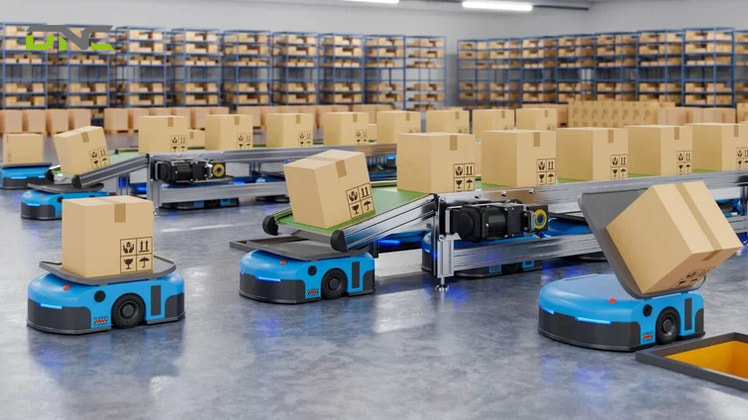
Protective behaviour converges more than marketing copy suggests. Both classes carry safety laser scanners, and they are often fitted with cameras and further sensors. The German integrator notes that the lidar an AMR uses to navigate often doubles as its safety scanner, so autonomy adds little protective hardware. AMR makers cite ISO 3691-4, the international standard for the safety requirements and verification of driverless industrial trucks and their systems. DNC’s EAGV300N layers laser anti-collision, mechanical anti-collision and a 3D binocular camera on the same vehicle.
Where the two classes differ is exposure. AGVs typically run in areas kept separate from people, one US integrator notes, which makes their predictability easier to guarantee. AMRs are sold precisely for shared aisles, and one ASRS maker lists the resulting risks as encounters with human-operated forklifts, traffic congestion and the software skills needed to manage both. Neither vehicle type is unsafe by design. Each shifts the protective burden to a different place, and with that the operating side of the comparison is complete.
Reliability and Protective Stops Beside People
Summary: Navigation, Flexibility and Reliability Compared
Compared on navigation, flexibility and reliability, AGV vs AMR differs first in route authority: the AGV follows a route fixed by markers or a stored line and waits when it is blocked, and the AMR plans its own route on a SLAM map. Sensors no longer tell them apart, because infrastructure-free AGVs use lidar too. Flexibility follows route authority — AMR routes change in software, AGV routes change with floor work by the supplier. Reliability runs the other way, with AGVs more predictable and AMRs carrying more error modes. The eight attributes compared so far are summarised in the table below.
| Attribute | AGV | AMR |
| Guidance | Tape, wire, QR codes, reflectors or a virtual line | SLAM map with sensor fusion |
| Blocked path | Stops and waits | Replans |
| Lost position | Manual reset | Self-recovery |
| Route change | Floor work, supplier-led | Map edit, site-led |
| Adding a vehicle | Must fit guidance layout | Joins the shared map |
| Redeployment | Reinstallation | Remap |
| Load staging | Precise positioning required | Tolerates misalignment |
| Predictability | High | Lower, more error modes |
Each of those eight AGV and AMR rows carries a price, which is where the cost comparison starts.
Cost: Unit Price Versus the Price of Every Layout Change
Cost in the AGV vs AMR comparison splits into two parts: the unit price, which usually favours the AGV, and the price of every later layout change, which usually favours the AMR. Supplier statements on the first part do not agree. One AMR maker concedes that AGVs typically cost less per vehicle, a European intralogistics integrator calls the AMR premium slight, the German AGV integrator calls AMRs significantly more expensive, and one industrial-robot maker says AMRs are now comparable in price to AGVs. That spread is itself the finding. The unit price alone does not settle the comparison.
The second part is where AGV costs accumulate. The same AMR maker lists what the AGV price leaves out: physical guides, under-floor wiring or magnetic tape, recommissioning whenever a route changes, and staff who reset vehicles that stop at obstacles. The European integrator adds that installing guidance in a running building often means stopping production. AMR costs sit elsewhere. One ASRS maker names medium acquisition costs with a risk of rapid depreciation, a technology history of only 10 to 20 years, charging-station planning and the skilled personnel that complex software demands.
Four cost lines decide the AGV vs AMR comparison over the life of a fleet, and they are listed below.
- Acquisition — vehicles, fleet software and commissioning.
- Guidance infrastructure — tape, wire, codes or reflectors; zero for a SLAM-only AMR.
- Layout changes × cost per change — rework, recommissioning and lost production each time a route moves.
- Support labour — staff who clear obstacles, reset vehicles and maintain markers or sensors.
The third line is the swing factor, and it is a number only your facility knows. A plant that expects no route changes over the fleet’s life pays for AMR flexibility it never draws on; a plant that re-lines twice a year pays the AGV change cost again and again.
Vendor payback claims show why supplier figures cannot stand in for that estimate. Two AMR makers quote a return on investment in under six months, one claims up to twice the ROI speed of AGVs, and an Indian AMR maker cites under two years. The German integrator’s verdict is the honest one: the question cannot be answered in general terms. Price bands by vehicle type are set out in our AGV and AMR robot cost guide, and one AMR maker offers robots as a service for an annual fee, which moves the acquisition line into operating expense. Once the layout-change count is estimated, the choice itself follows from a short set of site conditions.
Cost: Unit Price Versus the Price of Every Layout Change
Choosing Between an AGV and an AMR for Your Facility
Choosing between an AGV and an AMR for your facility comes down to how often routes, flows and obstacles change: stable routes with constant flows and few obstacles favour the AGV, while frequent layout changes, dynamic obstacles and planned fleet growth favour the AMR. A European intralogistics integrator frames it as three questions — which transport tasks the system performs, whether it has to be changeable and scalable, and whether goods flows are constant or highly dynamic. The site conditions that point each way are compared below.
| Site condition | Points to an AGV | Points to an AMR |
| Route stability | Same routes for years | Routes change with campaigns or re-lining |
| Goods flow | Constant, repetitive | Variable by shift or order mix |
| Obstacles on the route | Few; route kept clear | People, forklifts and carts share aisles |
| Destinations | Fixed destination points, often long runs | Destinations that vary by task |
| Fleet growth | Fleet size known at purchase | Phased growth planned |
| Floor features | Long uniform corridors | Walls and pillars to map against |
An end-of-line layout in a Malaysian food and beverage or glove plant often answers both columns. The route from the end-of-line palletizer to the dock runs between the same stations for years, which is AGV territory, while supplying cartons, film and labels to several packing lines crosses shared aisles, which suits an AMR. Where the fixed conveyor hands a pallet to a vehicle at all is a separate decision, made before either vehicle class is chosen.
For manufacturers planning automation under the New Industrial Master Plan (NIMP 2030), the practical first step toward an AGV or AMR is a route map rather than a vehicle catalogue. DNC’s engineers start every mobile-robot specification by listing each route, how often it changed in the past, and who shares the aisle with it. Many plants end up with both classes, which is why mixed fleets exist.
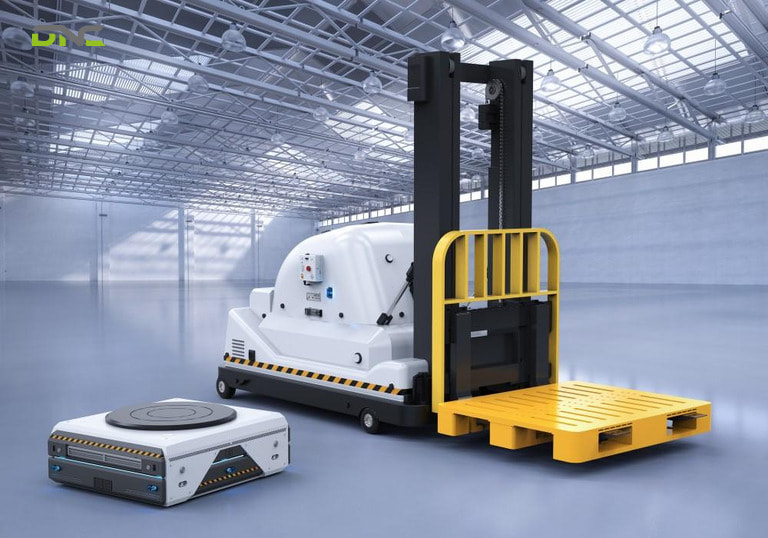
Choosing Between an AGV and an AMR for Your Facility
Mixed AGV and AMR Fleets Under One Fleet Manager
A mixed AGV and AMR fleet runs both vehicle classes under one fleet manager, so AGVs keep the repetitive fixed legs and AMRs take the variable ones. The enabling piece is an interface standard. VDA 5050, described by one AMR maker as the interoperability standard for mobile robot integrations, defines how a fleet manager talks to vehicles from different builders, and one industrial-robot maker’s fleet manager uses it to run AMRs, classic AGVs and industrial trucks together, connected to PLCs and to warehouse management (WMS), enterprise resource planning (ERP) and manufacturing execution (MES) systems.
The risk on the other side is lock-in. One ASRS maker lists vendor lock-in as an AGV limitation, because proprietary control software restricts interoperability between manufacturers and complicates fleet expansion or upgrades. A European intralogistics integrator describes the resulting architecture as a hybrid — automated transport, manual and automated conveyor systems, picking systems and mixed traffic, held together by software. Published cases show the scale. One sensor manufacturer’s plant in Hungary runs 27 AMRs alongside an automated small-parts warehouse, and a fleet manager from one Polish integrator is quoted handling 500 tasks with more than 20 mobile robots in 8 hours.
On the DNC side, the AGV scheduling system manages every vehicle over the plant’s wireless network and connects to MES and WMS, so the transport layer reports into the same control stack as the rest of the line. When a mixed fleet is on the table, the question to ask each supplier is short. Does the fleet manager accept vehicles it did not build? The remaining questions buyers ask about AGV and AMR are answered below.
Frequently Asked Questions About AGV and AMR
The six AGV and AMR questions below cover the terms, cost, floor requirements and standards that come up most often when Malaysian manufacturers compare AMR vs AGV options.
What do AGV and AMR stand for?
AGV stands for automated guided vehicle, and AMR stands for autonomous mobile robot. AGVS, a related term, means automated guided vehicle system — the vehicles plus their guidance, controller and fleet software.
Is an AMR a type of AGV?
No, an AMR is not a type of AGV; both are types of mobile robot. The AGV follows a route fixed in advance and waits when it is blocked, while the AMR plans its own route, which is why one German AGV integrator treats the two terms as opposites.
Which costs less, an AGV or an AMR?
An AGV usually costs less per vehicle, and an AMR usually costs less per layout change. Supplier statements on the unit-price gap range from “slightly higher” to “significantly more expensive” to “comparable”, so the lifetime comparison depends on how often your routes change.
Do AMRs need any floor infrastructure?
AMRs need no guidance markers such as tape, wire or reflectors. AMRs still need a smooth floor without significant inclines or gaps, charging positions, and fixed features such as walls or pillars to map against; DNC’s ESVR2 platform specifies floor flatness within ±10 mm (0.39 in / 1 cm).
Which standard covers AGV and AMR safety?
ISO 3691-4 covers safety requirements and verification for driverless industrial trucks and their systems, and AMR makers cite it for their vehicles. Both classes carry safety laser scanners, and an AMR’s navigation lidar often doubles as its safety scanner.
Do AGVs and AMRs work in the same facility?
Yes, AGVs and AMRs work in the same facility when one fleet manager coordinates both, typically through the VDA 5050 interface standard. AGVs then keep the fixed repetitive legs and AMRs take the routes that change. To map which of your routes suit each vehicle class, speak with a DNC engineer.
- 3 views
- 0 Comment
Recent Comments