


AGV Safety Standards: ISO 3691-4, Safety Scanners & Speed Zones

AGV safety standards are led by ISO 3691-4, the international safety standard for driverless industrial trucks, whose current 2023 edition covers automated guided vehicles, autonomous mobile robots, tunnel tuggers and under-cart vehicles, with ANSI/ITSDF B56.5 as the North American counterpart. Both AGV safety standards rest on the same mechanism. A safety laser scanner slows the vehicle when an object enters its warning field and stops it before contact when the object reaches its protective field, and the safety functions behind that stop are rated to a Performance Level under ISO 13849-1.
B56.5 then caps speed at 1.2 m/s in hazard zones and 0.3 m/s in restricted areas. The weakest point of any route is not the open aisle. It is the transfer station at a conveyor, stretch wrapper or rack face, where the protective field has to shrink so the vehicle can reach its load, and where site preparation under Annex A of ISO 3691-4 carries the safety case.
AGV Safety Standards and the Documents Behind Them
AGV safety standards are a small family of documents, each governing a different part of the system: the vehicle, the site it runs in, and the reliability of the control functions that stop it. ISO 3691-4 and ANSI/ITSDF B56.5 are the two primary AGV safety standards, and both describe a clear procedure for achieving safety on an AGV system for manufacturers and operators alike. The others either supply the method both rely on or extend coverage to newer vehicle types. A common misconception is that one certificate covers all of them, when each document governs a different layer of the same system. The documents that AGV builders and integrators cite are mapped below to what each one governs.
| Document | Full scope | What it governs in practice |
| ISO 3691-4:2023 | Industrial trucks — Safety requirements and verification — Part 4: Driverless industrial trucks and their systems | Vehicle, control system, guidance, and operating-zone preparation (Annex A) |
| ANSI/ITSDF B56.5 | Safety Standard for Driverless, Automatic Guided Industrial Vehicles and Automated Functions of Manned Industrial Vehicles | Vehicle, sensing, braking, zones and clearances; voluntary in the US, widely referenced by OSHA and insurers |
| ISO 12100 | General principles of machinery risk assessment | The hazard analysis ISO 3691-4 requires before any safety measure is specified |
| ISO 13849-1 | Safety-related parts of control systems, Performance Levels a–e | How reliable the stop, speed-limit and field-switching functions must be |
| EN 1175 · EN 60204-1 | Electrical requirements for industrial trucks · electrical equipment of machines | Electrical side of the truck and its fixed equipment |
| UL 3100 · R15.08 | Automated Mobile Platforms · industrial mobile robots (RIA) | Mobile platforms and mobile robots outside the classic AGV definition |
Two of these documents carry the weight. ISO 3691-4 is the pathway to CE marking in the European Union and is adopted by national standards bodies elsewhere, while B56.5 is the primary framework in the United States and Canada. One AGV system integrator states that its vehicles are designed to meet or exceed ISO 3691-4, B56.5 and UL 3100 together. The two primary documents share a goal but differ in method, and those differences are compared in the table below.
| Attribute | ISO 3691-4 | ANSI/ITSDF B56.5 |
| Legal footing | Referenced through CE marking in the EU | Voluntary consensus standard, cited by OSHA and insurers |
| Risk assessment | Formal, documented, aligned with ISO 12100 | Required, with more freedom in method |
| Control-system reliability | Required Performance Level (PLr) per safety function under ISO 13849-1 | Addresses control safety without the PL framework |
| Documentation | Declaration of conformity and technical file for CE marking | Lighter documentation burden |
| Distinctive content | Operating-zone preparation (Annex A); scope exclusions | Zone speeds, clearances and sensor test pieces |
For a Malaysian plant, the practical reading is to specify ISO 3691-4 first and then verify alignment with B56.5, the order one AGV maker recommends for multi-market deployments. DNC Automation’s range of AGV and AMR vehicles combines laser anti-collision, mechanical anti-collision and a 3D binocular camera on models such as the DNC-EAGV300N, and those devices are the hardware the standards test. Before comparing devices, though, the scope of the main standard matters, because ISO 3691-4 is narrower than its title suggests.

AGV Safety Standards and the Documents Behind Them
ISO 3691-4: Scope, Current Edition and What It Leaves Out
ISO 3691-4, the AGV safety standard for driverless industrial trucks, is edition-bound: the 2020 first edition (84 pages) is withdrawn, the 2023 second edition (74 pages, published June 2023) is current, and a third edition is already in draft. The draft, ISO/DIS 3691-4, runs to 135 pages. Its enquiry ballot opened on 17 June 2026 and voting closed on 10 September 2026, and ISO lists it as the document that will replace the 2023 edition. Some AGV supplier pages still cite the withdrawn 2020 edition.
Edition matters for one clause above all. ISO 3691-4 states that it “does not apply to trucks manufactured before the date of its publication.” A vehicle built before June 2023 was built to the 2020 text at best. A purchase specification that says “ISO 3691-4” without a year therefore leaves the supplier free to choose, and the declaration of conformity is the place to see which edition was actually applied.
The standard’s coverage is broad on vehicle types. It names the automated guided vehicle, the autonomous mobile robot, “bots”, the automated guided cart, the tunnel tugger and the under cart, and it covers automatic modes, rider transport, manual modes and maintenance modes. Trucks guided only by mechanical means such as rails, and remotely controlled trucks, fall outside it.
The exclusions matter as much as the coverage. The 2023 edition leaves out the items listed below, each of which needs its own standard or its own risk assessment.
- Trailers towed behind a truck— a tugger is covered, the carts it pulls are not.
- Power sources— battery and other power-source requirements sit outside the document.
- Noise, vibration and laser radiation— including the laser class of the scanner itself.
- Severe conditions— extreme climates, freezer applications and strong magnetic fields.
- Public zones and public roads, explosive atmospheres, hygienic applications and hazardous loads such as molten metal or acids.
- Rider platforms elevated above 1,200 mm (47.2 in)and elevated operator trucks.
One more line in the scope moves responsibility off the vehicle. ISO 3691-4 states that “the condition of the operating zone has a significant effect on the safe operation of the driverless industrial truck” and places the preparation of that zone in Annex A. A certified vehicle is not a certified site. The site’s contribution starts with the device that watches it from the vehicle — the safety laser scanner.

ISO 3691-4: Scope, Current Edition and What It Leaves Out
Safety Laser Scanners: Warning Fields, Protective Fields and Field Sets
A safety laser scanner on an AGV projects two nested detection areas ahead of the vehicle: an outer warning field that slows it and an inner protective field that stops it before contact. One integrator describes the sequence plainly — an object in the warning field makes the AGV adjust its speed, an object still detected in the protective field brings it to a complete stop, and travel resumes about three seconds after the field clears. If the obstruction stays, the vehicle waits. Across builders, the published scanner arrangements share four elements, set out below.
- Placement— one forklift AGV builder mounts three safety scanners at ankle height for a 360° view; another fits front, rear and lateral scanners.
- Field sets— each scanner holds several field shapes, and each field set defines a safe operating speed for a segment of the layout.
- Speed coupling— field size changes with vehicle speed, and one builder notes that its vehicles, capable of 2.5 m/s (9 km/h / 5.6 mph), look further ahead the faster they travel.
- Warnings— sound that intensifies when something is in the path, direction lights before a turn, a blue floor spot projected ahead of the vehicle, and emergency stops on the front and sides.
Why does field size follow speed? The protective field has to cover the vehicle’s stop zone, which published test research on B56.5 defines as the maximum stopping distance multiplied by the vehicle width, including onboard equipment and payload. A faster, heavier or wider load needs a longer field. B56.5 adds that a non-contact sensor used as the primary sensing device “shall be fail-safe in its operation and mounting”, and that detection at the leading edge of its field “shall cause a safety stop of the vehicle prior to contact”.
Scanners are one layer among several. DNC’s unmanned forklift series combines laser, mechanical and photoelectric anti-collision, and its AGVs pair laser and mechanical anti-collision with a camera. The scanner cannot decide how fast the vehicle is allowed to travel, though. That limit belongs to the zone.
AGV Speed Zones: Hazard Zones, Restricted Areas and Clearance
AGV speed zones are areas of the route where B56.5-2019 caps vehicle speed according to how much clearance surrounds the guidepath. The standard’s definitions are exact:
| Zone (ANSI/ITSDF B56.5-2019) | Definition | Maximum vehicle speed |
| Guidepath with full clearance | At least 0.5 m (19.7 in) clear on both sides, or on one side where the other side is within 100 mm (3.94 in) of a continuous wall | Set by the vehicle’s stopping performance |
| Hazard zone | Inadequate guidepath clearance | 1.2 m/s (4.32 km/h / 2.68 mph) |
| Restricted area | Inadequate clearance with no escape route, or clearance object detection cannot protect | 0.3 m/s (1.08 km/h / 0.67 mph) |
| Very narrow aisle restricted area | Fixed continuous racking with under 0.5 m (19.7 in) on both sides | Restricted; unauthorised personnel prohibited |
The clearance rule explains the zones. A person caught beside a moving vehicle needs somewhere to step, so 0.5 m of free space counts as an escape route, and a gap of 100 mm or less to a solid wall counts as no gap at all. Every other area has to be marked as a hazard zone or restricted area with signs, stripes or lights.
The speed caps are not arbitrary either. Kinetic energy rises with the square of speed, so a vehicle at the 0.3 m/s restricted-area limit carries one-sixteenth of the energy it carries at the 1.2 m/s hazard-zone limit, for the same vehicle and load. Quarter the speed. One-sixteenth the energy.
B56.5 also admits a limit to what sensing can do. Its exception clause states that if an object appears suddenly between the leading edge of the sensing field and the vehicle — a pedestrian stepping in at the last instant, or an item falling from overhead — the vehicle initiates braking but “may not be expected to stop in time”. In that window, the remaining protection is low speed. Restricted areas sit exactly where such windows are unavoidable, and on an end-of-line route the clearest example is the transfer station.
The Transfer Station: Where AGV Safety Is Decided
The transfer station is the point on an AGV route where the vehicle has to come closer to fixed equipment than its protective field allows, and AGV safety is decided there rather than in the open aisle. To pick a pallet from a conveyor end, a stretch wrapper outfeed or a rack face, the vehicle enters a space its scanner would otherwise treat as an obstacle. The field set has to shrink, or part of the field has to be switched off, for the pick to happen at all.
Published test research on B56.5 records the practice directly: “in order for AGVs to access loads or move in confined areas, sensor systems are sometimes turned off.” The same paper cites a 2012 incident in which an employee was pinned between a laser-guided AGV and a metal racking unit. One AGV builder describes addressing a customer-specific safety concern at an AGV-to-conveyor transfer point through custom engineering. None of the five AGV builder pages crawled for these searches explains what that concern is.
The four measures that move protection from the vehicle to the layout at a transfer station are listed below.
- Restricted-area speedon the final approach, because the reduced field no longer covers a full stop zone.
- Clearance or guarding— either the 0.5 m escape space beside the vehicle, or fencing and light curtains that keep people out of the gap between vehicle and machine.
- An interlock between vehicle and machine, so the conveyor or wrapper cannot move a pallet while the forks are inside the station and the vehicle cannot enter while the machine is cycling.
- Annex A site preparation— floor markings, lighting and the operating-zone conditions ISO 3691-4 assigns to the site rather than the truck.
Each of these measures belongs to whoever builds the station, not to the vehicle maker. That is why DNC’s engineers lay out an end-of-line AGV route from the transfer stations first, before any aisle speed is set. DNC supplies the palletizer, the pallet wrapper and the conveyor on one side of the station and the AGV on the other, so the light curtains, interlocks and safety PLC logic covered in its guide to packaging line safety standards extend across the hand-over instead of stopping at the machine frame. The same stop also has to be survivable for the load, which is why a pick-up placed after the stretch wrapper matters as much as the scanner does.
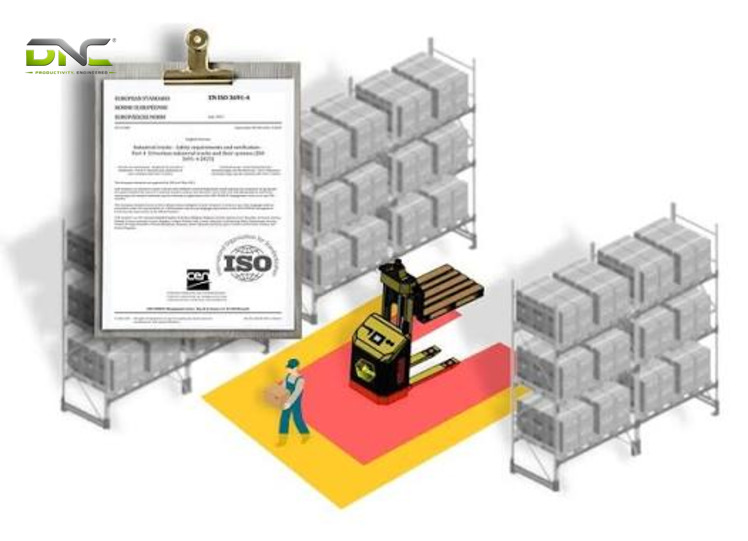
The Transfer Station: Where AGV Safety Is Decided
Summary: What the Standards Require of the Vehicle and the Site
AGV safety under ISO 3691-4:2023 and ANSI/ITSDF B56.5 is divided between the vehicle and the site. On the vehicle side, safety laser scanners slow the AGV in the warning field and stop it before contact in the protective field, and that field has to cover a stop zone of stopping distance times vehicle width including payload. On the site side, B56.5 caps speed at 1.2 m/s in hazard zones and 0.3 m/s in restricted areas, and counts 0.5 m of clearance as an escape route. ISO 3691-4 leaves towed trailers, power sources and laser radiation outside its scope, and hands operating-zone preparation to Annex A.
The transfer station is where the two sides meet and where the vehicle’s own protection is weakest. How reliable each safety function has to be is set by a separate method.
Risk Assessment, Performance Levels and Verification
AGV risk assessment under ISO 3691-4 is a formal, documented hazard analysis aligned with ISO 12100, and it comes before any safety measure is specified. The analysis identifies each hazard, estimates the severity and likelihood of harm, and sets the protective measure that lowers each risk to an acceptable level. For AGV routes, the recurring hazard categories are collisions with people or fixed structures, tip-overs from speed on turns or uneven floors, dropped loads, and entrapment between the vehicle and fixed objects.
The result of the risk assessment is a required Performance Level for each safety function under ISO 13849-1, on a scale from PL a to PL e. One navigation supplier’s published FAQ states that PL d is the industry-standard level AGV manufacturers are required to reach for safety programming. The functions that carry the rating include the emergency stop, the protective-field stop, speed limiting and the switching of field sets between layout segments. An emergency stop also has to stay latched. Both standards require human intervention to restart after an e-stop, with no automatic restart.
Test methods govern the next step, checking that the stop works. B56.5 and the older European standard EN 1525 test non-contact sensing with cylindrical test pieces of 70 mm × 400 mm (2.76 × 15.7 in) and 200 mm × 600 mm (7.87 × 23.6 in), and B56.5 adds a 0.5 m square flat panel, detected with the vehicle static, at half speed and at full speed. The same research points out that these shapes represent only portions of a human body, and that allowable bumper forces differ between B56.5 and the European standard. One AGV maker’s compliance checklist asks for obstacle detection and automatic stopping to be validated at maximum operating speed and with maximum payload, which are the two conditions that make the stop zone longest. A test certificate therefore proves detection of the test piece. It does not prove detection of a crouching worker in a transfer station, which is why the station itself is part of the verification.
The duty to re-check does not end at commissioning either, and part of it passes from the maker to the people who run the fleet.

Risk Assessment, Performance Levels and Verification
AGV Safety Responsibilities: Manufacturer, Integrator and Plant
AGV safety responsibilities are shared by three parties: the vehicle manufacturer, the system integrator and the plant that operates the fleet. B56.5 defines safety as a property of the whole system — the vehicle, its control system, the facility and the people in it — and ISO 3691-4 does the same by splitting vehicle requirements from operating-zone preparation. A common assumption is that a compliant vehicle makes a compliant installation. It does not. The division of duties that follows from both standards is shown below.
| Party | Owns | Evidence to ask for |
| Manufacturer | Vehicle design, sensing, braking, Performance Level of safety functions | Declaration of conformity naming the ISO 3691-4 edition; PL per function; test reports |
| Integrator | Operating zone, transfer stations, field sets per segment, interlocks with fixed machines, site risk assessment | Route layout with zone speeds, clearance drawings, interlock logic, validation record |
| Plant | Training, markings, maintenance, change control | Training records, marked aisles, maintenance log, updated risk assessment |
The plant’s duties are the ones most often dropped after commissioning. Every person who walks near the route needs training in guidepaths, hazard zones and alarm signals, not only the fleet operators. Blind corners need audible or visual alarms, and mirrors are recommended there. The risk assessment has to be updated whenever a route, a payload or the layout changes. B56.5 clause 4.2.1 adds a hard limit: no modification that affects the capacity, stability or safe operation of the vehicle without the prior written approval of the system supplier.
Changes to the load, its position, the floor surface or even battery weight alter stopping distance, so a new product on an existing route is a change in the safety sense.
For Malaysian manufacturers adding AGVs under the automation push of NIMP 2030, the useful order is the one the standards imply: name the edition, assess the risk, design the transfer stations, then choose the vehicle. When DNC specifies an end-of-line route, the transfer stations and their interlocks are drawn before any vehicle is quoted. Four practical questions follow from that order — on editions, fields, speeds and tuggers — and they are answered below.
Frequently Asked Questions About AGV Safety
These questions about AGV safety come up once a plant starts comparing supplier declarations, drawing the route and deciding which zones and transfer stations need restricted speed.
Is ISO 3691-4 compliance required for an AGV?
ISO 3691-4 compliance is voluntary in itself and becomes binding where a regulation or a contract references it, as CE marking does in the European Union. It is the standard most AGV and AMR suppliers declare against, so writing it into the purchase order, with its edition year, makes the supplier’s declaration checkable.
What is the difference between a warning field and a protective field?
A warning field is the outer scanner zone that makes the AGV slow down when an object enters it. A protective field is the inner zone that stops the vehicle before contact. The protective field has to cover the vehicle’s stop zone, so it grows with speed and payload.
What speed limits apply to AGVs near people?
ANSI/ITSDF B56.5-2019 limits AGVs to 1.2 m/s (2.68 mph) in hazard zones with inadequate clearance and 0.3 m/s (0.67 mph) in restricted areas with no escape route. Where the guidepath keeps 0.5 m (19.7 in) of clearance, speed is set by the vehicle’s stopping performance.
Does ISO 3691-4 cover AMRs and tugger trains?
ISO 3691-4 covers autonomous mobile robots and tunnel tuggers by name. It does not contain safety requirements for trailers towed behind a truck, so the carts in a tugger train need their own risk assessment.
________________________________________
AGV safety is specified in the same order the standards divide it: the edition and Performance Levels for the vehicle, the speed zones and clearances for the route, and the interlocks and guarding for each transfer station. DNC Automation designs the stations on both sides of the hand-over, so the vehicle’s safety case and the line’s safety case end up as one — to review the transfer stations on your own line, speak with a DNC engineer.
- 3 views
- 0 Comment
Recent Comments