


AGV Pallet Transport at End of Line: Palletizer → Stretch Wrapper → Dock
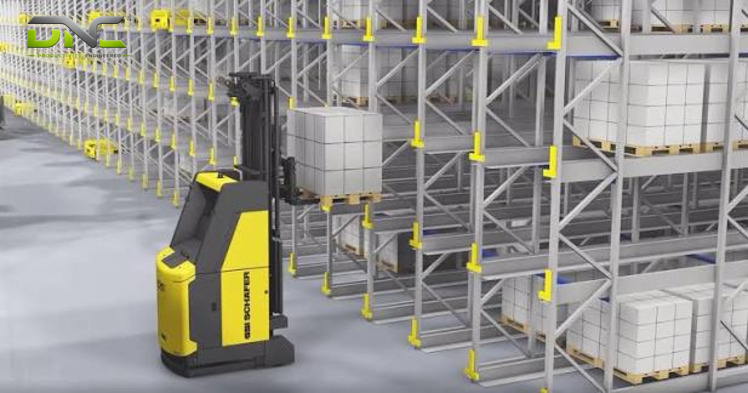
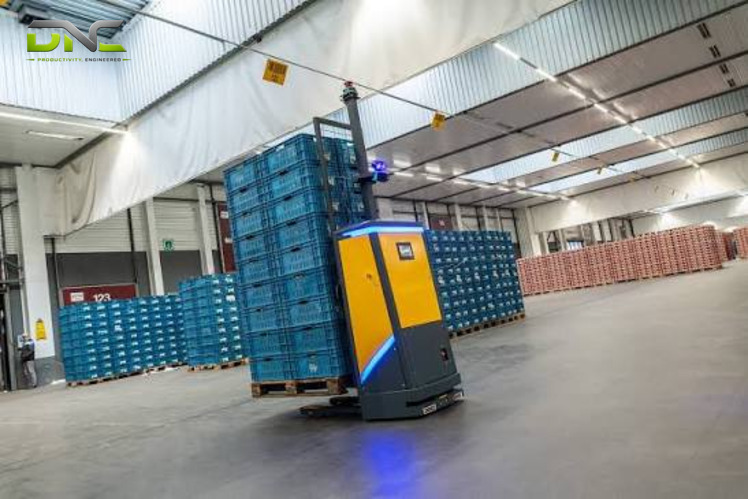
AGV pallet transport at the end of a production line moves finished unit loads without a driver, from the palletizer outfeed through the stretch wrapper to a staging lane at the dock, on orders a fleet manager receives from the plant’s PLC, WMS or MES. The vehicle is usually a pallet truck AGV with covering forks or a forklift-type AGV that reads its position by laser against walls and fixed equipment, and it stops at each pick-up station to within about ±10 mm.
Three decisions shape an AGV pallet transport route more than the vehicle model does. The pick-up station belongs after the stretch wrapper, because every protective stop is a horizontal deceleration on the load. The fleet size follows the pallet interval of the line, not the vehicle’s top speed. And the route ends at a flat staging lane, because published slope limits keep most pallet AGVs off the dock leveler.
AGV Pallet Transport: What a Pallet AGV Does at the End of the Line
AGV pallet transport is the automated movement of palletised goods between fixed stations by a driverless vehicle that picks up, carries and sets down each pallet without an operator. In an end-of-line layout those stations are known before the first pallet is built: the palletizing cell outfeed, the stretch wrapper, buffer positions, and a staging lane beside the dock. Builders design pallet AGVs for exactly this — repeated A-to-B transport between dedicated pick-up and drop-off stations.
The four vehicle forms that AGV builders publish are listed below, each suited to a different job between the palletizer and the dock.
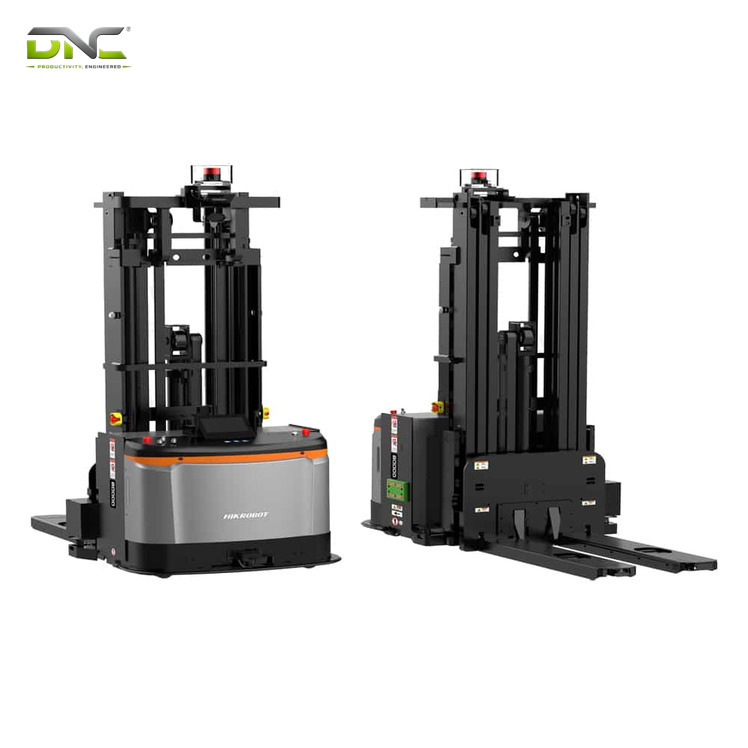
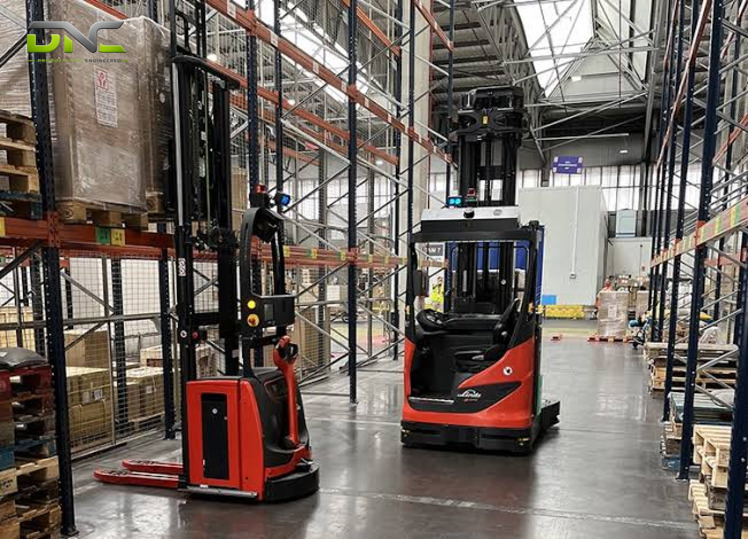
- Pallet truck AGV with covering forks— lowered, the fork arms sit over the vehicle’s rear wheels, which gives it the footprint of an electric pallet truck. One end-of-line machine builder’s model carries up to 1,500 kg (3,307 lb) and lifts its forks 675 mm (26.6 in) from the floor.
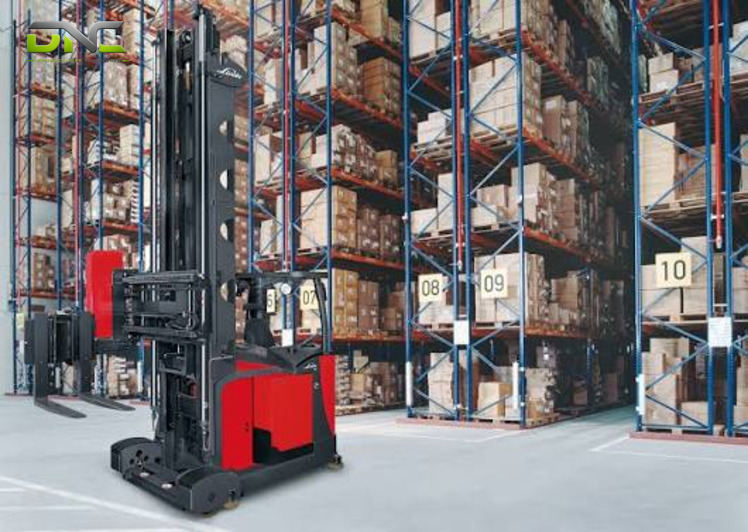
- Forklift or stacker AGV— lifts pallets to conveyor or rack height; one builder’s forklift mobile robot handles 1,500 kg at 1.6-4 m (5.2-13.1 ft).
- Counterbalanced and straddle AGVs— for heavier loads; one intralogistics integrator lists standard forklift AGVs up to 2,500 kg (5,512 lb) and customised vehicles up to 10,000 kg (22,046 lb).
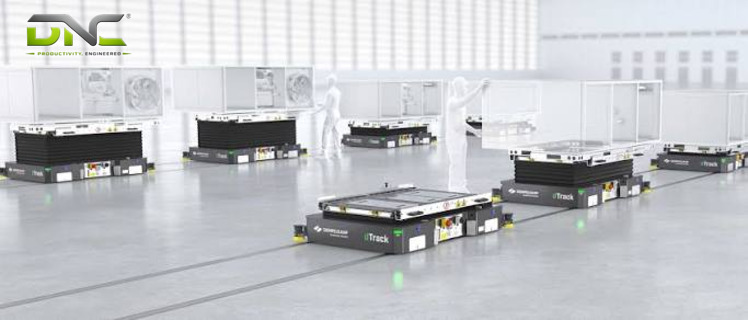
- Conveyor-top or platform AGVs— receive the pallet by roller transfer instead of forks, docking against the end of a conveyor.
DNC Automation supplies both ends of that range. Its AGV and AMR range pairs a self-developed navigation system with its own AGV motion controller for positioning accuracy of ±10 mm or ±5 mm (±0.39 in or ±0.20 in). Its unmanned forklift series, from the DNC-EBY15 to the DNC-EF-H1600, converts electric forklifts with a control box, laser, mechanical and photoelectric anti-collision, and a dispatching system linked to MES or WMS. For a Malaysian plant short of forklift drivers, either vehicle is only as useful as the stations on each side of it.
What a Pallet AGV Does at the End of the Line
The End-of-Line Sequence From Palletizer to Dock
The end-of-line sequence that AGV pallet transport serves runs in a fixed order: palletizer, pallet conveyor, stretch wrapper, outfeed conveyor, AGV pick-up, staging lane, dock. Each station hands the next one a pallet in a different state, and the AGV is specified from the state it receives, not from the catalogue. The table below lists what each station does to the pallet and what the vehicle needs from it.
| Station | What happens to the pallet | What the AGV needs from this station |
| Palletizer | Cases or bags stacked to a pattern program | Nothing — the vehicle never enters the cell |
| Pallet conveyor | Stack moved to the wrapper; queued pallets held | A defined transfer point, if a conveyor-top AGV is used |
| Stretch wrapper | Film applied with base wrap and containment force | A contained unit load |
| Outfeed conveyor | Wrapped pallets held in positions | A fixed pick-up position and a “pallet present” signal |
| AGV pick-up | Forks enter the pallet openings | Open-bottom pallet, repeatable pallet position |
| Staging lane | Pallet set down beside the dock door | Flat floor, lane assigned by the WMS |
| Dock | Pallet loaded onto the truck | Hand-over to the loading operator |
When the palletizer is a robotic palletizing cell, its pattern program fixes the footprint, height and weight of every pallet the AGV will carry, so the vehicle’s load capacity is read off the palletizer specification. One pallet AGV builder describes the handover in the same order — the vehicle waits at the conveyor end and picks each pallet as it arrives — and an integrator’s reference layout labels the point “production line with pallet wrapper and AGV pick-up”. Neither explains why the pick-up sits after the wrapper.
That position is not a routing convenience. It follows from what the vehicle does to the load every time it stops.
The End-of-Line Sequence From Palletizer to Dock
Why the AGV Pick-Up Point Sits After the Stretch Wrapper
The AGV pick-up point sits after the stretch wrapper because every safety stop a pallet AGV makes is a horizontal deceleration applied to the load on its forks, and only a wrapped unit load is built to hold together through it. Pallet AGV safety systems are designed to stop hard. One builder’s expert describes a front LiDAR scanner wired to safety PLCs that run separately from navigation, with the drive motors set up, in that expert’s words, “to put as much energy as possible into stopping the vehicle quickly”. Where people and forklifts cross the route, such stops are routine.
For the pallet, each stop is a dynamic horizontal acceleration — the condition EUMOS 40509:2020 uses to test the load stiffness of a palletised unit. A stack that has just left the palletizer resists it through only two things: its stacking pattern and the friction between layers. After the stretch wrapper, film with a base wrap covering at least one third of the pallet height locks the load to the pallet, and containment force — a field norm of 15-26 lb per linear inch (2.7-4.6 kg per linear cm) of load perimeter — ties the layers to each other. The wrapper turns a stack into a unit load.
Supplier pages on pallet AGVs describe the emergency stop as a feature that protects people. None of the eleven pages crawled from the Malaysian results for these searches describes the same stop as an event the load has to survive.
When DNC engineers lay out an end-of-line cell, the first AGV question is which side of the pallet wrapping machine the pick-up station sits on. A pick-up before the wrapper still works for a conveyor-top AGV on a short, fenced route with limited acceleration. That is a load-stability decision. It is not a default. Once the pick-up sits after the wrapper, the outfeed conveyor end becomes the precision interface between two machines, and its tolerances come next.
Pick-Up and Drop Stations: Pallet Type, Positioning Accuracy and Floor
A pick-up or drop station for a pallet AGV is a fixed floor position where the vehicle enters the pallet openings on every cycle, and three conditions decide whether it succeeds: the pallet type, the positioning accuracy of the vehicle, and the floor. The published requirements for each are summarised below.
| Condition | Published requirement | Source type |
| Pallet construction | Open at the bottom with entry openings; closed-bottom pallets only if raised so the wheel arms reach under | AGV builder, expert interview |
| Pallet format | EUR 800 × 1,200 mm (31.5 × 47.2 in) ideal; EUR 2 possible; non-standard sizes need vehicle adjustment | Datasheet, expert interview |
| Positioning accuracy | ±10 mm (±0.39 in) | End-of-line builder datasheet; DNC ±10 mm / ±5 mm |
| Slope | Maximum 3° / 5% on one datasheet; no inclines above 4% in another builder’s conditions | Datasheet, expert interview |
| Floor surface | Good grip, no deformation under load, free of moisture, dirt and oil, no highly reflective surfaces | Expert interview |
| Temperature | +5 to 35 °C (41-95 °F) indoor | Integrator specification, expert interview |
Pallet format selects the vehicle before anything else. One pallet AGV builder sells a 1,200 kg (2,646 lb) model for US, UK and SEA pallets and a separate 1,400 kg (3,086 lb) model for EUR pallets. A plant exporting on EUR pallets while shipping locally on another size is therefore specifying two pick-up geometries, not one.
Positioning accuracy only helps if the pallet is where the vehicle expects it. A ±10 mm vehicle picking from a conveyor end where pallets stop in a different place each cycle is limited by the conveyor, not its navigation, so the end stop, side guides and “pallet present” sensor on the outfeed conveyor system belong to the AGV specification. Floors behave the same way. Newly coated, slippery floors affect traction and navigation, and one builder warns that warm-to-cold air swings cause condensation in the electronics — worth checking wherever a dock door opens a conditioned hall to outside air.
Station geometry decides whether one pick succeeds. How many vehicles the route needs is decided by time.
Pick-Up and Drop Stations: Pallet Type, Positioning Accuracy and Floor
Sizing a Pallet AGV Fleet Against the Pallet Interval
Pallet AGV fleet size for an end-of-line transport route equals the round-trip time of one vehicle divided by the pallet interval of the line, rounded up, plus an allowance for charging. The pallet interval is the time between two wrapped pallets arriving at the pick-up station, set by whichever of the palletizer and the wrapper is slower. The round-trip time covers travel in both directions, the pick and the drop, waiting at doors, and every stop for traffic.
Take an illustrative line, not a vendor figure: a wrapper closing one pallet every 90 seconds runs at 40 loads per hour, the bottom of the rotary arm band one wrapper source publishes. If one round trip to the staging lane takes 6 minutes, 360 ÷ 90 gives 4 vehicles fully occupied, before any charging time. Double the pallet interval and the fleet halves. Raise vehicle speed and only the travel part shrinks; door waits, pick-ups and scanner stops do not. A published top speed, such as the 1.7 m/s (6.1 km/h / 5.6 ft/s) one integrator quotes, therefore predicts fleet size poorly.
The outfeed conveyor absorbs the difference between plan and reality. Each accumulation position after the wrapper holds one pallet, so each position adds one pallet interval of tolerance before a late AGV stops the wrapper, and then the palletizer behind it. This is the same coupling logic that governs any two stations on a line: the buffer between them decides how long one can wait for the other.
“Pallet truck AGVs are only as smart as the tasks they are given,” as one builder’s expert puts it. A fleet manager assigns each transport order to a vehicle, calculates the shortest path and talks to the fleet over Wi-Fi; the WMS or SCADA system sends it requests, and it triggers doors and elevators as vehicles arrive. At the end of the line the natural trigger is the conveyor PLC’s “pallet present” signal, and DNC’s scheduling system connects to MES or WMS for exactly this kind of order. The last of those missions ends at the dock.
The Dock End: Staging Lanes, Slopes and the Hand-Over to Loading
The dock end of an AGV pallet transport route is a flat staging lane where the vehicle sets each pallet down for loading, not the trailer itself, because published pallet AGV slope limits sit at a few degrees. One datasheet caps its vehicle at 3° / 5%; another builder rules out inclines above 4%. A dock leveler or ramp is an incline between the building floor and the truck bed. Its angle has to be checked against the vehicle’s rating before any AGV route crosses it, and in most layouts it rules the crossing out.
One integrator’s reference layout draws the same boundary: a “goods loading station for shipping” and a “door with transfer to AGV”. The fleet manager opens the door through an I/O signal, the vehicle sets the pallet down in the lane the WMS has assigned to that truck, and an operator-driven truck or a loading conveyor takes over. One pallet AGV builder states the operating envelope directly: indoor, on even and dry floors, above 0 °C (32 °F).
Staging lanes also give the dock its own buffer. Pallets for one truck accumulate in one lane while the previous truck is loaded, so loading speed and line output stop depending on each other minute by minute. The lane count is sized the same way as the outfeed conveyor: by how long the dock can fall behind the line before pallets have nowhere to go.
The Dock End: Staging Lanes, Slopes and the Hand-Over to Loading
Summary: The AGV Pallet Transport Route From Wrapper to Staging Lane
An AGV pallet transport route at the end of the line is specified by the stations around it rather than by the vehicle catalogue. The pick-up station sits after the stretch wrapper, because only a wrapped unit load is built for the deceleration of a protective stop. The station itself holds the pallet to the vehicle’s ±10 mm tolerance through a conveyor end stop, guides and a “pallet present” signal. Fleet size is the round-trip time divided by the pallet interval, with outfeed conveyor positions as the buffer that absorbs a late vehicle. The route ends at a flat staging lane, clear of the dock leveler.
Two questions remain once the route is drawn: the people who share it, and the investment behind it.
Safety Standards for Pallet AGVs Working Beside People
Pallet AGV safety beside people is governed by ISO 3691-4, the safety standard for driverless industrial trucks working in areas shared with people. One AGV builder’s expert treats it as the benchmark for comparing every supplier, and notes that the current revision tightens the requirements on safety features and on validating the vehicle’s automated functions.
The safety measures pallet AGV builders publish are listed below:
- Laser scanners in both travel directions, which slow the vehicle and then stop it as an obstacle comes closer.
- Fork-tip sensors, because the scanner under the load carrier is covered during a pick or a drop and has to be muted for that moment.
- Safety PLCs independent of navigation, so a navigation fault cannot suppress an emergency stop.
- Rubber bumpers and emergency stop buttonson the vehicle body.
- Virtual lanes, so pedestrians and drivers can see where the vehicle will travel; traffic between AGVs is handled by a higher-level system.
DNC’s AGVs add a 3D binocular camera to laser and mechanical anti-collision.
Equipment alone does not close the safety case, though. Builders also call for clear work agreements, marked safety zones and training for every person who meets the vehicles. Every one of these measures ends in the same event. A stop. That is why the pick-up position matters for the load as much as the scanner matters for the people.
Safety equipment is also a cost line, and it belongs in the payback calculation with everything else.
Safety Standards for Pallet AGVs Working Beside People
Payback, Commissioning Time and Service Life
Payback, commissioning time and service life of pallet AGVs each depend on how the vehicles are used, and payback depends most on the number of shifts they replace. One builder reports payback in roughly one to two years on a single 8-hour shift, sooner on 24/7 operation; another puts typical ROI at one to three years, with a two-shift example against a pallet jack operator at 20 EUR per hour breaking even in about nine months. A third claims savings of up to 60% against the annual cost of a driver-operated forklift. All of these figures are self-reported. None is a Malaysian quotation.
Commissioning time ranges widely. A stand-alone A-to-B pallet AGV can be installed in 2-3 days, according to one builder, while an integrator quotes 6-10 months from order to go-live for a designed AGV system. The gap is integration scope. A vehicle shuttling between two floor positions needs a map; an end-of-line route needs the conveyor signal, the wrapper interlock, the door I/O and the WMS lane logic as well. An AGV quoted without those interfaces is priced as a vehicle and then commissioned as a project.
Service life figures come from one builder. It puts a pallet AGV’s lifespan at around ten years, batteries at up to seven, and drive components at up to five, with regular checks on hydraulics, connections, drive, battery and sensors. Another builder schedules maintenance about twice a year for single-shift operation. Total cost of ownership therefore includes purchase price, maintenance, energy and downtime together. For Malaysian manufacturers weighing automation under NIMP 2030, that total — not the vehicle price — is the figure to set against the labour cost it replaces.
The same few questions come up once a plant starts pricing a route.
Frequently Asked Questions About AGVs for Pallets
These questions about AGVs for pallets cover pallet types, accuracy and the dock, and buyers ask them once the route from palletizer to staging lane is drawn.
What is a pallet AGV?
A pallet AGV is a driverless vehicle that lifts and carries palletised loads between fixed stations along programmed routes. Common forms are the pallet truck AGV with covering forks, the forklift or stacker AGV, and the conveyor-top AGV, which receives the pallet by roller transfer.
Do AGVs for pallets handle plastic or closed-bottom pallets?
AGVs for pallets handle both wooden and plastic pallets, provided the pallet is open at the bottom with entry openings for the forks. Closed-bottom pallets can only be transported if the station raises them high enough for the wheel arms to reach underneath.
Does AGV pallet transport replace the forklift at the dock?
AGV pallet transport usually ends at a flat staging lane beside the dock door rather than inside the truck. Published slope limits — 3° (5%) on one datasheet, 4% on another — keep most pallet AGVs off dock levelers, so loading onto the truck stays with an operator-driven truck or a loading conveyor.
How accurate is a pallet AGV at a pick-up station?
A pallet AGV positions itself at a pick-up station to within about ±10 mm (±0.39 in), and DNC’s AGVs reach ±10 mm or ±5 mm depending on the model. The station itself has to hold the pallet within the same tolerance, which is why the conveyor end stop and guides are part of the specification.
________________________________________
An end-of-line AGV route is specified from the stations around it — the wrapper that contains the load, the conveyor that buffers it and the dock that receives it. DNC Automation specifies AGV pallet transport starting from your palletizer and wrapper; to map that route for your own line, speak with a DNC engineer.
- 3 views
- 0 Comment
Recent Comments