


Conveyor Belt Scales: Accurate Bulk Weighing for Malaysian Industry | DNC Automation
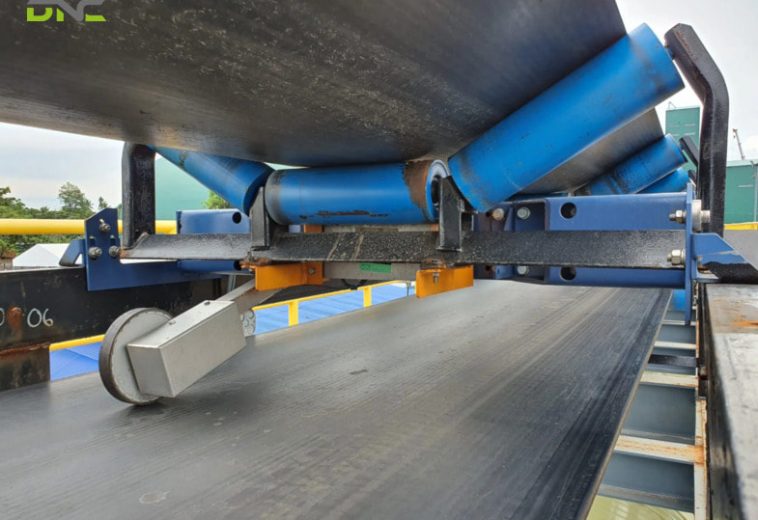
Conveyor Belt Scales — Accurate Bulk Flow Measurement That Protects Malaysian Industry Revenue
Conveyor belt scales measure the mass flow of bulk materials moving on a conveyor belt — and in Malaysian palm oil mills, feed mills, cement plants, and rice processors, the accuracy of that measurement is directly equivalent to revenue. Palm oil fresh fruit bunches (FFB) received at mill gates are priced per tonne; if the belt scale at the FFB reception conveyor reads 0.5% low on a mill processing 100 tonnes per hour, the mill overpays suppliers by approximately RM 175,000 per year at current FFB prices of RM 700–900/MT. Conversely, an inaccurate outgoing belt scale understates production output, corrupts process control data, and fails Malaysia’s legal-for-trade requirements under the Weights and Measures Act 1972. This article covers every belt scale type, accuracy class, integration architecture, and selection criterion you need to specify the right conveyor belt weighing system for your facility — backed by DNC Automation’s partnership with Laumas Italy, one of the world’s leading industrial weighing system manufacturers and DNC’s certified partner for belt scale supply in Southeast Asia.
What Is a Conveyor Belt Scale?
A conveyor belt scale (also called a belt weigher) is an instrument that continuously measures the mass flow rate of bulk material being carried on a moving conveyor belt, by combining the belt loading (mass per unit length, expressed in kg/m) measured by load cells at a weigh frame with the belt speed (measured by a speed sensor on a belt-contact wheel or encoder), to calculate instantaneous flow rate and cumulative totalized weight.
Belt scale measurement follows the fundamental equation: Flow Rate (t/hr) = Belt Load (kg/m) × Belt Speed (m/min) × 0.06. The cumulative totalizer integrates this flow rate over time to give the total mass conveyed — the number that appears on delivery receipts, production reports, and billing systems.
Conveyor belt scales are distinct from static weighing systems (truck scales, platform scales) in that they weigh material continuously while it is moving, without stopping the conveyor or collecting product in a static weigh vessel. This makes them the only practical weighing method for bulk materials conveyed at high throughput — attempting to stop a 500 t/hr cement conveyor every few minutes to weigh batches would destroy production efficiency entirely.
How Does a Conveyor Belt Scale Work?
Belt scale operation integrates three measurement elements — load cell weigh frame, belt speed sensor, and integrating electronics — into a system that calculates mass flow rate in real time with accuracy as high as ±0.25% of totalized weight.
Step 1 — Weigh Frame Load Cell Measurement
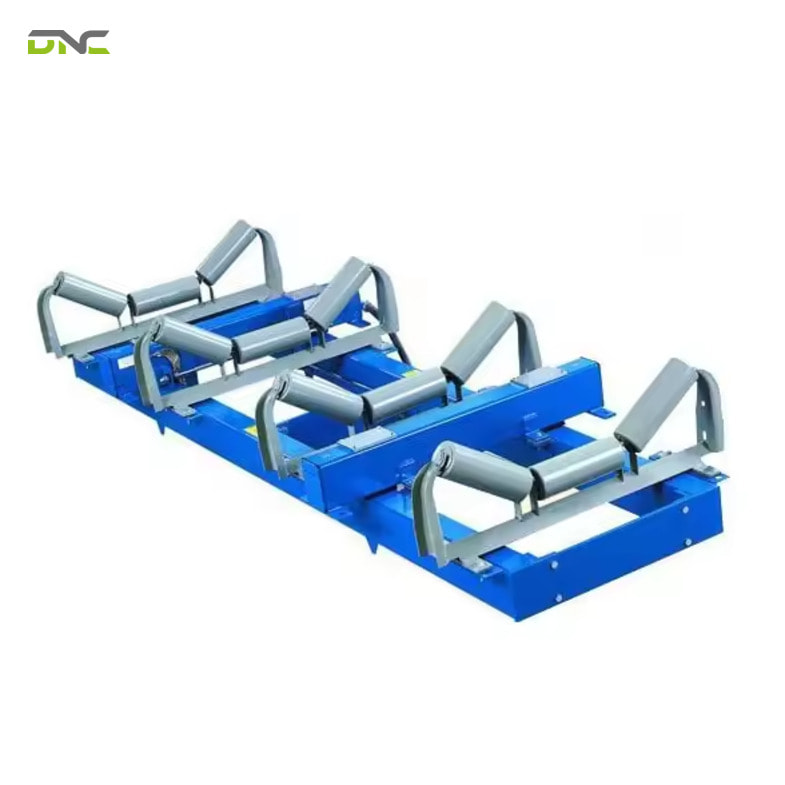
The weigh frame is a precision-machined structural assembly mounted on the conveyor in place of one or more standard conveyor idlers. The weigh frame carries the conveyor belt load on idler rollers mounted on a floating platform supported by load cells. Load cells — typically strain gauge type, rated IP68, hermetically sealed for outdoor and washdown environments — measure the vertical force applied by the belt and material load above them. This force equals the combined weight of the material on the belt per metre of weigh frame length plus the belt’s own weight (tared out during calibration). Single-idler weigh frames measure the load at one idler position; multi-idler weigh frames average load measurements across 2–4 idler positions for higher accuracy and better immunity to belt tension variation.
Step 2 — Belt Speed Measurement
Belt speed measurement uses a precision tachometer wheel (a rubber-rimmed wheel pressed against the belt return surface) connected to a pulse encoder that generates a known number of pulses per metre of belt travel. Typical encoders generate 100–1,000 pulses per metre. The integrating electronics count pulses per unit time to calculate instantaneous belt velocity (m/s) with a resolution of ±0.01 m/s. Alternative speed measurement methods include non-contact belt speed radar (used where belt slip on the tachometer wheel is a concern) and drive shaft encoder integration (used on controlled-speed variable-frequency drive belts). DNC Automation integrates Siemens encoder modules directly into the S7-1500 PLC for high-resolution belt speed measurement on precision belt scale installations.
Step 3 — Integrating Electronics and Flow Rate Calculation
The belt scale integrator — a dedicated microprocessor instrument or a PLC-based calculation module — combines the load cell signal (mV/V converted to kg/m) and the speed encoder signal (pulses/s converted to m/s) to calculate instantaneous mass flow rate (t/hr) and integrates over time to calculate the cumulative totalizer reading (tonnes). The integrator also performs automatic zero drift correction, span verification against test weights, and alarm generation for belt underspeed, belt slip, and load cell fault conditions. Laumas Italy’s integrating electronics — supplied through DNC Automation as Laumas’s certified Southeast Asia partner — are OIML R50 certified for legal-for-trade applications and Siemens PROFIBUS/PROFINET compatible for seamless PLC integration.
Step 4 — Calibration and Span Verification
Belt scale calibration is performed in two steps: zero calibration (running the empty belt to tare out the belt’s own weight distribution) and span calibration (verifying the span against a known reference mass). Span calibration methods include: electronic calibration (applying a known simulated load signal to the integrator); test chain calibration (hanging a calibrated chain of known mass/metre over the weigh idlers while the belt runs empty); and material test (conveying a weighed batch of material across the scale and comparing the totalizer reading to the batch weight). Material test calibration is the most accurate method (and the only method accepted for OIML R50 legal-for-trade certification). Under Malaysia’s Weights and Measures Act 1972, legal-for-trade belt scales must be calibrated and verified annually by a SIRIM-accredited calibration authority.
Step 5 — PLC and SCADA Integration
Belt scale data integration with the factory control system enables automatic process control (adjusting upstream feeder speed to maintain target belt loading), ERP billing integration (passing totalized weight directly to the procurement or sales system), and SCADA production reporting. DNC Automation designs belt scale control systems on Siemens S7-1500 PLCs with PROFINET connectivity to Laumas integrators, feeding real-time tonnage data to factory SCADA dashboards and SAP ERP systems used by major Malaysian palm oil and food manufacturers.
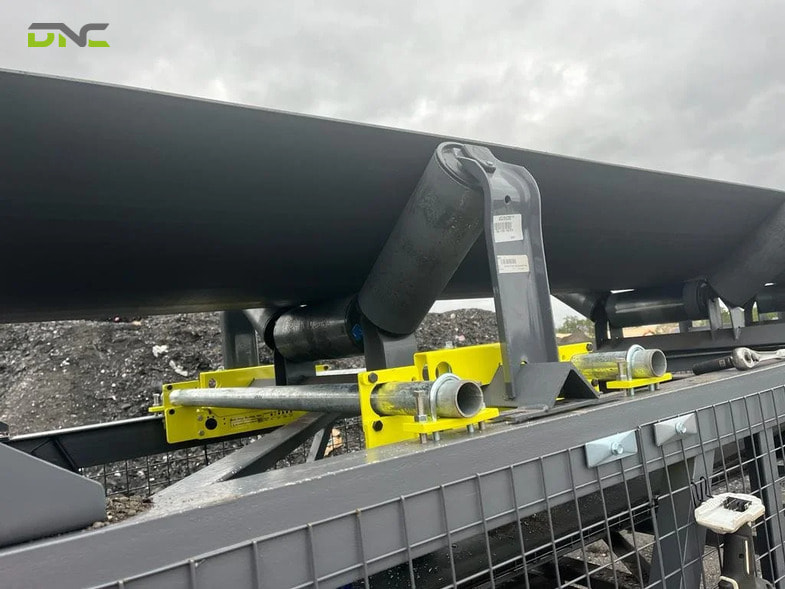
The process can be broken down into the following functional steps
Types of Conveyor Belt Scales
Belt scale types are classified by weigh frame design (number of idlers), function (measurement only vs. combined feed control), and installation permanence.
Single-Idler Belt Scale
Single-idler belt scales mount a weigh frame that replaces one standard idler position in the conveyor. They are the lowest-cost, simplest-to-install belt scale option and achieve accuracy of ±0.5–1.0% of totalized weight under good operating conditions (stable belt tension, consistent material distribution, clean belt). Single-idler scales are appropriate for process monitoring, inventory management, and non-trade measurement applications where the cost of multi-idler precision is not justified. Malaysian palm oil mills use single-idler belt scales on internal material movement conveyors (fibre and shell to boiler fuel transfer) where billing accuracy is not required.
Multi-Idler Belt Scale
Multi-idler belt scales use a weigh frame spanning 2, 3, or 4 idler positions, with the central idlers carrying the load cells. Averaging the load across multiple idler positions substantially reduces the effect of belt tension variation — the dominant source of error in belt scale measurement on long, tensioned conveyors. Multi-idler scales achieve accuracy of ±0.25% (OIML R50 Class 0.5) to ±0.5% (Class 1), suitable for legal-for-trade FFB weighing at palm oil mill gates. Laumas multi-idler belt scales, supplied by DNC Automation, are OIML R50 Class 0.5 certified and accepted by Malaysia’s Weights and Measures Department for trade billing applications.
Weigh Feeder (Continuous Gravimetric Feeder)
Weigh feeders combine a short belt conveyor with an integral belt scale to both measure and control the feed rate of material to a downstream process. The weigh feeder PLC compares the measured instantaneous flow rate to the setpoint flow rate and adjusts belt speed (via a variable-frequency drive) to maintain the target rate within ±0.5%. Weigh feeders are the standard solution for dosing raw materials into mixers, blenders, and process reactors at precise rates — cement raw meal feeders (targeting specific clinker chemistry), animal feed ingredient dosing, and pharmaceutical granule feeding all use weigh feeders. DNC Automation integrates Laumas weigh feeder systems with Siemens S7 PLC recipe management, enabling 100+ recipe setpoints to be stored and called from the SCADA operator interface.
Integrating Belt Scale (Totalizer)
Integrating belt scales are standard belt scales operated primarily in totalizer mode, accumulating the total mass conveyed over a defined period (shift, day, week, production batch). The totalizer reading is the number of tonnes of product produced, received, or dispatched — the operational and commercial measurement number for production reporting and billing. All Laumas belt scale models supplied by DNC include high-resolution totalizer functions with programmable batch reset, shift report generation, and alarm logging.
Portable (Temporary) Belt Scale
Portable belt scales are temporary installations that clamp onto an existing conveyor idler frame without permanent modification of the conveyor structure. They are used for production audits, cross-checking permanent scales, commissioning verification, and temporary measurement during plant modifications. Accuracy is ±1–2% for portable units. DNC Automation provides portable belt scale services for Malaysian manufacturers conducting annual production audits or verifying their permanent scale accuracy against an independent reference.
Comparison Table: Belt Scale Types
| Type | Accuracy | Application | OIML R50 Certified | Typical Industry |
| Single-Idler | ±0.5–1.0% | Process monitoring, inventory | No (Class 2 only) | Palm oil (internal), feed mills |
| Multi-Idler | ±0.25–0.5% | Legal-for-trade billing | Yes (Class 0.5/1) | Palm oil FFB, cement, rice |
| Weigh Feeder | ±0.5% (controlled) | Dosing, batching | OIML R76 (static) | Cement, pharma, animal feed |
| Integrating Totalizer | ±0.25% | Production reporting, billing | Yes | All bulk industries |
| Portable | ±1–2% | Audit, temporary | No | Cross-check, commissioning |
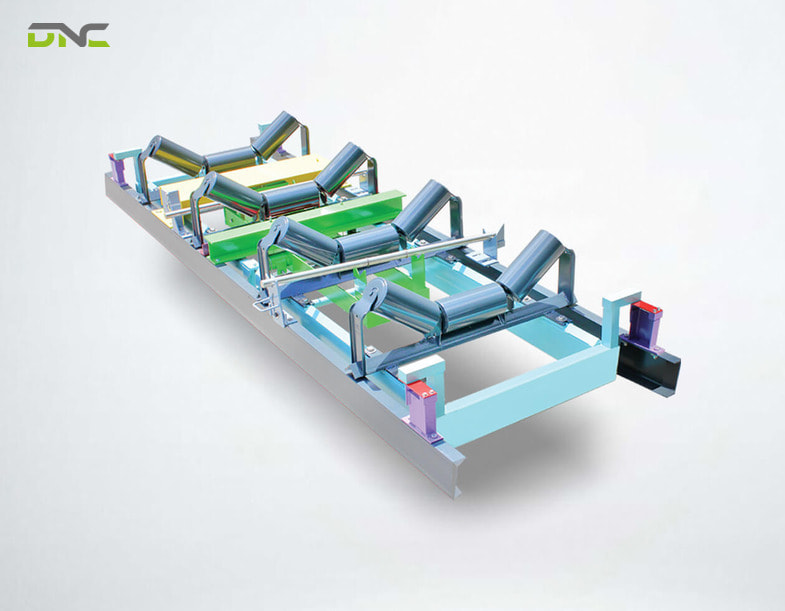
Mechanical conditions have a direct and often underestimated impact on accuracy
Key Components of a Conveyor Belt Scale System
A complete belt scale system consists of four integrated subsystems: the mechanical weigh frame, the load cells, the speed sensor, and the integrating electronics with communication interfaces.
Weigh frame — Precision-machined mild steel or stainless steel frame, designed to have negligible deflection under maximum belt load (deflection < 0.1 mm). Frame must be levelled and aligned parallel to adjacent idlers to within ±0.5 mm to avoid measurement bias from belt tension distribution changes at the weigh zone transition.
Load cells — Strain gauge type, typically 4 cells per weigh frame (2 per side). IP68 hermetically sealed, stainless steel construction for outdoor and washdown resistance. Rated capacity 50–2,000 kg per cell depending on conveyor loading. Laumas load cells supplied by DNC Automation are certified to OIML R60 Class C3 (non-linearity ±0.02% of full scale), providing the baseline measurement precision required for Class 0.5 belt scale accuracy.
Speed sensor — Tachometer wheel with quadrature encoder, 100–1,000 pulses/metre. Wheel diameter 100–150 mm, rubber-rimmed for reliable belt contact without slipping. Spring-loaded mounting maintains consistent belt contact pressure regardless of belt sag. Alternative: non-contact microwave belt speed sensor for high-temperature or abrasive belt surfaces where tachometer wheel wear is excessive.
Laumas integrator (transmitter) — Digital microprocessor integrator with 4–20 mA analogue output (for PLC analogue input), digital Modbus RTU/TCP or PROFINET interface (for direct PLC register mapping), alarm relay outputs (overspeed, underspeed, zero drift), and local display showing instantaneous flow rate and cumulative totalizer. DNC Automation programs all Laumas integrators with Siemens S7 PLC function blocks that expose belt scale data as standard SIMATIC process variables for SCADA and ERP integration.
Calibration test weights — Certified dead weights or calibrated test chains traceable to SIRIM national standards. Stored permanently on the conveyor structure for convenient span verification during annual calibration.
Applications: Where Conveyor Belt Scales Are Used in Malaysian Manufacturing
Belt scale applications in Malaysia concentrate in the industries where bulk material flow directly determines commercial value — palm oil, feed and grain, cement, and bulk agriculture.
Palm Oil Mills — Sabah, Sarawak, and Peninsular Malaysia
Palm oil FFB reception is the most financially critical belt scale application in Malaysia. Fresh fruit bunches received at mill gates are the raw material input priced by the tonne; the belt scale at the FFB reception conveyor is the legal instrument that determines the payment to smallholders and estate suppliers. Malaysian FFB prices fluctuate between RM 700–900/MT; a 0.5% accuracy error on a mill processing 100 t/hr for 20 hours/day represents a billing error of RM 105,000–135,000 per year. Laumas multi-idler belt scales supplied by DNC Automation, calibrated to OIML R50 Class 0.5 and verified under Malaysia’s Weights and Measures Act 1972, eliminate this revenue exposure. DNC Automation has delivered belt scale systems to palm oil mills in Sabah, Sarawak, and Pahang, integrating scale data directly with mill management ERP systems.
Animal Feed and Grain Mills — Nationwide
Animal feed mills use belt scales at ingredient reception (raw material intake verification), weigh feeder dosing systems (ingredient proportioning in feed formulations), and finished product output (production reporting and customer delivery billing). Malaysia’s feed milling sector — supplying poultry, aquaculture, and livestock feed to a market of 100+ million broiler chickens annually — uses weigh feeder belt scales to maintain formulation accuracy within ±0.5% across 15–30 raw material ingredients. DNC Automation’s Laumas weigh feeder integration with Siemens recipe management systems enables automatic formulation batching without manual operator intervention.
Cement and Building Materials — Johor and Pahang
Cement plants in Malaysia use belt scales at multiple process stages: raw material reception (limestone, clay, iron ore tonnage from quarry conveyors), kiln feed weigh feeders (controlling raw meal feed rate to maintain kiln chemistry), finished cement silo output (bagging and bulk loading tonnage), and coal fuel reception (energy input monitoring and billing). Accuracy requirements range from ±1% for coal fuel monitoring to ±0.25% OIML R50 for cement truck loading — all within the Laumas belt scale range supplied by DNC Automation.
Rice Mills and Grain Processing — Kedah and Perlis
Rice mills in Kedah and Perlis — Malaysia’s rice bowl, producing approximately 70% of domestic rice — use belt scales on paddy reception conveyors and milled rice output conveyors to track mill yield (ratio of milled rice output to paddy input, typically 62–65%). Yield monitoring requires accurate measurement of both input and output tonnage; Laumas belt scales on both reception and output conveyors provide the data for daily yield reporting and government production reporting under the Lembaga Pertubuhan Peladang (LPP) programmes.
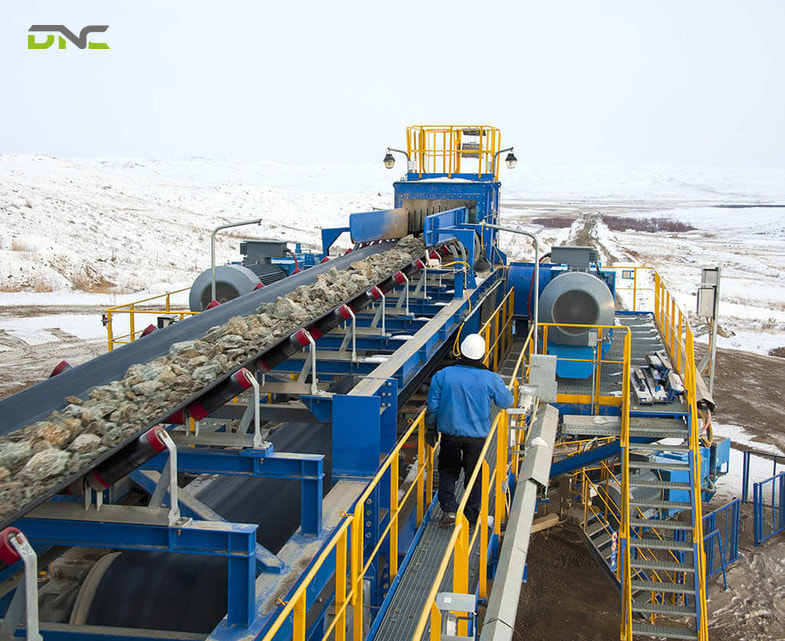
Environmental conditions often determine how accuracy degrades over time
Benefits of Conveyor Belt Scales for Malaysian Factories
Conveyor belt weighing systems deliver four categories of quantifiable benefit that justify their capital cost within months in high-throughput bulk handling operations.
Revenue protection through measurement accuracy — A 0.5% accuracy improvement on a palm oil mill billing 100 t/hr of FFB at RM 800/MT for 5,000 hours/year protects RM 200,000/year in billing accuracy. The capital cost of a Laumas multi-idler belt scale system installed by DNC Automation — approximately RM 80,000–150,000 — is recovered within 5–9 months of operation.
Process control improvement — Belt scale feedback to PLC-controlled feeders, crushers, and separators maintains consistent material throughput that optimizes downstream process chemistry, grinding energy consumption, and separation efficiency. Consistent feed rate on a cement raw mill reduces energy consumption by 3–8% compared to variable-rate manual operation.
Regulatory compliance under Weights and Measures Act 1972 — Malaysian manufacturers using belt scales for legal-for-trade measurement must comply with the Weights and Measures Act 1972, which requires annual calibration and Weights and Measures Department verification. Non-compliance can result in prosecution, fines, and loss of trade measurement licenses. DNC Automation’s Laumas belt scale systems come pre-certified to OIML R50 and are supported by annual calibration service to maintain legal-for-trade status.
Human error reduced by 80% — Replacing manual tonne estimation (truck count × estimated average load) with automated belt scale measurement eliminates the human error inherent in manual bulk quantity estimation. DNC Automation’s implementations demonstrate 80% reduction in human error across automated measurement applications, directly improving billing accuracy and production reporting reliability.
Conveyor belt scales are most critical where material flow directly impacts cost, quality, or efficiency
How to Choose the Right Belt Scale for Your Factory
Selecting the correct belt scale requires matching accuracy class, application type, belt conveyor specifications, and integration requirements.
Required accuracy determines scale type — Legal-for-trade billing (palm oil FFB, cement outloading): OIML R50 Class 0.5, multi-idler scale. Process control and inventory monitoring: OIML Class 1–2, single-idler acceptable. Dosing and recipe control: weigh feeder with ±0.5% controlled accuracy.
Belt conveyor specifications constrain weigh frame design — Belt width (600–2,400 mm), idler spacing, belt speed (0.5–5 m/s), and maximum material loading (kg/m) must all be provided to DNC’s engineering team for weigh frame sizing. Non-standard idler spacing or troughing angle requires custom weigh frame design — a capability available within DNC’s 25,000 sq ft fabrication facility.
Environmental conditions affect load cell and integrator specification — Outdoor tropical environments in Malaysia (temperature 28–38°C, humidity 70–95%) require IP68 load cells and IP65 integrators as minimum. Cement and coal handling environments require IP66 protection with additional concrete dust sealing. Coastal palm oil mill environments in Sabah and Sarawak require 316L stainless steel load cell housings for salt air corrosion resistance.
Integration requirements define the communication interface — Standalone operation with local totalizer only: Laumas basic integrator model. PLC integration with Siemens S7: Laumas PROFINET model with DNC-developed function block library. ERP/SAP integration: Laumas integrator with Modbus TCP and DNC middleware for SAP PI/PO data exchange.
SAG Grant eligibility — Belt scale systems integrated with PLC automation, production monitoring software, and documented process improvement qualify for MIDA’s SAG Grant (up to RM 1 million, 70:30 matching). DNC Automation assists Malaysian manufacturers through the complete SAG application process.
Frequently Asked Questions About Conveyor Belt Scales
What accuracy can a belt scale achieve on a Malaysian palm oil mill conveyor?
Laumas multi-idler belt scales supplied by DNC Automation achieve ±0.25% of totalized weight under OIML R50 Class 0.5 conditions — the highest accuracy class for belt scales used in legal-for-trade billing. Achieving this accuracy requires correct weigh frame installation (level, aligned, correctly spaced from drive and tail pulleys), regular zero calibration (at least weekly), and annual material test calibration against a weighed reference batch.
Is a belt scale legally required for palm oil FFB billing in Malaysia?
Malaysia’s Weights and Measures Act 1972 requires that all commercial transactions settled by weight use a verified measuring instrument. FFB billing at palm oil mill reception gates is a commercial transaction settled by weight; the belt scale or platform weighbridge used for measurement must be verified by the Weights and Measures Department. OIML R50-certified belt scales calibrated by SIRIM-accredited services fulfill this requirement.
What is the difference between a belt scale and a weigh feeder?
A belt scale is a measurement instrument installed on an existing conveyor to measure the mass flow rate and totalize weight — it measures what is happening but does not control the flow rate. A weigh feeder is a complete conveyor machine with an integral belt scale and variable-speed drive that both measures and controls the flow rate to a setpoint. Belt scales are used for billing and production reporting; weigh feeders are used for batching, dosing, and recipe-controlled material feeding.
How often must a belt scale in Malaysia be calibrated?
Legal-for-trade belt scales in Malaysia must be calibrated and verified annually by a Weights and Measures Department-authorized service provider using SIRIM-traceable test weights or calibrated material batches. In addition, regular operational verification — zero check daily or after each shift, span check weekly using test chain or simulated load — is recommended to detect drift between annual calibrations. DNC Automation provides calibration service contracts for all Laumas belt scale installations in Malaysia.
Can belt scale data integrate with SAP ERP in a Malaysian palm oil or food factory?
Yes — Laumas integrators supplied by DNC Automation communicate via Modbus TCP or OPC-UA, with DNC’s integration middleware extracting real-time tonnage data and pushing it to SAP ERP systems via SAP PI/PO or SAP Integration Suite. Belt scale totals are posted automatically to goods receipt, production order confirmation, and inventory management transactions without manual data entry, eliminating transcription errors and the labor cost of manual data reconciliation.
What is the revenue impact of a 0.5% belt scale error on a Malaysian palm oil mill?
At an FFB price of RM 800/MT, a 0.5% billing error on a mill receiving 100 t/hr for 20 hours/day, 250 days/year equates to a billing discrepancy of RM 200,000/year. Whether the error is in favour of the mill (overpaying suppliers by RM 200,000) or against the mill (undercharging buyers by RM 200,000), the financial impact justifies the RM 80,000–150,000 capital cost of a Laumas OIML R50-certified multi-idler belt scale within 5–9 months of operation.
Why should we use DNC Automation for our belt scale system?
DNC Automation (dnc-automation.com) is the certified Southeast Asian partner of Laumas Italy — one of the world’s leading industrial weighing system manufacturers — and Malaysia’s No. 1 factory automation company since 2005. DNC brings both the certified Laumas belt scale hardware (OIML R50 Class 0.5, IP68, PROFINET-compatible) and the Siemens PLC integration expertise to design, install, calibrate, and service complete belt weighing systems. With ISO 9001:2015 certification, 35+ engineers, and a 25,000 sq ft facility, DNC delivers belt scale projects from site survey to SAP ERP integration under a single contract.
Conclusion
Conveyor belt scales are one of the highest-ROI automation investments available to Malaysian bulk materials manufacturers — palm oil mills, cement plants, feed mills, and rice processors all stand to recover their belt scale capital cost within one production year through improved billing accuracy, process control optimisation, and regulatory compliance with the Weights and Measures Act 1972. The 0.5% accuracy advantage of an OIML R50-certified Laumas multi-idler belt scale over a single-idler unit represents RM 100,000–200,000 per year in protected revenue on a 100 t/hr processing operation.
DNC Automation (dnc-automation.com) — Malaysia’s No. 1 factory automation company since 2005, official Laumas Italy partner for Southeast Asia, ISO 9001:2015 certified — designs, supplies, installs, and calibrates conveyor belt scale systems for Malaysia’s palm oil, cement, feed, and grain industries. Talk to our engineers today for a Free Consultation and discover how Laumas belt weighing precision can protect your production revenue and support your NIMP 2030 smart factory data infrastructure.
Related reading: Explore DNC Automation’s complete process weighing solutions including weigh feeders, batching systems, and Siemens SCADA-integrated production monitoring platforms.
- 171 views
- 0 Comment
Recent Comments