

Shuttle Conveyor: Complete Guide for Malaysian Warehouses and Factories
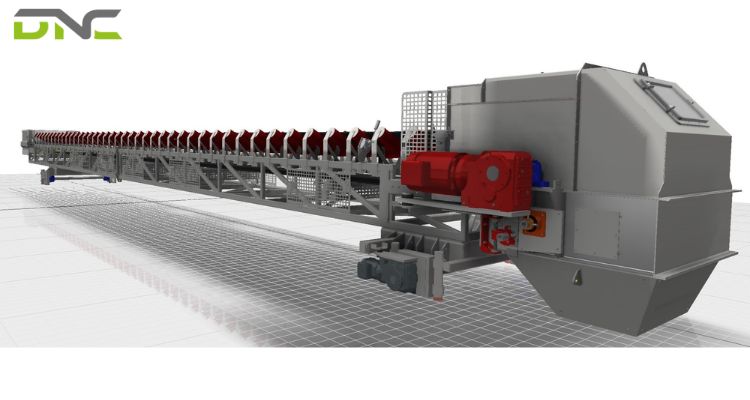
Pos Malaysia processes over 1 million parcels per day through its distribution network — a confirmed DNC Automation client operation where each parcel must be routed from a central sort conveyor to one of 200+ delivery routes without manual handling. E-commerce growth driven by Shopee and Lazada’s boom in Shah Alam, Bukit Raja, and Johor has increased Malaysian parcel volumes by 180% since 2020, making automated multi-destination routing the defining infrastructure challenge for logistics operators. Shuttle conveyors solve this challenge precisely: a shuttle conveyor is a conveyor carriage that travels back and forth on a fixed rail, delivering product from a single infeed point to any of 2 to 20+ programmable outfeed positions at throughput rates up to 2,400 cases per hour, with position accuracy of ±5 mm and fully automated PLC control. DNC Automation — Malaysia’s Top #1 Factory Automation Company since 2005, ISO 9001:2015 certified, official Southeast Asia partner for Comau Italy — engineers, supplies, and integrates shuttle conveyor systems with Siemens SIMATIC PLC control and Comau robotic palletizing for the full logistics and manufacturing automation scope. This guide covers every shuttle conveyor type, specification, application, and selection consideration for Malaysian operators.
What Is a Shuttle Conveyor?
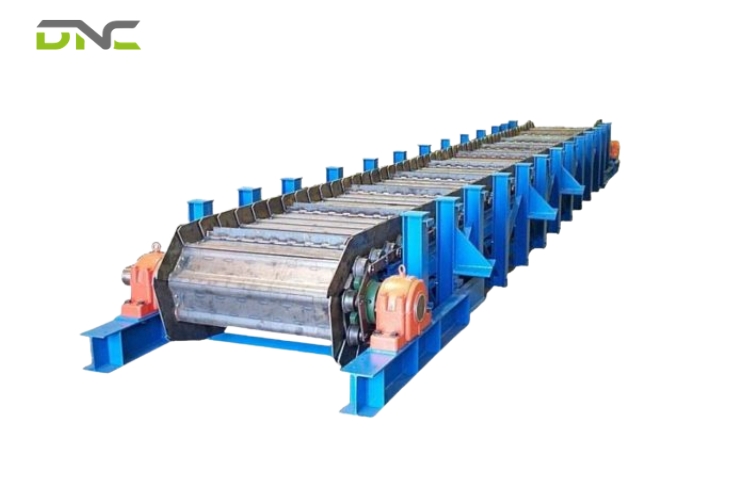
A shuttle conveyor is a mobile conveyor carriage mounted on a fixed overhead or floor-level rail track that reciprocates — travels back and forth — between a fixed infeed position and one of multiple selectable outfeed positions, delivering product from a single input source to multiple output destinations. The term “reciprocating conveyor” is used interchangeably with shuttle conveyor in engineering specifications.
Shuttle conveyors differ fundamentally from sorting conveyors (diverters, shoe sorters) in their operating principle: a diverter keeps the main conveyor stationary and deflects individual products sideways as they pass; a shuttle conveyor moves the entire carriage assembly to position its built-in transport surface opposite the target outfeed, then transfers product directly into that outfeed. This distinction makes shuttle conveyors superior for applications requiring very high per-destination throughput concentration, for handling products that diverter mechanisms cannot deflect reliably (irregular shapes, very heavy loads, fragile items), and for configurations where outfeed lanes are separated by distances too large for practical diverter arm reach.
How Does a Shuttle Conveyor Work?
Shuttle conveyor operation integrates mechanical positioning, product detection, and programmable PLC control to achieve automated multi-destination routing without human intervention.
Step 1 — Product Identification at Infeed
Products arriving at the shuttle conveyor infeed are scanned by a barcode reader, RFID antenna, or weight sensor integrated into the infeed conveyor. The scan data is transmitted to the shuttle conveyor PLC (Siemens SIMATIC S7 in DNC Automation installations) which queries the Warehouse Control System (WCS) or MES to retrieve the destination assignment for that product. Destination assignment may be based on product SKU, weight, customer order number, delivery route code, or production batch ID.
Step 2 — Shuttle Carriage Positioning
The shuttle carriage — carrying a short belt, roller, or chain conveyor section — accelerates from its current position along the rail toward the target outfeed position. Travel speed reaches up to 3 m/s for high-throughput warehouse applications, with controlled deceleration profiles preventing product sliding during stopping. Carriage position is tracked by a linear encoder (absolute or incremental) mounted on the carriage or rail, providing ±5 mm positioning accuracy. For installations with 10–20 outfeed positions spanning 20–40 meters of rail, accurate positioning requires servo motor drive rather than standard variable-frequency drive.
Step 3 — Carriage Docking and Transfer
At the target outfeed position, the shuttle carriage decelerates to a precise stop position. Mechanical docking pins or proximity sensor confirmation verifies carriage alignment with the outfeed conveyor before the transfer sequence initiates. The shuttle carriage’s built-in conveyor belt or rollers activate to transfer the product from the carriage surface onto the outfeed conveyor. Transfer time is typically 1.5–4 seconds depending on product size, weight, and conveyor speed.
Step 4 — Return Positioning and Next Assignment
After product transfer confirmation (photoelectric sensor at outfeed conveyor confirms product received), the shuttle carriage accelerates toward the next assigned position. The PLC calculates the optimal next position based on the queue of arriving products — if products are arriving at the infeed in a known sequence, the PLC pre-positions the carriage to minimize travel distance and maximize throughput. This pre-positioning logic is programmed by DNC Automation engineers to match each client’s product flow characteristics.
Step 5 — Continuous Throughput Optimization
At full operational throughput, shuttle conveyors operating with pre-positioning logic achieve 2,000–2,400 cases per hour at 10 destination positions by minimizing carriage travel between consecutive transfers. Without pre-positioning — if the carriage always returns to a home position between transfers — throughput drops to 800–1,200 cases per hour for the same physical installation. DNC Automation’s Siemens PLC programming includes pre-positioning algorithms developed from operational experience at Pos Malaysia and Johor logistics hub installations.
Step 6 — Error Detection and Recovery
Product jam detection at outfeed conveyors, carriage overrun detection, and encoder fault monitoring are all managed by the shuttle PLC. On detection of a fault condition, the carriage stops at a safe position, the PLC logs the fault event with timestamp, and an alarm is sent to the Siemens SCADA monitoring system. DNC Automation’s 24/7 support contract allows remote fault diagnosis via SCADA data access, resolving 60–70% of shuttle conveyor fault events without site visit.
Types of Shuttle Conveyor
Five shuttle conveyor configurations address different load capacities, facility layouts, and application requirements. Selecting the wrong configuration causes under-performance, excessive maintenance, or installation impracticality.
1. Fixed-Frame Shuttle Conveyor (Standard Floor or Overhead Rail)
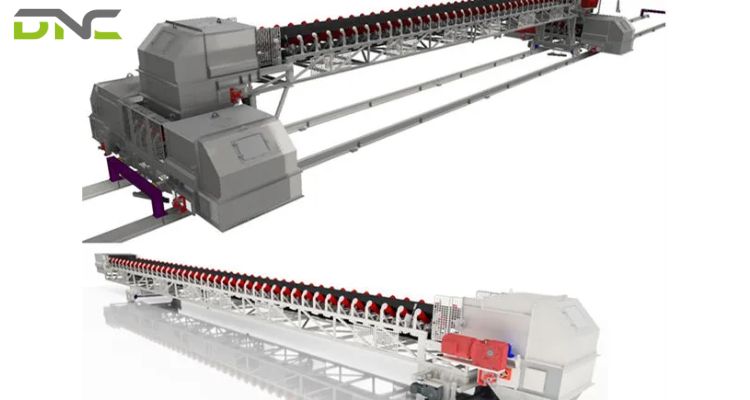
Fixed-frame shuttle conveyors mount the carriage on a rigid overhead gantry or floor-level frame rail, with the carriage traveling on precision guide rails or a rack-and-pinion drive system. Fixed-frame configurations are the most common shuttle conveyor installation in Malaysian manufacturing — used for packaging machine feeding (one production line feeding 4–6 packaging machines), cold storage lane distribution, and food factory multi-SKU routing. Load capacity ranges from 50 kg to 500 kg per carriage. DNC Automation designs and fabricates fixed-frame shuttle carriage assemblies in its 25,000 sq ft Selangor facility, custom-built to each client’s facility layout and lane spacing.
2. Mobile Self-Propelled Shuttle (Warehouse ASRS Feeder)
Mobile self-propelled shuttles travel on floor-level or elevated rack rails under their own motor power, navigating between rack aisles in automated storage and retrieval systems (ASRS). Self-propelled shuttles carry unit loads (pallets, bins, or totes) from the AS/RS infeed conveyor to specific storage rack positions and retrieve stored loads for outfeed. Travel speed reaches 3 m/s horizontally. DNC Automation integrates self-propelled shuttles with Comau Italy palletizing robots (DNC is Comau’s only official Southeast Asia partner) for turnkey ASRS systems serving Johor’s 3PL logistics hubs and cold storage facilities.
3. Boom Shuttle Conveyor (Deep-Storage Aisle Access)
Boom shuttle conveyors extend a telescoping conveyor boom from the shuttle carriage into deep storage aisles or into the back of trucks and shipping containers. The boom extends up to 5 meters from the carriage body, allowing product deposit or retrieval at distances unreachable by fixed-position conveyor systems. Boom shuttles are specified for deep-lane cold storage (halal food, palm oil derivative storage in Sabah and Sarawak), container loading/unloading operations, and high-bay warehouse ground-level ASRS systems.
4. Shuttle Car (Heavy-Duty Trackbound Vehicle)
Shuttle cars are heavy-duty track-guided vehicles designed for loads from 1,000 kg to 5,000 kg — carrying automotive body panels, steel coils, or industrial equipment between process stations. Shuttle cars in automotive assembly environments (Selangor Toyota plant) transport sub-assembled vehicle components between welding, painting, and trim assembly stations on floor-embedded or elevated track systems. Load capacity distinguishes shuttle cars from standard shuttle conveyors — automotive shuttle cars may carry full vehicle bodies at 1,500–3,000 kg.
5. Horizontal Carriage Shuttle (Pallet Distribution)
Horizontal carriage shuttles distribute pallets from a central induction conveyor to multiple parallel conveyor lanes — used at the end of manufacturing lines where palletized goods are routed to specific lanes for truck loading, stretch wrapping, labeling, or storage. Pallet shuttle carriage specifications: 1,200×1,200 mm standard pallet compatibility, 2,000–2,270 kg load capacity, lane-to-lane travel time of 3–8 seconds, PLC-programmable lane assignment.
Shuttle Conveyor Type Comparison Table
| Type | Load Capacity | Speed | Positions | Primary Application |
| Fixed-Frame | 50–500 kg | 1–3 m/s | 2–20 | Packaging/F&B routing |
| Self-Propelled ASRS | 50–1,000 kg | 2–3 m/s | Unlimited | Warehouse ASRS |
| Boom Shuttle | 50–500 kg | 0.5–1.5 m/s | 2–10 | Deep storage, loading |
| Shuttle Car | 1,000–5,000 kg | 0.5–1.0 m/s | 2–10 | Automotive, heavy industry |
| Horizontal Pallet | 500–2,270 kg | 0.5–1.5 m/s | 2–10 | Palletized end-of-line |
Key Components of a Shuttle Conveyor System
Carriage Drive System. Shuttle carriage propulsion uses rack-and-pinion (highest precision, suitable for long travel distances), belt drive (cost-effective for shorter runs up to 15 m), or linear induction motor (LIM) for very high-speed applications. DNC Automation specifies Siemens servo drive systems for shuttle carriage positioning — achieving ±5 mm accuracy through closed-loop encoder feedback. Servo drives also provide smooth acceleration and deceleration profiles that prevent product tipping during high-speed travel.
Position Measurement System. Absolute linear encoders mounted on the shuttle rail provide carriage position feedback to the PLC in real time. Absolute encoders (versus incremental encoders) retain position data through power cycling — the shuttle PLC knows carriage position immediately upon power-up without requiring a home reference cycle. Laser distance measurement is an alternative for very long shuttle runs (over 50 m) where encoder cable management becomes impractical.
Built-In Conveyor Section. The shuttle carriage includes a short conveyor section (belt, roller, or chain-driven live roller) that transfers product onto the carriage at infeed and off the carriage at outfeed. Built-in conveyor belt speed (typically 0.3–1.5 m/s) must match the infeed and outfeed conveyor speeds to prevent product sliding or impact during transfer. DNC Automation matches carriage conveyor speed to the overall system line speed specified in the client’s production rate requirements.
PLC Control System. Siemens SIMATIC S7-1200 or S7-300 PLCs control all shuttle conveyor functions: carriage positioning, speed profiles, product detection input processing, SCADA data logging, and fault management. DNC Automation programs PLC logic using Siemens TIA Portal, integrating shuttle conveyor control with upstream and downstream conveyor systems and with client WCS/MES software via OPC-UA or Ethernet/IP communication protocols.
Safety System. Personnel safety in shuttle conveyor operating zones requires physical guarding (safety fencing), light curtains at access points, emergency stop pull-cords along the carriage travel path, and safety-rated carriage overrun detection. DNC Automation designs all shuttle conveyor safety systems to Malaysian DOSH machinery safety regulations and IEC 62061 safety integrity level (SIL) requirements.
Applications: Where Shuttle Conveyors Are Used in Malaysian Manufacturing
Parcel Distribution — Pos Malaysia
Pos Malaysia — a confirmed DNC Automation client — processes 1 million+ parcels daily through regional distribution centers in Kuala Lumpur, Shah Alam, Penang, and Johor Bahru. Shuttle conveyors route inbound sorted parcels to outfeed lanes corresponding to specific delivery routes, postmen assignments, or outbound vehicle loading bays. The NIMP 2030 target of upgrading Malaysia’s logistics infrastructure to smart factory standards (3,000 facilities) directly applies to postal and courier distribution center automation — a sector where DNC Automation has demonstrated implementation capability.
E-Commerce Warehouse Sorting — Shah Alam and Johor
Lazada and Shopee’s Malaysian logistics operations — concentrated in Shah Alam and Bukit Raja (Selangor) and Johor — sort millions of parcels per day to hundreds of outbound destinations. E-commerce parcel variety (sizes from 200g envelopes to 15 kg boxes, irregular shapes) favors shuttle conveyors over diverter mechanisms for multi-lane routing because the shuttle carriage transfers product without the lateral force that diverter arms exert on irregular packages. DNC Automation’s experience integrating shuttle systems with Siemens WCS software enables seamless order management system to conveyor control integration.
Packaging Machine Feeding — F&B Production Lines
Food and beverage production lines (F&N, Ramly Burger, Guan Chong Berhad — all DNC Automation clients) require product routing from a single upstream production conveyor to 4–8 parallel packaging machines. Without a shuttle conveyor, dedicated fixed conveyors for each packaging machine require the entire production line to stop if any packaging machine goes down. A shuttle conveyor bypasses faulted packaging machines automatically, routing production to remaining operational machines and maintaining upstream production continuity during packaging machine maintenance.
Cold Storage Multi-Lane Distribution — Halal Food
Malaysia’s halal food sector — concentrated in Selangor and extending to Johor for ASEAN export operations — requires strict product segregation between halal certification categories, production batches, and temperature zones. Shuttle conveyors distribute frozen food pallets to specific cold storage aisles based on batch code and temperature zone assignment, with full PLC traceability logging confirming every product-to-lane assignment. DNC Automation’s cold-storage shuttle conveyors use stainless steel carriage construction and IP65-rated electronics rated for -30°C cold storage environments.
ASRS Integration with Comau Palletizing Robots
DNC Automation’s unique position as Comau Italy’s only official Southeast Asia partner enables turnkey integration of shuttle conveyors with Comau palletizing robot cells. The shuttle conveyor positions pallets precisely within the Comau robot’s reach envelope (±5 mm positioning accuracy matches the robot’s pick accuracy requirement), the robot stacks product onto pallets or depalletizes incoming goods, and the shuttle conveyor routes completed pallets to outfeed lanes. This integrated system — shuttle conveyor + Comau robot + Siemens PLC/SCADA — is a DNC Automation signature solution deployed at Johor logistics facilities.
Benefits of Shuttle Conveyor Systems for Malaysian Operations
2,400 Cases Per Hour Routing Capacity Eliminates Manual Sorting Labor. Manual parcel sorting in Malaysian distribution centers requires 6–10 workers sorting 300–400 cases per hour per person. A single shuttle conveyor system with Siemens PLC control handles 2,400 cases per hour — equivalent to 6–8 manual sorters — with 99.5% routing accuracy versus 97–98% for trained human sorters. DNC Automation’s shuttle conveyor installations reduce sorting labor requirements by 80% while increasing throughput capacity by 50%.
Flexible Programmable Routing Adapts to Changing Operations. Shuttle conveyor destination assignments are fully programmable via PLC configuration updates — adding, removing, or re-assigning outfeed lanes requires a software change, not physical conveyor reconstruction. Malaysian logistics operators facing seasonal peak volumes (Raya, 11.11, 12.12 e-commerce events) reprogram shuttle systems to handle temporary peak routing configurations within hours. Fixed diverter conveyor systems require physical lane reconstruction for layout changes.
±5 mm Position Accuracy Enables Precise Handoff to Downstream Equipment. Robotic pick-and-place systems, precision weighing equipment, and barcode verification stations all require product to arrive within defined position tolerances. Shuttle conveyor ±5 mm positioning accuracy guarantees product placement within these tolerances at every destination, eliminating the 2–5% misplacement rate that causes downstream equipment faults on conveyors with less precise positioning.
SAG Grant and NIMP 2030 Alignment. Malaysia’s NIMP 2030 target of 3,000 smart factory conversions specifically includes logistics automation infrastructure. Shuttle conveyor systems integrated with Siemens SCADA, barcode scanning, and WCS software qualify as smart automation investments under MIDA’s Smart Automation Grant — up to RM 1 million per facility at 70:30 matching. DNC Automation has assisted multiple Malaysian logistics operators with SAG grant applications for shuttle conveyor system investments.
How to Choose the Right Shuttle Conveyor for Your Facility
Define Required Throughput and Number of Destinations. Shuttle conveyor throughput capacity depends on carriage travel speed, carriage positioning accuracy, transfer time, and the number of destinations. 10 destinations within a 20-meter rail span with 2-second transfer time supports approximately 1,800 cases per hour at 70% carriage utilization. 20 destinations within a 40-meter span reduces throughput to approximately 1,200 cases per hour for the same transfer time. DNC Automation performs detailed throughput simulation before system specification to confirm the shuttle conveyor design meets peak throughput requirements.
Assess Product Characteristics. Shuttle conveyors handle products that diverter mechanisms cannot — fragile items (glass bottles, electronics), irregular shapes (garment bags, polybags), very heavy products (automotive components), and products on pallets. If your product mix includes items over 30 kg or larger than 600×600 mm, shuttle conveyor is the appropriate routing mechanism; diverter arms and shoe sorters are not designed for these loads.
Evaluate Facility Layout and Aisle Width. Fixed-frame shuttle conveyors require a clear travel path of shuttle width plus 200–400 mm safety clearance on each side throughout the full carriage travel range. Overhead shuttle installations avoid floor-level aisle conflicts but require structural calculations for ceiling-mounted rail loads. DNC Automation surveys facility layouts and performs structural calculations before committing to shuttle installation configurations.
Plan for Siemens SCADA Integration. Malaysian manufacturing facilities under NIMP 2030 smart factory programs require real-time production data visibility. Siemens SIMATIC WinCC SCADA integration with the shuttle conveyor PLC provides throughput dashboards, destination utilization reports, carriage utilization rates, and fault trend analysis. DNC Automation programs Siemens SCADA integration as standard for all shuttle conveyor installations above RM 250,000 project value.
Frequently Asked Questions About Shuttle Conveyors
Q: What is the difference between a shuttle conveyor and a diverter conveyor?
A shuttle conveyor moves the carriage (with its built-in transport surface) to position opposite each target destination before transferring product. A diverter conveyor keeps the main conveyor path fixed and deflects individual products sideways using arms, shoes, or belts as they pass the divert point. Shuttle conveyors handle heavier loads, irregular shapes, and products requiring precise destination positioning; diverters provide higher throughput (up to 10,000+ items/hour for shoe sorters) for lighter, uniform product streams.
Q: How many destinations can one shuttle conveyor serve?
Standard shuttle conveyor installations serve 2–20 programmable outfeed positions within a single rail span. Shuttle systems are physically limited by carriage travel time — more destinations and longer rail spans reduce maximum throughput. For systems requiring more than 20 destinations, multiple shuttle conveyors in series (each serving 10 destinations from an intermediate sort conveyor) achieve higher total destination counts. DNC Automation has designed systems serving up to 40 destinations using cascaded shuttle conveyor configurations.
Q: What is the maintenance requirement for shuttle conveyors?
Monthly maintenance: carriage drive chain/belt tension check, linear guide lubrication, drive motor current verification, position encoder calibration check. Quarterly: safety system functional test (light curtains, emergency stops, overrun detection), carriage docking pin wear inspection, PLC battery replacement. Annual: gearbox oil change, rail straightness survey, comprehensive drive system inspection. DNC Automation provides documented maintenance schedules with all shuttle conveyor installations.
Q: Can shuttle conveyors handle pallets?
Yes — horizontal carriage shuttle conveyors are specifically designed for pallet routing. Pallet shuttle capacity ranges from 500 kg to 2,270 kg (5,000 lbs) for standard 1,200×1,200 mm pallets. Chain-driven live roller (CDLR) carriage conveyor surfaces are standard for pallet shuttles — CDLR provides positive traction on both wooden and plastic pallets without requiring the pallet to be perfectly flat.
Q: What happens if the shuttle conveyor loses power during operation?
DNC Automation designs shuttle conveyor control systems with power loss safety protocols: (1) the servo drive applies regenerative braking to bring the carriage to a controlled stop; (2) absolute encoders retain carriage position data through power cycling; (3) on power restoration, the PLC reads the encoder position and resumes operation from the known position without requiring a home reference cycle; (4) any product on the carriage at power loss is detected by the infeed sensor and re-routed to its destination after power restoration.
Q: How does Malaysia’s e-commerce growth affect shuttle conveyor demand?
Malaysian e-commerce parcel volumes grew 180% from 2020 to 2025, driven by Shopee and Lazada’s expansion. Shah Alam, Bukit Raja, and Johor Bahru have become Malaysia’s primary logistics hub clusters — all requiring automated sorting infrastructure to handle peak volumes during 11.11, 12.12, and Raya sale periods. DNC Automation’s shuttle conveyor installations at Pos Malaysia and Johor 3PL facilities demonstrate the practical application of this technology for Malaysia’s specific logistics geography.
Q: What is the typical ROI period for a shuttle conveyor investment in Malaysia?
Shuttle conveyor ROI analysis for Malaysian logistics operations: labor cost savings at RM 2,500–3,500/month per replaced sorting worker × 6–8 workers = RM 15,000–28,000/month labor savings; throughput improvement value (50% more parcels sorted per shift) varies by operation. Combined, typical Malaysian logistics shuttle conveyor installations achieve 18–36 month payback on capital investment of RM 300,000–800,000 for complete systems. SAG grant contribution of up to RM 1 million at 70:30 matching reduces client capital outlay to 30% of project cost, reducing payback to 6–12 months.
Shuttle Conveyor vs. Diverter Conveyor: Choosing the Right Routing Solution
Malaysian logistics and manufacturing engineers frequently face the selection choice between shuttle conveyors and diverter conveyors. Both route products to multiple destinations — but the correct choice depends on product type, destination count, throughput rate, and facility geometry.
Throughput Rate. Sliding shoe diverter sorters achieve 2,400 cases per hour on a continuous belt — the product never stops, the divert mechanism activates briefly as each product passes. Shuttle conveyors achieve 2,000–2,400 cases per hour only with optimized pre-positioning logic and short rail spans. For throughput above 2,400 cases per hour, diverter sorters maintain the advantage. For throughput below 1,500 cases per hour, shuttle conveyors and diverters are equally capable.
Product Weight and Shape. Diverter shoe sorters handle products up to 50 kg on flat-based products — irregular shapes, flexible polybags, and products without consistent flat bases do not sort reliably on shoe sorters. Shuttle conveyors handle any product that can rest on a belt, roller, or CDLR surface — including 2,000 kg pallets, irregular cartons, bagged goods, and products in any container shape. For heavy or irregular products, shuttle conveyors are the only automated routing option.
Destination Count and Distance. Diverter sorters place all destinations along a linear belt — destinations are separated by the minimum product length plus safety gap (typically 600–900 mm per destination). A 20-destination shoe sorter requires a 12–18 meter long sorting section. Shuttle conveyors service destinations on both sides of a rail, in two dimensions — a 20-destination shuttle conveyor may serve 10 destinations per side of a 5-meter rail span, occupying significantly less linear floor space.
Facility Layout Geometry. Diverter sorters require linear outfeed chutes or conveyors on one or both sides of the main conveyor. Shuttle conveyors deliver products perpendicular to the rail travel direction — outfeed conveyors can be on either side, at any angle, making shuttle conveyors more adaptable to irregular facility geometries where straight-line diverter layouts are impractical.
DNC Automation’s Combined Approach. Large Malaysian logistics facilities often use both: a shuttle conveyor for initial product routing to 8–10 destination zones, followed by a sliding shoe sorter within each zone for final routing to 10–20 individual delivery lanes. This two-stage approach serves 80–200 destinations with the minimum total system footprint and investment. DNC Automation designs combined shuttle-plus-diverter systems with unified Siemens PLC control — a single SCADA dashboard monitors both routing tiers simultaneously.
Shuttle Conveyor System Commissioning Protocol
DNC Automation’s shuttle conveyor commissioning protocol ensures reliable operation from day one of production:
Mechanical Commissioning (Week 1). Rail straightness survey (maximum 2 mm deviation per 10 m rail length), carriage drive chain tension calibration, position encoder calibration across full rail span, docking pin engagement force verification (minimum 200 N engagement force), and surface conveyor belt tension verification.
Electrical Commissioning (Week 2). PLC program upload and I/O verification, servo drive parameter configuration (acceleration/deceleration profiles, position controller tuning), safety system functional tests (light curtain, emergency stops, overrun detection), and SCADA communication link verification.
Performance Commissioning (Week 3). 500-transfer position accuracy test (all destinations, 3 trials each), throughput trial at 110% of design rate (stress test), carriage positioning repeatability measurement (record encoder feedback vs. actual physical position), and surface conveyor speed synchronization verification with infeed and outfeed conveyors.
Handover Documentation. DNC Automation provides as-built drawings, PLC program backup, SCADA configuration backup, calibration records, safety system test records, and operations and maintenance manual at system handover — the complete documentation package required for ISO 9001, IATF 16949, or FDA 21 CFR facility audits.
Conclusion
Shuttle conveyors are the enabling infrastructure for Malaysia’s ambition to become ASEAN’s leading logistics and smart manufacturing hub. From Pos Malaysia’s 1 million+ daily parcel routing to F&N’s packaging machine feeding to DNC Automation’s Comau robot-integrated pallet distribution systems, shuttle conveyors deliver programmable multi-destination routing that no fixed conveyor layout can match. Malaysia’s NIMP 2030 program and MIDA SAG grants provide both the policy mandate and financial support for logistics and manufacturing facilities to invest in shuttle conveyor automation now.
DNC Automation — Malaysia’s Top #1 Factory Automation Company since 2005, ISO 9001:2015 certified, 35 engineers, official Comau Southeast Asia partner and Siemens partner — designs, builds, and integrates shuttle conveyor systems for Malaysian manufacturers and logistics operators. Talk to Our Engineers at dnc-automation.com for a free shuttle conveyor feasibility assessment for your facility.
- 107 views
- 0 Comment
Recent Comments