


Linear Conveyor: From Standard to Smart Factory | DNC Automation Malaysia
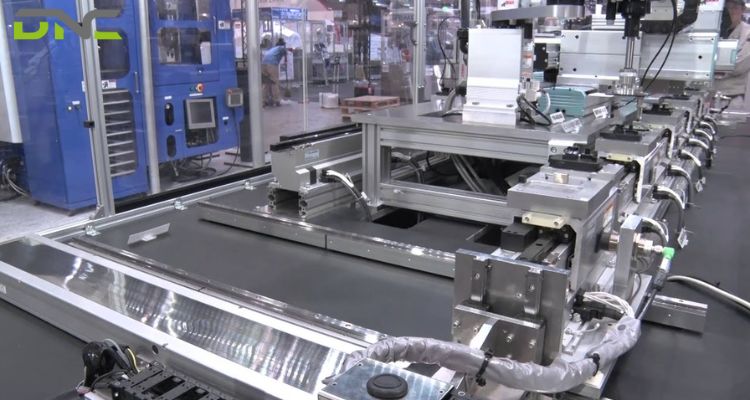
Linear conveyors account for more than 90% of all conveyor installations in Malaysian factories — and yet the term covers two fundamentally different technologies that serve very different manufacturing needs. The first meaning: a straight-path belt or roller conveyor, the most common material transport system in every Malaysian factory from Selangor automotive plants to Johor food processing facilities. The second meaning: a linear motor conveyor, an Industry 4.0 transport system where individually controlled movers travel independently on a closed-loop track, enabling the dynamic, flexible production lines that Malaysia’s NIMP 2030 smart factory vision demands. Choosing the wrong linear conveyor technology for a Malaysian manufacturing application — or not knowing that linear motor options exist — means either over-investing in capability that the production process cannot use, or under-investing in a conventional system that will require complete replacement within three years as customer requirements evolve. This guide covers both linear conveyor meanings in full technical depth, with specifications, application examples, and guidance on when each technology delivers the best value for Malaysian manufacturers.
What Is a Linear Conveyor?
A linear conveyor is any conveyor system where product transport follows a straight-line path — as distinguished from curved, spiral, or overhead conveyors that route products through non-linear paths. In its most common interpretation across Malaysian factories, a linear conveyor is a straight-path belt, roller, or modular plastic chain conveyor that transports products horizontally, on an incline, or on a decline between two fixed points. In its advanced Industry 4.0 interpretation, a linear conveyor is a closed-loop linear motor transport system where individual product carriers (movers) move independently along a magnetic track at speeds up to 4 m/s, with ±0.01 mm position accuracy, enabling flexible multi-product manufacturing on a single track without mechanical changeover. Both technologies share the linear path characteristic, but they differ in cost, flexibility, control complexity, and application suitability by an order of magnitude in every dimension.
How Does a Linear Conveyor Work?
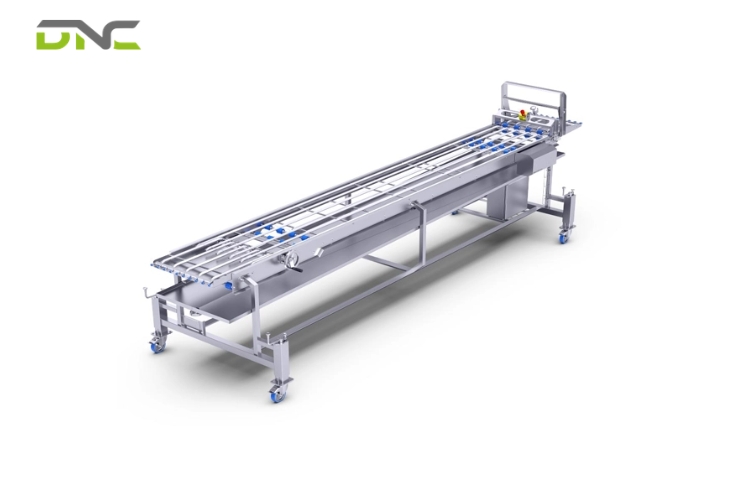
Understanding how linear conveyors work requires separate explanations for the two core technologies — conventional linear conveyors and linear motor conveyors — as their operating principles are fundamentally different.
Step 1: Standard Linear Conveyor — Drive and Transport
A standard linear belt conveyor operates through a motorized head pulley that drives a continuous belt loop around the head and tail pulleys. The belt surface carries products from the tail (infeed) end to the head (discharge) end at speeds determined by the motor frequency — typically 0.1–2.5 m/s for standard factory conveyors. Belt tension is maintained by a screw or gravity take-up at the tail pulley, set to the minimum tension required to prevent belt slippage on the drive pulley without over-stressing the belt carcass. A VFD (Variable Frequency Drive) connected to the conveyor motor allows speed adjustment from 5% to 100% of maximum speed, enabling synchronization with upstream and downstream process equipment. Standard linear belt conveyors handle products ranging from 50-gram biscuits at 30 m/minute to 500-kg automotive body panels at 6 m/minute, using belt widths from 200 mm to 2,000 mm and lengths from 0.5 m to 100+ m in a single straight run.
Step 2: Standard Linear Conveyor — Sensing and Control
Standard linear conveyors are controlled by a PLC — typically a Siemens S7-1200 or S7-1500 at DNC Automation installations — that monitors belt speed via encoder feedback, product presence via photoelectric sensors, and belt tension via load cell or current monitoring. The PLC executes start/stop sequences, speed ramps, emergency stops, and zone control (where applicable). On multi-zone linear conveyors, each zone has an independent drive controlled by the PLC, enabling accumulation, indexing, and speed variation between zones on the same linear path.
Step 3: Linear Motor Conveyor — Electromagnetic Propulsion
Linear motor conveyors replace mechanical drives with electromagnetic propulsion — the same physics that drives maglev trains, applied at factory scale. The track consists of a series of coil segments (stator) embedded in the track structure; each mover (carrier) contains a permanent magnet array. By energizing sequential coil segments with three-phase current, the control system generates a traveling magnetic field that propels the permanent magnet array — and the mover attached to it — along the track. Current through each coil segment is independently controlled by the drive system (Beckhoff TwinCAT, Siemens SIMOTION, or Rockwell Logix) allowing each mover’s position, speed, and force to be precisely commanded independently of all other movers.
Step 4: Linear Motor Conveyor — Independent Mover Control
Each mover on a linear motor conveyor carries a product carrier (pallet, fixture, or direct product holder) and receives real-time position updates from a linear encoder embedded in the track — resolving position to ±0.01 mm. The drive system controls each mover individually: Mover 1 may be stationary at a work station for 30 seconds while Mover 2 accelerates past at 4 m/s between stations and Mover 3 decelerates into the next work position. Movers can overtake each other on tracks with passing sections, change their sequence order dynamically, and adjust spacing in real time based on station status. This independent control enables production scheduling that is impossible with mechanically coupled systems: high-priority products can be routed to available stations ahead of standard products without stopping the line.
Step 5: Linear Motor Conveyor — Integration with Siemens Ecosystem
DNC Automation integrates linear motor conveyors using the Siemens SIMOTION or TIA Portal platform, connecting linear motor track controllers to S7-1500 PLCs via PROFINET with IRT (Isochronous Real-Time) communication at 250-microsecond cycle times. This integration connects linear motor movers with robots, vision systems, dispensing machines, and test equipment, enabling the coordinated multi-station processing that defines Industry 4.0 flexible manufacturing. OPC-UA connectivity links the linear motor system to MES/ERP systems, providing real-time production data — individual mover cycle times, station utilization, throughput rates, and quality gate results — for production analytics and continuous improvement.
Types of Linear Conveyor
Linear conveyor types span from the most basic gravity-assisted flat belt to the most advanced multi-mover linear motor system, covering every point on the cost-capability spectrum relevant to Malaysian manufacturing.
1. Flat Belt Linear Conveyor
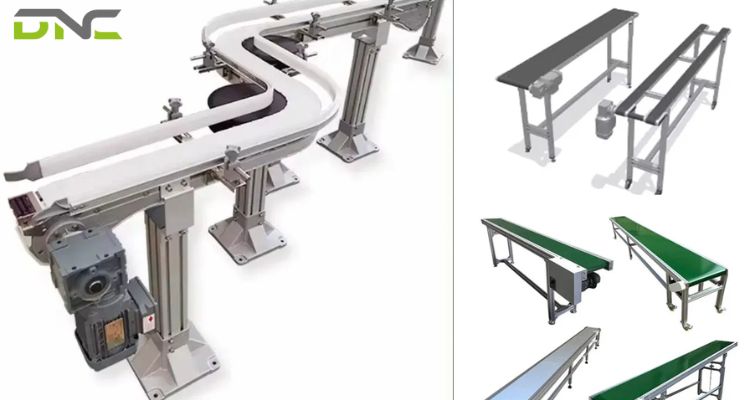
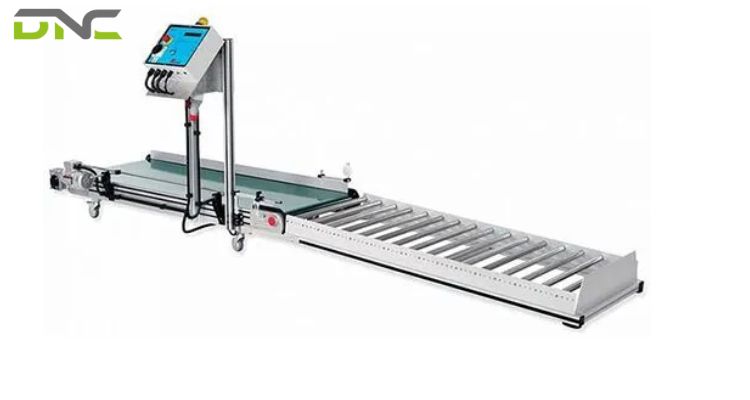
Flat belt linear conveyors use a flat, continuous belt surface — PVC, PU, rubber, or fabric depending on the application — driven by a motorized head pulley. Flat belt linear conveyors are the universal standard for light-to-medium product transport: cartons, bottles, trays, bags, pouches, and assembled products weighing up to 50 kg per meter of belt. Belt widths of 200–1,500 mm and lengths to 50 m per section handle the majority of Malaysian factory transport requirements. Flat belt conveyors from DNC Automation are manufactured on aluminium profile frames with Siemens motor drives, providing clean, adjustable, low-maintenance transport that satisfies both ISO 9001 quality requirements and HACCP food safety requirements when specified with food-grade belts and frames.
2. Roller Linear Conveyor
Roller linear conveyors transport products on a series of free-spinning (gravity) or driven (belt-driven or chain-driven) rollers arranged in a straight line. Roller linear conveyors handle heavier products than belt conveyors of equivalent size — rollers rated at 100–500 kg total load per roller station support automotive parts, heavy machinery components, and pallet-based production. Roller pitch (spacing between rollers) is selected to ensure at least three rollers support the product at all times. Motorized drive rollers (MDRs) on roller linear conveyors provide zone accumulation without additional drives, enabling intelligent buffering on the same roller track.
3. Modular Belt Linear Conveyor
Modular belt linear conveyors use interlocking plastic module belts (PP, POM, or PE) instead of continuous flat belts. Modular belts offer significantly longer life in harsh environments — food processing, washdown, and high-humidity Malaysian factories — than PVC or rubber flat belts. Individual module replacement costs RM 5–20 per module versus RM 200–2,000/m for continuous belt replacement, reducing belt maintenance costs by 40–60%. Modular belt linear conveyors are the standard choice for Malaysian F&B manufacturers operating HACCP-certified lines, where belt hygiene, drainage, and module-level replaceability are quality system requirements.
4. Incline / Decline Linear Conveyor
Incline and decline linear conveyors transport products between floor levels on a straight inclined path, eliminating the floor space consumed by ramp structures and reducing the manual labor required for vertical product movement. Standard incline angles for belt conveyors are 0°–20° for smooth belts, 20°–40° for rough-top or cleated belts, and 40°–90° for vertical cleated/bucket-style conveyors. Malaysian factories commonly use incline linear conveyors to transfer products from floor-level production to elevated sortation systems, from ground floor to mezzanine storage levels, and from process equipment to packaging lines at different elevations. DNC Automation specifies incline linear conveyors with anti-rollback devices (ratchet mechanisms on the motor shaft) that prevent loaded belts from reversing under power failure — a safety requirement under Malaysia’s DOSH machinery regulations.
5. Linear Motor Conveyor — Closed-Loop Track
Linear motor conveyors on closed-loop tracks represent the highest performance point in linear conveyor technology, enabling fully flexible production scheduling with zero mechanical changeover. Movers travel the closed loop continuously — processing products at work stations on the straight sections and returning empty on the return track. Track diameters from 0.5 m to 10 m, mover counts from 4 to 200+ per track, and speeds to 4 m/s enable production rates from 60 to 3,600 products/hour per track. Penang semiconductor and precision electronics manufacturers lead Malaysia’s adoption of linear motor conveyors, with Intel, AMD, and Flex using linear motor transport for wafer-level semiconductor processing steps where ±0.01 mm product positioning and zero particle generation (no belts, no chains, no lubrication) are process requirements.
6. Linear Motor Conveyor — Open-Path (Point-to-Point)
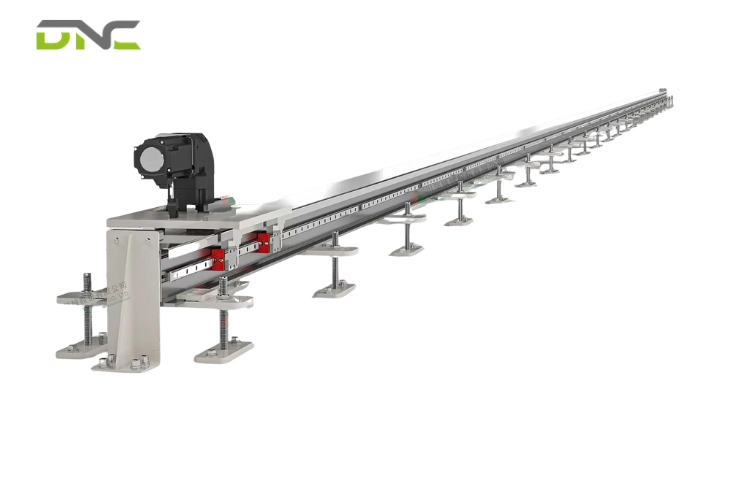
Open-path linear motor conveyors operate on a straight track between two or more points rather than a closed loop, enabling precise point-to-point positioning of products between process stations without a return path. A single-axis linear motor stage with a mover positions a product carrier to any programmed point along a 1–10 m travel range within ±0.01 mm, at acceleration rates to 50 m/s². Open-path linear motor stages replace conventional screw drives, pneumatic cylinders, and gear-rack drives in applications requiring high-speed, high-accuracy positioning — wafer handling, precision dispensing, and component placement in semiconductor manufacturing. DNC Automation integrates Siemens linear motor stages with the SIMOTION controller for high-speed pick-and-place and precision dispensing applications in Penang electronics manufacturing.
Linear Conveyor Type Comparison Table
| Type | Speed | Accuracy | Load Capacity | Cost (relative) | Best Application |
| Flat belt | 0.1–2.5 m/s | ±5–15 mm | Up to 50 kg/m | Low | Light product transport, F&B, packaging |
| Roller linear | 0.1–1.5 m/s | ±5–15 mm | Up to 500 kg/m | Low-medium | Heavy products, pallet handling |
| Modular belt linear | 0.1–1.5 m/s | ±5–15 mm | Up to 100 kg/m | Medium | F&B, washdown, harsh environments |
| Incline/decline | 0.1–1.5 m/s | ±5–15 mm | Application-dependent | Medium | Floor-to-mezzanine transfer |
| Linear motor (closed) | Up to 4 m/s | ±0.01 mm | Up to 50 kg/mover | High | Semiconductor, flexible multi-product |
| Linear motor (open path) | Up to 10 m/s | ±0.005 mm | Up to 50 kg/mover | High | Precision positioning, pick-and-place |
Key Components of a Linear Conveyor System
A linear conveyor system is an integrated assembly of mechanical, electrical, and control components selected to deliver the required transport speed, load capacity, and control precision across the conveyor’s full operating life.
Belt or Transport Medium. The product contact and transport surface — flat belt, modular plastic belt, roller surface, or mover platform. Belt material selection (PVC, PU, rubber, modular PP/POM) determines chemical resistance, temperature range, food contact compliance, and service life. Linear motor mover platforms are typically aluminum or stainless steel, matched to the product carrier fixture design.
Frame Structure. Carbon steel, stainless steel, or aluminium profile frame that maintains belt alignment, supports load forces, and provides the mounting interface for drives, sensors, and accessories. Aluminium profile frames (Item, Bosch Rexroth, FlexLink systems) are standard in Malaysian electronics manufacturing for their dimensional accuracy, cleanliness, and rapid reconfigurability. Stainless steel frames are standard in food processing.
Drive System. AC induction motor with VFD (standard linear conveyor) or linear motor stator coil array (linear motor conveyor). Motor sizing follows the CEMA formula for effective belt tension, accounting for product weight, belt weight, slope, and friction. VFD selection specifies the voltage class, overload rating, and communication interface (PROFINET, EtherNet/IP, or Modbus TCP for PLC connectivity).
Control System. Siemens S7-1200 or S7-1500 PLC with TIA Portal programming provides complete conveyor control — speed, direction, zone management, interlocking, fault detection, and HMI display. DNC Automation’s standard control architecture includes real-time speed monitoring via encoder feedback, OPC-UA data output for MES connectivity, and remote access via VPN for 24/7 remote diagnostics.
Sensors. Photoelectric sensors (SICK, Siemens SIRIUS, Balluff) detect product presence and position. Encoders on drive motors provide belt speed feedback. Temperature sensors on motor windings provide thermal protection. IO-Link connectivity integrates sensor diagnostic data into the TIA Portal HMI, providing condition monitoring without additional wiring infrastructure.
Applications: Where Linear Conveyors Are Used in Malaysian Manufacturing
Linear conveyors serve as the primary material transport infrastructure across every major Malaysian manufacturing sector.
Penang Semiconductor and Electronics
Penang’s “Silicon Valley of the East” designation reflects its dominance of Malaysian electronics manufacturing — 58% of Malaysia’s E&E exports, with Intel, AMD, HP, and Flex operating major facilities. Linear conveyors in Penang semiconductor fabs are predominantly linear motor systems (for wafer and component handling requiring ±0.01 mm accuracy and zero contamination) and aluminium profile flat belt conveyors (for PCB assembly post-process and packaging). Linear motor conveyors are growing rapidly in Penang as Intel and AMD expand advanced packaging operations under NIMP 2030 investment incentives. DNC Automation’s Penang team integrates linear motor transport systems using Siemens TIA Portal, providing local engineering support that eliminates the 6–12 week response times from foreign OEM technical teams.
Selangor Automotive Manufacturing
Toyota and Selangor’s broader automotive sector use flat belt and roller linear conveyors as the primary line-side transport for body panels, engine components, and assembled sub-systems. Standard linear conveyors at automotive facilities run at 0.3–1.0 m/s, carrying products at 15–60 kg per carrier, with Siemens S7-1500 PLC control enabling full integration with robotic welding, painting, and assembly stations. DNC Automation has supplied and commissioned linear conveyor systems for Toyota’s Malaysian operations, with documented productivity improvements of 50% versus previous manual transport methods.
Johor and Selangor Food and Beverage
F&N (DNC client), Ramly Burger (DNC client), and Malaysia’s broader F&B sector use flat belt and modular belt linear conveyors as the primary product transport between filling, packaging, labeling, check-weighing, and palletizing operations. HACCP MS 1480 compliance requires food-contact belt surfaces to be FDA-approved (21 CFR), frames to be washdown-rated (IP67), and all drainage to be directed away from product contact zones. DNC Automation specifies PU flat belts or modular PP/POM belts for food-contact sections, with aluminium profile or SS304 frames and enclosed Siemens motor drive panels rated IP65 for washdown environments.
Palm Oil — East Malaysia and Peninsular Mills
Palm oil processing in Sabah, Sarawak, and peninsular Malaysia uses heavy-duty roller linear conveyors for fresh fruit bunch (FFB) transport from reception to sterilizers, and flat belt linear conveyors for processed product transport between extraction stages. Belt widths of 800–1,500 mm and loads of 200–500 kg/m are typical. SS304 roller shells and IP67 bearing seals are mandatory for palm oil environments, where steam, FFB juice, and condensate create the most aggressive corrosive environment in Malaysian manufacturing. Malaysia’s 18.55 million metric tons of CPO produced annually (2023 data) — from 450+ mills — represents a large installed base of linear conveyor infrastructure that DNC Automation services and upgrades across the country.
Benefits of Linear Conveyor Systems for Malaysian Factory Operations
Linear conveyor systems deliver concrete, measurable operational improvements across every production metric that Malaysian factory managers track.
Throughput increase of 50%. Replacing manual cart transport with a linear belt conveyor increases product movement speed from 0.5–1.0 m/minute (manual) to 15–150 m/minute (belt), eliminating transport wait time from production cycles. DNC Automation’s implementations have consistently documented productivity increases of 50% in facilities transitioning from manual to linear conveyor transport.
Labor reallocation. A 50-meter linear conveyor replaces 3–5 material handlers who previously moved products manually between process stations. At Malaysian minimum wage of RM 1,700/month, this represents RM 61,200–RM 102,000 in annual labor cost savings — before accounting for associated benefits, training, and turnover costs. Freed operators are redeployed to value-added roles, increasing manufacturing value per employee.
Human error reduction of 80%. Manual product transport introduces misrouting, incorrect sequence, and product damage errors that automated linear conveyors eliminate through PLC-enforced routing and sequence logic. DNC Automation’s documented client data shows an 80% reduction in transport-related human errors following linear conveyor automation — directly reducing scrap, rework, and customer complaint rates.
NIMP 2030 Smart Factory Compliance. Malaysia’s National Investment Master Plan 2030, targeting 3,000 smart factory conversions with RM 8.2 billion in allocated funding, identifies automated material flow — including linear conveyor systems — as a foundational smart factory technology. Linear motor conveyor systems, specifically, satisfy the Industry 4.0 flexible manufacturing criteria that qualify factories for NIMP 2030 advanced manufacturing status and the associated investment incentives. The SAG Grant (RM 1 million, 70:30 MIDA matching) directly funds linear conveyor automation as part of broader factory automation investment packages.
How to Choose the Right Linear Conveyor for Your Factory
Choosing between standard linear belt/roller conveyors and linear motor conveyors — and selecting the correct specification within each category — requires answering five critical questions about current production requirements and future production flexibility needs.
Question 1: How many product variants do you currently produce, and how many do you plan to produce in 3 years? If your factory produces 1–5 product variants with stable configurations, a standard linear belt or roller conveyor with mechanical changeover guides provides adequate flexibility at minimal cost. If your factory produces or plans to produce 20+ product variants with frequent changeover, or if your customers are shifting to smaller lot sizes more frequently, a linear motor conveyor’s software-defined flexibility delivers ROI through changeover time elimination — reducing format change from hours to minutes.
Question 2: What positioning accuracy does your process require? Standard linear belt conveyors deliver ±5–15 mm product positioning — sufficient for manual operations and most automated processes with stop pins. Linear motor conveyors deliver ±0.01 mm — required for semiconductor processing, precision dispensing, and advanced vision inspection. Do not over-specify linear motor accuracy for applications that standard conveyors serve adequately.
Question 3: What is your environment? Food processing and washdown → modular belt linear conveyor with SS304 or aluminium profile frame. Palm oil processing → heavy-duty roller linear conveyor with SS304 components. Semiconductor cleanroom → linear motor or aluminium profile flat belt with ESD-safe construction. Automotive assembly → heavy-duty roller or flat belt with carbon steel frame. Standard dry indoor → standard flat belt linear conveyor.
Question 4: What is your investment horizon and payback expectation? Standard linear belt conveyors cost RM 15,000–RM 80,000 for a complete 10-meter system with PLC control. Linear motor conveyor systems for a 5-mover closed-loop track start at RM 300,000–RM 600,000. For most Malaysian SME manufacturers, standard linear conveyors with Siemens PLC control deliver payback within 12–24 months. Linear motor conveyors deliver payback within 24–48 months in high-mix, high-value manufacturing environments where flexibility justifies the premium.
Question 5: Who will integrate and support the system? DNC Automation provides complete linear conveyor system design, manufacturing, installation, programming, and 24/7 support with local Malaysian engineers — eliminating the multi-vendor integration risk and foreign OEM support delays that add months to commissioning timelines and weeks to fault resolution. Get a Free Consultation with DNC Automation’s engineering team to evaluate which linear conveyor technology delivers optimal ROI for your specific Malaysian manufacturing application.
Frequently Asked Questions About Linear Conveyors
What is the difference between a linear conveyor and a belt conveyor?
A linear conveyor is a broader category that includes all straight-path conveyors — belt, roller, modular chain, and linear motor. A belt conveyor is a specific type of linear conveyor that uses a continuous belt as the transport medium. All belt conveyors are linear conveyors if they run in a straight path, but not all linear conveyors are belt conveyors — roller conveyors, linear motor systems, and drag chain conveyors are all linear conveyors that do not use a traditional belt.
What speed does a linear motor conveyor achieve?
Linear motor conveyors achieve mover speeds up to 4 m/s in standard factory configurations (Beckhoff XTS, Rockwell iTRAK) and up to 10 m/s in high-speed precision transport applications (semiconductor wafer handling systems). At 4 m/s with 0.5 m mover spacing, a single track handles up to 7,200 products per hour — equivalent to 2 conventional belt conveyors running at maximum speed with zero changeover time between product variants. DNC Automation configures linear motor conveyor speeds based on work station cycle time requirements, ensuring mover speed does not outpace process speed at any station.
Is a linear conveyor suitable for inclined transport?
Standard flat belt linear conveyors handle inclines up to 20° with smooth belts and up to 40° with rough-top or cleated belts. Above 40° incline, vertical belt conveyors with closed cleats or bucket elevators are required. Linear motor conveyors are not typically used for inclined transport — their primary advantage is horizontal flexible transport, and inclined applications do not require the multi-mover flexibility that justifies linear motor investment. For inclined transport between Malaysian factory floor levels, DNC Automation recommends incline flat belt or modular belt conveyors with anti-rollback protection as the most cost-effective solution.
How does a linear conveyor integrate with Malaysia’s NIMP 2030 smart factory requirements?
NIMP 2030 mandates that 3,000 Malaysian factories transition to smart factory status by 2030, with automated material flow as a core requirement. Standard linear conveyors with Siemens PLC control and OPC-UA data connectivity satisfy the basic smart factory material flow requirement — they provide real-time throughput data, automated routing, and MES/ERP integration. Linear motor conveyors satisfy the advanced smart factory requirement for flexible manufacturing, enabling dynamic production scheduling and format-change flexibility that conventional systems cannot match. DNC Automation designs both levels of NIMP 2030-compliant linear conveyor systems, with SAG Grant application support to reduce capital investment requirements for qualifying Malaysian manufacturers.
What belt material should I specify for a food-grade linear conveyor in Malaysia?
For food-grade linear conveyors in Malaysia, PU (polyurethane) belts with FDA 21 CFR certification are preferred over PVC belts for direct food contact — PU resists fats, oils, and cleaning chemicals better than PVC, maintains flexibility at lower temperatures, and complies with both FDA 21 CFR and EU Regulation 10/2011 for food contact materials. Modular PP or POM plastic belts are preferred for washdown applications where individual module replacement is required. All food-grade belt selections for DNC Automation projects are verified against Malaysia’s HACCP MS 1480 requirements and the specific food product’s chemical contact requirements. Halal production lines require food-contact belt materials that are JAKIM-compatible — PU and PP/POM materials satisfy this requirement.
Can DNC Automation supply a complete linear conveyor system including PLC programming?
DNC Automation supplies, installs, and programs complete linear conveyor systems — from mechanical design through PLC control, HMI, and MES integration — as a turnkey solution. Our 35+ engineers at our 25,000 sq ft Selangor facility cover mechanical engineering, electrical panel design, PLC programming (Siemens TIA Portal, Xinje for cost-competitive applications), and project commissioning. Post-commissioning, DNC provides 24/7 remote monitoring and local on-site support with engineers based in both Selangor and Penang, covering both of Malaysia’s primary manufacturing hubs without foreign OEM wait times.
What is the minimum order quantity for a custom linear conveyor from DNC Automation?
DNC Automation designs and builds custom linear conveyor systems starting from a single unit — there is no minimum order quantity for custom conveyor systems. Standard configurations (flat belt 200 mm width, 2 m length, Siemens motor drive) are available from stock for rapid delivery. Custom configurations — special belt widths, lengths, belt materials, frame constructions, PLC integrations, and sensor packages — are designed and manufactured at DNC’s 25,000 sq ft facility to project-specific requirements. Delivery time for custom linear conveyors ranges from 3 weeks (standard modifications) to 12 weeks (complex multi-zone PLC-integrated systems). Contact DNC Automation for a quotation.
Conclusion
Linear conveyors are the material transport backbone of Malaysian manufacturing — from the flat belt conveyors moving cartons through F&N’s bottling lines in Selangor to the linear motor systems positioning semiconductor components to ±0.01 mm in Intel’s Penang facilities. Choosing the correct linear conveyor technology and specification for your manufacturing environment determines whether your investment delivers 15 years of productive service or requires costly replacement within 5 years. DNC Automation’s 20 years of Malaysian factory automation experience — with documented 50% productivity improvements and 80% human error reductions across clients including Toyota, Sony, F&N, Hartalega, Unilever, Ramly Burger, and Guan Chong Berhad — ensures that your linear conveyor system is correctly specified, expertly integrated, and reliably supported.
- 132 views
- 0 Comment
Recent Comments