


Conveyor Pulley: Types, Specifications & Selection Guide for Malaysian Factories

Conveyor pulleys are the structural anchors of every belt conveyor system — driving the belt forward, maintaining correct tension, training the belt to track accurately, and supporting the load across the full conveyor length. A conveyor pulley failure — whether from incorrect lagging specification, undersized shaft, bearing contamination, or misalignment — stops the entire production line. In Malaysian manufacturing, where conveyor systems operate 24/7 across high-humidity F&B facilities, high-temperature automotive paint lines, and high-volume palm oil mills, conveyor pulley specification is a critical engineering decision with direct operational consequences.
Conveyor belt pulleys perform six distinct functions across the conveyor system: drive (power input), tension (take-up), return (belt redirect), tracking (belt alignment), snub (wrap angle increase), and discharge (product release). Each function requires a different pulley type, different lagging specification, different face crown profile, and different shaft and bearing sizing. Specifying the same pulley configuration for all positions — a common error in low-cost conveyor procurement — results in belt slippage, premature lagging wear, and belt mistracking that accumulates to unplanned downtime.
This guide covers every conveyor pulley type used in Malaysian factory conveyor systems — from drive pulleys to wing pulleys — with technical specifications, lagging selection, shaft sizing, common failure modes, and a structured selection framework for Malaysian manufacturing conditions.
What Is a Conveyor Pulley?
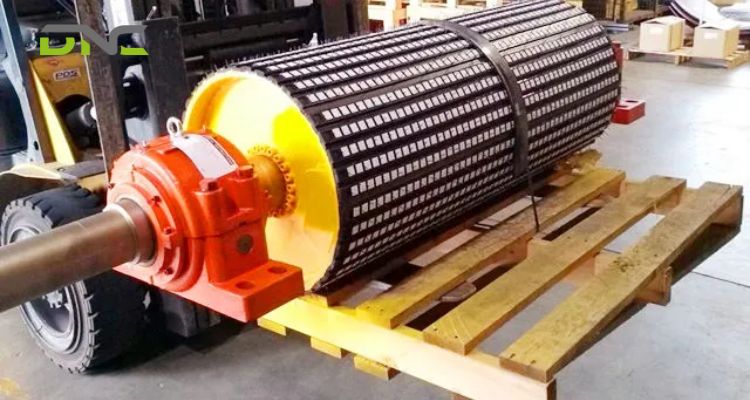
A conveyor pulley is a cylindrical component around which the conveyor belt wraps and rotates — serving as the interface between the mechanical drive system and the belt. Conveyor pulleys are constructed from a cylindrical steel shell welded to end discs, which are bored and keyed to accept the shaft. The shaft transmits torque from the motor/gearbox (at the drive pulley) or simply provides the rotational axis (at non-drive pulleys).
Core pulley components:
- Shell (drum): Cylindrical steel tube (typically 6–16 mm wall thickness depending on duty)
- End discs: Welded to shell ends; transmit torque from shaft to shell
- Shaft: Alloy steel (4140 or equivalent); transmits drive torque; supported by bearings at each end
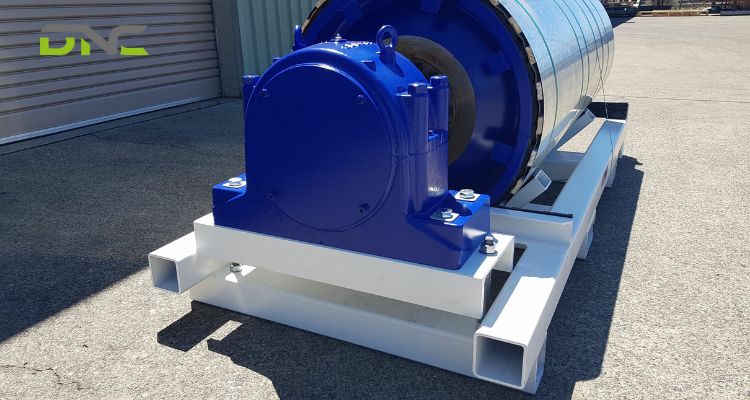
- Bearings: Pillow block (plummer block) bearings with self-aligning inner race — compensate for shaft deflection under load
- Lagging: Surface coating or bonded rubber/ceramic layer — improves belt grip, protects shell from wear, reduces slippage
Pulley dimensions — diameter, face width (length), shaft diameter — must be matched to belt width, belt tension, wrap angle, and operating speed. Incorrect dimensioning causes premature shell distortion, shaft fatigue failure, or bearing overload.
Types of Conveyor Pulleys
1. Drive Pulley (Head Pulley)
The drive pulley is the power-transmitting pulley of the conveyor — it receives torque from the gearmotor and transmits it to the belt via friction or positive drive (sprocket). The drive pulley is positioned at the discharge end of the conveyor (head end) in most configurations.
Drive pulley lagging: Lagging is the critical surface treatment on the drive pulley — it increases the coefficient of friction between pulley and belt, preventing belt slippage. Lagging options:
| Lagging Type | Material | Friction Coefficient | Applications |
| Plain rubber | 10 mm NR or SBR | 0.35–0.40 (dry) | Dry, light-duty |
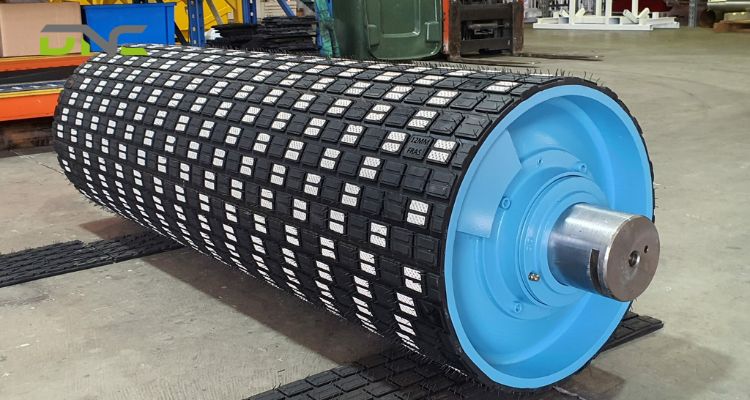
| Diamond-groove rubber | Patterned 12 mm | 0.40–0.45 (wet) | Wet/damp environments |
| Ceramic embedded | Rubber + ceramic tiles | 0.45–0.60 (wet) | High-tension, wet, critical drives |
| Polyurethane | PU compound | 0.35–0.40 | Food-grade, clean environments |
| Stainless steel | SS304/316 shell (no lagging) | 0.25–0.30 | Food processing, full washdown |
Malaysian context: Ceramic lagging is specified for palm oil mill conveyors where palm oil contamination reduces belt grip — ceramic tiles maintain friction even in heavily contaminated conditions. Food processing drive pulleys use polyurethane lagging or polished stainless steel shells (drum motor configuration) for HACCP compliance.
Wrap angle: Drive pulley effectiveness depends on the arc of contact between belt and pulley surface — the “wrap angle.” Minimum wrap angle for single-drive pulleys: 180° (with snub pulley assistance). Dual-drive pulleys can operate at lower wrap angles. Insufficient wrap angle → belt slippage at full load.
Drive pulley dimensions for Malaysian factory conveyors:
- Belt width 500 mm → minimum shell diameter 315–400 mm
- Belt width 800 mm → minimum shell diameter 400–500 mm
- Belt width 1,200 mm → minimum shell diameter 500–630 mm
- Face width = belt width + 50–100 mm overhang each side
2. Tail Pulley
The tail pulley is positioned at the feed end of the conveyor (opposite the drive end). It does not transmit power — it redirects the returning belt from the return run back to the carry side. The tail pulley maintains belt tension in combination with the take-up pulley.
Tail pulley lagging: Plain rubber lagging is standard — no grip enhancement required since the tail pulley does not drive the belt. Food processing conveyors use stainless steel tail pulleys (no lagging) for hygienic design compliance.
Self-cleaning tail pulleys: Bulk material handling conveyors (palm oil, cement, aggregate) specify wing-type tail pulleys (see below) instead of drum tail pulleys — the winged design allows material to fall through the wing gaps rather than building up between belt and pulley, which causes belt mistracking.
3. Snub Pulley
The snub pulley is a small-diameter pulley positioned adjacent to the drive pulley on the return run side — its purpose is to increase the wrap angle of the belt around the drive pulley. Without a snub pulley, belt wrap on a standard head pulley is approximately 180°. The snub pulley increases this to 200–240° — directly improving the drive pulley’s torque-transmitting capability and reducing slippage risk.
Snub pulley specifications:
- Diameter: Typically 60–80% of drive pulley diameter
- No lagging required (non-drive pulley)
- Positioned 100–300 mm from drive pulley on return side
- Bearing and shaft rating: must handle the belt tension reaction force
4. Take-Up Pulley (Tension Pulley)
The take-up pulley adjusts belt tension — maintaining the minimum tension required to prevent belt slippage at the drive pulley and to support the loaded belt between carrying idlers. Take-up pulleys are mounted on a movable carriage that slides in a take-up frame, tensioned via screw (manual) or gravity (automatic) mechanism.
Take-up types:
- Screw take-up: Simple, low cost; manual adjustment required as belt stretches; suitable for short conveyors (under 30 m)
- Gravity take-up: Automatic; weighted carriage maintains constant tension regardless of load variation or belt stretch; required for conveyors exceeding 30 m or those with significant load variation
- Hydraulic take-up: Automatic; hydraulic cylinder maintains tension; used for long-distance high-tension conveyors in mining and palm oil mill applications
Take-up travel: Minimum take-up travel = 2% of conveyor center-to-center distance (for synthetic fabric belts) to allow for belt stretch without manual readjustment.
5. Bend Pulley
Bend pulleys redirect the belt at any angle other than the straight carry and return runs — typically used on conveyors with complex routing, multiple elevation changes, or in-line belt storage configurations (loop take-up systems).
Key specification: Bend pulleys are non-drive pulleys but must be sized for the belt tension at that point in the system — which may be high if the bend is near the drive end. Undersized bend pulley shells distort under high tension → belt edge damage and tracking failure.
6. Wing Pulley (Self-Cleaning Pulley)
Wing pulleys replace the solid cylindrical shell with a series of flat steel wings (typically 4–8 wings) welded around the shaft in a helical or straight pattern. The spaces between wings allow material to fall through — preventing material build-up on the pulley face that causes belt mistracking and damage.
Applications: Tail pulleys and return-run pulleys on bulk material handling conveyors — palm oil FFB conveyors, cement conveyors, grain conveyors, aggregate handling. DNC Automation specifies wing tail pulleys for all palm oil mill and bulk material conveyor designs in Malaysia.
Limitation: Wing pulleys are not suitable for drive positions — the discontinuous contact surface increases belt fatigue and cannot transmit drive torque reliably.
7. Magnetic Pulley
Magnetic pulleys (also called magnetic head pulleys) incorporate permanent magnets inside the pulley shell — creating a magnetic field at the pulley surface that attracts and holds ferrous metal pieces as the belt wraps around, allowing non-magnetic product to discharge normally while trapping metal contamination.
Applications: Metal separation from bulk material streams — removes ferrous tramp metal (bolts, wire, tools) before downstream processing equipment is damaged; food factories (protecting grinders and presses from metal damage); recycling plants (ferrous separation from mixed waste).
Separation capacity: Depends on magnet strength, pulley diameter, belt speed, and material depth on belt.
Conveyor Pulley Specifications: Key Technical Parameters
Shell Diameter Selection
Minimum shell diameter is determined by belt tension and belt construction:
| Belt Tension Class | Minimum Drive Pulley Diameter |
| Up to 500 N/mm | 315–400 mm |
| 500–1,000 N/mm | 400–500 mm |
| 1,000–2,000 N/mm | 500–630 mm |
| 2,000–4,000 N/mm | 630–800 mm |
| Above 4,000 N/mm | 800–1,200 mm+ |
Using a pulley diameter smaller than minimum causes excessive belt bending stress at the pulley — accelerating belt cover cracking and ply separation.
Shaft Sizing
Shaft diameter is calculated from: bearing span (distance between bearing centers), maximum radial load (belt tension × wrap angle factor), bending moment, and torsional load (drive pulleys only). Shafts are designed to CEMA (Conveyor Equipment Manufacturers Association) or AS 1332 standards using alloy steel (4140 grade) — providing 30–50% higher fatigue strength than mild steel.
Common failure: Undersized shaft selection causes shaft fatigue cracking at the keyway seat — the highest stress concentration point. DNC Automation’s engineering calculations size all pulley shafts to minimum safety factor 2.0× on alternating bending stress.
Face Crown Profile
Conveyor pulleys have a slight crown on the shell face — the center diameter is larger than the edge diameter by 0.5–1.5 mm (depending on pulley diameter). The crown creates a self-centering force that keeps the belt tracking toward the center of the pulley. Face crown specifications per CEMA:
| Pulley Face Width | Crown Height |
| Up to 600 mm | 0.5 mm |
| 600–1,200 mm | 1.0 mm |
| Over 1,200 mm | 1.5 mm |
Flat-face pulleys (zero crown) are used for modular plastic belt conveyors where sprocket-drive tracks the belt positively without crown assistance.
Bearing Selection
Conveyor pulley bearings are typically spherical roller bearings in self-aligning pillow block housings — self-alignment compensates for shaft deflection under belt tension and thermal expansion. Bearing life is calculated per ISO 281 to minimum L10 life of 50,000 operating hours at rated load.
Seal selection for Malaysian environments:
- Standard factory: Triple-lip seal (TSN series) with food-grade grease
- Washdown/food processing: IP65/IP66 sealed bearing unit with V-ring seal
- Palm oil/contaminated: Heavy-duty labyrinth seal or sealed bearing with pressure grease fitting
Common Conveyor Pulley Failure Modes
1. Belt Slippage at Drive Pulley
Cause: Insufficient belt tension (take-up not adjusted), worn or contaminated lagging (reduces friction coefficient), insufficient wrap angle, pulley diameter too small for belt tension.
Consequences: Belt does not convey product at design speed; overheated lagging; belt cover damage from heat generated by slippage.
Prevention: Correct initial take-up tension setting; periodic lagging inspection; ceramic lagging for wet or contaminated drive environments; ensure minimum wrap angle with snub pulley.
2. Lagging Wear or Delamination
Cause: Abrasive belt underside contact, incorrect lagging material for environment (rubber in high-oil environments), lagging bonding failure from moisture ingress.
Detection: Belt slippage despite correct tension; visual inspection shows bare metal areas; lagging chunks in belt return path.
Prevention: Specify lagging material matched to environment (ceramic for wet/contaminated, polyurethane for food contact, diamond-groove rubber for moderately wet). Re-lag drive pulleys every 2–4 years depending on duty.
3. Shell Distortion
Cause: Excessive belt tension beyond shell rating; material build-up between belt and tail pulley causing localized overload; incorrect shell wall thickness specification.
Detection: Belt mistracking that cannot be corrected by take-up adjustment; visible out-of-round at pulley ends.
Prevention: Design pulleys for actual operating tension with safety factor; specify wing tail pulleys for bulk material applications; avoid material build-up through correct transfer point design.
4. Bearing Failure
Cause: Contamination by water, palm oil, or product reaching bearing; insufficient lubrication interval; vibration from misaligned pulley shaft; overload from excessive belt tension.
Detection: Audible growling or rumbling from bearing housing; heat at bearing housing; increased motor current draw; eventual catastrophic failure.
Prevention: Sealed bearings in contaminated environments; correct lubrication schedule (grease type and interval matched to speed and load); laser shaft alignment at installation.
5. Shaft Fatigue Cracking
Cause: Shaft undersized for actual belt tension; stress concentrations at keyway or shaft step; reversed bending fatigue from belt tension cycling.
Detection: Visible crack at shaft keyway; sudden shaft fracture (catastrophic).
Prevention: Engineering calculation of shaft size using actual belt tension and bearing span (not rule-of-thumb); specify 4140 alloy steel shafts; avoid sharp shaft shoulders (use fillet radii per ASME standards).
How to Select the Right Conveyor Pulley
Selection Checklist
Step 1: Identify pulley position and function
Drive, tail, snub, take-up, bend, or wing — each function determines minimum specifications.
Step 2: Determine belt tension at pulley location
Calculate tight-side (T1) and slack-side (T2) belt tensions. Maximum tension occurs at drive pulley tight side. Tension reduces toward tail pulley.
Step 3: Select minimum shell diameter
Based on belt tension class and belt construction — use CEMA or manufacturer selection tables. Always select next standard diameter above calculated minimum.
Step 4: Determine face width
Face width = belt width + 100 mm minimum (50 mm each side overhang). Food processing conveyors may specify equal face and belt width (flush face for hygiene).
Step 5: Specify lagging
Drive pulleys: ceramic (wet/contaminated), diamond-groove rubber (moderately wet), polyurethane (food-grade). Non-drive pulleys: plain rubber or bare steel.
Step 6: Calculate shaft diameter
Engineering calculation from bearing span, radial load, bending moment, torsion (drive pulleys). Minimum safety factor 2.0× on alternating bending stress.
Step 7: Select bearing type and seal
Spherical roller bearing in pillow block; seal type matched to environmental contamination level; bearing L10 life minimum 50,000 hours.
Step 8: Specify material
Mild steel for standard industrial; stainless steel (SS304 or SS316) for food processing, washdown, or corrosive environments.
Quick Reference: Pulley Type by Application
| Application | Drive Pulley | Tail Pulley | Return Pulleys |
| General manufacturing | Rubber lagging | Rubber lagging | Bare steel |
| F&B / food processing | PU lagging or SS drum motor | SS bare shell | SS bare shell |
| Palm oil mill | Ceramic lagging | Wing pulley | Wing pulleys |
| Automotive paint line | Rubber lagging, IP55 bearing | Rubber lagging | Bare steel |
| Bulk (cement, aggregate) | Ceramic lagging | Wing pulley | Wing pulleys |
Benefits of Correctly Specified Conveyor Pulleys
- Eliminate Belt Slippage — Increase Productivity by Up to 50%: Ceramic or diamond-groove lagging matched to operating conditions eliminates belt slippage — maintaining full belt speed and production rate at all times.
- Reduce Human Error by Up to 80%: PLC-monitored drive pulley speed feedback (via encoder or VFD output frequency monitoring) detects slip events immediately — alerting operators before slippage causes product loss or belt damage.
- Extended Pulley Service Life — 8–12 Years: Correctly sized shells, shafts, and bearings — engineered to actual operating conditions with safety factors — deliver 8–12 years of service before major reconditioning is required. DNC Automation’s pre-commissioning alignment and tension procedures establish the baseline for full service life.
- MIDA Smart Automation Grant Eligibility: Conveyor systems with PLC-integrated pulley speed monitoring and SCADA-connected predictive maintenance qualify for Malaysia’s Smart Automation Grant — up to RM 1,000,000 matching funding.
FAQ — Conveyor Pulleys
Q1: What is the difference between a drive pulley and a head pulley?
Head pulley and drive pulley refer to the same component in most conveyor configurations — the pulley at the product discharge end of the conveyor that receives motor torque and drives the belt. “Head pulley” refers to the physical position (at the head/discharge end); “drive pulley” refers to the functional role (transmitting drive torque to the belt). In some conveyor configurations, the drive pulley is not at the head end — it may be positioned mid-conveyor or at the tail end — and in those cases the terms are distinguished.
Q2: Why does my conveyor belt keep slipping despite correct tension?
Belt slippage despite correct tension indicates a lagging problem — the friction coefficient between the drive pulley surface and the belt underside is insufficient. Causes: worn rubber lagging (smooth surface, reduced grip); oil or palm oil contamination reducing friction; incorrect lagging type (smooth rubber in wet environment). Solution: replace lagging with diamond-groove rubber or ceramic-embedded lagging. DNC Automation’s engineers diagnose belt slippage causes and specify correct lagging replacement during maintenance visits across Malaysia.
Q3: What lagging material is correct for palm oil mill conveyor pulleys?
Ceramic lagging is the correct specification for palm oil mill drive pulleys. Palm oil contamination on the belt underside dramatically reduces rubber lagging friction — ceramic tiles maintain high friction coefficient even with heavy oil contamination. Wing pulleys are specified at tail and return positions to prevent palm oil and fibre build-up between belt and pulley — a major cause of belt mistracking in palm oil mill environments. DNC Automation designs complete palm oil mill conveyor systems with full ceramic lagging and wing pulley specifications.
Q4: How do I choose the correct conveyor pulley diameter?
Conveyor pulley diameter is determined by belt tension (N/mm of belt width) and belt construction. Higher belt tension requires larger pulley diameter — using a pulley diameter smaller than minimum causes excessive bending stress in the belt at the pulley contact zone, accelerating belt cracking and ply delamination. DNC Automation engineers calculate minimum pulley diameter from actual belt tension using CEMA standards — with belt tension calculated from conveyor load, speed, length, and incline.
Q5: What is the purpose of a snub pulley?
A snub pulley increases the wrap angle of the belt around the drive pulley — the arc of contact between belt and drive pulley surface. Greater wrap angle means more friction force available to drive the belt without slippage. Without a snub pulley, drive pulley wrap angle is typically 180°; with a correctly positioned snub pulley, wrap angle increases to 200–240°, allowing the same lagging to transmit 20–40% more drive torque before slippage occurs.
Q6: How often should conveyor pulley lagging be replaced?
Drive pulley lagging replacement interval depends on lagging material and operating conditions: rubber lagging in dry, clean conditions — 3–5 years; rubber lagging in wet or moderately contaminated conditions — 1–3 years; ceramic lagging in contaminated conditions — 5–8 years. Warning signs: belt slippage despite correct tension, visible wear on lagging surface, chunks of lagging appearing in the belt return path. DNC Automation’s preventive maintenance contracts include drive pulley lagging inspection and measurement at each 6-monthly visit.
Q7: What type of conveyor pulley is recommended for food processing lines in Malaysia?
Food processing conveyor pulleys must comply with HACCP and ISO 22000 hygiene design requirements — no hollow cavities that trap product or bacteria. Specifications: stainless steel (AISI 304 or 316) shell and end discs; smooth, cleanable surface; sealed bearings; no lagging on tail or return pulleys (lagging harbors bacteria). For drive pulleys, two options: stainless steel drum motor (motor, gearbox, and drive all inside the sealed drum) or externally mounted gearmotor with polyurethane lagging on stainless steel drive pulley. DNC Automation specifies drum motor drives for all new food processing conveyor installations in Malaysian F&B factories.
Q8: Can DNC Automation recondition existing conveyor pulleys, or is full replacement required?
DNC Automation offers both reconditioning and replacement depending on condition assessment. Reconditioning includes: lagging replacement, shell surface restoration (if within wall tolerance), shaft replacement (if cracked or fatigued), and bearing replacement. Full pulley replacement is recommended when shell wall thickness has reduced below 70% of original specification or when shaft shows visible fatigue cracks. DNC’s 35+ engineers conduct on-site pulley condition assessment across Malaysia — providing engineering-basis recommendations rather than blanket replacement recommendations.
Conclusion
Conveyor pulleys are precision-engineered load-bearing components that determine belt drive reliability, tracking performance, and system uptime across every conveyor in your Malaysian factory. Incorrect lagging specification causes belt slippage; undersized shafts fail under fatigue loading; incorrect bearing selection allows contamination to destroy bearings in weeks. The engineering precision applied to conveyor pulley selection directly determines your production line’s operational reliability and maintenance cost.
DNC Automation’s engineering team designs, manufactures, and installs conveyor pulley systems for Malaysia’s leading manufacturers — Toyota, Sony, Panasonic, F&N, Hartalega, and Ramly Burger — with ISO 9001:2015 quality management, in-house fabrication, and 24/7 local support across Selangor, Johor Bahru, and Penang.
Get a Free Consultation from DNC Automation — bring your conveyor specifications and operating conditions. Our engineers will select and size the correct pulley configuration, lagging, and bearing specification for your application.
- 195 views
- 0 Comment
Recent Comments