


RSC Case Packer: Complete Guide | DNC Automation Malaysia
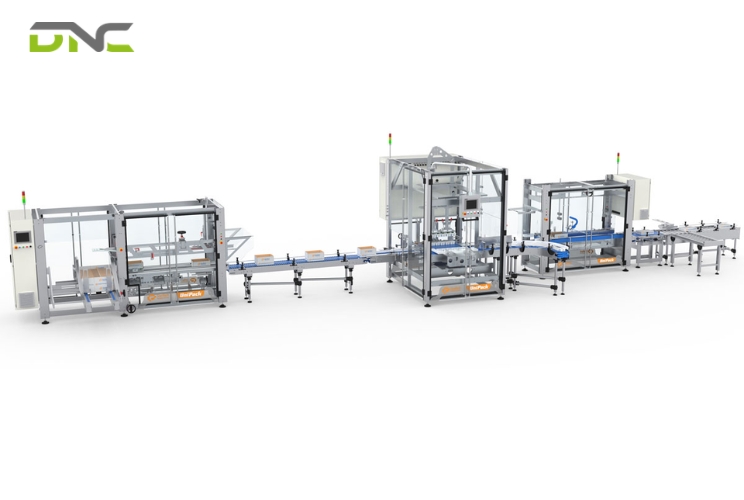
RSC case packers handle the most common corrugated case format in Malaysian manufacturing logistics — the Regular Slotted Container. Understanding the RSC format, how case packers handle it, and what configuration options are available allows Malaysian manufacturers to specify the right machine for their end-of-line packing requirement.
The RSC is the standard corrugated shipping case: four top flaps and four bottom flaps that meet at the centre when folded closed. It is the default shipping case format across Malaysian manufacturing because it is readily available from corrugated box suppliers throughout Selangor, Johor, and Penang, and it is compatible with the widest range of case sealing equipment. Every Malaysian manufacturer using corrugated shipping cases almost certainly uses RSC format — which means every Malaysian manufacturer using automated case packing is operating an RSC case packer.
What Is an RSC Case Packer?
An RSC case packer is a machine that opens pre-formed RSC corrugated cases from a case magazine, positions them for product loading, and discharges filled cases to a downstream case sealer. The machine does not form the case from flat blanks — RSC cases are purchased pre-glued and pre-formed from the corrugated box supplier and stored flat (knocked-down flat, or KDF) in the machine’s case magazine.
The RSC case packer’s three primary functions:
- Case erection: The machine pulls a KDF case from the magazine, opens it to rectangular cross-section, folds and seals the bottom flaps, and presents the case upright with the top open.
- Product loading: Products are loaded into the open-top RSC case — via top load (products placed from above), side load (products pushed in horizontally), or robotic loading.
- Case discharge: The filled, open-top RSC case is discharged on a conveyor to the case sealer, which folds and tapes or glues the top flaps closed.
RSC Case Format: Key Dimensions and Terminology
The Regular Slotted Container has a standardised geometry defined by its internal dimensions:
- Length (L): The longer internal dimension of the case
- Width (W): The shorter internal dimension
- Depth (D): The internal height from bottom to top (open face)
All four top flaps are the same depth (D/2); when folded, they meet at the centre of the case top. The same geometry applies to the four bottom flaps.
Flap gap tolerance: On a standard RSC, the top flaps should meet within ±5 mm of the case centre. Cases where top flaps overlap significantly or leave a gap exceeding 10 mm create sealing problems at the downstream case sealer. Malaysian corrugated box quality varies between suppliers — verify your supplier’s RSC manufacturing tolerance before specifying your case packer.
Board grade specification: RSC case packers are set for a specific corrugated board grade. Common Malaysian corrugated board grades: C-flute single wall (the most common), B-flute single wall (smaller flute, used for lighter products), BC-flute double wall (heavier products requiring transit protection). Confirm your board grade with the case packer supplier.
RSC Case Packer Configurations
Top Load RSC Case Packer
The top load RSC case packer erects the case, presents it open-top, and loads products from above. This is the most flexible RSC case packer configuration for product handling — the loading head (servo pick-and-place, vacuum array, or robot) can handle a wide range of product shapes, sizes, and orientations.
Best for: Pharmaceutical carton packing, food products requiring upright placement, electronics kitting, and any application where product geometry or fragility requires controlled vertical placement.
Throughput: 5–30 CPM per loading head.
Side Load RSC Case Packer
The side load RSC case packer erects the case with one end open (instead of the top face open) and loads products horizontally via a pusher mechanism. The case travels with its end opening facing the product collating zone; the pusher transfers the product group into the case in a single horizontal stroke.
Best for: High-speed uniform product loading — bottles, cans, shrink-wrapped multipacks, rectangular cartons — where throughput is the primary requirement.
Throughput: 10–80 CPM depending on continuous vs. intermittent motion.
Robotic RSC Case Packer
Robotic RSC case packers combine the standard RSC case erection and discharge mechanism with a robotic product loading system. The robot — delta, SCARA, or six-axis — picks products from an infeed conveyor and places them into the open RSC case according to a programmed packing pattern.
Best for: Mixed-SKU operations, products requiring precise or delicate placement, and production environments where packing pattern changes are frequent.
Throughput: 5–30 CPM per robot head (dependent on product weight, packing pattern, and robot model).
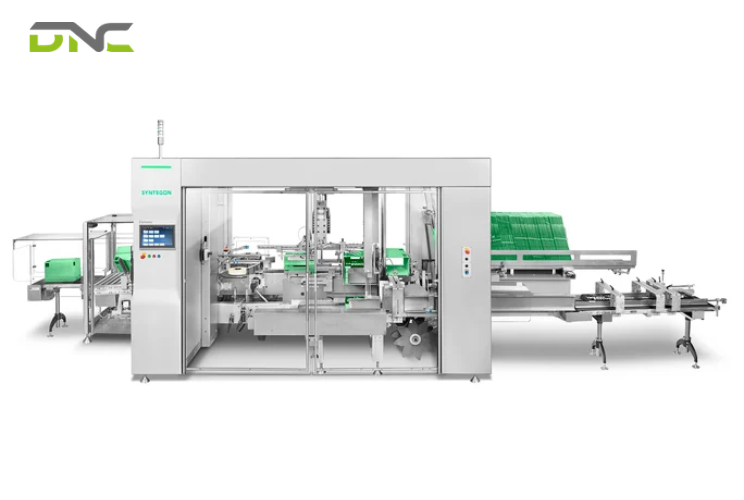
RSC Case Packer vs. Wraparound Case Packer: The Format Decision
Malaysian manufacturers choosing between RSC and wraparound corrugated case formats face a cost-versus-flexibility tradeoff:
| Factor | RSC Case Packer | Wraparound Case Packer |
| Case cost per unit | Higher (pre-formed case) | Lower (flat blank, less board) |
| Machine complexity | Lower (no case-forming from flat) | Higher (blank forming integrated) |
| Case size flexibility | Higher (change RSC size from magazine) | Lower (blank dimensions fixed) |
| Storage space (cases) | More (pre-formed KDF cases) | Less (flat blanks stack tighter) |
| Separate sealer required | Yes | No (seal integrated in wraparound) |
| Best volume | Low-to-medium | Medium-to-high |
For Malaysian manufacturers running relatively low annual case volumes (under 500,000 cases/year) with multiple case sizes, RSC format typically costs less overall despite the higher per-case material cost — because the machine is simpler and the case size flexibility is more easily managed.
For high-volume, dedicated-SKU lines, wraparound cases reduce corrugated board cost by 15–25% annually — a significant saving at 2–5 million cases per year.
Case Magazine Design and Capacity
The RSC case packer’s magazine holds KDF cases and feeds them one at a time to the case erector. Magazine design affects how frequently operators need to replenish the case supply — a higher magazine capacity means fewer interventions per shift.
Standard magazine capacity: 50–150 cases depending on machine model and case dimensions.
Magazine replenishment frequency: At 20 CPM with a 100-case magazine, replenishment is required every 5 minutes. This demands a dedicated case loading operator if the magazine is not automated.
Automatic magazine systems: High-speed RSC case packers can integrate automatic case magazine feeders — robotic or mechanical — that maintain a continuous supply of KDF cases to the machine without operator intervention. DNC Automation integrates automatic magazine systems where case loading frequency would otherwise require dedicated operators.
Integration Requirements for RSC Case Packers
Case Erection Quality
The RSC case packer’s case erector must produce square, fully erected cases with correct bottom flap sealing. Poor case erection — cases that are not square, have incompletely sealed bottom flaps, or have torn board at the erection point — causes loading failures and downstream case sealer jams.
Key erection quality parameters to verify during commissioning:
- Case squareness: <2 mm diagonal difference
- Bottom flap seal strength: 24-hour carton compression test after sealing
- Erection cycle reliability: <0.5% erection failure rate at rated CPM
Downstream Case Sealer Interface
RSC case packers discharge filled cases to a case sealer for top flap folding and sealing. The interface requires:
- Conveyor height match: Case packer discharge height = case sealer infeed height ±5 mm
- Case orientation match: Cases exit the RSC packer with a specific leading edge. The case sealer infeed guide must accept this orientation.
- Speed match: Case sealer infeed conveyor speed at least equal to the RSC packer discharge speed
PLC Integration
For Malaysian manufacturers implementing smart factory principles, the RSC case packer’s PLC integrates with the facility control system to report:
- Cases per hour (CPM trend)
- Case magazine low-level alert (triggers operator for replenishment)
- Erection failure counts
- Production order case count
DNC Automation implements PLC and SCADA integration for RSC case packers as part of the turnkey project scope.
RSC Case Quality: Specifications That Affect Machine Performance
The RSC case packer’s performance depends heavily on the quality and dimensional consistency of the corrugated cases it processes. Malaysian corrugated box manufacturers vary significantly in their production quality — and low-quality cases are the most common source of case packer stoppages that are incorrectly attributed to the machine.
Critical RSC Case Specifications
Squareness tolerance: A correctly manufactured RSC should have a diagonal dimension difference of less than 3 mm (measured corner to corner across the open top). Cases outside this tolerance fail to erect squarely, causing the product loading system to mis-align relative to the case opening and either jamming the loading head or producing incorrectly loaded cases.
Score line depth and position: The fold lines (score lines) on an RSC case must be at the correct depth — deep enough to fold cleanly, but not so deep that they weaken the board. Shallow score lines require higher force to fold, straining the case erector mechanism. Over-scored lines collapse under compression during shipment.
Moisture content: Malaysian ambient humidity affects corrugated board moisture content. Board above 10% moisture content loses stiffness — cases that feel firm in an air-conditioned warehouse may become limp in a factory environment running at 80%+ relative humidity. Limp board fails to erect squarely and collapses under product weight during loading.
Glue line quality on pre-glued cases: The manufacturer’s joint — the glued seam that holds the RSC in its knocked-down flat form — must withstand the erection force without delaminating. Weak manufacturer’s joints are the second most common cause of RSC case packer erection failures.
Recommendation: DNC Automation advises Malaysian manufacturers to qualify their corrugated box supplier’s RSC cases against the case packer’s specification before production commitment. We provide a case acceptance test protocol — a 10-minute manual test procedure — that identifies dimensional and quality issues before they create production stoppages.
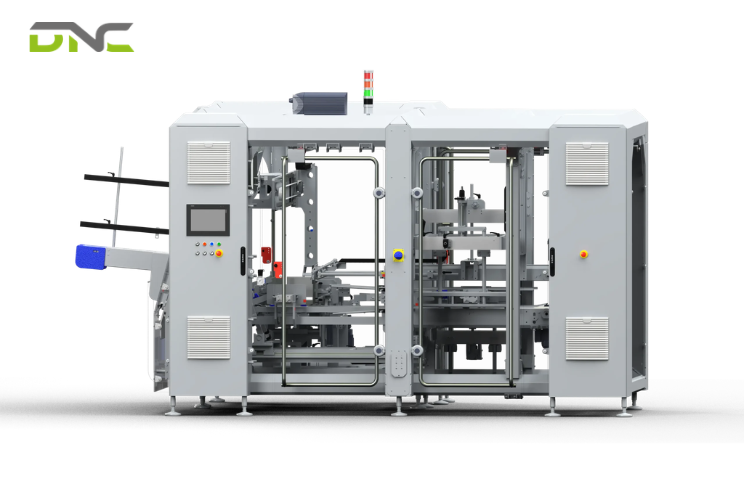
Cost Analysis: RSC Case Packer Investment and Running Costs
Capital Cost
RSC case packer machine costs in Malaysia vary with configuration, throughput, and automation level:
| Configuration | Typical Capital Cost (RM) |
| Semi-automatic RSC case packer | 25,000–60,000 |
| Automatic top load RSC (intermittent) | 80,000–180,000 |
| Automatic side load RSC (continuous) | 120,000–300,000 |
| Robotic RSC top load (single robot) | 180,000–400,000 |
These figures represent machine cost only. Add 15–25% for infeed handling system design and fabrication, plus 10–15% for commissioning and training — total installed cost typically runs 25–40% above machine purchase price.
Running Costs
Corrugated case material cost is the largest ongoing variable in RSC case packing operations. At RM 0.80–2.50 per RSC case (depending on size, board grade, and order volume), a line running 20 CPM on a two-shift operation consumes 19,200 cases per day — representing RM 15,360–48,000 in daily material cost. Even a 5% reduction in case cost through supplier negotiation or specification optimisation saves RM 280,000–876,000 annually.
Maintenance cost for an automatic RSC case packer running two shifts: approximately RM 15,000–35,000 per year in parts and labour, depending on throughput speed and machine complexity. Robotic configurations add robot maintenance costs (servo drive inspection, joint lubrication, calibration) estimated at RM 10,000–20,000 per robot per year.
Energy cost: Standard electric case packers draw 3–8 kW depending on size and configuration. At Malaysian Tenaga Nasional Berhad industrial tariff (approximately RM 0.35–0.45/kWh for peak demand), annual energy cost runs RM 9,000–25,000 per machine on a two-shift operation.
ROI Framework
The primary ROI driver for RSC case packer automation in Malaysia is labour elimination at the packing station. A manual RSC case packing operation with 3 workers per shift (case opening, product loading, case closing) on two shifts:
- Annual labour cost: RM 6 workers × RM 30,000/year = RM 180,000/year
- Automatic RSC case packer: 1 monitoring operator per shift = RM 60,000/year
- Net annual saving: RM 120,000/year
- Payback on RM 150,000 machine + RM 40,000 installation: < 16 months
Available MIDA and SME Corp automation grants reduce effective capital outlay by 20–40%, compressing the payback period further for qualifying Malaysian manufacturers.
Malaysian Industry Applications for RSC Case Packers
Food and Beverage — Johor and Selangor Operations
Malaysian food manufacturers in Johor’s Pasir Gudang industrial estate and Selangor’s Shah Alam and Klang corridor use RSC case packers on dedicated product lines. F&B-specific requirements: IP65 electrical enclosures for cleaning compatibility, stainless steel product contact surfaces for HACCP compliance, and case packer integration with upstream labelling and coding lines.
A typical Malaysian sauce or condiment manufacturer running 15 CPM on two shifts packs approximately 14,400 cases per day. RSC format is standard for these operations because the varied sauce bottle sizes — 200 ml, 500 ml, 1 L SKUs — are accommodated by adjustable RSC magazine settings without case format changes.
Pharmaceutical Secondary Packaging
Malaysian pharmaceutical manufacturers — producing OTC medicines, health supplements, and medical devices for export — use RSC case packers for secondary packaging. Individual medicine cartons are counted and top-loaded into RSC shipper cases; the RSC format is universal in pharmaceutical distribution chains.
Key requirement: electronic batch record keeping. The RSC case packer’s PLC must record case count per batch, time stamps, and operator ID — all of which feed into the pharmaceutical traceability system. DNC Automation configures this data capture as part of pharmaceutical case packer commissioning.
Warehouse and E-Commerce Fulfilment
Malaysian e-commerce fulfilment operations in Selangor’s logistics hubs use RSC case packers to handle the case format variety inherent in multi-SKU order fulfilment. Random automatic RSC case packers accommodate the size variation; robotic case packers handle the product type variation without mechanical changeover. RSC format is the standard fulfilment case in Malaysian last-mile logistics — all major courier and 3PL operators in Malaysia handle RSC cases on their automated sortation systems.
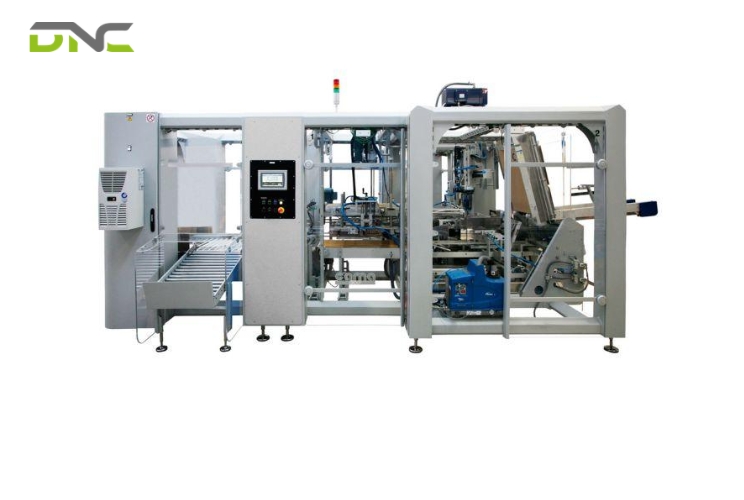
RSC Case Packer Throughput Optimisation
Running an RSC case packer at its rated CPM requires the surrounding line infrastructure to support that speed consistently. Three bottlenecks account for most RSC case packer throughput shortfalls in Malaysian manufacturing environments:
Case magazine capacity mismatch: At 20 CPM with a 60-case magazine, the magazine empties in 3 minutes — requiring a dedicated case loader whose replenishment pace must not fall below the machine’s consumption rate. If the case loader is also performing other tasks (a common Malaysian factory floor reality), case magazine starvation reduces effective throughput by 10–20%. Solutions: increase magazine capacity, add automatic case feeding, or schedule dedicated case loading coverage during peak production hours.
Upstream product accumulation: RSC case packers receive products from upstream equipment — fillers, primary packers, labellers. If the upstream equipment speed is variable (common in manual packing operations), the case packer starves during slow periods and accumulates product during fast periods. A buffer conveyor between the upstream equipment and the case packer infeed smooths this variation. Size the buffer for 3–5 minutes of production at maximum upstream speed.
Case erection quality at high speed: At speeds above 25 CPM, RSC case erection quality requirements become more stringent — a slightly out-of-square case that causes no problem at 15 CPM creates a jam at 30 CPM because there is less time for the guides to correct the misalignment before the loading stroke begins. At high-speed operation, corrugated box supplier qualification becomes critical. DNC Automation recommends running a 500-case erection quality trial at rated speed before production acceptance sign-off.
Maintenance Schedule for RSC Case Packers
Preventive maintenance discipline is the primary factor separating RSC case packer operations with 95%+ uptime from those with chronic stoppages. DNC Automation provides documented maintenance schedules with every installation:
| Frequency | Task |
| **Daily** | Clean case magazine, check glue nozzles (if bottom flap glue sealing), verify erection arm motion, inspect conveyor belt condition |
| **Weekly** | Lubricate chain drives and cam followers, check vacuum cup condition (if vacuum erection), verify sensor alignment, inspect magazine low-level switch |
| **Monthly** | Full mechanical inspection — check all fasteners, guide rail alignment, pusher stroke calibration; verify PLC battery backup |
| **Quarterly** | Replace worn vacuum cups, inspect pneumatic cylinder seals, calibrate case height/width sensors, clean electrical enclosure filters |
| **Annually** | Full overhaul — replace worn belts and chains, inspect motor bearings, update PLC firmware if applicable, re-commission case acceptance test |
RSC case packers in Malaysian factory environments face specific maintenance challenges: paper dust from corrugated board accumulates in sensor optics and conveyor drives; high ambient humidity accelerates corrosion on exposed carbon steel components; three-shift operations require machines specified for continuous duty cycles. DNC Automation’s maintenance schedules account for these Malaysian-specific conditions.
Corrugated Box Supplier Management for RSC Case Packer Operations
Malaysian corrugated box suppliers — the manufacturers of the RSC cases your case packer processes — vary significantly in production quality. Managing this supply chain is as important as maintaining the case packer itself, because poor-quality cases are the most common external cause of machine stoppages.
Supplier Qualification Criteria
Before approving a corrugated box supplier for production use on an automated RSC case packer, evaluate:
Dimensional consistency: Sample 30 cases from 3 different production batches. Measure length, width, and height of each. Acceptable standard deviation: <2 mm per dimension. Suppliers with dimensional standard deviation above 3 mm create frequent case erection failures at the case packer.
Board moisture content: Test with a moisture meter. Acceptable range: 6–10%. Above 10%, board softens and cases lose structural integrity during erection. Below 5%, board becomes brittle and creases at score lines instead of folding cleanly.
Manufacturer’s joint strength: Pull the KDF case open and close 5 times by hand. The manufacturer’s joint (the glued seam) must not delaminate under this manual test. Joints that fail manual cycling will fail under the case packer’s automated erection force.
Board ECT (Edge Crush Test): Verify the board ECT rating matches your case weight specification. Malaysian corrugated board suppliers sometimes substitute lower-specification board during raw material shortages without notifying customers. Periodic ECT spot-checks (quarterly) protect against this.
Managing Multiple Suppliers
Malaysian manufacturers who qualify two corrugated box suppliers — maintaining an approved supplier list rather than single-sourcing — reduce supply disruption risk significantly. The second supplier’s cases must be qualified on the actual case packer before approval, as dimensional differences between suppliers (even if both are “within specification”) sometimes require minor machine adjustment.
DNC Automation recommends running a 200-case erection quality trial at rated speed for each supplier’s cases whenever a new supplier is qualified or a supplier changes their corrugated board raw material. This 20-minute trial identifies incompatibilities before they create production stoppages.
Frequently Asked Questions
What does RSC stand for in case packing?
RSC stands for Regular Slotted Container — the most common corrugated shipping case format in Malaysian manufacturing and logistics. An RSC has four top flaps and four bottom flaps of equal depth that meet at the case centre when folded closed.
How does an RSC case packer differ from a case packer that uses flat blanks?
An RSC case packer uses pre-formed, pre-glued cases stored flat (knocked-down) in a magazine. A wraparound case packer uses flat corrugated blanks — unformed sheets — that the machine wraps around the product group. RSC packers are more flexible for case size variation; wraparound packers use less corrugated board per case.
What case sizes can an RSC case packer handle?
RSC case packer size ranges depend on the machine model. Most industrial RSC case packers handle cases from approximately 200 mm × 150 mm × 100 mm minimum to 600 mm × 400 mm × 400 mm maximum. Size changes within this range require mechanical adjustment of the case magazine and loading guides.
How many cases can an RSC case packer hold in its magazine?
Standard magazines hold 50–150 KDF cases depending on case dimensions and machine model. Larger cases reduce the number that fit in the magazine; smaller cases allow more per magazine fill. Replenishment frequency depends on magazine capacity and machine throughput speed.
Does DNC Automation supply RSC case packers for Malaysian manufacturers?
DNC Automation integrates RSC case packers as part of end-of-line automation projects. Our engineering team selects the appropriate machine configuration (top load, side load, or robotic), designs the infeed handling and downstream case sealer interface, commissions the PLC integration, and delivers the complete system as a working production line rather than individual equipment.
Integrate an RSC Case Packer into Your Production Line
RSC case packer selection, infeed design, and downstream integration require engineering assessment of your specific production scenario. DNC Automation conducts this assessment as a pre-project consultation — at no cost to Malaysian manufacturers evaluating end-of-line automation.
Talk to Our Engineers — describe your RSC packing requirement, case dimensions, and throughput target. We respond within 3 working days.
- 47 views
- 0 Comment
Recent Comments