


Cobot and Industrial Robot Palletizers: Definitions and Architecture
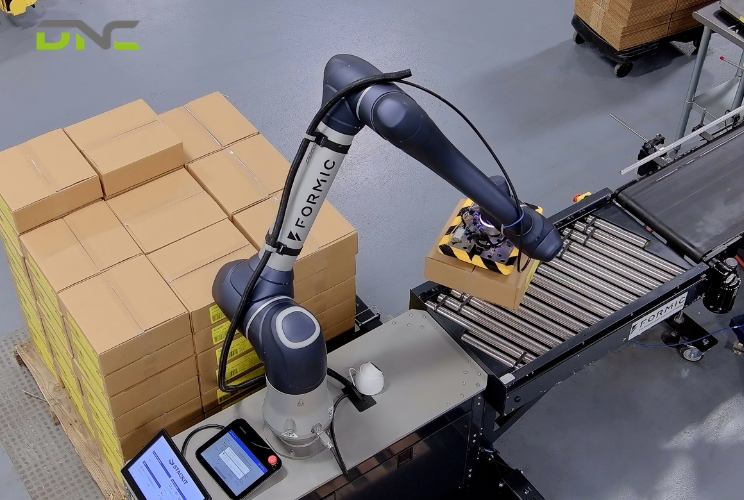
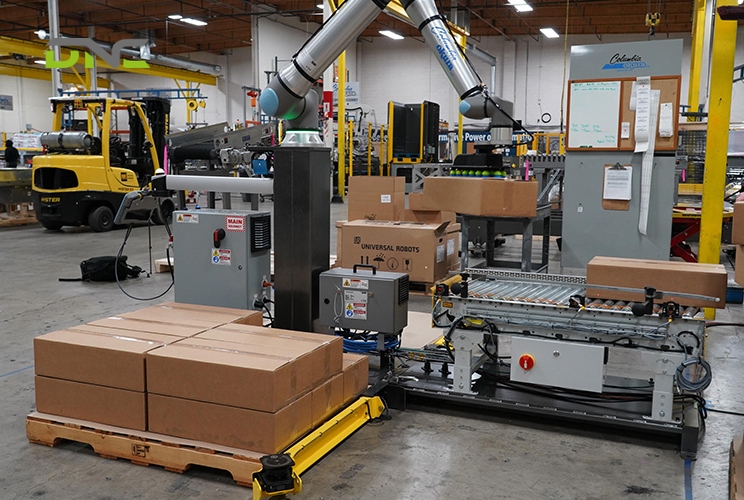
A cobot palletizer uses a collaborative robotic arm – a six-axis articulated arm built with integrated force-limiting sensors, torque monitoring on each joint, and collision detection – mounted at a workstation shared with or adjacent to human operators. The arm’s embedded safety systems allow it to slow down or stop when it detects unexpected contact force, reducing the injury risk of human-robot proximity at low speeds and light loads. Cobots used for palletizing typically carry payloads from 5 to 35 kg, with the 10 to 20 kg range covering most light-carton and light-case palletizing applications.
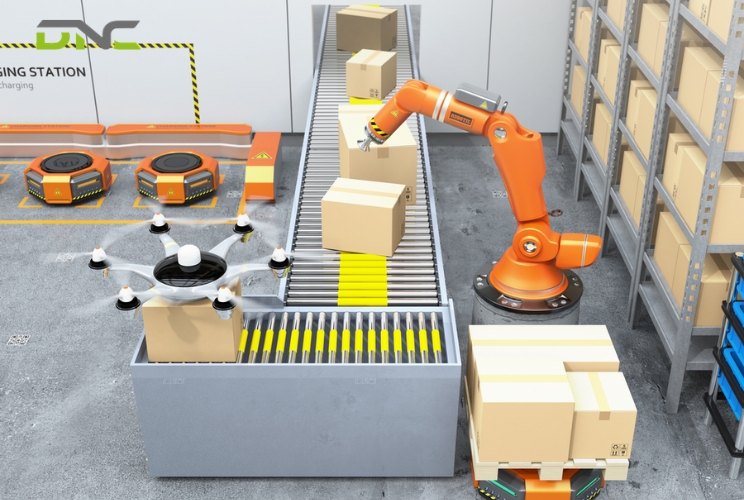
An industrial robot palletizer uses a purpose-built robotic arm – most commonly a four-axis or six-axis articulated configuration – engineered for continuous high-speed, high-payload operation without inherent safety limitations. These systems operate behind full perimeter guarding or area scanners, with no shared workspace with human operators during active cycles. Payload ranges for industrial palletizing robots run from 40 kg to over 500 kg, with specialist models handling up to 2,300 kg in heavy-industry applications.
The table below lists the core specification ranges that drive the selection decision:
| Attribute | Cobot Palletizer | Industrial Robot Palletizer |
| Payload range | 1–35 kg (palletizing sweet spot: 5–20 kg) | 40–500 kg standard; up to 2,300 kg specialist |
| Axes | 6 (articulated) | 4 or 6 (articulated) |
| Throughput (palletizing) | Up to 9–10 cpm; real-world often 5–8 cpm | 8–12 cpm standard; multi-pick: 16–48+ cpm |
| Pallet height reach | Typically max 2.2–2.4 m; lifting column needed above this | Full coverage to 2.5 m+ standard |
| Safety architecture | Integrated force-limiting sensors; area scanners still required at palletizing loads | Full perimeter guarding or area scanners required |
| Programming method | Teach-by-demonstration; operator-guided | Software-programmed; modern palletizing software reduces complexity |
| Arm weight | 25–75 kg (portable, fast installation) | 150 kg+ (fixed base, engineered installation) |
The fundamental difference is the operating envelope: cobots are designed for human proximity at low speed and payload; industrial robots are designed for maximum throughput and payload without proximity constraints. Every downstream difference in cost, footprint, safety requirements, and industry fit follows from this architectural distinction.
Payload Capacity and Product Handling Range
Payload capacity is the first specification to confirm – before throughput, before cost, before footprint. A system that cannot handle the product weight cannot be specified, regardless of every other advantage.
Cobot palletizers perform reliably with products weighing up to 20 kg per pick cycle. The 5 to 20 kg range covers light cartons, small corrugated cases, pharmaceutical boxes, electronics packaging, and light retail packs – a broad range of product formats in Malaysian light manufacturing and distribution. Performance degrades as loads approach the cobot’s rated maximum; a cobot rated at 25 kg operating consistently at 23–24 kg will cycle slower and accumulate joint wear faster than the same system at 15 kg.
Industrial palletizing robots maintain full rated performance across their entire payload range. A robot specified for 120 kg handles both 20 kg cartons and 100 kg sacks at the same cycle rate, with no speed degradation as load increases. This consistency proves critical for operations with variable product weights, seasonal product changes, or future production expansion requiring heavier formats.
Gripper compatibility further defines the effective payload range. Cobots are typically limited to vacuum-cup end-of-arm tooling – other gripper types (mechanical clamps, layer-forming grippers, row grippers) exceed the cobot’s payload capacity when added to the product weight. Industrial robots accommodate the full gripper menu: vacuum cups, mechanical clamps, bag grippers, layer-forming heads, row grippers, and magnetic tools – enabling palletizing of bags, bottles, sacks, drums, open-top crates, shrink-wrapped bundles, and cans from a single installation.
For Malaysian rubber glove manufacturers palletizing standardized cartons at 8–12 kg, cobots are technically capable on payload. For edible oil producers palletizing 25 kg (55 lb) bulk bags or 20-litre (20.5 kg / 45 lb) containers, industrial robots are the only viable specification.
Speed and Throughput Ceiling
Throughput ceiling – not just rated speed, but real-world palletizing output over a full production shift – is the second parameter that eliminates one system from contention in most medium-to-high volume applications.
Cobot Throughput: The Practical Range
Cobot palletizers rarely exceed 9 to 10 cycles per minute under real production conditions, even on the fastest available models. The force-limiting safety architecture imposes acceleration constraints that cap joint speed – this is a design requirement, not a product limitation that future models will eliminate. At heavier payloads within the cobot’s rated range (20–35 kg), throughput drops further as the controller reduces speed to maintain safe force thresholds.
In practice, most cobot palletizing installations operate at 5 to 8 cycles per minute for standard carton formats. For facilities producing 4 to 6 pallets per hour per line, this throughput range is adequate. For facilities requiring 8 pallets per hour or more, the cobot creates a palletizing bottleneck that limits the entire production line output – regardless of how efficiently the upstream processes operate.
Industrial Robot Throughput: The Production Floor Reality
Industrial palletizing robots deliver 8 to 12 cycles per minute consistently, with no speed reduction at higher payloads. Four-axis industrial palletizing arms running multi-pick grippers – row grippers that lift an entire row of cartons simultaneously, or layer-forming heads that pick a full pallet layer – multiply effective throughput by two to four times the single-pick rate. A 10 cpm robot with a four-unit row gripper delivers the equivalent of 40 single picks per minute.
This multi-pick capability has no cobot equivalent. The payload and inertia requirements of row and layer grippers are incompatible with cobot force-limiting architecture.
The economic crossover is at approximately 8 to 10 cycles per minute. Below 8 cpm, cobot and industrial robot total cost of ownership are comparable, and the cobot’s lower capital and simpler maintenance favour lighter applications. Above 8 to 10 cpm, industrial robots achieve lower cost per cycle – and the advantage compounds over a five-year ownership period as the throughput difference accumulates in lost production value.
Safety Requirements and Floor Space
The most persistent misconception in cobot palletizer discussions requires direct correction before any cost or footprint comparison is valid.
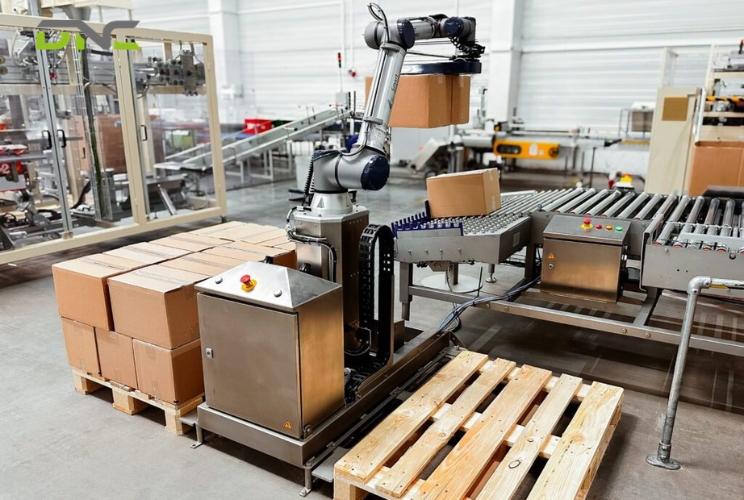
Cobots do not eliminate safety fencing in palletizing applications. The “collaborative” designation applies to light-duty, slow-speed, low-force operations – typically pick-and-place tasks under 5 kg at speeds slow enough to stop before injury-causing contact force is reached. The moment a cobot lifts palletizing loads (typically 8 kg and above) at palletizing speeds, it generates forces sufficient to cause pinch-point injuries during product placement and stopping distances too long to arrest movement before contact injury occurs.
Under the Machinery Directive and applicable safety standards, cobot palletizer installations handling products above approximately 5 kg at normal palletizing speeds require area scanners or guarding that is functionally equivalent to industrial robot safety systems. The granting of “collaborative” status to the arm itself does not exempt the complete palletizing cell from risk assessment and guarding requirements. Every cobot palletizer installation should be individually risk-assessed under the applicable machinery directive before commissioning.
In practice, the floor space difference between a cobot palletizer cell and an industrial robot palletizer cell is narrower than marketing materials suggest. A cobot cell with area scanners occupies approximately 2 to 3 square metres (21 to 32 sq ft) of exclusion zone around the arm. An industrial robot cell with full perimeter guarding occupies more floor area in absolute terms – but the industrial robot covers multiple pallet positions, multiple infeed lines, and higher stack heights from that cell, delivering more palletizing capacity per square metre of factory floor than a single-position cobot installation.
Where floor space is genuinely critical – brownfield installations with constrained layout, or facilities adding a single palletizing position to an existing line – a cobot with area scanners remains a viable option if the payload and throughput requirements fit.
Programming, Setup, and Changeover Time
Programming and setup time affect two separate cost categories: initial commissioning time and ongoing changeover time when product formats change. Cobots hold an advantage on both, though the gap has narrowed.
Initial Programming
Cobot palletizers support teach-by-demonstration programming: an operator physically guides the arm through the desired pick and placement positions, and the system records the path. This creates pallet stack programs without traditional code – a significant reduction in commissioning time and a meaningful advantage in facilities where engineering resources are limited. Initial cobot programming for a standard carton pallet pattern typically takes a few hours to a day.
Industrial robot palletizers have traditionally required trained robotics programmers for initial setup – a meaningful barrier for first-time automation buyers. Modern palletizing software platforms have substantially reduced this gap. Graphical pallet pattern editors, offline simulation tools, and point-and-click setup interfaces now bring industrial robot commissioning times close to cobot timelines for standard applications. The complex programming burden of industrial robots applies primarily to non-standard product handling, complex multi-line cells, and custom gripper configurations.
Product Changeover
Both systems handle product changeovers through software program recall – switching between saved pallet patterns requires minutes on either system, not mechanical adjustment. For standard carton format changes within the same product family, neither system holds a material advantage.
Where cobots retain an advantage: adding a completely new product format requiring a new teach-in. A non-specialist operator can teach the cobot a new product without engineering support. An industrial robot adding a new product format to a complex multi-line cell typically requires an integrator’s involvement if the new format falls outside the existing program library.
For Malaysian manufacturers new to automation – facilities commissioning their first palletizing system without an in-house robotics team – the cobot’s accessible programming significantly reduces the risk of the first project. This is the strongest practical argument for the cobot as an entry-point automation investment.
Total Cost of Ownership: Capital, Maintenance, and ROI
Total cost of ownership for cobot and industrial robot palletizers diverges in three components: capital cost, maintenance cost, and the throughput-driven value of every production hour. The headline capital comparison frequently misleads buyers who do not account for all three.
Capital Cost
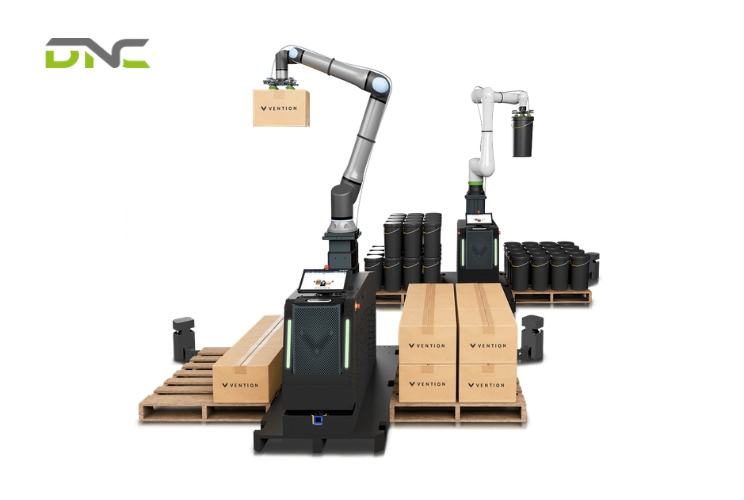
Cobot palletizers carry lower upfront capital cost for light-load, single-position applications. The arm itself, the EOAT, and the control system together typically represent a lower initial investment than an equivalent industrial robot cell. However, the total installed cost includes guarding or area scanners, conveyor interfaces, and integration engineering – and these costs apply to both systems. For small single-position cells, the cobot capital advantage is real. For larger cells covering multiple lines or pallet positions, the capital gap narrows.
Maintenance and Lifecycle Cost
Cobots are lightweight systems built for low-force operation; continuous palletizing at the upper end of their payload range accelerates mechanical wear and reduces service life relative to the same operation on an industrial robot. Industrial palletizing robots are purpose-built for continuous heavy-duty cycling – decades of refinement in this specific application have produced predictable maintenance schedules and documented service life exceeding 80,000 to 100,000 operating hours in standard configurations.
Cobot maintenance is generally accessible to non-specialist technicians. Industrial robot maintenance at the joint level requires certified robotics service expertise – the same regional access limitation that applied to gantry vs robotic arm selection applies here.
ROI and Throughput Value
For operations running below 8 cycles per minute with consistent light products, cobot and industrial robot ROI profiles are comparable – both systems return investment within two to four years in Malaysian manufacturing at current labor costs. Above 8 cpm, the industrial robot’s throughput advantage compounds: every additional unit produced per shift adds to the ROI numerator, and the industrial robot produces more units per hour for the lifetime of the system.
DNC’s engineering experience across 1,000+ projects in Malaysian manufacturing shows that correctly specified systems of both types achieve two-to-four-year payback. Misspecification – a cobot on a 12-cpm line that then becomes the production bottleneck, or an industrial robot specified for a 4-cpm light-product application at unnecessary capital cost – adds 12 to 18 months to the payback period.
Industry Applications in Malaysian Manufacturing
Industry fit for cobot and industrial robot palletizers in Malaysia maps primarily to product weight, production volume per shift, and whether the facility is entering automation for the first time or scaling an already-automated operation.
Cobot Palletizer Best-Fit Industries
Pharmaceutical and nutraceutical packaging represents the strongest cobot fit in Malaysia. Products are typically light (individual boxes 0.5–3 kg, multi-pack cartons 5–12 kg), production speeds are moderate, and product variety is high – cobots handle the multi-SKU flexibility requirement well, and the accessible programming supports frequent format changes without specialist engineering involvement. Malaysian pharmaceutical manufacturers in Selangor and Kuala Lumpur represent an active segment for cobot palletizing deployment.
Electronics and semiconductor end-of-line packaging shares the same profile: light products, precision placement requirements, frequent product variant changes, and facilities already accustomed to collaborative work between operators and automation. Cobots manage delicate component boxes and retail electronics packaging within their payload range without the over-specification cost of a heavy industrial robot.
Light food and beverage packaging – snack formats, single-serve beverage multipacks, condiment packs – fits the cobot payload range when individual carton weights stay below 15 kg. For Malaysian F&B manufacturers exploring automation for the first time under NIMP 2030 incentives, a cobot palletizer represents a lower-capital, faster-deployment entry point that demonstrates automation ROI before a full industrial robot cell commitment.
Industrial Robot Palletizer Best-Fit Industries
Rubber glove manufacturing – Malaysia’s single largest palletizing application by volume – requires industrial robot specifications. Throughput on glove carton lines routinely exceeds 12 cases per minute per line; carton weights at 8–15 kg per box are within cobot range but throughput requirements are not. Malaysia produces more than 60% of the world’s latex gloves; every major glove manufacturer in Klang Valley operates industrial palletizing robots on their primary lines.
Edible oil and palm oil packaging demands industrial specifications on payload alone. Five-litre jerry cans (5.2 kg / 11.5 lb per unit), 20-litre containers (20.5 kg / 45 lb), and 25 kg (55 lb) bulk bags all exceed the cobot’s reliable operating range. The palletizing speed requirements of these lines – continuous single-format, high-volume output – further confirm the industrial robot as the correct specification.
Cement, fertiliser, and bulk chemical packaging in 25 kg (55 lb) to 50 kg (110 lb) bag formats operates exclusively in industrial robot territory. No cobot is specified for these applications.
High-volume F&B manufacturers – major beverage producers, large-scale snack manufacturers, and FMCG facilities running three shifts – need industrial robot throughput. For these operations, the cobot’s modest cycle rate creates production constraints that offset every other advantage the collaborative format offers.
Cobot vs Industrial Robot Selection Framework
Selecting between a cobot and an industrial robot for palletizing requires evaluating four parameters in sequence. DNC’s specification process applies this framework on every palletizing project brief – the sequence matters, because earlier parameters eliminate one option before later parameters are relevant.
Parameter 1 – Payload per pick cycle
Confirm the maximum product weight the palletizer must handle, including the EOAT weight on the cobot’s payload budget. If any product in the production mix exceeds 20 kg per pick, specify an industrial robot – a cobot operating consistently above 20 kg degrades in speed, increases joint wear, and creates service reliability issues that accumulate over the ownership period. If all products stay below 20 kg, proceed to Parameter 2.
Parameter 2 – Required throughput
If the production line requires more than 8 cycles per minute to avoid creating a palletizing bottleneck, specify an industrial robot. Below 8 cpm, both systems are operationally viable and the decision shifts to Parameters 3 and 4. The 8 cpm threshold is a specification boundary, not a preference – facilities that specify a cobot at 10 cpm required throughput discover the production ceiling within the first operating month.
Parameter 3 – SKU variety and changeover frequency
High SKU variety (three or more distinct product formats per shift) and frequent changeovers (more than twice per week) favour the cobot’s accessible reprogramming over the industrial robot’s more complex program management in facilities without dedicated robotics engineering support. However, if Parameters 1 or 2 have already resolved to an industrial robot, modern palletizing software handles this requirement adequately.
Parameter 4 – Automation entry point or scale-up
For Malaysian manufacturers commissioning their first palletizing system – particularly SMEs qualifying for NIMP 2030 Smart Automation Grants – the cobot offers a lower-capital, faster-deployment entry point that reduces the first-project risk and builds in-house automation competency before a larger industrial robot investment. For facilities already operating automated equipment with in-house robotics capability, this parameter carries less weight.
NIMP 2030 consideration: Both cobot and industrial robot palletizing installations qualify for Malaysia’s Industry 4.0 capital investment incentives under MIDA’s Smart Automation Grant framework, provided the specification documentation demonstrates operational fit. The cobot’s lower capital cost may allow a smaller facility to meet the grant’s minimum qualifying investment threshold at lower total outlay. DNC’s turnkey palletizing integration includes the engineering specification and commissioning documentation required for MIDA grant applications as a standard project deliverable.
For facilities integrating the palletizer into a broader warehouse automation strategy – including automated conveyor staging, buffer zones, and stretch wrapping – the selection framework connects directly into the end-of-line specification that determines whether the palletizer output rate is matched to downstream storage and dispatch systems.
Talk to our engineers about specifying the right palletizing system for your production profile – get a free consultation.
Frequently Asked Questions
Cobot and industrial robot palletizers serve the same end function – stacking products onto pallets for storage or dispatch – but through architecturally different systems that produce distinct performance profiles. The following questions address the comparison criteria most frequently raised in DNC’s specification consultations.
What is the main difference between a cobot and an industrial robot for palletizing?
A cobot palletizer uses integrated force-limiting sensors to allow lower-speed, lower-payload operation with reduced guarding requirements at light loads; an industrial robot operates at full speed and payload without safety constraints, behind full perimeter guarding. The cobot’s collaborative architecture caps its speed and payload; the industrial robot’s enclosed architecture removes both ceilings. Every performance, cost, and application difference follows from this architectural distinction.
Do cobot palletizers need safety fencing?
Yes – in most palletizing applications. The “collaborative” designation applies to light-duty slow-speed operation. When a cobot palletizer handles products above approximately 5 kg at normal palletizing speeds, the forces involved exceed safe contact thresholds and the stopping distances are insufficient to prevent pinch-point injuries at placement positions. Under applicable machinery safety standards, cobot palletizer installations at normal palletizing payloads and speeds require area scanners or guarding equivalent to industrial robot cells. Every cobot palletizer installation must be individually risk-assessed before commissioning.
Which system is faster – cobot or industrial robot?
Industrial robots are faster in most palletizing applications. Cobots are limited to approximately 9 to 10 cycles per minute by their safety architecture, with real-world rates often between 5 and 8 cpm. Industrial robots deliver 8 to 12 cpm consistently, with multi-pick grippers multiplying effective throughput two to four times. The economic crossover is at 8 cpm: below that rate, cobot and industrial robot total cost of ownership are comparable; above it, industrial robots achieve lower cost per cycle over the ownership period.
When is a cobot the right choice for palletizing in Malaysia?
A cobot palletizer is the right specification when all three conditions apply: product payload consistently below 20 kg, throughput requirement below 8 cycles per minute, and the facility is either entering automation for the first time or handling high SKU variety without dedicated robotics engineering support. Malaysian pharmaceutical manufacturers, electronics packagers, and light F&B producers with these production profiles represent strong cobot fit scenarios, particularly when NIMP 2030 grant constraints favour lower initial capital.
What is the ROI period for a cobot or industrial robot palletizer in Malaysia?
Correctly specified systems of both types return investment within two to four years in Malaysian manufacturing at current labor costs. A cobot specified for a low-throughput, light-payload application and an industrial robot specified for a high-throughput, heavy-payload application both achieve this payback range. Misspecification – a cobot placed on a line requiring more than 8 cpm, or an industrial robot sized for a 4-cpm light-product application – extends payback by 12 to 18 months through either production bottlenecking or unnecessary capital expenditure.
Can both systems qualify for NIMP 2030 automation grants in Malaysia?
Yes. Both cobot and industrial robot palletizing installations qualify as Industry 4.0 capital investments under MIDA’s Smart Automation Grant framework. The qualifying criteria relate to the system’s demonstrated fit to the production process and its contribution to productivity improvement – not the type of robot arm used. DNC provides the engineering specification and commissioning documentation required for grant applications as a standard deliverable on every palletizing project. For Malaysian SMEs with tighter capital budgets, the cobot’s lower installed cost may allow the project to meet the minimum investment threshold at lower total outlay.
- 35 views
- 0 Comment
Recent Comments