


Robotic Arm vs Gantry Palletizer: Choosing the Right System for Your Production Line
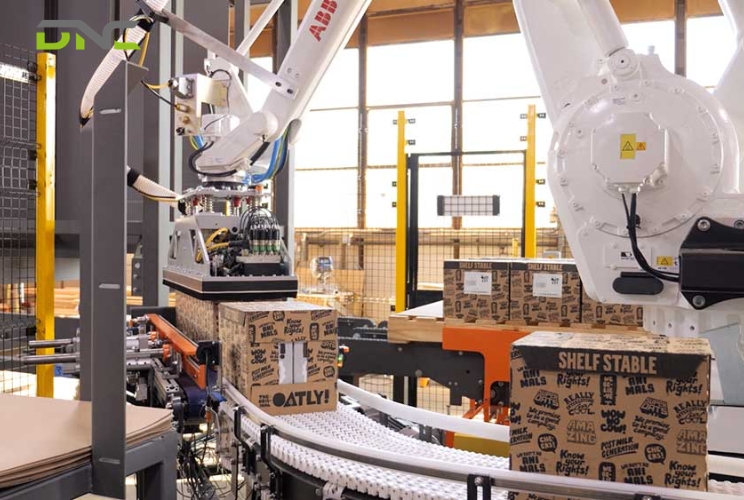
Selecting between a gantry palletizer and a robotic arm palletizer – and choosing the right system for your production line – is one of the highest-stakes decisions in an end-of-line automation project – the wrong specification adds 12 to 18 months to the payback period and, in space-constrained facilities, triggers retrofit costs that compound the delay. From an integration specification standpoint, the decision reduces to four facility variables: SKU count per shift, required throughput, available floor area, and in-house maintenance capability. DNC Automation has specified both system types across more than 1,000 projects in Malaysian manufacturing, and the selection consistently depends on the production line profile – not on which technology is newer.
This guide compares gantry and robotic arm palletizers across eight criteria – motion geometry, throughput ceiling, product flexibility, floor footprint, total cost of ownership, maintenance profile, industry fit, and a selection framework calibrated for Malaysian production lines in sectors including rubber gloves, edible oils, F&B, and pharmaceuticals. The framework applies whether your facility runs single-SKU carton lines in Selangor or multi-format export packaging in Johor Bahru.
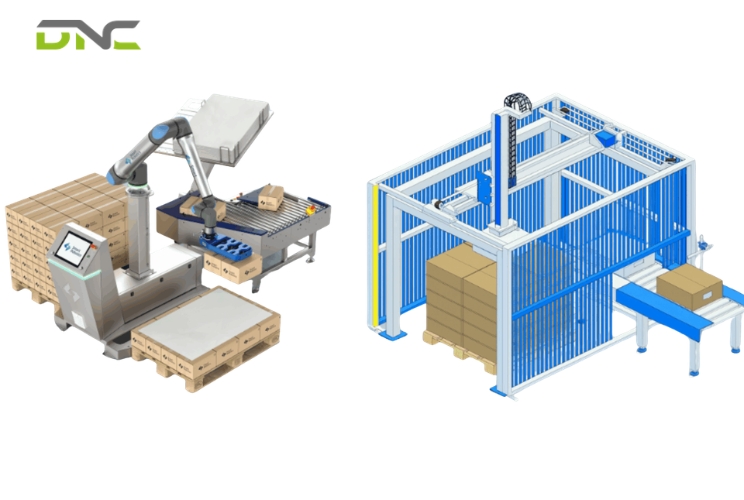
!robotic arm palletizer vs gantry system side-by-side comparison
Gantry and Robotic Arm Palletizers: Definitions and Operating Principles
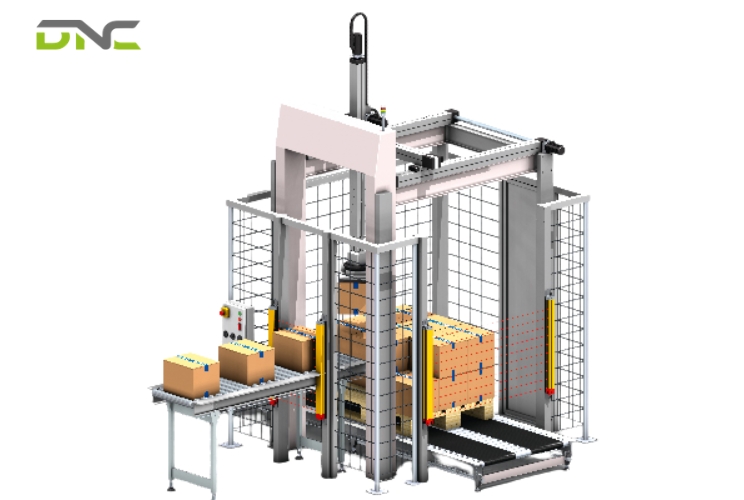
A gantry palletizer moves product along fixed linear rails arranged on X, Y, and Z axes – a Cartesian motion system purpose-built for structured, repeatable stacking tasks. The overhead frame spans the work envelope from above, with the gripper or vacuum EOAT (end-of-arm tooling) traveling in straight-line paths between defined pickup and placement positions. This architecture limits each transfer to pre-programmed Cartesian coordinates: every move is a translation along one or more straight axes, with no rotational freedom beyond the end-effector wrist.
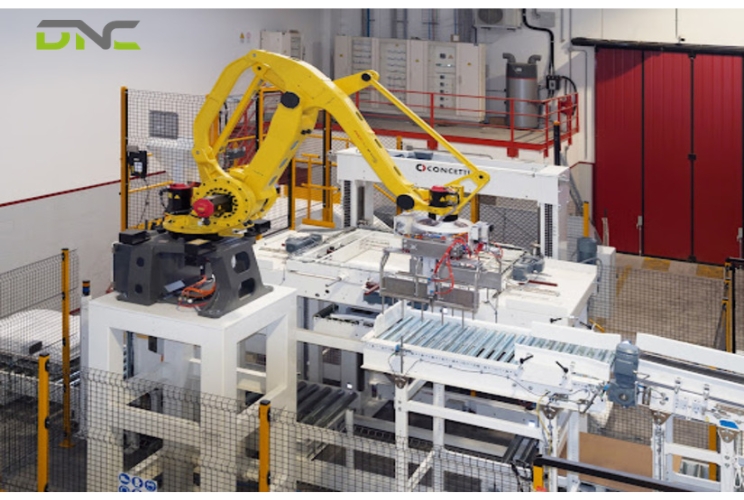
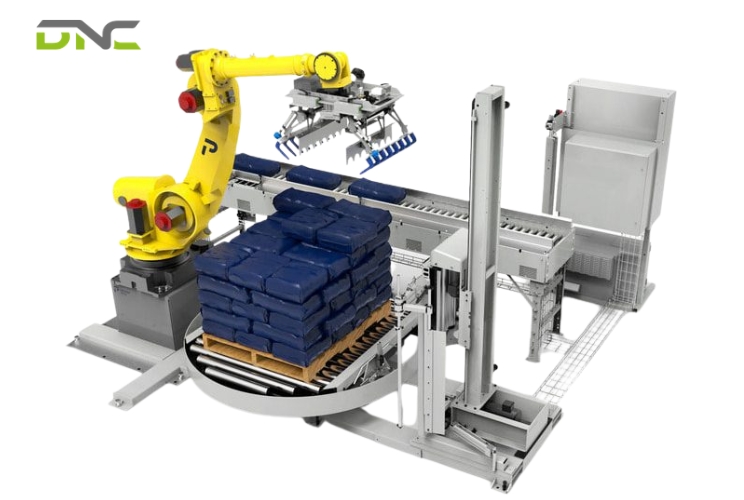
A robotic arm palletizer uses a six-axis articulated arm mounted at a fixed base point on the production floor. The arm replicates the degrees of freedom of a human shoulder, elbow, and wrist – each joint adding a rotational axis until the EOAT reaches any point within a spherical work envelope. This geometry allows the arm to approach a pallet from multiple angles, rotate packages during transfer, and reconfigure stacking patterns through software reprogramming rather than mechanical adjustment.
The table below lists the core specifications that drive the selection decision:
| Attribute | Gantry Palletizer | Robotic Arm Palletizer |
| Motion type | Cartesian (linear translation) | Articulated (rotational joints) |
| Number of axes | 2–4 (X, Y, Z + wrist) | 6 |
| Work envelope shape | Rectangular (fixed frame dimensions) | Spherical (arm reach radius) |
| Pattern change method | Mechanical adjustment or re-teach | Software program recall |
| Typical payload | Up to ~50 kg (110 lb) per gripper | 20–120 kg (44–265 lb) depending on arm model |
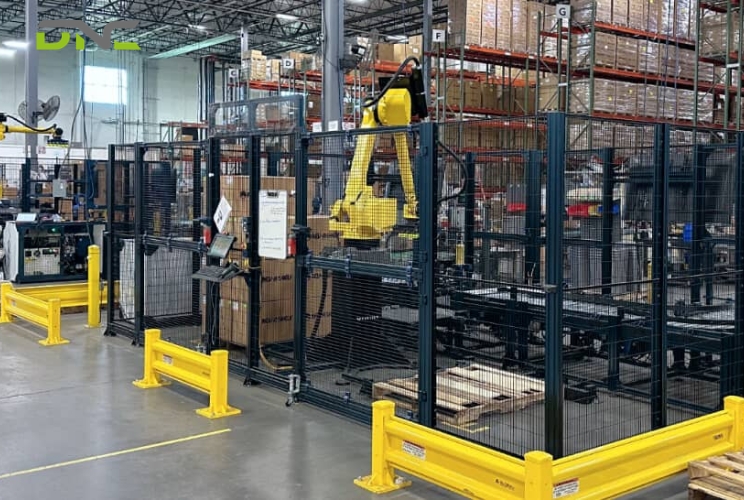
| Safety guarding | Frame-mounted – minimal exclusion zone | Full perimeter fencing required |
The operating principle difference is geometric: gantry systems use Cartesian linear translation; robotic arms use articulated rotational joints. Every downstream difference in throughput, footprint, flexibility, and cost traces back to this mechanical distinction.
Motion Geometry: Cartesian vs Articulated Architecture
The motion architecture of each palletizer type determines its performance ceiling for a given application. Gantry palletizers run on servo-driven linear actuators along two or three axes simultaneously, with the EOAT carried at the intersection of those axes. Each transfer – from infeed conveyor to pallet position – executes as a set of concurrent linear accelerations along straight paths with no curve interpolation required.
Robotic arm palletizers coordinate six independent joint rotations simultaneously to produce smooth curved trajectories between pick and place positions. The controller calculates joint angles for every point along the transfer path, enabling complex arcs, vertical lifts with mid-air rotation, and approach angles that a Cartesian system cannot replicate.
In practice, the Cartesian architecture of a gantry is faster for simple transfers. Three linear axes accelerating simultaneously produce short cycle times with minimal computation overhead per cycle. The six-axis arm adds path-planning computation per transfer, but this overhead becomes irrelevant when the task requires package orientation changes, mixed-layer interlocking, or variable approach trajectories.
DNC’s specification criterion at this stage is direct: if the stacking pattern requires any package rotation beyond 90° during transfer, or involves alternating layer orientations, the robotic arm is the correct architecture. If the infeed products arrive consistently oriented and the pallet pattern is uniform, the gantry achieves the same result at lower system complexity. The decision is mechanical – not preferential.
For facilities evaluating industrial robotic solutions as part of a broader end-of-line automation project, understanding the motion geometry difference is the necessary first step before comparing throughput or capital cost specifications.
Throughput and Speed Capacity
Throughput capacity separates gantry and robotic arm palletizers most sharply in high-volume, single-format production environments. The two system types do not compete on equal terms at the upper end of the speed range.
High-Speed Single-Format Lines
High-speed conventional and gantry layer palletizers exceed 200 cases per minute on optimized single-format lines – a throughput ceiling that articulated arm systems do not approach in continuous single-point operation. At these speeds, the gantry’s Cartesian linear motion executes transfers faster than the arm’s joint interpolation cycle allows, and the structural simplicity of the overhead frame handles those speeds without the vibration-dampening requirements of a high-inertia six-axis arm.
Robotic arm palletizers operate across a practical throughput range of 10 to 60 cycles per minute for most palletizing configurations, with higher-payload and longer-reach models at the lower end. Purpose-built high-speed robotic palletizers approach 80 cycles per minute, but at a capital cost that narrows the ROI advantage significantly for single-format applications where the gantry could deliver the same output at lower investment.
Multi-Format and Mixed-SKU Lines
In multi-format production environments, the throughput comparison shifts. Gantry systems require 15 to 30 minutes of production downtime for each mechanical product change – physical guide adjustment, EOAT swap, or fixture change when product dimensions or pallet configurations change. Robotic arm systems switch stacking programs through the control interface in under five minutes, with no physical access to the machine required.
For a Malaysian F&B manufacturer running two product changes per shift across a 250-day, two-shift year, the gantry accumulates 250 to 500 hours of annual changeover downtime. At a conservative production value of RM 500 per hour, that represents RM 125,000 to RM 250,000 annually in downtime losses – a cost entirely absent from the capital quotation but fully present in the total cost of ownership. The robotic arm’s software-based changeover eliminates the majority of this loss.
A single robotic arm also covers two or three parallel infeed conveyors by rotating between them during low-density periods. A gantry covers only the floor area beneath its fixed frame. For multi-line facilities, this multi-line coverage advantage compounds the throughput comparison further in the robotic arm’s favor.
Product Flexibility and SKU Range
Product flexibility is the decisive criterion when evaluating a palletizer for operations handling more than two distinct product formats per shift. Robotic arm palletizers store multiple stacking programs in the controller – switching from a carton pattern to a bag configuration or a tray format requires an operator to call a saved program, not retool the machine. Pattern changes that take 20 or more minutes on a gantry take under five minutes on a robotic arm.
Gantry palletizers handle flexibility within a defined mechanical envelope. A fixed-rail system accommodates multiple pallet configurations when product dimensions fall within the programmed XYZ coordinate range, but physical guides and EOAT attachments must match the product format being palletized. Changing to a product outside that defined range requires mechanical adjustment or EOAT replacement – time and cost that compounds across frequent SKU rotations throughout the year.
Three conditions consistently favor the robotic arm on flexibility and are detailed below:
- Product dimensions, weights, or shapes vary significantly within the same production line
- Stacking patterns include interlocked or alternating layers that require mid-transfer package rotation
- New product formats are introduced more than twice per year, requiring program updates rather than mechanical rebuilds
For a Malaysian rubber glove facility running a single carton size at high volume across all shifts, none of these conditions apply. The gantry handles this scenario without the flexibility overhead – and at lower system cost and maintenance complexity than a robotic arm installation of equivalent throughput.
Floor Footprint and Installation Space
Floor footprint and installation space planning are frequently underweighted in palletizer selection and then re-emerge as the binding constraint once site preparation begins. The issue is not the palletizer mechanism itself – it is the safety exclusion zone that each architecture requires around its operational envelope.
A robotic arm cell requires perimeter safety fencing to prevent contact with the rotating arm during operation. This fencing must extend beyond the arm’s full reach radius in all directions, expanding the total system footprint well beyond what the arm’s reach specifications suggest. For a single-SKU end-of-line configuration, a robotic arm cell requires approximately 756 square feet (70 m²) of floor space including guarding.
A gantry system mounts overhead, spanning the work envelope from above on a structural frame. The frame members occupy space above head height; the production floor beneath the frame remains accessible. For an equivalent single-SKU configuration, a gantry cell requires approximately 488 square feet (45 m²) – roughly 35% less floor area than the robotic arm installation.
Scaling to a four-SKU robotic system versus a one-SKU gantry configuration widens the disparity to approximately 65%. In Selangor and Penang industrial parks where factory floor space carries meaningful annual cost, the 268-square-foot footprint difference between system types becomes a factor in the total cost calculation – particularly in brownfield installations where floor space reallocation requires halting adjacent production processes.
Total Cost of Ownership: Capital, Labor, and Maintenance
Total cost of ownership for gantry and robotic arm palletizers diverges most sharply in maintenance complexity, not capital expenditure. The initial capital gap between equivalent-capacity systems has narrowed considerably – for many payload and throughput combinations, the upfront cost difference is under 15%.
Capital Cost Comparison
Gantry systems carry lower capital cost for simple, single-format applications. The linear actuator, servo motor, structural rail, and Cartesian controller components involve fewer specialized parts than a six-joint robotic arm with its servo axes, encoder assemblies, and teach-pendant programming environment. For throughput requirements below 60 cycles per minute with a consistent product format, gantry capital cost is typically 10 to 20% lower than an equivalent robotic arm installation.
Above 80 cycles per minute or for complex mixed-case stacking, the comparison reverses – the gantry requires additional mechanical complexity (layer formers, product orientors, specialized EOAT) that closes the capital gap or surpasses the robotic arm’s cost.
Maintenance and Changeover Costs
Gantry systems use linear rails, ballscrews, and servo drives that most Malaysian maintenance teams already service on CNC and packaging machinery. No specialized robotic programming knowledge is required for routine preventive maintenance – an advantage in facilities outside Klang Valley where certified robotics technicians are less accessible for urgent callouts.
Robotic arms require certified technicians for joint calibration, encoder replacement, and controller software updates. These service events are infrequent but carry significant labor and travel costs for facilities in Kedah, Pahang, or Sarawak – a factor that rarely appears in system quotations but affects total operating cost in years two through five.
The accumulated changeover cost is the most commonly overlooked differentiator in multi-SKU environments. Each mechanical product change on a gantry costs 15 to 30 minutes of production downtime. Across 250 operational days with two daily shifts and one to two product changes per shift, annual changeover losses reach 125,000 to 500,000 minutes – or roughly 200 to 830 production hours – at a cost the robotic arm’s software-based changeover eliminates almost entirely.
DNC’s engineering experience across 1,000+ projects in Malaysian manufacturing shows payback periods of two to four years for correctly specified systems of either type. Misspecification – a robotic arm on a single-SKU line that didn’t need multi-format flexibility, or a gantry on a high-SKU line accumulating daily changeover losses – extends payback by 12 to 18 months through costs that a correct specification would have avoided.
Industry Applications: Best-Fit Scenarios for Each System
Industry fit for gantry and robotic arm palletizers maps directly to production volume concentration and SKU count per shift. The scenarios below represent the application split DNC encounters across Malaysian manufacturing sectors.
Gantry Palletizer Best-Fit Industries
Gantry palletizer best-fit applications in Malaysia concentrate in three high-volume, single-format industries where throughput consistency and mechanical simplicity deliver the strongest return.
Rubber glove manufacturing is the clearest gantry application in the Malaysian context. Production is concentrated in a single carton format – standardized inner-pack boxes by count – at throughput rates that frequently exceed 100 cases per minute per line. Malaysia produces more than 60% of the world’s latex gloves, and the high-volume, single-format nature of glove carton palletizing makes the robotic arm’s multi-SKU flexibility an unnecessary cost premium on every production line.
Edible oil and palm oil packaging similarly favors gantry systems for heavy-load, single-format lines. Five-litre polyethylene jerry cans (approximately 5.2 kg / 11.5 lb per unit), 20-litre containers (approximately 20.5 kg / 45 lb each), and 25 kg (55 lb) bulk bags all represent consistent formats with defined dimensions and weights – within the gantry’s Cartesian coordinate system, these transfer reliably at cycle rates the robotic arm does not match per unit capital cost.
Cement and bulk building materials in single-bag or single-block formats present the same high-volume, single-format profile. Gantry systems handle 25 kg (55 lb) and 50 kg (110 lb) sack palletizing at speeds and payload capacities that justify the lower capital investment versus an articulated arm.
Robotic Arm Palletizer Best-Fit Industries
Robotic arm palletizers deliver the strongest ROI in three Malaysian manufacturing sectors where multi-SKU production and format change frequency are the operational norm.
Food and beverage manufacturers producing multiple SKUs – ready-to-drink beverages, snack formats, condiments, and mixed retail packs – require pattern flexibility across product changes that occur multiple times per shift. Robotic arm systems handle this without the mechanical downtime that accumulates across hundreds of gantry product changes per year. For F&B export operations in Johor Bahru or Selangor servicing multiple regional markets with different packaging configurations, the robotic arm’s program recall capability is operationally essential.
Pharmaceutical and medical device packaging, where product formats change frequently and mixed-pallet configurations are standard for distribution, represents a natural robotic arm application. The arm’s ability to rotate packages and construct interlocked mixed-case pallets for pharmaceutical distributors reduces downstream repacking labor at the distribution center – a cost saving that compounds across weekly dispatch cycles.
Export-market consumer goods manufacturers handling promotional packs, seasonal SKUs, and regional configuration variants – which rotate more than twice per year – should specify robotic palletizing to avoid the mechanical changeover losses that accumulate in gantry installations over a three-to-five-year ownership horizon.
For facilities where conveyor system integration feeds multiple SKU streams into a single palletizing cell, the robotic arm’s multi-line coverage capability provides a further operational advantage by reducing the number of palletizing cells required.
Palletizer Selection Framework for Malaysian Production Lines
Selecting between a gantry and robotic arm palletizer requires evaluating four facility-specific parameters before a system recommendation is valid. DNC’s specification process applies this framework to every palletizing project brief, regardless of client preference for either technology. The framework prevents the misspecification errors that account for the majority of extended-payback palletizer installations DNC has been called to remediate.
Parameter 1 – SKU count per shift
The operational dividing line is three distinct product SKUs per shift. Below three, a gantry system recovers its cost advantage through mechanical simplicity, lower maintenance overhead, and faster cycle times on consistent formats. At three or more SKUs per shift, accumulated changeover downtime on a gantry begins to exceed the robotic arm’s cost premium within the first two years of operation – making the robotic arm the more economical choice over the full ownership period.
Parameter 2 – Required throughput
For throughput requirements above 80 cycles per minute on a single-format line, evaluate a gantry or conventional layer palletizer first. Robotic arm systems approaching 80 cpm exist but carry significantly higher capital cost at that speed, and the maintenance profile becomes more demanding. Below 80 cycles per minute, the robotic arm is cost-competitive and delivers a flexibility premium that pays forward into future SKU expansions without requiring a system replacement.
Parameter 3 – Available floor area
If available floor area for the palletizing cell is below 500 square feet, the gantry configuration typically fits; a robotic arm cell with proper guarding typically does not. Above 800 square feet, either system fits and the selection shifts to Parameters 1 and 2. Between 500 and 800 square feet, a compact robotic arm with reduced-reach specifications and area scanners in place of full perimeter fencing may be evaluated – but requires engineering verification of the specific arm model and safety compliance under Malaysia’s Department of Occupational Safety and Health (DOSH) guidelines for robotic systems.
Parameter 4 – In-house maintenance capability
Facilities with automation technicians experienced in robotic programming support either system effectively. Facilities relying on third-party service for advanced maintenance – particularly those in industrial areas outside Klang Valley where certified robotics technicians are less available – should weight the gantry’s familiar mechanical profile in the total cost model. The maintenance capability gap narrows as Malaysia’s robotics workforce develops, but it remains a real operational variable through 2027.
NIMP 2030 grant timing
Under Malaysia’s National Investment Master Plan, Industry 4.0 automation grants and tax incentives are allocated on a first-approved basis, with the highest-value incentives available through 2027. Specifying the correct system – one that passes all four parameters above and demonstrates clear operational fit – matters not only for long-term ROI but for grant application eligibility. MIDA grant applications require specification documentation showing the system’s technical fit to the production line. DNC’s turnkey palletizing integration includes this specification documentation as a standard commissioning deliverable on every project.
For facilities integrating the palletizer into a broader warehouse automation strategy – including conveyor staging, ASRS buffer zones, and pallet stretch wrapping – the four-parameter framework above connects into the wider end-of-line specification that determines whether upstream and downstream systems are matched to the palletizer’s output rate.
Frequently Asked Questions
A gantry palletizer and a robotic arm palletizer perform the same end function – stacking products onto pallets – but through mechanically distinct architectures that produce different performance profiles across throughput, flexibility, footprint, and maintenance. The following questions address the comparison criteria most commonly raised in DNC’s specification consultations with Malaysian manufacturers.
What is the core mechanical difference between a gantry palletizer and a robotic arm palletizer?
A gantry palletizer moves along fixed linear rails on X, Y, and Z axes – Cartesian motion only. A robotic arm palletizer uses six rotational joints to produce articulated motion across a spherical work envelope. The gantry cannot rotate products during transfer beyond the end-effector wrist; the robotic arm reorients packages at any point along the transfer path. This mechanical difference is the root cause of every throughput, flexibility, and footprint distinction between the two systems – and the starting point for any valid specification comparison.
Which palletizer type is faster for high-volume single-SKU production?
High-speed gantry and layer palletizers exceed 200 cases per minute on optimized single-format lines – a throughput ceiling robotic arm systems do not match in continuous single-point operation. For throughput requirements above 80 cycles per minute with a consistent product format, a gantry or conventional layer palletizer is the correct specification. Robotic arm systems typically operate between 10 and 60 cycles per minute, with purpose-built high-speed models approaching 80 cpm at higher capital cost. For most Malaysian manufacturers, the 80 cpm threshold is the practical dividing line.
How much floor space does each palletizer system require?
A robotic arm palletizer cell requires approximately 756 square feet of floor space, including perimeter safety fencing. A gantry palletizer occupies approximately 488 square feet for an equivalent single-SKU configuration – roughly 35% less floor area. For a four-SKU robotic system versus a one-SKU gantry, the disparity increases to approximately 65%. In brownfield installations where floor space is constrained by existing production equipment, this 268-square-foot difference frequently becomes the deciding selection criterion before any throughput or cost comparison is needed.
Is a robotic arm palletizer the better choice for multi-SKU production lines?
Yes – for operations running three or more distinct product formats per shift, the robotic arm palletizer consistently delivers lower total cost of ownership than a gantry system. The robotic arm switches stacking programs in under five minutes; each gantry product change requires 15 to 30 minutes of mechanical downtime. In a facility running one to two product changes per shift across 250 operational days with two daily shifts, the gantry accumulates 200 to 830 hours of annual changeover downtime. The robotic arm’s software-based changeover eliminates the bulk of that loss – a cost difference that typically offsets the robotic arm’s higher capital cost within two years in high-SKU environments.
What is the typical ROI period for a palletizer installation in Malaysian manufacturing?
Correctly specified palletizer systems of either type return investment within two to four years in Malaysian manufacturing at current labor costs and production values. Misspecified systems – a gantry in a high-SKU environment, or a robotic arm on a single-format line that could have been served at lower cost – extend this payback period by 12 to 18 months. ROI is specification-dependent, not technology-dependent. DNC’s four-parameter framework – SKU count, throughput, floor area, and maintenance capability – is designed to prevent misspecification before project commitment.
How does NIMP 2030 affect palletizer investment decisions in Malaysia?
Malaysia’s National Investment Master Plan allocates Industry 4.0 automation grants and tax incentives on a first-approved basis, with the most favorable incentive tiers available through 2027. Palletizing automation qualifies as an Industry 4.0 capital investment under MIDA’s Smart Automation Grant framework, provided the specification documentation demonstrates technical fit to the production process. Facilities that delay automation past 2027 face a higher unsubsidized cost basis and a narrower incentive window. DNC provides the engineering specification and commissioning documentation required for MIDA grant applications as a standard deliverable on every turnkey palletizing project. Talk to our engineers about qualifying your facility’s palletizing project for available grants – get a free consultation.
- 41 views
- 0 Comment
Recent Comments