


Palletizing in Food and Beverage Industry: Complete Guide
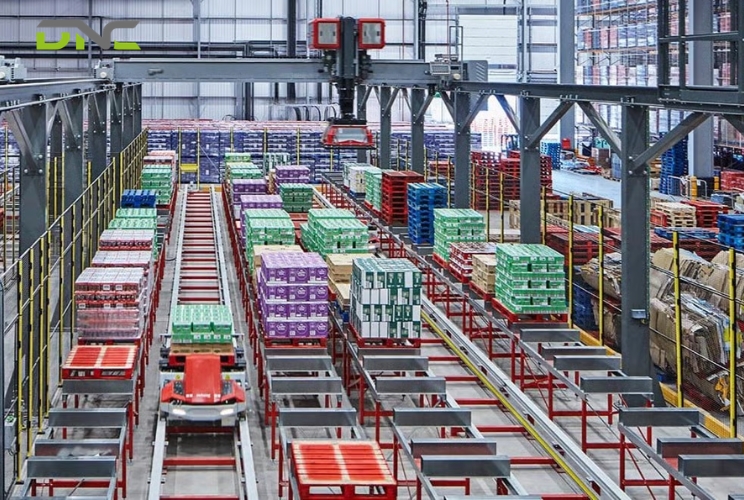
Palletizing in the food and beverage industry sits at the end of every production line – and the decisions made about this process determine whether packed goods reach distribution intact, on time, and compliant with food safety law. Unlike palletizing in automotive or electronics manufacturing, food and beverage palletizing must handle extreme product diversity – from glass bottles to flexible pouches to frozen meal trays – operate in temperature-controlled or wet-zone environments, and meet hygiene standards that govern material selection, surface finish, and cleaning protocols. A food-grade palletizing system is not simply a faster version of a general industrial palletizer; it is a purpose-engineered solution built for a stricter operating context.
This guide covers four system types available to F&B facilities, the hygienic design standards that determine whether a system is suitable for food production zones, how palletizers integrate with conveyor infeed, PLC/SCADA control, and WMS traceability, and the selection criteria Malaysian manufacturers weigh when evaluating automation investment under NIMP 2030.
What a Palletizing System Does in Food and Beverage Operations
A palletizing system is the automated equipment that takes packaged products off the production line and arranges them onto pallets for storage or dispatch. In food and beverage operations, this end-of-line function connects the output of filling, sealing, and packaging machines to the loading dock – and every pallet built must meet both structural stability requirements and food safety handling standards.
The basic sequence involves an infeed conveyor feeding products to the palletizer, which organizes them into rows or layers and builds the pallet to a programmed pattern. Once complete, the pallet moves to wrapping and labeling before staging for dispatch. What makes food and beverage palletizing distinct is the context in which this sequence must operate: packaging formats range from glass bottles and aluminium cans to flexible pouches, paper bags, and corrugated cases – sometimes on the same line within the same shift. No two products behave identically on a conveyor or under a gripper.
Throughput requirements in F&B are also demanding. High-volume beverage lines require palletizing rates of 10 to 100 cycles per minute depending on system type. Meeting that rate while maintaining pallet stability, product integrity, and hygiene compliance is the engineering challenge that separates a system designed for food production from a general-purpose machine adapted to it.
F&B Palletizing: A Different Operating Context
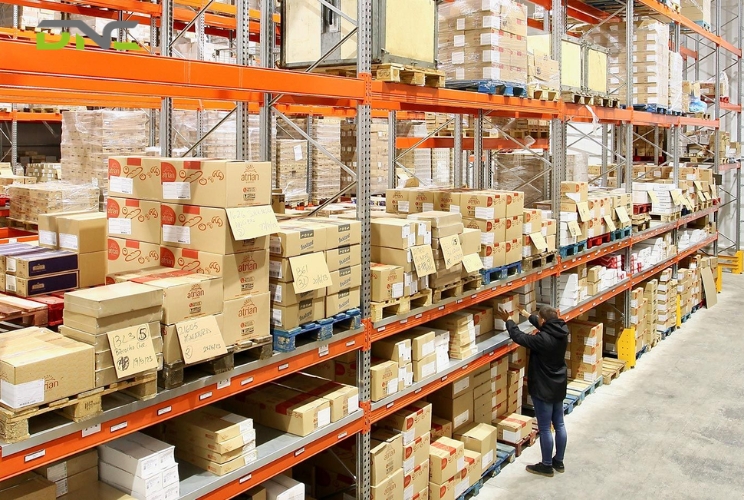
A common misconception: any industrial palletizer placed at the end of a food production line works with minor adaptation. The operating context of a food and beverage facility creates requirements – hygiene, temperature range, regulatory traceability – that standard industrial palletizers are not engineered to meet. This distinction matters in practice: a general-purpose machine placed in a food production zone produces compliance gaps that become visible during food safety audits, in facilities where hygiene standards apply to all end-of-line equipment.
Most industrial palletizers are built for dimensional consistency – stacking uniform boxes or bags with predictable weight distribution. Food and beverage operations rarely offer that consistency. The combination of product diversity, operating environment conditions, and regulatory obligations creates requirements that general-purpose systems cannot satisfy.
Product Diversity and Packaging Complexity
F&B palletizers are designed to accommodate a wider range of packaging formats than almost any other sector. A single facility commonly runs formats that include:
- Glass bottles (fragile, irregular when multi-packed in trays or shrink film)
- Aluminium cans and tetra pak cartons
- Flexible pouches and vacuum-sealed bags
- Corrugated cardboard cases
- Reusable plastic crates (RPC) and totes
- Shrink-wrapped multipacks
Each format behaves differently under automation. Glass breaks under excessive gripping force. Flexible pouches shift position mid-transfer. Shrink-wrapped multipacks compress unpredictably under vacuum. The palletizer’s end-of-arm tooling and layer pattern software must be configured for each format – which directly drives the choice between robotic and conventional system architectures.
Product diversity defines what the palletizer must handle. The physical environment it operates in defines what the palletizer itself must withstand.
Temperature-Controlled and Wet-Zone Operating Environments
Food production lines often operate in conditions that standard industrial equipment is not rated for. Cold chain facilities require palletizers that function at temperatures as low as -40°C (-40°F). Cold-rated systems require low-temperature lubricants, plastic parts rated for cold storage rooms, and in some cases a heating system for sensitive electronics. Thermal covers may be needed for robotic arms operating in freezer environments.
Wet-zone applications – bottling halls, meat processing lines, dairy facilities – require equipment rated for high-pressure washdown. Frame welds, cable routing, and bearing housings all become contamination risks if not designed for regular cleaning. An IP65-rated system is the minimum for water jet cleaning; IP67 is appropriate where immersion-level cleaning occurs.
These physical environment requirements do not exist in isolation – they are reinforced by the regulatory frameworks that food and beverage producers are legally required to meet.
Regulatory Compliance: HACCP, FDA FSMA, NSF, and 3-A Standards
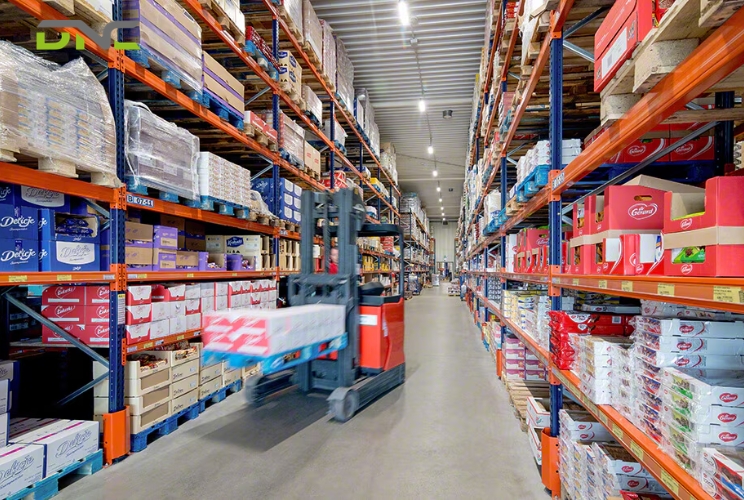
Food and beverage producers operating in Malaysia – particularly those exporting to international markets – operate within food safety frameworks that directly constrain equipment design, including palletizing system specifications. The applicable standards are:
| Standard | Scope | Design Implication for Palletizing |
| HACCP | Hazard analysis at critical control points | Palletizer must not introduce contamination risk at end-of-line |
| FDA FSMA | US food traceability and safety modernization | Lot-level pallet traceability; barcode or RFID integration required |
| NSF International | Equipment sanitation certification | Material and surface finish specifications for food-adjacent zones |
| 3-A Sanitary Standards | Dairy and food processing equipment | Hygienic design of product-contact and near-contact surfaces |
Malaysian manufacturers exporting to GCC, EU, or US markets are required to align with Codex Alimentarius standards adopted under Malaysian food safety legislation. In facilities subject to these frameworks, the palletizing system is part of the regulatory audit trail – not merely a mechanical end-of-line asset.
Types of Palletizing Systems Used in Food and Beverage Facilities
Four main palletizer types are deployed in F&B production environments. Each has a defined performance envelope, and selecting the wrong type for your throughput and product mix creates either a capacity bottleneck or an over-engineered capital commitment.
Conventional Layer Palletizers
Conventional layer palletizers use a row-forming mechanism – a pusher, sliding plate, or sweep arm – to organize products into rows, accumulate a full layer, then deposit that layer onto a pallet. This architecture has been the backbone of high-volume FMCG and beverage production for decades.
The principal advantage is speed. On an optimized single-format beverage or canned goods line, high-speed conventional systems can exceed 200 cases per minute – a throughput ceiling robotic arms cannot match. The trade-off is inflexibility: conventional systems are engineered for one product format, and mechanical changeovers for a new case size require physical adjustment of guides, pushers, and layer patterns, typically 15 to 30 minutes per change.
Best suited for: high-volume single-SKU production – carbonated beverage canning, bottled water, canned food.
Where product mix introduces fragile packaging, irregular formats, or frequent changeover, a different architecture is required.
Robotic Palletizers
A 6-axis articulated arm forms the basis of any robotic palletizing system, combined with interchangeable end-of-arm tooling (EOAT) to pick and place products onto a pallet. Three EOAT types are standard in food production:
- Vacuum gripper – suction grip for smooth flat surfaces (cartons, boxes, shrink-wrapped cases); an open-air system, not for direct food contact zones
- Rigid gripper – mechanical clamp or fork for heavier, robust packaging such as cased goods and totes
- Soft gripper – flexible silicone or foam contact surfaces for fragile or irregular items including glass bottle packs, eggs, and specialty food packaging
Robotic changeover is software-driven: calling a new product program takes under 5 minutes with no mechanical adjustment required. Typical throughput is 10 to 60 cycles per minute – lower than high-speed conventional systems but sufficient for most mid-volume F&B lines. The compact footprint makes robotic cells viable in facilities where floor space is constrained.
Best suited for: mixed SKU operations, frequent changeovers, fragile products, and facilities running multiple product formats on rotating shifts.
For operations where format is fixed and throughput is the only design variable, inline architecture takes a more direct approach.
Inline High-Speed Palletizers
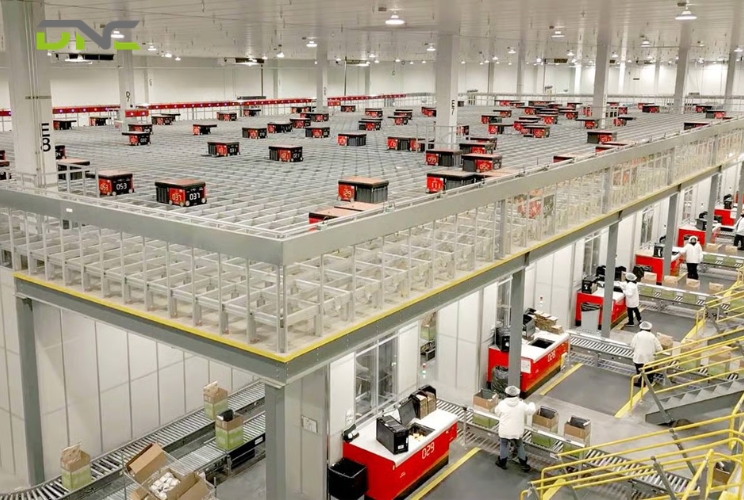
Inline palletizers are positioned directly in the product flow of a filling or packaging machine, with no buffer accumulation between the line and the palletizer. This tight integration is designed for continuous-flow bottling and beverage canning operations where the packaging rate is constant and throughput is the primary design criterion.
The limitation mirrors conventional systems: inline palletizers are optimized for single-format, high-volume output. Any upstream stoppage flows directly to the palletizer with no buffer to absorb it. They are not suited to mixed-SKU environments or operations with frequent format changes.
Best suited for: dedicated bottling lines, beverage canning, and high-speed FMCG facilities with consistent single-format output.
The three system types above address production-side palletizing. Mixed-case architecture addresses a different point in the supply chain – outbound distribution where each pallet carries multiple product types.
Mixed-Case Palletizers
Mixed-case palletizers build retail-ready pallets containing multiple different products in a single pallet load – configured to a specific store or distribution customer’s order. This architecture is common in F&B distribution centers rather than production plants, where outbound pallets must match retailer planogram requirements.
Mixed-case systems are software-intensive: WMS integration is not optional – it drives the stacking sequence per order. Speed is lower than the above types, but the value lies in eliminating manual order-picking and building stable mixed-product pallets that can be moved directly to the retail floor.
Best suited for: F&B distribution centers and logistics operations shipping mixed-product orders to supermarket and retail chains.
A fifth architecture addresses a constraint none of the above resolve – floor space limitations and operator-adjacent installation requirements in smaller F&B facilities.
Collaborative Robot (Cobot) Palletizers
Collaborative robot palletizers use a cobot arm rated for operation alongside human workers without perimeter safety fencing – in cases where a risk assessment confirms safe proximity limits are maintained. In food production environments, cobots designed for F&B duty are specified with food-grade grease (NSF H1 rated), white epoxy or rust-resistant coating, and IP67 arm ratings to withstand washdown.
The cobot architecture addresses a specific problem in smaller F&B facilities: floor space is limited, staffing is mixed (operators work near the palletizer), and the capital cost of a full robotic cell with safety fencing and light curtains is difficult to justify at lower throughput. A cobot palletizing station can be installed with minimal structural modification and programmed through teach-pendant or guided programming – reducing deployment time compared to conventional robotic cells.
Payload capacity for cobot palletizers typically ranges from 10 to 35 kg per pick – suited to lighter carton and bottle formats rather than heavy bag or bulk container applications. Above that payload range, a standard industrial robotic arm with appropriate safety guarding remains the engineering-correct choice.
Best suited for: smaller F&B facilities running lighter packaging formats, operations where operators work adjacent to end-of-line equipment, and sites where fenced robotic cell installation is impractical.
System type at a glance:
| Type | Best For | Throughput | Changeover | F&B Use Case |
| Conventional Layer | High-vol single-SKU | Very High | 15–30 min | Beverage, canned goods |
| Robotic (6-axis) | Mixed SKU, fragile, 50–800 kg payload | Medium | <5 min | Dairy, glass bottles, FMCG |
| Cobot | Lighter formats, operator-adjacent zones | Low–Med | <5 min | Bakery, light cartons, SME F&B |
| Inline High-Speed | Continuous flow lines | Very High | Low flexibility | Bottling, beverage canning |
| Mixed-Case | Retail-ready distribution | Low–Med | Software-driven | F&B distribution centers |
Summary – Palletizer Type Selection: Conventional and inline systems deliver the highest throughput (up to 200+ cases/min, or 12,000+ cases/hour) for dedicated single-format lines, with changeover times of 15–30 minutes per format change. Robotic systems operate at 10–60 cycles/min (600–3,600 cycles/hour) with software-driven changeover under 5 minutes – the trade-off suited to facilities running multiple product formats or fragile packaging. Cobot palletizers handle payloads of 10–35 kg per pick for operator-adjacent, fenceless installation at lower throughput. Mixed-case architecture is specific to distribution, not manufacturing, requiring WMS integration as a baseline. The operating environment – wet zone, cold chain (-40°C / -40°F), or dry production – narrows the field by imposing IP ratings and material grades that not all systems satisfy at standard build.
Hygienic Design Standards for Food-Grade Palletizing Systems
A palletizing system operating in a food production zone is subject to the same material and surface standards applied to processing equipment – even though it does not contact food directly. The rationale is contamination risk: a poorly designed frame collects product residue, moisture, and debris; incomplete cleaning creates bacterial or allergen cross-contamination at the audit point.
Food-grade palletizing systems are required to meet a specific set of material and design requirements – particularly in facilities where the palletizer operates within or adjacent to open-product zones:
Material specification:
- Stainless steel 304 for general food production zones – corrosion-resistant, easy to clean, compatible with standard cleaning agents
- Stainless steel 316 for high-salt, acidic, or aggressive chemical cleaning environments (seafood processing, pickled products, certain dairy applications)
- All surfaces adjacent to product zones are specified as non-toxic, non-absorbent, resistant to staining, free of hollow structural sections that trap moisture
IP ratings and washdown design:
- IP65 minimum for wet zones – protected against water jets from any direction; applicable where daily high-pressure hosing is the cleaning protocol
- IP67 for facilities using immersion-level or high-pressure foam cleaning protocols
- NEMA 4X enclosure rating for electrical panels and control boxes – sealed against water ingress and corrosive cleaning agents; the North American equivalent standard to IP66/IP67 for enclosure compliance
- Hygienic cable routing removes hollow conduit tubes that accumulate moisture – only when systems are specified with sealed stainless cable trays or fully embedded conduit from the outset
- Horizontal ledges and flat-topped structural members – standard on industrial frames – are eliminated or angled to prevent liquid and debris pooling
Lubrication:
- Bearings and drive components in or near food zones use NSF H1-rated food-grade lubricants – specified for incidental food contact scenarios
- Grease nipple placement is specified to allow servicing without contaminating adjacent product zones
EOAT hygiene:
- Vacuum gripper cup materials: food-safe silicone; cup replacement intervals defined in the maintenance schedule
- Rigid gripper contact surfaces: stainless construction with smooth-radius edges to prevent product damage and allow cleaning access
- Soft gripper: replaceable silicone contact pads with documented food-grade certification, inspected at each product changeover
Audit-ready design features are increasingly required by food safety auditors: removable access panels for internal frame cleaning, belt and chain replacement without disassembly of adjacent structure, and no unventilated enclosed spaces where moisture can accumulate between cleaning cycles.
Integrating Palletizers with Your Production Line and Control Systems
A palletizing cell does not operate in isolation. Its throughput and reliability depend on the quality of the upstream feed, the intelligence of the control layer, and the completeness of the downstream traceability chain. The palletizer is one component in a coordinated automation system – not a standalone machine purchase bolted to the end of the line.
Upstream Infeed: Conveyor Synchronization and Product Conditioning
The infeed conveyor system delivers products to the palletizer at a consistent rate, in the correct orientation, and with appropriate spacing between items. Accumulation conveyors buffer between variable upstream production speed and the palletizer’s cycle time – preventing infeed jams without starving the palletizer during upstream pauses.
Sensors at the infeed detect product gaps, orientation errors, and damaged packaging before they reach the palletizer. A damaged carton entering a layer former causes a jam; a misoriented bottle entering a robotic cell creates a pattern error in the pallet layer. In cases where infeed detection is properly integrated with line control, unplanned downtime and pallet rework are significantly reduced.
The physical feed handles product delivery. The control layer above it determines how the palletizer responds to what the infeed sensors report – and how that data connects to the rest of the facility.
Control Layer: PLC, SCADA, and HMI Integration
The palletizer’s sequencing logic runs on a PLC. In an integrated smart manufacturing environment, the palletizer PLC connects to a SCADA system that provides facility-wide visibility: OEE tracking, alarm management, production count reporting, and remote diagnostics. Operators manage product programs through an HMI – selecting the correct pallet pattern, layer count, and EOAT configuration for each product SKU without engineering intervention.
As a Siemens-authorized integrator, DNC Automation engineers palletizing control architecture on the Siemens TIA Portal platform, providing consistent programming standards across all line equipment and simplifying troubleshooting when multiple machines share the same control environment.
Remote diagnostics accessible via SCADA or direct connection allow engineering teams to diagnose faults and push program updates without a site visit, reducing downtime response time materially on multi-shift operations.
The control layer manages the palletizer’s own cycle data. Downstream traceability extends that data to the pallet itself – linking production records to the distribution chain at the point the pallet leaves the line.
Downstream Traceability: Stretch Wrappers, RFID/Barcode, and WMS
Once a pallet is built, it enters the downstream traceability chain. A stretch wrapper applies film for structural stability. A barcode printer-applicator or RFID tag station assigns a pallet-level ID linked to the product lot, production date, and line data in the warehouse management system.
Pallet-level traceability is required for FDA FSMA lot tracking compliance and critical for FIFO management of perishable food products. For facilities using accumulation or gravity racking downstream, PLC-controlled FIFO logic tracks which pallet entered first and ensures it exits first – a function manual tracking cannot guarantee at scale. ERP integration at this stage syncs dispatch data automatically, eliminating manual entry errors and enabling real-time inventory visibility across the distribution network.
The Business Case for Palletizing Automation in Malaysian F&B Manufacturing
Malaysian food and beverage manufacturers face a structural labor challenge that end-of-line automation directly addresses. Manual palletizing is one of the most physically demanding roles on the production floor – and one of the hardest to staff and retain consistently.
A manual palletizing station requires 4 to 6 workers per shift. At Malaysian wage rates including EPF and SOCSO contributions, each worker costs between RM 4,500 and RM 6,500 per month. For a facility running two or three shifts, palletizing labor alone reaches RM 54,000 to RM 117,000 per month – before overtime, replacement, or injury costs.
Facilities experiencing annual workforce turnover above 20% in palletizing roles face compounding onboarding costs of RM 1,500 to RM 3,000 per replacement worker alongside production rate inconsistency during onboarding periods. Musculoskeletal disorder claims from repetitive heavy lifting drive SOCSO insurance premium increases of 15 to 30% over time.
Automated palletizing becomes cost-justified at sustained throughput above approximately 150 cases per hour. Below 80 cases per hour on a single line, manual palletizing typically remains more flexible and cost-effective. Between those thresholds, the decision turns on shift count, SKU complexity, and operator availability.
A robotic palletizing cell in the Malaysian market – including cell engineering, safety fencing, PLC and SCADA integration, and commissioning – requires capital investment in the range of RM 250,000 to RM 600,000 depending on throughput and integration scope. Against multi-shift manual labor costs, payback periods of 2 to 4 years are achievable for mid-volume manufacturing operations.
The NIMP 2030 policy context strengthens the investment case. Government automation grants and tax incentives available through MIDA and Industry 4.0 programs favor manufacturers that implement automation between 2024 and 2028. Facilities that delay lose access to this grant window and face a higher cost basis against competitors that have already reduced labor dependency at end of line. With 20 years of engineering experience and over 1,000 projects completed across Malaysian manufacturing, DNC Automation’s project data consistently shows that the risk of under-investing in end-of-line automation is greater than the risk of committing capital to a well-scoped project.
Palletizing System Selection: Five Criteria for F&B Facilities
Selecting a palletizing system requires matching system architecture to five operational realities specific to your facility. Mismatching on any one of them produces either a capacity bottleneck or a system too complex for your throughput needs.
- Product characteristics
Define the heaviest, most fragile, and most irregular packaging format your line runs. Fragile glass, flexible pouches, or irregular shapes require a robotic system with appropriate EOAT. Consistent uniform cartons or cans support conventional or inline systems at higher speed.
- Throughput requirements
Map your sustained cases-per-hour output per line. Below 80 cases per hour, evaluate manual palletizing first. Above 150 cases per hour consistently, an automated system is justified. Above 300 cases per hour on a single format line, consider high-speed conventional or inline architecture.
- SKU mix and changeover frequency
If your facility runs more than one product format per line per week, changeover time becomes a significant uptime factor. Robotic systems change over in under 5 minutes via software program recall. Conventional systems require 15 to 30 minutes of mechanical adjustment per change. For mixed-SKU operations, the robotic architecture recovers its cost premium through accumulated uptime gains.
- Operating environment
Your palletizing area falls into one of three categories: wet zone, cold chain environment, or standard dry production space. Wet and cold environments require specific IP ratings, material grades, and lubrication specifications that standard systems do not meet. Misspecifying the environment leads to accelerated equipment degradation and hygiene compliance failures.
- Integration scope
Determine whether you need a standalone palletizer or a fully integrated end-of-line system covering infeed conveyor, control layer, stretch wrapper, and WMS traceability. Standalone equipment is simpler to procure but leaves integration gaps that surface as downtime during commissioning. A turnkey scope ensures the palletizer performs within the full automation system as a coordinated engineering project.
| Criterion | Conventional | Robotic | Inline High-Speed | Mixed-Case |
| Fragile or irregular products | Not suited | Best | Not suited | Capable |
| High-volume single format | Best | Capable | Best | Not suited |
| Frequent format changeover | Not suited | Best | Not suited | Capable |
| Wet or cold zone rated | Available | Available | Available | Less common |
| WMS integration required | Optional | Optional | Optional | Required |
For a facility assessment or detailed scope recommendation, talk to DNC Automation’s engineers.
Frequently Asked Questions
The questions below cover the most common decision points F&B facility managers and engineers raise when evaluating palletizing systems.
What is the difference between a conventional and robotic palletizer?
A conventional layer palletizer uses mechanical row-forming and pushing mechanisms optimized for high-speed single-format production – suitable for beverage and canned goods lines requiring peak throughput (200+ cases/min, or 12,000+ cases/hour). A robotic palletizer uses a programmable articulated arm with interchangeable EOAT, operating at 10–60 cycles/min, and completing software-driven changeover in under 5 minutes versus 15–30 minutes for mechanical adjustment on conventional systems. The right choice depends on whether your operation prioritizes throughput rate or product mix adaptability.
What hygiene standards must food-grade palletizing systems meet?
Food-grade palletizing systems are evaluated against HACCP risk assessment requirements, NSF and 3-A sanitary design standards, and USDA/FDA FSMA guidelines for food production equipment. In practice, this requires stainless steel 304 or 316 construction, IP65 or higher washdown rating, NSF H1-rated food-grade lubricants at all near-product bearings, and hygienic cable routing that removes moisture-trapping enclosures – only when the system is specified to food-grade design standards from the outset. Specific standards apply based on the product type and whether the palletizer operates in direct or indirect food contact zones.
Can a palletizing system integrate with our existing conveyor and WMS?
Yes, provided the control architecture is properly scoped. PLC-to-PLC integration connects the palletizer to upstream conveyor systems; SCADA or OPC-UA interfaces connect to facility WMS or ERP. Integration complexity depends on the age and protocol compatibility of existing systems – a technical assessment before purchase is necessary to define integration scope and avoid commissioning delays.
How do I know if my facility is ready for palletizing automation?
The clearest readiness signals are: sustained throughput above 150 cases per hour (~2.5 cases/second), two or more operating shifts, annual palletizing workforce turnover above 20%, or a product mix requiring more than one format per line per week. Any combination of these signals indicates that automation will deliver positive ROI within the typical 2 to 4 year payback window for Malaysian manufacturing conditions.
What is the typical investment range for a robotic palletizing system in Malaysia?
A robotic palletizing cell – including cell engineering, safety fencing, PLC integration, and commissioning – ranges from RM 250,000 to RM 600,000 (approximately USD 53,000–USD 128,000 at current exchange rates) depending on throughput capacity, EOAT complexity, and integration scope. This range covers mid-volume single-line cells. Multi-line or high-throughput configurations require separate scope assessment and budgeting.
- 45 views
- 0 Comment
Recent Comments