

Vertical Conveyor: Spiral, Reciprocating, and Continuous Lift Types for Malaysian Factories
Vertical Conveyor: Spiral, Reciprocating, and Continuous Lift Types for Malaysian Factories
A vertical conveyor moves products or materials between floor levels — from ground floor to mezzanine, from production floor to packing area overhead, or from high-bay racking to shipping level. Vertical conveyors replace manual carrying, forklifts, and goods lifts for continuous material flow between elevations in factories, distribution centres, and multi-level warehouses.
In Malaysian manufacturing, vertical conveyors solve a specific layout challenge: factories and distribution centres built in compact industrial areas (Shah Alam, Batu Caves, Prai, Johor Bahru) where floor space is limited but ceiling height allows mezzanine installation — vertical conveyors enable multi-level operations without the floor footprint of ramp conveyors (which would require 5–10× the floor area for the same elevation change).
Why Vertical Conveyors (Not Incline Belt Conveyors)
Incline belt conveyors can change elevation — but they require substantial floor space. A 5-metre elevation change on a 20° incline requires 13.7 metres of horizontal floor space. The same 5-metre elevation change on a spiral vertical conveyor requires a footprint of 2.5–3.5 m diameter — a 75–85% floor space saving.
Vertical conveyors also solve the speed limitation of incline conveyors — steep inclines (>20°) require cleated belts, limiting product types and speeds. Vertical conveyors transport products at any angle up to 90° vertical without product stability constraints.
Use incline conveyors: When elevation change is small (<2 m), product needs incline orientation, or conveyor is outdoor/mobile.
Use vertical conveyors: When elevation change is significant (>2 m), floor space is constrained, high throughput is required, or products are fragile and must remain horizontal.
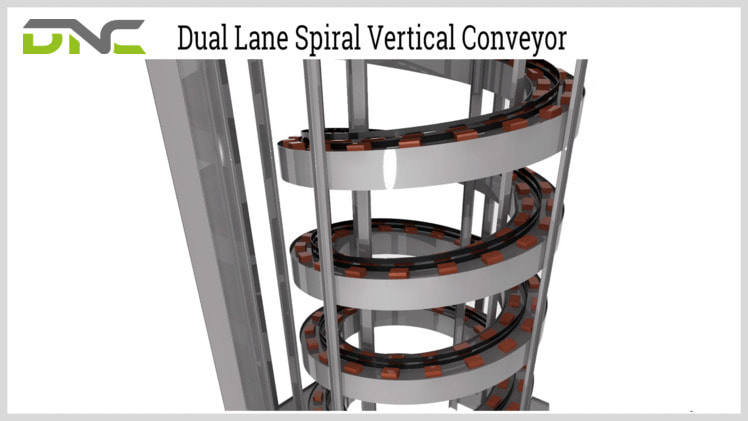
Dual lane spiral vertical conveyor
Vertical Conveyor Types
1. Spiral Conveyor
A spiral conveyor wraps a continuous belt or slat conveyor around a central tower in a helical path — rising (or descending) continuously as the product travels around the spiral. Products enter at the bottom and discharge at the top (or vice versa) without stopping.
Key advantage: Continuous operation — throughput limited only by product spacing, not by cycle time. Spiral conveyors achieve 3,500–5,000 cartons per hour, versus 1,200–1,500 CPH for platform lifts.
Specifications:
- Elevation change: 1–20 m (standard models); up to 40 m custom
- Tower diameter: 1.8–4.0 m (larger diameter = gentler helix angle = suitable for taller products or higher speeds)
- Belt width: 400–1,200 mm
- Belt speed: 0.2–0.8 m/s along the helix
- Product dimensions: up to 600 mm wide, 600 mm long, 600 mm tall (model dependent)
- Load per carton: typically 1–30 kg
Belt types: Modular plastic chain (standard — flexible for helical path); fabric belt with edge guides (for delicate products); flat-top, friction-top, or roller-top surface.
Applications: High-throughput carton conveying between distribution centre mezzanine and ground floor; biscuit and snack food packaging line elevation changes; soft drink canning line elevation between filler floor and packaging mezzanine.
Malaysian application: Nestlé’s Chembong factory (Negeri Sembilan) and Fraser & Neave Beverages use spiral conveyors for high-speed carton elevation between production and warehouse levels — where throughput of 2,000+ cartons/hour makes platform lifts impractical.
Up vs Down spiral: Both upward and downward spiral conveyors exist. For downward spirals, controlled belt deceleration prevents product acceleration under gravity — typically achieved with back-tensioned belt or regenerative drive motor.
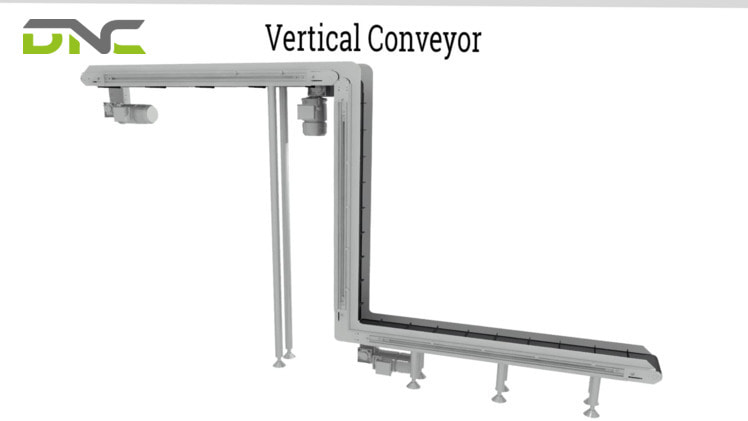
Introduction to vertical conveyor
2. Vertical Reciprocating Conveyor (VRC)
A VRC is a powered industrial lift designed exclusively for goods (not personnel) — using a carriage, platform, or fork that travels vertically between two or more levels. The platform loads at one level, travels vertically to the next level, discharges product, and returns for the next cycle.
How it differs from a freight elevator: A VRC is a conveyor — designed for continuous production use, not occasional lift cycles. VRCs operate at 200–400 cycles per day versus 10–50 for freight elevators. They are approved for goods only under Malaysia’s Factories and Machinery Act (FMA) and DOSH regulations — not for personnel.
Key specifications:
- Travel speed: 0.2–0.6 m/s (12–36 m/min) — some high-cycle models up to 2.0 m/s
- Lift height: Up to 20 m (typical production VRC); up to 60 m (high-rise warehouse)
- Platform capacity: 100–20,000 kg
- Cycle throughput: 3–8 loads per minute at short travel distances; 1–3 loads/minute at full travel height
- Cartons per hour: 1,200–1,500 CPH typical; up to 3,000 CPH for fast-cycling VRCs
VRC configurations:
- Single level (2-stop): Standard — ground floor to one mezzanine level.
- Multi-stop: Platform serves 3, 4, or more floor levels — common in high-bay warehouse with multiple pick levels.
- Hydraulic drive: Smooth, quiet, lower maintenance for moderate speeds (<0.5 m/s).
- Mechanical drive: Chain or belt driven by electric motor and counterweight — higher speed, longer travel distances.
Malaysian application: Automotive parts distributors in Shah Alam with 2-level warehouses use VRCs to lift heavy tote bins (200–500 kg) from ground-level receiving to mezzanine storage — replacing forklift operations that require aisle space and are limited to intermittent operation.
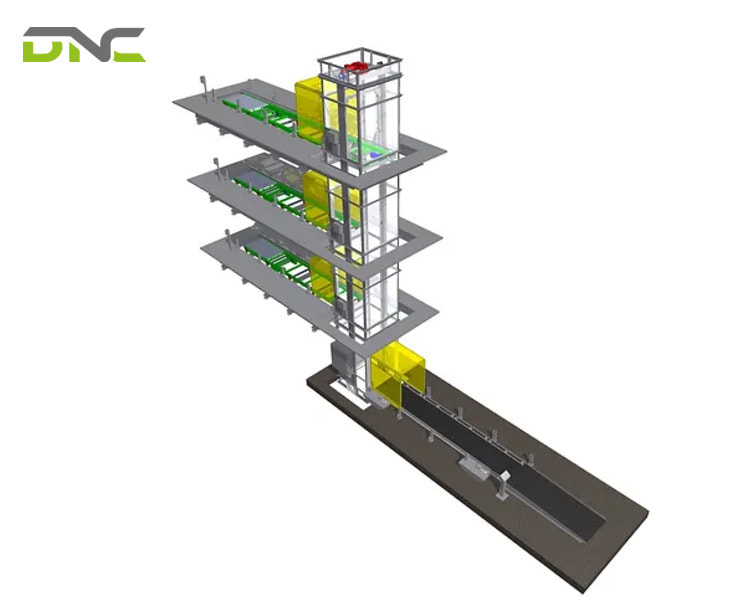
Vertical reciprocating conveyors (VRC)
3. Continuous Vertical Conveyor (CVC)
A CVC uses a series of carriers, shelves, or slats attached to a continuous loop chain running vertically — loading and discharging continuously without stopping. Products are placed on a carrier at the infeed, the carrier travels vertically, and the product discharges at the outfeed level.
Types:
- Bucket/shelf type: Fixed carriers at fixed positions on the chain. Best for stable, self-supporting products (cartons, totes, containers).
- C-type (paternoster): Carriers that remain horizontal regardless of chain position — using a four-bar linkage mechanism to keep the shelf level. Suitable for products that must remain upright (liquids in open containers, loose piles).
Throughput: 5,000–10,000 items/hour (much higher than VRC or most spiral conveyors, because loading and discharging happen simultaneously without cycle waiting).
Applications: Very high-throughput operations — newspaper printing plant circulation, postal sorting between floors, high-speed packaging line elevation.
Limitation: Product must be loaded and discharged in sync with the carrier movement — requires precise timing or integration with accumulation zones at both levels.
4. Lift-and-Transfer Unit (Mini-Lift)
A compact powered lift integrated directly into a conveyor line — lifting individual products 100–1,500 mm vertically to transfer between conveyor levels within the same production area. Not a full vertical conveyor system, but solves short elevation changes without routing products to a separate lift area.
Specifications: Typically 50–500 kg capacity; 100–1,500 mm stroke; pneumatic or servo-driven; cycle time 2–5 seconds.
Applications: Pallet lifting from floor conveyor to elevated roller conveyor; PCB lifting from main conveyor level to inspection station above; carton lifting from conveyor to merge point at higher level.

Circulating vertical conveyors
Vertical Conveyor Comparison
| Parameter | Spiral Conveyor | VRC Platform Lift | Continuous VRC |
| Throughput | 2,000–5,000 CPH | 1,200–3,000 CPH | 5,000–10,000 CPH |
| Product types | Cartons, totes | Any (platform) | Cartons, totes |
| Max load/item | 30 kg | Up to 20,000 kg | 30 kg |
| Elevation range | 1–20 m | Up to 60 m | 3–15 m |
| Floor footprint | Small (2–4 m diameter) | Very small (1 m² platform) | Medium |
| Product handling | Continuous, gentle | Batch, precise | Continuous |
| Height flexibility | Fixed helix height | Adjustable stops | Fixed |
| Best for | High throughput, fixed height | Heavy loads, multiple levels | Very high speed |
| Typical cost | RM 80,000–300,000 | RM 60,000–200,000 | RM 150,000–500,000 |
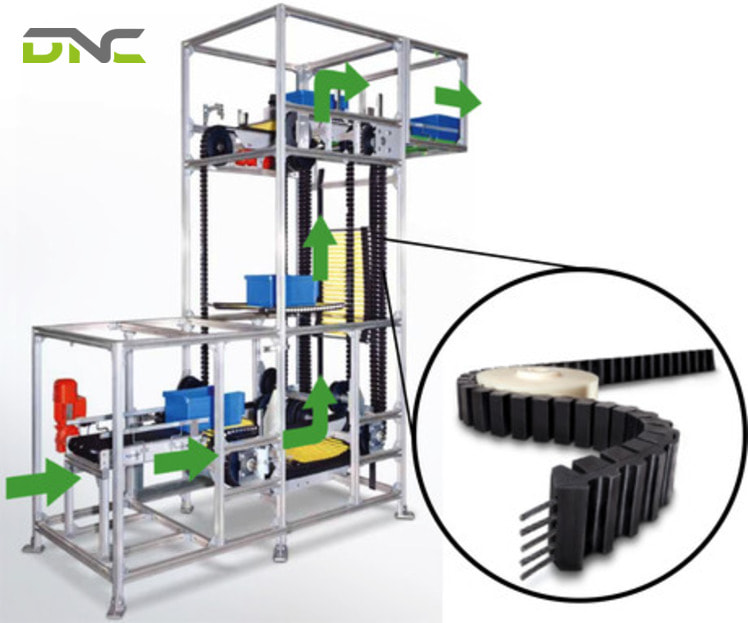
Benefits of vertical conveyor for business
DOSH and Safety Requirements for Vertical Conveyors in Malaysia
Malaysia’s Department of Occupational Safety and Health (DOSH) regulates goods lifts and vertical conveyors under the Factories and Machinery Act 1967 and associated regulations:
Goods lift / VRC registration: Lifting equipment above specified capacities requires DOSH registration, form submission, and periodic inspection. Consult the Machinery Ordinance (Lifting Equipment) Regulations for current thresholds.
Design approval: VRCs serving multiple levels must have structural design approved by a registered Professional Engineer (PE) in Malaysia.
Safety devices: All VRCs must have: overtravel limit switches (top and bottom), overload sensors, interlocked access gates at each level (gate open → lift cannot move), emergency stop accessible from each level.
Spiral conveyor: Not classified as a lifting device (product moves on a conveyor, not a platform) — no DOSH registration required, but standard machinery safety requirements apply (EN ISO 11161, guarding per EN 953).
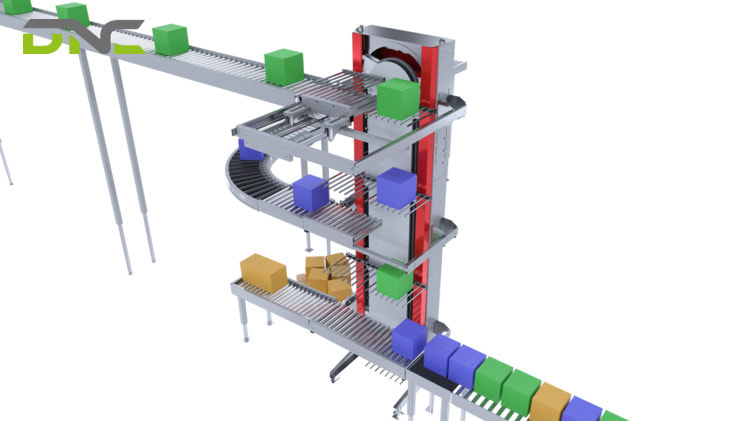
Applications of vertical conveyors in industries
Applications in Malaysia by Industry
Distribution and Logistics
Klang Valley distribution centres (including DHL, CEVA, Schenker regional hubs) use spiral conveyors for outbound carton flow from multi-level picking mezzanines to ground-floor packing stations — 3,000–5,000 cartons/hour continuously without operator intervention.
Food and Beverage Manufacturing
F&N’s Shah Alam plant uses VRC platform lifts to transfer heavy ingredient totes (300–500 kg) from ground-level receiving to mezzanine mixing areas — replacing forklift incursions into the production area.
Biscuit and confectionery manufacturers (Khong Guan, Julie’s) use spiral downward conveyors from oven mezzanine to ground-floor packing lines, allowing cooling time during the helical descent.
Automotive Parts
Tier-1 automotive parts manufacturers in Pegoh and Shah Alam use CVC continuous vertical conveyors between stamping floor (lower level) and assembly floor (upper level) — transferring stamped components at 5,000–8,000 parts/hour without manual handling.
Pharmaceutical
Pharmaceutical manufacturers in Selangor use mini-lift units integrated into tablet press conveyor lines — lifting individual tablet containers from conveyor height to inspection station height — with full GMP documentation and IP65 construction.
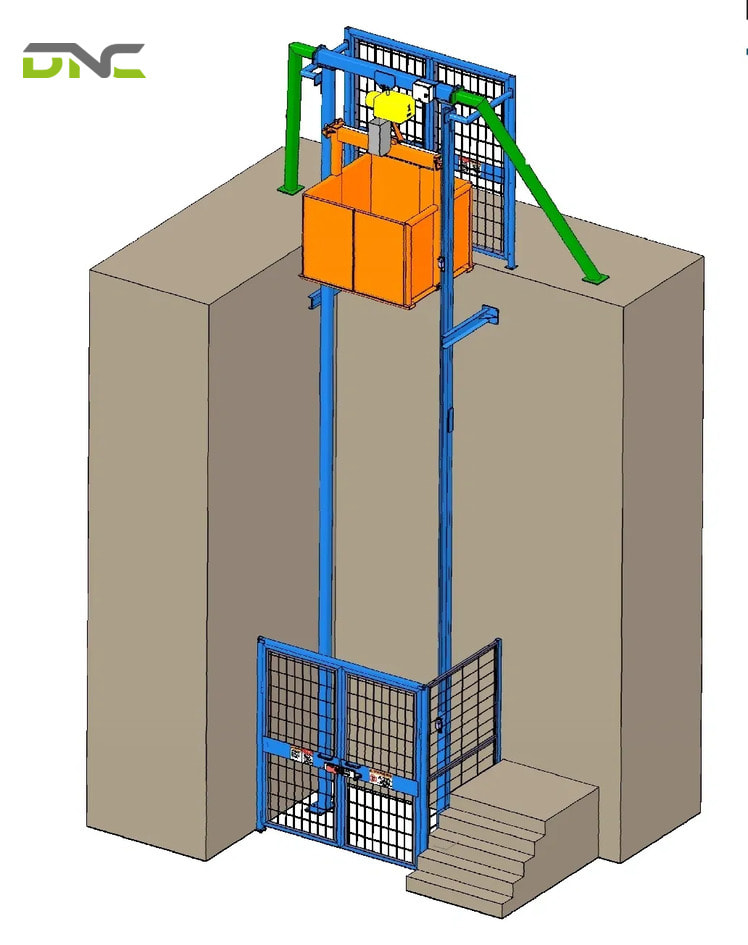
Price of vertical conveyor
DNC Automation’s Vertical Conveyor Solutions
DNC Automation designs and integrates vertical conveyor systems for Malaysian manufacturers — including spiral conveyors, VRC platform lifts, and mini-lift transfer units — with full Siemens PLC control and DOSH compliance documentation.
Scope: System selection based on throughput, product, and elevation requirements; structural design with Malaysian PE sign-off for DOSH compliance; installation and commissioning; integration with upstream and downstream conveyor systems; MIDA SAG documentation.
Contact DNC Automation for vertical conveyor assessment and proposal.
Summary
Vertical conveyors — spiral, VRC, and continuous types — solve multi-level material flow in Malaysian factories and distribution centres where floor space constraints make incline ramps impractical. Spiral conveyors deliver the highest throughput for carton handling; VRC platform lifts handle heavy or bulky loads at any elevation; continuous vertical conveyors achieve very high-speed continuous flow. Selection depends on throughput, load weight, elevation distance, product type, and safety regulatory compliance under DOSH requirements.
- 322 views
- 0 Comment
Recent Comments