


Optimizing Industrial Flow: Why Flat Belt Conveyors are the Heart of Modern Automation
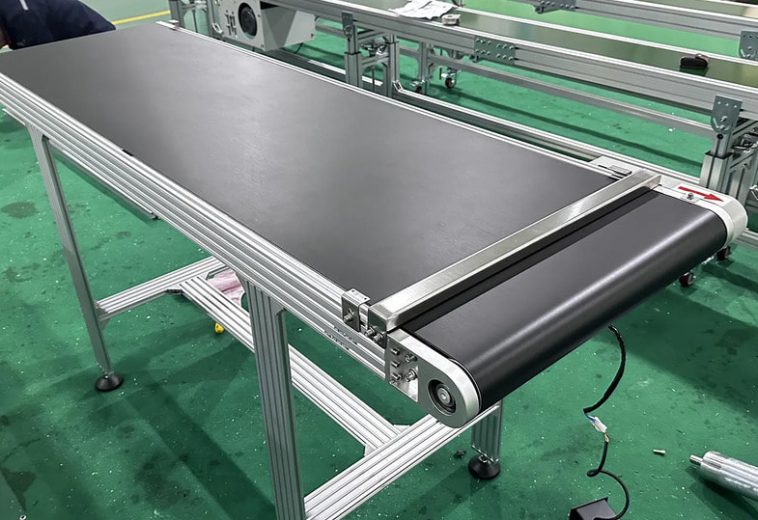
A flat belt conveyor carries products on a smooth, continuous belt surface moving horizontally, on an incline, or on a decline between two points. It is the most versatile and widely deployed conveyor type in manufacturing and logistics — used for everything from transporting PCBs between SMT process stages to moving packaged food products from filling to cartoning.
Unlike roller conveyors (which require a product with a flat rigid base to bridge between rollers) or chain conveyors (which require specific attachment points), a flat belt conveyor supports any product — cartons, bags, small parts, fragile items, irregular shapes — on its continuous surface. This universality makes flat belt conveyors the default choice when product type or size is variable or when maximum product stability is required during transfer.
How a Flat Belt Conveyor Works
The belt — a continuous loop of PVC, polyurethane (PU), rubber, or fabric composite — is tensioned over a head pulley (driven) at one end and a tail pulley (passive) at the other. The drive unit (geared motor) rotates the head pulley; friction between the pulley lagging and the belt surface transmits force into the belt. The upper (carrying) strand of the belt supports the product; the lower (return) strand travels back below the frame.
Belt support: The carrying strand rests on slider beds (flat UHMWPE or stainless steel plates — smooth, low friction) or on carrier rollers (spaced 300–600 mm for heavier loads). Slider beds provide continuous product support for small or fragile items; carrier rollers reduce belt tension and motor power for long, heavy conveyors.
Tensioning: A screw take-up (at the tail pulley) or gravity take-up (weighted carriage on the return strand) maintains correct belt tension — sufficient for traction at the head pulley without overstressing the belt splices.
Tracking: The belt tends to migrate laterally without tracking control. Crowned head pulleys, crowned idler rollers, and self-tracking tail pulley mechanisms keep the belt running centrally. Manual tracking adjustment via tail pulley shaft bolt positions fine-tunes alignment.
Flat Belt Conveyor Frame Types
Aluminium Profile Frame
Extruded aluminium profile (40×40, 80×40, 80×80 mm standard sections) bolted together. Lightweight, corrosion-resistant, quick to assemble, and easily modified — add brackets, sensors, guarding, or accessories by sliding T-slot components into the profile channels.
Best for: Electronics assembly, light manufacturing, clean environments. Standard for conveyor widths up to 600 mm at loads up to 50 kg/m.
Malaysian application: PCB assembly lines in Penang electronics factories use aluminium profile flat belt conveyors between SMT machines, reflow ovens, and inspection stations — where the lightweight profile reduces machine vibration transmitted to PCBs.
Mild Steel Welded Frame
Heavy-gauge mild steel channel or box section, welded construction. Higher structural stiffness for wide conveyors, heavy loads, and long spans.
Best for: Carton conveying, logistics, distribution centre infeed conveyors. Widths 600–2,000 mm, loads up to 500 kg/m of conveyor length.
Surface finish: Painted (light industrial), galvanised (moderate humidity), or powder-coated (heavy use, outdoor).
Stainless Steel Frame
SS304 or SS316 welded construction — mandatory for food processing, pharmaceutical, and chemical environments where corrosion resistance and hygienic cleanability are required.
Design details for hygiene: Minimum horizontal surfaces (bacteria accumulation), sloped ledges (self-draining), open frame legs (access for cleaning underneath), and IP65/IP69K drive motors.
Malaysian application: F&N dairy production and Nestlé food processing facilities specify SS316 flat belt conveyors with hygienic design for product-contact zones — compliant with HACCP and BRC food safety audit requirements.
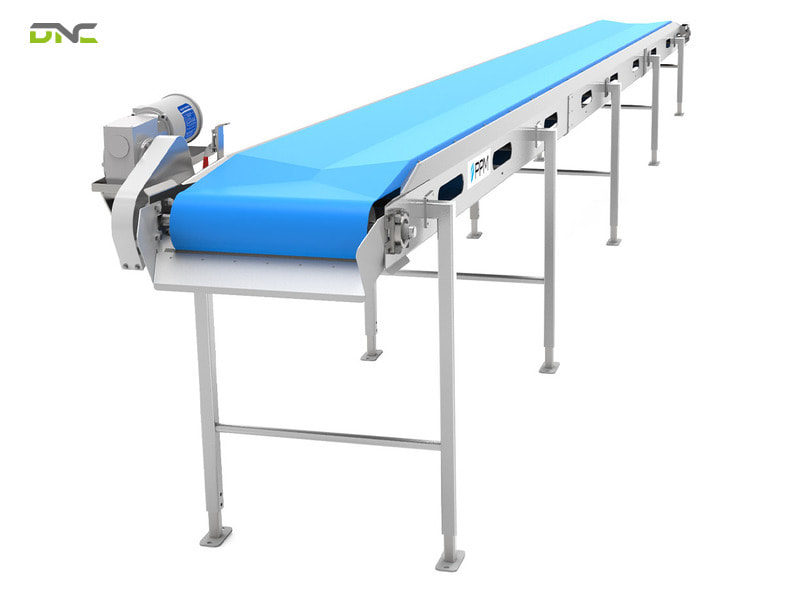
Each component plays a specific role in the system’s longevity
Belt Materials for Flat Belt Conveyors
PVC Belt
Polyvinyl chloride — the most economical food-safe belt material. Available in white (food), black (general industrial), green (standard conveyor colour), and multiple surface textures.
Properties: Temperature range -10°C to +70°C; FDA-compliant white grade for direct food contact; easy cleaning with standard detergents; moderate abrasion resistance.
Limitations: Not suitable for oily environments (oil degrades PVC over time); not suitable for temperatures above 70°C; some PVC formulations not compliant with EU food contact regulations — verify with material data sheet for export markets.
Cost index: 1× (baseline)
Polyurethane (PU) Belt
Higher-performance alternative to PVC. Better chemical resistance, wider temperature range (-30°C to +80°C), superior oil resistance, and better abrasion resistance.
Surface options: Smooth (product contact), rough-top friction (incline applications), micro-perforated (allows air flow-through for product cooling), and FDA/EU 10/2011 compliant grades for direct food contact.
Standard in: Pharmaceutical packaging, bakery (post-oven handling at higher temperatures), confectionery, and SMT electronics conveying.
Cost index: 1.5–2×
Rubber Belt
Multi-ply fabric-reinforced rubber — the standard for heavy industrial and bulk material applications. Higher load capacity, higher temperature range (rubber compounds up to +120°C), and better impact resistance than PVC or PU.
Types: EP (polyester-nylon) ply belts for general industrial; HR (heat resistant) for high-temperature applications; AR (abrasion resistant) for aggregate and mining.
Food application: Rubber belts are generally not used for direct food contact — use food-grade PU or PVC for food applications.
Cost index: 0.8–1.2× depending on ply rating and compound.
Fabric/Mesh Belt
Open weave fabric (polyester, nylon) or wire mesh — allows air circulation through the belt for product cooling, drying, or steam treatment.
Applications: Bakery cooling conveyors (bread loaves cooling after oven), vegetable washing lines, post-pasteurisation cooling, SMT reflow cooling zones.
Malaysian application: Local bread manufacturers (Gardenia, Massimo) use fabric cooling conveyors for baked bread cooling before slicing and packaging.
Modular Plastic Belt
Interlocking plastic modules (PP, POM) forming a flat conveying surface — not technically a flat belt, but performs the same function. Covered in detail in the Modular Belt Conveyor guide.
Incline and Decline Flat Belt Conveyors
Flat belt conveyors can transport products on inclines and declines. Key design considerations:
Maximum incline angle without product slip:
- Smooth PVC/PU belt, smooth product base: 8–12°
- Rough-top or friction belt: 20–30°
- Cleated belt (integral transverse cleats): 40–60° (see cleated conveyor belt guide)
Incline belt selection: For inclines above 15°, specify friction-top or rough-top belt surface. For smooth-base products (glass bottles, metal cans) on inclines, specify very high-friction belt (µ > 0.7) and limit incline to 10–12°.
Decline design: Products on declines may accelerate under gravity and push against belt tension. Design the drive unit to provide regenerative braking (motor holds back the belt on steep declines). Install speed governor or tachometer feedback control to maintain constant belt speed on declines.
Malaysian context: Factory mezzanine-level production lines commonly use incline conveyors at 15–25° to transfer products between floor levels — avoiding elevators and spiral chutes that damage fragile products.
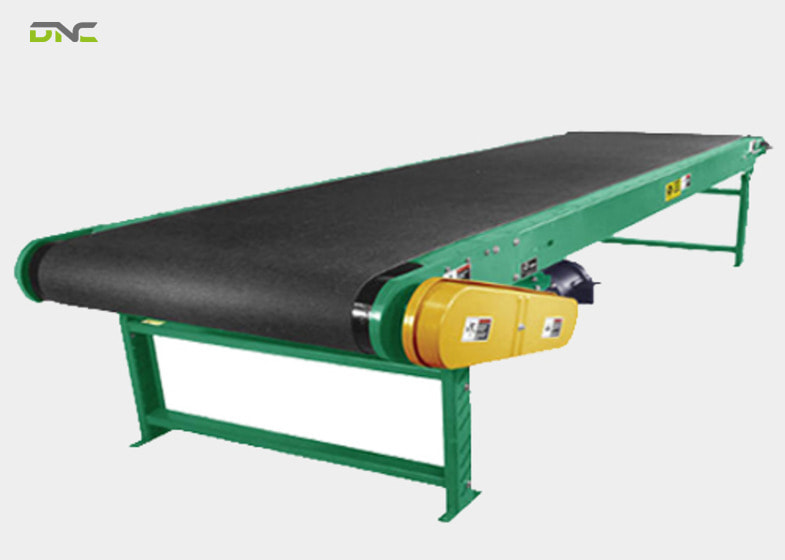
Depending on the friction requirements, incline angles, and product sensitivity, one of the following variations may be necessary
Belt Conveyor Design Parameters
Belt Width
Standard widths: 300, 400, 500, 600, 750, 900, 1,050, 1,200, 1,500, 1,800 mm.
Selection: Belt width = widest product + minimum 50 mm each side (for edge clearance and belt tracking allowance). For products that might rotate during transport, add 100 mm each side.
Belt Speed
Standard speed range: 0.05–3.0 m/s (3–180 m/min).
Selection based on required throughput:
Throughput (products/min) = belt speed (m/s) × 60 / (product length + gap between products)
For product inspection under cameras: 0.1–0.3 m/s (slow enough for camera resolution).
For carton accumulation: 0.2–0.5 m/s.
For high-speed packaging infeed: 1.0–2.5 m/s.
Motor Sizing
Drive power (kW) = (belt tension × belt speed) / (1,000 × drive efficiency)
Belt tension = load × friction coefficient (belt on slider bed: 0.25–0.35; belt on carrier rollers: 0.05–0.10) + belt weight × friction.
Always add 25–30% service factor to calculated power for start-up torque and load variation.
Belt Tension
Correct belt tension is critical:
- Too low → belt slip on drive pulley (belt slows, product jams)
- Too high → premature splice failure and belt edge fraying
Formula: T₁ (tight side) / T₂ (slack side) = e^(µ×θ)
Where µ = drive pulley friction (lagging µ = 0.35 bare; 0.45 rubber lagged) and θ = belt wrap angle on drive pulley (usually π radians = 180°).
In practice: specify a drive pulley with rubber lagging for maximum µ; adjust tail pulley take-up to achieve correct T₁/T₂ ratio; verify no belt slip during start-up under full load.
Flat Belt Conveyor Applications in Malaysia
Food and Beverage Processing
Malaysian food manufacturers use flat belt conveyors throughout their production lines:
- Bakery and confectionery: PU or fabric belt for post-oven product cooling; SS frame for hygienic design; variable speed for matching production rate.
- Dairy and beverage: SS316 flat belt for bottle and can line conveying; accumulation zones before labelling and capping.
- Frozen food: Low-temperature PU belt (-30°C rated) for frozen product transfer in chilled areas.
- Snack food and biscuits: PVC flat belt for finished product transfer to packaging machines.
Electronics Manufacturing (SMT and Assembly)
Penang and Selangor electronics factories use aluminium-profile flat belt conveyors extensively:
- SMT pre/post reflow transfer (ESD-safe belt options for static-sensitive PCBs)
- Box-build assembly line product transfer between stations
- Finished product inspection transfer under vision systems
Logistics and Distribution
Distribution centres across Malaysia’s Klang Valley logistics hubs use flat belt conveyors for:
- Carton infeed and merge conveyors (stainless or mild steel, 500–1,200 mm wide)
- Decline conveyors from mezzanine pick levels to ground-floor dispatch
- Packaging station accumulation belts
Pharmaceutical
GMP-compliant SS316 flat belt conveyors for tablet, capsule, and blister pack transfer between processing stages — with validated cleaning protocols, IP65 motors, and full material certificates.
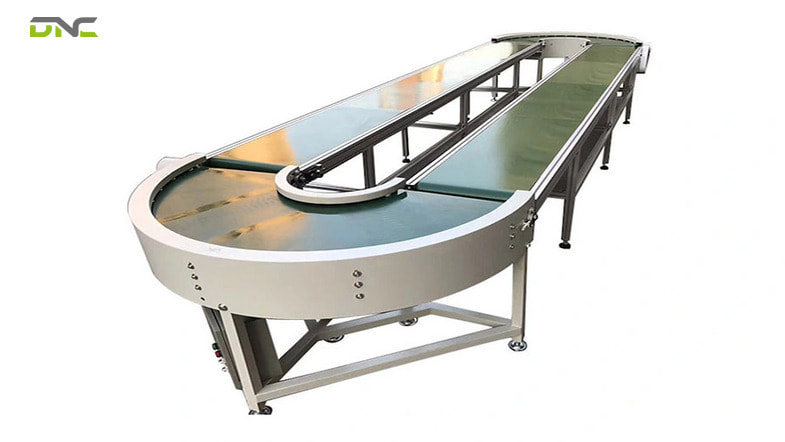
When our engineers at DNC Automation design a system, we look beyond just “moving a box.
Maintenance Schedule
| Interval | Tasks |
| Daily | Belt tracking check (confirm running centrally); belt surface inspection for cuts or embedded debris; check motor temperature |
| Weekly | Belt tension check (feel for correct tautness or measure take-up position vs. baseline); clean slider bed from product residue; confirm no product accumulation under belt at tail pulley |
| Monthly | Drive pulley lagging inspection (replace at 30% wear); tail pulley bearing lubrication; splice condition check (peeling, cracking, or embedded fastener loosening); conveyor frame bolt torque check |
| Annual | Belt replacement assessment (measure elongation and surface wear; replace if splice integrity or surface condition compromised); gearbox oil change; drive motor bearing inspection; full frame inspection for corrosion |
DNC Automation’s Flat Belt Conveyor Solutions
DNC Automation designs, fabricates, and commissions flat belt conveyor systems for Malaysian food, electronics, pharmaceutical, and logistics customers — from single conveyor supply to complete multi-zone systems with PLC control.
Engineering scope: Belt selection for product and environment, frame type and finish, drive sizing, speed control (fixed or VFD variable), sensor integration, and PLC control (Siemens S7-1500 with PROFINET).
Food-grade capability: HACCP-compliant SS316 frame conveyors, FDA/EU-compliant PU belt, IP69K drives, hygienic design (drainable, no crevices), and NSF-H1 lubricants — with full BRC and FSSC 22000 compliance documentation.
MIDA SAG: Flat belt conveyor systems as part of production automation investments qualify for MIDA’s Strategic Automation Grant (up to RM 1 million, 50% of qualifying capex).
Contact DNC Automation for flat belt conveyor specifications, layout design, and turnkey proposals.
Summary
Flat belt conveyors deliver product transport across horizontal, inclined, and declined routes with the widest product compatibility of any conveyor type. Belt material (PVC, PU, rubber, fabric) determines temperature range, food compliance, friction, and cost. Frame material (aluminium, mild steel, stainless steel) determines weight, corrosion resistance, and hygienic cleanability. Drive and speed control selection depends on throughput, incline angle, and automation integration requirements. With correct belt selection, proper tensioning, and structured maintenance, flat belt conveyors achieve 5–10 year service lives with only belt splice and pulley lagging as recurring replacement items.
- 230 views
- 0 Comment
Recent Comments