


Indexing Conveyor: Types, Applications, and Selection Guide for Malaysian Manufacturers
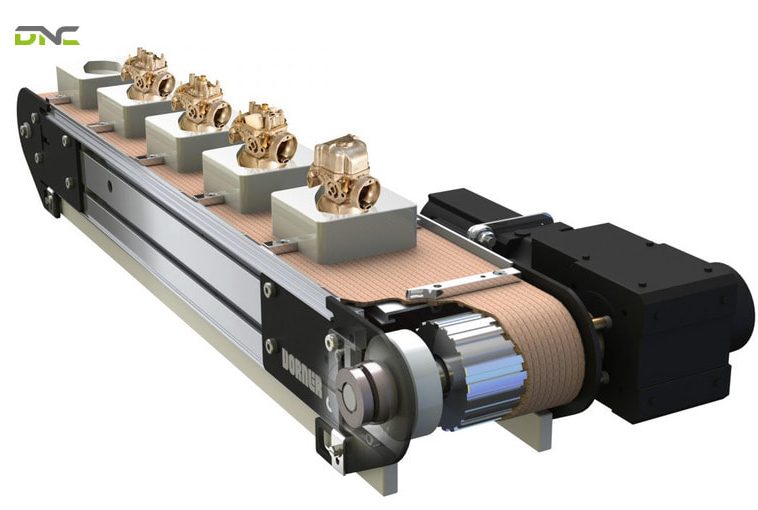
An indexing conveyor is a material handling system that moves products in precise, incremental steps — stopping at defined positions for processing, inspection, or assembly — then advancing to the next station on command. Unlike continuous conveyors that move product at constant speed, an indexing conveyor delivers repeatable positioning accuracy of ±0.05 mm to ±0.5 mm depending on drive mechanism, making it the default choice for automated assembly lines, PCB handling in SMT processes, and pharmaceutical packaging.
Malaysian manufacturers operating under NIMP 2030’s Industry 4.0 mandate increasingly specify indexing conveyors for electronics assembly in Penang, medical device production in Iskandar Malaysia, and automotive sub-assembly in Shah Alam — environments where 0.1 mm positional error can mean a failed weld, a misaligned pick-and-place cycle, or a failed vision inspection.
What Is an Indexing Conveyor and How Does It Work
An indexing conveyor operates on the index-dwell cycle: the conveyor advances the product by a fixed distance (the index pitch), dwells at the stop position for a defined time (the dwell time), then indexes again. This cycle repeats continuously.
The sequence involves three phases:
Advance phase — The drive mechanism accelerates the belt or chain, moves the product exactly one pitch distance, then decelerates to a smooth stop. Acceleration and deceleration profiles are controlled to minimise product shift and inertial forces on fragile components.
Dwell phase — The product remains stationary at the workstation. During dwell, robots, pick-and-place heads, screwdrivers, dispensers, or inspection cameras perform their tasks. Dwell time is typically 0.5 to 10 seconds depending on process complexity.
Signal phase — A PLC receives a “cycle complete” signal from the workstation, triggers the next advance, and the cycle repeats.
The key performance metrics are positioning repeatability (how consistently the product stops at the same point), index time (how fast the advance phase completes), and load capacity (how heavy the product or fixture can be).
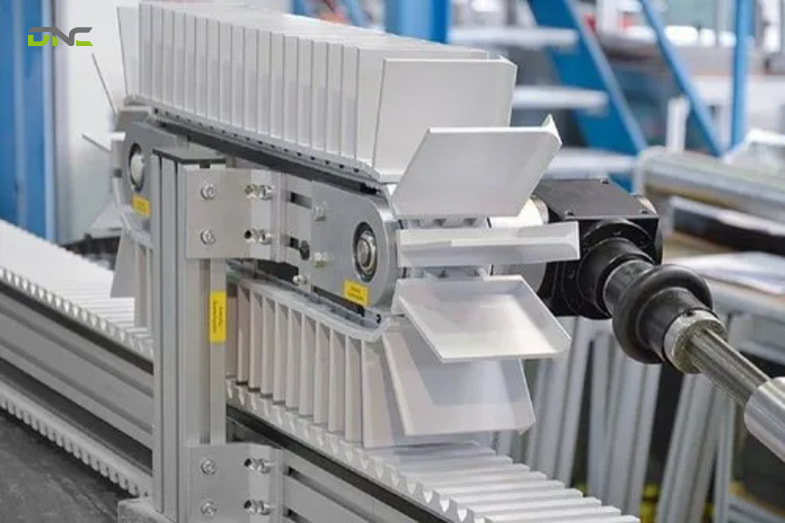
Indexing Conveyor Types and Drive Mechanisms
1. Timing Belt Indexing Conveyor
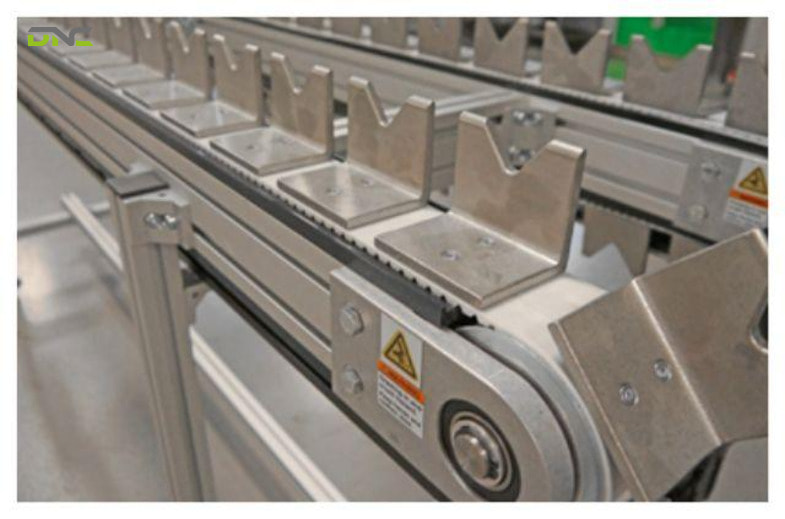
Timing belt systems use a toothed belt driven by a servo motor or stepper motor. The tooth engagement between belt and pulley provides positive drive without slip, delivering positioning accuracy of ±0.1 mm to ±0.3 mm.
Applications: PCB assembly (SMT reflow pre/post handling), small electronics, medical device sub-assembly, optical component inspection.
Advantages: Low noise, clean (no lubrication needed), suitable for cleanrooms (Class 10,000 equivalent), lightweight product handling up to 10 kg per carrier.
Limitations: Belt stretch over time affects accuracy — systems require periodic re-tensioning or belt replacement every 12,000–20,000 operating hours.
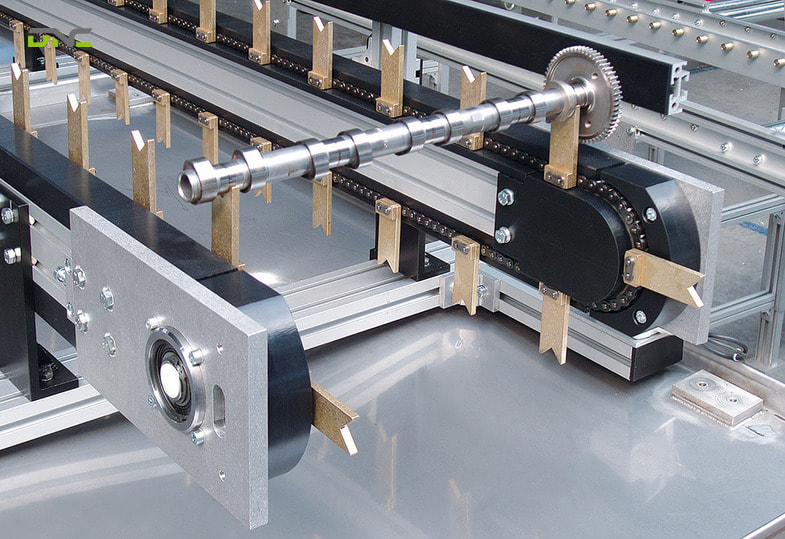
2. Chain-Driven Indexing Conveyor
Roller chain or engineering plastic chain provides higher load capacity than belts. Servo-driven chain indexing conveyors handle 50–500 kg carrier loads in automotive assembly.
Applications: Cylinder head assembly, gearbox assembly, engine sub-assembly, PCBA board handling in heavy-duty electronics.
Accuracy: ±0.3 mm to ±1.0 mm — adequate for manual assembly or robot welding with vision correction but insufficient for precision press-fit operations without locating fixtures.
Malaysian context: Toyota Shah Alam, DRB-Hicom, and Proton sub-assembly suppliers commonly use roller chain indexing lines with 1,200 mm pitch and 6–12 station configurations.
3. Walking Beam Indexing Conveyor
A walking beam uses a horizontal beam with lift-and-carry motion: the beam rises, advances, lowers to deposit products on fixed rails, retracts, and rises again. No belt or chain contacts the product during transfer — making it ideal for precision-machined parts, hot forgings, or high-temperature processes.
Accuracy: ±0.05 mm to ±0.2 mm. The highest accuracy class of indexing conveyor.
Applications: Engine block machining lines, bearing race grinding, aerospace component inspection, prismatic cell battery production.
Key advantage: Since the workpiece sits on fixed V-locators or precision rails during dwell, positional accuracy is decoupled from conveyor drive accuracy. The locating fixture — not the conveyor — determines final position.
4. Rotary Indexing Table (Dial Table)
Though technically a rotary conveyor, dial tables perform the same index-dwell function for circular part flow. A servo-driven cam or DD (direct drive) motor rotates the table by exactly 360°/N where N = number of stations.
Station count: 2 to 24 stations. Common configurations: 4, 6, 8, 12 stations.
Accuracy: ±5 arc-seconds for cam-driven; ±1 arc-second for direct drive torque motor.
Applications: Stator winding, connector assembly, multi-axis machining centres, lens assembly, relay assembly.
Cycle time advantage: Rotary tables eliminate linear return travel — every station cycles simultaneously, giving throughput equal to the slowest station dwell time.
5. Pallet-Based Indexing Conveyor (Pallet Transfer System)
Pallet-based systems use precision steel or aluminium pallets (fixtures) that carry products between stations. The conveyor indexes pallets from station to station; at each station, mechanical or pneumatic locating pins lift and locate the pallet to ±0.02 mm before processing.
System components: Indexing drive (belt, chain, or friction roller), pallets with locating bushings, lift-locate units at each station, return conveyor or recirculating loop.
Applications: Complex sub-assembly requiring multi-step operations at each station — clutch assembly, alternator winding and testing, medical pump assembly.
Malaysia relevance: Hartalega’s automation projects for glove stripping and packaging, and multinational pharmaceutical facilities in Selangor, frequently use pallet transfer indexing lines for consistent product positioning across 8–16 stations.
Indexing Conveyor vs. Continuous Conveyor: When to Choose Each
| Parameter | Indexing Conveyor | Continuous Conveyor |
| Positioning requirement | ±0.05–1.0 mm | Not critical |
| Station dwell | Fixed, precise | Operator-controlled |
| Product type | Pallets, fixtures, PCBs | Bulk, bags, cartons |
| Automation level | Robotic, vision, auto-screwdriving | Manual, semi-auto |
| Speed | Cycle-based (20–120 cycles/min) | Linear (0.1–3.0 m/s) |
| Changeover | Medium | Fast |
| Cost | Higher | Lower |
Choose an indexing conveyor when: (1) robots or automated tools must interact with stationary products, (2) inspection cameras require zero motion during image capture, (3) assembly requires repeatability across multiple shifts, or (4) the product is fragile and cannot absorb the forces of a moving process tool.
Choose a continuous conveyor when: throughput is the priority, products are robust, and human operators can adapt to slight positional variation.
Key Parameters for Indexing Conveyor Specification
Index Pitch
The distance the conveyor advances per cycle. Standard pitches range from 100 mm to 2,000 mm. The pitch must equal or exceed the longest workstation footprint plus clearance gaps (typically 50–100 mm) between pallets or product carriers.
For a 6-station PCB testing line handling 150 mm × 200 mm boards: minimum pitch = 200 mm + 60 mm gap = 260 mm. Standard pitch selection: 300 mm.
Index Time and Dwell Time
Index time = total advance phase duration, typically 0.3–3.0 seconds. Shorter index time = higher throughput but greater acceleration forces on the product.
Dwell time = dictated by the longest station operation. A robot screwdriving 4 fasteners at 1.5 sec/fastener requires minimum 6 seconds dwell. Total cycle time = index time + dwell time.
For a 400 mm pitch system running 2.0 s index + 6.0 s dwell = 8.0 s cycle = 7.5 cycles/min = 450 cycles/hour throughput.
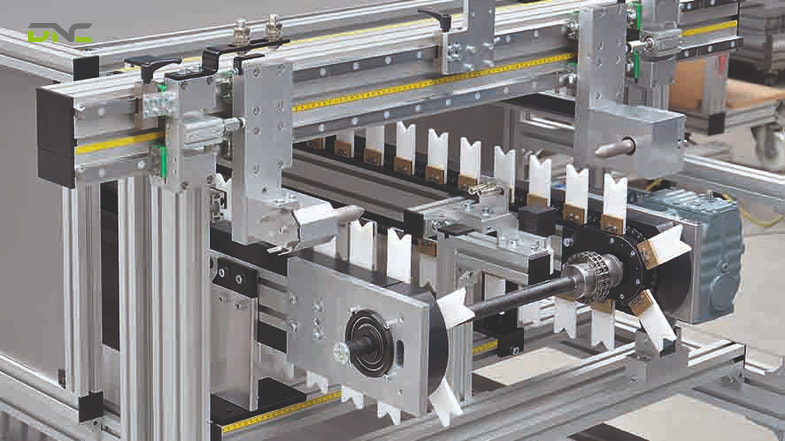
Positioning Accuracy Requirements
| Application | Required Accuracy | Recommended Drive |
| Manual assembly | ±1.0 mm | Chain with stop |
| Semi-auto screwdriving | ±0.5 mm | Servo belt or chain |
| Robotic pick-and-place | ±0.3 mm | Servo belt + locating |
| Vision inspection | ±0.2 mm | Walking beam or pallet |
| Precision press-fit | ±0.05 mm | Pallet with lift-locate |
| Micro-component placement | ±0.02 mm | Direct drive rotary table |
Load Capacity
Calculate total fixture weight + heaviest product weight + dynamic forces during acceleration. Apply a 1.5× safety factor. For pallet-based systems, add cumulative pallet weight if multiple pallets coexist on the conveyor simultaneously.
Indexing Conveyor Applications in Malaysian Industries
Electronics Manufacturing (Penang, Johor, Selangor)
Penang’s electronics cluster — home to Intel, Bosch, Jabil, Motorola Solutions, and over 200 supplier factories — is the highest-density indexing conveyor application area in Malaysia. Key uses:
- SMT pre/post reflow handling: Timing belt indexers feed PCBs into reflow ovens at precise intervals, preventing board-to-board contact and ensuring dwell time matches thermal profile requirements.
- In-circuit testing (ICT): Pallets advance PCBs under flying probe testers or bed-of-nails fixtures, dwell for the test cycle, advance to next station.
- Box-build assembly: Multi-station pallet indexing lines for cable harness connection, connector insertion, functional testing, and labelling.
Pharmaceutical Packaging (Selangor, Johor)
Malaysia’s pharmaceutical sector, growing at 8.3% annually, uses indexing conveyors for:
- Blister pack sealing — indexing film under thermoforming and sealing stations
- Vial filling — rotary dial tables indexing vials under fill needles, stoppering, and crimping stations
- Cartoning — timing belt indexers feeding cartons under insert, fold, glue, and weight-check stations
GMP compliance requires stainless steel construction, IP65 minimum protection, CIP/SIP capability, and full audit trail from PLC/SCADA.
Automotive Sub-Assembly
Tier-1 suppliers in Shah Alam, Batu Caves, and Tanjung Malim use pallet-based indexing conveyors for:
- Brake calliper assembly (8–12 stations, 800 kg pallet capacity)
- Alternator and starter motor assembly
- Instrument cluster assembly combining PCBs, display modules, and harnesses
Medical Device Manufacturing
Malaysia’s medical device industry (exports: USD 5.7B in 2024) increasingly uses cleanroom-rated indexing conveyors for:
- Syringe barrel and plunger assembly
- Catheter assembly and inspection
- Implant component inspection under 5-megapixel vision systems
Indexing Conveyor Integration with Industry 4.0 Systems
Modern indexing conveyors integrate with factory automation systems through standardised interfaces:
PLC integration: Siemens S7-1500 or Allen-Bradley CompactLogix typically controls indexing drives via EtherNet/IP or PROFINET. Signal exchange: index trigger input, cycle complete output, fault status, encoder position feedback.
SCADA and MES: OPC-UA enables real-time cycle time monitoring, availability tracking (OEE), and traceability — linking product serial numbers to specific station dwell times and tool states.
Vision inspection integration: Cameras trigger on “index complete + dwell stable” signals, ensuring zero motion during image capture. Failed parts trigger rejection at downstream divert station.
Predictive maintenance: Servo drive current monitoring detects chain wear (increasing resistance), belt stretch (encoder drift), and bearing degradation (vibration signature changes) — enabling planned maintenance before failure.
DNC Automation’s conveyor automation projects typically integrate Siemens S7-1500 PLCs with PROFINET-connected servo drives, providing full OPC-UA connectivity to customer MES systems for production counting and OEE reporting.
Common Indexing Conveyor Failures and Prevention
Missed Index (Product Does Not Advance)
Causes: Servo drive fault, chain jump (worn sprocket or chain), belt slip (insufficient tension), mechanical obstruction, overload.
Prevention: Monthly chain tension inspection, annual sprocket replacement, daily torque fault log review.
Positioning Drift (Product Position Shifts Over Time)
Causes: Belt elongation, pallet wear at locating bushings, locating pin wear, thermal expansion.
Prevention: Weekly accuracy verification using gauge block at reference station, annual belt replacement, pallet bushing replacement at 500,000 cycles.
Station Collision (Product Hits Tooling During Index)
Causes: Tooling not retracted before index trigger, sensor failure, PLC logic error.
Prevention: Dual-channel safety monitoring of tool-clear signals before index enable, physical stroke limiters on pneumatic tooling.
Noise and Vibration Increase
Causes: Chain elongation, worn roller bearings, improper drive alignment, index cam wear.
Prevention: Bi-annual vibration baseline measurement, replace chain at 3% elongation, align drive shafts to within 0.1° angular misalignment.
Indexing Conveyor Selection Checklist
Before specifying an indexing conveyor system, confirm:
- Maximum product/fixture weight (kg)
- Index pitch required (mm) — from station footprint + clearance
- Required positioning accuracy (mm) — from tool/process requirement
- Dwell time required (seconds) — from slowest station cycle
- Index time target (seconds) — from throughput target
- Number of stations — including buffer and testing stations
- Environment: cleanroom, food-grade, washdown, high-temperature
- Product fragility: can it withstand indexing acceleration forces?
- PLC/SCADA integration requirements
- Maintenance access: can technicians reach drive components without disassembly?
Why Malaysian Manufacturers Choose DNC Automation for Indexing Conveyor Systems
DNC Automation engineers custom indexing conveyor systems from specification to commissioning, with a 35-engineer team experienced across electronics, pharmaceutical, and automotive applications in Malaysia.
System design capabilities:
- Timing belt indexers for PCB and electronics handling (±0.1 mm accuracy)
- Pallet transfer systems for complex multi-station assembly
- Walking beam systems for precision machined components
- Rotary indexing tables for compact, high-throughput assembly
Integration expertise: Every indexing conveyor system is commissioned with Siemens PLC control, PROFINET servo drives, and OPC-UA data interface for MES connectivity — meeting Industry 4.0 requirements under Malaysia’s NIMP 2030 framework.
MIDA SAG grant support: Capital investment in automated conveyor systems qualifies for MIDA’s Strategic Automation Grant (SAG), which covers up to RM 1 million or 50% of qualifying capital expenditure. DNC Automation assists clients with grant documentation and technical justification.
Proven installations: DNC has delivered indexing conveyor systems for PCB manufacturers in Penang, pharmaceutical packaging facilities in Klang Valley, and Tier-1 automotive suppliers in Shah Alam — with documented OEE improvements of 15–35% over manual or semi-automated baselines.
Contact DNC Automation’s engineering team to discuss your indexing conveyor requirements — from single-station proof-of-concept to 20-station turnkey assembly lines.
Summary
Indexing conveyors are precision material handling systems that define product position in automated assembly and inspection processes. The choice between timing belt, chain-driven, walking beam, rotary table, and pallet-based systems depends on required accuracy, load, throughput, and environment. For Malaysian manufacturers implementing Industry 4.0 under NIMP 2030, indexing conveyors are the enabling infrastructure for robotic assembly, vision inspection, and automated testing — delivering consistent throughput across multiple shifts with full MES traceability.
- 461 views
- 0 Comment
Recent Comments