


Conveyor Belt Types: Complete Guide for Malaysian Factory Managers
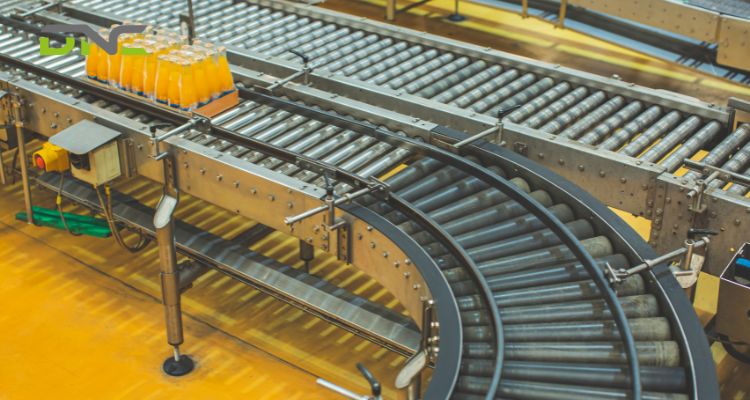
Conveyor belt types determine production line performance — the wrong belt type costs Malaysian manufacturers in downtime, product damage, hygiene compliance failures, and energy waste across the full service life of the system. Every conveyor belt type is engineered for a specific set of conditions: load weight, surface temperature, product contact requirements, incline angle, and environment. Specifying a rubber troughing belt where a modular plastic food-grade belt is required does not save money — it creates a compliance failure, a maintenance burden, and a safety risk.
This guide classifies all major conveyor belt types used in Malaysian manufacturing — from flat belt and modular plastic through cleated, mesh, rubber, timing, and specialty configurations — with technical specifications, industry applications, and a structured selection framework engineered for Malaysia’s F&B, automotive, electronics, palm oil, and warehouse sectors.
Under Malaysia’s NIMP 2030 national industrial transformation agenda, 3,000 factories are targeted to become smart factories by 2030. Conveyor belt selection is the foundational layer of that transformation — the right belt type, correctly integrated with PLC control and IoT monitoring, delivers the productivity gains and energy efficiency that NIMP 2030 demands.
What Defines a Conveyor Belt Type?
Conveyor belt type is defined by three intersecting parameters: construction (how the belt is built), material (what it is made from), and function (what operational purpose it serves). These three parameters interact — a modular plastic belt can be flat, cleated, or side-flexing depending on module design; a rubber belt can be flat or troughed depending on idler configuration.
Understanding which parameter is primary for your application is the starting point for correct belt type selection:
- Temperature-critical applications → Material is primary (PTFE, high-alloy wire, heat-resistant rubber)
- Hygiene-critical applications → Construction is primary (modular plastic, open mesh, stainless steel)
- Incline or containment applications → Function is primary (cleated, sidewall, troughed)
- Precision timing applications → Construction is primary (timing belt, positive drive chain)
Conveyor Belt Types: Full Classification
1. Flat Belt Conveyor
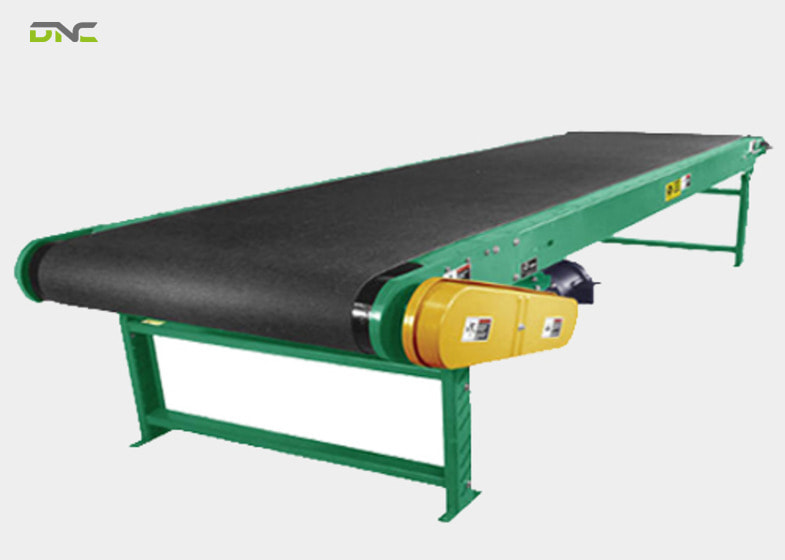
The flat belt conveyor is the most widely used belt type across Malaysian manufacturing — a continuous flat belt surface running over drive and idler pulleys, transporting product horizontally or at inclines up to 20–25° (depending on belt surface friction and product weight).
Belt materials for flat belts:
- Rubber: Abrasion-resistant for heavy industrial product (aggregates, automotive parts); temperature range -30°C to 80°C
- PVC (Polyvinyl Chloride): Food-grade variants available; temperature range -10°C to 80°C; resistant to oils and fats
- PU (Polyurethane): Superior food-grade hygiene; FDA/EU compliant; temperature range -30°C to 100°C; easy to clean; preferred for Malaysian F&B lines
- Fabric/nylon core belts: High tensile strength for heavy loads; reinforced with polyester or nylon plies
Applications in Malaysia: General assembly lines, packaging lines, warehouse conveying, food product transport (where incline < 20°), electronics assembly, automotive component transport
DNC Automation delivers: Flat belt conveyors from 300 mm to 2,400 mm width; PLC-controlled with VFD speed adjustment; Siemens SCADA integration for throughput monitoring
2. Modular Plastic Belt Conveyor
Modular plastic belt conveyors use interlocking injection-molded plastic tiles (modules) connected by pivot rods — forming a belt that flexes around sprockets, absorbs impacts, and allows module-by-module replacement when individual sections wear or break.
Key advantage over continuous flat belts: No full belt replacement when a section fails — replace only the damaged modules. This reduces maintenance cost by 40–60% over the belt’s service life and eliminates full production line shutdowns for belt replacement.
Material options: Polypropylene (PP) — -20°C to 110°C; Acetal/POM — -40°C to 140°C; Nylon — up to 120°C; HDPE (for cold chain)
Surface configurations: Flat (standard), open mesh (drainage), raised rib (grip), flush grid (washthrough), side-flexing (curved conveyor paths)
Applications in Malaysia: F&B production lines (F&N, Ramly Burger — modular belts on wash and packing lines); pharmaceutical tablet conveying; beverage canning; poultry and seafood processing; e-commerce sortation lines (Lazada, Shopee fulfillment centers)
3. Wire Mesh / Open Mesh Belt
Wire mesh and open mesh conveyor belts are defined by their permeable construction — 30–70% of the belt surface is open (void) space, enabling airflow, drainage, heat transfer, and steam penetration through the belt.
Wire mesh subtypes:
- Balanced weave: Standard food processing and industrial; AISI 304/316; up to 870°C
- Flat wire: Wider product support surface; preferred for biscuit and cookie baking
- Spiral wire: Lateral flexibility for curved and spiral conveyor configurations
- High-alloy: AISI 310, Inconel — up to 1,150°C for heat treatment furnaces
Plastic open mesh: Modular plastic with open-grid surface design — food-grade, wash-through, FDA compliant; limited to 110–140°C
Applications in Malaysia: Baking ovens (PTFE or flat wire mesh), automotive parts washing (SS304/316 mesh), food cooling conveyors, electronics SMT reflow oven transport, palm oil sterilizer loading

4. Cleated Belt Conveyor
Cleated belt conveyors carry fixed transverse projections (cleats) molded or vulcanized onto the belt surface. Cleats create product containment pockets — preventing product from sliding backward on steep inclines and maintaining consistent product spacing on the belt.
Cleat configurations:
- T-cleats (T-profile): General incline containment; height 20–150 mm; spacing 50–500 mm
- V-cleats (chevron): Self-cleaning V-shape; prevents bulk material bridging between cleats
- Sidewall belts with cleats: Full containment walls plus cross-cleats — enables vertical elevation of loose bulk material
Incline capability:
- Standard cleated belt: up to 35–40°
- High-profile cleated sidewall belt: up to 90° (near-vertical elevation)
Applications in Malaysia: Palm oil FFB reception and loading hoppers (high-angle elevation); rice and grain mills (bulk elevation); aggregate and cement plants; food ingredient elevation (sugar, flour, salt) in F&B factories; automotive parts elevation between production levels
5. Rubber Conveyor Belt (Troughed / Bulk)
Rubber conveyor belts for bulk material handling are the workhorse of Malaysia’s heavy industrial sector — palm oil mills, cement plants, feed mills, quarries, and mining operations. The rubber belt runs on troughing idlers (typically 20°, 35°, or 45° trough angle) that cup the belt into a U-shape — allowing it to carry loose bulk material without spillage.
Belt construction:
- Cover grades: General-purpose (M/S grade), abrasion-resistant (N17 grade per ISO 14890), oil-resistant (OR grade), heat-resistant (T/T2 grade — up to 180°C), fire-resistant (FR grade per ISO 340)
- Tensile strength: 500 N/mm to 5,000+ N/mm (carcass rating)
- Carcass types: Multi-ply fabric (polyester/nylon EP); steel cord (for long-distance, high-tension)
Applications in Malaysia: Palm oil FFB transfer conveyors (high-volume: 60–150 TPH); cement raw material handling; coal and ash handling (power plants); aggregate and quarry operations; rice and grain mills
6. Timing Belt Conveyor (Positive Drive Belt)
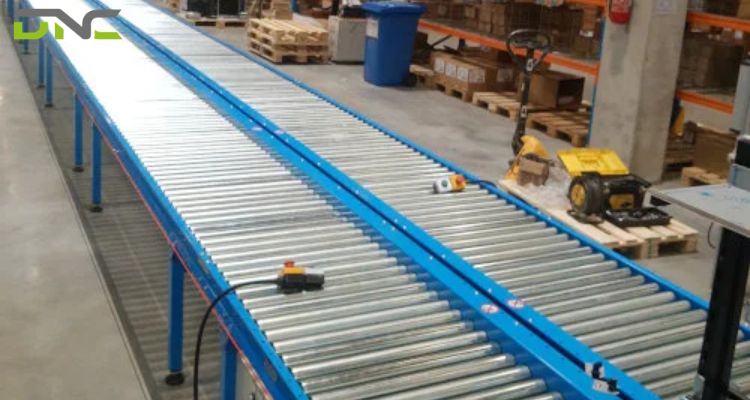
Timing belt conveyors use a toothed belt profile engaging precisely with matching sprockets — creating a positive drive with zero belt slip and exact positional control. Unlike friction-drive flat belts, timing belts deliver the exact position repeatability required for automation-integrated conveyor systems.
Belt materials: Polyurethane (PU) with steel or Kevlar tension members — cleanroom compatible, oil-resistant, FDA food-grade variants available
Pitch options: T5 (5 mm pitch), T10 (10 mm), AT10 (anti-backlash), HTD (high torque) — selected based on drive torque and positioning accuracy requirement
Key advantage: Positioning accuracy to ±0.1 mm — required for robot pick-and-place integration, vision inspection stations, and precision assembly line indexing
Applications in Malaysia: SMT electronics assembly line indexing (Penang EMS factories); robot cell infeed/outfeed; pharmaceutical blister pack conveying; precision indexing between assembly stations in automotive manufacturing; cleanroom semiconductor substrate transport
7. Chain Conveyor Belt
Chain conveyor belts use metal roller chains (single or double strand) as the drive element, with flat plates, slats, or attachments riding on the chain to form the carrying surface. Chain conveyors handle loads and operating conditions where belt conveyors reach their limits.
Chain belt subtypes:
- Slat conveyor: Steel or stainless steel slats mounted across double-strand chain; handles hot, oily, or sharp-edged products; automotive paint cure lines
- Roller chain conveyor: Products rest directly on chain roller tops; for pallet and heavy unit load transport
- Drag chain conveyor: Double-strand chain with flight attachments drags bulk material along a trough; palm oil mill and cement plant applications
Applications in Malaysia: Automotive paint curing ovens (slat chain at 200°C); pallet transport in heavy manufacturing (Toyota, DRB-Hicom); palm oil FFB and kernel handling (drag chain); foundry and die-casting plants
8. Magnetic Conveyor Belt
Magnetic conveyor belts use permanent magnets embedded in the conveyor structure (belt or surface) to attract and hold ferrous metal parts during transport — enabling inclined, vertical, and overhead transport of metal components without mechanical containment.
Configurations: Horizontal magnetic belt (parts held on top surface), inclined magnetic belt (parts held against inclined surface), vertical elevator (parts held against vertical surface), overhead magnetic conveyor (parts suspended beneath the belt/magnet surface)
Specifications: Width 150–1,500 mm; length 2–20 m; speed up to 2.5 m/s; load 50–1,000 kg/m; temperature range -20°C to 150°C (up to 250°C specialty)
Applications in Malaysia: Automotive stamping plants (scrap metal removal from press lines); electronics manufacturing (ferrous component sorting); metal fabrication shops (parts washing and inspection lines); recycling plants (ferrous separation from mixed waste streams)
9. Cleated Sidewall Belt
Cleated sidewall belts combine corrugated sidewalls (fixed to the belt edges) with transverse cleats — creating a fully enclosed product pocket. This configuration enables conveying of loose bulk materials at any angle from horizontal to vertical without spillage or product loss.
Maximum incline: Up to 90° (vertical elevation)
Capacity: Up to 6,000 m³/hour depending on belt width and speed
Materials: Rubber (standard), food-grade rubber, PVC
Applications in Malaysia: Grain elevator replacement in rice and feed mills; sugar and salt elevation in F&B factories; aggregates and sand elevation in construction material plants; waste and recycling plant elevation systems
10. Polyurethane (PU) Flat Belt
PU flat belts deserve separate classification from rubber belts — their material properties serve applications where rubber fails. PU belts offer: FDA/EU food-grade compliance, oil and fat resistance, operating temperature range -30°C to 100°C, surface hardness options from 60 Shore A to 98 Shore A, and antistatic variants for ESD-sensitive applications.
Applications in Malaysia: F&B light product transport (bakery, confectionery, fresh produce); pharmaceutical solid dose product conveying; electronics component transport (antistatic grade); textile and garment industry transport; printing and paper handling
11. Vacuum Belt Conveyor
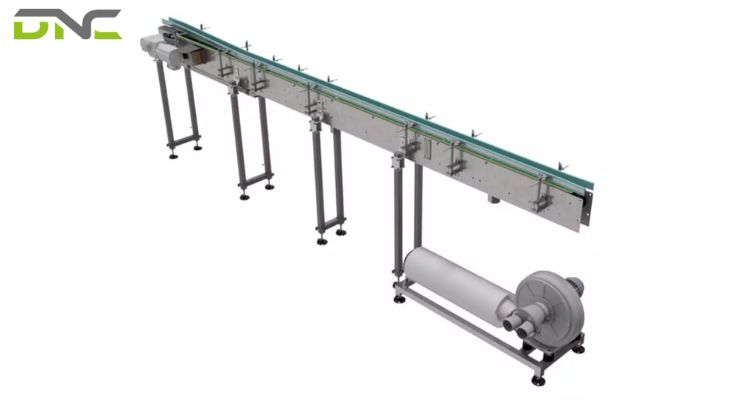
Vacuum belt conveyors use negative air pressure (suction) applied through perforations in the belt surface to hold lightweight, flat, or flexible product against the belt — preventing product sliding, flipping, or misalignment during high-speed transport.
Applications: Flat flexible packaging film and pouches; printed circuit board (PCB) transport in SMT lines; paper and card sheet handling in printing factories; thin food products (wafers, crackers) on incline conveyors
Application note for Malaysia: PCB handling in Penang EMS factories represents the primary Malaysian market for vacuum belt conveyors — PCBs cannot be allowed to slide or flip during high-speed SMT line transport, and mechanical edge guides can damage sensitive components.
Conveyor Belt Types by Industry — Malaysia Reference
| Industry | Primary Belt Type | Secondary Belt Type | Key Requirement |
| F&B Processing | Modular plastic (PP) | Wire mesh / PTFE | HACCP, FDA food-grade |
| Automotive | Slat chain / Flat rubber | Magnetic belt | High temp, heavy load |
| Electronics/EMS | Timing belt / Vacuum | Flat PU (ESD) | Precision, ESD safety |
| Palm Oil Mill | Rubber troughed / Drag chain | Wire mesh (SS316) | High volume, heat/steam |
| Warehouse/Logistics | Modular plastic flat | Rubber flat belt | High throughput, sortation |
| Glove Manufacturing | Overhead chain | Flat rubber | Chemical resistance, heat |
| Pharmaceutical | Modular plastic / Flat PU | Timing belt | FDA, cleanroom, precision |
| Cement/Aggregates | Rubber troughed (abrasion) | Cleated sidewall | Abrasion, high volume bulk |
Common Failure Modes Across Belt Types
Malaysian factories lose an estimated USD 260,000 per hour during unplanned production downtime (Aberdeen Group). Understanding failure modes specific to each belt type prevents the majority of unplanned stoppages:
Flat belt: Belt mistracking (misaligned pulleys or uneven loading), belt slippage (insufficient tension or worn lagging), edge wear (belt contact with frame due to tracking failure)
Modular plastic belt: Module cracking from impact or overtensioning, pivot rod wear from inadequate lubrication, sprocket tooth wear from abrasive product contamination
Wire mesh belt: Cross-rod fatigue from overtensioning or thermal cycling, wire corrosion from incorrect material grade selection, belt mistracking from shaft misalignment
Rubber troughed belt: Belt cover wear from abrasive product, splice failure from dynamic loading or incorrect splice type, belt slippage from worn drive pulley lagging, idler seizure from contamination
Cleated belt: Cleat delamination from repeated impact loading, base belt fatigue at cleat attachment points, product jamming between cleats from oversized product
Chain conveyor: Chain elongation from wear (causes sprocket skipping), corrosion from chemical or moisture exposure, lubrication failure causing rapid wear and seizure
How to Choose the Right Conveyor Belt Type
Decision Framework — 5 Key Parameters
- Product Type and Weight
- Light products (under 5 kg): Flat PU, modular plastic, timing belt, vacuum belt
- Medium products (5–50 kg): Flat rubber, modular plastic, slat chain
- Heavy / bulk (over 50 kg or bulk material): Rubber troughed, drag chain, roller conveyor
- Temperature
- Ambient (-20°C to 40°C): Any belt type
- Elevated (40°C to 110°C): Heat-resistant rubber, modular plastic (POM/PA), PU
- High (110°C to 260°C): PTFE mesh, heat-resistant rubber (T grade)
- Extreme (260°C to 870°C): Wire mesh SS304/316
- Ultra-high (870°C to 1,150°C): High-alloy wire mesh
- Hygiene Requirement
- No food contact: Any industrial belt type
- Indirect food contact: FDA/EU food-grade rubber or PU
- Direct food contact: Modular plastic (PP), PU, PTFE mesh, SS wire mesh
- HACCP / ISO 22000: Modular plastic + stainless steel frame + CIP design
- Drive Precision
- Standard conveying (±5 mm): Flat belt friction drive adequate
- Indexed positioning (±1 mm): Modular plastic with sprocket drive
- High-precision (±0.1 mm): Timing belt with servo drive
- Incline Angle
- 0–15°: Flat belt (any type)
- 15–35°: Cleated belt, chevron rubber belt
- 35–90°: Cleated sidewall belt
- Any angle for ferrous metal: Magnetic belt
Selection Matrix
| Requirement Priority | Recommended Belt Type |
| Lowest cost | Flat rubber belt |
| Best hygiene | Modular plastic PP |
| Highest temperature | High-alloy wire mesh |
| Steepest incline | Cleated sidewall belt |
| Best precision | Timing belt |
| Bulk material | Rubber troughed |
| Ferrous metal handling | Magnetic belt |
| High-speed flexible product | Vacuum belt |
| Easiest maintenance | Modular plastic (module replacement) |
Benefits of Correct Belt Type Selection
- Reduce Human Error by Up to 80%: Correctly integrated conveyor belt systems eliminate manual product handling between process stages — documented DNC Automation performance outcome across Malaysian F&B and automotive deployments.
- Increase Productivity by Up to 50%: Matching belt type to product and process eliminates speed limits imposed by product slippage, damage, or hygiene non-compliance — enabling full rated line speed.
- Save Up to 50% in Operational Cost: Correct belt type selection eliminates premature belt failure, product damage, and hygiene compliance failures that drive unplanned cost across the belt service life.
- MIDA Smart Automation Grant Eligibility: Conveyor belt systems with PLC, VFD, and IoT integration qualify for Malaysia’s Smart Automation Grant — up to RM 1,000,000 on a 70:30 matching basis. DNC Automation structures proposals to maximize SAG grant coverage.
- NIMP 2030 Alignment: Smart conveyor systems with real-time monitoring, predictive maintenance, and MES integration directly contribute to the Industry 4.0 KPIs targeted under Malaysia’s NIMP 2030 — positioning your factory for audit compliance and government incentive eligibility.
FAQ — Conveyor Belt Types
Q1: What is the most common conveyor belt type used in Malaysian food factories?
Modular plastic belts — specifically polypropylene (PP) modules with open-grid surface design — are the dominant belt type in Malaysian food processing. They satisfy HACCP and ISO 22000 hygiene requirements, allow CIP washdown through the open mesh, contain no metal that could trigger false positives in downstream metal detectors, and allow module-by-module replacement when individual sections wear. DNC Automation has delivered modular plastic conveyor systems to F&N, Ramly Burger, and multiple Malaysian F&B manufacturers under ISO 9001:2015 quality management.
Q2: What conveyor belt type handles the steepest incline?
Cleated sidewall belts handle inclines from horizontal to vertical (90°) — the only belt type capable of near-vertical bulk material elevation. For unit products (boxes, bags, individual items) at inclines up to 35–40°, standard cleated belts are sufficient. For inclines above 40° or for loose bulk material, cleated sidewall is the only practical belt type. DNC Automation engineers cleated conveyor systems for palm oil mill FFB loading and grain elevator applications across Malaysia.
Q3: What is the difference between a PU belt and a rubber belt?
Polyurethane (PU) and rubber conveyors belts both use polymer materials but differ in key properties. PU belts offer superior oil and fat resistance, FDA/EU food-grade compliance as standard, cleaner surface for product hygiene, and operating temperature range down to -30°C. Rubber belts offer greater abrasion resistance for heavy industrial materials, higher tensile strength at wide widths, and lower cost for bulk material handling applications. Choose PU for F&B and pharmaceutical product contact; choose rubber for heavy industrial and bulk material conveying.
Q4: Which conveyor belt type is best for the electronics manufacturing sector in Penang?
Penang’s EMS and semiconductor factories require three belt types depending on the application: (1) Timing belts with servo drive for precision PCB indexing between SMT machines (±0.1 mm positioning); (2) Flat ESD-safe PU or antistatic modular belts for general board transport; (3) Stainless steel wire mesh belts (ESD-grounded) for SMT reflow oven transport at 260°C peak temperature. DNC Automation has delivered conveyor systems to Penang electronics manufacturers including Sony and Panasonic — with full ESD compliance and SMEMA interface compatibility.
Q5: How do I know if my conveyor belt type is eligible for Malaysia’s Smart Automation Grant?
The MIDA Smart Automation Grant (SAG) funds automation technology adoption — conveyor belt systems qualify when they include PLC control, VFD drive, and IoT or SCADA connectivity. The grant provides up to RM 1,000,000 on a 70:30 government-to-company matching basis. Belt type alone does not determine grant eligibility — the control and monitoring technology integrated with the belt system does. DNC Automation designs all conveyor proposals with SAG eligibility in mind and provides documentation support for the MIDA application process.
Q6: What conveyor belt type is used in palm oil mills in Malaysia?
Malaysian palm oil mills — operating across Sabah, Sarawak, Pahang, and Johor — use multiple belt types across the FFB processing flow: (1) Rubber troughed belts for high-volume FFB reception and transfer (60–150 TPH); (2) Drag chain conveyors for moving FFB and palm fruit through sterilizer loading at elevated temperature; (3) Wire mesh (AISI 316) for steam-sterilizer loading environments where corrosion resistance is critical; (4) Cleated incline belts for FFB elevation at reception hoppers. DNC Automation provides turnkey conveyor systems for palm oil mill applications, including Siemens-integrated process control.
Q7: How often should conveyor belts be replaced in Malaysian factory conditions?
Service life depends on belt type, material, and operating conditions: flat rubber belts in heavy industrial use — 3–5 years; modular plastic belts in food processing — 3–5 years (with module-level replacement); wire mesh belts in food processing — 3–5 years; rubber troughed belts in bulk material handling — 2–4 years depending on abrasiveness of material; timing belts in precision conveying — 2–3 years. DNC Automation’s preventive maintenance contracts include belt elongation measurement, wear assessment, and proactive replacement scheduling — eliminating unplanned downtime from unexpected belt failure.
Q8: Can DNC Automation supply all conveyor belt types from a single source?
Yes. DNC Automation is a turnkey automation integrator with in-house engineering, fabrication, and commissioning capability for all major conveyor belt types — flat belt, modular plastic, wire mesh, cleated, rubber troughed, slat chain, magnetic, timing belt, and specialty configurations. All systems are designed using SolidWorks 3D engineering, pre-commissioned in DNC’s 25,000 sq ft facility, and installed by DNC’s 35+ engineers. Single-source supply eliminates the coordination risk and interface failures that arise from multiple sub-suppliers on complex conveyor projects.
- 102 views
- 0 Comment
Recent Comments