


Selective vs Drive-In Pallet Racking: Which Fits Your Warehouse?
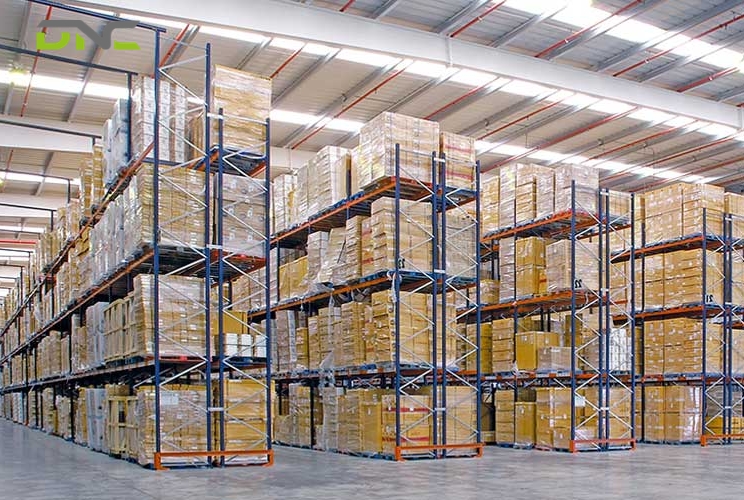
Selective pallet racking and drive-in pallet racking solve fundamentally different warehouse storage problems – one maximises access, the other maximises density. Selective racking places every pallet in a directly accessible position, giving operators the freedom to pick any SKU at any time without moving other loads. Drive-in racking pushes pallets deep into consolidated storage lanes, eliminating most warehouse aisles and fitting 40–60% more pallet positions into the same building footprint. The decision between these two racking systems shapes your facility’s storage efficiency, inventory rotation method – FIFO or LIFO – and whether your layout supports future warehouse automation integration.
This guide compares selective and drive-in pallet racking across five dimensions: storage density, pallet selectivity, inventory rotation, forklift requirements, and cost per pallet position. It also covers double-deep racking as a transitional middle-ground option, a full pallet racking types comparison chart, and a structured decision framework based on SKU profile and warehouse automation compatibility – the factor most facilities assess only after the racking installation is complete.
What Is Selective Pallet Racking?
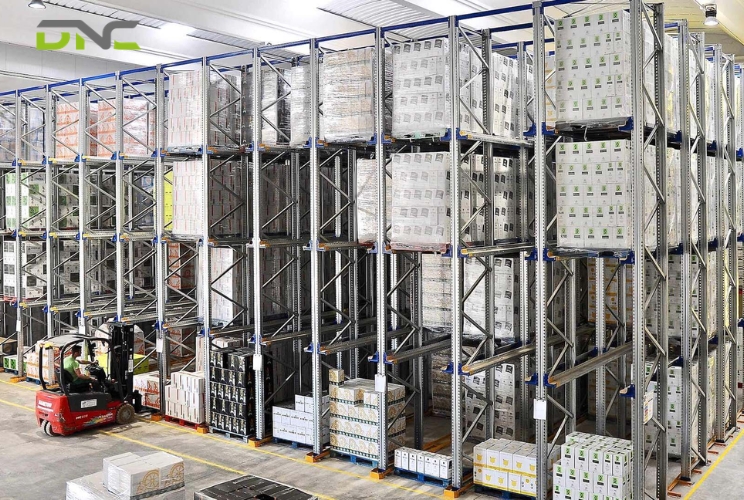
In warehouse storage, selective pallet racking stores each pallet one position deep on horizontal beams, with every pallet position directly accessible from the aisle in front of it. No pallet blocks another. Operators retrieve any load without sequencing constraints – making selective racking the default architecture for operations that manage many different product types with variable turnover rates.
How Selective Racking Works
Each pallet rests on a pair of horizontal beams attached to vertical upright frames. Standard upright heights run from 2,000 mm to 12,000 mm, configurable to warehouse clear height. Beam levels adjust vertically along the upright, allowing operators to reposition them for pallets of different heights without replacing structural components.
A forklift drives along the aisle face of the rack, stops at the target bay, and picks or places the pallet directly. Standard load capacity per beam level runs from 500 kg to 1,500 kg depending on beam specification and upright rating. Aisle width depends on the forklift type: reach trucks require a minimum 2.8 m clear aisle, sit-down counterbalance forklifts need 3.5–4.5 m, and very narrow aisle (VNA) turret trucks operate in aisles as tight as 1.5 m.
Advantages of Selective Pallet Racking
Selective racking provides these operational benefits across warehouse types:
- 100% pallet selectivity – every position accessible independently, no sequencing required
- Compatible with all forklift types without structural modification to the rack
- Supports any inventory rotation method: FIFO, LIFO, or lot-based traceability
- Beam levels adjustable to accommodate mixed pallet heights within the same system
- Lowest risk of racking damage – forklifts never enter the rack structure itself
- Straightforward installation and reconfiguration as the product mix changes over time
Limitations of Selective Racking
The trade-off for full selectivity is floor space. Selective racking requires one aisle per rack row, so a significant portion of the facility floor serves as forklift travel space rather than storage. In bulk storage scenarios where many pallets hold the same product, this aisle overhead translates directly to under-utilised storage capacity relative to high-density alternatives.
Selective racking costs less per rack bay to install, but the cost per individual pallet position becomes less competitive than drive-in racking when floor space is constrained or expensive. For facilities approaching storage capacity, the density gap between selective and drive-in matters more than the per-bay install differential. The right response to that gap depends on the SKU profile, which the decision framework in the final section addresses directly.
What Is Drive-In Pallet Racking?
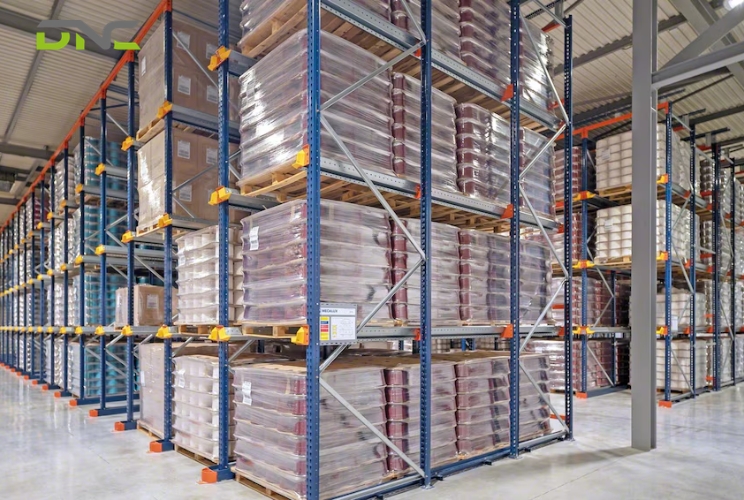
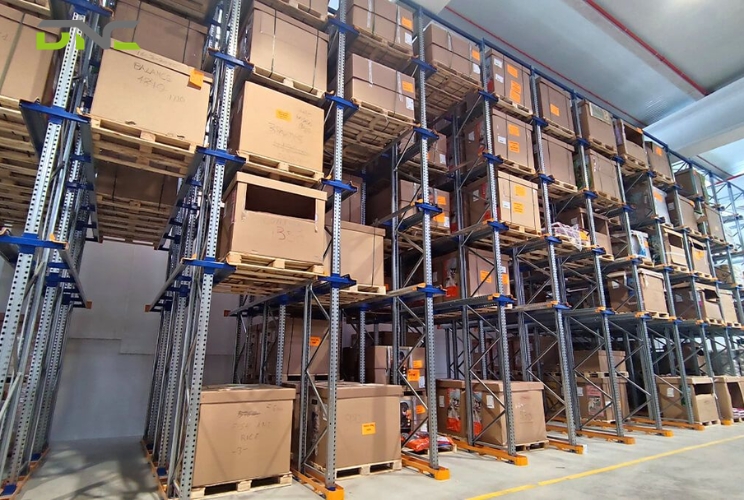
Drive-in pallet racking is a high-density storage system in which forklifts drive inside the rack structure to load and retrieve pallets stored multiple positions deep on continuous horizontal support rails. By eliminating aisles between storage rows, drive-in racking fits substantially more pallet positions into the same building footprint than selective systems – at the cost of individual pallet accessibility.
How Drive-In Racking Works
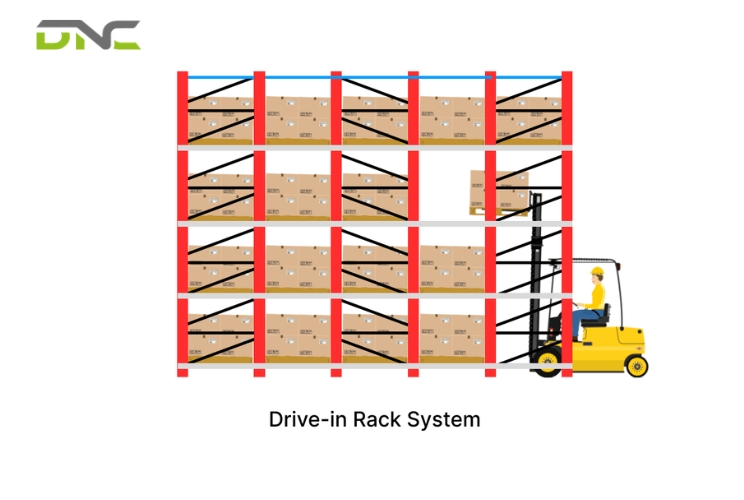
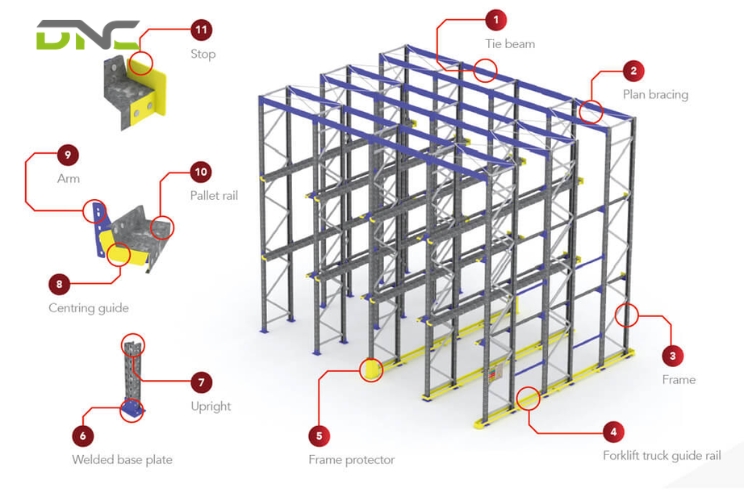
Pallets in a drive-in system do not rest on cross-beams. Instead, each pallet sits on a pair of support rails running the full depth of the storage lane – typically 3 to 10+ positions deep. The forklift enters from the single front aisle, lifts above the stored pallet level, travels to the target depth, lowers the pallet onto the rails, and reverses out.
Steel guide rails at floor level run the lane length, protecting uprights from wheel contact and steering the forklift through the confined bay. The result is a configuration with far fewer aisles – one access aisle serves an entire block of deep lanes rather than one aisle per row.
Drive-In vs Drive-Thru: Key Difference
Standard drive-in racking uses one aisle for both loading and retrieval, which forces Last In, First Out (LIFO) inventory rotation by physical constraint – the most recently loaded pallet blocks all pallets behind it in the lane. This is not a programmable setting; it is a consequence of single-entry lane geometry.
Drive-thru racking adds a second aisle at the rear of the structure, enabling First In, First Out (FIFO) operation by loading from one end and picking from the other. The functional benefit comes at a floor-space cost: drive-thru requires an aisle on both sides of the block, which eliminates roughly 35–40% of the floor-space savings that drive-in achieves. Drive-thru is the right specification only when FIFO is operationally mandatory and the remaining density advantage still exceeds a selective racking layout.
Advantages of Drive-In Racking
Drive-in racking includes the following storage gains when the operational profile matches its structural strengths:
- Highest pallet density of any static rack system – 40–60% more positions in the same footprint vs selective
- Minimal aisle count – one access aisle per lane block instead of per row
- Effective for temperature-controlled facilities where floor space directly equals refrigeration operating cost
- Suited to bulk homogeneous stock where dedicating full lanes to one SKU is operationally viable
- Lower cost per pallet position stored when lane fill rates are consistently high
Limitations of Drive-In Racking
Drive-in racking imposes real operational constraints that selective racking does not:
- LIFO inventory rotation only in standard configuration – not suitable for perishable goods, pharmaceutical lots, or date-coded products requiring FIFO compliance
- Access restricted to the front pallet per lane – retrieving any other pallet requires emptying all positions in front of it
- Higher forklift damage probability – operators navigate a confined structural bay and upright impacts are more common than in open selective aisles
- Forklift must fit within the lane opening – mast width and extended-mast height both need to clear bay dimensions before specifying this system
- Poorly suited to high-SKU-count operations where lane dedication to single SKUs leaves lanes chronically under-filled
For facilities planning to integrate automated retrieval systems – AGV-based picking, ASRS, or WMS-directed workflows – drive-in racking presents additional compatibility constraints covered in the decision framework section below.
How Do Selective and Drive-In Racking Compare?
In warehouse design, the choice between selective and drive-in racking comes down to five measurable factors: how many pallets fit per square metre, how accessible each pallet is, what inventory rotation method the system supports, what equipment it requires, and what each pallet position actually costs.
| Factor | Selective Racking | Drive-In Racking |
| Pallet density | ~1 pallet per 25–30 sq ft | ~1 pallet per 14–20 sq ft |
| Pallet selectivity | 100% – all positions directly accessible | Low – front pallet per lane only |
| Inventory rotation | FIFO, LIFO, or lot-based | LIFO standard; FIFO via drive-thru |
| SKU flexibility | High – unlimited SKUs | Low – 1 SKU per lane recommended |
| Forklift type | Any type | Counterbalance or specific reach truck |
| Aisle requirement | 1 aisle per rack row | 1 aisle per 3–10+ lane block |
| Budget cost/pallet position | $50–80 (US market reference) | $115–140 (US market reference) |
| Forklift damage risk | Low | Higher |
| Automation compatibility | Full – AGV, ASRS, WMS | Limited – no standard AGV integration |
Storage Density
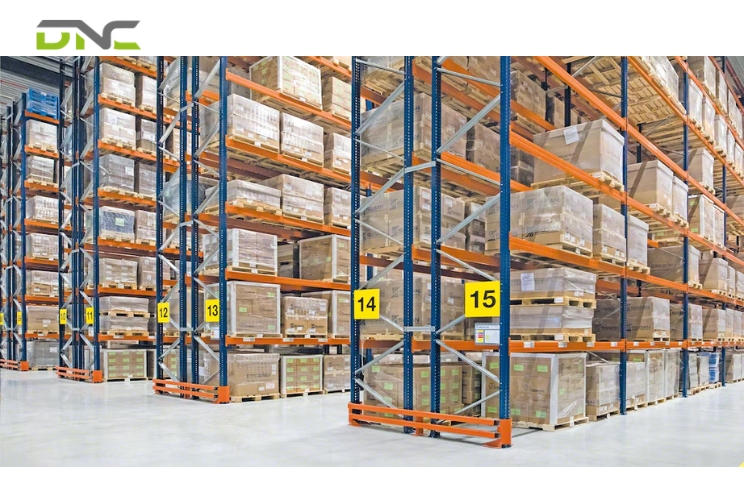
Selective racking achieves approximately 1 pallet position per 25–30 square feet (2.3–2.8 m²) of floor space when aisle width is included in the calculation. Drive-in racking reduces that to approximately 1 pallet per 14–20 square feet (1.3–1.9 m²) – a 40–60% increase in stored pallet positions within the same building footprint.
For ambient storage, this density difference affects total pallet capacity per facility. For temperature-controlled environments, the impact is more direct: cold storage and blast freezer facilities carry refrigeration operating costs of $8–15+ per square foot annually (US industry benchmark from material handling equipment distributors). Every square metre saved through higher rack density reduces ongoing refrigeration cost, not only the one-time construction cost.
Pallet Selectivity and Access
The density advantage of drive-in racking comes at the direct cost of pallet selectivity. In a selective system, any pallet is accessible at any time – an operator picks a specific lot number or SKU without touching another load. In a drive-in system, the front pallet in each lane is the only pallet retrievable without first removing every load in front of it.
A practical threshold from material handling engineering practice: operations with fewer than 8–10 pallets of the same SKU at any given time will find selective racking more operationally efficient than drive-in. Drive-in becomes efficient when an operation consistently stores 20 or more pallets of the same product per lane slot – enough to fill the lane without leaving empty gaps that reduce effective utilisation, a condition called honeycombing.
Inventory Rotation: FIFO vs LIFO
Selective racking supports any rotation method because every pallet position is independently accessible. FIFO, LIFO, and lot-based traceability systems all operate without structural constraints, and any WMS slotting strategy applies directly.
Standard drive-in racking is incompatible with operations that store products with expiry dates, pharmaceutical lot traceability requirements, or food safety standards mandating date-based rotation. Drive-thru racking enables FIFO at the cost of a rear access aisle, but that aisle offsets a portion of the density advantage. The rotation method also constrains WMS integration: selective systems support any WMS slotting logic; drive-in systems limit the WMS to lane-based retrieval sequences – a constraint that matters when integrating real-time inventory tracking or automated replenishment workflows.
Forklift Requirements and Aisle Width
Selective racking works with any forklift type. Aisle width varies by equipment: reach trucks require a minimum 2.8 m clear aisle, sit-down counterbalance forklifts need 3.5–4.5 m, and VNA turret trucks operate below 1.8 m. Equipment choice and aisle width together determine storage density achievable within a selective layout.
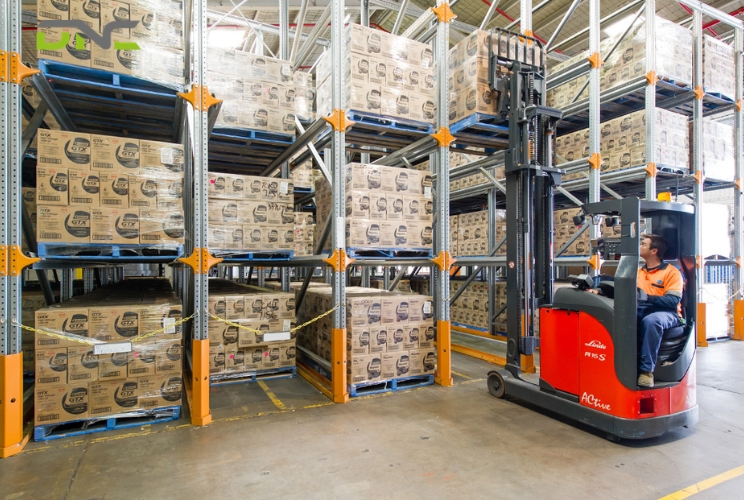
Drive-in racking constrains the forklift selection. The forklift mast width, extended mast height, and load-handling attachment must all clear the structural bay dimensions. Sit-down counterbalance forklifts and specific reach trucks typically qualify, but compatibility verification is a required step before specifying a drive-in system. Operating at height inside a confined bay surrounded by upright frames demands experienced operators and a regular racking inspection programme to identify impact damage before it becomes a structural safety issue.
Cost Per Pallet Position
Selective racking carries a lower installation cost per rack bay. A single selective bay costs less to procure and install than a comparable drive-in bay – the budget cost reference from US material handling distributors runs $50–80 per pallet position for selective vs $115–140 per position for drive-in. These figures represent equipment cost only; installation, floor slab preparation, guide rail anchorage, and structural permitting are additional.
The cost-per-pallet-position comparison reverses in dense bulk storage scenarios: drive-in systems store more pallets per bay and per square metre, which lowers the cost per individual pallet position when lane fill rates are consistently high. Full total cost of ownership modelling should include forklift impact damage rates – measurably higher in drive-in configurations – and any floor slab reinforcement required for guide rail anchorage under loaded lane conditions.
Summary: Selective vs Drive-In at a Glance
Selective racking delivers 100% pallet accessibility at moderate density (~1 pallet per 2.3–2.8 m²) and works with any forklift and any inventory rotation method. Drive-in racking delivers maximum density (~1 pallet per 1.3–1.9 m²) at the cost of LIFO-only rotation and restricted pallet access. The density gain runs 40–60% more positions in the same footprint. Selective is the right specification for high-SKU, variable-turnover, or automation-compatible operations. Drive-in is the right specification for bulk homogeneous stock in space-constrained or cold-storage environments. For mixed profiles, a hybrid layout allocates each system to its appropriate operational zone – covered in the section below.
Where Does Double-Deep Racking Fit?
Double-deep racking is a selective racking adaptation that stores pallets two positions deep instead of one, increasing pallet density by approximately 30–40% compared to single-deep selective while retaining partial aisle-based access. It occupies the operational space between standard selective and full drive-in – more density than selective, more access flexibility than drive-in.
The structure uses the same upright frames and beam configurations as standard selective racking, set up in back-to-back pairs. Accessing the rear pallet requires a double-reach forklift or a reach truck fitted with a pantograph (scissor-reach) attachment – equipment that extends its forks to the second-deep position without the truck entering the rack structure.
| Factor | Selective | Double-Deep | Drive-In |
| Depth per bay | 1 pallet | 2 pallets | 3–10+ pallets |
| Pallet accessibility | 100% | ~50% (rear blocked) | Low (front of lane only) |
| Inventory rotation | Any | LIFO (default) | LIFO |
| Forklift requirement | Any type | Double-reach or pantograph | Counterbalance or specific reach |
| Budget cost/position | $50–80 | $80–200 | $115–140 |
| Best for | High-SKU, variable turnover | Moderate-SKU, transitional | Bulk, homogeneous stock |
Double-deep racking is the appropriate transitional step for facilities expanding storage capacity beyond single-deep selective before committing to a full drive-in architecture. It preserves the ability to revert to standard selective configuration if the product mix changes, and it does not require the forklift fleet overhaul that a full drive-in specification sometimes demands. Budget cost range runs $80–200 per pallet position (US market reference), reflecting the pantograph forklift requirement and back-to-back frame configuration. For the next level of system comparison, the full chart below maps all six common racking types side by side.
How Do All Pallet Racking Types Compare?
Four additional racking system types address storage problems that selective and drive-in racking do not solve. The table below maps all six common types across density, selectivity, rotation support, best application, and relative cost per pallet position.
| Racking Type | Density | Selectivity | Rotation | Best Application | Relative Cost/Position |
| Selective | Moderate | 100% | Any | High-SKU, variable turnover | Lowest |
| Double-Deep | Medium-High | ~50% | LIFO | Moderate-SKU, transitional growth | Low–Medium |
| Drive-In | Very High | Low | LIFO (drive-thru = FIFO) | Bulk, homogeneous stock | Medium |
| Push-Back | High | Medium | LIFO | 3–6 pallets per SKU, medium-density | Medium–High |
| Pallet Flow | Very High | Medium | FIFO | Perishable goods, high-turnover distribution | High |
| Cantilever | Specialised | Direct | N/A | Long, irregular, or unstackable items | Varies by load |
Push-back racking uses nested gravity carts on inclined rails, storing up to six pallets deep per lane while retaining front-aisle retrieval – a LIFO system with better selectivity than drive-in. Pallet flow racking uses roller-based gravity lanes for FIFO rotation at high density; it is the appropriate specification for cold chain food distribution, pharmaceutical staging, or any application where expiry-date rotation is mandatory and density is also a priority. Cantilever racking addresses items that cannot be palletised: structural steel, timber, pipe, and similar long or irregular materials that standard pallet rack frames cannot store.
When Drive-In Racking Is the Right Choice
Drive-in racking suits operations where bulk storage density outweighs individual pallet access. The following scenarios show when drive-in racking is the appropriate specification:
- Cold storage and blast freezer environments – every square metre saved reduces the floor area subject to refrigeration operating cost; the density advantage translates directly to lower energy cost per pallet stored
- Seasonal overflow storage – temporary high-volume inventory of a single SKU, loaded and cleared in bulk, with no mixed-lot retrieval requirements during the storage period
- Raw material staging areas – homogeneous input materials received in full-pallet quantities, consumed in full-lane batches without individual pallet selection
- Finished goods bulk zones – single-SKU palletised output staged before outbound shipment, where LIFO rotation is operationally acceptable and pallets move as complete blocks
- Facilities approaching capacity limits – drive-in density delays or eliminates a facility expansion, deferring significant capital expenditure when floor space cannot be added
For Malaysian manufacturers in food and beverage, edible oils, oleochemical processing, and palm oil derivatives, the product profile is often homogeneous bulk – large volumes of the same product, received and shipped in full-pallet loads with no individual-pallet picking requirement. This operational pattern is structurally aligned with drive-in racking’s density optimisation and is a common specification in those production sectors.
When Selective Racking Is the Right Choice
Selective racking is the appropriate specification when operational flexibility matters more than raw storage density. The following profiles indicate selective racking:
- High-SKU distribution and 3PL warehousing – many product lines with moderate quantities per SKU and frequent pick requirements across diverse product types throughout the day
- E-commerce fulfilment – variable order profiles with single-unit or mixed-pallet picks requiring independent access to any pallet at any point in the pick cycle
- Food, pharmaceutical, and cosmetics manufacturing – FIFO rotation mandatory for expiry date compliance and lot traceability; LIFO is not operationally or regulatory acceptable
- Mixed-turnover operations – fast-moving and slow-moving products stored in the same system, requiring access to any position without sequencing constraints
Selective racking is also the prerequisite for most warehouse automation integrations. AGV and AMR systems navigate open warehouse aisles – the consistent travel lanes that selective racking provides. Drive-in systems have no navigable aisle within the lane structure, which prevents standard AGV-based automated picking without a purpose-built lane automation system (a significantly higher-cost solution uncommon outside large-scale retail distribution). WMS-directed ASRS systems built on selective racking frames are common in mid-to-large manufacturing facilities; equivalent ASRS configurations for drive-in frames require proprietary structural integration and are far less cost-effective.
For facilities in any industry planning to integrate automation within the next two to five years, selective racking is the layout that preserves that option without structural rebuild when the automation project starts.
Can You Use Selective and Drive-In Racking in the Same Warehouse?
The most effective racking layout for mid-to-large warehouses divides the floor plan into functional zones and matches each zone’s racking type to its operational profile. Most facilities do not operate on a single racking type once they reach moderate scale and SKU complexity.
The common hybrid configuration places selective racking in the forward pick zone – where operators access individual pallets frequently across many SKUs – and drive-in racking in the bulk reserve zone, where the same product fills entire lanes and high density reduces the storage footprint. The forward zone runs high-selectivity, low-density operations; the reserve zone runs low-selectivity, high-density operations.
Determining the right ratio between the two zones requires three inputs: total active SKU count, average pallet quantity per SKU, and daily pick frequency by product line. SKUs with fewer than 8–10 pallets and high pick frequency belong in selective; SKUs with 20 or more pallets and batch-movement patterns belong in the drive-in zone.
One operational factor in hybrid layouts that affects forklift routing and WMS configuration: the transition zone between selective and drive-in blocks needs deliberate aisle planning before installation. Poorly defined transition points create dead-end aisle geometry – areas where forklifts cannot complete a turn efficiently – adding travel time and partially negating the density benefit of the drive-in zone. Confirming aisle continuity through transition zones during the layout design phase eliminates this problem before any steel goes in the ground.
Summary: Matching Racking Type to Operational Profile
Drive-in racking fits cold storage, seasonal overflow, and bulk homogeneous stock operations where LIFO rotation is acceptable and density is the primary requirement. Selective racking fits high-SKU distribution, FIFO-required industries such as food, pharma, and cosmetics, and any facility where AGV, ASRS, or WMS integration is planned within a two-to-five year horizon. A hybrid layout – selective in the forward pick zone, drive-in in the bulk reserve zone – captures the strengths of both systems when the SKU profile is mixed. The decision framework in the next section quantifies the right split based on your operational data.
How to Choose the Right Racking System
Choosing between selective and drive-in racking is an engineering specification decision – the correct answer depends on measurable operational data, not facility size or budget alone.
The SKU-Depth Decision Rule
The most reliable starting point for system selection is the relationship between your SKU count and your average pallet quantity per SKU. The following three-step framework produces the right starting specification for most warehouse profiles:
- Step 1 – Calculate your average pallets per SKU. Divide total pallet positions currently stored by your active SKU count. This number determines whether lane dedication – required for drive-in efficiency – is operationally viable.
- Step 2 – Apply the depth threshold:
- Fewer than 8–10 pallets per SKU on average → selective racking is the practical choice. Drive-in lanes would be chronically under-filled, creating honeycombing waste that negates the density advantage.
- 10–20 pallets per SKU average → double-deep or push-back racking evaluation. These middle-ground options deliver meaningful density gains without the lane-dedication commitment of drive-in.
- 20 or more pallets per SKU, with a SKU count that allows full lane dedication → drive-in racking is operationally efficient. Each lane holds one product, loading and clearing in bulk at high utilisation.
- Step 3 – Apply the rotation constraint. FIFO required for any part of the inventory eliminates standard drive-in for those SKUs. The alternatives are selective, double-deep, or pallet flow racking depending on density requirements.
This framework narrows the choice to one or two candidates before cost modelling begins – avoiding the common error of specifying drive-in for density before confirming that SKU volume and rotation method make lane dedication viable in the first place.
Matching Racking to Your Warehouse Automation Setup
The pallet racking system a facility installs today determines which warehouse automation technologies are structurally compatible with that facility tomorrow. This is the selection factor most operations teams assess only after the racking is installed – at which point retrofit cost is substantial.
Selective racking is fully compatible with the standard warehouse automation stack: AGV and AMR systems navigate the open aisles; AS/RS (Automated Storage and Retrieval Systems) integrate with selective frames in both mini-load and unit-load configurations; WMS slotting logic directs any pallet to any position without structural constraints. Selective racking installed to the correct load rating and aisle width today requires no structural modification to support automation when the project begins.
Drive-in racking is not compatible with standard AGV-based automated picking. The lane interior provides no navigable path – an AGV cannot enter a drive-in lane, retrieve a specific pallet, and return autonomously. ASRS integration with drive-in frames is possible in purpose-built automated drive-in systems, but these are significantly more expensive than AS/RS systems built on selective frames and uncommon outside large-scale purpose-built distribution centres. Facilities that install drive-in racking and later decide to automate picking typically face partial or full racking replacement in the automation zones.
DNC’s engineering practice – developed across 20 years and 1,000–1,200+ factory automation installations in Malaysia and Southeast Asia – treats pallet racking selection as part of the broader warehouse automation roadmap, not a standalone procurement decision. For Malaysian manufacturers operating under NIMP 2030 incentives with automation timelines of two to five years, the racking type specified today determines whether the future integration is a standard project or an expensive structural rebuild. ASRS systems in Malaysian mid-manufacturing facilities typically achieve payback within two to four years at current labour cost levels.
If your facility is evaluating pallet racking as part of a warehouse automation plan, DNC’s engineers can specify the right system for your load profile, SKU count, and automation timeline. Talk to our engineers about your warehouse layout.
Frequently Asked Questions
What is the difference between selective and drive-in pallet racking?
Selective pallet racking stores each pallet one position deep on beams, with every position directly accessible from the aisle. Drive-in pallet racking stores pallets multiple positions deep on structural rails, with forklifts driving inside the rack to load and retrieve. Selective maximises individual pallet access; drive-in maximises storage density by eliminating most warehouse aisles. The trade-off between these two properties determines which system fits a given operation’s SKU profile and inventory rotation requirements.
Is drive-in racking FIFO or LIFO?
Standard drive-in racking operates LIFO (Last In, First Out) by structural constraint – the most recently loaded pallet is the only pallet accessible in each lane, blocking all loads behind it. Drive-thru racking, which adds a rear access aisle, enables FIFO operation by loading from one end and picking from the other. FIFO is mandatory for perishable goods, pharmaceutical lot traceability, and food products with expiry dates; in those cases, selective racking or pallet flow racking is the appropriate specification.
What does selective racking mean?
Selective racking is a pallet storage system where every stored pallet sits in a directly accessible position – retrievable from the aisle without moving any other load. It is the most common warehouse racking type because it supports any inventory rotation method, works with all forklift types without structural modification, and requires no specialised handling equipment. “Selective” refers to the unrestricted access of every pallet position, independent of all others.
What is double-deep racking vs selective racking?
Double-deep racking places two standard selective racks back-to-back, storing two pallets deep instead of one per bay position. It increases pallet density by approximately 30–40% over single-deep selective racking, but reduces selectivity to approximately 50% – only the front pallet in each paired position is directly accessible without reaching past it. A double-reach forklift or pantograph attachment is required for the rear position. Double-deep is the appropriate transitional option for facilities expanding beyond single-deep capacity before committing to full drive-in architecture.
Which pallet rack type offers the highest storage density?
Drive-in racking and pallet flow racking offer the highest storage density among static and semi-static racking types. Drive-in achieves approximately 1 pallet per 14–20 square feet including access aisles – 40–60% more positions than selective in the same footprint. Pallet flow racking achieves comparable density with mandatory FIFO rotation but at a higher installation cost per pallet position, making it the appropriate high-density choice for perishable goods or high-turnover distribution rather than general bulk storage.
Can drive-in racking be integrated with a WMS or automated retrieval system?
Drive-in racking in standard configuration is incompatible with AGV-based automated picking – the lane interior provides no navigable path for autonomous vehicles. A WMS directs lane-based loading and retrieval sequences, but individual pallet tracking within a lane requires manual lane management discipline. AGV-based automated picking is not compatible with standard drive-in lanes – the lane interior has no navigable path for autonomous vehicles. Purpose-built automated drive-in ASRS systems exist but are significantly more expensive than AS/RS systems built on selective frames. Facilities planning automation within two to five years should confirm this compatibility before specifying drive-in racking.
What are the main advantages of selective pallet racking?
Selective pallet racking provides 100% pallet selectivity, compatibility with all forklift types, support for any inventory rotation method, and the lowest structural damage risk of any racking type. It is the only common racking type fully compatible with AGV systems, ASRS integration, and WMS-directed automated workflows without requiring structural modification. For operations with high SKU diversity, variable turnover, FIFO requirements, or automation plans, selective racking is the architecture that accommodates all of those requirements simultaneously.
How do I choose between drive-in and selective racking for my warehouse?
Apply the SKU-depth threshold first: fewer than 8–10 average pallets per SKU points to selective racking; 20 or more pallets per SKU with lane-dedication feasibility points to drive-in. Then apply the rotation constraint – FIFO required for any inventory eliminates standard drive-in for those SKUs. Finally, assess the two-to-five year automation plan: AGV, ASRS, or WMS integration on the roadmap favours selective racking, which preserves automation compatibility without structural rebuild when the project begins.
- 55 views
- 0 Comment
Recent Comments