


Checkweigher vs Static Weighing Scale | DNC Automation
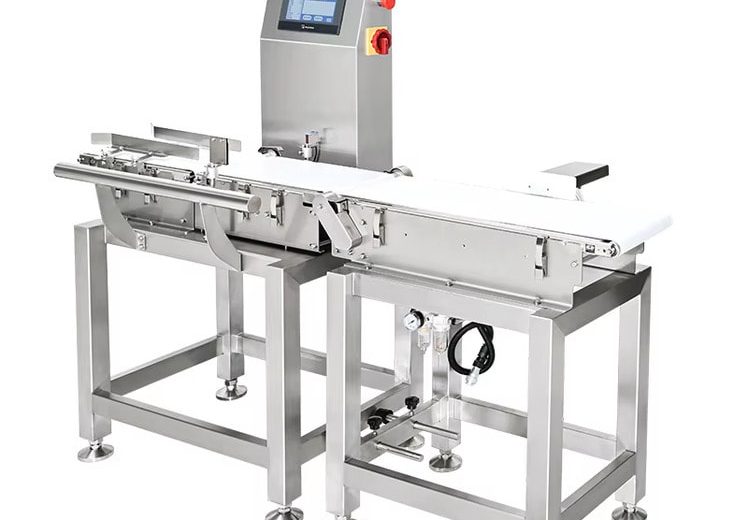
A checkweigher weighs every pack while it travels along the line; a static weighing scale weighs one pack at a time while it rests on a platform. That single mechanical difference sets inspection coverage, throughput, capital cost, and regulatory exposure. Both instruments read force through the same strain gauge load cell and weighing controller. A static scale needs several seconds for the load cell reading to settle, so either the line pauses or the sample leaves the line for weighing. A checkweigher resolves the same weight in fractions of a second across infeed, weighing, and outfeed conveyors, then fires a reject device at any pack outside the tolerance band. Food, pharmaceutical, and packaging plants working under average-weight rules sit on the checkweigher side of that division.
A Checkweigher Weighs in Motion, a Static Scale Weighs at Rest
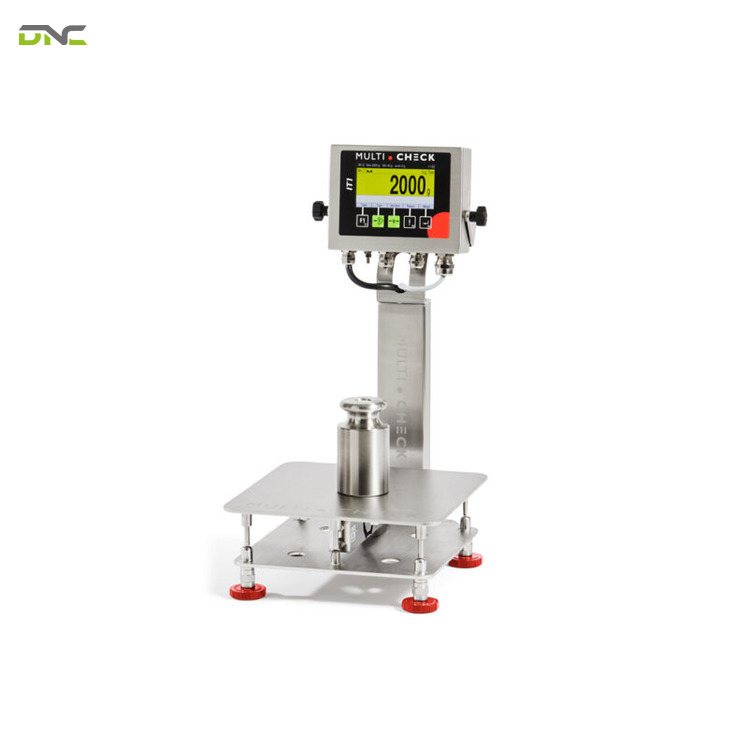
From a measurement mechanics point of view, the difference between a checkweigher and a static weighing scale is the state of the product at the moment of weighing. An in-motion checkweigher, also called a dynamic checkweigher, weighs a product while it moves and then accepts or rejects it against preset weight zones. A static checkweigher verifies weight against the same preset target, and it requires an operator to move product onto and off the platform.
Motion is what the static instrument cannot tolerate. VBS Systems states the mechanism directly: a static checkweigher cannot have any motion on the load cell, because stabilisation takes several seconds and product movement makes the load cell readings oscillate into unstable values. A checkweigher has to obtain an accurate weighment in fractions of a second instead, which is why product transfer geometry and overall system design matter far more on a dynamic machine than on a bench scale.
Checkweigher and static scale are therefore built from different parts. The components of each system are listed below.
| Subsystem | In-motion checkweigher | Static weighing scale |
| Product handling | Infeed and outfeed conveyor belts carry product through the weighing zone | Flat-top, roller-top or ball-top platform for manual transfer |
| Weight reading | Weight indicator or controller acting as command centre for operation and calibration | Indicator with over, under and target alert lights, column-mounted or standalone |
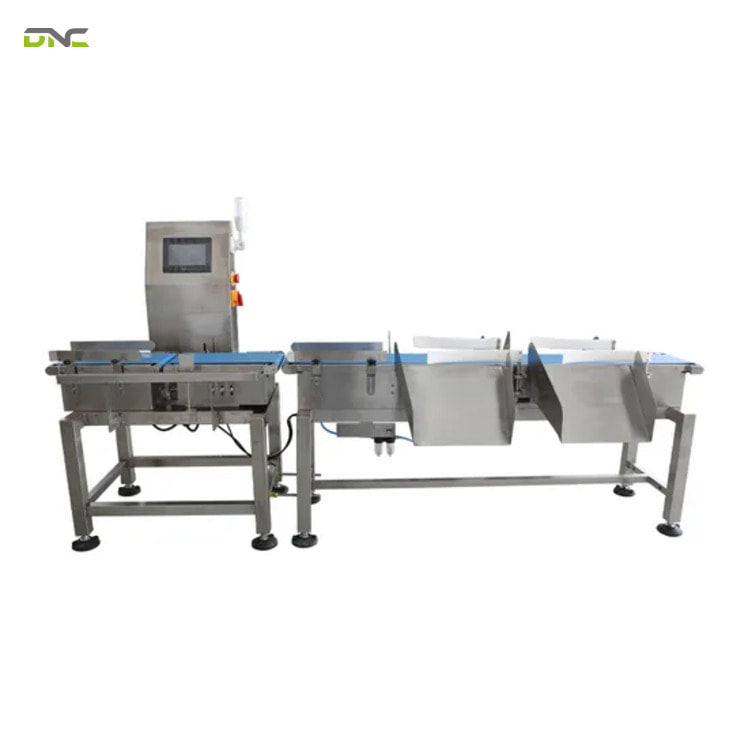
| Response to out-of-tolerance | Automatic reject device – pneumatic push rod or jet spray gun | Operator reads the light and sets the pack aside |
| Options | Stack lights, alarms, fieldbus protocols | Stack lights, column mounts, mobile carts |
| Cleaning | Weigh conveyor kept clear of product accumulation, with automatic tare where build-up occurs | Platform specified for quick cleaning, some built for environments requiring heavy washdowns |
Kenwei describes static checkweighing as a labour-intensive routine: weigh the product, record the result, remove the product, repeat. Rice Lake notes the flip side of that simplicity – a static checkweigher requires very little maintenance, and it carries no process control to service. Labour intensity, not measurement error, is the first cost that shows up when production volume rises – and the second is how little of that rising volume a sampling routine actually inspects.
Sampling Versus 100% Inspection Decides Your Real Exposure
Measured by inspection coverage, the two systems are not close: a checkweigher inspects 100% of production, while a static scale inspects a sample. Dynamic weighing checks the weight of every product on the line automatically. Static weighing typically involves manual spot-checks on samples, which leaves the rest of the batch unverified.
The exposure that creates is arithmetic rather than opinion. Frank Borrmann, Market Manager for Checkweighing & Vision at Mettler-Toledo Garvens, puts a figure on it in his IFSQN guide: weighing 15 out of 6,000 packages covers just 0.25% of the run. The remaining 99.75% ships on the assumption that the sampled packs represent it.
Sampling on a static scale assumes a stable filling process, and filling is not stable. VBS Systems lists the random events that shift fill weight during a shift: nozzle area reduction from product accumulation, humidity change, temperature change, voltage spikes, changing product density, and inattentive personnel. An exact fill on every unit is not achievable, which is what makes the tolerance band – not the target weight – the thing being controlled.
Checkweigher coverage cuts both directions on the cost line. Underfilled packs draw complaints, consumer-group testing, and regulatory action; overfilled packs quietly consume margin on every unit produced. VBS Systems frames the overfill case in production terms: a food processor filling millions of containers a year that identifies an overfill of even a few grams (fractions of an ounce / thousandths of a kilogram) per container, then trims the filler, saves tens of thousands of dollars annually. Labelling law works at the same resolution – TDI Packsys uses the example of a plant that has to ship 12-ounce (340 g / 0.34 kg) cereal boxes rather than 11-ounce (312 g) ones. Whether that saving is reachable depends on how accurately the instrument reads under real line conditions.
Sampling Versus 100% Inspection Decides Your Real Exposure
Accuracy Depends on Installation and Maintenance, Not on Motion
On accuracy specifically, installation and maintenance decide the result rather than motion: a serviced checkweigher and a serviced static scale deliver comparable accuracy levels. TDI Packsys states the equivalence in exactly those terms, provided both are maintained and serviced. VBS Systems dates the change: weighing technology has improved significantly over the last decade, to the point that in-motion weighing is almost as accurate as static weighing.
In-motion checkweighing then earns a practical edge from coverage rather than from resolution. A machine that reads every pack leaves no room for a light or heavy outlier to pass, while a scale sampling one or two packs at a time can let outliers through between checks.
What actually degrades a checkweigher reading is the environment around it, not the fact of motion. The conditions that affect checkweigher accuracy are listed below.
- Temperature variationin the surrounding environment
- Floor vibrationtransmitted from nearby machines
- Air currentsacross the weighing platform
- Dustsettling on the scale during a shift
- Product accumulationon the weigh conveyor
- Static buildupfrom moving product
- Electrical noisefrom nearby devices such as mobile phones and walkie-talkies, and noise carried in the power supply
Each condition has a countermeasure, and every countermeasure costs less than the checkweigher accuracy it protects. VBS Systems recommends frequent cleaning, a draft shield against air currents, a constant-temperature environment, a power conditioner to reduce electrical noise, and proper grounding of all metal components. Two further fixes sit on the product-handling side: guide rails installed before the weighing zone stabilise the pack, and automatic tare handles product build-up on the conveyor.
Product behaviour sets the ceiling on checkweigher accuracy. Anything whose contents shake or vibrate – soups, beverages, shampoos, liquid concentrates – disturbs the reading, and any pack with a high centre of gravity tends to wobble during transfer, which shortens the settled window available for an accurate weight. Rigid containers outperform free-flowing packaging such as loose plastic bags for this reason. Container geometry belongs in the specification conversation, and so does the throughput the line has to sustain while that geometry is being weighed.
Accuracy Depends on Installation and Maintenance, Not on Motion
Throughput and Purchase Cost Move in Opposite Directions
Throughput and purchase cost move in opposite directions between the two systems: a static scale costs less to buy and maintain, and a checkweigher protects line throughput. TDI Packsys is direct about the capital comparison – purchasing an in-motion checkweighing machine usually costs more than a static scale, and the checkweigher also requires more maintenance.
Throughput moves the other way. Weighing on a static scale means slowing or halting the line at least temporarily to pull product off and weigh it, which reduces process throughput. On a checkweigher every pack is weighed while moving, so line speed holds and product reaches dispatch sooner.
Payback closes the gap faster than the price difference suggests. VBS Systems reports that checkweighers typically pay back in under 12 months, driven by two mechanisms working at once: overfill trimmed at the filler, and underfilled containers caught before they reach a customer or a recall. Rice Lake lists reduced product giveaway alongside legal compliance, captured process data, customer satisfaction, and elimination of human error as the standing benefits of adding a checkweigher of either type.
For Malaysian manufacturers the labour side of that equation carries extra weight. Manual weighing consumes an operator position per shift in a market already short of production labour, while the same inspection runs unattended once the checkweigher is commissioned. Whether the machine is optional or obligatory, though, is usually decided by the regulatory regime in the export destination rather than by the payback model.
Regulatory Exposure Decides the Choice for Exported Goods
Regulatory exposure decides the choice between a checkweigher and a static weighing scale for exported goods, because weights and measures law holds the producer to the quantity declared on the label whether that weight was verified by sampling or by 100% inspection. Enforcement differs by market, and Malaysian manufacturers exporting into stricter regimes inherit the destination market’s rules.
Three regimes govern checkweighing and static weight verification in the packaging literature, and each is described below.
- United States.The average weight of the packaged product must match the label, and no package may exceed legal limits. Fill ranges are tied to National Institute of Standards and Technology requirements. The FDA separately enforces stringent rules on food labelling terms, so a mislabelled pack weight sits alongside fines, recalls, and other penalties.
- European Union.Average weight legislation – the “e-mark” system – requires product weights to meet the declared amount with no package significantly underfilled, and the Measuring Instruments Directive governs whether the instrument itself is fit for legal use. Non-compliance can force products off the market.
- The Prepackaging Regulation (FertigPackV) prohibits defined prepackaged goods from falling below the nominal fill quantity, and it places responsibility on the manufacturer to prove compliance with appropriate measuring methods and devices. BOSCHE positions static checkweighers as an accepted control method under this regulation.
Liability for underfill is personal to the producer and does not require intent, whichever instrument did the weighing. VBS Systems answers the question plainly: a producer can be held liable for unknowingly under-filling product, because the pack simply has to meet or exceed the labelled weight. Consumer advocacy groups buy product off the shelf and weigh it, and state Weights and Measures offices act through oral recommendations, instructions, warnings, or legal action.
The regulation does not name a machine, which is the point Malaysian plant engineers most often miss. A static scale satisfies a nominal-fill obligation on a low-volume line where every unit can genuinely be checked; on a line running thousands of units per shift, only 100% in-motion inspection produces a defensible record of the batch that shipped.
Regulatory Exposure Decides the Choice for Exported Goods
Summary: Checkweigher vs Static Weighing Scale at a Glance
Summary of the checkweigher and static weighing scale comparison, across the attributes that decide the specification, stands as follows.
| Attribute | In-motion checkweigher | Static weighing scale |
| Product state during weighing | Moving | Stationary |
| Weighment time | Fractions of a second | Several seconds to stabilise |
| Inspection coverage | 100% of production | Sample spot-check |
| Response to out-of-tolerance pack | Automatic reject device | Operator intervention |
| Purchase and maintenance cost | Higher on both | Lower on both |
| Effect on line throughput | Neutral – line keeps running | Reduces throughput during checks |
| Typical payback | Under 12 months | Not applicable – low capital outlay |
| Typical industries | Food, pharmaceutical, packaging | Consumer goods, automotive, retail |
| Labour demand | Unattended after commissioning | One operator per weighing station |
Both instruments remain useful in the same plant. Static scales set weight targets and run sample tests during changeover; dynamic systems hold every pack to that target once the run is live. The choice for a given line comes down to three measurable thresholds.
Three Thresholds Decide the Right System for Your Line
Three thresholds decide whether a checkweigher or a static weighing scale fits your line: industry requirement, production volume, and available capital. TDI Packsys sets out all three, and volume is the one that most often settles the argument on its own.
Industry requirement acts as the first filter. In-motion checkweighers dominate food, pharmaceutical, and packaging operations where uniform pack weight is regulated. Static scales hold their position in consumer goods, automotive, and retail applications where weight verification is a quality step rather than a legal one.
Production volume sets the second threshold, and TDI Packsys frames it as a spread between 50 products a day and 5,000 a day. A low-volume line can genuinely check every unit on a static scale. Above that band the operator becomes the bottleneck, and sampling silently replaces inspection.
Capital availability sets the third. A static scale keeps initial outlay low, and the payback case for the checkweigher rests on giveaway recovery and avoided recall cost rather than on purchase price. Weight is an unusually broad quality proxy, which widens that payback case further: VBS Systems estimates that about 99% of processes can be measured by weight, and reports checkweighers sensitive enough to detect a missing SIM card in a mobile phone package and divert it for rework. Quantity itself becomes verifiable – pills, screws, and discs sold by count are checked through the fixed relationship between count and weight.
Once a checkweigher reads every pack, that same inspection point carries considerably more than weight.
Integration Turns the Checkweigher Into a Full Inspection Point
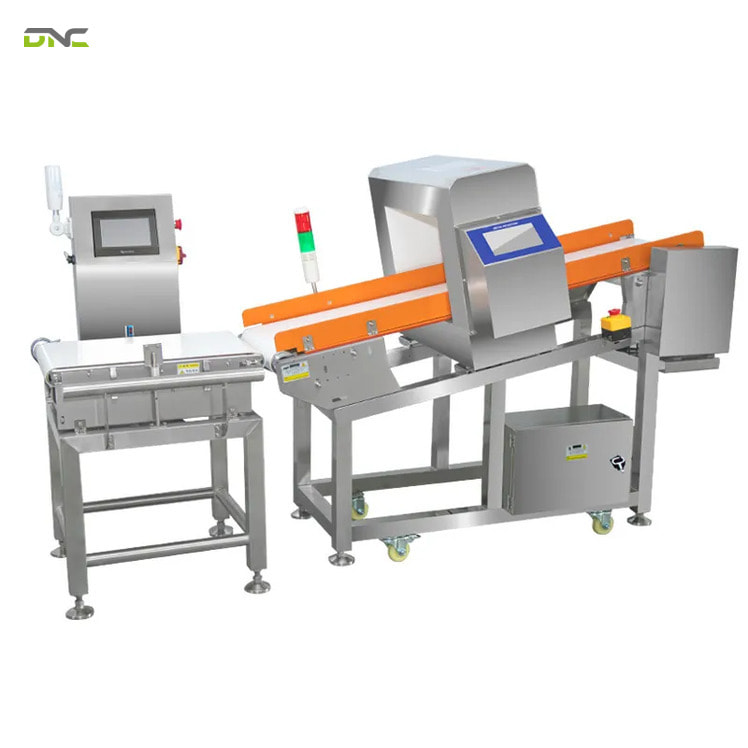
Integration separates the checkweigher decisively from a bench scale, because the machine already sits in the product flow with a controller, a reject device, and a data connection. Rice Lake describes production management software that captures weight data throughout production, reports on ingredient use, integrates with existing ERP and MRP systems, and supports product traceability.
Three inspection functions are commonly combined with the checkweigher at that single point, and each is described below.
- Checkweigher and metal detector.The combined unit verifies pack weight and inspects for ferrous, non-ferrous, and stainless steel contaminants at one station.
- Checkweigher and X-ray.X-ray inspection extends contaminant detection to glass and stone hidden inside the pack.
- Checkweigher and vision inspection.Vision systems catch open carton flaps, missing caps, skewed packages, absent labels, and missing batch numbers, expiry dates, or best-before dates – the label errors that create allergen and ingredient risk.
Checkweigher placement follows the risk. Dynamic weighers are positioned at Critical Control Points, before and after packaging, and immediately before goods leave the facility, so weight discrepancies surface before they turn into waste or a compliance violation.
Feedback control is the function that changes the economics. When the checkweigher communicates upstream to the filling machine, detected weight deviation triggers an automatic fill-volume adjustment, which reduces overfill, ingredient waste, and rework instead of merely recording them. That closed loop is standard practice in intelligent weighing automation, and it is the same PLC and control-integration work DNC’s engineers perform when specifying automated inspection systems for a Malaysian production line. Static instruments sit outside that loop by design – which is precisely where they still belong.
Integration Turns the Checkweigher Into a Full Inspection Point
Static Checkweighers Still Earn Their Place in Portioning and Picking
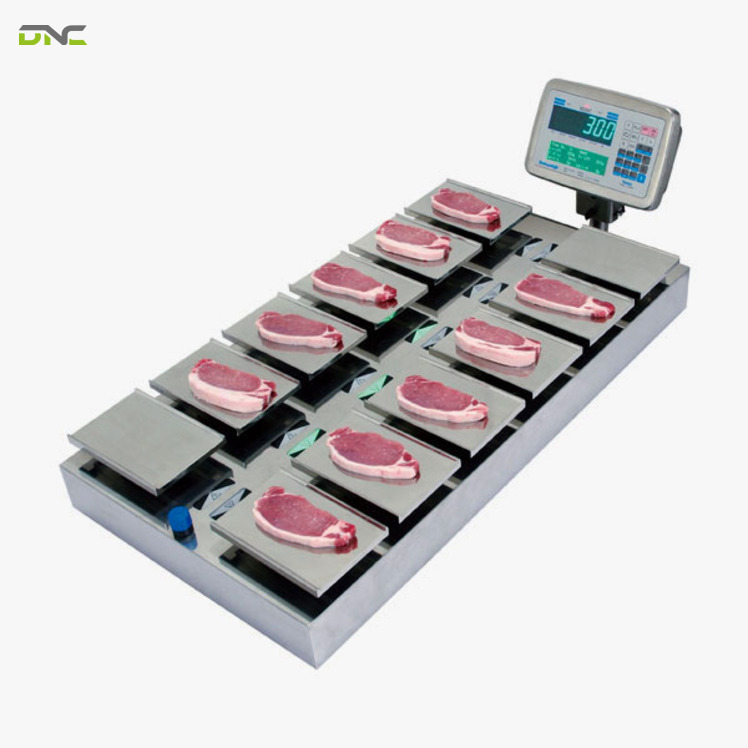
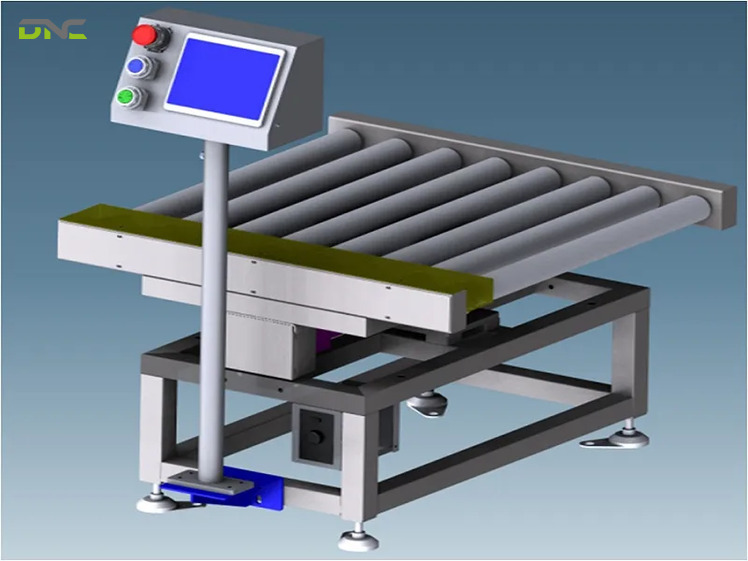
Static checkweighers earn their place wherever weighing is a portioning or picking task rather than a line-inspection task. BOSCHE describes them as standalone devices operated manually and not integrated into fully automated processes, and lists order picking, portioning, production monitoring, and shipping-weight control as their standard applications.
Static checkweigher operation is deliberately minimal. The operator enters a target weight and a tolerance range at the terminal, and the result is shown as a traffic-light signal: yellow for underweight, green for acceptable, red for overweight. No extensive training is required, which matters in roles with high turnover.
Several established variants exist, each named for its task. A harvest weigher packs fruit into crates at a specified weight directly in the field. A picker weigher shows the operator in real time whether the current handful sits inside the tolerance range. A portioning scale handles repacking of bulk goods into smaller containers, and a mobile checkweighing unit on a height-adjustable material stand brings the scale to the workstation instead of moving the work to the scale.
Capability is wider than the price suggests. BOSCHE reports accuracy class III and IIII certification on its checkweighing displays, recipe memory for up to 100 stored products, and a tare function that isolates net content weight – a crate is tared first so only the contents are evaluated, on the assumption that crate weights vary less than a single item. Weighing range is set by the platform rather than the display, and a weighbridge fitted with the same checkweighing software monitors fill levels up to 20 tons (20,000 kg / 44,092 lb).
A static instrument fails at only one thing, and it fails at it completely: it cannot verify the batch that already shipped.
Frequently Asked Questions About Checkweighers and Static Weighing Scales
The questions asked most frequently about checkweighers and static weighing scales cover the core distinction, accuracy under motion, payback, regulatory sufficiency, and whether both instruments belong on the same line.
What is the difference between an in-motion checkweigher and a static checkweigher?
A static checkweigher weighs an item that is not moving, while an in-motion checkweigher weighs the item as it travels and rejects any pack outside specification. The static unit cannot tolerate motion on the load cell, since stabilisation takes several seconds and any movement oscillates the reading. The in-motion unit resolves the same weight in fractions of a second, which makes product transfer and system design far more influential on the result.
What is the difference between an in-motion checkweigher and a static checkweigher?
Is a checkweigher as accurate as a static weighing scale?
A checkweigher is as accurate as a static weighing scale when both instruments are well maintained and serviced, per TDI Packsys. In-motion weighing is now almost as accurate as static weighing after a decade of measurement improvements. The in-motion machine gains a practical advantage from coverage rather than resolution, because weighing 100% of production removes the outliers that pass unseen between static samples.
How long does a checkweigher take to pay for itself?
A checkweigher takes under 12 months to pay for itself in typical installations, according to VBS Systems, though every situation differs. The return comes from two directions at once. Detecting overfill of a few grams per container and correcting the filler saves tens of thousands of dollars a year for a processor filling millions of containers, and catching underfilled packs prevents complaints, lost revenue, and potential recall.
Does a static scale satisfy average weight regulations?
A static scale satisfies nominal-fill obligations only on lines where every unit produced is genuinely verified. The German Prepackaging Regulation accepts static checkweighers as a control method for prepackaged goods, and the manufacturer carries the burden of proving compliance with appropriate measuring methods. On a line producing thousands of units per shift, sampling 0.25% of the run does not produce a defensible record of the batch that shipped.
What affects checkweigher accuracy on a production line?
Checkweigher accuracy is affected by temperature variation, floor vibration, air currents, dust, product accumulation, static buildup, and electrical noise from nearby devices or the power supply. Frequent cleaning, a draft shield, a constant-temperature environment, a power conditioner, and proper grounding of metal components hold these effects down. Guide rails before the weighing zone and automatic tare handle the product-side causes.
Can a plant use both a checkweigher and a static scale?
Most plants use both, because the two instruments answer different questions. Static scales set weight targets, run sample tests during changeover, and handle portioning and order picking at manual stations. In-motion checkweighers hold every pack to the target once the run is live and reject the ones that miss it. The pairing is standard practice in food and pharmaceutical production.
Specifying Weight Inspection for Your Line
Specifying weight inspection for your line resolves into a coverage decision between a checkweigher and a static weighing scale, not a technology preference. Both instruments read force through the same strain gauge load cell, and both hit comparable accuracy when maintained – the static unit needs several seconds and an operator, the in-motion unit needs fractions of a second and none. Coverage is what separates them: 100% of production against a sample that may represent 0.25% of the run. Volume, industry regulation, and available capital decide which side of that line your operation sits on, and integration with metal detection, vision, and filler feedback control decides how much value the inspection point returns once it is installed.
DNC Automation engineers and commissions weighing, checkweighing, and end-of-line inspection systems for Malaysian manufacturers, integrating load cells, conveyor system solutions, and PLC control into a single verified inspection point. If your line is running average-weight compliance on spot checks today, get a free consultation with our engineers about the coverage gap that leaves open.
- 18 views
- 0 Comment
Recent Comments