


How to Calculate Palletizer Throughput | DNC Automation Malaysia

Palletizer throughput is a multiplication followed by a subtraction. The multiplication is simple: cycle rate multiplied by the number of units a gripper picks per cycle gives units per minute, and multiplying that by 60 converts it to units per hour. The subtraction is where most spec-sheet numbers fall apart, because a robotic arm’s rated cycle rate is not the rate the line actually runs once conveyor infeed speed, pallet-change time and slip-sheet placement are accounted for. A cobot cell and a conventional gantry can both be quoted a correct cycle rate, and both can still be the wrong throughput number for a line if neither figure carries the bottleneck that will cap it. Getting from a catalogue cycle rate to a defensible cases-per-hour figure for a Malaysian production floor takes three steps in order: calculate the theoretical number, identify the slowest station, then adjust for it.
The Base Formula: Cycle Rate x Units Per Cycle, Then x 60
To calculate palletizer throughput for any machine type, apply the same two-step cycle rate formula. First, multiply the palletizing cell’s cycle rate by how many products the gripper places in a single cycle:
Throughput (units/minute) = Cycle rate (cycles/minute) x Units picked per cycle
Second, convert minutes to hours by multiplying by 60:
Throughput (units/hour) = Throughput (units/minute) x 60
So a cell running 25 cycles per minute with a single-pick gripper handles 25 units per minute, or 1,500 units per hour. The same cell fitted with a dual-pick (multipick) gripper handling two units per cycle handles 50 units per minute — 3,000 units per hour — without the robot’s cycle rate changing at all. This is the single most common reason two lines quoted at “the same robot” produce different throughput figures: the cycle rate was compared, but the units-per-cycle term was not.
This is also why a bare cycles-per-minute number, on its own, answers less than it appears to. A palletizer rated at 30 cycles per minute could be handling 30 boxes per minute or 90 boxes per minute, depending entirely on gripper configuration — and the gripper configuration is a product-format decision, not a robot-spec decision.
Cycle Rate Depends on Palletizer Type — There Is No One Industry Number
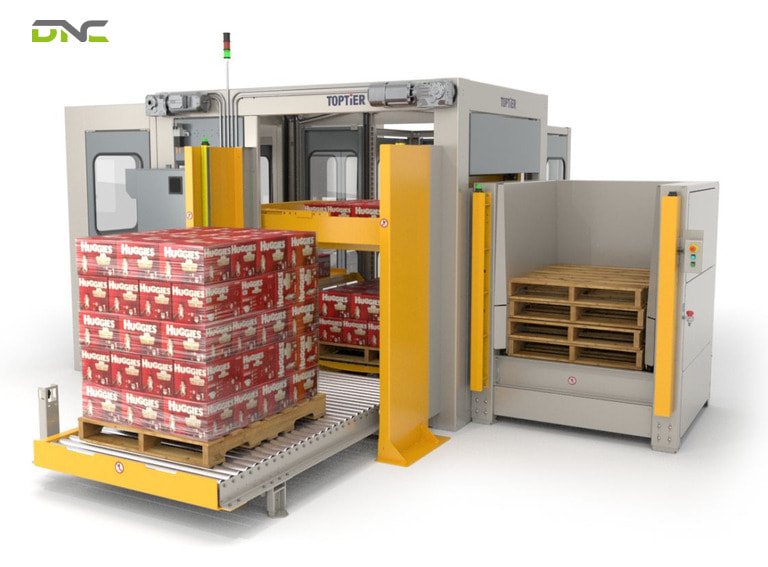
The cycle-rate term moves according to palletizer class by an order of magnitude, which is why quoting “palletizer throughput” as a single figure without naming the class is close to meaningless. DNC’s own project data across manual, cobot and robotic palletizing lines puts the classes in the following bands:
| Palletizer class | Typical throughput |
| Manual palletizing | 180–360 cases/hour |
| Cobot / single-case robotic (mixed-SKU) | 300–1,000 cases/hour |
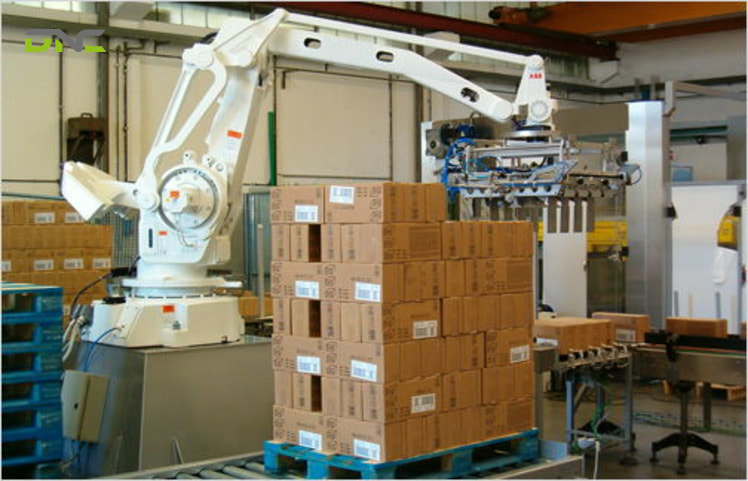
| 6-axis articulated-arm palletizer (general) | 10–60 cycles/minute (600–3,600 cycles/hour); high-speed purpose-built units approach 80 cpm |
| Robotic layer-forming (single robot) | up to ~2,200 products/hour |
| Conventional high-speed gantry/layer (single-format beverage/FMCG) | exceeds 200 cases/minute |
A manual station and a high-speed conventional gantry sit almost two orders of magnitude apart, and a cobot cell and a robotic layer-forming cell — both “robotic” — sit more than two times apart from each other. The class you are calculating for has to be fixed before the cycle-rate number means anything, which is why the first useful question in any throughput calculation is not “how fast is a palletizer” but “which class of palletizer is this.”
Within the robotic classes, the placement unit matters as much as the class name: a system built to transfer whole layers in one motion reaches a materially higher products-per-hour figure than one placing individual cases, precisely because the units-per-cycle term in the base formula jumps from one case to an entire tier. That distinction is worth working through on its own before comparing quoted cycle rates between suppliers.
Cycle Rate Depends on Palletizer Type — There Is No One Industry Number
Three Bottlenecks Cap the Theoretical Number Before the Line Ever Runs
Compared to the delivered number, a palletizer’s own cycle rate is only ever the ceiling, because three stations around the robot commonly run slower than the robot itself. Each one needs to be checked before a cycle-rate figure is treated as a throughput figure.
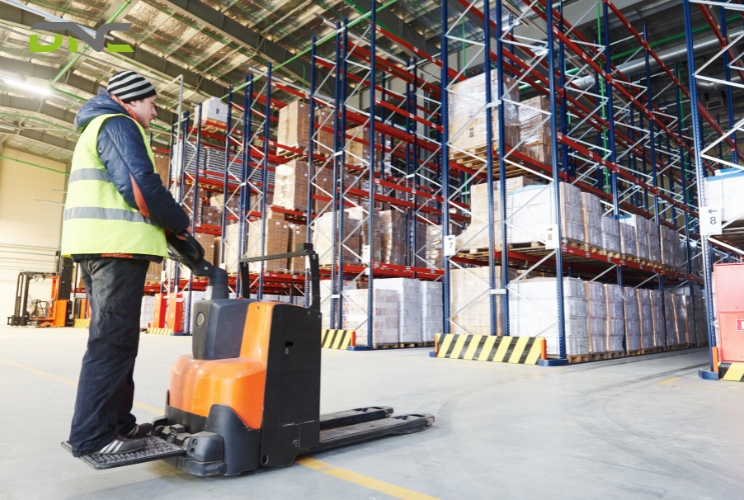
- Conveyor infeed speed.The palletizer cannot pick faster than product arrives. Above roughly 25 products per minute, the infeed conveyor needs to actively sequence and orient product — a simple belt is no longer sufficient — and if that upgrade hasn’t happened, the conveyor becomes the true throughput ceiling regardless of what the robot is rated for.
- Pallet feeding.A cell without an automatic pallet dispenser and outfeed has to stop the palletizing cycle every time a full pallet needs to be removed and an empty one put in position. A high cycle-rate robot paired with manual pallet changeover delivers a much lower hourly average than its per-cycle number implies.
- Slip-sheet placement.Every slip sheet inserted between layers is a break in the pick-and-place sequence. The time spent placing slip sheets has to be subtracted from the theoretical cycle time directly, not treated as a rounding error — on a product that uses a slip sheet every layer, this can be the single largest source of gap between a rated cycle rate and delivered cases-per-hour.
The rule that follows from all three: throughput is set by whichever station in the cell is slowest, not by the robotic arm. A calculation that stops at the robot’s own cycle rate is calculating the ceiling, not the answer.
Units Per Cycle Is the Variable Most Calculations Skip
Compared to cycle rate, units-per-cycle changes the result at least as often, and it is the term most spec-sheet comparisons leave out entirely. A single documented case illustrates the gap directly: a pet food manufacturer targeted 10 to 13 boxes per minute at the palletizing station. Once slip-sheet placement and pallet changes were factored into a standard single-pick setup, that target was not achievable on the base configuration. Switching the same cell to a dual-pick gripper — two boxes per cycle instead of one — without changing the robot’s cycle rate, took the line to 17 to 22 boxes per minute, comfortably clearing the original target.
That case is worth reading as a formula check rather than as a marketing claim: the robot’s cycle rate did not change, the units-per-cycle term did, and the result moved with it exactly as the base formula predicts. It is the clearest evidence available that gripper configuration, not robot selection, is often the fastest and cheapest lever for closing a throughput gap on an existing cell.
Units Per Cycle Is the Variable Most Calculations Skip
Summary So Far: Three Facts Decide the Calculation
Three facts need to be settled before any numbers get worked through. First, throughput is always cycle rate multiplied by units per cycle, converted to hours by multiplying by 60 — the same formula regardless of palletizer class. Second, the class sets the cycle-rate band, from manual at 180–360 cases/hour up to conventional high-speed gantries exceeding 200 cases/minute, so a class has to be named before a number is comparable. Third, the robot’s own cycle rate is only the ceiling: conveyor infeed, pallet feeding and slip-sheet placement each cap the theoretical figure independently, and the documented multipick case shows the units-per-cycle term moving the delivered result as much as the robot’s rated speed does. What remains is putting all of this together on one line, and checking the result against how the pallet itself is built.
A Worked Example: From Spec-Sheet Number to Line Number
This worked example applies the formula to a supplier quote — a robotic palletizing cell rated at 40 cycles per minute with a single-pick gripper — turning a spec-sheet cycle rate into a line number. The calculation includes five steps:
- Theoretical throughput:40 cycles/min x 1 unit/cycle = 40 units/min = 2,400 units/hour.
- Check the conveyor.The line’s infeed conveyor is a simple belt rated for 25 products per minute without the sequencing upgrade the palletizer would need above that rate — so infeed, not the robot, caps the line at 25 units/min = 1,500 units/hour.
- Check pallet feeding.An automatic pallet dispenser is already specified, so this station does not add a further cap.
- Check slip sheets.The product uses a slip sheet every second layer; the time cost of that placement reduces the achievable rate by a further margin that has to be measured on the actual cell, not assumed.
- Result:the deliverable number for this line is close to the conveyor-capped 1,500 units/hour, not the robot’s spec-sheet 2,400 units/hour — a 37.5% gap between the number on the datasheet and the number the line will actually produce.
Now change one variable: fit a dual-pick gripper (2 units/cycle) and upgrade the conveyor to match. Theoretical throughput becomes 40 x 2 = 80 units/min = 4,800 units/hour, and the conveyor is no longer the binding constraint. This is the same arithmetic that took the documented pet food case from an unreachable single-pick target to a rate well above it — the formula, applied against the actual bottleneck, not against the robot spec alone.
Validate the Calculation Against Pallet Capacity, Not Just Cycle Time
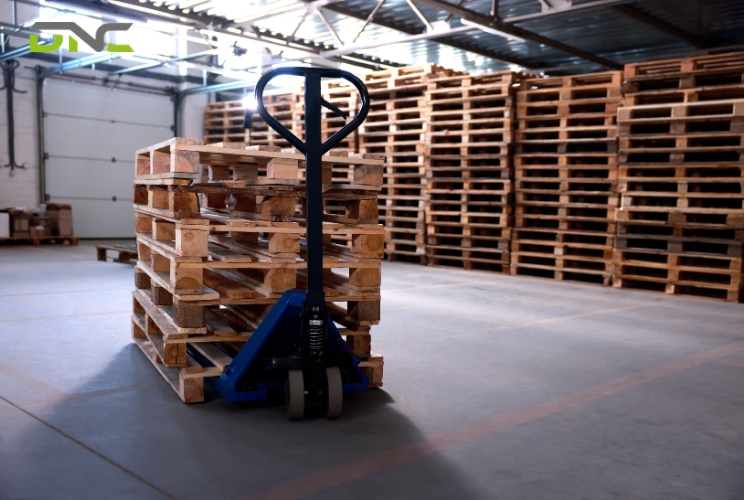
Compared to the cycle-time calculation alone, a second independent check confirms whether the number of units the cycle-time formula predicts per hour actually fits the pallets being built. Take the total units per pallet — units per layer multiplied by number of layers — and divide the target units-per-hour figure by it to get pallets per hour. Cross-check that pallets-per-hour figure against how many pallets the pallet-feed and outfeed stations can physically cycle through in an hour, and against safe working load: a standard 48″x40″ pallet carries a safe working load up to 4,600 kg (10,141 lb / 4.6 tonnes), and a Euro pallet (1200mm x 800mm) up to 1,500 kg (3,307 lb / 1.5 tonnes), so a units-per-hour target that implies overloading either limit is not a throughput problem to solve with a faster robot — it is a pallet-pattern or product-weight problem that a faster robot cannot fix. This cross-check is the fastest way to catch a units-per-cycle assumption that looks correct in isolation but does not survive contact with the actual pallet being built.
As a short worked check: if the cycle-time calculation predicts 1,500 units per hour, and the pallet pattern places 20 units per layer across 10 layers (200 units per pallet), the line needs to complete 7.5 pallets per hour to sustain that rate. If the pallet-feed station can only cycle 5 full pallets in and out per hour, the pallet-feed station — not the robot, and not the conveyor — is the actual ceiling, and the earlier cycle-time number was never achievable regardless of gripper configuration. This is why the pallet-capacity check runs alongside the cycle-time calculation rather than after it: either one, checked alone, can report a number the other one rules out.
Validate the Calculation Against Pallet Capacity, Not Just Cycle Time
Extending the Calculation to Pallets Per Shift and Cases Per Day
To convert the units-per-hour figure from the base formula into a shift or daily total, remember it is a rate, not a shift total. The two are only the same number if the line runs at that rate for the entire shift without interruption, which it does not. Extending the calculation to a shift or a day means starting from documented output in the same three units every time: cases per hour, pallets per shift, and daily throughput across all product lines running through the cell. Peak periods, seasonal surges and promotional volume spikes need to be checked against the calculated hourly rate separately from the average, because a cell sized to the average will fall behind during the busiest weeks even if the yearly total looks fine on paper.
Two adjustments matter most when moving from an hourly rate to a shift or daily figure. First, planned downtime — changeovers, breaks, and product-format switches — has to be subtracted from the nominal shift length before the hourly rate is applied; an 8-hour shift with 45 minutes of changeover and breaks is a 7.25-hour production window, not an 8-hour one. Second, multi-shift operations place different demands on the same cell than a single-shift operation does even at identical daily output, because sustained multi-shift running has less slack to absorb a bottleneck that single-shift running would tolerate. A calculation built only around the peak hourly number, without checking it against a full shift and a full day, is answering a narrower question than the one a capacity decision actually needs answered.
Frequently Asked Questions About Calculating Palletizer Throughput
What is the formula used to calculate palletizer throughput?
Cycle rate (cycles per minute) multiplied by units picked per cycle gives units per minute; multiplying that result by 60 converts it to units per hour. The formula is the same across manual, cobot, robotic and conventional palletizers — only the cycle-rate and units-per-cycle values differ by class.
Why does my palletizer run slower than its rated cycle rate?
Because the rated cycle rate is the robot’s own ceiling, not the line’s delivered number. Conveyor infeed speed, pallet-change time and slip-sheet placement commonly run slower than the robot and become the actual limit — the calculation has to check all three, not stop at the robot’s spec.
Does a faster robot always mean higher palletizer throughput?
No. If the conveyor, pallet feed or slip-sheet station is already the bottleneck, a faster robot delivers no measurable gain until that bottleneck is resolved. In the documented multipick case, throughput increased without any change to the robot’s own cycle rate — only the units-per-cycle term changed.
How many cases per hour can a robotic palletizer handle?
It depends on the class. Single-case robotic (mixed-SKU) palletizing typically runs 300–1,000 cases per hour; robotic layer-forming palletizing can reach up to roughly 2,200 products per hour on a single robot; a 6-axis articulated-arm palletizer generally runs 10–60 cycles per minute, with high-speed purpose-built units approaching 80. The class has to be specified before a single number means anything.
What is the difference between BPM and BPH in a throughput calculation?
BPM (boxes/bags per minute) and BPH (boxes/bags per hour) describe the same rate at two time scales. BPH equals BPM multiplied by 60 — a palletizer running at 100 BPM handles 6,000 BPH. Suppliers quote whichever unit makes the number easier to compare to a target; converting between them is a fixed multiplication, not a separate measurement.
Should slip-sheet placement be included in a throughput calculation?
Yes, whenever the product uses slip sheets. Each slip sheet placed is a break in the pick-and-place cycle, and the time it costs has to be subtracted from the theoretical cycle time directly. Leaving it out is one of the more common reasons a calculated throughput number runs ahead of what the line actually delivers.
Frequently Asked Questions About Calculating Palletizer Throughput
Get Your Line’s Throughput Calculated, Not Estimated
Your line’s throughput needs to be calculated against real bottlenecks, not estimated from a spec-sheet cycle rate on its own. The number that matters for a Malaysian production line is the one calculated against your actual conveyor infeed, pallet-feed setup and slip-sheet requirement — not the robot’s rated ceiling. DNC Automation’s engineers size robotic palletizing cells against the bottleneck a line will actually hit, backed by 35 engineers, a 25,000 sq ft (2,323 m²) production facility, and ISO 9001:2015 certification across Malaysian manufacturing installations.
If you have a target cases-per-hour figure and want to know which station in the line will actually decide whether you hit it, walk through the numbers with our engineering team before a palletizer is quoted on cycle rate alone. See how a full end-of-line cell is sized in robotic palletizing systems, or compare placement mechanisms in layer vs mixed-case palletizing if your product mix is the open question.
- 23 views
- 0 Comment
Recent Comments