


Intralogistics Explained: Material Flow from Goods-In to Dispatch
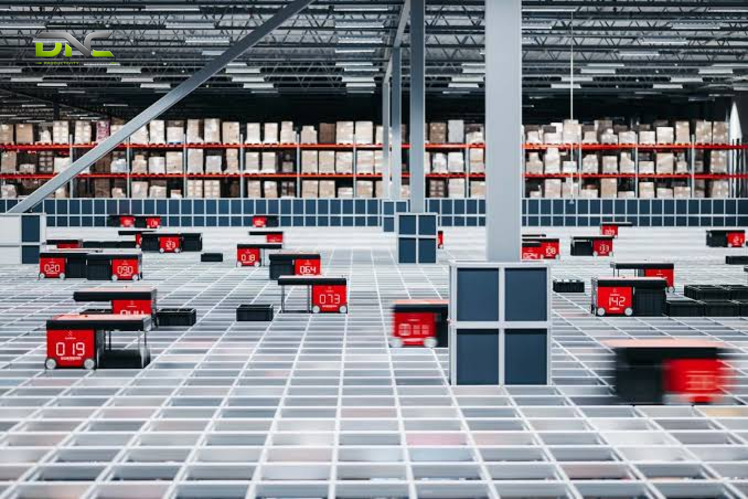
Intralogistics, or internal logistics, is the organisation, control and optimisation of every material and information flow inside one site, from the goods-in dock where supplier pallets arrive to the dispatch lane where finished pallets leave. In a factory that path runs through raw-material storage, line-side supply, production, the end-of-line packing cell and the finished-goods warehouse. Intralogistics solutions are the equipment and software that carry it: conveyors and AGVs move loads, an ASRS stores them, a checkweigher, a strapping machine and a stretch wrapper turn products into shippable units, and a WMS, WCS or MES decides what moves next. The flow is clearest when it is divided where the handling unit changes — pallet to tote, tote to single piece, piece to case, case to wrapped pallet. Each change brings a new conveyance method, a buffer between two rates, and a point where count, weight or identity has to be confirmed again.
What Intralogistics Means Inside a Factory
Intralogistics inside a factory means internal logistics: planning, running and improving how materials, goods and the data about them move within the boundary of one plant. The word explains itself. “Intra” means within. Logistics as a whole includes transport and goods traffic outside the company, while intralogistics stops at the site boundary and covers only what happens inside it.
The name is recent. One AMR maker dates the first definition of intralogistics to 2004 and draws the scope from the moment raw materials arrive until finished products are released. The same source splits the discipline into three categories: internal material flow, the flow of information and inventory, and warehouse management. A storage-system maker orders the working areas as receiving, warehousing and its administration, order compilation, packing and issuing goods out.
Most published definitions are written for a warehouse or distribution centre, where goods arrive, wait and leave. A factory adds production in the middle. That creates two inbound flows instead of one: supplier material flowing to the line, and finished product flowing from the line into storage. One intralogistics integrator describes its own scope in exactly these terms, managing goods “from the reception from production or suppliers” through transport, the automated warehouse and order picking “to the dispatch”.
DNC Automation groups this work under material handling and intralogistics: conveyors, AGVs, automated storage, automatic identification and data collection, controls, industrial robots and packaging. The companion guide to material handling equipment classifies those machines by type. The sections below follow the goods instead, stage by stage.
The Material Flow From Goods-In to Dispatch, Stage by Stage
Intralogistics material flow from goods-in to dispatch in a manufacturing plant passes through seven stages, and the unit being handled changes at almost every one of them. The table below maps each stage to the unit that arrives, the equipment that usually carries it, and what has to be confirmed before the unit moves on.
| Stage | Handling unit arriving | Typical intralogistics equipment | Confirmed before it moves on |
| 1. Goods-in | Supplier pallet | Dock, pallet conveyor, AGV or truck | Quantity, condition, match to purchase order |
| 2. Raw-material storage | Pallet or bin | Racking, ASRS with cranes or shuttles | Storage location, stock level |
| 3. Line-side supply | Tote, bin or kit | AGV, AMR, tugger train, conveyor | Right part at the right station |
| 4. Production | Single piece or process container | Process conveyors, industrial robots | Process quality |
| 5. End-of-line packing | Sealed case or bag | Case sealer, checkweigher, strapping machine | Weight, count, closure |
| 6. Palletizing and wrapping | Wrapped unit load | Robotic palletizer, stretch wrapper | Stacking pattern, load containment |
| 7. Finished-goods storage and dispatch | Pallet assigned to a shipment | Pallet conveyor, AGV, ASRS, staging lanes | Pallet label, lane, truck |
A distribution centre runs a shorter intralogistics chain. One inventory-software guide lists seven activities for it — reception, storage, retrieval, picking, packing, sorting and shipping — and puts transport at about 60% of operational time, picking and packing at about 30%, and waiting at the remaining 10%. In that list, packing is one line.
In a factory, packing is an entire stage. Stages 5 and 6 are where individual products become cases, cases become a stack, and the stack becomes a unit load that can survive a truck. They are also where the handling unit changes most often in the shortest distance. Those changes are the key to dividing the whole intralogistics flow.
Why Handling-Unit Changes Divide Intralogistics Into Stages
Handling-unit changes divide intralogistics into stages because each change alters three things at once: the equipment that carries the load, the rate at which loads arrive, and the evidence available about what is inside. Plan around those three and the equipment list follows.
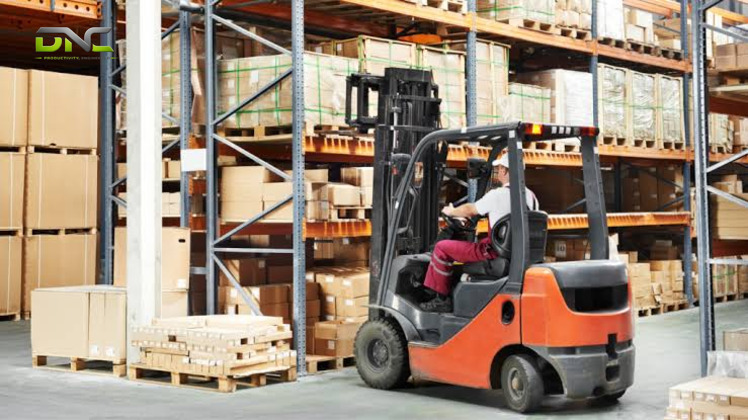
Conveyance changes. In intralogistics, a pallet and a carton do not travel on the same machine. DNC’s pallet conveyors carry up to 1,500 kg (3,307 lb) at 5-30 m/min (16-98 ft/min), while cases run on belt or roller conveyors sized for a fraction of that weight. A storage-system maker separates continuous conveyors, such as roller and belt conveyors, from discontinuous ones, such as forklift trucks and AGVs. Every handling-unit change is where one family hands over to the other.
Rate changes. One unit load may hold dozens of cases. So the line upstream of the palletizer counts cases per minute, while everything downstream counts loads per hour. Two rates meet at every change, and they never stop at the same moment. That mismatch is why intralogistics puts a buffer at every such hand-over.
Evidence changes. A sealed case hides its contents. From that point, mass is the only property still readable from outside, which is why a checkweigher belongs after the case sealer. An in-motion checkweigher reads every pack, where a static sampling routine might check 15 packs out of 6,000 (0.25%). Once the stack is wrapped, the cases disappear too. From then on, the load label carries the identity through the rest of the internal logistics chain.
None of the ten pages ranking for intralogistics in Malaysia that could be read uses the term “handling unit”. None names a checkweigher or a stretch wrapper either. The published intralogistics guides describe activities, while a plant engineer has to specify interfaces. DNC engineers therefore draw a boundary at every handling-unit change before choosing a single machine, and ask the same three questions at each: what carries the unit, how fast it arrives, and what proves it is correct. The first question is answered by four equipment families.
Intralogistics Solutions by Stage: Conveyors, AGVs, AMRs and ASRS
Intralogistics solutions by stage fall into four equipment families — conveyors, driverless vehicles, automated storage and end-of-line machines — and each family suits a different handling unit and rate. The published intralogistics solution lists overlap heavily; one Malaysian component distributor names conveyor belts and roller tracks, AGVs and AMRs, AS/RS, pick-to-light systems, and WMS and MES software.
| Family | Handling unit it suits | Strength | Limit |
| Conveyors | Pallets, cases, totes on a fixed route | High, steady rate; built-in buffering | Fixed path; a route change means rebuilding |
| AGVs and AMRs | Unit loads, carts, totes on variable routes | Route changes in software | One load per trip; empty return leg |
| ASRS | Unit loads, bins, trays in storage | Dense storage, controlled retrieval | Throughput set by cranes, shuttles and I/O stations |
| End-of-line machines | Cases, bags, loads being formed | Turn products into shippable units | Sized to the line rate, not the warehouse |
Intralogistics Solutions by Stage: Conveyors, AGVs, AMRs and ASRS
Conveyors take the high, steady intralogistics flows. DNC Automation designs, builds and integrates industrial conveyor systems with PLC control and industrial robots as a single line. One AGV maker puts the rate at which a conveyor often becomes the better pallet solution at around 80 pallets an hour per line.
AGVs and AMRs take the variable intralogistics routes. AGVs follow predetermined paths, originally wires or magnetic strips; AMRs build their own route from sensors and cameras. One software guide traces navigation from magnetic strips in the 1960s to laser guidance in the 1990s and SLAM mapping today. DNC’s AGV and AMR range positions to ±10 mm or ±5 mm (±0.39 or ±0.20 in) and connects its scheduling system to MES or WMS.
ASRS places and retrieves loads from set locations under computer control, and it forms the storage stage of intralogistics. One warehouse integrator groups it into shelf-based, bin-based and robotic picking systems. An ASRS warehouse from DNC combines racking, cranes or shuttles, conveyors and WMS/WCS software.
End-of-line machines create the unit that dispatch will handle. A robotic palletizing cell builds the stack, and a pallet wrapping machine locks it: base wrap over at least one third of the pallet height, with a containment force field norm of 15-26 lb per linear inch (2.7-4.6 kg per linear cm). Most intralogistics guides stop before this stage. Machines move the goods; software decides which goods move.
The Information Flow: WMS, WCS, MES and the PLC Layer
The information flow in intralogistics runs through four layers — WMS, WCS, MES and the PLC — and each decides a different part of what moves next. Material and information travel together. When they separate, intralogistics loses track of the load, and it ends up in the wrong lane.
- WMS (warehouse management system)— holds orders, stock and storage locations for the internal logistics flow. It receives orders from ERP and passes them to the transport systems. One warehouse integrator points out that a WMS usually stops short of controlling the automated machines.
- WCS (warehouse control system)— directs real-time activity and gives the material handling systems one consistent interface. A storage-system maker describes a comparable “material flow computer” that connects warehouse technology to the WMS.
- MES (manufacturing execution system)— releases production orders and records what the line has made. In a factory it is the source of the second inbound flow.
- PLC and SCADA— run each conveyor, machine and cell. The conveyor PLC knows when a load is present at a pick-up point; SCADA collects that state across the line.
Each handling-unit change in intralogistics is also an information change. A case that leaves the checkweigher carries a weight result. A unit load leaving the stretch wrapper needs an identity the WMS can store and read back at the dock. An AGV mission only starts when a PLC signal tells the fleet manager a load is waiting. Automatic identification and data collection, listed in DNC’s material handling scope, is what joins the physical unit to its record at each of these points.
For a Malaysian plant, this intralogistics control layer usually decides the project scope. DNC connects the machine and control layer — PLC, SCADA and the AGV scheduling system — to the plant’s existing WMS or MES rather than replacing them. The signals exchanged at each handling-unit change are then written into the specification, not discovered during commissioning. Signals also expose the next problem. Two stages rarely run at the same rate.
Buffers Where Rates Change Between Intralogistics Stages
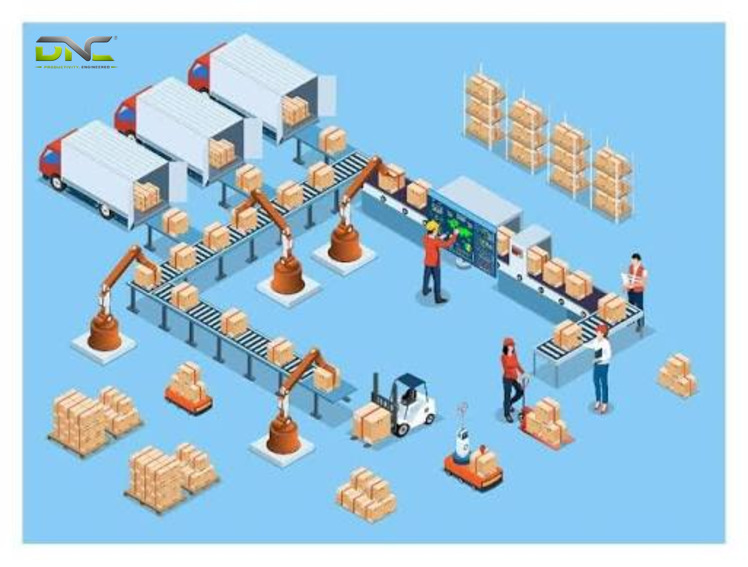
Buffers belong wherever the rate changes between two intralogistics stages, because upstream and downstream equipment never stop at the same moment. A buffer lets one stage keep working while the other is briefly down. Without it, every short stoppage travels the length of the flow.
Intralogistics transport time makes this visible. If transport accounts for around 60% of operational time in a distribution centre, as one software guide estimates, most of that time is loads moving between stages that run at different speeds. The buffer is where that difference is absorbed.
On a conveyor, the intralogistics buffer is an accumulation section. Each zone has its own drive and a photo-eye at its discharge end, so product queues back one zone at a time instead of stopping the whole conveyor. Zone length is set by the longest product. The number of zones matters more. Size it against how long the downstream stage is expected to stop — a changeover, a minor jam, an operator intervention — not taken from a catalogue length.
At the end of the line the same intralogistics logic moves to unit loads. Take an illustrative stretch wrapper closing one load every 90 seconds, or 40 loads an hour. Each outfeed conveyor position after the wrapper holds one load, so each position buys 90 seconds of tolerance before a late AGV stops the wrapper, and then the palletizer behind it. Staging lanes at the dock work the same way for the trucks.
In the internal logistics of a factory, the finished-goods warehouse is therefore sized by the pallet rate leaving the end of the line. Published readiness gates such as 1,500-2,000 orders a day are e-commerce and third-party logistics metrics. They measure only the outbound side. A plant also has an inbound rate set by production, and that rate decides conveyor length, accumulation, AGV count and ASRS input stations.
Buffers Where Rates Change Between Intralogistics Stages
Summary: Intralogistics From Goods-In to Dispatch
Intralogistics, the internal logistics of a factory, moves goods through seven stages, from the supplier pallet at goods-in to the wrapped, labelled pallet in a dispatch lane. The flow divides cleanly wherever the handling unit changes, because each change brings a different conveyance, a different rate and a different way of proving the unit is correct. Conveyors carry the high, fixed flows; AGVs and AMRs carry the variable routes; an ASRS holds stock; end-of-line machines — checkweigher, strapping machine, palletizer, stretch wrapper — create the unit that dispatch handles. WMS, WCS, MES and PLC signals keep the record attached to the unit, and buffers absorb the rate difference at every hand-over. Turning those rules into a project is a planning sequence.
Planning Intralogistics Solutions for a Malaysian Plant
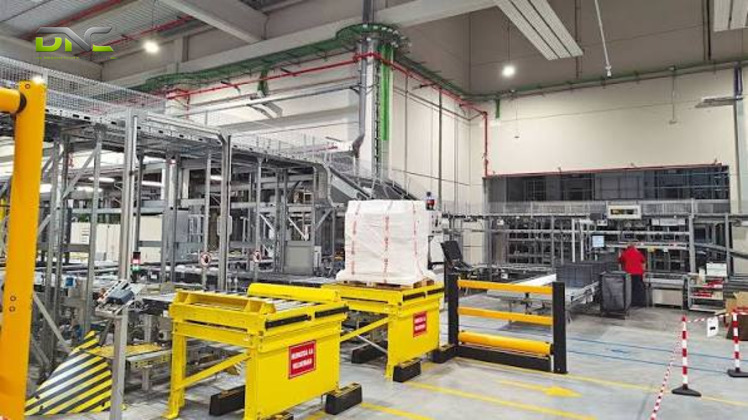
Planning intralogistics solutions for a Malaysian plant starts with the flow map and ends with the equipment list, not the other way round. One transport-design guide sets out the order for vehicle routes in five steps — define the routes, analyse the cycle or takt time of each, set speeds, calculate the total cycle including stops and recharging, then determine the number of vehicles. The same order applies to the whole plant, and its six steps are listed below.
- Map the intralogistics stagesfrom goods-in to dispatch and mark every handling-unit change.
- Measure the rateat each stage — cases per minute before the palletizer, pallets per hour after it.
- Choose the conveyancefor each segment: conveyor for high, fixed flows; AGV or AMR for variable, lower-rate routes.
- Place buffersat every rate change and size them by stoppage duration.
- Define the data hand-overat each change: weight, count, label and the PLC signal that releases the next move.
- Phase the deployment, automating the stage with the highest return first.
The obstacles to automating internal logistics in Malaysia are well documented. One local distributor lists the capital cost of automation, particularly for SMEs; older buildings that need modification for conveyors or AGV paths; interoperability with legacy software and machines; and training for operators and maintenance teams. The same source notes that pilot testing and phased deployment are common ways to validate ROI. A storage-system maker makes the matching point: partial automation concentrates investment where it returns most and shortens amortisation, provided the long-term concept covers the whole flow and the interfaces between automated and manual areas.
Labour is the pressure behind many intralogistics projects. Malaysian manufacturers face structural labour shortages and rising wages, and the New Industrial Master Plan 2030 (NIMP 2030) pushes plants towards Industry 4.0. Industry4WRD-linked funding scores connectivity and integration rather than a like-for-like machine swap, so a staged plan that links each new machine to PLC, SCADA or MES is easier to justify. The flow map comes first. The equipment list follows it.
Planning Intralogistics Solutions for a Malaysian Plant
Frequently Asked Questions About Intralogistics
These questions about intralogistics come up once a plant starts mapping its flow from goods-in to dispatch, and they cover scope, equipment, factory use and how automation is phased.
What is the difference between logistics and intralogistics?
Logistics covers the movement of goods between locations, including transport outside the company. Intralogistics is internal logistics: it covers only the material and information flows inside one site — receiving, storage, internal transport, production supply, packing and dispatch — and ends where the goods leave the dock.
What are examples of intralogistics solutions?
Examples of intralogistics solutions include conveyors, AGVs and AMRs, automated storage and retrieval systems (ASRS), pick-to-light systems, checkweighers, strapping machines, stretch wrappers and robotic palletizers, together with WMS, WCS, MES and PLC software that controls them.
Does intralogistics apply only to warehouses?
Intralogistics applies to factories as much as to warehouses. A factory adds production between goods-in and dispatch, so it has two inbound flows — supplier material to the line and finished goods to storage — and an end-of-line packing stage that most warehouse definitions leave out.
Can intralogistics be automated in stages?
Intralogistics is often automated in stages, and pilot testing with phased deployment is common in Malaysia. The usual approach automates the stage with the highest return first, often transport or end-of-line packing, while the long-term plan defines the buffers and data hand-overs between automated and manual areas.
________________________________________
Intralogistics in a factory is planned at the points where the handling unit changes, not at the machines between them. DNC Automation maps those points from your goods-in dock to your dispatch lane before specifying conveyors, AGVs, ASRS or end-of-line equipment; to review the flow in your own plant, speak with a DNC engineer.
- 2 views
- 0 Comment
Recent Comments