


Timing Belt Conveyor: Precision Positioning, Tooth Profiles, Servo Integration, and Applications
Timing Belt Conveyor: Precision Positioning, Tooth Profiles, Servo Integration, and Applications
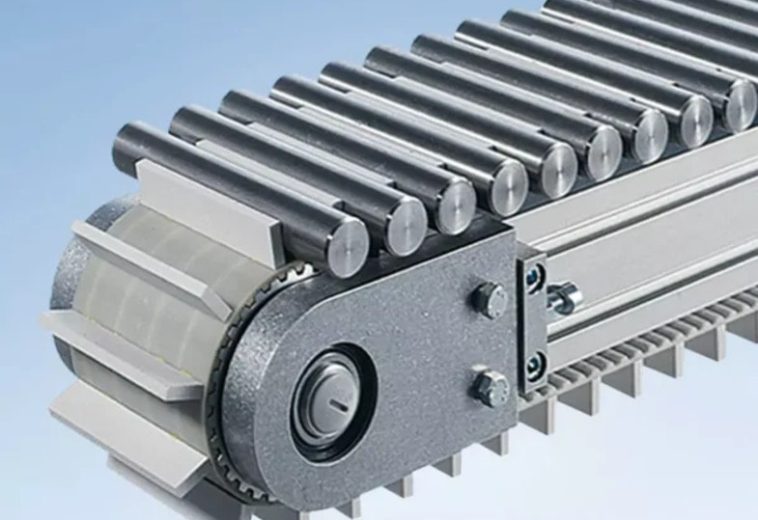
A timing belt conveyor uses a toothed (synchronous) belt running over toothed pulleys — instead of friction-driven flat pulleys — to transmit drive force without slippage. The positive engagement between belt teeth and pulley teeth means every pulley rotation corresponds to an exact belt linear displacement: 1 tooth × belt pitch = guaranteed linear movement. This positive drive makes timing belt conveyors the choice for precision positioning, indexing, and synchronised multi-belt applications where slip-free, repeatable movement is required.
In Malaysian electronics assembly (Penang, Selangor), pharmaceutical packaging, and automotive sub-assembly, timing belt conveyors serve as the motion element in indexing systems, robotic pick-and-place infeed, vision inspection transport, and servo-driven positioning stages — where ±0.1–0.5 mm repeatability is required across thousands of cycles per shift.
How Timing Belt Conveyors Differ from Flat Belt Conveyors
Flat belt conveyor: Belt driven by friction between belt underside and drive pulley surface. At high load or during fast acceleration, belt can slip on the drive pulley — losing positional reference. Speed is approximately controlled; position is not guaranteed without encoder feedback.
Timing belt conveyor: Toothed belt engages with toothed pulley sprocket. No slip possible — every tooth engagement is a fixed, guaranteed displacement. Position is determined by pulley rotation × belt pitch, without additional feedback in open-loop stepper systems. In servo-driven systems, encoder feedback at the motor provides sub-millimetre position accuracy.
Key consequence for automation: A timing belt conveyor driven by a servo motor with encoder feedback can achieve positioning repeatability of ±0.1–0.5 mm — enabling direct robot interaction, vision inspection, and automated assembly without additional product locating fixtures (though fixtures improve accuracy further).
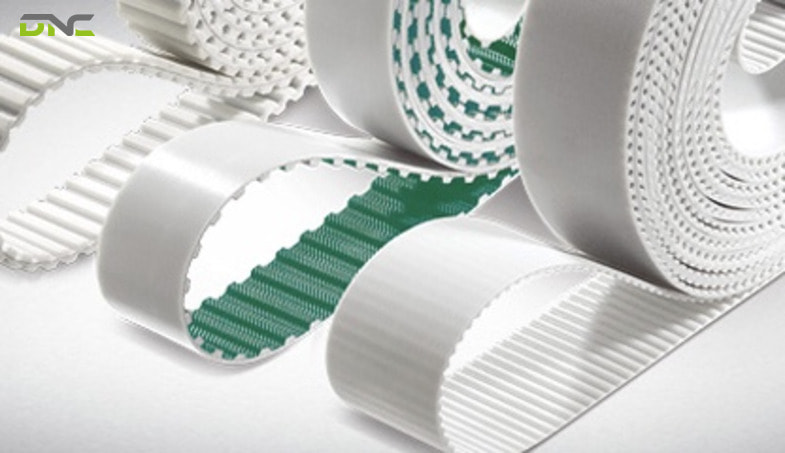
Conveyor belts are commonly categorized into three main types based on how they transmit motion and handle loads.
Timing Belt Tooth Profiles
The belt tooth profile determines the maximum load (tooth shear strength), efficiency, and noise level:
T-Series (Trapezoidal)
The original timing belt tooth profile. Trapezoidal teeth engage with matching pulley grooves.
- T5: 5 mm pitch — light duty, narrow belts, small machine drives. Typical conveyor width: 25–100 mm.
- T10: 10 mm pitch — medium duty. Typical conveyor width: 50–200 mm.
- T20: 20 mm pitch — heavier loads, wider conveyors.
Limitation: Trapezoidal tooth engagement generates noise (tooth engagement click) and some backlash at reversal — not optimal for bidirectional precision positioning.
AT-Series (Modified Trapezoidal)
AT5, AT10, AT20 — modified trapezoidal profile with improved tooth root geometry and wider tooth face. Higher load capacity than T-series at the same pitch; lower backlash.
Best for: Linear positioning stages where bidirectional accuracy is important. Used in pick-and-place gantry conveyors.
HTD (High Torque Drive — Curvilinear)
Curvilinear (rounded) tooth profile. The rounded tooth shape provides larger contact area between tooth and pulley groove — higher torque capacity, lower belt stress at tooth root.
- 3M (3 mm pitch): Very fine pitch for precision short-stroke positioning
- 5M (5 mm pitch): Standard precision conveyor
- 8M (8 mm pitch): Medium-heavy precision conveyor
- 14M (14 mm pitch): Heavy-duty applications
HTD is the dominant profile for precision automation — used in Siemens, Bosch Rexroth, and SEW-Eurodrive servo linear axis systems.
GT/RPP (Curvilinear Modified)
Further refined curvilinear profiles from Gates (GT3) and Habasit (HabaSYNC) — optimised for zero-backlash bidirectional positioning and high-speed operation. Used in the most demanding semiconductor and medical device manufacturing conveyors.
Timing Belt Specifications for Conveyor Applications
Belt Width and Load
Timing belt conveyor load capacity is determined by the belt’s permissible tension per unit width:
| Profile | Pitch | Typical Tension/25 mm width | Typical Conveyor Width |
| T5 | 5 mm | 100–150 N | 25–100 mm |
| T10 | 10 mm | 200–350 N | 50–200 mm |
| AT10 | 10 mm | 300–500 N | 100–400 mm |
| HTD 5M | 5 mm | 150–250 N | 50–200 mm |
| HTD 8M | 8 mm | 300–600 N | 100–500 mm |
For conveyor load calculations: Total permissible belt pull = tension/width × conveyor width × number of belt strands. This must exceed the sum of product weight + belt weight × friction coefficient.
Positioning Accuracy
Open-loop stepper motor + timing belt: ±0.5–2.0 mm repeatability (limited by stepper motor step angle × belt pitch / pulley diameter).
Servo motor + encoder: ±0.1–0.5 mm repeatability in standard servo systems; ±0.02–0.1 mm in high-precision servo systems with linear encoder.
Belt elongation effect on accuracy: Timing belts elongate under sustained tension load (creep) — most critical for long positioning strokes (>500 mm). For sub-0.1 mm accuracy over long strokes, use a linear encoder (direct measurement of carriage position) rather than relying on motor encoder + belt geometry.
Speed
Timing belt conveyors operate at higher speeds than modular chain conveyors:
- Standard automation: 0.1–1.0 m/s
- High-speed PCB transport: up to 3.0 m/s
- Precision indexing: 0.05–0.5 m/s (slower = less overshoot at stop position)
Timing Belt Conveyor Types
Single-Belt Indexing Conveyor
One timing belt runs the full length of the conveyor. Products placed on the belt at one end are indexed (advanced a defined distance) repeatedly by servo or stepper motor commands from the PLC. Used where products must stop at defined stations for fixed-position operations.
Applications: PCB panel transport between SMT process stages; tablet blister pack indexing under camera inspection; dispensing and screw-driving stations.
Dual-Belt (Side-Drive) Conveyor
Two timing belts run along the edges of the conveyor — the product (typically a PCB, panel, or pallet) bridges between the two belts and rests on them at the edges. The belts move simultaneously; the product rides between them on the belt surface.
Key advantage: The product centre is free — no belt contact under the product. Essential for PCBs that must be exposed on both top and bottom surfaces for inspection or soldering. Also allows product to be clamped from above/below at processing stations.
Applications: SMT (Surface Mount Technology) conveyor lines — the standard configuration for PCB transport through screen printers, pick-and-place machines, reflow ovens, and AOI inspection; photovoltaic (solar panel) cell transport.
Width adjustability: Most dual-belt SMT conveyors are motor-adjustable width (servo-adjusted rail gap) to accommodate different PCB widths without manual adjustment — a critical feature for multi-product electronics factories.
Rodless Linear Axis (Belt-Driven Positioning Stage)
A linear slide or guide rail with a carriage driven by a timing belt connected to a servo motor at one end. The timing belt is the linear drive element of a positioning stage — not a conveyor belt with product resting on it, but a mechanical drive component.
Applications: Gantry robot axes (X/Y motion), pick-and-place linear axes, vision system scanning stages.
Accuracy: ±0.1–0.5 mm positioning with servo + motor encoder; ±0.02 mm with linear encoder.
Vertical Timing Belt Elevator (Synchronous Lift)
Two synchronised timing belt drives (left and right) lifting a horizontal platform — used where precise vertical positioning is required (filling nozzle height adjustment, inspection stage Z-axis).
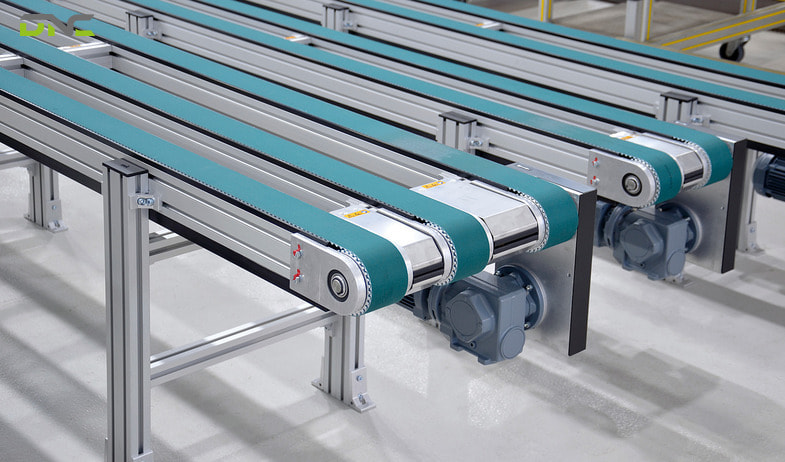
Timing belt conveyors are the “special forces” of material handling, used in high-complexity environments
Servo Motor and Stepper Motor Integration
Stepper Motor + Timing Belt
Stepper motors move in discrete steps (typically 1.8°/step = 200 steps/revolution). Connected to a timing belt conveyor:
- Position is controlled open-loop (no encoder) — the controller assumes the stepper executed each commanded step without checking
- Maximum speed: limited by stepper torque curve — above the pull-out speed, steps are missed and position is lost
- Position accuracy: ±1 motor step × belt pitch / pulley diameter
- Cost: Low — steppers are inexpensive
Suitable for: Light-load conveying (<5 kg total product load on belt), short conveyors (<2 m), moderate positioning accuracy (±0.5–1.0 mm), applications where stall is not critical.
Not suitable for: High load, high speed, or applications where a missed step causes a defective product or equipment collision.
Servo Motor + Timing Belt
Servo motors use encoder feedback to verify position. The motor continuously corrects to reach the commanded position.
- Position accuracy: ±0.02–0.5 mm (depending on encoder resolution and belt elongation)
- Speed: Higher — servo motor torque is not limited by step frequency
- Behaviour on overload: Servo detects position error (torque limit exceeded) → generates fault → controller can handle it safely
- Cost: Higher — servo motor + driver + encoder adds 3–5× cost versus stepper
Suitable for: Precision indexing conveyors (±0.1–0.5 mm), high-speed PCB transport (>1.0 m/s), robotic pick-and-place infeed, applications where stall detection is required for safety or quality.
DNC Automation integrates timing belt conveyors with Siemens servo drives (SINAMICS S120) and Siemens SIMOTION motion controllers for synchronised multi-axis timing belt conveyor systems — achieving ±0.1 mm positioning accuracy for electronics assembly lines.
Applications in Malaysia
SMT Electronics Manufacturing (Penang, Selangor)
Malaysia is one of the world’s largest electronics manufacturing hubs. SMT production lines — screen printer → pick-and-place → reflow oven → AOI inspection — use dual-belt width-adjustable timing belt conveyors as the connecting transport between every machine:
- Standard PCB widths: 50–460 mm (SMEMA standard)
- Belt speed: 0.5–2.0 m/s between machines; 0.1–0.3 m/s through machines
- Width adjustment: Servo-motor adjustable, controlled by SMEMA machine interface signals
- Belt material: ESD-safe coating (surface resistivity 10⁶–10⁹ Ω) to prevent static damage to sensitive PCBs
Pharmaceutical Packaging
Blister pack indexing under vision inspection cameras: timing belt indexes each blister one cavity at a time (12–24 cavities/blister × 5–20 mm pitch per cavity), stopping precisely for camera inspection. Any missed step → tablet position error → false reject or missed detection.
Automotive Sub-Assembly
Precision assembly stations (torque wrench, dispensing, pressing) use indexing timing belt conveyors to present fixtures at exactly the correct position under the tooling — with PLC confirmation of position before tooling is activated.
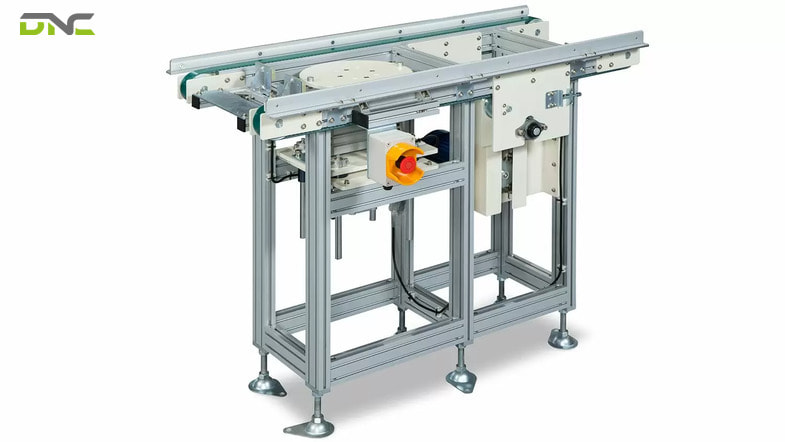
While timing belt systems are low-maintenance, they are not “no-maintenance.” To ensure long-term accuracy, follow these protocols
Selection Guide
Choose timing belt conveyor when:
- Positioning accuracy ±0.5 mm or better is required
- Synchronised multi-zone operation (all zones advance simultaneously)
- No-slip positive drive is mandatory (robot interaction, camera inspection)
- High speed >1.0 m/s with repeatable stop position
Choose flat belt conveyor when:
- Product transport (not positioning) is the primary function
- Positioning accuracy >1.0 mm is acceptable
- Wide conveyor (>500 mm) is needed — timing belts are less economical at very wide widths
- Lower cost is priority
Tooth profile selection:
- Light duty, small machine: T5 or T10
- General automation: AT10 or HTD 5M/8M
- High precision, zero backlash: HTD 8M/14M or GT3
DNC Automation’s Timing Belt Conveyor Solutions
DNC Automation designs and integrates timing belt conveyor systems for Malaysian electronics assembly, pharmaceutical, and precision manufacturing applications.
Scope: Belt profile and width selection based on load and accuracy requirements; pulley and drive shaft design; Siemens servo motor and SINAMICS drive integration; SMEMA-compatible SMT conveyor width adjustment; PLC programming for indexing sequence and position confirmation.
Products: Habasit HabaSYNC, Gates GT3, and Forbo Siegling timing belts — with aluminium and stainless steel frame options.
Contact DNC Automation for timing belt conveyor specifications, accuracy analysis, and servo system integration.
Summary
Timing belt conveyors provide positive, slip-free belt drive enabling precision product positioning for electronics assembly, pharmaceutical packaging, and automated sub-assembly. Tooth profile selection (T-series, AT-series, HTD/GT curvilinear) determines load capacity and backlash. Servo motor integration achieves ±0.1–0.5 mm repeatability — sufficient for direct robot and vision system interaction without additional locating fixtures. For Malaysian SMT electronics manufacturers, dual-belt width-adjustable timing belt conveyors are the mandatory standard for inter-machine PCB transport.
- 238 views
- 0 Comment
Recent Comments