


Truck Scale (Weighbridge): Parts, Load Cells and Types
A truck scale (weighbridge) is a heavy-duty platform scale that weighs a whole road vehicle and the load on board in one stationary reading. The deck rests on load cells, a junction box sums the cell signals and an indicator shows the gross weight. Subtracting the empty-truck tare gives the net weight of the cargo. Five choices define a truck scale: the load cell set, the scale type, the deck length and capacity, the approval route and the data connection. Plant engineers and procurement teams in Malaysia settle these five before a supplier such as DNC Automation quotes a weighbridge for your facility.
What Is a Truck Scale, and Is a Weighbridge the Same Thing?
A truck scale is a large platform scale that weighs an entire road vehicle and the contents, and a weighbridge is the same device under its non-US name, according to Wikipedia’s truck scale entry. Malaysian supplier pages use “truck scale”, “lorry weighbridge” and “vehicle weighbridge” for one product family. Wikipedia lists electronic, digital, mechanical, electro-mechanical, portable, axle and in-motion versions under the same entry, so the name covers a product family rather than one design. The device answers one question at a plant gate: how much did this vehicle carry?
Weighing the loaded truck on the truck scale gives the gross weight. Weighing the empty truck gives the tare weight. Gross minus tare gives the net weight. That number goes on the delivery note, the invoice and the stock ledger.
Wikipedia names two uses for a truck scale: charging by weight over the bridge, which needs trade approval, and check-weighing axle and gross weights to stop overloading. Mines, quarries, recycling yards, concrete and asphalt plants, grain terminals and industrial processing plants all run a weighbridge, according to manufacturer guides. DNC Automation specifies the weighbridge as one turnkey truck scale and weighbridge solution with the deck, load cells, indicator, software and accessories chosen together for Malaysian factories.
Every truck scale reading starts as force on the deck, so the signal path comes next.
How Does a Truck Scale Weigh a Truck Wherever It Stops?
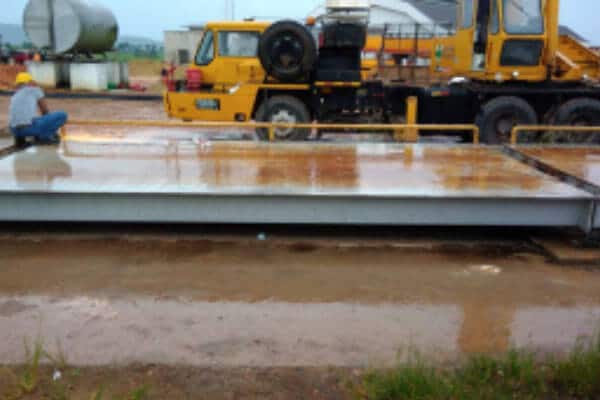
A truck scale weighs a truck by carrying the deck on load cells, summing the cell signals in a junction box and converting the sum to a weight in the indicator. The signal travels in five steps.
- The truck drives onto the deck and stops.
- Each load cell under the deck compresses slightly, and the strain gauges in the cell change electrical resistance in proportion to the force.
- Each cell sends an analog signal to the junction box, which combines the signals into one.
- The controller digitises the combined signal with an analog-to-digital converter.
- The indicator registers the gross weight, subtracts the stored tare and prints the net weight on a ticket.
A truck stops at a slightly different position on the weighbridge every time, and its axles load the cells unevenly. The reading is trustworthy only if the sum ignores that split. Wikipedia states the same requirement for older lever-type scales: the response of the scale must be independent of the distribution of the load.
Electronic weighbridges meet it with matched cells. One load cell manufacturer notes that cells working four, six or eight to a scale must have exactly the same sensitivity. A truck-scale guide from another manufacturer adds that the junction box serves for trimming and diagnostics. A truck scale is therefore a sum of four to twelve cell outputs plus one subtraction for tare, which is why the parts list matters as much as the capacity.
How Does a Truck Scale Weigh a Truck Wherever It Stops?
What Are the Parts of a Truck Scale?
A truck scale has seven working parts: foundation, deck, load cells, junction box, cables, indicator and software. The table lists what each part does and which detail the manufacturer pages stress.
| Part | Job on the weighbridge | Detail the sources stress |
| Foundation | Carries the deck and cells as a pit, slab or pier | Permanent installations sit on a concrete foundation; a robust deck cannot compensate for poor drainage or an unstable base |
| Deck | Forms the road surface in modular steel or concrete sections | Steel decks arrive factory-built with no field-poured concrete to cure; concrete decks add placement and curing |
| Load cells | Convert the force on the deck into electrical signals | Four to twelve per scale, set at the corners of the modules |
| Mounting assemblies | Connect the deck to the cells | Reduce side-load effects and allow expansion, contraction and shock absorption |
| Junction box | Combines the cell signals into one | Used for trimming and diagnostics; some digital systems omit it |
| Indicator | Shows the weight and links the printer and remote display | Acts as the connection point to the plant network |
| Software | Stores tare records and prints tickets | Passes weights to reporting and ERP systems |
Peripheral equipment completes the truck scale installation. Ramps serve above-ground decks, a scale house shelters the operator, guardrails keep trucks on the deck, remote displays and traffic lights guide the driver, and a manhole gives access to a pit foundation. Unattended kiosks let a driver weigh without an operator.
Of these parts, the load cell carries the most specification detail, and weighbridge load cells follow their own rules.
Which Load Cells Does a Weighbridge Use?
A truck scale uses a weighbridge load cell, a high-capacity steel sensor that converts the weight of a vehicle into an electrical signal for the indicator. Capacity, accuracy class and sealing decide which cell suits which truck scale.
Two families dominate the manufacturer pages for load cells for a weighbridge. The following table compares them with the figures the pages publish.
| Family | Capacity in the sources | Mounting logic | Build |
| Double-ended shear beam | 10, 20 and 30 t on one data sheet (30 t = 30,000 kg, 66,139 lb); 9 to 27 t on another maker’s double shear range | Suits modular weighbridges where side forces and structural movement must be absorbed | Nickel-plated alloy steel, IP68 (ingress protection) hermetic sealing |
| Column (canister, compression) | 10 to 40 t on one data sheet, 10 to 50 t on another maker’s range | Suits truck scales that need high overload resistance and vertical installation without extra side-force handling | Alloy steel or stainless steel, IP68, installed in groups of at least four |
Four manufacturer and supplier pages name accuracy class C3 for these weighbridge cells, under the OIML R 60 framework. One Malaysian supplier calls OIML C3 the standard for most legal-for-trade commercial use in Malaysia. The same supplier sets IP65 as the minimum ingress protection rating for outdoor use and IP67 or IP68 for wet sites.
Overload ratings differ by maker. Two data sheets both give a safe load of 150% of full scale, but the ultimate overload figure reads 200% on one and 300% on the other. A manufacturer FAQ lists what a replacement cell must match: dimensions, mounting assembly, rated capacity, communication protocol and indicator. DNC Automation supplies weighbridge load cells with weighing indicators as a load cell and indicator supplier for Malaysian and Singapore factories. The number of cells under the deck comes next.
How Many Load Cells Does a Weighbridge Need?
A weighbridge needs four to twelve load cells in one group, according to manufacturer guides that quote four, six or eight cells on one hand and six to twelve on the other. Each cell carries one share of the deck, and a deck with more cells spreads a heavy axle over more points.
Weighbridge capacity adds up as arithmetic. Eight 30 t cells (240 t of nominal cell capacity) under an 80 t scale give a ratio of three to one. The three-to-one figure illustrates quoted numbers only, and the supplier’s design calculation fixes the real cell count and size.
Mounting assemblies protect the weighbridge cell group. A manufacturer guide credits them with reducing side-load effects, allowing the deck to expand and contract, and absorbing shock. Whether the group reports as one analog signal or as eight digital readings depends on the type of load cell.
Does a Weighbridge Need Analog or Digital Load Cells?
A weighbridge runs on either analog or digital load cells: analog cells feed one summed signal through a junction box, and digital cells report each reading along a bus. The choice decides where a fault becomes visible.
In an analog system the junction box returns a single combined signal. A weak cell therefore shows up as drift in the total rather than as a named channel. A digital cell has its own address, and one maker’s RS-485 serial bus accepts up to 32 addresses. Another maker states that each digital cell can be monitored individually, which shortens fault diagnosis on a large weighbridge.
Digital cells also give stable signal transmission over long cables and stronger resistance to electrical interference, according to that maker. DNC’s load cell page adds the cost: digital cells are more expensive and need a digital controller. A truck scale on a long cable run or with a high cell count gains most from the digital option, and that choice completes the load cell set.
Does a Weighbridge Need Analog or Digital Load Cells?
Summary: What Does the Load Cell Set Fix Before the Deck Is Chosen?
A truck scale weighs the whole vehicle on four to twelve load cells, and the load cell set fixes the deck load before the scale type is chosen. The indicator subtracts the tare to find the net weight. Matched cell sensitivity and junction box trim keep the reading independent of where the truck stops. Double-ended shear beam and column cells carry the weighbridge, class C3 and IP68 are the usual build, and analog or digital signalling decides how a fault shows. The deck and scale type follow from the cell set.
What Types of Truck Scale Exist, and What Does Each Reading Settle?
Truck scale types fall into three groups by the job of the reading: settle a transaction, screen a vehicle or control a process. The table orders the types by that job instead of by product name.
| Job of the reading | Scale type | What the sources say |
| Settle a transaction | Full-length static scale, permanent or portable | Weighs the whole vehicle at rest in one pass and is the usual start for legal-for-trade gross weighing |
| Settle a transaction with axle detail | Multi-platform or multi-axle scale | Captures gross and axle-group weights in one stationary transaction |
| Screen a vehicle | Axle scale, axle pad, weigh-in-motion system | Axle scales are not typically trade approved, heavy axle models are labelled “not legal for trade”, and weigh-in-motion accuracy sits an order of magnitude below a conventional weighbridge |
| Control a process | Any internal scale feeding loading or batching | Serves inventory, loading and process data inside the plant |
A weigh-in-motion truck scale screens vehicles without stopping them, which suits weigh stations and ports where a stop at every vehicle would cause queues. Speed costs accuracy. A weigh-in-motion result rarely settles an invoice.
Installation style is a second decision. A pit-mounted truck scale sits with the deck flush to the road, at the price of excavation, drainage planning and below-deck cleanout access. An above-ground (pitless) weighbridge needs ramps and approach space but keeps the underside open for inspection and cleaning. Permanent scales stand on an engineered foundation, while portable full-length scales suit temporary sites such as construction, quarry and roadwork, and one manufacturer quotes two to four hours for installation on a prepared surface.
Deck material is the third truck scale decision. A steel deck shortens the installation window because no field-poured concrete has to cure. A concrete deck adds traction and a durable driving surface at the cost of placement and curing time. The deck choice leads to the size of the truck scale.
What Capacity, Length and Width Does a Truck Scale Need?
A truck scale needs the capacity, length and width that suit the heaviest, longest and widest vehicle on site, with room for future fleet changes. Manufacturer guides describe typical full-length weighbridges as 60 to 120 ft (18 to 36 m) long and 10 to 12 ft (3 to 4 m) wide, rated up to 280,000 lb (130 t) of load capacity.
Modular widths run from 8 to 14 ft (2.4 to 4.3 m), and one heavy-duty steel deck reaches 135 t with 25 ft (7.6 m) modules. Another maker lists 20 to 120 t across its range, and a third quotes up to 80 t for heavy vehicles. The spread shows that nominal capacity alone does not describe a weighbridge.
A manufacturer buying guide adds that concentrated load capacity, duty cycle, axle loading and traffic volume belong in the same truck scale specification. The trucks per day set the weighing throughput, and the vehicle envelope below is the data a supplier needs.
- The longest and widest vehicle that will cross the deck.
- The maximum gross load and the axle spacings.
- The trucks per day and the peak-hour arrivals.
- The direction of traffic, queue space and growth plan.
Capacity alone is not enough. A nameplate capacity is not a weighbridge specification. Your facility’s vehicle mix decides the deck, and the approval route decides what the reading may be used for.
Is a Truck Scale Approved for Trade Use in Malaysia?
Whether a truck scale is approved for trade use in Malaysia depends on the local approval route, and approval of the model alone does not make an installed weighbridge legal for trade. In the United States, commercial scales need National Type Evaluation Program (NTEP) approval under Handbook 44 of the National Institute of Standards and Technology (NIST), according to Wikipedia. One US manufacturer adds that NTEP type approval does not approve the installed scale, which may still need testing, sealing, registration or placing in service by the local weights-and-measures agency. European makers cite OIML, CE and MID instead.
Malaysian supplier pages treat the same steps as separate services. Weighbridge stamping, weighbridge calibration and pattern approval each have their own page on one Malaysian supplier’s site, and load cell pages use OIML R 60 class C3 as the common baseline. No source in this research names the Malaysian authority or the legal text, so the purchase document should state the approval route in writing and ask the supplier to list the commissioning steps.
DNC recommends naming the model approval, the installed-scale inspection and the calibration evidence as three separate lines in the weighbridge specification. One Malaysian supplier lists calibration and stamping next to the weighbridge itself, so the quotation should say who carries each step. An approved weight only matters once the truck scale passes it to the production line, so the data connection comes next.
Is a Truck Scale Approved for Trade Use in Malaysia?
How Does a Truck Scale Connect to the Production Line?
A truck scale connects to the production line through the weighing ticket: the indicator and software pass inbound and outbound weights, tare records and product codes to the systems that run the plant. A manufacturer guide lists the usual integration items: vehicle or customer identification, tickets, data exports, traffic lights, gates and cameras. An unattended kiosk identifies the driver, captures the weight, issues the ticket and operates the gate.
Most guides stop at the ticket. For a plant that fills, packs and ships by lorry, one consignment leaves two weight records: the sum of the pack weights that the checkweigher verified, and the weighbridge net. One manufacturer notes that incoming vehicle weight, internal material movement and outbound shipment records can be compared when the scales work together. A logistics guide says terminals use truck scales to reconcile weights for billing and documentation.
The comparison works only when both records share a tare convention: one agreed tare for the pallet, the packaging and the empty truck. DNC’s engineers have specified and commissioned weighing systems for automotive, food and beverage, and glove manufacturing facilities in Malaysia. When we evaluate a packing line, the first specification we anchor is the measurand at each station, and the weighbridge is the last station on that list, one step beyond the end-of-line packing area.
A weighbridge that nobody reconciles against the line is a gate, not a measurement. Specifying weighing system integration puts the weighbridge, the indicator and the line scales on one data path, and how a checkweigher works explains the line side of the comparison. For factories pursuing NIMP 2030 (New Industrial Master Plan 2030) and Industry 4.0 targets, the weighing ticket is production data and belongs in the same database as the line counts. The ticket carries only the accuracy that calibration and maintenance keep in the truck scale.
How Is a Truck Scale Calibrated and Maintained?
A truck scale is calibrated against known test weights and maintained through routine inspection, cleaning and drainage checks. Calibration frequency depends on the cells and the environment, according to one equipment supplier, which also advises following the manufacturer’s recommendations and keeping detailed records. Malaysian supplier pages list standard test weight services and weighbridge calibration as separate offers, and one scale manufacturer lists test trucks and test carts for larger decks.
A manufacturer maintenance plan for a truck scale lists seven routine items.
- Visual inspection of the deck and the approaches.
- Cleaning around and beneath the deck where access allows.
- Debris and ice removal.
- Drainage checks.
- Cable and connection inspection.
- Indicator verification.
- Calibration checks by qualified technicians.
High-volume, legal-for-trade and harsh-environment sites need more frequent checks than a lightly used internal scale. A robust weighbridge cannot compensate for poor drainage, an unstable foundation or neglected maintenance, according to the same guide. DNC’s weighbridge page states that each unit is factory assembled and performance tested before shipment, which leaves site calibration as the step that ties the truck scale to your own test weights. The same guide advises defining the service response and a backup weighing plan before a failure happens. Open access for cleaning and cell replacement lowers downtime over the life of the weighbridge.
Frequently Asked Questions: What Do Buyers Ask About a Truck Scale?
These five questions cover the basics of a truck scale for plant engineers and buyers: naming, load cell count, installation style, accuracy class and installation time.
What is the difference between a truck scale and a weighbridge?
A truck scale and a weighbridge are the same device: truck scale is the US name and weighbridge is the name used elsewhere. Vehicle scale is the neutral term, and a rail weighbridge applies the same principle to rolling stock.
How many load cells does a truck scale have?
A truck scale has four to twelve load cells in one group. Manufacturer guides quote four, six or eight cells on some scales and six to twelve on others, summed in a junction box or on a digital bus.
What is a pitless weighbridge?
A pitless weighbridge is an above-ground truck scale that sits on the surface and is reached by ramps. The underside stays open for inspection and cleaning, which reduces excavation compared with a pit-mounted deck.
Which accuracy class do weighbridge load cells use?
Weighbridge load cells are usually sold in accuracy class C3 under the OIML R 60 framework. Four manufacturer and supplier pages name C3 for truck scale cells, with IP68 sealing for outdoor use.
How long does a truck scale take to install?
A truck scale takes hours to install when portable on a prepared surface, and several weeks when permanent, according to one manufacturer FAQ, because foundation work, concrete curing and inspection extend a permanent schedule.
- 1 views
- 0 Comment
Recent Comments