


Pick and Place Robot: Types, Cycle Time and Specification
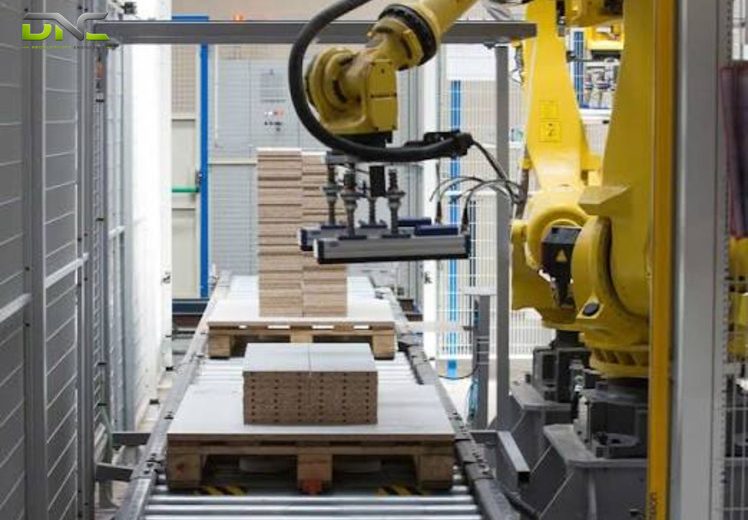
A pick and place robot is an industrial or collaborative robot arm that lifts an item at a pick point and sets it down at a place point, using an end effector, a vision system and a controller. Delta, SCARA, articulated and cartesian arms all do the work, and a pick and place robot is chosen by the seconds it has for each pick, not by the name of the arm. DNC Automation integrates industrial robotic arms, cobots and pick-and-place robots for assembly, palletizing, packaging and inspection, with Comau and Doosan robotics in its range. Five decisions define the cell: robot class, time per pick, end effector, vision and the hand-over to the next station.
Pick and Place Robot Meaning: Pick, Move and Place
Pick and place robot meaning is a robot arm that lifts an object at one location and moves it to another, repeated for every item in the run. The arm picks at a known point, travels a planned path and releases the item at the place point. A robot integrator’s guide dates the category to 1961, when Unimate, the first industrial robot, moved die castings for automotive work.
Three phrases circulate for the same field. “Pick and place robot” names the machine, “pick and place robots” is its plural, and “automated pick and place” or “pick and place automation” names the application that the machine performs. Search results for all four phrases describe the same arms, grippers and conveyors.
One term needs a boundary. In electronics, “pick and place machine” often names a machine that sets electronic components on circuit boards. That machine belongs to electronics assembly, and this article covers robot arms only.
Factories adopt the pick and place robot to take dull, repetitive handling away from people. One gripper maker lists shorter working time, higher productivity and better ergonomics as the gains. For Malaysian manufacturers, labour shortage and rising wages under the New Industrial Master Plan 2030 (NIMP 2030) push the same direction. DNC lists pick-and-place robots under its robotic solutions alongside conveyors, AGV and AMR systems and warehouse automation.
Every pick and place robot, whatever its arm type, is built from the same four groups of parts.
Pick and Place Robot Components: Arm, End Effector, Vision and Controller
Pick and place robot components fall into four groups: the arm, the end effector, the sensors and the controller with its software. The table lists the job of each group and the detail the sources give.
| Component | Job | Detail from the sources |
| Robot arm | Moves the tool between pick and place | Three to six axes, per one robot integrator |
| End effector | Touches the item | Vacuum cups, mechanical fingers, magnetic tools |
| Vision and sensors | Locate the item and control grip force | 2D or 3D cameras, force and proximity sensors |
| Controller and software | Plans the path and the timing | Motion planning, task coordination |
| Conveyor or feeder | Presents the item | Trays, belts or feeders keep material flowing |
The end effector (also called end-of-arm tooling, EOAT) decides what the robot can hold. Vacuum suits sealed items and boxes, and it fails on open or porous cartons, according to one integrator. Mechanical fingers need open space around the item. Magnetic tools suit iron and steel parts. One robot maker adds that vacuum works on flat, non-porous surfaces, while clamps run on electric or air power.
Payload counts the product and the tool together. A robot rated at 2 kg (4.4 lb) carries a 1.5 kg (3.3 lb) item only if the gripper weighs under 0.5 kg (1.1 lb). That maker publishes 2 kg and 3 kg models with 300 mm (11.8 in) and 650 mm (25.6 in) reach, and a European robot maker lists payloads up to 10 kg (22 lb) for its pick and place robots and cobots.
Reach and payload fix the size of the pick and place robot. The working sequence fixes how fast the robot repeats each cycle.
How a Pick and Place Robot Works: Detect, Plan, Grip and Place
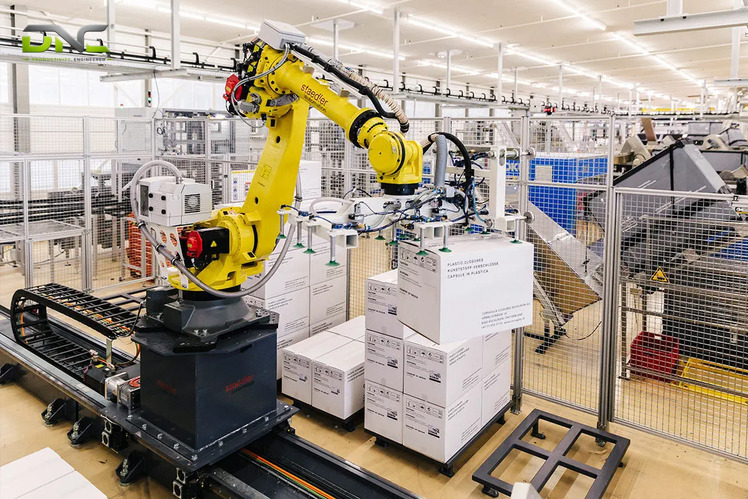
A pick and place robot works through four steps: detect, plan, grip and place. The list follows one cycle from the camera image to the released item.
- Detect: a camera or sensor finds the item and reports its position, size and orientation to the robot.
- Plan: the controller calculates a path to the item that avoids obstacles.
- Grip: the end effector closes or applies suction on the item.
- Place: the arm moves to the place point and releases the item with the required orientation.
Detection takes time. One robot maker states that its robots process an image and pick the correct object in 0.2 seconds. One integrator warns that vision processing adds 100 to 500 milliseconds per pick, which damages throughput when the cycle time is planned without it. Robots that process the image while the arm is moving hide part of that time.
Product supply sets how hard step 1 is. A structured supply lets the robot go to the same spot every time. Bulk supply or mixed shapes call for robot vision, and in the hardest case for bin picking. Shiny or reflective items make detection harder, according to one robot maker.
That integrator separates vision into three levels. A 2D rule-based camera is the entry level and fails when light or part shape changes. 2D deep learning handles variation after training on a few hundred images. 3D vision covers random orientation and reflective parts. DNC’s vision inspection system range lists robot vision guidance and visual positioning among its applications.
Which pick and place robot performs the four steps depends on speed and payload, and the four arm types differ on both.
How a Pick and Place Robot Works: Detect, Plan, Grip and Place
Types of Pick and Place Robot: Delta, SCARA, Articulated and Cartesian
Types of pick and place robot differ in how many axes they move and how fast they repeat a short pick. The table sets the four common arm types side by side with the figures the sources publish.
| Type | Motion | Fit | Published figure |
| Delta | Parallel arms hung above a conveyor | Light, fast items from belts | Up to about 300 picks per minute on some models; one maker states 4,000 to 6,000 parts per hour |
| SCARA | Rigid horizontal arm with a vertical stroke | Small parts, assembly | One maker lists a cycle as short as 0.36 s at 500 mm (19.7 in) reach |
| Articulated (5 or 6 axes) | Jointed arm, 6 axes re-orient the item | Mixed tasks, heavier items | One maker states at most 800 to 1,000 parts per hour |
| Cartesian | Three linear axes at right angles | Large work areas, structured loads | No speed figure; fewer new installations, per one maker |
The delta robot came from a research team led by Reymond Clavel at the Swiss Federal Institute of Technology in Lausanne (EPFL) in the early 1980s, per Wikipedia. SCARA stands for selective compliance assembly robot arm, introduced in 1981 by three Japanese companies, with Professor Hiroshi Makino of Yamanashi University guiding the work. SCARA arms are generally faster than comparable cartesian robots.
A 5-axis arm moves items in a relatively straight line, and a 6-axis arm twists them before the place. That one difference sets the choice between arm types for a part that must land in a given orientation. The collaborative robot, covered below, is an articulated arm built for shared workspaces.
The choice of pick and place robot follows rate and payload, so the pick rate needs a number to check each type against.
Summary: What Fixes a Pick and Place Robot Before the Arm Is Named
A pick and place robot is fixed by four inputs before a supplier names an arm. The pick rate gives the time per pick. The item weight plus the tool weight gives the payload. The item surface gives the end effector: vacuum, fingers or magnet. The supply of the item gives the vision level, from none to 3D.
Delta, SCARA, articulated and cartesian robots then follow from those four inputs rather than from brand or habit. The first input, time per pick, is the one that no competitor page turns into a number, and the pick and place cycle time below does.
Pick and Place Cycle Time: The Time Allowance That Sets Picks per Minute
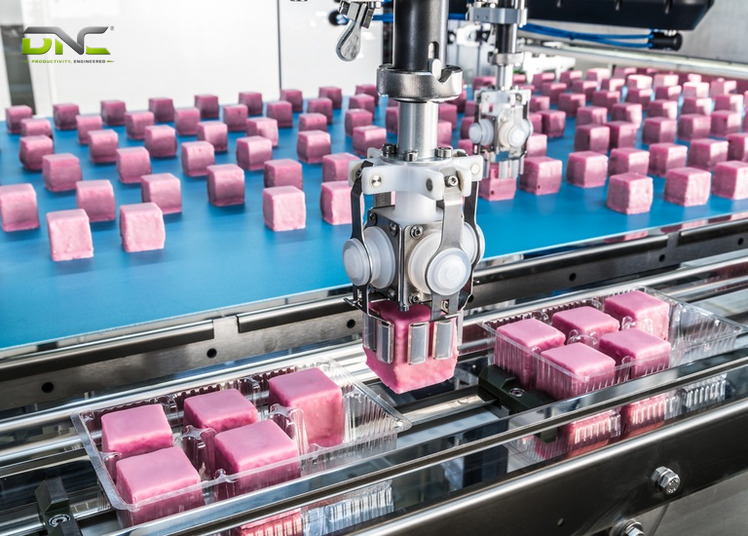
Pick and place cycle time is the seconds one robot has for each pick, and it equals 60 divided by picks per minute. The table gives the derived arithmetic for the rates a packing line asks for, next to the class of arm that the published figures point to.
| Picks per minute | Seconds per pick, one robot | Arm class the published figures point to |
| 15 | 4.0 s | 6-axis articulated (about 13 to 17 per minute at the stated 800 to 1,000 parts per hour) |
| 60 | 1.0 s | SCARA or delta |
| 100 | 0.6 s | Delta (67 to 100 per minute at the stated 4,000 to 6,000 parts per hour) |
| 300 | 0.2 s | Fastest delta models only |
DNC derived these figures from the published ceilings. The ceilings come from a robot maker’s FAQ and from Wikipedia, and the sources quote them as upper limits. A packing line does not run at the ceiling.
Vision takes a share of the second in every pick and place robot cycle. At 60 picks per minute the allowance is 1.0 s, so 100 to 500 ms of vision processing that is not overlapped with arm motion consumes 10 to 50 percent of it. At 100 picks per minute the same 100 to 500 ms consumes 17 to 83 percent of a 0.6 s allowance. This is why the vision level belongs in the rate calculation, not after it.
Two robots change the sum. At 120 items per minute a single robot has 0.5 s per pick, and two robots sharing the conveyor have 1.0 s each. One European robot maker states that its software coordinates up to 10 robot arms on multiple conveyors for this reason.
The calculation gives a number, and the number points to a robot class. A shortfall is solved by a faster class, by a second robot or by a lower rate, never by trusting the nameplate. A cobot enters the same table at the slow end.
Pick and Place Cycle Time: The Time Allowance That Sets Picks per Minute
Pick and Place Cobot: Where a Collaborative Arm Fits
A pick and place cobot is a collaborative robot arm that picks and places in a workspace shared with people. Cobots are slower than industrial arms and excel in flexibility and ease of deployment, per one sensor maker’s guide. They suit low-volume runs and mixed manual and robot work, according to the same guide.
The slow end of the cycle-time table is the cobot’s home. At 15 picks per minute the allowance is 4.0 s, and a cobot with a vision camera meets it where a 100-per-minute line is out of reach. One cobot integrator describes a fixed cell beside the pick area, where a camera finds each item in 2D or 3D.
Cobots share the arm types and the end effector choices above. A cobot maker lists three decisions for the buyer: axes, reach and repeatability. The same four steps apply, and detection is the step that a cobot cell most often underestimates.
For palletizing, DNC compares the two classes in cobot vs industrial robot palletizers. The same logic holds for a pick and place cobot: a cobot is chosen where the time allowance is generous and the workspace is shared. A line that needs under one second per pick calls for an industrial arm behind a guard.
Several of the pages that rank for the cobot phrase are cobot makers and integrators with solution pages, so the cobot keyword is a candidate for its own page. Where a pick and place cobot goes depends on the application, and four application groups cover most cells.
Automated Pick and Place Applications: Packaging, Machine Loading, Bin Picking
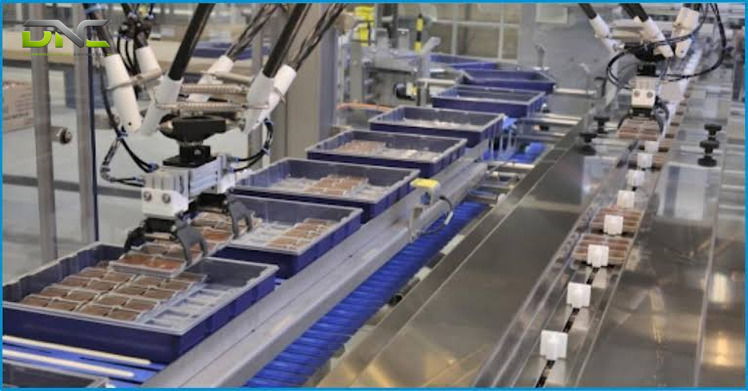
Automated pick and place applications fall into four groups: packaging, machine loading and unloading, assembly and sorting, and bin picking. The list gives one example for each group from the sources.
- Packaging: robots pick finished goods from a conveyor and place them into trays, cartons or cases, including food and produce end-of-line packing.
- Machine loading and unloading: arms load blanks and remove finished parts at CNC and injection moulding machines.
- Assembly and sorting: arms place parts at an assembly point or arrange products on a moving conveyor.
- Bin picking: a 3D camera locates unsorted parts in a bin, which one robot maker calls the hardest pick and place task.
One robot-software vendor names product sorting and case packing as the first tasks worth automating, because the gain is quick to measure. Palletizing is a further application. One robot maker lists palletizing robots with payloads up to 1,300 kg (2,866 lb), a class of arm far above the pick and place range discussed so far.
The border between main content and buying questions sits here. The sections above define the machine, and the sections below turn it into a cell for a factory. DNC’s conveyor system lines feed these robots and can be integrated with robots or sensors, per the DNC robotics page.
The packaging group is the one that touches the rest of an end-of-line, so the place side of the pick and place cell is followed downstream.
Automated Pick and Place Applications
Pick and Place Automation at the End of the Line: What the Place Side Hands Downstream
Pick and place automation at the end of the line is the robot that fills the carton, and the carton is the input of every station after it. The place side fixes the count of items, their orientation and the fill pattern of the carton. One integrator notes that placing is often harder than picking, especially with deformable items.
The stations downstream react to the place. A case sealer closes the flaps over what the robot placed, so an item standing proud of the carton rim fouls the flap fold. A checkweigher reads the gross weight of the closed case, so a missing item appears as an under-weight reject. A palletizing robot assumes a case of declared weight and shape. This chain is derived reasoning from how each station works, not a published figure.
Robot palletizing follows the same logic upstream of the pallet. DNC supplies robotic palletizing cells that take the closed case from the conveyor, and the place side of the pick and place cell is what that cell receives. An end-of-line specification therefore names the carton, the item count and the tolerance on the fill, before the robot is selected.
DNC integrates the robot with the conveyor, the vision camera and the control layer that sequences them. DNC engineers, supplies and commissions packaging and weighing stations as well as robotic cells, so the interface between the robot and the next station sits in one scope.
An integrator’s failure list for pick and place robot cells points the same way. It names lighting, a gripper chosen for looks, a thin cycle-time allowance, an untested place side and no feasibility study as the causes of six-figure deployments that did not work. The specification checklist turns those causes into questions.
Pick and Place Robot Specification: Axes, Reach, Payload, Repeatability and Speed
A pick and place robot specification starts from the pick rate, the item and the place requirement, and only then the arm. The list gives the inputs a buyer prepares, in the order a supplier asks for them.
- Picks per minute at peak, and the line pattern behind it, from which the seconds per pick follow.
- Item weight, size, surface and fragility, plus the tool weight, for the payload.
- Supply of the item: structured, bulk or mixed, which sets the vision level.
- Axes: one robot guide gives four to five axes for placing onto a conveyor or into a container and six or more when the item must rotate.
- Reach: the distance from the centre of the base to the farthest point of the gripper, per one guide.
- Repeatability: one guide quotes under 0.5 mm (0.020 in) as a target for order-fulfilment picking, and a circuit-board task needs better.
- Speed: the spec sheet gives degrees per second, so peak demand is checked against the time allowance.
A feasibility test of the pick and place robot comes before the order. One integrator reports payback for most of its cells of 12 to 18 months at Swiss labour rates, with the economics improving at higher product mix or 24/7 operation. Malaysian labour cost differs, so the payback of a cell is calculated on the factory’s own pick rate.
Lighting deserves its own line item in a robot specification. That integrator ranks controlled lighting above camera resolution. Mixed items on one line ask for a gripper that handles every item, and the place side asks for a fixture or a defined carton.
To turn a pick rate and an item list into a quotation-ready robot specification, speak with a DNC engineer. Common questions on the terms follow.
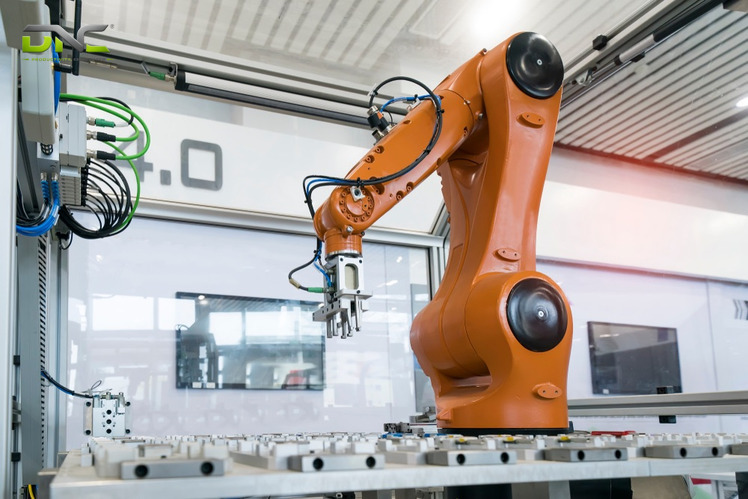
Pick and Place Robot Specification
Frequently Asked Questions
Frequently asked questions about the pick and place robot cover the five terms buyers search most: the meaning, the types, the cobot, the automation and the speed.
What is a pick and place robot?
A pick and place robot is a robot arm with an end effector that lifts items at one point and sets them down at another. It combines an arm, a gripper or suction tool, sensors and a controller.
What are the types of pick and place robots?
The types of pick and place robots are delta, SCARA, articulated (5 or 6 axis), cartesian and collaborative. Delta arms are the fastest class, and 6-axis arms re-orient items before the place.
Can a cobot do pick and place?
A cobot does pick and place in a workspace shared with people, at lower speed than an industrial arm. It suits low-volume and mixed runs, and it needs a camera when items arrive in random positions.
What does pick and place automation include?
Pick and place automation includes the robot, the end effector, the vision system, the conveyor or feeder and the control layer that sequences them. At end-of-line, it also includes the carton and the hand-over to sealing and weighing.
How fast is a pick and place robot?
A pick and place robot is as fast as its time per pick allows, which equals 60 divided by picks per minute. Published ceilings run from about 800 to 1,000 parts per hour for a 6-axis arm to up to about 300 picks per minute for a delta.
- 3 views
- 0 Comment
Recent Comments