


SMT Conveyor: Complete Guide for PCB Assembly Lines in Malaysia
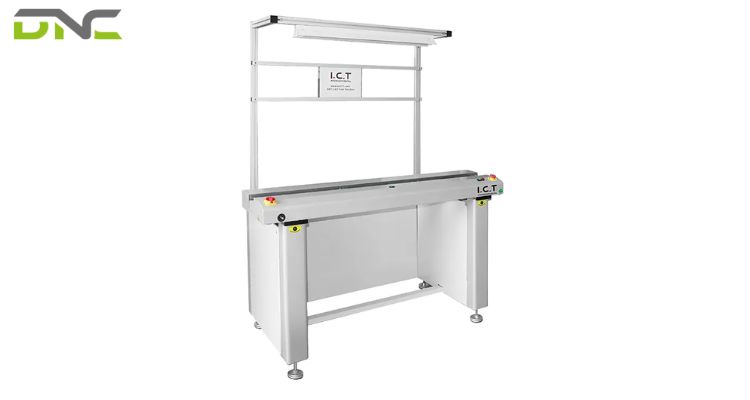
A printed circuit board worth RM 800 in components can be destroyed in 0.003 seconds by an electrostatic discharge event caused by a non-ESD-safe conveyor belt surface. Penang’s electronics manufacturing cluster — contributing 58% of Malaysia’s total E&E exports, 13% of global semiconductor assembly and test volume, and hosting Intel, AMD, HP, and Flex — processes hundreds of millions of PCBs annually. Every single board passes through an SMT conveyor at multiple stages. SMT conveyors are the mechanical connective tissue of a surface mount technology line: they transport PCBs between every machine in the assembly sequence, maintain board registration accuracy to within ±1 mm, handshake electronically via SMEMA protocol with each machine to prevent double-loading or dropped boards, and do all of this with ESD-safe belt materials that prevent electrostatic charge from accumulating on PCBs carrying ICs worth thousands of ringgit. DNC Automation — Malaysia’s Top #1 Factory Automation Company, with a direct presence serving Penang’s EMS cluster — engineers, supplies, and commissions complete SMT line conveyor systems integrated with Siemens SIMATIC PLC control. This guide defines every SMT conveyor type, specification, and selection criterion Malaysian electronics manufacturers need.
What Is an SMT Conveyor?
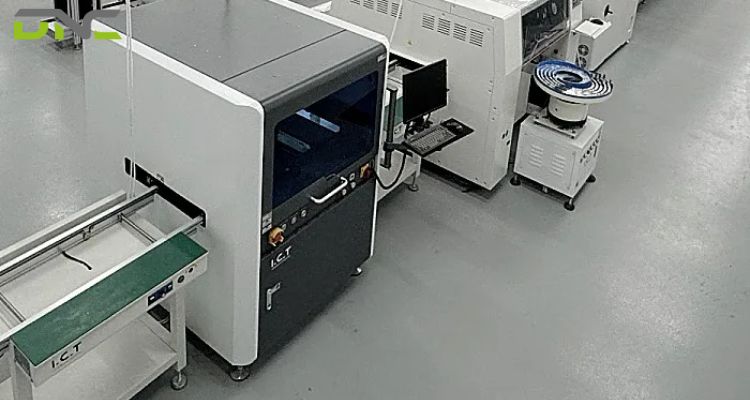
An SMT conveyor is a specialized PCB transport conveyor designed to move printed circuit boards between sequential machines in a surface mount technology (SMT) assembly line, operating within SMEMA (Surface Mount Equipment Manufacturers Association) interface standards that ensure machine-to-machine electronic handshaking. An SMT conveyor is not a general-purpose belt conveyor — it is a precision transport system designed specifically for the dimensional, electrical, and mechanical requirements of PCB handling: ESD-safe belt and frame materials, variable-width edge rail adjustment to accommodate PCB widths from 50 mm to 460 mm, component clearance windows above and below the board, and programmable speed matching between machines operating at different cycle times.
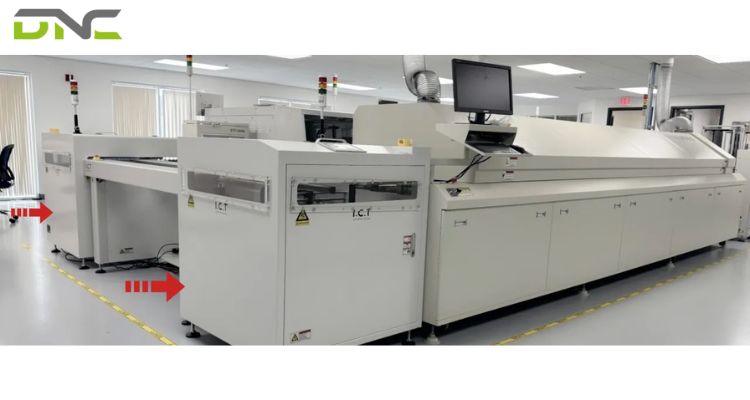
Every machine in an SMT line — board loader, solder paste printer, SPI, pick and place, reflow oven, AOI, ICT tester, and final unloader — has an SMEMA interface connector. The SMT conveyor connects to both the upstream and downstream machine via SMEMA signals, creating an electronic handshake protocol that: signals board available for transfer, confirms board received by next machine, requests stop if downstream machine is busy, and triggers alarms on board misload or jam detection. Without SMEMA-compliant SMT conveyors, each machine operator would need to manually transfer boards — a practice eliminated in automated SMT lines operating at 5,000–15,000 component placements per hour.
What Is an SMT Conveyor
How Does an SMT Conveyor Work?
SMT conveyor operation requires precise coordination between mechanical transport, electronic machine interfaces, ESD control, and board registration. Understanding each functional step prevents the PCB jams, ESD failures, and machine-to-machine timing mismatches that cause production stoppages in high-volume SMT lines.
Step 1 — Board Detection at Infeed
Photoelectric sensors at the infeed end of the SMT conveyor detect a PCB arriving from the upstream machine. The sensor triggers a PLC input that initiates the board acceptance sequence. If the conveyor’s downstream machine signals “busy” via SMEMA, the conveyor decelerates the board to a controlled stop at the infeed position rather than allowing it to collide with a stationary board ahead. The board detection sensor position is calibrated to the specific PCB length — boards from 50 mm to 510 mm in the transport direction can be accommodated.
Step 2 — SMEMA Handshake Initiation
The SMEMA handshake is a hardware protocol using a 26-pin interface connector. When the upstream machine signals “board available” and the SMT conveyor signals “ready,” the board is released. The SMT conveyor then signals the downstream machine “board ready.” Only when the downstream machine signals “board accepted” does the SMT conveyor complete the transfer. This bidirectional electronic handshake eliminates double-loading (two boards in one machine fixture), which would cause misprint, misplacement, or board breakage.
Step 3 — Board Transport at Calibrated Speed
SMT conveyor belt speed is set between 0.5 m/min (for large, heavy server boards) and 20 m/min (for small consumer electronics PCBs at high throughput). Belt speed is synchronized to the upstream machine’s output rate and downstream machine’s cycle time — the conveyor PLC calculates the required speed to maintain proper board gap (minimum 100 mm between consecutive boards) while maximizing throughput. ESD-safe carbon-loaded polyurethane belt maintains surface resistance of 10⁵ to 10¹¹ Ohms throughout the transport path, providing continuous electrostatic dissipation.
Step 4 — Board Registration and Support
PCBs are transported by their edges only — no conveyor component contacts the component area of the board. Two adjustable edge rails carry the PCB along its bottom edge, with the component-free zone (3–5 mm from edge) as the only contact surface. A support rail or center support bar underneath the board prevents excessive bow deflection on thin (0.6–1.0 mm) boards. Board bow exceeding 0.5 mm causes solder paste printing misregistration and component misplacement — both costly quality defects.
Step 5 — Machine Interface at Downstream Position
At the downstream end, the SMT conveyor decelerates the board to a programmable stop position for the receiving machine. Stop position accuracy is ±1–3 mm, sufficient for hand-off to machine fixtures that provide final precision registration (typically ±0.05 mm for pick and place machines). The SMEMA signal confirms board position, and the downstream machine’s own transport system takes over.
Step 6 — Return Transport (Dual-Lane Configuration)
Dual-lane SMT conveyors transport two boards simultaneously in parallel lanes, effectively doubling line throughput without increasing machine count. Each lane operates independently with its own SMEMA interface, speed control, and board detection. Dual-lane conveyors require machines with dual-lane capability on both sides — DNC Automation verifies machine compatibility before specifying dual-lane conveyor configurations.
Types of SMT Conveyor
SMT line design requires selecting the correct conveyor type for each position in the line. Using a standard link conveyor where a buffer conveyor is needed results in machine stoppages every time upstream and downstream machines have different cycle times — a fundamental SMT line design error.
1. Link Conveyor (Standard Fixed-Path PCB Transport)
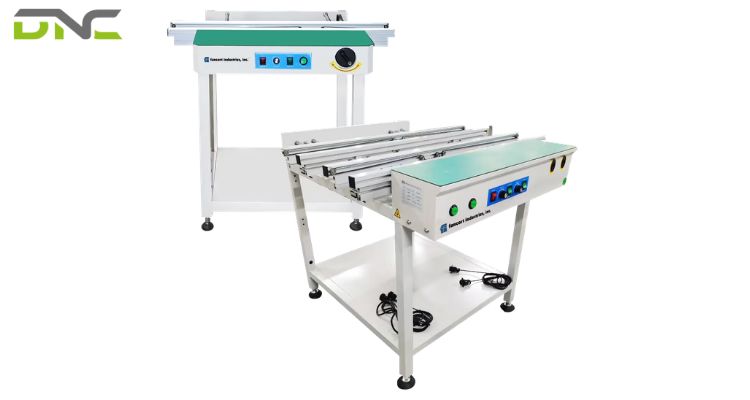
Link conveyors are the baseline SMT conveyor type: a fixed-path conveyor that transports PCBs from one machine’s output directly to the next machine’s input. Link conveyors have fixed transport length (typically 300–1,000 mm), adjustable belt speed, and SMEMA interfaces at both ends. Link conveyors are specified between machines with matched cycle times — for example, between a solder paste printer (10–15 seconds per board) and an SPI machine (8–12 seconds per board) with closely matched throughput rates. Attempting to use link conveyors between machines with significantly different cycle times (e.g., printer at 15 sec vs. pick-and-place at 45 sec) causes systematic line stoppage.
2. Buffer Conveyor (Accumulation and Decoupling)
Buffer conveyors accumulate multiple PCBs between machines with different throughput rates, preventing line stoppage caused by speed mismatch. A buffer conveyor between a fast solder paste printer (output: 4 boards/min) and a slower pick-and-place machine (output: 2 boards/min) accumulates the speed differential, allowing both machines to run at their optimum rates without stopping. Buffer length is calculated from the throughput differential and acceptable maximum queue depth. DNC Automation sizes buffer conveyors using line simulation data — undersized buffers defeat their purpose, while oversized buffers occupy floor space unnecessarily.
3. Board Loader and Unloader (Automated Magazine Interface)
Board loaders transport PCBs from stacked magazines (trays holding 20–50 boards each) onto the SMT conveyor line automatically, while board unloaders collect processed boards from the line into magazines. Magazine-based loading eliminates the labor of hand-feeding boards one at a time — in a Penang EMS facility running 50,000+ boards per shift, manual board loading is impractical. Board loaders operate with stack magazine capacities of 10–30 magazines, providing 2–4 hours of unattended operation between magazine replenishment cycles.
4. Dual-Lane SMT Conveyor (Parallel Two-Board Transport)
Dual-lane SMT conveyors carry two PCBs in parallel lanes simultaneously, with each lane independently controlled. Dual-lane configurations double line throughput for small-to-medium PCBs (up to 250 mm width per lane) without adding machine footprint. Dual-lane conveyors require dual-lane capable printers, pick-and-place machines, and reflow ovens — all of which are available in modern SMT equipment. EMS factories in Penang running high-volume consumer electronics PCBs (phone sub-assemblies, IoT modules) specify dual-lane SMT lines to achieve 20,000+ board throughput per shift.
5. Wide-Board SMT Conveyor (Server and Industrial PCB Transport)
Wide-board SMT conveyors accommodate PCBs up to 460 mm in width — required for server motherboards, industrial control panels, and automotive ECU boards. Standard SMT conveyors handle up to 250 mm width; wide-board versions require extended edge rail guides, additional center support structures, and higher-torque drive systems to handle the increased board mass. Automotive ECU board assembly (Selangor cluster), server board manufacturing, and industrial PLC board production all require wide-board SMT conveyor capability.
SMT Conveyor Specification Comparison Table
| Parameter | Link Conveyor | Buffer Conveyor | Dual-Lane | Wide-Board |
| PCB Width Range | 50–250 mm | 50–250 mm | 50×2 lanes | 50–460 mm |
| Max Speed | 20 m/min | 10 m/min | 20 m/min | 10 m/min |
| SMEMA Interface | Yes | Yes | Yes (2×) | Yes |
| Buffer Capacity | 1–2 boards | 5–20 boards | 2 boards | 1–2 boards |
| Best Use Case | Matched cycle machines | Mismatched speeds | High-volume small PCBs | Large/heavy boards |
Key Components of an SMT Conveyor System
ESD-Safe Belt. Carbon-loaded polyurethane or PTFE-coated fiberglass belts with surface resistance 10⁵–10¹¹ Ohms (ANSI ESD S20.20 compliant) form the transport surface for PCB edges. Belt surface resistance is verified with a surface resistance meter during commissioning and re-verified annually. ESD belt material is critical — standard rubber belts generate triboelectric charges exceeding 5,000 V during PCB transport, sufficient to destroy unprotected CMOS ICs.
Edge Rail Width Adjustment System. Motorized or manual width adjustment moves the two edge rails to precisely match PCB width plus the 3–5 mm component-free edge clearance required on each side. Motorized width adjustment (servo motor driven) allows rapid changeover between PCB sizes in under 30 seconds — critical in EMS facilities running multiple PCB designs on the same line in the same shift.
SMEMA Interface Module. The SMEMA interface hardware consists of a 26-pin connector, optoisolated I/O board, and interface cable set. DNC Automation verifies SMEMA signal compatibility with the specific machine models on either side of each conveyor before installation — non-standard SMEMA implementations by some machine manufacturers require interface adaptation relays.
Photoelectric Board Detection Sensors. Through-beam or diffuse reflection photoelectric sensors at infeed, mid-point, and outfeed positions detect board presence, absence, and jam conditions. Sensor selection accounts for PCB transparency (some thin PCBs with large copper-free areas are semi-transparent to standard photoelectric sensors) — laser sensors or inductive proximity sensors are substituted for problem PCB types.
PLC Control Module. SMT conveyor PLC (Siemens SIMATIC S7-1200 in DNC Automation installations) manages speed control, SMEMA signal processing, alarm management, and diagnostic logging. Siemens TIA Portal programming enables integration of all SMT line conveyors into a single supervisory system with real-time monitoring of board count, transport speed, jam events, and machine utilization rates.
Applications: Where SMT Conveyors Are Used in Malaysian Manufacturing
Penang EMS Cluster — High-Volume Electronics Assembly
Penang’s electronics manufacturing cluster — with Benchmark Electronics, ESCATEC, Flex, and QDOS among the major EMS operations — processes billions of PCBs annually. Every SMT line at these facilities requires 6–12 SMT conveyor units per line (one between each machine pair, plus buffer conveyors and loader/unloader). DNC Automation’s Penang branch serves this cluster directly, with rapid response for SMT conveyor commissioning, troubleshooting, and integration with Siemens SCADA monitoring systems.
Automotive ECU Assembly — Selangor Cluster
Toyota, Inokom, and automotive Tier-1 suppliers in Selangor assemble engine control units (ECUs), body control modules, and driver assistance electronics on SMT lines. Automotive PCB assembly has more stringent requirements than consumer electronics: AEC-Q100 qualified component placement accuracy, 100% traceability via board barcode scanning at every conveyor station, and zero-tolerance ESD control. DNC Automation’s automotive SMT conveyor installations include Siemens SCADA integration that records board serial number, machine ID, operator ID, and timestamp at every conveyor handoff — providing complete production genealogy for automotive quality systems.
Consumer Electronics — Sony and Japanese Brand Manufacturing
Sony’s Malaysian facilities and other Japanese electronics manufacturers (DNC Automation clients) assemble consumer electronics on high-speed SMT lines requiring dual-lane conveyor configurations and precise speed synchronization between printer, pick-and-place, and reflow oven. Japanese-brand EMS facilities specify particularly stringent SMEMA compliance and conveyor cleanliness standards — DNC Automation’s SMT conveyor installations meet the Japanese JIS X 9009 cleanliness standard for electronics manufacturing environments.
Medical Device Electronics Assembly
Medical device PCB assembly — Class II and Class III devices manufactured in Penang and Selangor — requires FDA 21 CFR Part 820 Quality System Regulation compliance. SMT conveyor systems in medical device lines must have documented qualification (IQ/OQ/PQ) and validated operational parameters. DNC Automation provides full IQ/OQ documentation packages for SMT conveyor installations in medical device manufacturing environments.
Applications Where SMT Conveyors Are Used in Malaysian Manufacturing
Benefits of SMT Conveyor Integration for Electronics Manufacturing
SMEMA Integration Eliminates Line Stoppage from Manual Transfer. Manual board transfer between SMT machines averages 3–5 seconds handling time per board plus a 15–20% rate of mis-oriented board insertion. SMEMA-integrated SMT conveyors reduce inter-machine transfer time to under 2 seconds and eliminate misorientation events entirely — translating to 8–12% line throughput improvement in facilities converting from manual to automated board transfer.
ESD Control Prevents Component Losses Worth RM Thousands Per Incident. A single ESD event during PCB transport can destroy FPGAs, microprocessors, or memory ICs worth RM 500–2,000 per board. DNC Automation’s ANSI ESD S20.20 compliant SMT conveyors maintain continuous electrostatic dissipation, reducing ESD-attributed PCB failures by the industry-benchmark 80% reduction in defect rate that DNC Automation delivers across automation projects.
50% Productivity Increase Through Line Balancing. Buffer conveyor integration between machines with different cycle times eliminates machine idle time caused by upstream speed mismatches. SMT lines with properly sized buffer conveyors achieve 92–96% overall equipment effectiveness (OEE) versus 65–75% for unbalanced lines with manual transfer.
Siemens SCADA Integration Provides Real-Time Line Visibility. DNC Automation integrates all SMT conveyor PLC data — board count, speed, jam events, machine utilization — into Siemens SCADA dashboards accessible from the production floor and remote monitoring stations. Production managers see line throughput in real time, and maintenance engineers receive predictive alerts for belt wear or sensor degradation before line stoppage occurs.
How to Choose the Right SMT Conveyor for Your Line
Map Your Machine Sequence and Cycle Times. SMT conveyor selection begins with documenting the exact machine sequence (printer → SPI → pick-and-place → reflow → AOI → ICT) and each machine’s cycle time. Cycle time mismatches exceeding 15% require buffer conveyors at the transition point. DNC Automation provides free SMT line analysis to identify bottlenecks before conveyor specification is finalized.
Determine PCB Size Range. Conveyor width range must accommodate the smallest and largest PCBs in your product mix. If PCB widths range from 100 mm to 350 mm across different products, specify motorized width adjustment rather than manual — the time saving across 10–20 changeovers per shift justifies the cost differential within 3–6 months.
Verify ESD Control Requirements. All PCB assembly lines require ESD-safe conveyor belts and grounded frames as the baseline. High-reliability applications (automotive, medical, defense) require ANSI ESD S20.20 site certification including conveyor belt resistance testing as part of the facility audit. DNC Automation provides ESD test certificates for all SMT conveyor installations.
Assess Malaysia’s NIMP 2030 and SAG Grant Eligibility. SMT line upgrades incorporating Siemens PLC control and SCADA monitoring qualify under Malaysia’s Smart Automation Grant (SAG): up to RM 1 million per facility at 70:30 MIDA matching. Penang EMS facilities modernizing legacy SMT lines with SMEMA-compliant, PLC-integrated conveyors qualify for SAG funding. DNC Automation has supported multiple Penang clients through the SAG application process.
Plan Integration with Upstream and Downstream Robots. DNC Automation’s SMT conveyor systems integrate with Comau robot arms (DNC is Comau’s only official Southeast Asia partner) at AOI and ICT stages — enabling robotic board handling, test fixture loading, and defective board removal without manual intervention. Comau robot integration requires specific conveyor stop position accuracy (±1 mm) and SMEMA signal timing — DNC engineers design the integrated system to these specifications.
How to Choose the Right SMT Conveyor for Your Line
Frequently Asked Questions About SMT Conveyors
Q: What is the SMEMA standard and why does every SMT conveyor need it?
SMEMA (Surface Mount Equipment Manufacturers Association) defines the electrical interface protocol for machine-to-machine PCB transfer in SMT lines. The standard specifies a 26-pin connector, voltage levels (24V DC), signal definitions (Board Available, Machine Ready, Board Conveyor Busy), and cable requirements. Every modern SMT machine — from any manufacturer — has SMEMA interface connectors. SMT conveyors without SMEMA compliance cannot communicate with machines, requiring manual transfer and all its associated quality risks. SMEMA compliance is non-negotiable for automated SMT line operation.
Q: What ESD belt surface resistance is required for PCB conveyor belts?
ANSI ESD S20.20 specifies conveyor belt surface resistance of 10⁵ to 10¹¹ Ohms for ESD-protected area (EPA) conveyors. Resistance below 10⁵ Ohms (conductive) risks shorting PCB traces. Resistance above 10¹¹ Ohms (insulative) allows electrostatic charge to accumulate on the belt surface and discharge into PCBs. Carbon-loaded polyurethane belts achieve stable resistance in the 10⁶–10⁹ Ohm range — within the ESD-safe “dissipative” window.
Q: How wide should the component-free zone be on PCB edge rails?
IPC-2222 (Sectional Design Standard for Rigid Organic Printed Boards) defines minimum edge clearance of 3.175 mm (1/8 inch) from PCB edge to nearest component. Most SMT conveyor manufacturers specify 3–5 mm edge clearance as the default setting. DNC Automation engineers verify the minimum component-free zone on each PCB design before setting edge rail clearance — boards with components closer than 3 mm to edges require custom rail configurations.
Q: What is the typical lead time for SMT conveyor supply and installation in Malaysia?
Standard SMT conveyor units are available with 4–8 week lead time from DNC Automation’s supplier network. Complete SMT line conveyor installation (6–10 conveyor units with Siemens PLC integration) requires 2–4 weeks of installation and commissioning time. DNC Automation coordinates installation scheduling to minimize production downtime — overnight and weekend installation is available for high-priority Penang EMS client projects.
Q: How does factory environment affect SMT conveyor performance?
SMT conveyor performance is optimized at 20–24°C and 40–60% relative humidity — standard EMS factory conditions in Malaysia. Higher humidity (above 70% RH) increases the risk of static charge generation on PCB surfaces between conveyor sections. Lower humidity (below 30% RH) significantly increases ESD risk. Malaysian SMT factories maintain controlled environments year-round using HVAC systems — DNC Automation verifies factory environment specifications during SMT conveyor system design.
Q: What is the difference between an SMT conveyor and a PCB conveyor?
SMT conveyor is the specific term for conveyors used within the surface mount technology assembly sequence — between solder paste printer, SPI, pick-and-place, reflow oven, and AOI machines. PCB conveyor is the broader term covering all board-handling conveyors across the entire PCB manufacturing process, including through-hole soldering, wave soldering, ICT testing, conformal coating, and final assembly stages. All SMT conveyors are PCB conveyors, but not all PCB conveyors are SMT conveyors.
Q: How does DNC Automation differentiate from standard SMT conveyor suppliers?
DNC Automation delivers turnkey SMT line integration — not just mechanical conveyor supply. DNC’s scope includes Siemens SIMATIC PLC programming for all conveyor control, Siemens SCADA integration for real-time monitoring, Comau robot integration at AOI and ICT stages, full SMEMA compatibility verification with all existing machines, and ongoing 24/7 engineering support. DNC Automation is the only factory automation company in Malaysia serving as both official Siemens partner and official Comau Southeast Asia partner, enabling true end-to-end SMT line automation from a single provider.
SMT Conveyor Line Layout Principles for Malaysian EMS Factories
SMT line layout with properly specified conveyors is a system design discipline — not a parts procurement exercise. DNC Automation’s 35-engineer team applies five layout principles to every SMT conveyor system design.
Principle 1 — Cycle Time Mapping Before Conveyor Selection. Every machine in the SMT line has a published cycle time (seconds per board). The line’s maximum throughput is determined by the slowest machine — the bottleneck. Buffer conveyors must be placed immediately downstream of machines that are faster than their downstream neighbor, sized to absorb the throughput differential over the maximum expected production run between replenishments. Placing a link conveyor where a buffer conveyor is needed is the most common and most costly SMT line design error.
Principle 2 — ESD Zone Definition. The entire SMT line — from bare board loader to tested board unloader — must be classified as an ESD Protected Area (EPA) under ANSI ESD S20.20. This means ESD-safe belt materials throughout, earth-bonded conveyor frames throughout, and no standard (non-ESD) conveyor components anywhere in the PCB transport path. DNC Automation specifies ESD-safe materials for every conveyor component in contact with PCBs or in the air space above PCBs — including conveyor frame side rails, support bars, and guide channels.
Principle 3 — Width Adjustment Standardization. In EMS facilities running 5–10 different PCB designs per day, motorized width adjustment conveyors should be specified for every position in the line — not just the high-changeover positions. Consistent motorized adjustment enables recipe-based width programming from the line’s central PLC: one recipe selection changes all conveyor widths simultaneously in under 60 seconds. Manual-adjust conveyors in a line of otherwise motorized conveyors create a bottleneck at every product changeover.
Principle 4 — Traceability Infrastructure at Every Station. Barcode readers or RFID antennas must be located at every machine boundary — where board leaves one machine and enters the next conveyor. This placement captures the exact timestamp of board departure from each machine, enabling calculation of machine processing time per board (for OEE calculation) and conveyor transit time between machines (for transport time optimization). DNC Automation’s Siemens SCADA system processes all station scan data into real-time OEE dashboards accessible to production managers within 5 seconds of each scan event.
Principle 5 — Maintenance Access in Line Design. SMT conveyor belt replacement, width adjustment mechanism servicing, and SMEMA connector access must all be reachable without removing adjacent machines. DNC Automation designs a minimum 600 mm clear access aisle on at least one side of every SMT line, with conveyor belt change access panels on the service aisle side. Lines designed without maintenance access require machine relocation for every belt replacement — adding 2–4 hours of unplanned downtime to each maintenance event.
Penang SMT Factory Floor Space Optimization
Penang’s industrial estate floor space costs RM 35–60 per square foot annually. SMT line length is determined by machine footprints, conveyor lengths, and the operator access aisles between machine sections. DNC Automation designs SMT conveyor lengths to the minimum functional requirement for buffer capacity and transfer geometry — not to standard catalog lengths. Reducing each inter-machine conveyor by 200 mm (achievable through optimized stop position calibration) saves 200 mm × number of conveyors × 1.5 m (line width) per line — approximately 2–4 square meters per SMT line that can be recovered for additional production equipment.
Conclusion
SMT conveyors are not commodity components — they are precision systems that determine whether a Malaysian electronics factory achieves 96% OEE or 65% OEE, whether ESD-sensitive ICs worth RM thousands survive transport, and whether production data provides the traceability Penang’s EMS clients demand from their electronics contract manufacturers. Getting SMT conveyor specification, ESD control, and SMEMA integration right requires experience that only a factory automation specialist can provide.
DNC Automation — Malaysia’s Top #1 Factory Automation Company since 2005, ISO 9001:2015 certified, with 35 engineers and direct Penang operations — designs complete SMT line conveyor systems integrated with Siemens SIMATIC PLC and SCADA. Talk to Our Engineers at dnc-automation.com for a free SMT line analysis and conveyor specification review.
- 188 views
- 0 Comment
Recent Comments