


Chain Roller Conveyor: CDLR Types, Load Specifications, and Heavy-Duty Applications
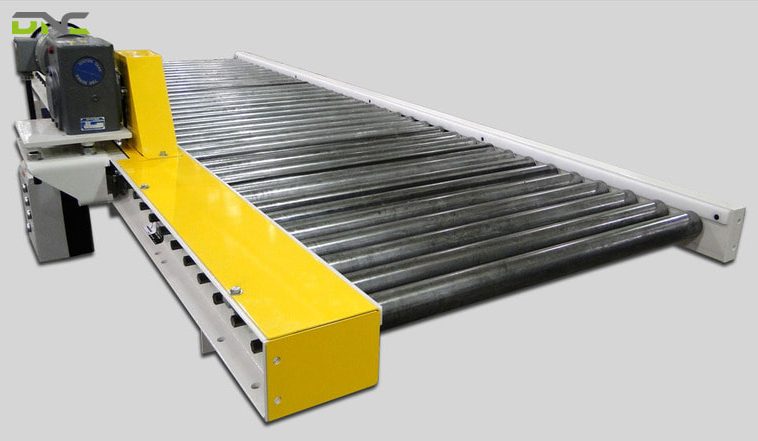
A chain roller conveyor (formally: Chain Driven Live Roller conveyor, or CDLR) powers each roller individually through a continuous roller chain running beneath the conveyor frame — connecting every roller sprocket in sequence. This positive chain drive makes every roller an active drive element, capable of transporting heavy unit loads (pallets, drums, castings, containers) that would stall belt-under-roller or O-ring driven conveyors.
CDLR conveyors are the standard for heavy-load powered roller transport in Malaysian automotive manufacturing, warehouse pallet handling, drum and container movement, and foundry operations — where loads from 500 kg to 5,000 kg per unit require positive roller drive without slip or belt degradation.
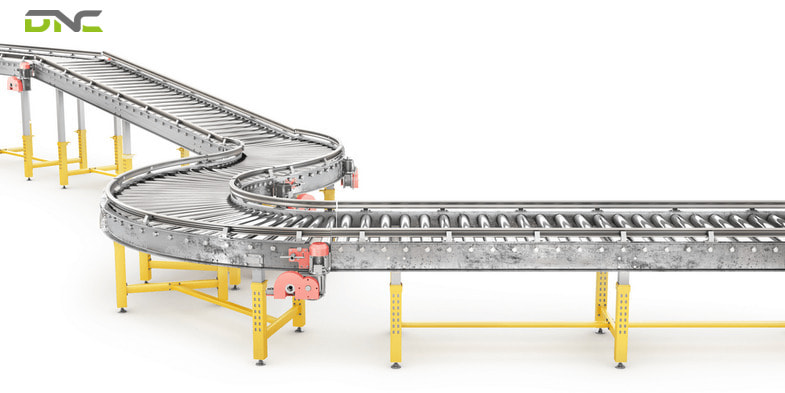
How Chain Driven Live Roller Conveyors Work
A single roller chain (or multiple parallel chains on wide conveyors) runs in a loop below the conveyor frame. A small sprocket on each roller shaft engages with the chain. As the chain moves, every sprocket — and every roller — turns at the chain speed. The rollers in contact with the pallet or product bottom generate friction that advances the load along the conveyor.
Drive options:
- End drive: Single drive unit at the head or tail — chain runs the full conveyor length engaging all rollers. Simple, economical, but high chain tension over long runs.
- Under-drive (belly-drive): Drive unit positioned under the middle of the conveyor frame — chain runs in two directions from the centre, reducing maximum chain tension. Required for long conveyor sections (>8 m) or high load applications.
- Zone drive: Multiple independent chain drive sections — each with its own motor and chain run — enabling accumulation zones where individual sections can stop while others continue.
CDLR Types
Standard CDLR (Medium Duty)
1.9″ (48 mm) diameter rollers at 4.5″ (114 mm) centres. ANSI #40 or #50 roller chain. Frame: 7-gauge (4.8 mm) steel channel.
Load capacity: Up to 500 kg per section; 200 kg per pallet maximum for sustained operation.
Best for: Drums (200L standard oil drums), medium totes, empty pallet returns, automotive sub-assembly components.
Heavy Duty CDLR
2.5″ (63 mm) or 2.9″ (73 mm) diameter rollers at 4.5″–6″ centres. ANSI #60 roller chain. Frame: 5-gauge (5.6 mm) or 3-gauge (6.4 mm) steel channel.
Load capacity: 500–2,000 kg per pallet.
Best for: Loaded pallets, heavy automotive parts (engine blocks, transmissions), steel coils, heavy industrial containers.
Extra Heavy Duty CDLR
3.5″ (89 mm) diameter rollers or larger. ANSI #60 or #80 chain. Heavy structural steel frame. Additional rollers between chain-driven rollers for product support.
Load capacity: 2,000–5,000 kg per unit.
Best for: Steel coil handling, heavy machinery, large castings, automotive body and powertrain systems.
Accumulation CDLR (Zone-Controlled)
Each zone (typically 1.5–3 m) has its own independent drive motor and chain. A photo sensor at the zone exit detects whether the downstream zone is occupied. If occupied, the upstream zone motor stops (zero velocity accumulation) — products queue without pressure.
Key difference from MDR ZPA: CDLR accumulation zones use chain and fixed rollers with zone motor stop/start control — not individual MDR motors per roller. Stopping response time is slower than MDR (1–3 seconds) but load capacity is much higher.
Applications: Pallet buffer accumulation at automated pick stations, pallet accumulation before stretch wrapper or palletiser, automotive body accumulation buffer before paint booth.
How Chain Driven Live Roller Conveyors Work
Roller Specifications
Roller Diameter Selection
Larger diameter rollers:
- Distribute pallet load over larger contact surface → lower product marking
- Rotate at lower RPM for the same belt speed → longer bearing life
- Support heavier loads at the same roller-to-roller span
Selection guide:
- 1.9″ (48 mm): Medium products, 50–200 kg/pallet
- 2.5″ (63 mm): Heavy products, 200–1,000 kg/pallet; standard for loaded pallet conveying
- 3.5″ (89 mm): Extra heavy or high-impact zones (forklift drop zones, coil handling)
Roller Spacing (Centres)
Product must be supported by at least 3 rollers simultaneously:
- Minimum product length = 3 × roller centre spacing + safety margin
- Standard spacings: 3″ (76 mm), 4.5″ (114 mm), 6″ (152 mm), 9″ (229 mm), 12″ (305 mm)
For pallet conveying (1,000 × 1,200 mm standard Euro pallet): use 4.5″–6″ (114–152 mm) centres — pallet bottom boards are typically spaced 50–75 mm apart, wider roller spacing may allow pallet boards to fall between rollers.
Roller Wall Thickness
Standard: 3.4 mm (schedule 40) for light-medium duty. Heavy duty: 4.8–6.4 mm (schedule 80) for impact zones and heavy loads.
Impact zones (where loads are dropped by forklift): Specify schedule 80 heavy wall rollers + additional intermediate rollers between standard chain-driven rollers to provide continuous support during impact.
Chain Selection
| Application | Recommended Chain | Breaking Load |
| Light CDLR (<200 kg load) | ANSI #40 (12.7 mm pitch) | 13.9 kN |
| Standard CDLR (200–500 kg) | ANSI #50 (15.875 mm pitch) | 21.8 kN |
| Heavy CDLR (500–2,000 kg) | ANSI #60 (19.05 mm pitch) | 31.8 kN |
| Extra heavy CDLR (>2,000 kg) | ANSI #80 (25.4 mm pitch) | 57.8 kN |
Working load limit = breaking load / 6 (safety factor for conveyor applications).
For CDLR conveyors with high total chain pull (long conveyors with many rollers, heavy loads), verify the accumulated chain pull at the drive sprocket does not exceed the chain WLL.
Lubrication: The Critical Maintenance Item
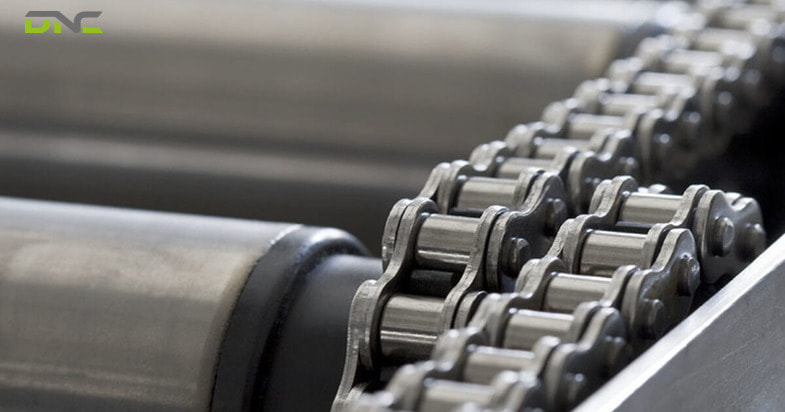
Chain lubrication is the single most important maintenance task for CDLR conveyors. Dry chain wear at ANSI #60 generates approximately 3× more friction than lubricated chain — dramatically shortening chain and sprocket life and increasing drive motor power consumption.
Lubrication Methods
Manual lubrication: Brush or drip oil applied to chain at defined intervals (daily or weekly for high-cycle conveyors). Simple, low cost, but depends entirely on maintenance discipline. Inconsistent in practice.
Automatic chain oiler (drip oiler): A motorised pump delivers oil drops to the chain at defined intervals automatically. Consistent, low maintenance intervention, adjustable oil rate. Standard on production conveyors.
Oil bath lubrication: Chain runs through an oil bath at the drive unit — provides continuous lubrication on chain that passes through. Effective but messy if chain exits the bath contaminated with product dust.
Oil mist lubrication: Compressed air and oil are mixed into a fine mist and directed at the chain — for enclosed spaces where drip oilers cannot be positioned.
Lubricant selection: Standard industrial chain oil (ISO VG 68–100) for ambient temperature applications. NLGI 1 or 2 grease where drip oil would contaminate the product. NSF H1 food-grade oil for food and pharmaceutical environments.
Lubrication interval: Every 8–40 hours of operation depending on load, speed, and environment. High load + dusty environment = more frequent lubrication.
Lubrication: The Critical Maintenance Item
CDLR vs. Other Heavy-Duty Conveyor Options
| System | Load Capacity | Speed | Accumulation | Product Type | Cost |
| CDLR standard | Up to 2,000 kg | 0.1–0.5 m/s | Zone stop | Pallets, drums | Medium |
| CDLR heavy duty | Up to 5,000 kg | 0.05–0.3 m/s | Zone stop | Heavy pallets, coils | Medium-high |
| Belt conveyor | Up to 500 kg | 0.1–2.0 m/s | No | Light products | Low |
| MDR roller | Up to 500 kg (48V) | 0.1–2.5 m/s | ZPA | Cartons, totes | High |
| Friction live roller | Up to 1,000 kg | 0.1–0.5 m/s | Slip accumulation | Pallets, drums | Medium |
| Drag chain | Bulk | 0.1–0.5 m/s | No | Bulk material | Medium |
CDLR is the best choice when: Product weighs >200 kg per unit, chain drive positive traction is needed (smooth belt would slip on heavy load), oily or contaminated environment (chain more tolerant than belt), heavy accumulation without MDR sensitivity.
Malaysian Industry Applications
Automotive Manufacturing
Toyota (Shah Alam), Perodua (Rawang), Honda (Pegoh), and DRB-Hicom (Pekan) use heavy-duty CDLR conveyors for:
- Engine sub-assembly transport (engine on fixture: 400–800 kg)
- Transmission and drivetrain conveying
- Door and body panel transfer at body shop
- Pallet conveying from stamping press output to body shop
Warehouse and Distribution (Pallet Handling)
Logistics centres in Port Klang, Klang Valley, and Johor Bahru use CDLR pallet conveyors for:
- Goods-in pallet receiving → stretch wrap station → storage
- Pick-and-pack pallet accumulation
- Loading dock outfeed
Drum and Container Handling
Chemical and petroleum product plants (Petronas, Shell, ExxonMobil terminals) use CDLR drum conveyors (200L standard drums at 230 kg each) for drum filling line transport.
Foundry and Heavy Industrial
Metal casting foundries in Kuantan and Pengerang use heavy-duty CDLR (3.5″ rollers, 5,000 kg capacity) for hot casting transport from mould knock-out to cleaning and inspection stations.
Toyota (Shah Alam), Perodua (Rawang), Honda (Pegoh), and DRB-Hicom (Pekan) use heavy-duty CDLR conveyors
Maintenance Schedule
Weekly: Check chain oil level in oiler reservoir; inspect chain for dry links (look for silver-coloured chain in an otherwise dark-oiled chain — indicates dry section); listen for increased chain noise; verify chain tension (should be snug, not sagging excessively).
Monthly: Measure chain elongation at a reference span (10 links) — replace at 2% elongation; inspect roller sprockets for tooth wear (replace at 25% tooth reduction); check roller rotation by hand on unloaded sections.
Quarterly: Drive motor current vs. baseline (increase = chain tension too high or chain worn); chain guard inspection for damage; under-conveyor cleaning (oil and product residue buildup under drive chain reduces chain life).
Annual: Full chain and sprocket replacement at high-cycle sections; roller bearing inspection (hand-spin all rollers, replace grinding ones); drive unit gearbox oil change.
DNC Automation’s Chain Roller Conveyor Solutions
DNC Automation designs and fabricates CDLR chain roller conveyor systems for Malaysian automotive, warehouse, and heavy industrial applications — from standard pallet conveyors to custom heavy-duty systems for castings and coil handling.
Engineering scope: Load analysis, roller and chain sizing, zone accumulation design, Siemens PLC integration with zone stop control and pallet tracking, automatic chain oiler integration, and full steel fabrication.
MIDA SAG: CDLR pallet conveyor systems as part of automated warehouse or production automation investments qualify for MIDA’s Strategic Automation Grant (up to RM 1 million, 50% of qualifying capex).
Contact DNC Automation for CDLR chain roller conveyor specifications and layout design.
Summary
Chain driven live roller (CDLR) conveyors provide heavy-load positive roller drive for pallet, drum, casting, and container transport in environments where belt conveyors and MDR systems cannot match the load requirement. Roller diameter, spacing, and chain size are selected based on unit load weight and floor contact pattern. Chain lubrication is the single most critical maintenance task — dry chain causes 3× faster wear and is the primary cause of premature CDLR failure. For Malaysian automotive, heavy warehouse, and industrial applications with loads from 200 to 5,000 kg, CDLR conveyors are the engineered standard for heavy unit load conveying.
- 125 views
- 0 Comment
Recent Comments