


Mobile Pallet Racking System: Cost, Layout & Space Savings Guide
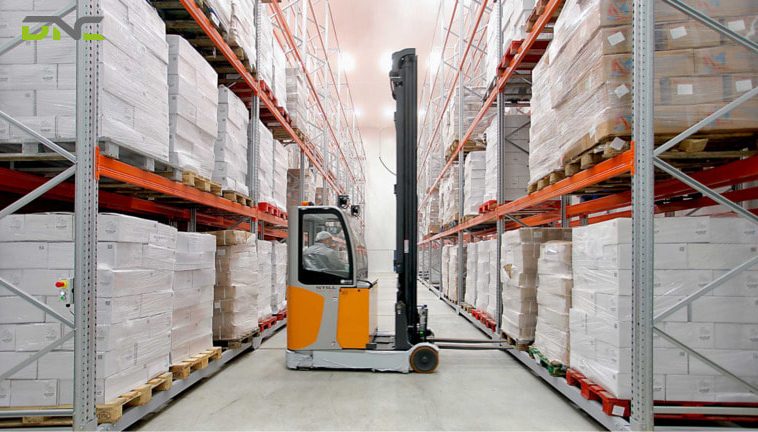
Mobile pallet racking systems mount standard selective racks on motorised bases that glide laterally along floor rails — eliminating all but one working aisle and achieving up to 90% floor utilisation. For Malaysian cold room operators paying RM 3,000–5,000 per square metre in construction costs, mobile racking’s 40–50% space reduction versus selective racking translates to RM 1,000,000–3,000,000 in avoided facility expansion. This guide covers the mechanical design, cost structure, layout optimisation, ROI modelling, and application data that warehouse managers need to evaluate mobile racking against competing high-density systems. DNC Automation integrates mobile racking solutions with WMS, IoT sensors, and safety systems — engineering installations that maximise density without compromising access speed or operator safety.
What Is a Mobile Pallet Racking System?
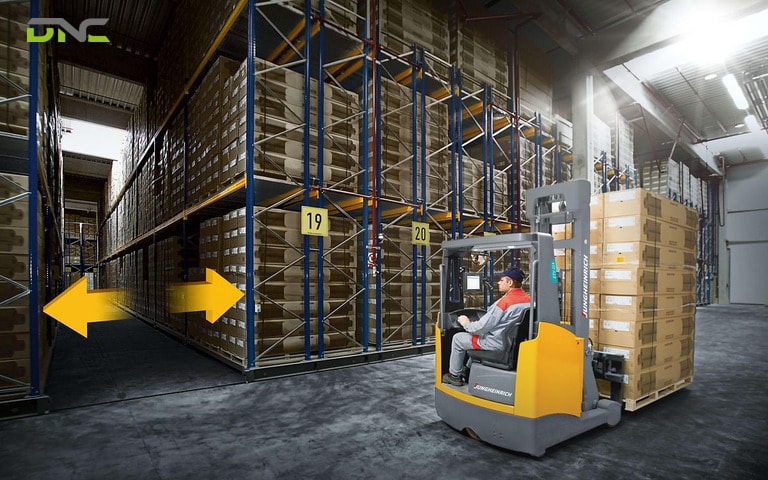
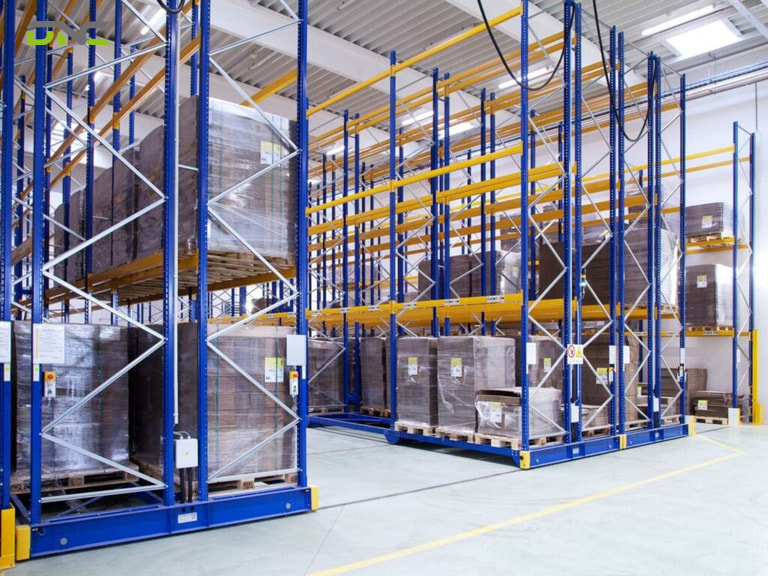
Mobile pallet racking — also called movable pallet racking — is a high-density storage system where conventional rack rows are mounted on powered bases that move laterally along floor-embedded rails. When the operator needs to access a specific rack row, they command the system (via control panel, remote control, or WMS interface) to open an aisle at that location. The adjacent rack bases glide apart, creating a standard-width working aisle. All other aisles remain closed, compressing the storage block to maximum density.
The key engineering principle: a conventional selective racking layout dedicates 45–50% of floor area to aisles. Mobile racking retains only one open aisle at a time — reducing aisle allocation to approximately 10% of floor area. This recovers 35–40 percentage points of floor space for additional storage, translating directly into 80–100% more pallet positions within the same building footprint.
Mobile racking preserves 100% selectivity when the aisle is open — every pallet is directly accessible, exactly as in a standard selective rack. This combination of maximum density with full selectivity distinguishes mobile racking from all other high-density systems: drive-in sacrifices selectivity; shuttle limits access to channel-based retrieval; pallet flow restricts access to the pick face only.
The system originated in archival storage (libraries, government records) in the 1960s and scaled to pallet-weight applications in the 1980s with advances in electric motor drives and floor rail engineering. In Malaysia, mobile racking adoption has accelerated since 2015, driven by rising cold room construction costs, NIMP 2030 smart factory incentives, and warehouse rental inflation in Selangor and Johor industrial zones.
How Does a Mobile Pallet Racking System Work?
Mobile racking operates through the coordinated movement of multiple rack bases along a shared rail system. The mechanical, electrical, and safety systems work together to open aisles on demand while protecting operators and inventory.
Base Drive System
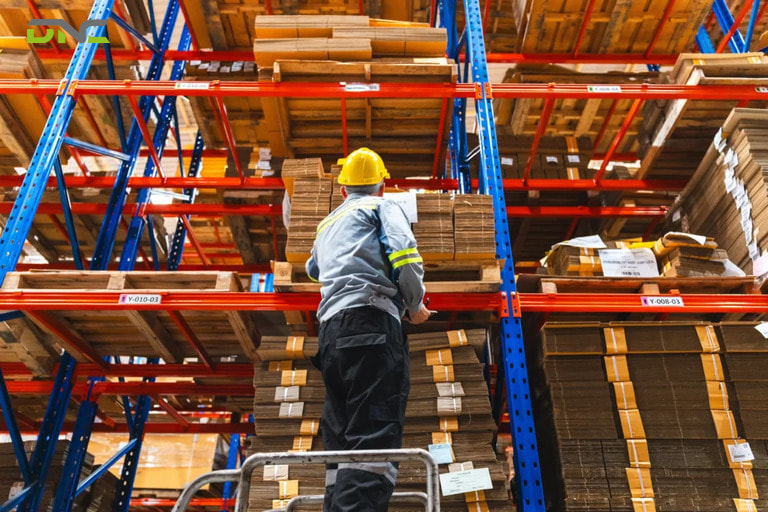
Each rack row sits on a steel base frame equipped with electric motors driving rubber-tyred or steel wheels along floor rails. Standard configurations use one or two motors per base (depending on rack length and total load), powered by 380V three-phase electrical supply. Motor power ranges from 0.37 kW for light-duty bases to 2.2 kW for heavy-duty cold room installations carrying 100+ tonnes per base.
Base travel speed is typically 4–6 m/min — fast enough to open an aisle in 15–30 seconds but slow enough for operator safety. Variable frequency drives (VFDs) provide smooth acceleration and deceleration, preventing load shift and reducing mechanical wear. DNC Automation specifies Siemens VFDs for mobile racking projects — leveraging our strategic Siemens partnership for proven drive reliability.
Floor Rail System
Steel guide rails embedded in (or mounted on) the warehouse floor provide the travel path for each mobile base. Rail profiles are typically hot-rolled C-channel or I-beam sections bolted to the concrete slab at 600–900 mm intervals. Floor rail installation requires precise levelling — maximum tolerance ±2 mm over 3 metres — to prevent base binding and uneven wear.
Rail load capacity must support the total weight of the rack base plus stored inventory. A single rail supporting a 40-metre rack row carrying 150 tonnes (rack + pallets) generates concentrated rail loads of 2.5–4.0 tonnes per linear metre. Floor slab design must accommodate these concentrated loads — typically requiring 200 mm+ reinforced concrete versus the 150 mm minimum for static racking.
Aisle Opening Command
Operators command aisle opening through three interface options:
Push-button control panel mounted on each rack end. The operator presses the aisle number, and the system calculates which bases need to move (and in which direction) to open that aisle. This is the standard interface for manually operated mobile racking.
Remote control (handheld RF unit) allows operators to command aisle opening from the forklift seat — reducing dismount-and-walk time by 30–60 seconds per access cycle. Practical for warehouses with 10+ mobile rack rows.
WMS-integrated automatic opening connects the mobile racking controller to the warehouse management system. When the WMS assigns a pick location, it automatically commands the mobile racking to open the required aisle before the forklift arrives — reducing wait time to near zero. DNC Automation integrates mobile racking with SAP EWM and custom WMS platforms for this zero-wait-time operation.
Safety Systems
Mobile racking incorporates multiple safety layers to prevent personnel injury during base movement:
Floor-level light curtains (photoelectric sensors) scan the aisle entrance for obstructions. If any object or person is detected, the system halts immediately. Light curtain height covers the full operator working zone (0–2,100 mm).
Pressure-sensitive floor strips across the aisle entrance trigger an emergency stop when stepped on — a redundant safety layer independent of the photoelectric system.
End-of-travel limit switches prevent bases from travelling beyond their designated range, protecting end walls and adjacent equipment.
Motor overload protection stops movement if the drive encounters unexpected resistance — indicating an obstruction, rail blockage, or mechanical failure.
Emergency stop buttons on every control panel and at aisle entry points provide manual override.
These safety systems comply with EN 15095 (movable storage systems) and DOSH workplace safety requirements. DNC Automation specifies redundant safety systems for every mobile racking project — single-point safety failures must not create personnel risk.
Types of Mobile Pallet Racking Configurations
Standard Electric Mobile Racking
Standard configuration: electric motor drives, floor-embedded rails, push-button or remote control operation. Suitable for ambient warehouse temperatures (10–45°C). Base capacity 50–200 tonnes per base depending on rack length and height.
Cold Room Mobile Racking
Cold room installations require: IP65-rated motors with low-temperature lubricants (operating range –30°C to +5°C), stainless steel or galvanised rail components, heated control panels, and cold-rated safety sensors. The rack structure uses hot-dip galvanised frames — standard powder-coated frames corrode within 3–5 years in cold room condensation cycles.
Cold room mobile racking is the highest-value application in Malaysia. Cold room floor space costs RM 3,000–5,000/m² to build (insulated panels, refrigeration plant, reinforced floor) plus RM 150–300/m²/year in energy costs. Mobile racking’s 40–50% floor area reduction generates the fastest ROI in this environment.
Semi-Automated Mobile Racking
Semi-automated configurations integrate mobile racking with shuttle carts or mini-load systems operating within the mobile rack structure. The mobile base opens the aisle; the shuttle or automated system handles pallet placement and retrieval within the rack. This hybrid approach bridges the gap between manual mobile racking and full AS/RS.
Powered Mobile with Seismic Bracing
For East Malaysian installations (Sabah — Malaysia’s only seismic zone), mobile racking bases incorporate seismic locks that engage during earth tremor detection. Accelerometers mounted on the base structure trigger automatic locking, preventing uncontrolled base movement during seismic events. Frame bracing patterns also differ — K-bracing replaces X-bracing for superior lateral force resistance.
Types of Mobile Pallet Racking Configurations
Key Components of a Mobile Racking System
Mobile Bases
Steel fabricated platforms carrying the rack structure. Base dimensions match the rack row footprint — typically 1,200–1,400 mm wide × rack length (10–50 m). Base steel gauge: 5–8 mm plate with reinforcing ribs at rail wheel contact points. Weight: 500–2,000 kg per base (empty), plus rack and pallet load.
Drive Motors and VFDs
AC electric motors (0.37–2.2 kW) with VFD speed control. Motor count: 1–2 per base depending on base length and load. Motor protection rating: IP54 minimum (IP65 for cold room). Drive chain or gear coupling connects motor to wheel axle.
Floor Rails
Hot-rolled steel C-channel or I-beam profiles. Surface-mounted rails bolt to the floor slab; flush-mounted rails sit in floor channels with a level-surface finish. Rail length: cut to match base travel distance plus overrun buffer (200–300 mm per end). Material: carbon steel with zinc plating (standard) or stainless steel (food-grade/cold room).
Control System
PLC-based controller managing base movement sequences, safety interlocks, and optional WMS communication. Standard protocol: Profinet or Modbus TCP for WMS integration. Display: touch-screen HMI at each aisle end showing system status, aisle availability, and diagnostic information.
Racking Structure
Standard selective racking (frames, beams, connectors, safety accessories) mounted on the mobile bases. Rack specifications are identical to static selective racking — any compatible frame-and-beam system works. The mobile base engineering accommodates the rack’s point loads through reinforced base plate mounting.
Applications: Where Mobile Racking Serves Malaysian Industries
Applications: Where Mobile Racking Serves Malaysian Industries
Cold Chain and Frozen Storage
Mobile racking dominates Malaysian cold room installations for frozen food (seafood, poultry, ice cream), chilled distribution (dairy, fresh produce), and pharmaceutical cold chain. Companies like Ramly Burger, QL Resources, and cold chain 3PLs use mobile racking to maximise storage within existing cold room footprints.
ROI data from Malaysian cold room projects: A 3,000-position cold room using selective racking requires 8,000 m² floor area. The same 3,000 positions in mobile racking require 4,800 m². Floor area saved: 3,200 m² × RM 4,000/m² construction cost = RM 12,800,000 avoided construction cost. Annual energy saving: 3,200 m² × RM 200/m²/year = RM 640,000/year. Against a mobile racking premium of RM 2,000,000–3,000,000 over selective, ROI occurs within the first year of operation.
Pharmaceutical Storage
GDP-compliant pharmaceutical warehouses require segregated temperature zones (ambient, 2–8°C, –20°C) with batch traceability and validated temperature mapping. Mobile racking maximises storage within each temperature zone — critical because each zone requires independent refrigeration and monitoring infrastructure. Pharmaceutical distributors in Selangor and Penang use mobile racking to consolidate temperature zones into smaller, more efficiently controlled footprints.
Archive and Document Storage
Government agencies, banks, and legal firms store physical records in climate-controlled archives where mobile racking’s extreme density (up to 90% floor utilisation) reduces facility size requirements. While not a pallet-scale application, the technology and supplier ecosystem are identical.
High-Value Goods Warehousing
Electronics, luxury goods, and aerospace components stored in security-controlled warehouses benefit from mobile racking’s closed-aisle configuration — aisles open only when accessed, providing an additional physical security layer. Access logging through the control system creates an audit trail of which aisles were opened, when, and by whom.
Industrial Manufacturing (Buffer Storage)
Automotive and electronics manufacturers use mobile racking for production buffer storage — WIP (Work in Progress) and finished goods staging between production lines and shipping. The density advantage is most valuable when manufacturing floor space carries a premium opportunity cost — every square metre used for storage is a square metre not available for production.
Benefits of Mobile Pallet Racking
Up to 90% floor utilisation — the highest of any racking system. Mobile racking eliminates all but one working aisle, recovering 35–40% of floor area versus selective racking.
100% selectivity retained. When the aisle is open, every pallet is directly accessible — identical to selective racking. No selectivity compromise versus high-density alternatives like drive-in (low selectivity) or shuttle (channel-based selectivity).
40–50% reduction in cold room footprint. For Malaysian cold rooms at RM 3,000–5,000/m² construction cost, this translates to millions of ringgit in avoided capital expenditure.
Energy cost reduction. Smaller refrigerated footprint = lower refrigeration plant capacity = lower energy consumption. Cold room mobile racking reduces annual energy costs by RM 150–300 per square metre saved.
FIFO and LIFO flexibility. Mobile racking supports both stock rotation methods — the rack rows are standard selective, so any pallet can be accessed in any sequence when the aisle is open.
Physical security. Closed aisles provide a barrier against unauthorised access. Access control integration logs every aisle opening — valuable for pharmaceutical, defence, and high-value inventory storage.
Automation-ready. Mobile racking integrates with WMS for automatic aisle pre-opening, AGV-compatible aisle dimensions, and sensor-based inventory tracking at every rack position.
Benefits of Mobile Pallet Racking
Mobile Pallet Racking System Cost in Malaysia
Capital Cost Breakdown
| Component | Cost Range (RM) | Notes |
| Racking structure | 350–600/position | Same as selective racking |
| Mobile base (per row) | 25,000–80,000 | Depends on row length and load |
| Floor rails (installed) | 150–300/linear metre | Including floor preparation |
| Control system (per block) | 30,000–80,000 | PLC + HMI + safety sensors |
| Safety systems | 15,000–40,000/block | Light curtains, floor strips, e-stops |
| Installation | 15–20% of hardware | Includes commissioning |
| Total per position | RM 1,200–2,500 | All-inclusive installed cost |
Cost vs. Selective Racking
For a 2,000-position warehouse:
- Selective: 2,000 × RM 500 = RM 1,000,000 | Floor: 5,000 m²
- Mobile: 2,000 × RM 1,800 = RM 3,600,000 | Floor: 3,000 m²
Additional mobile cost: RM 2,600,000
Floor saved: 2,000 m²
ROI Scenarios
Ambient warehouse (RM 3.50/sq ft rent):
- Annual floor cost saved: 2,000 m² × RM 37.67/m²/month × 12 = RM 904,080/year
- ROI: 2.9 years
Cold room (RM 4,000/m² build cost):
- Construction cost avoided: 2,000 m² × RM 4,000 = RM 8,000,000
- Annual energy saved: 2,000 m² × RM 200/year = RM 400,000/year
- ROI: Less than 6 months (construction savings alone exceed mobile premium)
Conclusion: Mobile racking ROI is strongest in cold rooms and premium-rent facilities. For standard ambient warehouses with available expansion land, the 3-year ROI may not justify the premium over selective racking — unless future expansion costs are factored in.
How to Specify a Mobile Racking System
Floor Load Assessment
Mobile racking concentrates loads along rail lines — creating higher point loads than static racking. Standard requirements: 200 mm+ reinforced concrete slab, 50 kN/m² minimum floor loading, and ±2 mm flatness tolerance over 3 m. DNC Automation includes floor core sampling and load calculation in every mobile racking project scope.
Base Sizing
Base dimensions must accommodate the rack row footprint plus clearance for wheel assemblies and drive motors. Base travel distance determines rail length — typically 1,200–1,400 mm per base plus one aisle width (3,000–3,500 mm).
Motor and Drive Selection
Motor power depends on total base load (rack + pallets) and desired travel speed. Rule of thumb: 0.5 kW per 50 tonnes of base load at 5 m/min travel speed. Cold room applications require oversized motors (add 20–30%) to compensate for increased friction from cold-temperature lubricants.
Safety System Specification
Minimum: floor-level photoelectric light curtains + end-of-travel switches + emergency stop buttons. Recommended additions: pressure-sensitive floor strips, motor overload protection, and aisle-occupied indicator lights visible from adjacent rows.
WMS Integration
For maximum operational efficiency, integrate the mobile racking controller with your WMS. The WMS sends aisle-open commands before the forklift arrives — eliminating the 15–30 second wait time for manual aisle opening. Integration protocols: Profinet (Siemens PLCs), Modbus TCP, or OPC-UA. DNC Automation’s control system engineers handle WMS integration as part of the project scope.
How to Specify a Mobile Racking System
FAQ — Mobile Pallet Racking System
What is a mobile pallet racking system?
A mobile pallet racking system mounts conventional selective racks on motorised bases that travel laterally along floor rails. Only one working aisle opens at a time — the operator commands the system to open the required aisle, and the adjacent bases move apart. This eliminates multiple fixed aisles, achieving up to 90% floor utilisation while maintaining 100% pallet selectivity when the aisle is open.
How much does mobile pallet racking cost in Malaysia?
Mobile pallet racking costs RM 1,200–2,500 per pallet position fully installed — approximately 2.5–4× the cost of standard selective racking. The premium covers mobile bases (RM 25,000–80,000 per row), floor rails (RM 150–300/linear metre), control systems (RM 30,000–80,000 per block), and safety systems (RM 15,000–40,000 per block). ROI typically occurs within 6 months for cold rooms and 2–3 years for ambient warehouses.
Is mobile racking worth the cost for cold rooms?
Mobile racking delivers the strongest ROI in cold room applications. Cold room construction costs RM 3,000–5,000/m² (insulation, refrigeration, reinforced floor). A 2,000-position cold room using mobile racking requires 2,000 m² less floor area than selective racking — avoiding RM 6,000,000–10,000,000 in construction costs. The mobile racking premium of RM 2,000,000–3,000,000 is recovered before the facility opens. Annual energy savings of RM 300,000–600,000 further strengthen the case.
How fast does mobile racking open an aisle?
Standard mobile racking bases travel at 4–6 metres per minute. Opening a single aisle typically takes 15–30 seconds depending on the number of bases that need to move and the total travel distance. WMS-integrated systems pre-open aisles before the forklift arrives — reducing effective wait time to near zero during normal picking operations.
Can mobile racking support FIFO stock rotation?
Mobile racking supports both FIFO and LIFO because the mounted rack rows are standard selective racking with 100% selectivity. When the aisle is open, any pallet can be accessed in any order — identical to conventional selective racking. WMS-directed picking enforces FIFO sequencing by guiding operators to the oldest batch position, regardless of physical location.
What safety features does mobile racking include?
Standard safety features: floor-level photoelectric light curtains (detecting objects/persons in the aisle), end-of-travel limit switches, emergency stop buttons on every control panel and aisle entry, and motor overload protection. Optional additions: pressure-sensitive floor strips (redundant personnel detection), aisle-occupied indicator lights, and access control integration (keycard/PIN required to open aisles). These systems comply with EN 15095 and DOSH workplace safety requirements.
How long does mobile racking installation take?
A 1,000-position mobile racking system takes 20–30 working days to install — including floor rail preparation, base assembly, rack erection, electrical connection, safety system commissioning, and testing. This is 50–70% longer than equivalent selective racking installation due to floor rail work and electrical commissioning. DNC Automation minimises on-site time through factory pre-assembly of mobile bases and rack sections.
Can existing selective racking be converted to mobile?
Conversion is possible if the existing rack components (frames, beams, connectors) are structurally compatible with mobile base mounting. The process involves dismounting racks, installing floor rails and mobile bases, remounting racks on the bases, and adding control and safety systems. Conversion costs 60–70% of a new mobile installation — saving 30–40% versus buying entirely new mobile racking. DNC Automation assesses existing racking compatibility before recommending conversion versus new installation.
Conclusion
Mobile pallet racking systems deliver the highest storage density of any selective-access racking solution — achieving 90% floor utilisation while retaining the 100% pallet selectivity that other high-density systems sacrifice. For Malaysian cold room operators, pharmaceutical warehouses, and premium-cost facilities, mobile racking’s space savings generate ROI within months rather than years.
DNC Automation engineers mobile racking solutions with Siemens-driven control systems, comprehensive safety packages, and WMS integration — ensuring every installation meets EN 15095, DOSH compliance, and operational performance targets. Our 35+ engineers handle every phase from floor load assessment through commissioning, and our 25,000 sq ft facility supports factory pre-assembly that reduces on-site installation time.
- 87 views
- 0 Comment
Recent Comments