


PP Strap vs PET Strap | DNC Automation
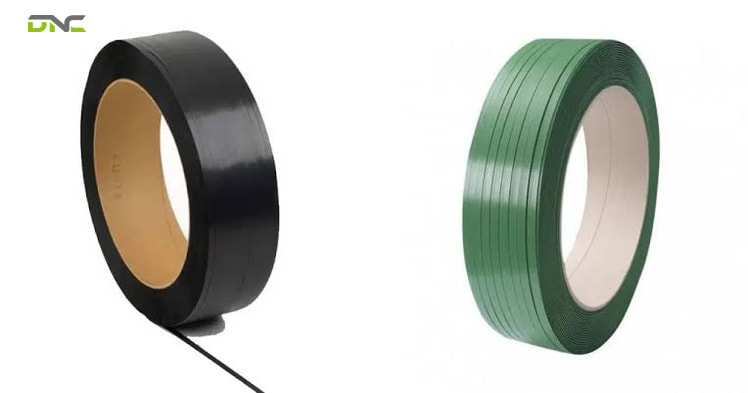
PP strap is polypropylene; PET strap is polyethylene terephthalate, a polyester. The two coils look identical on the pallet rack and behave differently the moment tension goes on. Polypropylene stretches, absorbs shock and then relaxes, which suits cartons and bundles that move quickly through a controlled indoor line. Polyester stretches far less and holds what it was tensioned to, which is why it replaces steel strap on bricks, timber and metal coils bound for export. Load weight and storage conditions decide most of that comparison, and every material chart on the subject stops there. ASTM D3950 does not: the standard verifies breaking strength and joint strength as two separate properties, because the closure – a friction weld, a heat weld, or a metal seal – carries the load, and a strapping head is built for one strap or the other.
PP and PET Differ in One Property That Produces All the Others
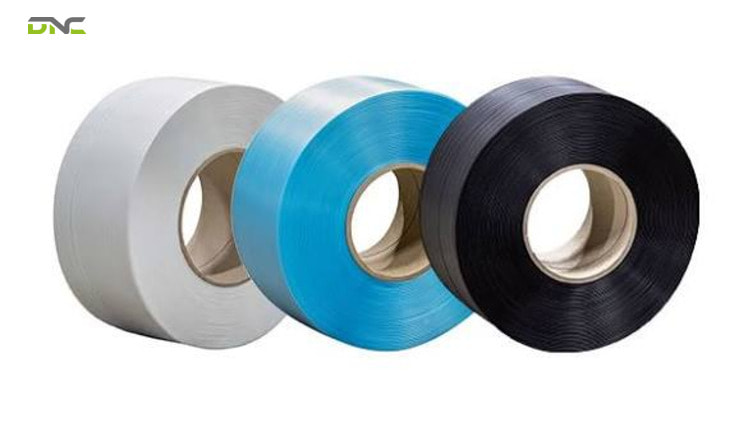
Elongation is the property that separates polypropylene strapping from polyester strapping, and every other difference between them follows from it. Polypropylene is a low-density thermoplastic with long, loosely packed chains that extend under tension. Polyethylene terephthalate is a denser polyester whose chains resist that extension. Stretch under load and relaxation after load are the same behaviour observed at two timescales, so a strap forgiving enough to absorb a knock in transit is also the strap that goes slack once the knock is over.
The specification figures published across the strapping supply trade fall into a consistent pattern, summarised below.
| Property | PP strap (polypropylene) | PET strap (polyester) |
| Tensile strength | Roughly 54–272 kg (120–600 lb) as published by the strapping supply trade | Up to roughly 1814 kg (4000 lb / 1.8 tonne), comparable with steel strap |
| Secured load | Up to about 400 kg (880 lb / 0.4 tonne) | 520 kg at 25 mm width, rising to about 960 kg |
| Elongation | 14–50% depending on grade and measurement basis | 10–20% |
| Tension retention | Loses about half of applied tension within 1–2 hours | Holds through vibration and extended storage |
| Service temperature | Degrades under UV and sustained heat | Stable from about −30 °C to 80 °C (−22 °F to 176 °F) |
| Common widths | 5, 8, 11, 12, 15, 16 mm; 12–19 mm most specified | Supplied against the same width families |
| Resin code | #5 | #1 |
Those numbers describe the strap on a test bench. What they do not describe is the closure that has to transmit them, which is where the comparison usually goes wrong.
PP and PET Differ in One Property That Produces All the Others
Load Weight Sets the Shortlist, Strap Width Sets the Number
Load weight is the first specification variable, and the threshold the trade converges on is around 136 kg (300 lb / 0.14 tonne) – above it, Greenbridge puts the load on polyester. Below that, polypropylene handles cartons, printed matter, home appliances, furniture, ceramic tiles, and food and beverage secondary packaging. Above it sit the rigid loads: bricks, timber, steel coils, construction materials, and palletised freight going into a container.
The figure that matters is not the polymer, though. Of every capacity claim published on this topic, only one attaches a width to the number – 520 kg at 25 mm – and that is the correct form. Break strength is a function of width, thickness and grade. A 5 mm polypropylene strap and a 16 mm polypropylene strap are the same polymer and are not the same specification, which is why “we use PP” tells an engineer almost nothing about what a pallet is rated to carry.
Load weight also sets nothing about how long the load stays strapped, and that is the second variable.
A PP Strap Applied Too Early Reaches the Truck Already Slack
A PP strap sheds roughly half of its applied tension within one to two hours, which is why a pallet strapped too early reaches the truck slack, according to Alliance Packaging Group’s published comparison. Read that as a clock rather than a material property. One to two hours is shorter than most buffer steps, shorter than a staging bay wait, and far shorter than an overnight hold before a morning collection.
The consequence is a line-layout decision that no strapping comparison states. A pallet strapped in polypropylene at a station upstream of an accumulation conveyor system arrives at the loading bay with a fraction of the tension the operator set. The same strap applied at the last station before dispatch arrives tight. Where the strapping head sits on the line is therefore part of the material decision, not a separate layout question – and if the head cannot be moved, the material has to change to polyester.
Dwell time before dispatch is one clock; time in storage and transit is the other.
Ultraviolet and Heat, Not Moisture, Are Where PP Gives Out
Ultraviolet exposure and sustained heat are the two conditions that degrade polypropylene strapping, and it is worth being precise about that, because polypropylene resists chemicals and moisture perfectly well. A yard-stored pallet under Malaysian sun is a UV problem. A damp warehouse, on its own, is not.
Polyester holds its rated performance across roughly −30 °C to 80 °C (−22 °F to 176 °F) and resists UV and moisture together, which is why it is the default on anything stored outdoors or shipped by sea. Malaysian exporters running containers to Europe or North America are combining every condition that favours polyester at once: weeks of transit, temperature cycling inside a steel box, and a rigid load that will not forgive tension loss.
Environment and load between them look like a complete answer. They are not, because both describe the strap and neither describes the joint.
The Joint Sets the Ceiling, Not the Strap
The joint sets the load ceiling because a strapped pallet is held by its closure, and that closure is rated separately from the strap itself. ASTM D3950, the specification covering nonmetallic strapping and joining methods, classifies strapping into five types by material and requires conformance to breaking strength and elongation, transverse strength, and joint strength – four properties, not one. The standard treats the seal as a verified component because it is the point that fails.
Joint efficiency expresses that as a percentage of the strap’s own break strength, and the accepted benchmark is 75%. Friction welding on polyester routinely exceeds it. A metal seal closure typically delivers under half of the strap’s rated strength. Put those figures against the material table above and the ranking inverts: a 1814 kg (4000 lb / 1.8 tonne) polyester strap closed with a metal seal transmits under 900 kg, while a 272 kg polypropylene strap friction welded at 75% transmits about 204 kg of its 272 kg. The polyester still wins that particular pairing – but the strap alone accounted for a 6.7× advantage, and the closure gave most of it back.
DNC’s engineers specify the head and the consumable in the same document for exactly this reason. A load rating derived from a strap datasheet, with no joint figure behind it, is a number the pallet has never been asked to deliver.
Which closure a line can use is not an open choice, and that is where the strap meets the machine.
The Joint Sets the Ceiling, Not the Strap
Surface Finish Is a Machine Interface, Not a Cosmetic Option
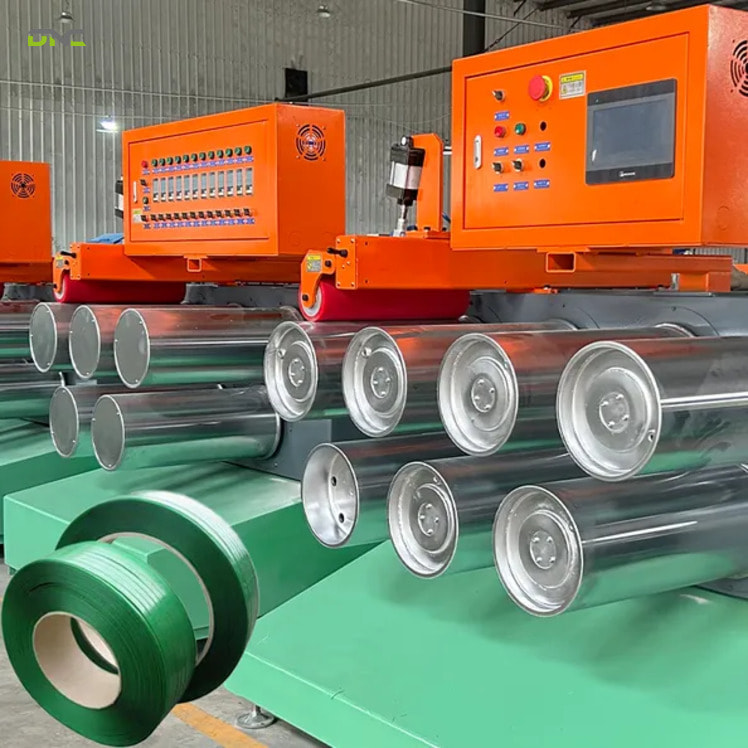
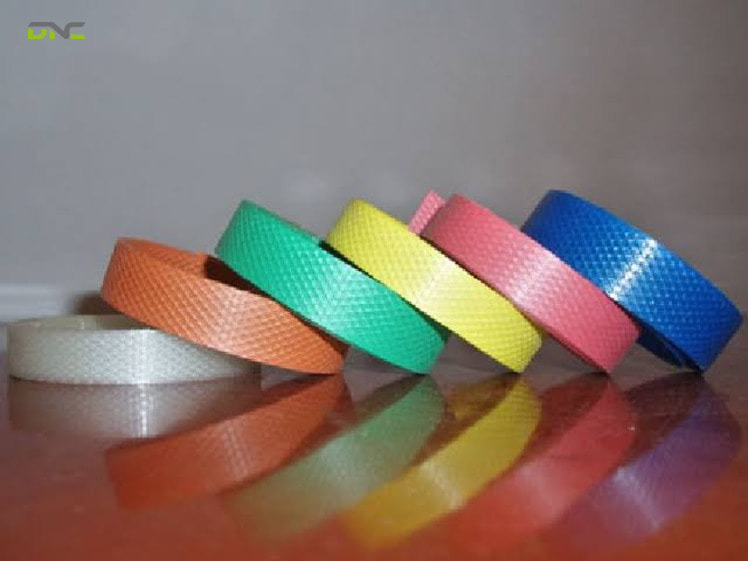
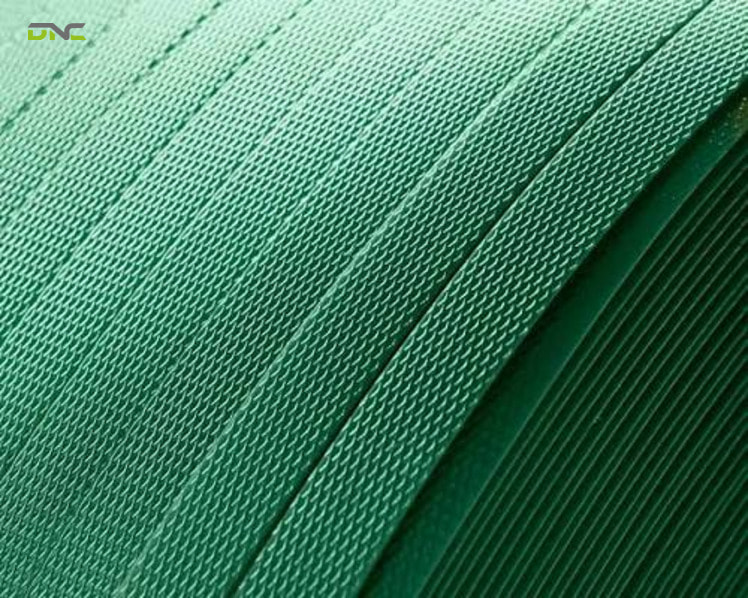
Surface finish determines which sealing method a strap will accept, and the mechanism is straightforward: friction welding generates heat by abrading two strap faces against each other, and a smooth face slips instead of heating. Embossing gives the weld something to work against. The pairings the supply trade publishes are consistent:
- Embossed polypropylene seals well under friction weld tooling; flat-finish polypropylene is specified for heat seal equipment.
- Embossed polyester runs with friction weld or notch-and-seal tools.
- Smooth polyester is made for heat seal heads.
- Recycled-content polyester is available up to 100% post-consumer, in the same finish families.
This is why polypropylene and polyester are not interchangeable on one machine. Every supplier states the incompatibility and stops; the reason is that the head, not the strap, is the fixed asset. Greenbridge’s own field service intake makes the coupling explicit – before its technicians will diagnose a fault, the form demands machine type, head type, and strap being used as three separate mandatory fields. A manufacturer’s service desk does not ask for information it can infer.
Polyester also runs better in high-speed automatic heads, which matters on any line where strapping is integrated with palletising rather than performed by hand. Where a robotic cell handles the load, the strap specification is fixed at the same time as the robotic solutions cell layout, because retrofitting a different head into a commissioned cell is a mechanical change, not a purchasing one.
Head type settles the seal method. The room it stands in settles how well that seal performs.
A Heat Weld Behaves Differently on an Unconditioned Floor
Heat weld quality varies with ambient temperature, which makes the seal method an environmental specification rather than a preference. As the surrounding temperature fluctuates, the thermoelectric plates in a heat seal head carry heat variances that show up as weld abnormalities, and the outer edges of those plates distribute heat less evenly than the centre. Friction welding has no equivalent failure mode.
For a Malaysian plant, that is a live distinction. A conditioned pharmaceutical or electronics packing hall holds a heat weld head at a stable operating point. An open production floor with roller shutters up does not. Two facilities can buy the same head, the same coil and the same tension setting, and get a different joint out of them – an outcome that shows up as intermittent transit failures rather than an obvious machine fault, which is the hardest kind to trace.
That variability is one reason DNC’s engineers default to friction weld heads on unconditioned lines, and it is the kind of constraint that belongs in the specification rather than in the commissioning report.
A Heat Weld Behaves Differently on an Unconditioned Floor
Summary: The Comparison in the Order an Engineer Meets It
This comparison resolves, in the order an engineer meets it, into a sequence rather than a verdict. Load weight and rigidity narrow the choice, with roughly 136 kg (300 lb / 0.14 tonne) as the crossover into polyester. Dwell time before dispatch tests whether polypropylene’s one-to-two-hour tension decay survives the distance between the strapping head and the loading bay. Storage and transit conditions remove polypropylene wherever ultraviolet exposure or temperature cycling is involved. The joint then fixes what the load is genuinely rated to hold, since a metal seal transmits under half the strap’s break strength while a friction weld exceeds 75% of it. The head that forms that joint – and the surface finish it demands – is the constraint that decides whether the strap the load needs is the strap the line can run.
A Purchase Order Specifies Width, Thickness and Grade – Not a Polymer
Strapping is specified by four parameters together: material, width, thickness and grade. Hand grade and machine grade exist in both polymers and are not substitutes – machine grade is built for the tension and feed cycle of automated equipment, hand grade for manual tensioners.
Published elongation figures make the case for reading the grade datasheet rather than a comparison chart. One supplier’s comparison table gives polypropylene elongation as 14–50%; another manufacturer’s product tables state “smaller than 20%” across every grade from 5 mm to 12 mm. Both cannot describe the same measurement, and they almost certainly do not – one is elongation at break, the other a production tolerance. A specification written off either number, without knowing which, is guessing.
Two practical rules are worth holding to:
- Take capacity and elongation from the datasheet of the grade being purchased, not from a PP-versus-PET table.
- Match width and thickness to product weight, and hold the tension setting below the strap’s rating – over-tensioning snaps a correctly chosen strap as readily as an undersized one.
Specification discipline controls performance. Cost is the argument that usually overrides it.
A Purchase Order Specifies Width, Thickness and Grade – Not a Polymer
Total Cost of Ownership Has an Unmodelled Machine Term
Polypropylene carries the lower unit price and polyester the lower total cost on demanding loads, and the trade states that inversion consistently: a low-cost strap that loses tension mid-transit and forces re-strapping costs more than a higher-priced strap that holds from warehouse to destination. Against steel, the case is stronger still – polyester delivers four times the linear footage of steel for the same weight, which Alliance Packaging Group puts at a 30–50% reduction in raw material spend.
The term missing from every one of those models is the head. Switching material can mean a different sealing method, and a different sealing method means a different head – capital equipment, not consumables. A total cost comparison that prices coils and re-strapping labour while treating the machine as fixed has left out the only line item large enough to change the answer. For Malaysian manufacturers building an automation case under NIMP 2030 incentives, that term belongs in the capital request, alongside the smart manufacturing controls the line will run on.
Cost decides the purchase. Resin code decides what happens to the strap afterwards.
PP and PET Leave the Plant Through Different Recycling Streams
Polypropylene strapping carries resin code #5 and polyester strapping resin code #1, so the two materials leave a facility through separate streams. Polyester is accepted at most recycling centres and holds the higher recycling value; polypropylene requires cleaning of contaminants and a facility that takes the resin.
Treat that as a floor-level segregation task rather than an environmental credential. A plant running both materials – which is normal, since light and heavy lines rarely share a strap – needs two collection points and an operator habit to match, or the recyclable fraction is contaminated before it leaves the building.
Frequently Asked Questions
The questions below come up in strapping enquiries, and every answer returns to the joint rather than to the strap. Breaking strength is a property of the material; the load ceiling is set where the strap closes on itself.
Can PP and PET strapping run on the same machine?
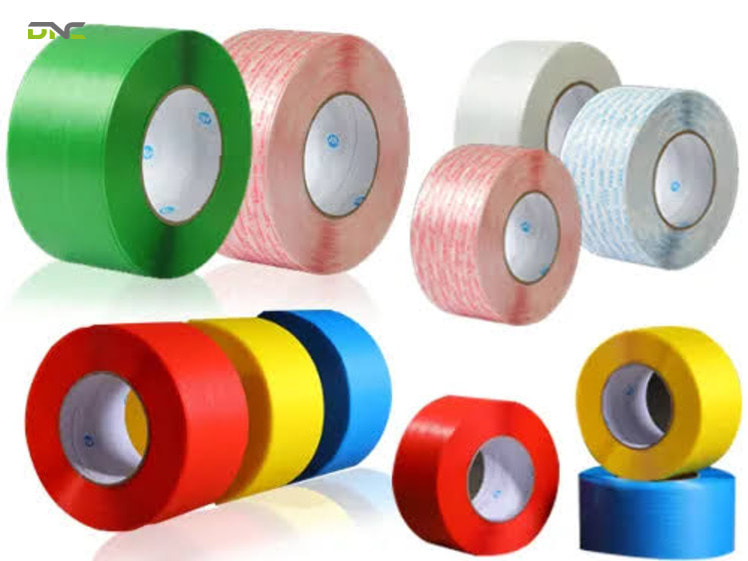
PP and PET strapping do not run on the same machine without a head change. The sealing method is what differs, not just the strap: friction weld tooling needs an embossed surface to generate heat by abrasion, while heat seal equipment is built for a smooth finish. Confirm head compatibility before ordering a different material – the coil is the inexpensive half of that decision.
Is PET strapping a true replacement for steel strapping?
PET strapping is an accepted replacement for steel strapping on most palletised loads. Polyester matches steel on load retention without the sharp edges, rust risk or handling hazard, and it delivers four times the linear footage per unit weight. Loads with sharp corners or extreme point loading still need review against the specific grade rather than a general substitution.
How much tension does PP strapping actually lose?
PP strapping loses about half of its applied tension within one to two hours, on the supplier figures cited above. The relevant question is what happens to the pallet during those two hours – a load dispatched immediately is unaffected, while a load held overnight in a staging bay is not.
Which strap is stronger, PP or PET?
PET strap is stronger than PP strap by a wide margin on the strap itself – up to roughly 1814 kg (4000 lb / 1.8 tonne) against 54-272 kg for polypropylene. The joint changes the working answer, because a metal seal transmits under half the strap’s rating while a friction weld exceeds 75% of it.
What does ASTM D3950 cover?
ASTM D3950 covers nonmetallic strapping and joining methods for closing, reinforcing and bundling articles for shipment, unitizing and palletizing. It classifies strapping into five types by material and requires conformance to breaking strength and elongation, transverse strength, and joint strength – which is why joint efficiency belongs in a strap specification.
Can PP and PET strapping run on the same machine?
Specifying Strap Material for Your Packaging Line
Specifying strap material resolves into four decisions taken in order, not a choice between two polymers. Load weight and rigidity set the shortlist, with roughly 136 kg (300 lb) as the crossover point. Dwell time before dispatch decides whether polypropylene’s one-to-two-hour tension decay is survivable at the station where the head sits. Storage and transit conditions rule polypropylene out wherever UV exposure or temperature cycling is involved. The joint then sets what any of it is actually rated to hold – and the head that makes that joint, along with the surface finish it demands and the ambient temperature it works in, is the constraint that decides whether the strap the load needs is the strap the line can run.
DNC Automation engineers, supplies and commissions strapping machines, stretch wrapping machines and robotic palletising lines for Malaysian manufacturers, specifying the head, the seal method and the consumable as one set rather than three purchases. If your line is running a strap material your head was not built for, talk to our engineers about what that is costing at the loading bay.
- 21 views
- 0 Comment
Recent Comments