


Food Grade Stainless Conveyor: Construction, Standards and Line Fit
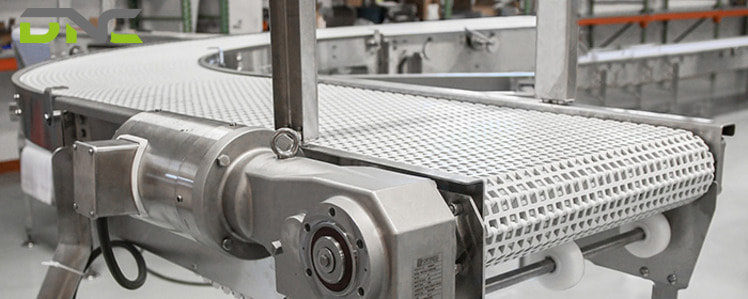
A food grade stainless conveyor is a conveyor built with a stainless steel frame — commonly 304 or 316 grade — specifically for environments where corrosion resistance, cleanability and contamination control decide whether a line passes a hygiene audit. The frame material is only the starting point: how that frame is joined, radiused and kept clear of moving components is what actually determines whether the conveyor can be washed down daily without failing early. Manufacturers researched for this article specify against named standards — FDA and USDA materials rules, 3-A Sanitary Standards, GFSI components like BRC and SQF — rather than leaving hygiene to the frame material alone. DNC Automation integrates food grade stainless conveyors as part of its DNX-CV line on Malaysian food and beverage production lines, where the same construction choices also decide whether a downstream checkweigher keeps reading accurately.
What Is a Food Grade Stainless Conveyor?
A food grade stainless conveyor is a conveyor whose frame — and, depending on the model, its supports, bearings housings and drive components — is built from stainless steel specifically to meet hygiene and corrosion-resistance requirements in food, beverage and pharmaceutical processing. The stainless frame is what separates it from a standard mild-steel or aluminium conveyor: stainless resists the corrosion that repeated washdown, cleaning chemicals and food acids would otherwise cause, and its smooth, non-porous surface does not harbour bacteria the way a painted or coated frame can once the coating is scratched.
Frame material alone does not make a conveyor food grade, though. A stainless frame with sharp internal corners, exposed bearings sitting in the product path, or a bolted joint that traps residue will fail a hygiene inspection regardless of what the frame is made of. That is why food-grade specification is really two decisions bundled together: the material (stainless steel, and which grade), and the construction method that determines whether the frame is actually easy to clean.
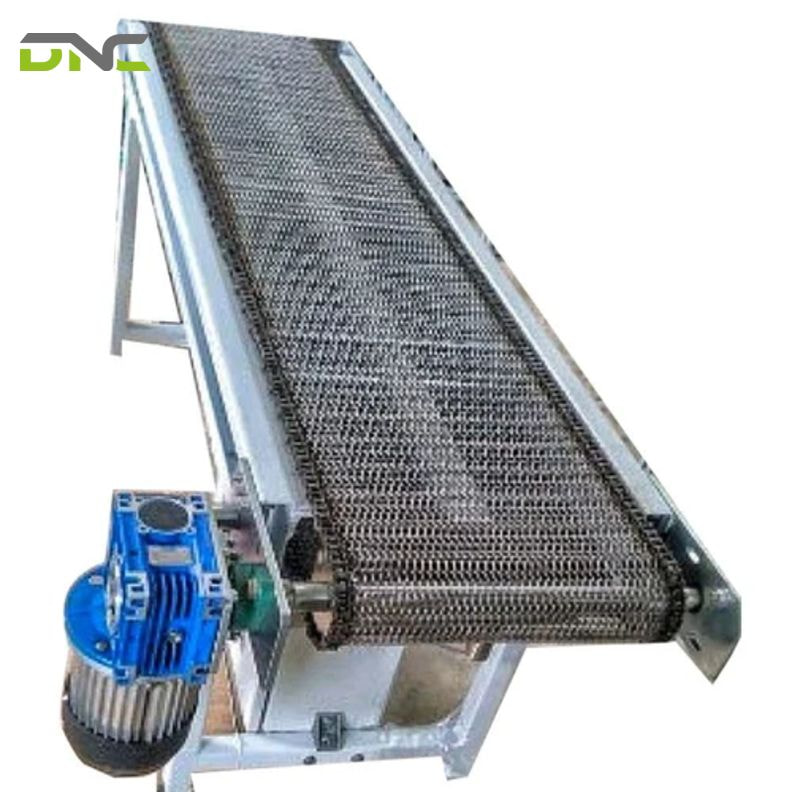
where-can-you-buy-reputable-stainless-steel-conveyor-belts
Which Stainless Steel Grade Does a Food Grade Conveyor Use?
Food grade stainless conveyors most commonly use 304 or 316 stainless steel for the frame, supports and structural components. 304 is the more widely specified grade for general food-contact framing; 316 adds molybdenum for extra corrosion resistance and is typically reserved for higher-corrosion environments — heavy chloride exposure from washdown chemicals, or coastal/humid conditions, both relevant on a Malaysian production line. Component-level parts, such as roller end caps, are also available in the same 304L/316L family alongside non-food-grade carbon steel grades used elsewhere in general material handling — the “L” suffix marking a lower-carbon variant chosen to reduce weld-decay risk on welded assemblies.
Grade selection is a cost-and-environment trade-off, not a fixed rule: 304 covers most dry or lightly washed-down applications at a lower material cost, while 316 is worth specifying wherever the conveyor sits inside a frequent wet-washdown zone or handles a corrosive product (brined, acidic, or high-salt foods). Getting this choice right up front avoids a conveyor that looks correctly specified on paper but pits or stains within a year of continuous washdown — a mistake in the material decision that no amount of correct hygienic-design construction can fix afterward.
What Makes a Conveyor’s Construction Hygienic, Not Just Its Frame Material?
Hygienic construction on a food grade stainless conveyor comes down to eliminating catch points — the joints, corners and component placements where product residue, moisture and bacteria accumulate undetected between cleanings. Two construction approaches cover most of the market: continuous-weld construction, where frame seams are fully welded rather than bolted, giving a fully washdown-rated, tool-less-disassembly conveyor built for daily high-pressure cleaning; and open-frame, bolt-together construction, designed for frequent washdown rather than continuous submersion, which trades some of the continuous-weld tier’s cleanability for lower cost and easier field reconfiguration.
Beyond the joint method, hygienic construction shows up in several specific, checkable details. Internal radii at frame joints are built to a standard minimum — commonly around 6 mm (0.24 in / 0.6 cm) — specifically so a cleaning brush or washdown spray reaches the corner instead of leaving a sharp internal angle residue hides in. Bearings and other moving components sit external to the frame; one researched supplier’s own spec keeps them at least 25 mm (0.98 in / 2.5 cm) clear of the product-contact zone, rather than inside it where a bearing seal failure could contaminate product directly. Support feet use sealed, threadless designs rather than threaded fasteners that trap residue at the base. And visible surfaces are polished to a fine, consistent finish — one researched supplier specifies 32 microinch (0.8 micron / 0.0008 mm) on internal frame components — fine enough that residue has nowhere to lodge and rinses clear under normal washdown pressure.
What Belting and Surface Materials Are Used on Food Grade Conveyors?
Frame finish is only half of what touches the product — the belt or surface it rides on is the other half, and it is specified as its own decision. Food grade stainless conveyors run a range of belting materials, chosen for the product and the cleaning regime rather than the frame material itself. PVC suits general-purpose handling at lower cost; rubber grips heavier or oilier products; plastic modular belting gives the easiest cleaning and tightest transfers between conveyor sections; urethane resists cuts and abrasion in heavy-duty use; and wire mesh lets air through the belt for draining, cooling, freezing or cooking applications. Modular plastic belting is built from interlocking sections, which is what lets a damaged section be replaced without swapping the entire belt run.
Belting choice is specified independently of the frame’s stainless grade, but both are held to the same regulatory bar: belting materials researched for this article are described as FDA-approved, meeting the same food-contact-safety requirement the stainless frame itself is chosen to satisfy. A conveyor with a correctly specified 316 stainless frame and non-food-safe belting fails the same hygiene requirement a mild-steel frame would — the belt and the frame are not independent decisions in practice, even though they are specified as separate line items.

What Belting and Surface Materials Are Used on Food Grade Conveyors?
Which Named Standards Does a Food Grade Conveyor Need to Meet?
Frame material, construction method and belting only add up to a genuinely food-grade conveyor if all three are checked against the same named standards, not each supplier’s own version of a food-safe claim. A general food-safe claim does not tell a buyer which specific requirement the conveyor was actually built to satisfy. FDA and USDA rules govern which materials and lubricants contact food, or sit close enough to risk incidental contact. 3-A Sanitary Standards set construction requirements specifically for belting and chain. The Global Food Safety Initiative’s component standards — BRC, SQF, FSSC 22000 — cover the wider hygiene management system a plant certifies against, not just the equipment. And the Food Safety Modernization Act’s equipment requirement is built around hygienic design principles, easy disassembly for cleaning, and FDA-approved materials as the compliance mechanism, rather than a single pass/fail test.
One detail worth specifying explicitly rather than assuming: lubricant classification. Food-contact lubricants fall into an H1 or H2 category depending on whether incidental food contact is possible at the lubrication point — H1 where contact is possible, H2 where it is not — and a conveyor’s own lubrication points need to be checked against this classification individually, since a single conveyor can have both types depending on where each lubricated component sits relative to the product path. A buyer asking a supplier “which standards is this built against, and which lubricant class at each point” gets a specific, checkable answer; asking only “is this food safe” does not.
So Far: What Decides Whether a Conveyor Is Actually Food Grade?
A food grade stainless conveyor is really three stacked decisions, not one. The frame material — 304 for most dry or lightly washed applications, 316 where washdown chemicals or corrosive product justify the extra cost — sets the corrosion-resistance baseline. The construction method — continuous-weld for full washdown duty, open-frame bolt-together for frequent but lighter washdown — decides whether that stainless frame is actually cleanable in practice, through details like joint radii, bearing placement and support-foot design. And the belting, specified independently but held to the same FDA-approval bar as the frame, completes the product-contact surface. Getting any one of the three wrong — the right grade on a badly welded frame, or a hygienic frame with non-food-safe belting — still produces a conveyor that fails the hygiene requirement the other two decisions were correctly aimed at. What still needs answering is which conveyor configuration actually fits a given process step, and what a food grade conveyor’s own construction quality means once it feeds into the next station on the line — a checkweigher or inspection point, where DNC’s own line-integration work actually starts.
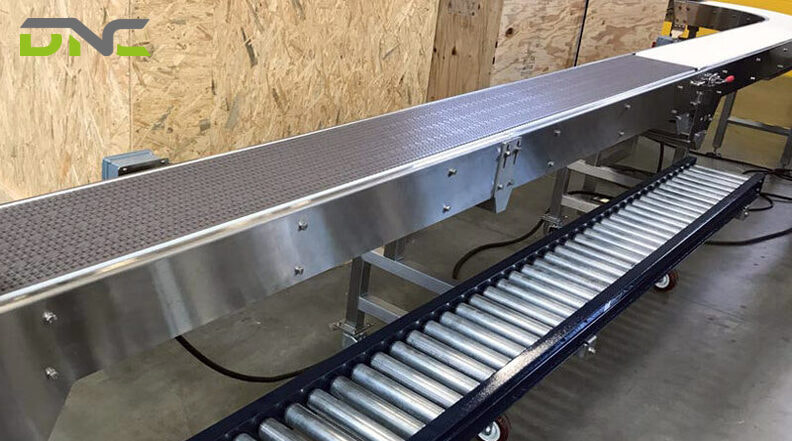
What Decides Whether a Conveyor Is Actually Food Grade?
Which Food Grade Conveyor Type Fits a Given Process Step?
Different food grade stainless conveyor types fit different jobs on a line, and the choice usually follows the product and the transfer, not just the hygiene requirement all of them share.
| Conveyor type | Typical fit | Note |
| Belt conveyor | General product transport, continuous flat run | Widest belting-material choice (PVC, rubber, modular, urethane, wire mesh) |
| Modular belt conveyor | Applications needing easy section replacement or tight transfers | Interlocking plastic modules swap without replacing the full run |
| Roller conveyor, incl. motorized driven roller (MDR) | Packaged or boxed product, not loose/wet product directly on rollers | Stainless MDR units are built specifically for the food-grade tier of this category |
| Tabletop / slat chain conveyor | Bottles, cans, pouches — rigid containers | Runs well through washdown and bottling/labelling zones |
| Rotary accumulation table | Unscrambling and single-filing containers before filling, capping or labeling | A line-transition device, not a transport conveyor — sits between stations |
| Wire mesh / spiral / vibratory / bucket elevator | Specialty needs — draining, cooling, vertical space-saving, bulk grain/powder handling | Narrower range of suppliers offer the full specialty set; confirm availability before specifying |
The pattern across the table is that container geometry and product state decide the type before hygiene does — a belt or modular conveyor handles loose or irregular product a roller conveyor cannot, while a roller or MDR conveyor handles rigid packaged goods more efficiently than a belt does. Hygiene requirements then apply across whichever type fits the product, not as a separate filter that eliminates types on their own.
Why Does Conveyor Construction Matter Beyond the Hygiene Audit?
Hygienic conveyor construction is not only a hygiene-audit outcome — it is a precondition for the next station on the line reading correctly, and none of the food-grade conveyor suppliers researched for this article connect their own hygienic-design detail to that downstream consequence. A conveyor that corrodes, pits, or accumulates residue at a weld seam or catch point does not just risk a failed inspection; a corroded or fouled transfer surface changes how a product sits, slides or settles as it crosses into a checkweigher’s weighing zone or an inspection station’s detection window, which is exactly the kind of mechanical inconsistency that undermines a stable in-motion reading. DNC’s own line-integration work already treats a checkweigher’s reject subsystem as something specified against real line constraints rather than picked from a catalogue, precisely because Malaysian food and edible-oil exporters carry the reject record inside their export documentation chain — a bad reading is not just a quality problem, it is a compliance record problem.
That is the practical reason a food-grade conveyor’s hygienic construction and its downstream weighing or inspection accuracy are the same specification decision, not two separate ones, on a line DNC integrates end to end. DNC’s engineers size conveyor systems against the checkweigher station or inspection station they feed, not against the conveyor’s hygiene rating in isolation — a distinction covered in more mechanical detail in How a Checkweigher Works, including how upstream mechanical inconsistency reaches an in-motion weighing reading.
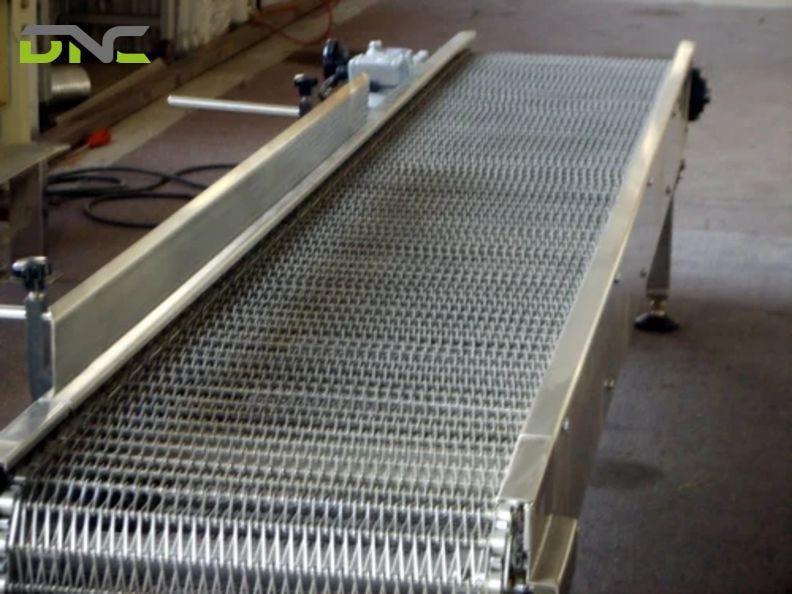
Why Does Conveyor Construction Matter Beyond the Hygiene Audit?
How Does This Apply on a Malaysian Food or Beverage Line?
A food grade stainless conveyor on a Malaysian line carries the same construction requirements covered above, with two local factors that raise the stakes. Humidity accelerates corrosion at any weld seam or joint not built to the continuous-weld or properly radiused standard, and export documentation means a hygiene or accuracy failure downstream is not just an internal quality issue but a record a food or edible-oil exporter has to account for. A conveyor specified on frame material alone, without the construction-method and downstream-integration decisions covered in this article, is the kind of gap that shows up months later as unexplained corrosion or an inspection station that drifts out of calibration for reasons the conveyor’s own spec sheet never flagged.
Food and beverage manufacturing is also one of the industries DNC already integrates end-of-line packaging and palletizing for on Malaysian lines, which is the same context a food grade stainless conveyor typically feeds into — covered from the packaging and palletizing side in Palletizing in the Food & Beverage Industry.
What Do Buyers Ask About Food Grade Stainless Conveyors?
These frequently asked questions about food grade stainless conveyors cover the material, construction and standards details that come up most often once a line moves from choosing a conveyor type to specifying it.
What stainless steel grade should a food grade conveyor use?
304 stainless steel covers most dry or lightly washed-down food applications; 316 stainless steel is worth the added cost where the conveyor sits in a frequent wet-washdown zone or handles a corrosive, high-salt or acidic product.
How Does Continuous-Weld Construction Differ From Open-Frame Construction?
Continuous-weld construction fully welds the frame seams for full washdown duty and tool-less disassembly; open-frame, bolt-together construction is built for frequent but lighter washdown, trading some cleanability for lower cost and easier reconfiguration.
What is the difference between H1 and H2 food-grade lubricants?
H1 lubricants are rated for use where incidental food contact is possible at the lubrication point; H2 lubricants are rated only where no food contact is possible. A single conveyor can need both classifications at different lubrication points.
Does a hygienic conveyor design actually affect checkweigher accuracy?
Yes — a conveyor surface that corrodes, pits, or fouls at a catch point changes how a product sits or moves as it crosses into a checkweigher’s weighing zone, which is the kind of mechanical inconsistency that undermines a stable in-motion reading downstream.
What Do Buyers Ask About Food Grade Stainless Conveyors?
- 16 views
- 0 Comment
Recent Comments