


Piston vs Pump Filling Machine: What Each One Measures
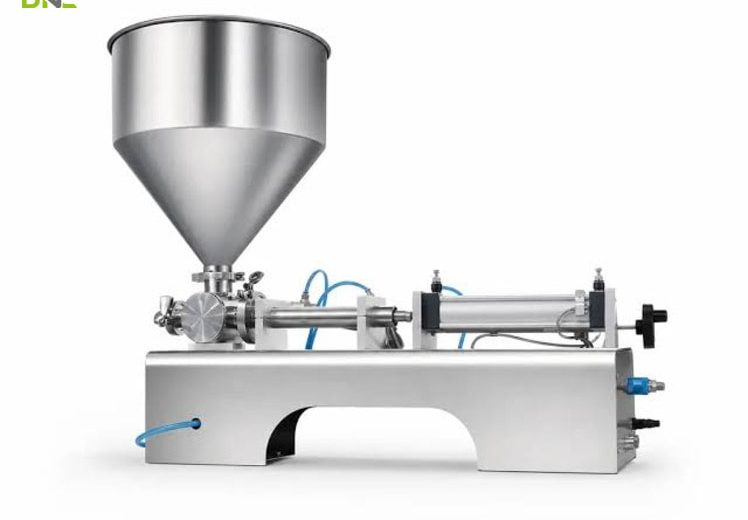
A piston filling machine and a pump filling machine differ in which part of the dose each one defines. A piston fixes the dose geometrically: one stroke sweeps a set volume inside a cylinder, and that volume is settled before the discharge valve opens. A pump fixes a rate instead, so the dose becomes flow multiplied by elapsed time or by a count of revolutions. Both belong to the volumetric family alongside gravity filling, which means both hold volume constant and neither reports mass. Gear, peristaltic, diaphragm and progressive cavity pumps each meter by a different geometry, while a centrifugal pump meters nothing at all. The mass-based alternative is governed by OIML R 61-1:2017, a recommendation that publishes accuracy as a class rather than as a brochure percentage.
What Is the Difference Between a Piston Filling Machine and a Pump Filling Machine?
The difference between a piston filling machine and a pump filling machine is which element defines the dose: the piston is a metering element, the pump is a transfer element. That single distinction generates every operating difference the market compares afterwards.
A metering element decides first. The quantity is fixed before product moves. Accutek Packaging describes piston filling machines as “volumetric systems designed to deliver a measured amount of product into each container using positive displacement”, and Fuluke states the same mechanism as “a reciprocating piston inside a cylinder to draw a set volume of product, then dispense it into a container”. Nothing about elapsed time enters that description. The cylinder bore and the stroke length are the dose.
A transfer element decides differently. It sets a rate, not a quantity. A pump delivers flow, so the machine has to convert that flow into a quantity by running the pump for a controlled interval or a controlled number of revolutions. Filamatic draws the boundary in a definition sentence — piston fillers “use pistons, rather than pumps, to push the product into the containers”, while pump fillers “use different pumps to match your liquid product”.
The consequence lands on what has to stay stable. On a piston route, repeatability is a mechanical question about stroke length and seal integrity. On a pump route, repeatability is a question about whether the delivered quantity per unit of motion is still what it was last month, and that quantity lives in a wearing part. Each element reaches its dose differently. The piston stroke is the shorter to describe.
How Does a Piston Meter a Dose?
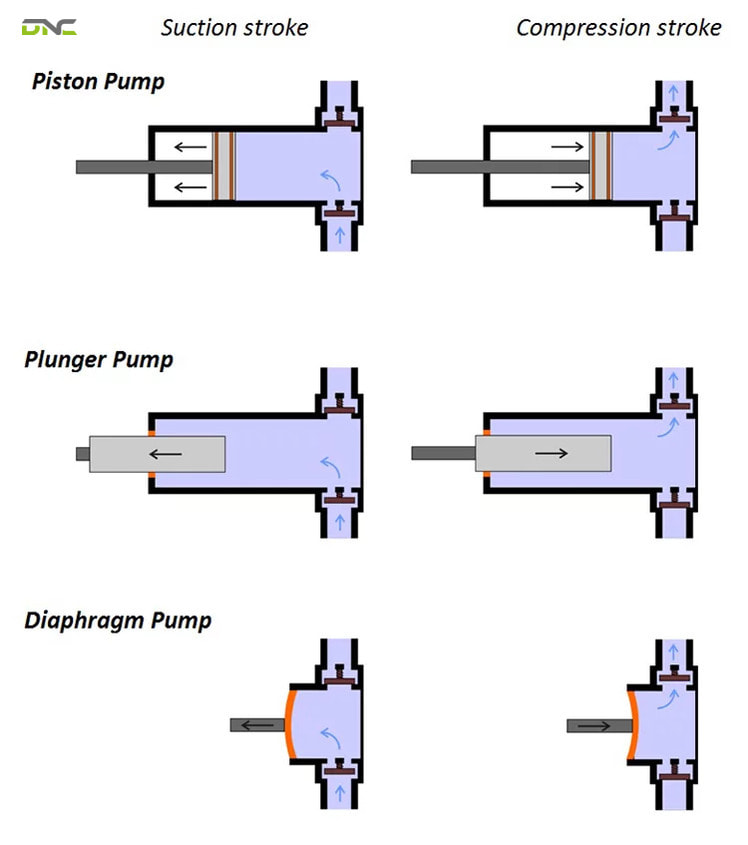
A piston meters a dose by drawing product into a cylinder of known volume and then pushing that same volume out, one dose per stroke. Volumetric Technologies names the five parts that make this work: a hopper holding bulk product, the piston itself, the piston cylinder that “undergoes continuous suction and compression cycles”, a valve regulating flow, and the nozzles directing product into the container.
The cycle runs in two halves. On the intake half, the valve opens toward the hopper and the retracting piston pulls product into the cylinder to a preset stroke position. On the discharge half, the valve rotates to close the hopper port and open the nozzle port, and the advancing piston pushes the trapped volume out. Between those halves the product is enclosed and stationary, which is why the method tolerates thick and irregular material.
Servo drive changes how the stroke is commanded without changing what defines the dose. KWT specifies “volumetric filling system by piston pumps, driven by servo motors” on a machine whose largest dose is 1,000 ml (33.8 fl oz / 1.0 litre / 4.23 cup) and whose smallest is 200 ml, spread across four to twelve nozzles at roughly 50 bottles per minute. The servo makes the stroke programmable and repeatable. The stroke still sets the quantity, which is the part that changes as soon as a rotating pump replaces the cylinder.
How Does a Pump Meter a Dose?
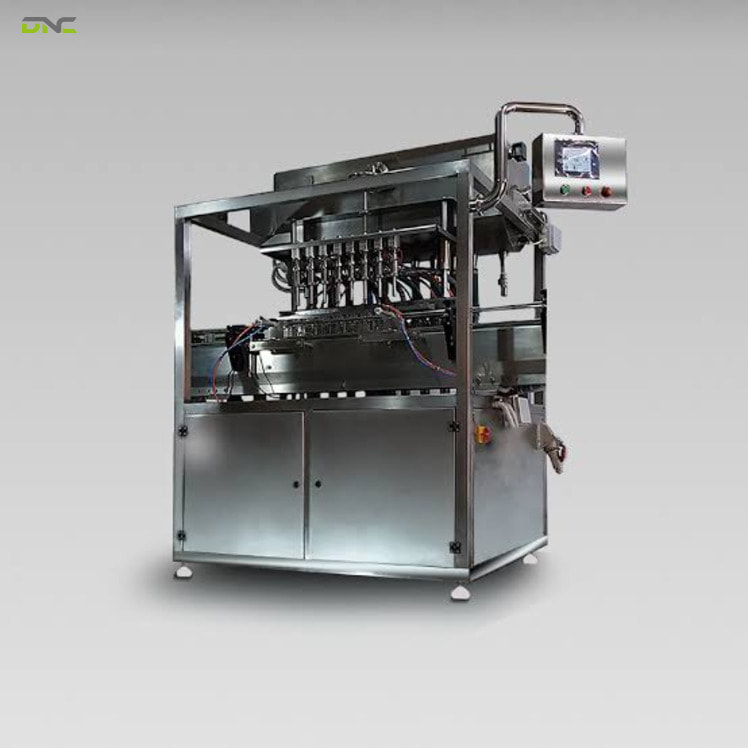
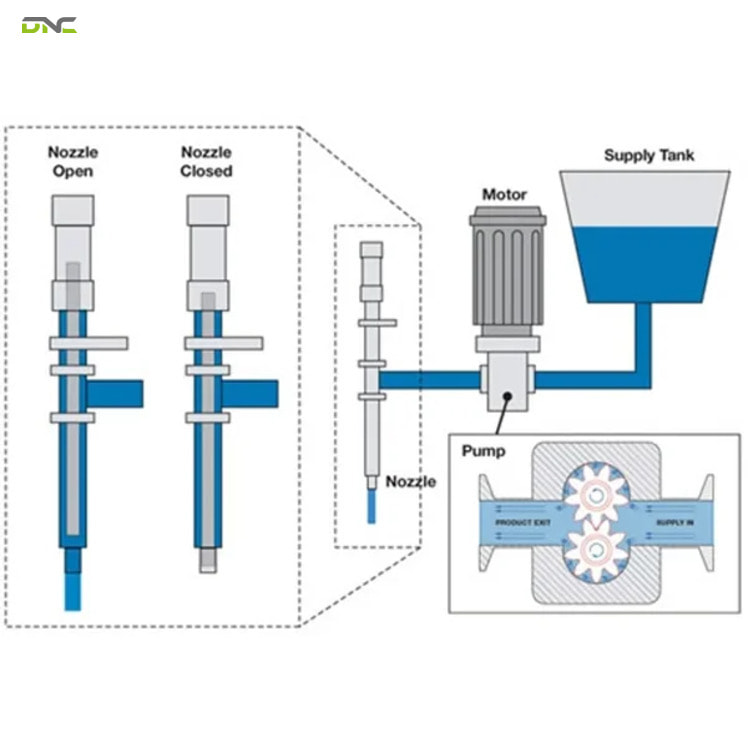
A pump meters a dose by repeating a fixed displacement many times per fill rather than once, which puts the metering geometry inside a moving part. Fuluke groups the family as “gear, diaphragm and progressive cavity pumps”, each carrying “a different balance of flow stability, shear, and material compatibility”, and describes peristaltic pumps as moving fluid “through a flexible tube by sequentially compressing the tube”.
Each of those devices encloses a volume and carries it from inlet to outlet: a tooth space on a gear pump, a chamber on a diaphragm pump, a cavity on a progressive cavity pump, a length of squeezed tube on a peristaltic pump. Counting those events meters the fill. One centrifugal pump breaks the pattern, since it accelerates liquid rather than enclosing it, and Fuluke confines it to “low-viscosity liquids at high speeds”.
That difference matters at specification stage more than at purchase stage. Every positive-displacement pump on the list can be made to meter accurately; the centrifugal one cannot meter unaided, and needs a flow meter, a weigh platform or a level probe to close the loop. In practice the machine label rarely says which of the two situations applies.
How Does a Pump Meter a Dose?
Why Is One Machine Sold as a Piston Pump Filling Machine?
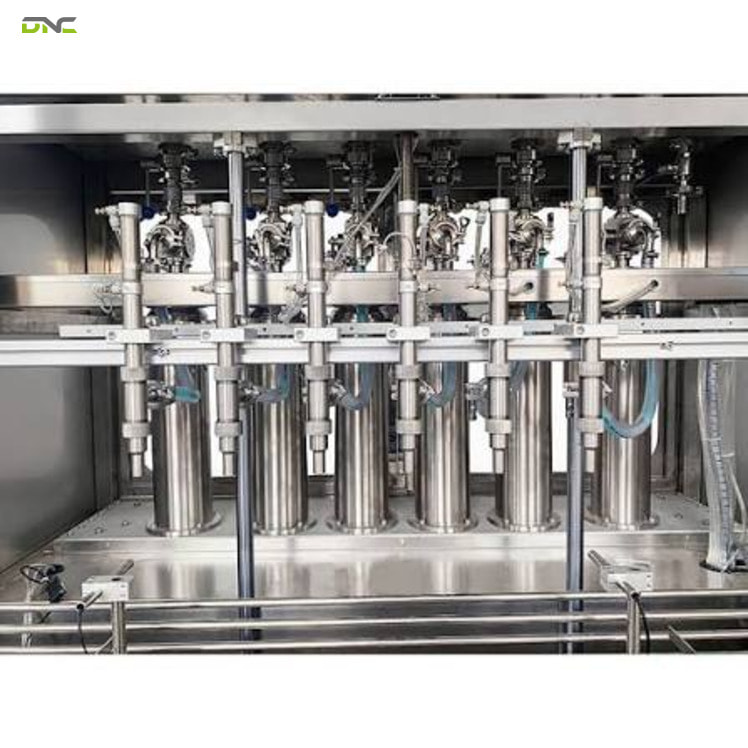
The phrase “piston pump filling machine” describes a device that is genuinely both a pump and a metering chamber at the same time, which is why suppliers disagree about how to classify it. A reciprocating piston moving inside a cylinder between an inlet and an outlet valve satisfies the engineering definition of a positive-displacement pump. The same assembly also satisfies the definition of a metering chamber, because the swept volume is fixed.
Three sources ranking for this piston-versus-pump comparison state three incompatible positions, and each is internally correct.
| Source | Stated position | Why it holds | What it leaves out |
| KWT | The machine is a piston pump filler, described as a “volumetric filling system by piston pumps” | The piston-and-valve assembly pumps product | That the same assembly also fixes the quantity |
| Filamatic | Piston fillers “use pistons, rather than pumps” | The metering function is not shared by rotary pumps | That a reciprocating piston is a pump by construction |
| Fuluke | Piston is its own family, separate from “pump-based fillers” | Piston behaves unlike gear or peristaltic in service | That the separating attribute is discreteness, not the word “pump” |
Reading the three together resolves the contradiction rather than deepening it. All three suppliers are separating the same pair of jobs — moving product and defining quantity — and disagreeing only about which job the word “pump” refers to. An enquiry written in those terms cannot be answered in those terms, and a specification written around what the machine has to hold constant can.
Why Is One Machine Sold as a Piston Pump Filling Machine?
Which Route Handles Which Liquids?
A piston route handles liquids a pump route cannot, and the reverse holds as well — particulates, viscosity and shear sensitivity settle which liquids go where, applied in that order. Lancing UK reaches the same conclusion from the buyer’s side: “a great many filling projects are really decisions about filling principle rather than about a specific machine model.”
Particulates come first. They cut the field rather than rank it. Five of the seven pages ranking for this comparison attach chunk handling to the piston family, and Liquid Packaging Solutions gives the mechanism: “the open cylinder can be used to accommodate products like salsa, salad dressings, soaps and other products that use particulates”. The capability sits in the open chamber and the draw path, not in the piston itself, which is why Accutek accommodates chunky products “with an optional valve and direct-from-drum draw kits”.
Particulates do not remove the whole pump family, and the same source is explicit about it. Positive-displacement pumps trap “a certain amount of product and then force it through the product pathway”, and that trapping action works on solids as well as liquid — “these pumps can trap both product and particulates”. Diaphragm, lobe and vane types therefore stay in contention alongside the piston, while gear and centrifugal routes, which move product through a running clearance, do not. What survives the first cut is the group that encloses product rather than shearing it past a gap.
Viscosity ranks the survivors. Liquid Packaging Solutions publishes a ladder of named products running from water at 70°F (21°C) through motor oils, corn syrup, honey and molasses, then ketchup, tomato paste and peanut butter, up to caulking compound and window putty. A route that fills water comfortably may stall on peanut butter, and the ladder gives a practical way to place a real product between two reference materials rather than arguing about a viscosity figure. Products at the upper end are the reason an automated bottle filling line is specified around the metering head rather than around the conveyor.
Shear sensitivity decides the last of the three. Fuluke rates shear on product as low to medium for piston filling, low for peristaltic, and medium to high for other pump types, noting that “gear pumps can be high”. Emulsions, creams and lotions that break under shear therefore push the shortlist toward the gentle end even when viscosity alone would not. Those three properties rank the routes against the product; the container then decides whether the winning route can still hold its dose band.
Where Does Container Size Change the Answer?
Container size changes the answer by moving the fill out of the band a given head was designed for, and published machine ranges show how wide that band is. Accutek publishes a mini-dose filler covering 0.1 ml to 200 ml (0.003 to 6.8 US fl oz) across eight heads, while KWT publishes 200 ml to 1,000 ml on a bottle 50 mm to 90 mm in diameter (1.97 to 3.54 in) and 120 mm to 300 mm tall (4.72 to 11.81 in).
Larger packs shift the problem again. Filling a drum at 200 L (52.8 gallon / 211 quart / 423 pint) concerns flow rate, splash control and weight capture far more than it concerns cylinder geometry, which is why automatic drum filling is engineered as a separate station rather than as a large version of a bottle filler. Container size is the attribute most often supplied late in an enquiry and most likely to invalidate an earlier recommendation. Accuracy travels the opposite way: it arrives first in every enquiry, as a percentage, and it survives inspection least well.
How Accurate Is Each Route, and What Does the Percentage Actually Mean?
Each piston and pump route publishes an accuracy percentage, and those percentages are not comparable to each other, because none of them states the band the figure applies to. Fuluke publishes typical accuracy as ±0.5–1% achievable for piston filling, ±1–3% for peristaltic filling “dependent on tube wear”, and ±1–5% for other pump-based filling depending on pump type. DNC’s own consistency record carries a separate figure of 3–5% relative to setpoint for volumetric dosing, from a different single source.
Those two published ranges disagree about the same filling activity. Neither states a fill size, neither states whether the filler is newly verified or mid-life, and neither states whether the percentage refers to mass or to volume.
Legal metrology answers all three questions for the weight-based route, and the contrast is instructive. OIML R 61-1:2017 assigns instruments an accuracy class in the form X(x) and publishes maximum permissible deviation as a nine-band staircase against fill size rather than as one figure. For class X(1) at initial verification, permissible deviation runs at 7.2% of the fill below 50 g, 3.6% between 100 g and 200 g, 2.4% between 300 g and 500 g, 1.2% across the band that tops out at 10 kg (10,000 g / 22 lb / 353 oz), and 0.8% above 15 kg (33 lb). In-service limits sit at 1.25 times those figures in every band, and the recommendation also sets a Minfill floor below which the instrument is not considered to be measuring at all.
Read against that structure, a bare “±1%” carries no information about which band, which verification state, or which quantity. A batching and dosing weighing system is specified by class, band and floor for exactly this reason, and the same discipline transfers to filling. Four things about the piston and pump comparison are settled at that point, and one is not.
How Accurate Is Each Route, and What Does the Percentage Actually Mean?
Summary: What Has the Piston and Pump Comparison Settled So Far?
The piston and pump comparison has settled four findings so far. The piston is a metering element and the pump is a transfer element, so the two differ in what defines the dose rather than in quality. The phrase “piston pump filler” is accurate rather than confused, because a reciprocating piston is simultaneously a pump and a metering chamber. Product properties choose the route in a fixed order — particulates cut the field to the enclosing routes, viscosity ranks what is left, shear sensitivity narrows it again — and container size can invalidate the result late. Published accuracy percentages are not comparable across suppliers, since none of them names the fill band, the verification state or the measured quantity, while the legal-metrology structure for weight-based filling names all three. What remains is the quantity itself — whether either route measures the mass a label declares.
Do Piston and Pump Fillers Measure the Mass on Your Label?
Piston and pump fillers do not measure the mass on your label. Both routes hold volume constant, and the declared net content on a Malaysian export pack is normally a mass. Filamatic places both inside the volumetric family in its own taxonomy, alongside gravity filling, and defines the family by the fact that volumetric machines “fill containers with a consistent volume of a liquid product” whatever the container interior does.
Volume and mass are not the same quantity. Bulk density joins them. Nothing inside a cylinder, a gear set or a length of tubing observes density, so a temperature change, a formulation change or entrained air moves the delivered mass while the delivered volume stays exactly where it was set. Bottom-up nozzles address one input to that drift rather than the drift itself: KWT specifies “bottom-up filling nozzles that fill below the liquid surface, reducing foaming and splashing”, which controls entrained air at the container and leaves density unmonitored.
The unmonitored term has to be absorbed somewhere, and it is normally absorbed by overfilling. A margin set wide enough to keep the lightest pack legal is paid on every pack for the life of the line, which makes it an operating cost rather than a one-off engineering allowance.
Weighing closes the loop the volumetric route leaves open. A load cell and indicator converts the filled pack into a mass reading, and a checkweigher system applies that reading to every pack rather than to samples. Notably, one of the pages ranking for this comparison lists “Net Weight Filling Machines” in its own product navigation and never devotes a sentence of body copy to it — the category is acknowledged across the market and left undescribed. Whichever route ends up on the line, what that route costs to keep running is decided by a different part again.
What Does Each Route Cost to Keep Running?
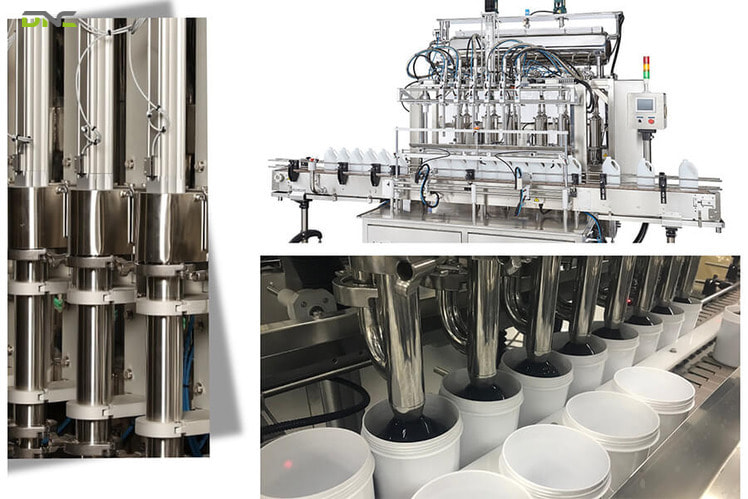
A piston route and a pump route cost different amounts to keep running, and the difference sits in which wearing part carries the metering geometry. Fuluke states the consumables directly — “tubing for peristaltic pumps, seals for piston pumps” — and warns that “a lower upfront cost pump may incur higher labor and replacement costs over time”.
The two wear events differ in kind. On a peristaltic route the tube bore is the metering geometry, so wearing it changes the dose, which is why Fuluke observes that “tubing wear may gradually affect volume” and recommends a replacement schedule to preserve accuracy. On a piston route the stroke length remains mechanically fixed as seals age; a worn seal leaks past a dose that is still geometrically defined, producing a different failure signature that shows up as loss rather than as drift.
Contact materials and cleaning regime carry the rest of the cost. Fuluke notes 316L stainless steel for corrosion resistance in cosmetic and pharmaceutical machinery with 304 common in less aggressive environments, and KWT specifies SUS 304 liquid contact parts on its piston range. Peristaltic tubing changes are quick; clean-in-place on a piston head is more involved but avoids a recurring consumable. Neither is cheaper in the abstract, which is why the route has to be specified against the product rather than picked from a comparison of machines.
What Does Each Route Cost to Keep Running?
How Do You Specify the Route Instead of Picking a Machine?
Specifying a piston or pump route instead of picking a machine works as an ordered sequence of gates, because the first gate eliminates and the last gate only ranks. Lancing UK reaches the shortlist stage with four open questions and leaves them unanswered; ordering them turns them into a specification.
The five gates below run in the order that removes the most filling routes earliest.
- Particulate size and settling behaviour— measure the largest solid the product actually contains and check whether it settles at rest. Solids remove the routes that move product through a running clearance and leave the enclosing routes — piston, diaphragm, lobe, vane — in contention. Settling solids add an agitated supply tank to the scope whichever route wins, a point Liquid Packaging Solutions raises alongside the pump selection itself.
- Shear tolerance— establish whether the formulation degrades under shear. A yes here removes gear pumps and pushes toward peristaltic or piston.
- Declared quantity— confirm whether the pack declares mass or volume. A mass declaration means the filling route alone cannot verify the pack, and a weighing stage enters the scope.
- Changeover frequency— count product and pack changes per week. Frequent changes favour routes whose product path swaps quickly over routes whose accuracy survives longest between services.
- Rate— apply the throughput target last, since it ranks the survivors rather than eliminating anything. Accutek publishes up to 30 containers per minute semi-automatic and up to 120 containers per minute automatic, so rate is usually satisfiable by configuration once the earlier gates have chosen a family.
Gates one to three are product facts that a laboratory sample settles in an afternoon. Gates four and five are production facts that come from the schedule. An enquiry that arrives naming a piston or a pump but none of the five is an enquiry that has answered a downstream question first.
Where Does the Filling Machine Sit in a Malaysian End-of-Line?
A piston or pump filling machine sits at the head of a Malaysian end-of-line sequence that ends on a pallet, and the metering decision propagates downstream through every station after it. DNC’s engineers specify the filling head, the weighing stage and the conveying in one pass rather than in three, because a route that leaves mass unverified pushes that verification into equipment nobody quoted for.
The sequence runs filling, capping, weight verification, labelling and coding, case packing, then palletizing and pallet stabilisation. Weight verification placed immediately after filling catches drift while the batch is still running; placed after labelling it catches the same drift after value has been added to the reject. The spacing that lets a weighing stage settle comes from conveyor system automation, since a checkweigher needs stable presentation more than it needs speed.
Malaysian manufacturers face a specific version of this problem. Export packs travel under a declared net weight into markets whose inspectors test against the declaration rather than against the machine setting, while NIMP 2030 incentives push toward instrumented lines that produce records rather than toward faster uninstrumented ones. A filling line that meters volume and never weighs produces neither the record nor the confidence.
The common procurement pattern runs the other way — the filler is chosen on price and throughput, and weighing is added after a customer complaint. Specification-first ordering costs less because the weighing stage is engineered into the conveyor layout rather than retrofitted into a line that has no room for it. Understanding how a checkweigher works before the filler is ordered is what makes that ordering possible.
Where Does the Filling Machine Sit in a Malaysian End-of-Line?
Frequently Asked Questions: What Else Separates a Piston Filler From a Pump Filler?
Piston and pump fillers raise the same handful of questions once the metering distinction is clear, and each answer below stays inside this comparison rather than opening a separate filling method.
Is a piston filler more accurate than a pump filler?
A piston filler holds its dose definition in fixed hardware while most pump routes hold it in a wearing part, which favours the piston route on repeatability over a service interval. Published percentages disagree too widely to settle the comparison on their own, since none of them states the fill band or the verification state the figure applies to.
Can one filling machine handle both thin liquids and thick pastes?
One filling machine handles both thin liquids and thick pastes once it is configured for the span. Fuluke records that “different pump heads, piston sizes, or programming allow a range of viscosities”, while warning that extreme differences “may require different technologies or additional hardware adjustments”. Accutek publishes a semi-automatic range spanning water to thick caulking compound, which shows the width is real and also shows it is a configuration outcome rather than a default.
Where does a peristaltic filler sit in this comparison?
A peristaltic filler sits on the pump side of the comparison and counts as a positive-displacement device at the same time. It meters by the volume of tube squeezed per compression, which places it with gear and diaphragm pumps on the continuous-displacement side of the comparison rather than with the piston.
Do piston and pump fillers need a checkweigher?
Piston and pump fillers need a checkweigher whenever the pack declares a mass, because no volumetric filling route produces a mass measurement. Adding weighing system integration after the filler is what converts a volume setting into a verified net content.
What causes fill variation on a machine that was accurate at commissioning?
Fill variation on a settled machine traces to a wearing metering geometry, an entrained-air change, or a product density shift, and the three produce different signatures. Tube or seal wear drifts slowly in one direction, air entrainment scatters results run to run, and a density shift moves mass while volume readings stay unchanged.
- 17 views
- 0 Comment
Recent Comments