


Bottle Filling and Capping Line Explained | DNC Malaysia
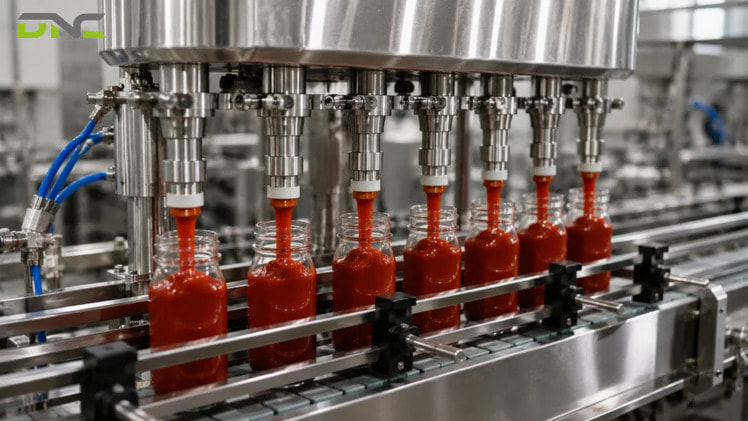
A bottle filling and capping line is a chain of single-purpose stations — bottle feeding, rinsing or washing, filling, capping, labeling and packing — joined end to end by conveyor, so a container leaves one machine already inside the next machine’s work window. Equipment suppliers describe that chain station by station and quote a rate for each machine, from 120 bottles per minute on a linear filler-capper to 24,000 bottles per hour on an integrated water line. The rate a Malaysian packing hall actually books gets decided somewhere else: inside the conveyor between two stations, and at the moment a capped bottle stops being inspectable by eye. Both points sit outside the station list every supplier publishes. Both lead to the same instrument — the checkweigher that measures what the filling head only assumed.
A Bottle Filling and Capping Line Is a Chain of Single-Purpose Stations
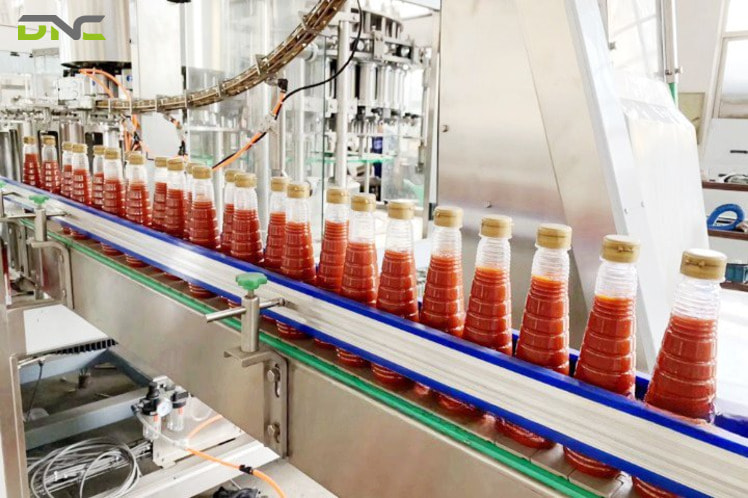
A bottle filling and capping line performs one operation per station and hands the container to the next station on a conveyor belt, which is what separates a bottling line from a single filler-capper machine. On the pharmaceutical variant that transport is a stainless steel slat conveyor belt running the length of the filling machine. Adinath International, a pharmaceutical machinery builder, states the joint plainly: “All machines aligned together to work as one complete system. Conveyors of each machine connected with each other for untouched automatic operations.” From an equipment-integration point of view, that sentence is the whole definition — the stations are ordinary, the connection is the design.
Station sets differ by industry rather than by principle. The three published sets below cover the pharmaceutical, beverage and end-of-line variants of the same chain.
| Stage | Pharmaceutical line | Bottled-water line | Integrated end-of-line (DNC) |
| 1 | Bottle washing | Water treatment | Bottles loading |
| 2 | Filling | Bottle blowing from preforms | Material filling |
| 3 | Capping (ROPP) | Rinsing | Auto capping |
| 4 | Inspection | Filling | Bottles labeling |
| 5 | Sticker labeling | Capping | Carton erector |
| 6 | — | Labeling | Bottle cartoning |
| 7 | — | Packaging | Carton sealing |
| 8 | — | Palletizing (optional) | Checkweigher |
| 9 | — | — | Robot palletizing |
Three details in that table carry more weight than the station names. ALPS Machine collapses stages 3 to 5 of its own list into one frame it calls an RFC monoblock — rinsing, filling and capping sharing a single rotor. The pharmaceutical washing station runs vials along a stainless steel wire-mesh conveyor with automatic loading, then discharges onto an optional turn table. And the DNC column ends with two stations no other published set contains: a checkweigher and a robot palletizer, which is the difference between a line that packages product and a line that also verifies it.
Container material and product family decide which version of that chain a plant needs. One base filling machine handles polyethylene terephthalate (PET), plastic, glass, aluminium, stainless steel and copper containers, and Makwell’s application list spans carbonated soft drinks, juice, milk, wine, sauces, mayonnaise, honey, cosmetic creams, inks, solvents and corrosives; LEKA Pack Line groups the same range into food and beverage, personal care and chemical lines carrying edible oil, drinking water, shampoo, lotion, detergent and lubricant oil. A glass bottle takes the torque a screw cap needs and shatters on a hard transfer; a lightweight PET bottle survives the transfer and deforms under the same chuck. The chain stays identical while every format part inside it changes.
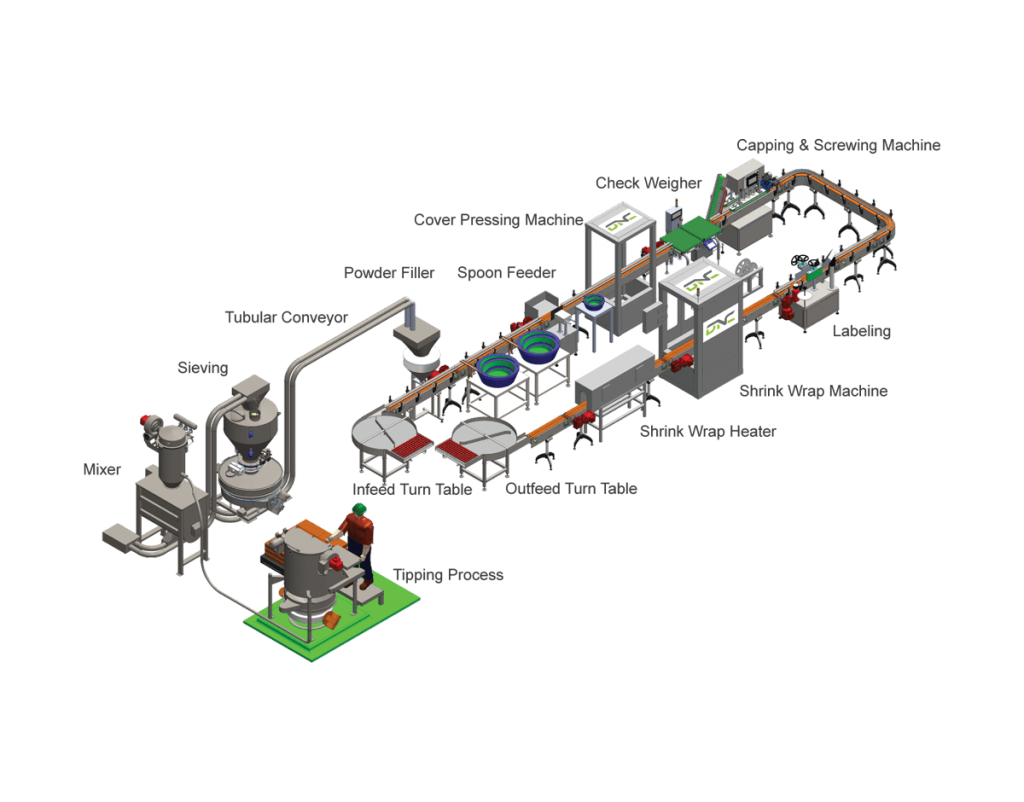
Malaysian manufacturers rarely buy the whole chain at once. A juice producer in Johor typically starts at the filling and capping pair, adds a labeler in the second year, and reaches the palletizing end only when case volume justifies it. Each addition changes what the existing machines are connected to, which is why DNC’s engineers specify the chain as one system; the nine-stage automated bottle filling line on this site shows the shape a staged build eventually reaches, down to the carton sealing machine that closes the case before it is weighed.
Stations sitting in a row still need something to move bottles past them, and the three ways of doing that produce three very different machines.
A Bottle Filling and Capping Line Is a Chain of Single-Purpose Stations
The Stations on a Bottle Line Do Not Share One Clock
Motion architecture on a bottle filling and capping line falls into three families, and the family decides whether a station works on a moving container or a stationary one. LEKA Pack Line separates the first two by geometry: inline machines “move bottles in a straight line through the production process” and suit small to medium capacity where flexibility matters, while rotary machines “use a rotating carousel to move bottles through different stations” for high-speed output. In mechanical terms the carousel never stops — the bottle and the filling valve travel together, so dwell time comes from arc length rather than from a pause.
Makwell’s own machine description shows the linear equivalent in motion. A starwheel holds the bottle in position while a cam system lowers the nozzles, the nozzles rise before the bottle indexes onward, and a sensor enforces a no bottle, no filling interlock so an empty pocket never triggers a dose. Fill volume adjusts by changing piston stroke length, and non-return valves on the syringes reduce variation between the suction and dispensing halves of each cycle. Every one of those parts — nozzle, valve, syringe barrel — is stainless steel where it touches product, at 316 grade on the wetted surfaces.
The third family is not a motion type at all, and confusing it with one is the most common specification error in this market. Automatic and semiautomatic describe how much of the cycle a person performs, not how the container travels. LEKA states the axis correctly — semiautomatic machines “require more operator involvement” and suit smaller batches or product testing. Makwell’s own working principle then shows what that means in a packing hall: bottles travel onto a turn table after filling, “the operator caps each one after a few bottles on the turn table”, and “on the outfeed turn table, improperly capped bottles will collect.”
Does a semiautomatic bottle filling and capping line still count as a line? It does, and its rate is genuinely a machine rate — Makwell quotes up to 120 bottles per minute (7,200 bottles per hour) across round, flat and square bottle shapes. What changes is where the variability lives. A carousel repeats the same arc every revolution; a human at a turn table does not, and the turn table itself becomes the reason the filler never has to wait.
That turn table is the first hint that a bottle line’s output has less to do with any machine’s rated speed than the datasheets suggest.
Line Output Comes From the Coupling Between Stations, Not the Fastest Machine
Line output on a bottle filling and capping line equals the rate the slowest station sustains minus everything the other stations lose while waiting for it, and the size of that second term depends entirely on what sits in the conveyor between them. Every ranked supplier on this query publishes rates as a machine property. King Machine lists combiblock models at 12,000 to 81,000 bottles per hour and separate lines at 18,000, 24,000 and 30,000. ALPS Machine gives the only line-level figure on the page, “production capacity (e.g., 2,000 to 24,000 bottles per hour)”, and one sentence about the joint: “Modern systems synchronize labeling speed with the output of the automatic water bottle filling machine to maintain a continuous flow and reduce downtime.” None of them names what happens when synchronisation fails, which is where a real line spends its day.
From a line-balancing point of view, a station coupled to its neighbours occupies one of three states at any instant. DNC’s engineers use the following three-state model when auditing an existing packing hall, and it is this site’s own framing rather than a supplier’s.
| State | What the station is doing | What causes it | What the operator sees |
| Running | Processing containers at its own cycle rate | Containers arriving and leaving freely | Normal output |
| Starved | Idle with capacity to spare | The upstream station stopped, so no container arrived | A machine running empty, no alarm |
| Blocked | Finished a container it cannot release | The downstream station stopped, so the outfeed is full | A machine holding, often read as a fault on the wrong machine |
Line Output Comes From the Coupling Between Stations, Not the Fastest Machine
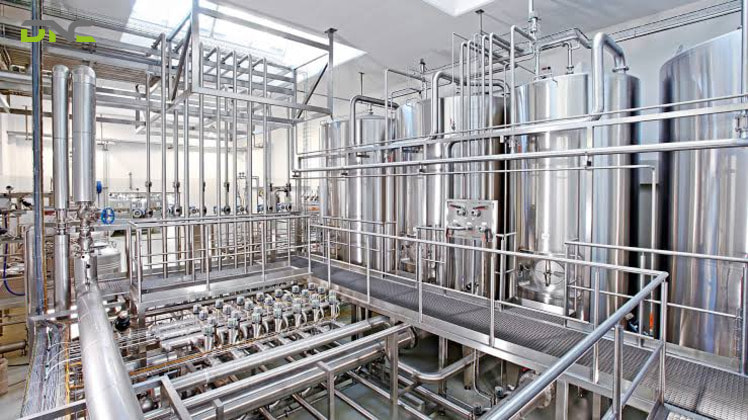
Two stations bolted together with no space between them share every stoppage in both directions. A capper that jams for 40 seconds starves the labeler and blocks the filler for the same 40 seconds, so a single fault removes three machines from production. Put a length of conveyor between them that holds 60 bottles, and the filler keeps dosing into that conveyor while the capper is down, the labeler keeps drawing from stock built earlier, and a 40-second capper stoppage costs the line nothing at all. The conveyor is not transport. The conveyor is storage that happens to move.
Makwell describes the only decoupling element any competitor on this query names, and describes it as a convenience: “optional turn tables at the in-feed and out-feed units with independent drives corresponding to the flow of the bottles coming in and going out.” The phrase that matters is independent drives. A turn table geared to the filler cannot buffer the filler, because it stops when the filler stops. A turn table on its own motor holds bottles the filler has already produced and feeds bottles the capper has not yet taken, which makes it a two-sided buffer. The pharmaceutical washing station carries the same component, also as an option, also without the consequence.
Sizing that buffer is arithmetic a specification can carry. A buffer that holds 60 bottles on a line running 120 bottles per minute (2 bottles per second) covers a 30-second stoppage; the same buffer on a 24,000-bottle-per-hour line covers 9 seconds. Malaysian food and beverage plants running multi-SKU schedules see short, frequent stoppages — a cap misfeed, a label web splice, a bottle fallen on the transfer — far more often than long ones, which is why buffer length usually returns more output than a faster machine does. Buffer length gets designed as part of conveyor system automation, and it is the line item most often cut first from a quotation.
One line architecture removes the buffer deliberately, and it is worth understanding why that trade is sometimes correct.
A Combiblock Trades the Buffer for Shorter Handling
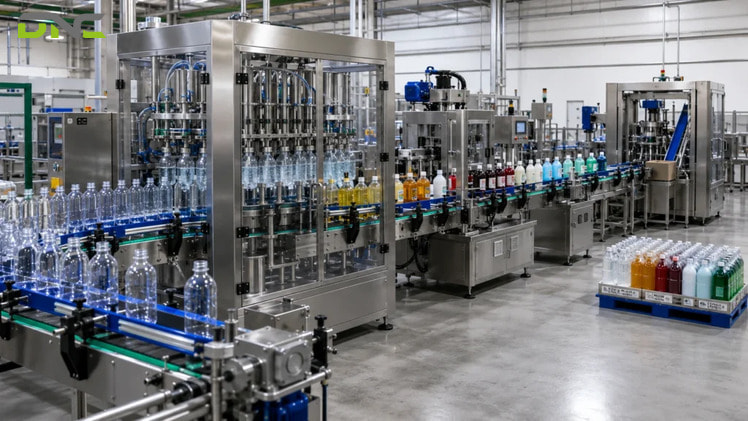
A combiblock trades the buffer for shorter handling, fusing bottle blowing, filling and capping into one frame and eliminating the conveyor between them. King Machine describes the machine and the reasoning together: the combiblock “combines three key components: the blowing machine, the filling machine, and the capping machine, into one compact unit”, and the integration “reduces space requirements, minimizes product handling, and ensures smooth transitions between processes.” From a hygiene and floor-space point of view, every one of those gains is real. A freshly blown polyethylene terephthalate (PET) bottle never travels through open air, never sits on an accumulation table collecting dust, and never needs a second bottle-handling system to feed it.
The cost of that design is stated nowhere on the page, and it follows directly from the three-state model. Rigid coupling means the blower, the filler and the capper are permanently starved and blocked by each other. A capping fault stops the filler in the same rotor revolution, and it stops the blower with it, so the machine carries one availability figure rather than three. ALPS Machine’s air-conveyor arrangement sits between the two approaches — the blower connects “directly with the filling machine via an air conveyor”, which is both a transport path and a modest buffer.
Which architecture suits a Malaysian bottler better? Single-SKU, high-volume water and carbonated soft drink plants gain more from the combiblock’s handling and footprint than they lose to shared stoppages, because a mature water line runs long uninterrupted campaigns. Multi-SKU producers — sauces, edible oils, personal care, household chemicals — change bottle and cap formats often enough that discrete stations with buffers between them recover more hours per month. Neither answer is universal, and a rate figure alone cannot distinguish them.
Before the article turns from how the line runs to how it is checked, the three ideas established so far are worth holding together.
A Combiblock Trades the Buffer for Shorter Handling
Summary: Stations, Clocks and Buffers So Far
Stations, clocks and buffers describe three separate properties of a bottle filling and capping line, and a specification naming only the first two is incomplete. The stations are ordinary and well documented — washing or rinsing, filling, capping, inspection, labeling, packing, and on an integrated line a checkweigher and palletizer. The clock is the motion architecture: a rotary carousel carries the container past a moving valve, an inline machine indexes it into a stationary one, and a semiautomatic layout puts a person inside the cycle. The buffer is the conveyor length between two stations, and it converts a machine’s nameplate rate into the line rate a plant books, because a station with no buffer inherits every stoppage from both neighbours. A combiblock removes that buffer on purpose, trading one shared availability figure for hygiene and floor space — and none settles what the capping station does to inspection.
Capping Closes the Last Window for Visual Inspection
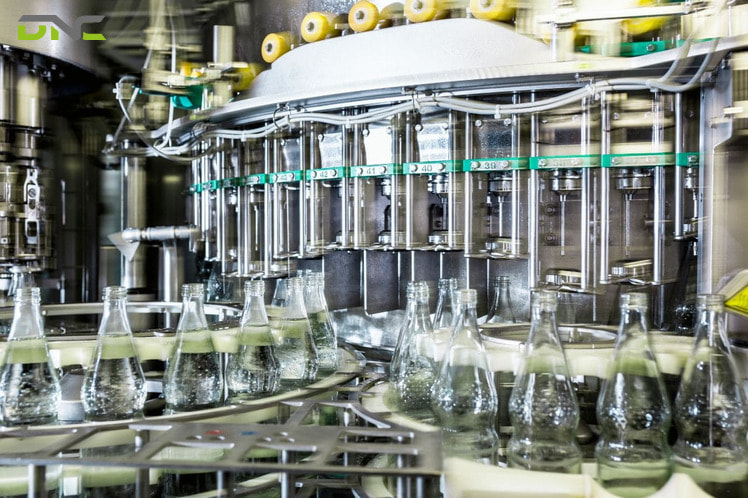
Capping closes the last window in which a fill is still judgeable by eye, and every station downstream of it hides the fill further. The pharmaceutical station set makes the point without drawing it: its bottle inspection machine is “a three-track conveyor with a hood with lighting arrangement and visual inspection background of alternate black and white color”, built for inspecting liquid vials and bottles against a contrast field. That is a human eye, or a camera, reading a transparent container. From a quality-assurance point of view, it is an excellent instrument for particulates, fill height and cap seating, and a useless one for anything sealed, sleeved or labeled.
Makwell’s outfeed turn table shows the same principle at manual scale. A bottle cap that sits crooked is visible from two metres away, and improperly capped bottles “will collect” there — an operator spots a crooked or loose closure by eye and pulls it before it travels on. The detection works because the defect is visible. A bottle that received 480 ml instead of 500 ml (16.9 oz / 0.5 L) leaves that turn table looking exactly like a good one, and no one on the line will ever know.
Three things happen after the capping station that each remove information. The labeler covers the fill line, and the pharmaceutical set’s sticker labeling machine applies transparent no-look labels at high speed with no format part needed between sizes. The cartoner puts six or twelve bottles inside a closed box. The carton sealer tapes it shut. By the time the unit load reaches a pallet, the only property of the product still observable from outside is its weight.
Where does that leave the fill accuracy the filling machine reported? It leaves it as an assumption, because the filler measured the thing it controls rather than the thing the customer buys. King Machine states the categories cleanly — volumetric fillers “measure and dispense a fixed volume”, gravimetric fillers “use weight sensors to measure the product as it is dispensed”, overflow fillers “ensure that each bottle is filled to the same level by allowing excess liquid to overflow”. Underneath those three labels sit the mechanisms a plant actually buys: gravity valves timed open under a static head, piston strokes, gear and peristaltic pumps counting revolutions, flow measurement by flow meter, and vacuum filling that draws product to a level. Each of them regulates elapsed time, liquid level or displaced volume. Only the net-weight family regulates delivered mass, and the market runs mostly on the others.
That difference between what a filling head controls and what a label declares is the reason a bottle line ends at a weighing instrument.
Capping Closes the Last Window for Visual Inspection
Mass Is the Only Measurand Left Once the Cap Is On
Mass is the only measurand left once the cap is on, so a bottle filling and capping line that never weighs its output holds no closed loop between what it declared and what it delivered. From a legal metrology point of view, the two documents involved govern different objects: OIML R 61-1:2017 covers the automatic gravimetric filling instrument that produced the fill, while OIML R87 covers the net quantity declared on the finished prepackage and the sampling plans applied to it in market surveillance. Not one page ranking for this query names either. The distinction decides who carries the risk — a compliant machine does not by itself produce a compliant pack.
The mechanism underneath a bottle filling and capping line is arithmetic. Delivered mass equals dispensed volume multiplied by bulk density, and a worked example from the metering literature puts a bulk density of 0.5 g/mL against a 200 ml (6.76 oz / 0.2 L) dose to give 100 g (3.53 oz). The relation holds only while the density term holds. Nothing inside a volumetric filler monitors bulk density, so a batch that warms two degrees, carries entrained air from an aggressive transfer pump, or arrives at a different solids ratio produces a different mass from an identical, correctly executed machine cycle. The filler reports every one of those cycles as a success, because by its own measurand every one of them was.
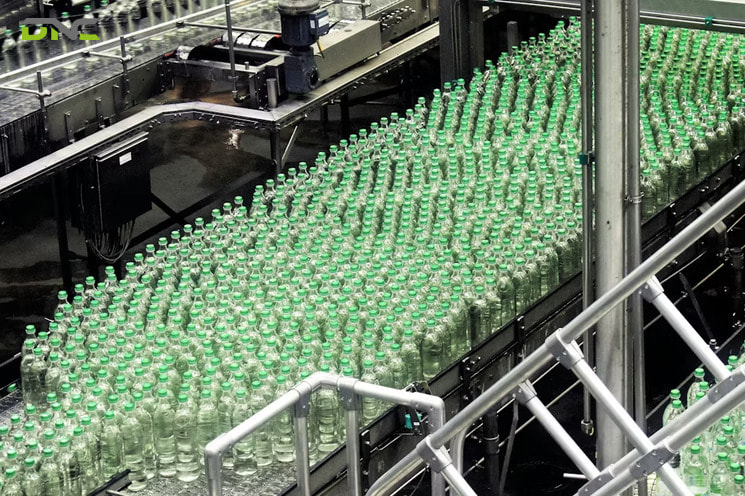
A checkweigher restores the loop by measuring the object the declaration refers to. It weighs in fractions of a second while the pack is moving, against several seconds for a static scale that has to settle, which is what makes 100% inspection possible instead of sampling — one documented alternative regime checks 15 packs out of 6,000, or 0.25% (1 pack in 400). Adding a checkweigher system after the capper turns the whole chain into a measured process: the filler proposes, the weigher disposes, and the reject device removes what fails.
One subtlety separates weighing a capped bottle from weighing an open one, and it belongs in the specification rather than in commissioning. A checkweigher on a bottle line returns gross weight — product plus bottle plus cap plus label. Net content is gross weight minus a tare value the instrument assumes, and that assumption is only as good as the packaging is consistent. Preform weight varies between moulding cavities, cap weight varies between suppliers, and a label plus adhesive adds a small but real term.
Tare variation therefore sets a floor on achievable net-content accuracy that no amount of weighing precision improves, and lightweighting a PET bottle to save resin can widen that floor without anyone recording the change. DNC’s engineers fix the tare regime — fixed tare, batch tare, or empty-container sampling — before a checkweigher is quoted, because the number a plant needs is net content and the number the instrument produces is not.
Every point covered so far can be reduced to a short list of places a capped bottle is still open to checking.
Mass Is the Only Measurand Left Once the Cap Is On
Summary: The Three Places a Capped Bottle Stays Open to Checking
A capped bottle stays open to checking in three places, and each place measures something different from the last. Before the cap, a lit inspection hood with an alternating black-and-white background reads fill height, particulates and cap seating on transparent containers, which works for exactly as long as the container stays see-through. At the cap, a manual outfeed turn table or an automatic reject catches closures that sit visibly wrong, and catches nothing about the volume underneath them. After the cap, mass is the only property still readable from outside, so a checkweigher weighing every pack in motion is the last opportunity to compare what the line declared against what it delivered — subject to a tare assumption that packaging consistency, not weighing precision, controls. A line specified without the third check inspects its packaging and takes its product on trust.
Specification Points That Decide the Line Before Any Station Is Quoted
Specification for a bottle filling and capping line starts with four decisions that sit above every machine datasheet, and each one eliminates options rather than ranking them. Suppliers organise their selection guides around the machine. LEKA Pack Line asks for product type, bottle size and shape, production capacity and automation level; Dizayn Makina asks a prospective buyer to “enter the product and capacity information”; ALPS Machine lists production capacity, bottle sizes, cap and label types, factory space, regulatory compliance and scalability. Every list is sound and every list is a machine list.
The four decisions below come first because they constrain which machine lists are worth reading for a bottle filling and capping line.
- The measurand at the filling station.Volume, level or mass — the choice determines whether density drift shows up as a fill error and whether a downstream weight check is a verification or a discovery.
- The verification point and its tare regime.Where the line proves net content, and how the instrument accounts for bottle, cap and label weight.
- The buffer length between each pair of stations.Expressed as seconds of upstream stoppage absorbed, not as metres of steelwork.
- The changeover set.Which format parts change when the bottle or cap changes, and how many minutes that takes at the worst SKU pair in the schedule.
A specification that answers those four can then read a machine list productively, because the questions the machine list asks have already been narrowed. Product viscosity picks the filling technology once the measurand is fixed. Capacity picks between inline and rotary once the buffer strategy is fixed. Regulatory scope picks the material and finish grade once the verification point is fixed. Malaysian exporters shipping into markets with average-quantity regimes carry the weight declaration in their documentation chain, which moves point two from an operational preference to a commercial requirement.
Bottle and cap geometry sits underneath all four points, and it is where changeover time is actually spent.
Specification Points That Decide the Line Before Any Station Is Quoted
Bottle and Cap Tolerances Set the Format Parts and the Changeover
Bottle and cap tolerances determine which parts of a bottle filling and capping line physically change when a plant switches SKU, and the count of those parts is the changeover time. LEKA Pack Line describes the constraint at container level: round, square, small, large and irregular containers “may require different guide rails, positioning systems, and filling adjustments”, and the machine must be compatible with the bottle’s dimensions and shape. Adinath adds the exception that proves the rule — its sticker labeling machine needs “no change parts / format parts” between bottle sizes, which is unusual enough to be a selling point.
Cap style drives the capping head rather than the transport. Three families appear across the ranked suppliers, and the differences are mechanical rather than commercial.
- Screw cappingapplies rotation and torque to seat a threaded closure, and King Machine notes that modern heads carry torque control “to ensure each cap is sealed to the correct specification”.
- Press-on and snap cappingapply linear force for flip-top and snap closures, with no rotation involved.
- ROPP cappingforms the thread into a blank aluminium shell against the bottle’s own neck finish, and one pharmaceutical supplier pairs it with an orientation-type cap feeder for continuous online feeding.
Torque is the property that connects the cap to the product, and it is the least documented figure on this query — one page mentions cap torque once, and none gives a value or a measurement method. A bottle cap applied too loosely leaks and admits oxygen; applied too tightly it deforms the liner or strips the screw thread, and a consumer cannot open it. Both failures are invisible on a labeled bottle, which places closure torque in the same category as fill volume: a property the line controls and stops being able to see.
Torque, format parts and fill accuracy all depend on line utilities that rarely appear in a bottle line quotation at all.
Utilities and Hygienic Design a Bottle Filling and Capping Line Depends On
Utilities and hygienic design set the operating envelope for a bottle filling and capping line, and a station specified without them performs to its datasheet only in the supplier’s factory. Dizayn Makina publishes the clearest utility figure on this query: a pneumatic pressure requirement of 6 to 8 bar (87 psi / 600 kPa at the lower end), with food-grade stainless steel in 304 and 316 quality as the wetted material. Air below that band slows every pneumatic actuator on the line simultaneously — nozzles, valves, chucks, pushers — and shows up as an efficiency loss no single machine reports as a fault.
Hygienic options attach to the same frame and address contamination rather than throughput. Dizayn lists ultraviolet (UV) lamps, HEPA filtration, nitrogen gas flushing, and heaters and mixers in the hopper as machine-level additions, while ALPS Machine sterilises caps “using UV light or disinfectant before application” and rinses formed bottles with sterilised water or air inside the RFC monoblock before filling. The pharmaceutical capping machine is finished in stainless steel over mild-steel framing, with the inspection station built to GMP standards.
Water-based lines carry an upstream utility chain the bottle line inherits whole — sand and carbon filtration, reverse osmosis, ultraviolet sterilisation and an ozone generator holding sterility in the storage tanks, per ALPS Machine. A treatment fault upstream reaches the filling head as product, not as an alarm.
Control ties the utilities to the stations. King Machine describes the layer directly — a programmable logic controller (PLC) sequences blowing, filling and capping “at the correct time and in the correct sequence”, while a human-machine interface (HMI) presents real-time data for operator adjustment. That control layer is also what makes weight data useful rather than merely recorded: a line that feeds checkweigher results back into the filler setpoint corrects drift automatically, and the mechanics of that feedback are covered in how a checkweigher works. Where the product is dosed by mass from bulk before it ever reaches a bottle, the same control principle governs the batching and dosing weighing system that prepares it.
Several questions come up repeatedly when Malaysian manufacturers move from a single filler to a connected line.
Utilities and Hygienic Design a Bottle Filling and Capping Line Depends On
What Malaysian Manufacturers Ask About Bottle Filling and Capping Lines
Malaysian manufacturers specifying a bottle filling and capping line raise four questions more often than any others, and the answers turn on the same coupling and measurement principles established above. From a procurement point of view, each answer changes a line item rather than an opinion.
Does a faster filling machine raise line output? It raises line output only while the stations downstream can absorb the extra containers. A filler upgraded from 60 to 120 bottles per minute in front of an unchanged capper produces a blocked filler, not more product, and the money would have bought more output as accumulation length.
Is a monoblock the same thing as a combiblock? They differ by which operations are fused. A monoblock merges rinsing, filling and capping on one rotor, as in ALPS Machine’s RFC arrangement; a combiblock adds bottle blowing to the same frame. Both are rigid couplings sharing one availability figure.
Does a checkweigher belong before or after the labeler? It belongs wherever the pack is complete enough that its tare is stable, which on most bottle lines means after capping and after labeling. Weighing before the label means the label and adhesive weight is unaccounted for, and weighing before the cap means the pack is not yet the object the declaration describes.
Does the same reasoning apply to drums and pails? It does, with different numbers. A drum filling system runs at a fraction of a bottle line’s rate, so buffers are measured in containers rather than in hundreds, while the measurand question and the tare question stay identical.
Those four answers point to the same conclusion a line audit reaches.
What Malaysian Manufacturers Ask About Bottle Filling and Capping Lines
What a Line Specification Looks Like in a Malaysian Packing Hall
A line specification written for a Malaysian packing hall names three things the market’s station lists leave out: the measurand at the filling head, the seconds of stoppage each buffer absorbs, and the point at which net content is proved. Everything else is well documented and widely supplied — washing, rinsing, filling, capping, labeling, cartoning and sealing appear in near-identical form across every published station set. What decides whether a plant books 18,000 bottles a shift or 12,000 lives in the conveyor between the machines, and what decides whether a declared weight survives an audit lives in the instrument after the cap.
For manufacturers moving up the automation ladder under NIMP 2030 incentives, that ordering matters commercially. A grant-funded upgrade spent entirely on faster stations produces a line that starves and blocks itself at a higher speed, while the same capital split across buffer conveyor and a verification point produces measured output. DNC’s engineers audit an existing packing hall by fixing the measurand and the verification point first, then sizing the buffers, and only then quoting stations.
Specifying a bottle filling and capping line from scratch, or joining machines you already own into one, starts from the same two questions — talk to our engineers about buffer sizing and the verification point before any station is quoted.
- 15 views
- 0 Comment
Recent Comments