


Automatic Case Packer Guide | DNC Automation Malaysia
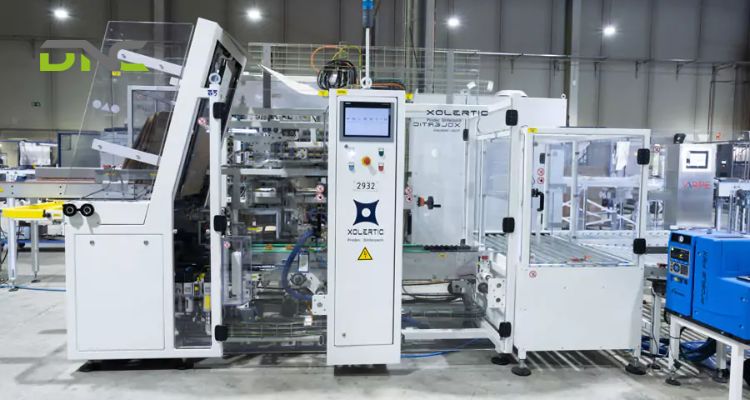
Automatic case packers deliver measurable output at predictable cost — the two variables that define whether an end-of-line automation investment makes operational sense for Malaysian manufacturers. Where a manual case packing station produces 4–8 cases per minute with 4–6 workers per shift, an automatic case packer achieves 15–60 cases per minute with one monitoring operator. The labour saving is immediate; the throughput consistency compounds over every shift, every week, every year of operation.
Malaysian manufacturers are accelerating this transition. Rising minimum wages, structural labour shortages in the manufacturing sector, and the NIMP 2030 national industrial agenda are pushing end-of-line automation investment up the production planning priority list. Automatic case packers — the machines that load products into corrugated shipping cases without human intervention — sit at the centre of this investment cycle.
This guide covers automatic case packer technology, configuration options, ROI calculation methodology, and the integration requirements that determine whether a new automated case packing machine delivers its projected return.
What Is an Automatic Case Packer?
An automatic case packer is a machine that receives products from an upstream conveyor, groups them into the correct pack configuration, places them into corrugated cases, and discharges filled cases downstream — continuously, without operator loading intervention.
The machine handles what would otherwise require 3–6 manual workers per shift: counting products, forming groups, opening cases, loading, and maintaining output rate. An automated case packer replaces this manual activity with servo-driven product handling, programmable packing logic, and mechanical or robotic case loading — running at consistent speed regardless of shift timing, worker availability, or fatigue.
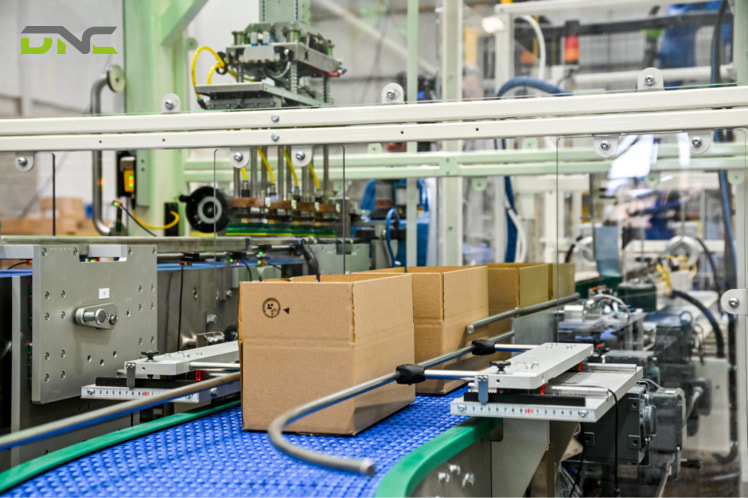
Three subsystems define every automatic case packing machine:
- Product infeed and collating system — receives products from upstream, counts them, and forms the pack pattern (e.g., 3×4 arrangement, 2 layers of 6).
- Case handling system — erects flat corrugated blanks or opens pre-formed cases from a magazine; positions the open case for loading.
- Loading mechanism — transfers the collated product group into the case via top-loading, side-loading, or wraparound action (see configuration types below).
Automatic Case Packer Configurations
Fully Automatic Wraparound Case Packer
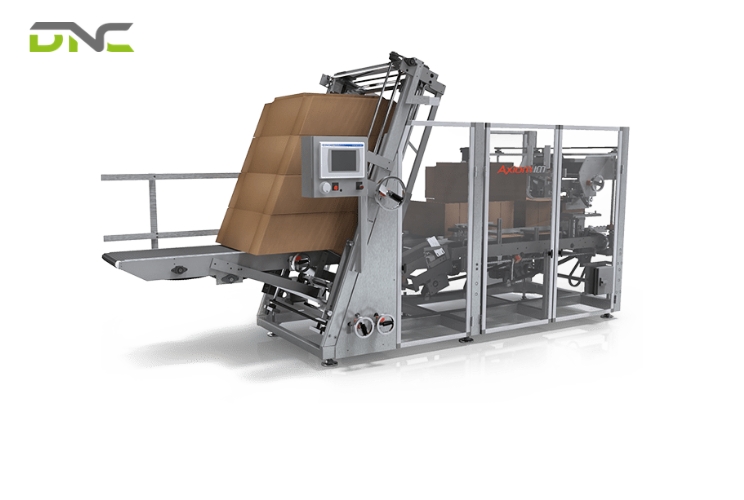
The wraparound automatic case packer wraps a flat corrugated blank around a pre-grouped product set. Products are grouped on an infeed platform; a blank is retrieved from a flat magazine and positioned beneath the product group; forming arms fold and glue the blank into a closed case around the product. No separate case sealing step is required.
Best for: High-speed F&B and beverage operations, edible oil producers, and FMCG manufacturers in Malaysia where corrugated board cost per case and line speed are both critical. Wraparound configurations consume 15–25% less corrugated board per case than RSC-format packing.
Throughput: 20–60 CPM on uniform products.
Fully Automatic Top Load Case Packer
Top load automatic case packers open RSC or half-slotted cases from a magazine and load products vertically from above. Products arrive via conveyor; the automatic loading head — vacuum, mechanical gripper, or controlled drop — places products into the open case top. Cases then move to a downstream sealer.
Best for: Pharmaceutical carton packing, food products requiring upright orientation (bottles, cups), and home appliance or electronics packaging where product fragility requires controlled placement rather than high-speed mechanical transfer.
Throughput: 5–30 CPM depending on product dimensions and loading pattern complexity.
Fully Automatic Side Load Case Packer
Side load automatic case packers push product groups horizontally into the open end of a pre-formed RSC case. A collating zone accumulates the correct product count; a servo or pneumatic pusher slides the group sideways into the case in a single motion. High-speed continuous-motion side load packers achieve the highest throughput in the automatic case packer category.
Best for: Beverage canning and bottling lines, can packing, and high-volume uniform product streams where throughput is the primary specification. Malaysian carbonated beverage producers and dairy operations use side load automatic case packers on their fastest production lines.
Throughput: 30–80 CPM on uniform cylindrical or rectangular products.
Automatic Robotic Case Packer
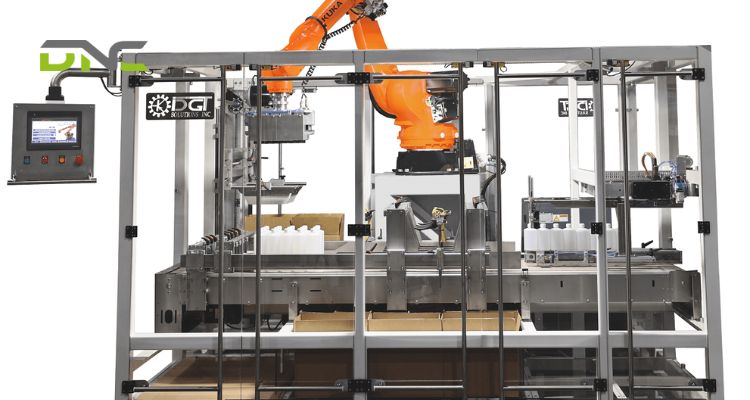
Robotic automatic case packers use one or more industrial robot arms — delta robots for high-speed light products, SCARA robots for medium-speed precision applications, six-axis arms for heavy or complex products — to pick products from an infeed conveyor and place them into open cases according to a programmed packing recipe.
Best for: Mixed-SKU operations, products requiring precise orientation or gentle handling, and production environments where packing pattern changes are frequent. The packing recipe is changed via the HMI touchscreen — mechanical changeover is minimal or zero.
DNC Automation note: DNC Automation integrates robotic case packing systems using Comau robot arms, combining Comau’s robot payload and reach specifications with DNC’s end-of-line integration engineering. This positions DNC as a single point of accountability for the robot arm, the gripper tooling, the vision system for product detection, and the case handling interface — rather than requiring the manufacturer to coordinate between multiple suppliers.
Throughput: 10–60 picks per minute per robot; multiple robot heads for higher throughput.
What Are the Key Components Automatic Case Packing?
ROI Calculation: Automatic Case Packer for Malaysian Manufacturers
Automatic case packer ROI in the Malaysian manufacturing context rests on four value drivers:
1. Direct Labour Elimination
Manual case packing in a Malaysian manufacturing environment typically requires 4–6 workers per shift at the packing station (product counting, case opening, loading, flap folding). At current Malaysian manufacturing wages:
| Labour Cost Component | Per Worker/Month |
| Basic wage | RM 1,800–2,500 |
| EPF (employer) 12% | RM 216–300 |
| SOCSO | RM 50–80 |
| EIS | RM 20–30 |
| **Total per worker/month** | **RM 2,086–2,910** |
For a 5-worker packing station on 2 shifts (10 workers total):
- Annual labour cost: RM 250,000–350,000
- Reduction with automatic case packer: 8–9 workers eliminated (one monitoring operator retained per shift)
- Annual labour saving: RM 200,000–280,000
2. Throughput Increase Value
Manual packing rates average 4–8 CPM — human-limited. An automatic case packing machine at 20 CPM on the same line increases end-of-line throughput by 2.5–5×. If the case packing station is the production bottleneck, this throughput increase translates directly to higher saleable output per shift.
Conservative throughput value calculation:
- Additional cases per shift: 400–600 cases (based on 2 CPM net improvement over 4-hour effective manual packing time)
- At RM 50–150 product value per case: RM 20,000–90,000 additional daily output potential
3. Reduced Rework and Waste
Manual case packing produces error rates of 2–5% — incorrect counts, damaged products from rough handling, misconfigured cases. Automatic case packers reduce packing errors to under 0.5% with integrated vision systems, reducing rework labour and material waste.
4. Consistency Value for Export Compliance
Malaysian manufacturers exporting to Japan, South Korea, the EU, and the GCC face zero-tolerance policies on case weight discrepancy and pack count errors from retail chains and distributors. Automatic case packers with integrated checkweighing achieve count and weight accuracy that manual packing cannot consistently replicate — preventing chargeback penalties that can reach RM 5,000–50,000 per incident.
Sample Payback Calculation
| Item | Value |
| Automatic case packer investment | RM 180,000 |
| Annual labour saving (8 workers eliminated) | RM 225,000 |
| Annual rework reduction | RM 30,000 |
| Simple payback period | **< 8 months** |
This calculation represents a mid-range automatic case packer on a two-shift, two-SKU Malaysian manufacturing operation. Actual payback depends on specific labour costs, product value, and machine configuration.
Malaysia’s MIDA automation incentives and SME Corp digitalisation grants may reduce the effective capital outlay by 20–40% for qualifying manufacturers, further compressing the payback period.
Automatic Case Packer for Malaysian Manufacturers
Automatic Case Packer: Key Technical Specifications to Verify
| Specification | What to Ask | Why It Matters |
| Throughput (CPM) | Cases per minute at your case dimensions | Must exceed your line requirement with 25% margin |
| Product infeed rate | Products per minute accepted | Must match upstream equipment output |
| Case size range | Min/max length, width, height | Covers your current and planned SKU range |
| Pack configuration flexibility | How many patterns programmable? | Determines SKU changeover capability |
| Changeover time | Minutes per SKU change | Impacts effective capacity on mixed lines |
| HMI type | Touchscreen, PLC brand | Operator usability and IT integration |
| Robot payload (if robotic) | kg per pick | Must accommodate your heaviest product |
| Servo motor brand | Which OEM? | Spare parts availability in Malaysia |
| Case magazine capacity | Number of flat blanks or pre-formed cases | Determines replenishment frequency |
| Integration protocol | Profinet, EtherNet/IP, Modbus | Must match your line PLC protocol |
| Electrical supply | 3-phase 415V/50Hz | Malaysian facility standard |
Automatic Case Packer Integration: Line Connectivity
Product Infeed Design
Automatic case packers require a consistent, organised product stream at the infeed. Products arrive from upstream primary packaging — fillers, labellers, carton packers — often in a single-lane continuous flow. The case packer’s infeed system must convert this single-lane flow into the multi-product group required for the packing configuration.
Infeed components:
- Laning conveyors: Divide single-lane flow into multiple lanes matching the pack pattern width
- Metering belt: Controls product spacing and feed rate into the collating zone
- Collating zone: Accumulates products into complete groups for loading
- Vision system (optional): Detects product orientation and identifies non-conforming products for rejection before loading
DNC Automation designs and fabricates these infeed handling systems in-house at our Selangor facility — ensuring geometric compatibility with both the upstream equipment discharge and the case packer infeed specification.
PLC and Control Integration
Automatic case packers in Malaysian manufacturing environments operate in one of three control configurations:
Standalone control: The case packer runs its own PLC program independently. Start/stop signals are the only interface with the broader production line. Simple to commission; limited data integration.
Line PLC integration: The case packer PLC exchanges data with the production line master PLC. Case count data, throughput rates, and fault signals are shared. Line speed changes command corresponding case packer speed adjustments. This is the minimum integration standard DNC Automation recommends for new installations.
SCADA/MES integration: The automatic case packing machine reports production data — cases per hour, OEE, downtime events, pack configuration changes — to the facility-level manufacturing execution system or SCADA platform. This enables production scheduling integration, real-time monitoring from the control room, and historical trend analysis for maintenance planning.
DNC Automation implements all three levels. For manufacturers on Malaysia’s NIMP 2030 smart manufacturing adoption pathway, SCADA integration is the target state — and DNC’s engineering team has the software capability to deliver it alongside the mechanical and electrical installation.
Downstream Integration
After the automatic case packing machine, the filled case flow must connect seamlessly to:
- Case sealer (if not wraparound type): Conveyor height and speed matched to case packer discharge
- Checkweigher: Positioned immediately post-sealer to verify case weight before labelling
- Print-and-apply labeller: Case shipping label applied at this point
- Palletizer: Accumulation conveyor feeds the palletizer infeed with appropriate buffer capacity
DNC Automation integrates the complete downstream sequence. The project scope typically covers the automatic case packer, case sealer, checkweigher interface, and palletizer infeed conveyor as a unified system — eliminating the interface ambiguity that occurs when multiple machine suppliers each claim the connection point as another supplier’s responsibility.
Benefits of Automatic Case Packing
Common Specification Errors to Avoid
Underspecifying throughput: Automatic case packers specified to exactly match current production speed offer no capacity headroom. Any upstream speed increase — a common result of adding a second shift or improving the filler throughput — immediately creates a case packing bottleneck. Specify 25–30% above your current required CPM.
Ignoring corrugated board grade: Automatic case packers are calibrated for a specific corrugated board grade (B-flute, C-flute, BC double-wall). Running a machine calibrated for C-flute on B-flute board causes misalignment at the case forming station. Document your current and planned board specifications before machine selection.
Skipping infeed handling design: The automatic case packer datasheet shows CPM at the machine outlet. Getting products from the upstream conveyor discharge into the case packer infeed in the correct count, lane, and spacing is an engineering task separate from the machine itself. Budget for infeed handling system design in every automatic case packer project.
Single-source spare parts risk: Specify case packers whose critical wear components — servo drives, taping heads, vacuum pumps — have Malaysia-based distributors or 2-week or shorter lead time from regional stock. A 6-week lead time on a critical spare part on a production-critical line represents unacceptable downtime risk.
Automatic Case Packer Maintenance: Keeping Your Line at Peak OEE
An automatic case packing machine running at 85% OEE (Overall Equipment Effectiveness) delivers 36% more output per shift than the same machine running at 65% OEE — without any capital investment. Maintenance discipline drives OEE. Malaysian manufacturers who treat case packer maintenance as reactive (fix when broken) consistently achieve 60–70% OEE; those with structured preventive maintenance programmes achieve 80–90%.
Preventive Maintenance Schedule
| Frequency | Task | Time Required |
| **Daily** | Clean infeed sensors and product guides; inspect case magazine for jammed blanks; check belt tension; verify glue nozzle condition (if hot melt) | 15 minutes |
| **Weekly** | Lubricate chain drives and cam followers; inspect vacuum cup seals (if top load); check pusher alignment (if side load); verify PLC fault log for recurring warnings | 30 minutes |
| **Monthly** | Full mechanical inspection — fasteners, guide rail alignment, pusher stroke measurement; calibrate box sensors; verify servo motor thermal readings | 2 hours |
| **Quarterly** | Replace worn vacuum cups; inspect pneumatic cylinder seals; calibrate vision system (if vision-guided); verify safety circuit function; inspect motor coupling alignment | 4 hours |
| **Annually** | Full machine overhaul — replace worn belts and chains, inspect gear reducers, verify servo drive parameters, update PLC backup, re-commission product acceptance trials | 1–2 days |
Common Failure Modes and Prevention
Product jamming at collating zone: The most common automatic case packer stoppage. Cause: upstream product spacing irregularity (inconsistent metering belt speed) or product shape variation exceeding the collating zone guide tolerance. Prevention: maintain metering belt drive system at correct tension; audit upstream equipment for speed consistency quarterly.
Case erection failure: The case packer erects a case incompletely or at incorrect squareness. Cause: worn vacuum cups in erection system; corrugated board moisture content variation; worn manufacturer’s joint on KDF cases. Prevention: replace vacuum cups every 3–6 months; qualify corrugated box supplier’s dimensional tolerance annually.
Servo drive fault: Servo drives on automatic case packers generate faults under thermal overload (typically from blocked cooling vents) or from cable chafing in high-cycle applications. Prevention: clean servo drive enclosures monthly; inspect cable routing for chafe points at commissioning and quarterly thereafter.
DNC Automation provides documented preventive maintenance programmes — including digital maintenance logs and spare parts minimum stock lists — with every automatic case packer installation. Our service team conducts scheduled annual maintenance visits as part of post-commissioning support agreements.
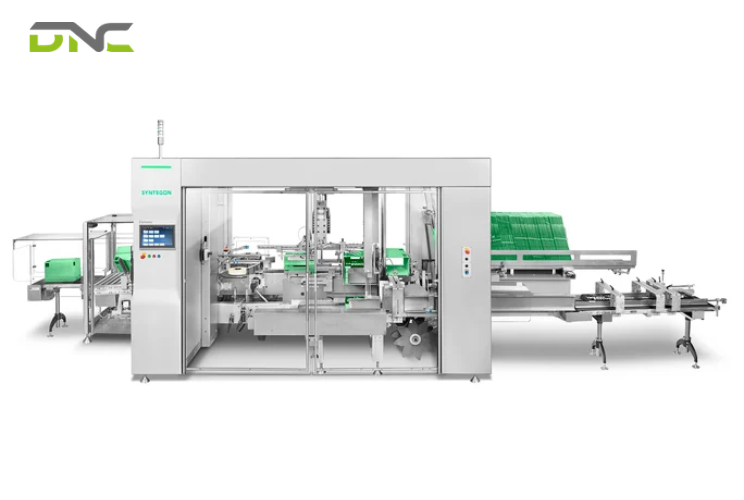
Robotic RSC Case Packer
Industry 4.0 Integration: Automatic Case Packers in Malaysia’s Smart Factory Roadmap
Malaysia’s NIMP 2030 and the accompanying Industry4WRD national policy have made smart manufacturing investment a priority for Malaysian manufacturers competing in export markets. Automatic case packers are a key data point in the smart manufacturing framework — because end-of-line throughput (cases per hour) is one of the most direct operational metrics in any manufacturing facility.
What Industry 4.0-Ready Case Packers Report
An automatic case packing machine integrated into a Malaysian smart factory reports the following data streams to the facility SCADA or MES:
- Throughput (cases/hour, cases/shift, cases/production order) — compared against planned production target in real time
- OEE components — availability (uptime %), performance (actual CPM vs. rated CPM), quality (case rejection rate)
- Fault events — fault code, timestamp, duration, frequency (enabling MTBF trending for predictive maintenance)
- Recipe/changeover events — what product was running, changeover duration, operator ID
- Energy consumption — kWh per production run, per case (enabling energy intensity tracking)
MIDA and SME Corp Grant Qualification
Malaysian manufacturers investing in Industry 4.0-capable automation — including data-integrated automatic case packers — may qualify for MIDA’s Smart Automation Grant (SAG) or SME Corp’s SME Technology Transformation Fund. Both programmes have supported automation projects at Malaysian manufacturing facilities in Selangor, Johor, and Penang.
DNC Automation’s project team assists clients in preparing the technical documentation required for grant applications — including equipment specification, OEE baseline measurement, and projected improvement metrics. In DNC’s experience, MIDA grant applications for automation projects take 8–16 weeks from submission to approval; the grant application process should begin at the same time as the project engineering phase, not after installation.
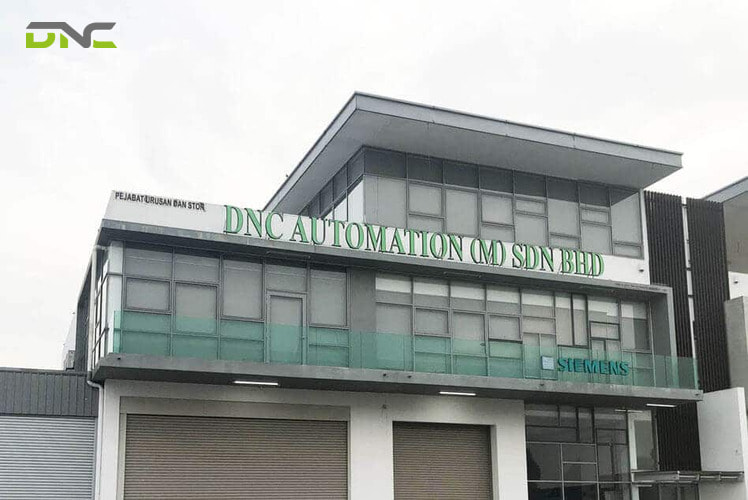
DNC Automation – the Right Automatic Case Packing Solution
Frequently Asked Questions
How fast does an automatic case packer work?
Automatic case packers achieve 5–80 cases per minute depending on configuration. Robotic top load systems: 5–30 CPM. Side load continuous-motion: 30–80 CPM. Wraparound: 20–60 CPM. The correct throughput specification for your line is your daily case output requirement divided by your production hours, multiplied by 1.25 safety factor.
What is the difference between an auto case packer and a semi-automatic case packer?
Semi-automatic case packers require an operator to manually open cases, load products, or both. Automatic case packers handle case opening, product loading, and case closure without operator intervention at the loading station. One monitoring operator per shift manages multiple automatic case packers; a semi-automatic system requires a dedicated operator at the machine.
Can an automatic case packer handle multiple product sizes?
Yes — robotic case packers handle multiple sizes via recipe programming with minimal changeover. Mechanical automatic case packers (side load, top load, wraparound) require mechanical guide adjustment for different product or case sizes, typically taking 20–45 minutes per changeover. Changeover frequency should guide the choice between mechanical and robotic configurations.
What return on investment should I expect from an automatic case packer in Malaysia?
Malaysian manufacturers replacing 4–6 manual case packing workers with a fully automatic case packer typically achieve payback in 8–18 months through direct labour cost savings. The payback period shortens when throughput increase value and rework reduction are included. Available MIDA and SME Corp automation grants can reduce effective payback period to 5–10 months for qualifying manufacturers.
Does DNC Automation supply automatic case packers as standalone machines or only as integrated systems?
DNC Automation focuses on turnkey integration — the automatic case packing machine plus all infeed handling, downstream conveyors, PLC integration, SCADA connectivity, and operator training as a complete system. This approach eliminates the integration risk that occurs when manufacturers source machines separately and attempt to commission the interfaces independently. DNC has delivered case packing line integrations across Malaysian F&B, pharmaceutical, glove, and FMCG manufacturing sectors.
What support does DNC Automation provide after installation?
Post-commissioning support includes scheduled preventive maintenance, spare parts supply, remote diagnostics for PLC-integrated systems, and on-site breakdown response from DNC’s Selangor-based service team. DNC’s 35+ engineers maintain the technical capability to support both the mechanical and software elements of integrated automatic case packing lines.
What corrugated case formats can an automatic case packer handle?
Automatic case packers are configured for specific case formats. RSC (Regular Slotted Container) is the most common Malaysian format — handled by both top load and side load automatic case packers. Wraparound format (flat blank) requires a wraparound-specific case packer. HSC (Half Slotted Container — top only) requires top load configuration. If you change your case format after machine purchase, a mechanical retrofit is typically required — specify all planned case formats before machine selection.
How do I calculate the right automatic case packer speed for my line?
Formula: (Daily production target in cases ÷ production hours per day ÷ 60 minutes) × 1.25 safety factor = minimum required CPM. Example: 14,400 cases per day ÷ 8 hours ÷ 60 minutes × 1.25 = 37.5 CPM minimum. Round up to the next standard machine throughput rating. For three-shift operations, use the shift with highest production volume as your calculation base.
What is the minimum case size an automatic case packer handles?
Minimum case dimensions vary by machine model, but most industrial automatic case packers handle cases as small as 150 mm × 100 mm × 100 mm. Very small cases — common in pharmaceutical and nutraceutical packaging — may require specialised small-format case packer configurations. Verify your minimum case size against the machine’s specification before purchase; retrofitting a standard case packer for very small cases is costly and usually unsuccessful.
Start Your Automatic Case Packer Project
Automatic case packer selection and integration is a production engineering decision, not a catalogue selection. The right configuration — machine type, throughput specification, infeed design, and control system integration level — depends on your specific production line, product range, and operational targets.
DNC Automation’s engineering team conducts production line surveys at manufacturing facilities across Malaysia — documenting upstream equipment, carton specifications, throughput requirements, and control system architecture before making any machine recommendation.
Talk to Our Engineers — describe your case packing operation and we respond with a configuration recommendation within 3 working days.
Request a Quote — for complete automatic case packing line integration from product infeed through palletizer discharge.
*DNC Automation | Malaysia Top #1 Factory Automation Solution Company | ISO 9001:2015 Certified | 35+ Engineers | 1,000+ Projects Delivered*
- 55 views
- 0 Comment
Recent Comments