


Automated Palletizer: Boosting Efficiency and Safety in Manufacturing
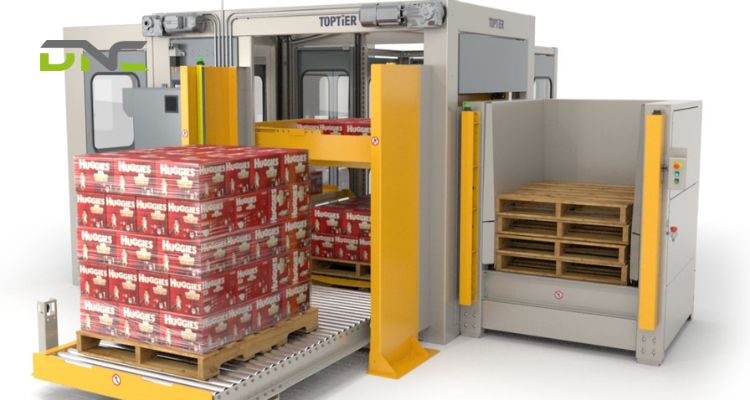
Automated palletizing systems replace manual end-of-line stacking with robotic, mechanical, or hybrid automation — handling 8–60 cases per minute at consistent quality while eliminating 4–8 workers per shift from the most physically demanding station on the packaging line. For Malaysian manufacturers confronting structural labour shortages (200,000+ unfilled manufacturing positions), rising minimum wages, and NIMP 2030 smart factory mandates, automated palletizing delivers the fastest end-of-line automation ROI — typically 12–36 months depending on system type and labour cost displacement. This guide covers the full spectrum of automated palletizing technology, integration architecture, ROI modelling, and implementation strategy for Malaysian F&B, pharmaceutical, chemical, and consumer goods operations. DNC Automation — as a Comau robotics partner and Siemens controls integrator — designs automated palletizing solutions that connect end-of-line packaging to the broader smart factory ecosystem.
What Is an Automated Palletizing System?
An automated palletizing system is a production line subsystem that receives finished products from upstream packaging operations and stacks them onto pallets in programmed patterns without direct human intervention. The system encompasses the infeed conveyor, product orientation and layer formation equipment, the palletizing mechanism itself (robot, mechanical layer former, or gantry), pallet handling (dispenser and discharge), and the control system coordinating all components.
The automation spectrum ranges from semi-automated (operator loads products to a staging area; machine builds the pallet) to fully automated (products flow from the production line through palletizing, wrapping, and labelling with zero human touch). Most Malaysian installations target full automation for the palletizing cell itself, with manual intervention only for pallet removal and stretch wrapping — though fully integrated end-of-line automation is increasingly common.
Automated palletizing differs from manual palletizing in three measurable dimensions: speed (8–60 cases/minute versus 4–8 manual), consistency (zero stacking errors versus 2–5% manual error rate), and endurance (24/7 operation versus 8-hour shifts with fatigue degradation). These three advantages compound into significant operational and financial benefits that justify the capital investment.
The Malaysian market for automated palletizing equipment has grown 15–20% annually since 2020, driven by post-pandemic labour uncertainty, government automation incentives, and the demonstrated ROI of early adopters. DNC Automation has seen palletizing project enquiries from Malaysian manufacturers triple since 2022 — spanning F&B, pharmaceutical, chemical, and general manufacturing sectors.
How Does an Automated Palletizing System Work?
System Architecture
An automated palletizing system operates as a coordinated subsystem within the production line:
Infeed section: Products arrive on conveyor(s) from the upstream packaging line. Sensors detect product presence, orientation, and spacing. Accumulation zones buffer 30–120 seconds of production output to absorb rate variations between the packaging line and palletizer.
Orientation and singulation: Products are oriented (rotated 0° or 90° as needed for the layer pattern) and singulated (separated into individual units or grouped into rows). Mechanical turntables, pusher systems, or robotic pick-and-rotate operations handle orientation.
Layer formation: Individual products or rows are assembled into complete layers matching the pallet footprint. The layer pattern — column stack, interlocked, pinwheel, or custom — is programmed into the palletizer’s control system.
Palletizing (layer placement): The formed layer is transferred onto the pallet. Mechanical sweep systems slide the layer from a forming table; robotic arms pick and place individual products or complete rows; gantry heads pick complete layers.
Inter-layer operations: Optional slip sheet placement between layers (for stability or product separation), layer compression (pressing layers together for stability), and pattern verification (vision system confirming correct placement).
Pallet handling: Empty pallet dispensers feed pallets from a magazine (10–15 pallets). Full pallet discharge via roller or chain conveyor moves completed pallets to wrapping, labelling, or forklift pickup.
Control system: PLC-based controller (DNC Automation specifies Siemens S7-1500) managing sequence logic, recipe management (stacking patterns per product), fault handling, and HMI interface. WMS/MES integration enables automated recipe selection based on production order.
Integration with Production Line
Automated palletizing must synchronise with the upstream production line speed. If the palletizer operates slower than the packaging line, products accumulate and eventually halt production. If faster, the palletizer waits for products — under-utilising the investment.
Line balancing approach: DNC Automation sizes palletizer throughput at 120–150% of the peak packaging line speed — providing a 20–50% buffer for rate variations, product changeover periods, and accumulated product after brief line stops. This buffer prevents the palletizer from becoming the production bottleneck.
Multi-Line Palletizing
Many Malaysian factories operate multiple packaging lines sharing a single palletizer. A robotic palletizer with sufficient reach and speed can serve 2–4 infeed conveyors, picking products from different lines and building pallets for each line simultaneously. This multi-line configuration maximises robot utilisation and reduces the per-line automation cost by 50–70%.
DNC Automation designs multi-line palletizing cells with intelligent conveyor routing — products from each line are tracked by barcode or RFID, and the robot’s control system selects the correct stacking pattern and destination pallet for each product automatically.
Types of Automated Palletizing Systems
Conventional Mechanical Palletizer
High-speed layer-forming machines using mechanical sweeps, row pushers, and pattern tables. Products are oriented, grouped into rows, assembled into layers, and swept onto the pallet in a continuous mechanical cycle.
Speed: 15–60 cases/minute
Ideal for: High-speed, single-SKU production lines (beverages, canned goods, uniform cartons)
Investment: RM 500,000–2,000,000
Strengths: Highest throughput; lowest cost per case palletized at high volumes
Weaknesses: Large footprint; slow mechanical changeover (30–60 min); single-SKU optimised
Robotic Palletizer (Articulated Arm)
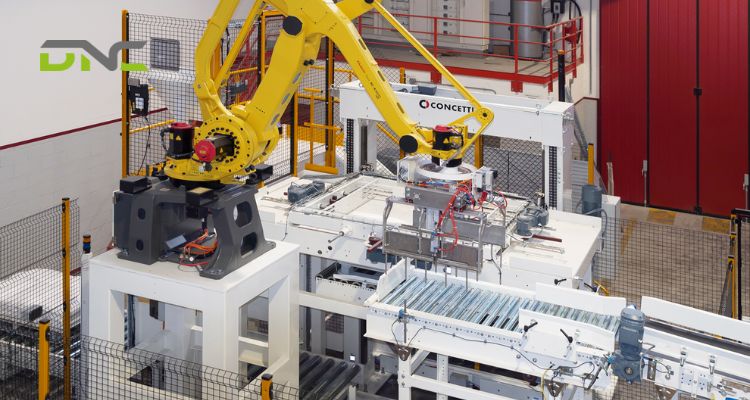
Industrial robots (Comau, FANUC, ABB, KUKA) with custom EOAT pick products from infeed and place them on pallets in programmed patterns. Software-defined pattern changes enable multi-SKU operation.
Speed: 8–30 cases/minute per robot
Ideal for: Multi-SKU lines, frequent changeover, mixed product types
Investment: RM 400,000–1,500,000
Strengths: Maximum flexibility; software changeover; compact footprint; multi-line capable
Weaknesses: Lower peak speed than conventional; requires safety fencing
Cobot Palletizer
Collaborative robots (Doosan, Universal Robots, FANUC CRX) operating without safety fencing. Force-limited operation per ISO/TS 15066.
Speed: 5–15 cycles/minute
Ideal for: SME manufacturers; low-medium throughput; space-constrained facilities
Investment: RM 150,000–500,000
Strengths: Lowest cost; smallest footprint; no fencing; easy programming
Weaknesses: Lower speed and payload; limited reach
Gantry Palletizer
Overhead cartesian gantry with XYZ motion. Picks from infeed and places on one or more pallets within the gantry envelope.
Speed: 5–20 cases/minute
Ideal for: Heavy products; multi-pallet operation; limited floor space
Investment: RM 300,000–1,200,000
Strengths: Handles very heavy loads (up to 500 kg/pick); multi-pallet serving
Weaknesses: Slower than articulated robots; requires overhead structure
Hybrid System
Combination of conventional layer forming with robotic layer placement — the layer former builds complete layers at high speed; the robot transfers formed layers onto the pallet. This hybrid approach achieves conventional palletizer speeds with robotic flexibility for layer orientation and multi-pallet operation.
Speed: 15–40 cases/minute
Investment: RM 600,000–2,500,000
Best for: High-speed multi-SKU lines requiring both speed and flexibility
Benefits of Automated Palletizers
Key Components
Robot / Palletizing Machine
The core automation unit. Articulated robots offer 4-axis (SCARA-type, for simple pick-place) or 6-axis (full articulation, for complex orientation) configurations. Payload range: 20 kg (cobot) to 700 kg (heavy industrial). DNC Automation specifies Comau robots for industrial palletizing (leveraging our exclusive Southeast Asia partnership) and Doosan cobots for collaborative applications.
End-of-Arm Tooling (EOAT)
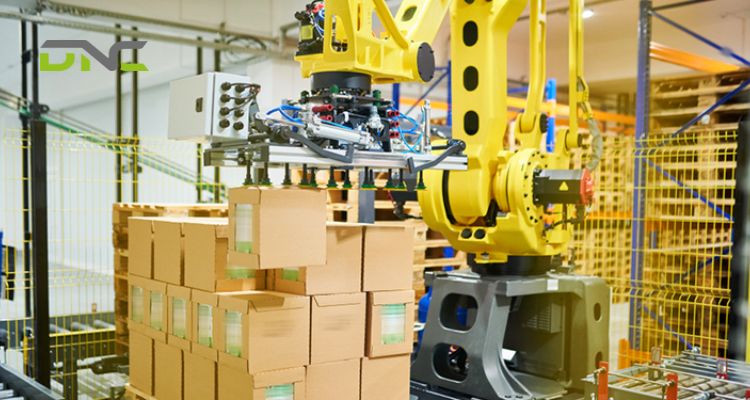
Custom-designed gripper interfacing between the robot and the product. Vacuum grippers (most common for cartons), clamp grippers (bags, irregular shapes), fork grippers (pails, drums), and multi-function grippers (handling multiple product types without tool change). EOAT design is often the most critical engineering decision in a robotic palletizing project — DNC Automation designs and fabricates EOAT in-house.
Infeed Conveyor System
Roller, belt, or chain conveyors matched to product type and line speed. Accumulation zones, diverters, and orientation devices upstream of the palletizer. DNC Automation’s extensive conveyor engineering expertise ensures seamless material flow from packaging to palletizing.
Pallet Handling System
Empty pallet dispenser (magazine-fed, 10–15 pallets), pallet centering guides, and full pallet discharge conveyor. Optional: automated pallet labelling and stretch wrapping integration.
Safety System
Industrial robots: perimeter fencing (mesh panels, interlocked access gates), light curtains at product entry/exit openings, area scanners, and emergency stop circuits per ISO 13849. Cobots: built-in force/speed limiting per ISO/TS 15066, risk assessment documentation.
Control and Software
PLC (Siemens S7-1500, Allen-Bradley, Mitsubishi) + HMI touchscreen. Recipe management for multiple stacking patterns. Data logging for OEE (Overall Equipment Effectiveness), throughput tracking, and fault analysis. MES/WMS integration for automated recipe selection and production reporting.
Applications in Malaysian Manufacturing
Food and Beverage
The largest palletizing automation segment in Malaysia. F&B production lines run 10–40 cases/minute — exceeding manual palletizing capacity. Products: cartons of beverages, canned food, packed cooking oil, dairy products, snack foods. DNC Automation has delivered automated palletizing for Malaysian F&B companies including edible oil producers (Siemens integration) and food manufacturers.
Pharmaceutical
GDP-compliant palletizing requires consistent pallet configurations, batch traceability, and gentle product handling. Robotic palletizers with force-controlled EOAT and vision-verified placement meet pharmaceutical quality standards. Serialisation data (carton-level barcode) is captured during palletizing for track-and-trace compliance.
Chemical and Petrochemical
Bag palletizing (25–50 kg chemical bags) is the most physically demanding manual packaging operation. Automated bag palletizers handle 8–15 bags/minute — replacing 6–8 workers per shift while eliminating the musculoskeletal injury risk that makes manual bag palletizing a workplace safety concern.
Consumer Goods and FMCG
Multi-SKU production environments (10–50 product variations per line) need the flexibility of robotic palletizers. Software-defined pattern changes handle product changeovers in 2–5 minutes versus 30–60 minutes for mechanical changeover — critical for short production runs that characterise Malaysian FMCG manufacturing.
Building Materials
Cement bags, tile boxes, and heavy construction products require high-payload palletizers. Gantry systems handle 200–500 kg per cycle for heavy building material palletizing.
ROI Analysis for Malaysian Operations
Labour Cost Savings
| Workers Replaced | Monthly Saving (RM) | Annual Saving (RM) |
| 4 per shift (3 shifts) = 12 | 30,000 | 360,000 |
| 6 per shift (3 shifts) = 18 | 45,000 | 540,000 |
| 8 per shift (3 shifts) = 24 | 60,000 | 720,000 |
Based on RM 2,500/month average operator cost including EPF, SOCSO, and management overhead
Additional Savings
- Product damage reduction: 30–50% fewer damaged goods → RM 50,000–200,000/year (depends on product value)
- Throughput increase: 30–100% more cases/hour → additional revenue capacity
- Injury reduction: Elimination of manual lifting injuries → RM 20,000–100,000/year in medical costs, lost time, and SOCSO claims
- Overtime elimination: Automated operation eliminates overtime premiums for end-of-line staffing
ROI Calculator
| System Type | Investment (RM) | Annual Savings (RM) | ROI Period |
| Cobot | 250,000 | 360,000 | 8 months |
| Robotic | 800,000 | 540,000 | 18 months |
| Conventional | 1,200,000 | 720,000 | 20 months |
| Hybrid | 1,500,000 | 720,000 + throughput | 22 months |
Government incentives (MIDA capital allowance, ITA) can reduce effective investment by 20–40%, further accelerating ROI
Malaysian Government Incentives
- MIDA Automation Capital Allowance: Accelerated depreciation for qualifying automation equipment
- Investment Tax Allowance (ITA): Tax relief on qualifying Industry 4.0 capital expenditure
- NIMP 2030 grants: Specific programs for manufacturing automation adoption
- DNC Automation assists with incentive application documentation
Applications of Automated Palletizers
Implementation Strategy
Phase 1: Assessment (2–4 weeks)
DNC Automation conducts a production line assessment covering: current throughput, product specifications, packaging line speed, floor space availability, electrical infrastructure, and labour cost baseline. Deliverable: conceptual design + ROI model.
Phase 2: Design (4–8 weeks)
Detailed engineering: robot selection, EOAT design, conveyor layout, safety system design, control system architecture, WMS integration specification. 3D simulation validates throughput targets before fabrication begins.
Phase 3: Fabrication and Assembly (6–12 weeks)
DNC Automation’s 25,000 sq ft facility enables in-house fabrication of EOAT, conveyor systems, and control panels. Robot programming and system integration testing occur before shipment — reducing on-site commissioning time.
Phase 4: Installation and Commissioning (2–4 weeks)
On-site installation, electrical connection, safety system validation, and production trial runs. Operator and maintenance training included. DNC Automation provides 24/7 support during the initial production ramp-up period.
FAQ — Automated Palletizing System
What is an automated palletizing system?
An automated palletizing system is a production line subsystem that stacks products onto pallets in programmed patterns without manual intervention. It includes infeed conveyors, product orientation/layer formation, the palletizing mechanism (robot, mechanical, or gantry), pallet handling, and a PLC-based control system. Automated palletizers handle 8–60 cases/minute and replace 4–8 manual workers per shift.
How much does automated palletizing cost in Malaysia?
Investment ranges from RM 150,000 (cobot systems) to RM 2,000,000 (high-speed conventional). Robotic palletizing systems — the most commonly specified type in Malaysia — cost RM 400,000–1,500,000 including robot, EOAT, conveyors, safety system, and integration. ROI period: 12–36 months based on labour savings.
Which industries benefit most from palletizing automation?
F&B manufacturing (highest adoption rate in Malaysia), pharmaceutical, chemical/petrochemical, consumer goods/FMCG, and building materials. Any industry with production lines running 8+ cases/minute, 3-shift operations, or manual palletizing involving 25+ kg product handling benefits from automation.
Can automated palletizers handle multiple products?
Robotic and cobot palletizers handle multiple products through software pattern changes — changeover in 2–5 minutes. Multi-tool EOAT designs handle different product shapes without physical tool changes. Conventional mechanical palletizers handle multiple products but require mechanical changeover (30–60 minutes). For operations with 5+ product types and frequent changeovers, robotic systems deliver the best total productivity.
How long does palletizing automation installation take?
Total project timeline: 14–28 weeks from assessment to production. Breakdown: assessment 2–4 weeks, detailed design 4–8 weeks, fabrication 6–12 weeks, installation and commissioning 2–4 weeks. DNC Automation overlaps design and fabrication phases to compress timelines. Emergency retrofit projects can be completed in 10–12 weeks with expedited procurement.
Do I need to modify my existing production line?
Most palletizing systems connect to the existing production line through an infeed conveyor extension — no modification to the packaging line itself. The palletizer installs at the end of the line, receiving products from the existing conveyor discharge. Electrical infrastructure (power supply, compressed air) may require upgrade if the existing facility lacks capacity. DNC Automation surveys infrastructure requirements during the assessment phase.
Conclusion
Automated palletizing systems deliver the most accessible, fastest-payback automation investment available to Malaysian manufacturers. Whether the entry point is a RM 150,000 cobot or a RM 2,000,000 high-speed conventional system, the labour savings, throughput increase, injury elimination, and pallet quality improvement generate measurable ROI within 12–36 months.
DNC Automation designs automated palletizing solutions across the full technology spectrum — Comau industrial robots, Doosan cobots, conventional mechanical systems, and gantry platforms. Our 20+ years of automation expertise, in-house EOAT design capability, and Siemens control system integration ensure every palletizing project delivers production-line performance from day one.
- 73 views
- 0 Comment
Recent Comments