


E-Commerce Fulfillment Warehouse Design Guide | DNC Automation
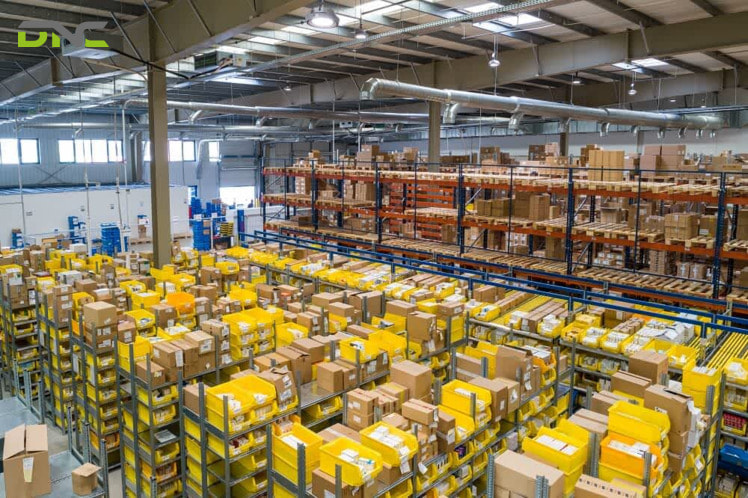
Ecommerce fulfillment warehouse design is the structured process of configuring space, storage systems, automation technology, and control architecture to support high-volume individual order processing – and decisions made at the design stage determine whether the facility sustains throughput as order volumes grow. Unlike bulk distribution warehouses that handle pallet-in, pallet-out workflows, ecommerce fulfillment warehouses process thousands of individual picks per day across a wide SKU range, with returns volumes reaching approximately 30% of outbound orders and demand patterns that shift with promotions, seasonal cycles, and business growth.
This guide covers the functional zones every ecommerce fulfillment warehouse requires, the racking and storage systems suited to high-SKU environments, the automation technologies – conveyors, robotic picking, ASRS – that scale throughput without proportional labor increases, and how WMS and PLC control architecture ties these systems together. For Malaysian operators, the guide addresses investment context, NIMP 2030 grant positioning, and the turnkey integration scope that separates a well-engineered facility from one assembled piecemeal.
What Ecommerce Fulfillment Warehouse Design Covers
Ecommerce fulfillment warehouse design is the engineering and operational discipline that determines how a warehouse is physically configured to support order receipt, storage, picking, packing, and dispatch for online retail channels. The central challenge it addresses is structural: ecommerce order profiles are fundamentally different from bulk or wholesale warehousing.
Where a bulk distribution center receives and dispatches full pallets, an ecommerce fulfillment warehouse processes thousands of individual orders – often one to two items per order – under delivery commitments of one to two business days. This shifts the design requirement from pallet-flow efficiency to single-item pick speed, accuracy, and throughput at scale.
Effective ecommerce fulfillment warehouse design integrates four elements: functional zone layout that separates receiving, storage, pick/pack, and dispatch without bottlenecks; storage systems matched to SKU volume and product characteristics; automation technology that scales picking and sorting capacity; and a control layer – WMS, SCADA, and ERP integration – that provides real-time inventory visibility across all order channels.

How Ecommerce Order Profiles Shape Warehouse Design Decisions
Ecommerce order profiles shape warehouse design decisions at every level – from zone sizing and racking selection to automation scope and control architecture. Four order profile characteristics create the most significant design constraints.
Order profile analysis is the starting point for every ecommerce fulfillment warehouse design project. Without it, zone sizing, racking selection, and automation scope are all guesswork.
Order Volume and Single-Line Pick Frequency
Order volume and single-line pick frequency are the two metrics that define the pick workload of an ecommerce facility. A warehouse shipping 5,000 orders per day at 1.5 items per order generates 7,500 individual pick events – each requiring a separate location visit, pick, and verification. This pick density drives the layout requirement for fast, direct access to the full SKU range, with the most frequently ordered SKUs positioned at the shortest travel distance from the packing station.
SKU velocity analysis – identifying which products move fastest – is the data input that makes slotting strategy possible.
SKU Range and Product Mix Complexity
Ecommerce operations carry a wider SKU range than comparable bricks-and-mortar retail, with frequent additions as categories expand. Storage systems must accommodate varying product dimensions, weights, and fragility levels within the same facility. Slotting logic assigns locations based on velocity, size, and pick compatibility rather than product category alone. A WMS-driven dynamic slotting system resequences pick locations as velocity data updates, keeping fast-movers near the pick face without manual replanning.
SKU range complexity determines storage system selection. Returns volume, covered next, determines whether a fifth zone is load-bearing or residual.
Returns Processing as a Design Constraint
Returns in ecommerce account for approximately 30% of outbound orders across most product categories. A fulfillment warehouse without dedicated returns processing space finds that the reverse flow competes directly with the pick-and-pack operation for space, staff, and system attention. Returns processing requires four steps: inspection, grading, re-labeling, and restocking – a workflow that needs its own zone, conveyor feed, and WMS routing logic to keep returned inventory out of the active pick face until it passes inspection.
Returns volume scales with order volume. The facility must also accommodate the growth that drives both flows.
Rapid Growth and Layout Scalability
Ecommerce operations scale quickly – doubling order volume within 12 to 18 months is not uncommon in high-growth markets. A fulfillment warehouse designed at current throughput without scalability provisions faces physical reconfiguration under growth pressure, which disrupts operations while they are already at peak load. Scalable design means modular racking configurations that extend vertically, automation systems with defined expansion paths, and a WMS architecture that supports additional pick zones and order channels without replacing the core platform.
These four order profile characteristics translate directly into physical space requirements – and physical space is where the warehouse layout begins.

Functional Zones in an Ecommerce Warehouse Layout
An ecommerce warehouse layout organizes the facility into dedicated functional zones that separate each stage of the order fulfillment process. Zone sequence determines traffic flow – and traffic flow determines whether pickers, forklifts, and inbound pallets can move simultaneously without congestion bottlenecks.
Three layout shapes apply to ecommerce fulfillment warehouse design: U-shaped (inbound and outbound on the same wall, storage in the center), I-shaped (inbound on one end, outbound on the opposite), and L-shaped (a variation for irregular building footprints). The U-shaped layout is the most common choice for mid-sized facilities – it consolidates dock doors, reduces forklift travel, and keeps the picking zone central. Within any layout shape, five functional zones follow a fixed operational logic.
The sequence begins at the point goods enter the facility.
Inbound Receiving and Quality Check Zone
The receiving zone is where inbound stock is unloaded, counted, inspected, and scanned into the WMS before put-away. Receiving is positioned at dock doors or inbound bays with sufficient staging space for pallets awaiting processing. For ecommerce operations handling a high SKU count, receiving workflow speed directly affects how quickly new stock becomes available for picking – a critical factor during promotional or seasonal demand peaks.
Once goods pass receiving inspection, the storage zone determines how they are held until picked.
Storage Zone
The storage zone occupies the largest footprint in an ecommerce fulfillment warehouse and is where racking system selection has the most direct impact on facility performance. Storage density, pick path efficiency, and scalability all originate from decisions made about this zone. Storage is subdivided by velocity: fast-moving SKUs are stored nearest to the pick and pack zone; slow-movers are assigned to higher racks or deeper locations accessed less frequently.
Products move from the storage zone into the pick and pack zone for order assembly.
Pick and Pack Zone
The pick and pack zone is where order assembly and packaging occur. In ecommerce fulfillment, this zone is the operational bottleneck point – pick speed and accuracy here determine order cycle time and error rate. Pick stations are positioned adjacent to the storage zone to minimize picker travel. Packing tables, cartonization systems, and label printers are co-located so that a picked order moves directly to packaging without a separate transfer step.
Completed orders move from pack to the dispatch zone for staging and shipment loading.
Dispatch and Staging Zone
The dispatch zone holds packed orders organized by carrier, delivery window, or route before loading. Staging capacity must match peak outbound volume – insufficient staging space causes completed orders to back up into the pack area. The dispatch zone is positioned adjacent to outbound dock doors, with WMS-managed staging sequences that sort orders by carrier manifest automatically.
Returns enter through a dedicated zone that keeps the reverse flow separated from the forward operation.
Returns Processing Zone
The returns zone handles inbound returned goods through a four-step process: receipt, inspection, grading, and restock or quarantine. Positioning the returns zone near the inbound dock – but physically separated from new stock receiving – prevents mixing of new and returned inventory at the scanning stage. A dedicated returns conveyor feeding back into the storage zone, controlled by WMS routing logic, restocks sellable returns without manual intervention at each item.
With the five zones defined and sequenced, the next design decision is what storage system fills the largest of them – the storage zone itself.

Racking and Storage Systems for Ecommerce Operations
Ecommerce warehouse racking selection balances two competing requirements: storage density – storing the maximum SKU count in the available footprint – and pick accessibility – ensuring every SKU is reachable quickly without moving adjacent stock. The right system depends on SKU count, product dimensions, velocity distribution, and whether automation is planned for the storage zone.
The most common starting point is selective racking – suited to the widest range of product types and the most flexible for future reconfiguration.
Selective Pallet Racking
Selective pallet racking provides direct access to every pallet position from the aisle, making it the default storage system for ecommerce warehouses handling bulk-stored products and palletized inbound stock. It accommodates standard and non-standard pallet sizes and integrates with all standard forklift and reach truck equipment. The limitation is aisle space: each rack row requires a dedicated access aisle, reducing storage density compared to higher-density alternatives.
For SKUs stored at carton or item level rather than pallet level, carton flow systems provide better pick ergonomics.
Carton Flow and Shelving Systems
Carton flow racking uses gravity rollers to present cartons at the pick face, with replenishment from the rear. This first-in-first-out design keeps the pick face stocked without picker interference during replenishment and suits fast-moving ecommerce SKUs stored at carton level. For facilities with a high proportion of small-item picks, light-duty shelving at ergonomic picking height – combined with barcode or pick-to-light guidance – reduces pick time and error rate at the individual item level.
Where floor space is the constraint, mezzanine structures extend usable storage vertically within the existing building envelope.
Mezzanine Storage
Mezzanine storage systems create additional floor levels within an existing warehouse structure, doubling or tripling usable storage area within the same building footprint. In ecommerce fulfillment warehouse design, mezzanines locate shelving-based item pick zones on upper levels while bulk pallet storage remains at ground level. The structural load requirements of mezzanine installation require engineering assessment of floor loading capacity and column positions before specification – this is a structural engineering input, not a racking selection decision.
At the highest level of storage density, AS/RS replaces the racking-plus-aisle model with a compact robotic storage grid.
Automated Storage and Retrieval Systems (AS/RS)
Automated storage and retrieval systems remove the aisle space conventional racking requires, storing 2 to 4 times (200–400%) more SKUs in the same floor footprint. AS/RS presents items to stationary pick ports rather than directing pickers into aisles – a design that eliminates picker travel time entirely and maintains consistent throughput regardless of order volume peaks. Integration with the facility WMS enables real-time inventory location, dynamic slotting, and automated replenishment sequencing without manual intervention. DNC Automation designs and commissions warehouse automation systems – including AS/RS integration – as part of turnkey fulfillment centre projects for Malaysian operators.
Summary – Ecommerce Fulfillment Warehouse Design: Zones and Storage: The five functional zones of an ecommerce fulfillment warehouse – inbound receiving, storage, pick and pack, dispatch staging, and returns processing – create the spatial framework that all other design decisions build on. Zone sequence determines traffic flow; traffic flow determines throughput capacity. Within the storage zone, four racking system types address different combinations of density and pick accessibility: selective pallet racking for flexible general-purpose storage, carton flow for fast-moving SKUs at the pick face, mezzanine systems for vertical space utilization, and AS/RS for maximum density at 2 to 4 times (200–400%) conventional racking capacity. System type selection is driven by SKU count, velocity distribution, and whether automation is planned for the storage zone – decisions that must be made at the design phase, not during commissioning.
Fulfillment Centre Automation Technologies
Fulfillment centre automation connects the physical storage system to the order management layer through machines that move, sort, and direct products without manual handling. Three automation technology categories apply directly to ecommerce fulfillment warehouse design: conveyor and sortation, robotic picking, and WMS-driven integration.
The movement backbone of an automated fulfillment centre is the conveyor system.
Conveyor and Sortation Systems
Conveyor and sortation systems carry products between zones – from receiving to storage, from pick stations to packing, from packing to dispatch. In a fulfillment centre handling high pick volumes, a conveyor system replaces manual trolley transport and removes the variable travel speed of individual pickers from the throughput equation.
Sortation conveyors – using tilt trays, pop-up wheels, or shoe sorters – automatically route items or cartons to their assigned packing station or dispatch lane based on real-time WMS order data, at speeds manual sortation cannot sustain.
Robotic systems extend automation further, replacing the human pick action at the item level.
Robotic Picking and Palletizing
Robotic picking systems deploy articulated arms or gantry arms to pick individual items from shelving, bins, or conveyor feeds. In ecommerce environments, robotic picking addresses the labor intensity of high-volume single-item picks – a repetitive, high-frequency task that is well-suited to automation without the variability introduced by manual handling. DNC Automation’s robotic solutions cover item-level picking cells and end-of-line palletizing for outbound dispatch – the two robotic applications with the highest throughput ROI in a fulfillment centre context.
All automation technologies perform at the level their control architecture supports.
WMS-Driven Automation Integration
WMS-driven automation integration determines how intelligently each piece of equipment responds to live order data. A conveyor running without WMS integration moves product. A conveyor integrated with WMS routing logic moves the right product to the right location based on live order data. The smart manufacturing integration model DNC Automation applies to fulfillment projects connects PLC machine control, SCADA facility visibility, and WMS order data through a unified control architecture – so each automation layer responds to order status rather than operating as an isolated machine.
The automation layer executes at the machine level. The WMS and control architecture above it determines what the machines are instructed to do – and how that instruction connects to every other system in the facility.
WMS and Control Architecture for Ecommerce Warehouses
A warehouse management system coordinates every operational process in an ecommerce fulfillment warehouse: receiving, put-away, pick path optimization, packing, dispatch, and returns. WMS integration is the point at which the physical warehouse – racks, conveyors, robots, dock doors – becomes an intelligent order fulfillment system rather than a collection of separate machines and areas.
The WMS connects outward in four directions. It connects to the ecommerce platform – Shopify, Magento, or marketplace APIs – to receive orders in real time. It connects to the ERP system for inventory value and procurement visibility. It connects to carrier APIs for label generation and shipment booking. It connects to the automation layer – PLC-controlled conveyors, sortation systems, and AS/RS – via OPC-UA or proprietary interface to direct machine action at the item and order level.
For operators running multiple sales channels – own website, marketplace listings, and B2B wholesale – the WMS provides a single shared inventory pool, preventing overselling and enabling accurate available-to-promise data at checkout.
Control architecture for an ecommerce fulfillment warehouse is specified during the design phase. Retrofitting integration architecture after equipment installation generates commissioning delays and interface gaps between systems that were not scoped together. Defining which systems connect, which data points are exchanged, and which processes are automated is a design-phase deliverable – not a procurement decision made after the racking goes up.
3PL Warehouse Design: Multi-Client Layout Principles
3PL warehouse design applies the same functional zone logic as a dedicated ecommerce fulfillment warehouse, with an additional complexity layer: the facility serves multiple clients whose inventory, order flows, and system requirements are physically and logically separated within the same building.
Client segregation in a 3PL warehouse is achieved through dedicated storage zones – either fixed rack sections assigned per client or dynamic allocation managed by the WMS. Fixed segregation is simpler to manage and audit; dynamic allocation improves storage utilization when client volumes fluctuate. The choice depends on client contract terms, regulatory requirements for stock separation, and WMS zone management capabilities.
In a 3PL warehouse, outbound lanes, packing stations, and staging areas are either dedicated per client or shared with routing logic that prevents cross-client mix. 3PL billing integration requires the WMS to log every operational event at the client-SKU level: each pick, pack, pallet movement, and storage slot used per client – not just order-level totals.
For Malaysian 3PL operators adding ecommerce clients to an existing facility, the design challenge is typically retrofitting ecommerce-compatible picking and automation infrastructure into a building originally designed for pallet-in, pallet-out bulk logistics. DNC Automation’s turnkey approach assesses the existing layout, designs the zone reconfiguration, and commissions the automation and control systems as a single integrated project rather than a series of disconnected vendor engagements.
Setting Up an Online Retail Warehouse in Malaysia: Investment and Scope
Malaysian online retail operators setting up a fulfillment warehouse face a market context that has strengthened the case for automation over the past three years. Labor availability in the warehouse and logistics sector has tightened, wage costs continue rising under minimum wage revisions, and customer delivery expectations in major urban markets have compressed from three to five days to next-day or same-day.
A fulfillment warehouse setup in Malaysia – including racking, conveyor infeed, a basic automation layer, and WMS integration – involves capital investment that varies significantly based on automation level and building footprint. Entry-level configurations with selective racking and basic conveyor systems are accessible at lower capex. Fully automated fulfillment centres with AS/RS, robotic picking, and integrated WMS represent a larger investment with a 2 to 4 year payback period (24–48 months) achievable at mid-to-high sustained order volumes.
The NIMP 2030 policy framework supports this investment through MIDA automation grants and Industry 4.0 tax incentives available to Malaysian manufacturers and logistics operators between 2024 and 2028. Operators that implement automation during this window access better economics on the capital investment than those who delay until the grant window closes.
DNC Automation has delivered over 1,000 automation projects across Malaysian manufacturing and logistics over 20 years, with 35+ engineers and an in-house 25,000 sq ft production facility. Warehouse automation projects are delivered as turnkey scope – from layout design and racking supply through conveyor installation, PLC/SCADA integration, and WMS commissioning – through a single engineering contract that eliminates the integration gaps generated by multi-vendor procurement.
For a warehouse design assessment or investment scoping, talk to DNC Automation’s engineers.
Frequently Asked Questions
The questions below address the most common decision points facility managers and logistics operators raise when evaluating ecommerce fulfillment warehouse design.
What is the difference between an ecommerce fulfillment warehouse and a distribution center?
An ecommerce fulfillment warehouse processes individual customer orders – typically one to three items – for direct dispatch to consumers, with cycle times measured in hours. A distribution center processes bulk wholesale orders to retail stores or logistics hubs, moving full pallets or large cartons with longer cycle times. The design requirements differ at every level: fulfillment warehouses prioritize single-item pick speed and high SKU accessibility; distribution centers prioritize pallet throughput and bulk storage density.
What warehouse layout is best for ecommerce fulfillment?
The U-shaped layout is the most commonly specified configuration for ecommerce fulfillment warehouses – it positions inbound and outbound docks on the same wall, keeps the storage and pick zone central, and minimizes forklift travel between zones. I-shaped layouts suit facilities with high-volume linear flow where inbound and outbound volumes are balanced. The optimal layout depends on building shape, dock door positions, and the ratio of inbound to outbound volume at your specific facility.
How many functional zones does an ecommerce fulfillment warehouse need?
A correctly designed ecommerce fulfillment warehouse requires five functional zones: inbound receiving, storage, pick and pack, dispatch staging, and returns processing. Each zone must be physically sized for its peak workload – receiving for peak inbound volume, returns for peak return volume, dispatch staging for peak outbound. Undersizing any single zone creates a bottleneck that propagates through the entire facility operation.
When does ecommerce fulfillment warehouse automation become cost-justified?
Automation is cost-justified when manual labor costs, order volume, and error rates reach the point where the payback period falls within 2 to 4 years. For Malaysian operators, this threshold is typically reached at sustained daily pick volumes above 500 to 1,000 picks per shift, or where SKU count exceeds practical manual slotting management. NIMP 2030 grants available through 2028 improve the economics further by reducing the effective capital cost of the investment.
What should a turnkey ecommerce warehouse design project include?
A turnkey ecommerce fulfillment warehouse design project covers layout design and zone planning, racking system supply and installation, conveyor and sortation system commissioning, robotic picking or AS/RS integration where applicable, PLC and SCADA control architecture, WMS selection and integration, and full system testing and operator training before handover. Projects assembled from multiple separate vendors – racking from one, automation from another, WMS from a third – typically generate integration gaps that surface as commissioning-phase downtime.
- 135 views
- 0 Comment
Recent Comments