


Pallet Racking System: Complete Guide for Malaysian Warehouses
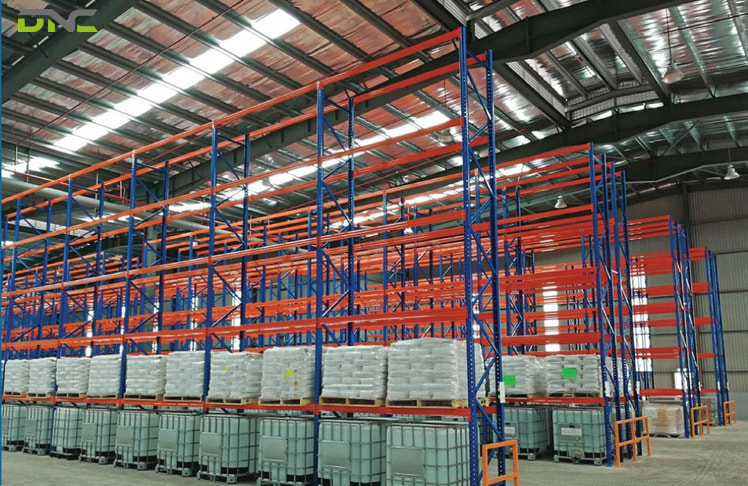
Pallet racking systems form the structural backbone of every high-performing warehouse in Malaysia — from automotive parts distribution centres in Shah Alam to cold-chain facilities serving the F&B sector in Johor Bahru. A correctly specified racking system increases storage density by up to 85%, cuts picking time by 30–40%, and delivers full ROI within 18–24 months. This guide covers every type, component, specification, and selection criterion that Malaysian factory managers and warehouse operators need before committing capital to a pallet racking investment. DNC Automation has designed and integrated warehouse storage solutions across 1,000+ projects in 20+ years — the insights here reflect that field experience.
What Is a Pallet Racking System?
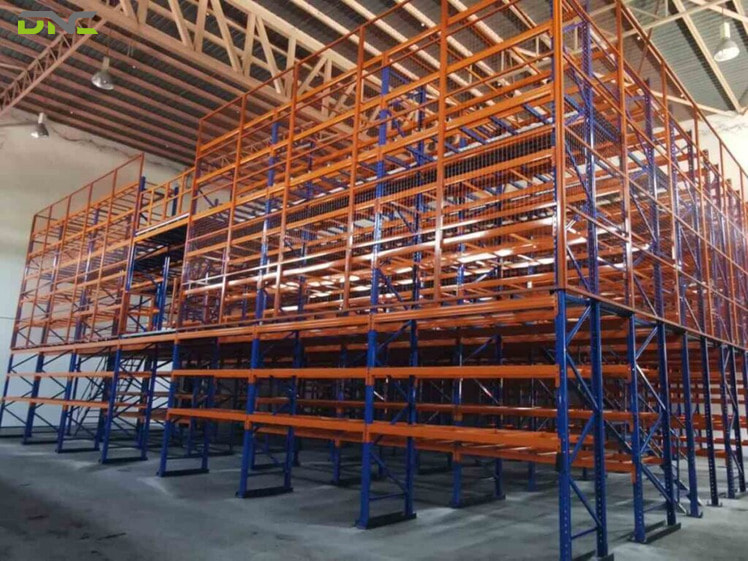
Pallet racking systems are engineered steel frameworks designed to store palletised goods in horizontal rows across multiple vertical levels. Each system uses upright frames, load beams, and optional decking to create defined storage positions accessible by forklifts, reach trucks, or automated retrieval equipment.
A standard selective pallet rack in a Malaysian warehouse holds between 1,000 kg and 3,500 kg per beam level, with frame heights ranging from 3 metres in low-ceiling facilities to 12 metres or more in purpose-built distribution centres. The standard pallet size in Malaysia follows the ISO 1200 × 1000 mm footprint — the same dimension used across most ASEAN logistics networks.
Pallet racking differs from shelving systems in three fundamental ways: load capacity (tonnes versus kilograms), access method (forklift-operated versus manual), and structural engineering requirements (bolted steel columns versus bolt-free clip assemblies). Industrial pallet racking systems serve manufacturing, logistics, retail distribution, pharmaceutical, and cold-storage operations — any environment where palletised inventory must be stored vertically, accessed efficiently, and rotated according to FIFO or LIFO protocols.
The system’s value extends beyond simple storage. A well-designed warehouse pallet racking system integrates with warehouse management software (WMS), barcode scanning, and IoT-based inventory tracking to deliver real-time stock visibility — a core requirement under Malaysia’s National Industrial Master Plan (NIMP 2030) push toward smart manufacturing.
How Does a Pallet Racking System Work?
Pallet racking operates on a straightforward mechanical principle: vertical steel frames support horizontal beams at adjustable heights, creating shelf levels where pallets sit. The engineering behind this principle, however, determines whether a racking system handles 500 kg per level or 5,000 kg — and whether it lasts 5 years or 25.
Load Transfer Mechanism
Every pallet racking system transfers load through a specific path: pallet weight moves from the beam surface to the beam connector, through the upright column, down the base plate, and into the warehouse floor slab. Engineers calculate this load path to ensure no single component exceeds its rated capacity. In our 20+ years of warehouse projects, we have seen racking failures caused by one recurring mistake — operators exceeding beam capacity without adjusting the frame gauge.
Beam-to-Upright Connection
The connection between beams and uprights defines the system’s structural integrity. Most modern systems use a hook-in or bolted connector that locks into slots punched along the upright column. This design allows beam height adjustments in 50 mm or 75 mm increments — critical for warehouses storing mixed pallet heights. The connector type also determines how quickly a warehouse team can reconfigure storage levels; hook-in connectors take under 5 minutes per beam adjustment versus 15–20 minutes for fully bolted systems.
Forklift Interaction
Pallet racking systems are designed around the forklift type that will operate within them. Counterbalance forklifts require aisle widths of 3.5–4.0 metres; reach trucks reduce this to 2.5–3.0 metres; and very narrow aisle (VNA) trucks operate in aisles as tight as 1.6 metres. The aisle width directly affects storage density — choosing VNA trucks over counterbalance forklifts can increase pallet positions by 40–50% within the same floor area. DNC Automation’s warehouse layout engineering factors forklift turning radius, mast height, and load centre into every racking design to prevent costly retrofits.
Safety Interlocks and Compliance
Malaysian warehouses must comply with DOSH (Department of Occupational Safety and Health) guidelines and FEM/EN 15512 or AS 4084 racking design standards. A compliant pallet racking system includes base plate anchoring to the concrete slab, column protectors at aisle ends, beam safety clips preventing accidental dislodgement, and load signage at every bay. Seismic considerations apply in East Malaysia (Sabah) where higher lateral force requirements affect frame bracing design.
Types of Pallet Racking Systems
Pallet racking systems divide into seven primary categories, each optimised for a specific balance of storage density, access speed, and stock rotation method. The right type depends on your SKU count, throughput volume, and inventory management protocol.
Selective Pallet Racking
Selective racking is the most widely installed system in Malaysian warehouses — and for good reason. Every pallet position is directly accessible from the aisle, enabling 100% selectivity with zero need to move other pallets first. The system uses a simple frame-and-beam configuration, costs the least per pallet position, and accommodates mixed SKUs on every level.
Best for: Warehouses with high SKU variety and moderate pallet volume per SKU. Typical applications include automotive spare parts, electronics distribution, and general FMCG warehousing.
Specifications: Beam levels adjustable every 50 mm; frame heights 3–12 m; beam capacity 1,000–3,500 kg per pair; aisle width 2.5–4.0 m depending on forklift type.
Limitation: Selective racking uses approximately 45–50% of floor area for aisles, making it the least space-efficient option for high-volume, low-SKU operations.
Double Deep Pallet Racking
Double deep racking places two pallets deep on each side of the aisle, effectively doubling storage density compared to selective racking while still maintaining reasonable access. A deep-reach forklift or double-deep reach truck is required to place and retrieve the back pallet.
Best for: Operations with 10–20 SKUs per product group and moderate stock rotation requirements. Food manufacturers storing raw ingredients, for example, benefit from double deep’s density-to-access balance.
Specifications: Requires double-deep reach trucks with 1,200 mm extended fork reach; reduces aisle count by up to 50%; typical bay depth 2,400–2,800 mm.
Limitation: The back pallet is only accessible after the front pallet is removed, creating partial selectivity (approximately 50%).
Drive-In and Drive-Through Racking
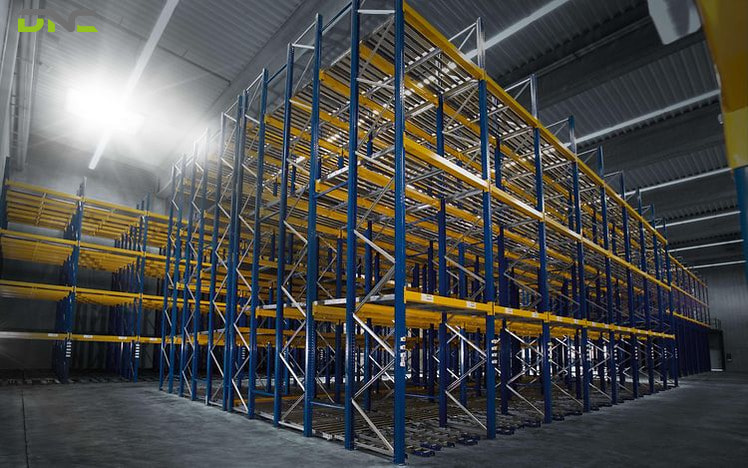
Drive-in racking allows forklifts to enter the rack structure itself, driving along rail guides to place pallets on support arms at multiple levels. Drive-in systems operate on a LIFO (last in, first out) basis because forklifts enter and exit from the same end. Drive-through racking adds an entry at both ends, enabling FIFO rotation.
Best for: High-volume, low-SKU environments: cold storage, beverage warehousing, building materials. A single drive-in block can store 8–12 pallets deep.
Specifications: Lane depth up to 12 pallets; height up to 10 m; floor rail spacing matches standard pallet width. Storage density reaches 75–85% floor utilisation.
Limitation: Slower put-away and retrieval speed compared to selective racking; higher risk of frame damage from forklift contact within the structure.
Pallet Flow Racking (Gravity Flow)
Pallet flow systems use inclined roller lanes that allow pallets to travel by gravity from the loading face to the picking face. This configuration guarantees FIFO stock rotation automatically — a critical requirement for food, pharmaceutical, and perishable goods warehouses.
Best for: High-throughput operations with strict date-code rotation. Palm oil refineries in Perak and dairy processors in Selangor use pallet flow systems to maintain batch traceability.
Specifications: Lane depth 3–20 pallets; roller pitch 100–150 mm; lane inclination 3–5%; speed controllers and pallet separators at discharge end.
Limitation: Higher cost per pallet position due to roller conveyors; requires consistent pallet quality (damaged pallets jam the rollers).
Push Back Racking
Push back racking stores pallets on nested carts that sit on inclined rails. When a new pallet is loaded, it pushes the existing pallets back along the rail. When the front pallet is removed, gravity rolls the remaining pallets forward. The system operates on a LIFO basis and typically stores 2–6 pallets deep per lane.
Best for: Facilities that need higher density than selective racking but require faster access than drive-in systems. Common in electronics component warehouses and FMCG distribution.
Specifications: Lane depth 2–6 pallets; cart capacity up to 1,500 kg per pallet; rail inclination 3%.
Mobile Pallet Racking (Movable Racking)
Mobile racking mounts selective racks on motorised bases that move laterally along floor rails. Only one aisle opens at a time — the operator commands the system to open the required aisle, and the racks on either side glide apart. This eliminates all but one aisle, achieving up to 90% floor utilisation.
Best for: Temperature-controlled environments where floor space carries a premium cost — cold rooms, pharmaceutical storage, and archive warehousing. In Malaysia, mobile racking is increasingly adopted in halal-certified cold chain facilities where building new cold room capacity costs RM 3,000–5,000 per square metre.
Specifications: Base travel speed 4–6 m/min; load capacity matches the mounted racking type; floor rail installation required.
Shuttle Pallet Racking
Shuttle racking uses a semi-automated shuttle cart that travels within the rack channels to place and retrieve pallets. An operator loads the pallet at the channel entry, and the battery-powered shuttle carries it to the first available position. This system bridges the gap between manual racking and full AS/RS (Automated Storage and Retrieval System) automation.
Best for: Operations moving toward warehouse automation incrementally. The shuttle cart eliminates forklift entry into the rack structure, reducing frame damage and improving safety. DNC Automation integrates shuttle systems with WMS and IoT sensors for real-time position tracking.
Specifications: Shuttle speed 0.6–1.0 m/s loaded; battery life 8–12 hours per charge; channel depth up to 40 pallets; compatible with FIFO or LIFO operation depending on configuration.
| Racking Type | Density | Selectivity | Stock Rotation | Cost/Position | Best Application |
| Selective | Low | 100% | FIFO/LIFO | RM 350–600 | High SKU variety |
| Double Deep | Medium | ~50% | LIFO | RM 400–650 | Moderate SKU, bulk |
| Drive-In | High | Low | LIFO | RM 300–500 | Low SKU, high volume |
| Pallet Flow | High | 100% (front) | FIFO | RM 800–1,500 | Perishables, date-coded |
| Push Back | Medium-High | Front only | LIFO | RM 600–1,000 | Medium SKU density |
| Mobile | Very High | 100% | FIFO/LIFO | RM 1,200–2,500 | Cold storage, premium |
| Shuttle | Very High | Channel-based | FIFO/LIFO | RM 1,000–2,000 | Semi-automated, high volume |
Key Components of a Pallet Racking System
Every pallet racking system, regardless of type, shares a common set of structural components. Understanding these components helps warehouse managers evaluate supplier quotations, compare material quality, and ensure compliance with safety standards.
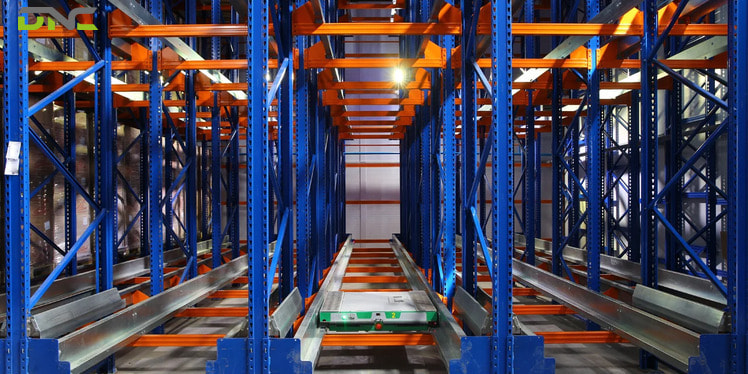
Upright Frames
Upright frames are the vertical load-bearing columns connected by diagonal and horizontal bracing. Frame gauge (steel thickness) ranges from 1.5 mm for light-duty applications to 2.5 mm for heavy industrial loads. Frame height determines maximum storage levels — a 6-metre frame typically supports 3 beam levels plus floor-level storage; a 10-metre frame supports 5–6 levels.
Key specification: Frame load capacity ranges from 5,000 kg to 30,000 kg per frame, depending on gauge, bracing pattern, and height. SSI Schaefer, Mecalux, and local Malaysian manufacturers like TTF and SKB Shutters all publish load tables per frame configuration.
Load Beams
Load beams span horizontally between two upright frames, creating the surface on which pallets rest. Box beams (closed rectangular profile) provide superior strength-to-weight ratios compared to open C-channel step beams. Beam capacity is rated per pair — a standard pair handles 1,000 kg to 3,500 kg depending on span length and steel profile.
Beam deflection: EN 15512 limits maximum beam deflection to span/200 under full load. For a 2,700 mm beam, maximum allowable deflection is 13.5 mm. Exceeding this threshold risks pallet instability.
Wire Decking and Panel Supports
Wire mesh decking sits on top of beams to support pallets with damaged or non-standard bottom boards. Decking also serves as a fire safety measure — mesh allows sprinkler water to penetrate between rack levels, which is a requirement in many Malaysian fire code compliance audits (Bomba — Fire and Rescue Department standards).
Base Plates and Floor Anchoring
Base plates distribute frame loads across the warehouse floor slab. Chemical anchor bolts or expansion bolts fix the base plate to the concrete — minimum two bolts per base plate under EN 15512, four bolts per base in seismic zones. Floor slab thickness must match the racking system’s point load requirements; most pallet racking systems need a minimum 150 mm reinforced concrete slab rated at 5 tonnes/m².
Safety Accessories
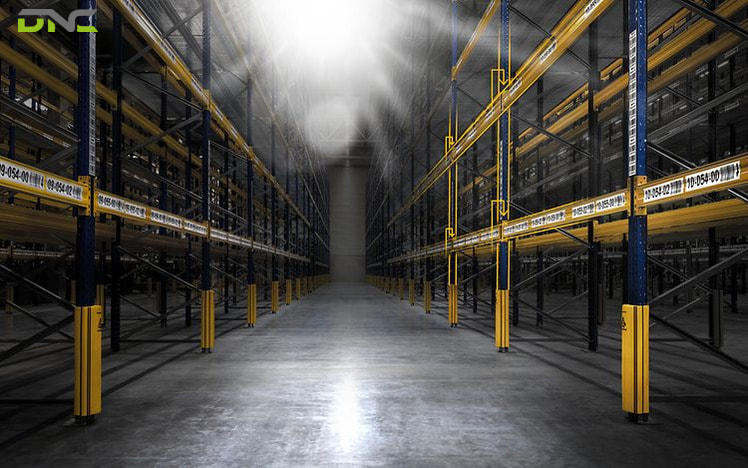
Column guards protect upright frames from forklift impact — the leading cause of racking failure in Malaysian warehouses. End-of-aisle protectors, row spacers, anti-collapse mesh at the back of racks, and pallet backstops complete the safety package. DNC Automation’s warehouse projects include a standard safety assessment identifying high-risk impact zones and specifying guard placement.
Applications: Where Pallet Racking Systems Serve Malaysian Manufacturing
Pallet racking systems operate across every major manufacturing and logistics sector in Malaysia. The system type, configuration, and integration level vary by industry — a cold room for frozen seafood in Penang demands different racking engineering than an automotive JIT warehouse in Proton City.
Warehouse and Logistics
Third-party logistics (3PL) providers and e-commerce fulfilment centres represent the largest pallet racking market segment in Malaysia. Companies like Pos Logistics, DHL Supply Chain, and CEVA Logistics operate multi-client warehouses where selective racking dominates — high SKU variety demands 100% pallet selectivity. Warehouse pallet racking systems in this sector integrate with WMS platforms (SAP EWM, Manhattan Associates, Blue Yonder) for real-time inventory tracking.
Food and Beverage
F&B manufacturers require pallet racking systems that withstand cold room environments (–25°C to +5°C) and comply with halal storage separation requirements. Hot-dip galvanised frames resist condensation-driven corrosion — standard powder-coated frames deteriorate within 3–5 years in cold room conditions. Pallet flow racking supports strict FIFO rotation for date-coded products; companies like F&N and Ramly Burger rely on automated stock rotation to maintain food safety certification.
Automotive Manufacturing
Automotive supply chains in Malaysia — Toyota, Perodua, Proton, Honda — operate on JIT (Just-in-Time) delivery schedules that demand rapid pallet access. Selective racking with narrow-aisle configurations maximises parts storage while maintaining the sub-15-minute picking targets required by production line sequencing. DNC Automation has completed automotive warehouse projects that reduced picking errors by 80% through integrated barcode verification at every rack position.
Electronics and Electrical
Electronics manufacturers in Penang’s Free Industrial Zone store PCB assemblies, components, and finished goods on anti-static pallet racking with ESD-safe decking. Controlled-environment warehouses for semiconductor companies require cleanroom-compatible racking materials — stainless steel frames and sealed beam surfaces that do not generate particulate contamination.
Pharmaceutical and Healthcare
GDP (Good Distribution Practice) compliance requires pharmaceutical warehouses to maintain segregated storage zones (ambient, cold chain, controlled substance), full batch traceability, and validated temperature mapping. Pallet racking systems in pharma warehouses use mobile racking to maximise cold room capacity and integrate temperature sensors at rack level for continuous monitoring.
Malaysia’s NIMP 2030 roadmap targets 50% smart factory adoption among medium-to-large manufacturers by 2030. Pallet racking systems serve as the physical infrastructure layer that connects to WMS, IoT sensors, and automated retrieval systems — making racking selection a strategic decision with long-term automation implications.
Benefits of Pallet Racking Systems for Factory Operations
Pallet racking delivers measurable operational benefits that justify the capital expenditure within 18–24 months for most Malaysian warehouse operations.
Storage density increase of 40–85%: Vertical storage on pallet racks converts unused overhead volume into productive storage. A warehouse with 8-metre ceilings and selective racking stores 3× the pallet volume compared to floor stacking — without expanding the building footprint.
Picking efficiency improvement of 30–40%: Organised pallet positions with clear location labels reduce search time, picking errors, and forklift travel distance. Warehouses implementing racking with WMS integration report error rates below 0.1% — compared to 2–5% in floor-stacked operations.
Inventory accuracy above 99%: Defined storage locations enable cycle counting, barcode verification, and real-time stock visibility. This accuracy directly reduces carrying costs by minimising overstock and eliminating lost inventory.
Workplace safety improvement: Properly installed racking eliminates unstable pallet stacks, reduces manual handling, and creates defined forklift traffic lanes. DOSH incident data shows warehouses with engineered racking systems report 60% fewer material handling injuries than facilities relying on block stacking.
Floor space cost reduction: In Selangor’s industrial zones, warehouse rental costs RM 2.50–4.50 per square foot monthly. High-density racking systems (mobile, shuttle, or drive-in) reduce the floor area needed for the same pallet count — translating to RM 50,000–200,000 annual rental savings for a 50,000 sq ft facility.
Scalability and reconfigurability: Selective and double deep systems allow beam height adjustments within hours. As product mix changes — a common reality in contract manufacturing — the racking adapts without structural modification.
How to Choose the Right Pallet Racking System for Your Warehouse
Selecting the correct pallet racking system requires evaluating five interdependent variables. A mistake in any one variable cascades into wasted space, operational bottlenecks, or premature system replacement.
SKU Count vs. Pallet Volume per SKU
The ratio of unique SKUs to total pallet positions determines the minimum selectivity requirement. Warehouses with 500+ SKUs and fewer than 5 pallets per SKU need selective racking — any reduction in selectivity creates unacceptable picking delays. Operations with fewer than 50 SKUs and 100+ pallets per SKU benefit from high-density systems (drive-in, shuttle, or pallet flow).
Stock Rotation Requirements
FIFO-mandatory industries (food, pharma, chemicals) eliminate LIFO-only systems from consideration. Pallet flow racking guarantees automatic FIFO; shuttle racking achieves FIFO when configured with load and unload faces on opposite ends. Drive-in racking is strictly LIFO and unsuitable for date-coded inventory.
Forklift Fleet and Aisle Width
The forklift type already in your fleet constrains the racking options. Counterbalance forklifts need 3.5 m+ aisles (selective racking only); reach trucks operate in 2.5 m aisles (selective, double deep); VNA trucks handle 1.6 m aisles (selective with wire guidance). Purchasing new forklift equipment to match a racking system adds RM 80,000–250,000 per unit to the total project cost.
Building Constraints
Ceiling height, floor slab capacity, column spacing, fire sprinkler positions, and loading dock locations all affect racking layout. A pre-installation site survey identifies these constraints before the racking design is finalised — DNC Automation conducts free structural assessments as part of every warehouse project.
Budget and ROI Timeline
Budget-conscious operators choosing between selective racking at RM 400/position and mobile racking at RM 2,000/position should calculate total cost of ownership: racking cost + floor space cost + labour cost + equipment cost over a 10-year period. In cold room environments where floor space costs RM 5,000/m² to build, mobile racking’s higher per-position cost is offset by 50% floor area savings within 3 years.
| Selection Factor | Selective | Double Deep | Drive-In | Pallet Flow | Mobile | Shuttle |
| SKU count > 200 | ✓ Best | ✓ Good | ✗ Poor | ✓ Good | ✓ Best | ✓ Good |
| FIFO required | ✓ | ✗ | ✗ | ✓ Best | ✓ | ✓ |
| Budget < RM 500/pos | ✓ | ✓ | ✓ | ✗ | ✗ | ✗ |
| Cold room | ✓ | ✓ | ✓ | ✓ | ✓ Best | ✓ |
| Automation path | Limited | Limited | Limited | Moderate | Moderate | ✓ Best |
FAQ — Pallet Racking System
What is a pallet racking system and how does it work?
A pallet racking system is an engineered steel storage structure that holds palletised goods on horizontal beams supported by vertical frames. Forklifts or reach trucks place and retrieve pallets from defined positions at multiple height levels. The system works by transferring pallet loads through beams to upright columns and down to the floor slab via base plates. Standard configurations in Malaysian warehouses support 1,000–3,500 kg per beam level and reach heights of 3–12 metres.
How much does a pallet racking system cost in Malaysia?
Pallet racking costs in Malaysia range from RM 300 to RM 2,500 per pallet position depending on the system type. Selective racking costs RM 350–600 per position; double deep RM 400–650; drive-in RM 300–500; pallet flow RM 800–1,500; mobile RM 1,200–2,500; and shuttle RM 1,000–2,000. Installation, floor preparation, and safety accessories add 15–25% to the base racking cost. A 1,000-position selective racking project typically costs RM 400,000–700,000 fully installed.
What is the difference between selective and drive-in pallet racking?
Selective racking provides 100% pallet accessibility — every position is directly reachable from the aisle — making it ideal for high-SKU warehouses. Drive-in racking stores pallets 6–12 deep within the rack structure, achieving 75–85% floor utilisation but limiting access to LIFO (last in, first out) only. Selective racking suits warehouses with 200+ SKUs; drive-in racking suits operations with fewer than 20 SKUs and high volume per SKU, such as beverage or building materials storage.
How do I calculate the number of pallet positions needed?
Calculate pallet positions using this formula: Total Positions = (Maximum Inventory in Pallets) × (1 + Safety Stock %) × (1 + Growth Factor %). For example, a warehouse holding 800 pallets maximum with 20% safety stock and 15% growth factor needs: 800 × 1.20 × 1.15 = 1,104 positions. Add 5–10% for damaged or quarantine stock zones. DNC Automation provides free warehouse capacity planning as part of our consultation process.
What safety standards apply to pallet racking in Malaysia?
Pallet racking in Malaysia must comply with FEM 10.2.02 (European racking design standard), EN 15512 (steel static storage systems), or AS 4084 (Australian racking standard — widely adopted in Malaysia). DOSH guidelines require annual racking inspections, load signage at every bay, and column protection at aisle ends. Fire code compliance (Bomba standards) mandates adequate sprinkler clearance between the top of stored goods and ceiling sprinkler heads — minimum 150 mm in standard warehouses.
Can pallet racking systems be integrated with warehouse automation?
Pallet racking systems serve as the physical foundation for warehouse automation. Selective racking integrates with VNA systems using wire-guided or rail-guided forklifts. Shuttle racking connects to WMS for automated pallet placement and retrieval. The next step — full AS/RS (Automated Storage and Retrieval System) — builds crane-operated retrieval directly into the racking structure. DNC Automation designs racking systems with automation-readiness built in: standardised beam heights, sensor mounting points, and WMS-compatible location labelling that allow phased automation upgrades without replacing the racking.
How long does pallet racking installation take?
Installation timeline depends on system size and type. A 500-position selective racking system installs in 5–7 working days; a 2,000-position system requires 15–20 days. Mobile racking and shuttle systems take 20–30% longer due to floor rail installation and electrical work. DNC Automation conducts factory pre-assembly and testing to reduce on-site installation time by up to 40% — a critical advantage for facilities that cannot shut down operations during installation.
What maintenance does a pallet racking system require?
Pallet racking requires quarterly visual inspections checking for: beam deflection beyond allowable limits, upright column damage (dents, bends, or rust), base plate anchor integrity, and safety clip presence. Annual professional inspections per EN 15635 should assess structural load paths, measure frame verticality (maximum allowable lean: height/350), and verify load signage accuracy. Damaged components must be unloaded and replaced immediately — a bent upright column loses up to 50% of its load-bearing capacity.
Conclusion
Pallet racking systems represent the single highest-impact infrastructure investment for Malaysian warehouse operations — delivering measurable returns in storage density, picking efficiency, inventory accuracy, and workplace safety. The choice between selective, double deep, drive-in, pallet flow, push back, mobile, or shuttle racking depends on your specific SKU profile, stock rotation requirements, forklift fleet, and facility constraints.
DNC Automation brings 20+ years of warehouse engineering experience, ISO 9001:2015 certified processes, and partnerships with global racking and automation suppliers to every project. Our team of 35+ engineers conducts free site assessments, 3D warehouse layout design, and ROI modelling before any commitment — ensuring the racking system you install today supports your automation roadmap for the next decade.
- 209 views
- 0 Comment
Recent Comments