


Vertical vs Horizontal Case Packer | DNC Automation Malaysia
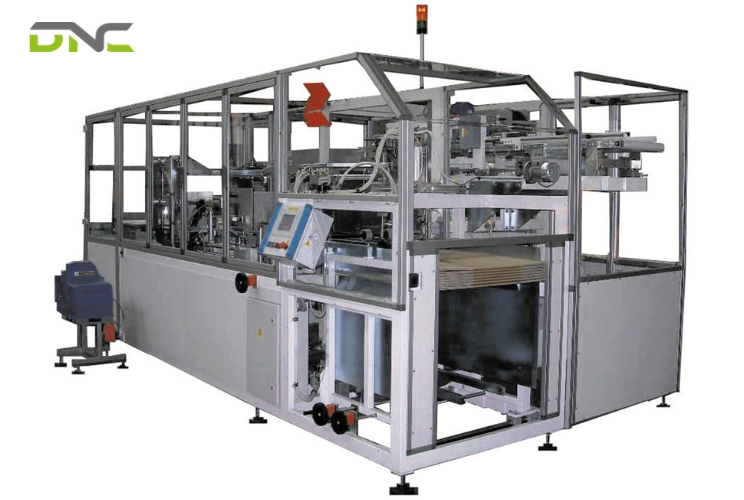
The terminology used for case packer machines describes the direction of product movement into the case — and that direction determines which products the machine handles well, which production speeds it achieves, and what integration complexity it adds to your line. Vertical case packers load products from above (top-down); horizontal case packers load products from the side. Neither is universally superior — each is the correct choice for specific production scenarios.
Malaysian manufacturers specifying case packing equipment need to match the loading direction to their product characteristics, case format, and throughput requirement before evaluating machine suppliers. The wrong loading direction means a machine that cannot reliably handle your product — regardless of its rated CPM or supplier reputation.
This guide explains vertical case packers, horizontal case packers, top load and side load configurations, and the selection logic that determines which orientation fits each Malaysian manufacturing scenario.
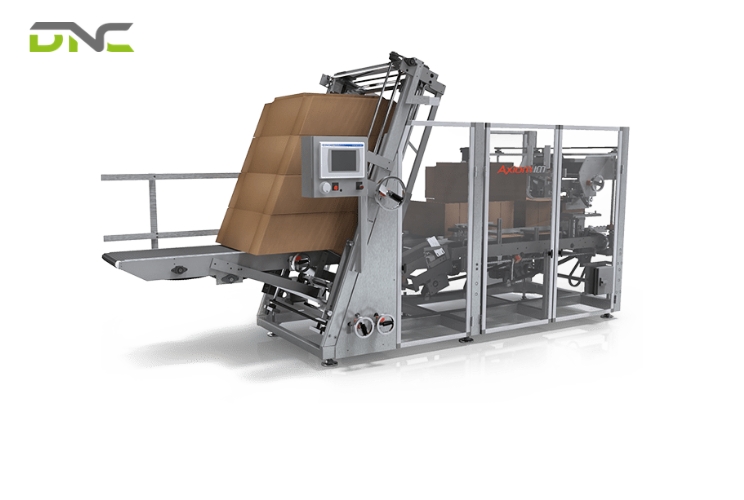
Vertical Case Packer (Top Load Case Packer)
A vertical case packer loads products from above — products are placed, dropped, or lowered into an open corrugated case through the case’s open top. The machine is also called a top load case packer because loading occurs through the top face of the case. After loading, the case moves to a downstream sealer that folds and tapes or glues the top flaps closed.
How Top Load Case Packers Work
Cases arrive at the loading station with the top flaps open — either from a case magazine (pre-formed cases) or from an integrated case erector. The product handling system — which may be a servo-controlled pick-and-place head, a vacuum array, a robotic arm, or a controlled-drop guide — positions products through the open case top.
Products can be placed in a single layer or in multiple layers separated by tier sheets or interlayer pads. After the final product layer is placed, the filled case exits on the discharge conveyor to the case sealer.
Products Suited to Vertical (Top Load) Case Packing
Top load case packers handle products that can be loaded from above without tipping, sliding out of position, or sustaining impact damage from vertical placement:
- Upright bottles and jars — products that must remain standing in the case benefit from top load placement, which maintains upright orientation throughout the loading process
- Pharmaceutical cartons — flat cartons require precise upright or on-edge placement that top load servo systems deliver
- Pouches and sachets — lay-flat pouches are placed horizontally into cases from above; their flexible geometry makes horizontal (side load) pushing impractical
- Trays of products — pre-filled food trays, cup products, and portion packs are top-loaded as a unit
- Electronics and home appliance accessories — fragile, irregularly shaped items requiring controlled gentle placement
- Multi-layer packing with tier sheets — only top load configuration allows inserting interlayer pads between product layers
Throughput Range
- Servo pick-and-place top load: 5–20 CPM
- Robotic top load (delta): 10–30 CPM per robot
- High-speed mechanical top load: 15–30 CPM
Top load case packers generally achieve lower throughput than horizontal (side load) machines because the vertical loading motion is slower than horizontal pushing — and multi-layer loading requires additional cycle time per case.
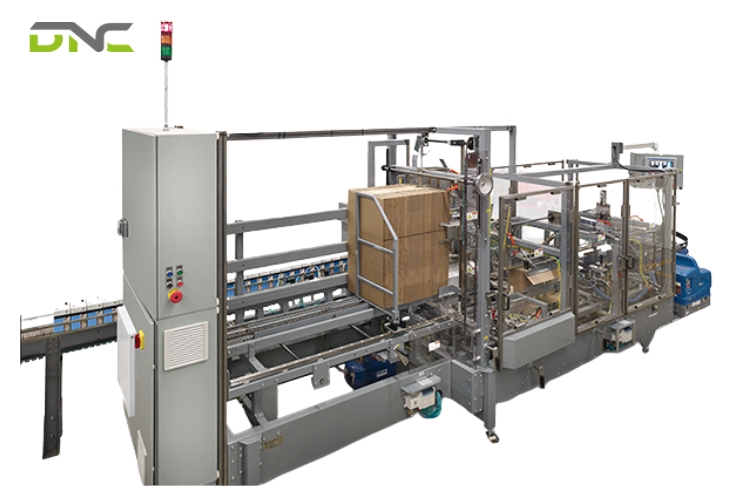
Application in Malaysian Manufacturing
Malaysian pharmaceutical manufacturers — producing OTC medicine cartons, supplement boxes, and medical device secondary packaging — specify vertical case packers (top load) for their precision and gentle handling capability. The servo-controlled placement head deposits each carton at the exact position in the case, with positioning accuracy of ±2–3 mm.
Malaysian home appliance manufacturers in the Klang Valley use top load case packers for kitting operations — placing accessories, power cables, and user manuals into the main product shipper case in a defined arrangement. The top load configuration provides the accessibility needed to place multiple item types in a configured arrangement.
Horizontal Case Packer (Side Load Case Packer)
A horizontal case packer loads products by pushing them horizontally into the open end of a corrugated case. The machine is also called a side load case packer because loading occurs through the open side (end) of the case. Products accumulate in a collating zone, then a pusher mechanism slides the product group horizontally into the waiting case in a single motion.
How Side Load Case Packers Work
Cases travel on a conveyor with one end open — either the case arrives pre-formed from a magazine, or a case erector forms it inline. Products accumulate upstream in a collating zone: laning conveyors separate products into the correct number of rows; a metering belt controls spacing; products fill the collating zone to the correct count.
When the collating zone holds a complete product group, a linear pusher — servo-driven for high precision, pneumatic for simpler applications — transfers the entire product group horizontally into the case in a single stroke. The case end flap is then closed and sealed. On continuous-motion machines, the case moves alongside the collating zone at matched speed — allowing the pusher to load without stopping the case flow.
Products Suited to Horizontal (Side Load) Case Packing
Side load case packers handle products that can be pushed horizontally without tipping, bridging (products interlocking and jamming), or sustaining damage from the pushing motion:
- Cylindrical bottles and cans — round products slide predictably when pushed horizontally; they are the classic side load case packing application
- Rectangular cartons — uniform flat-sided cartons push cleanly in a collated group
- Shrink-wrapped multipacks — shrink film surface slides well on conveyor and under pusher guides
- Pouches in regular arrangement — stand-up pouches in a laned arrangement push into cases horizontally
- Canned food and beverages — the highest-speed beverage can packing operations globally use continuous-motion side load case packers
Throughput Range
- Intermittent-motion side load: 10–25 CPM
- Servo continuous-motion side load: 25–60 CPM
- High-speed continuous-motion: 60–80+ CPM
Horizontal side load case packers achieve the highest throughput in the case packer category — particularly the continuous-motion configuration, where the case moves alongside the collating zone at matched speed, eliminating the index-stop cycle time of intermittent machines.
Application in Malaysian Manufacturing
Malaysian carbonated beverage producers and bottled water manufacturers — running filling lines at 20,000–60,000 bottles per hour — use continuous-motion side load case packers to match filler throughput. A beverage line running 36,000 500 ml bottles per hour (10 CPM at 24 cans/case) requires a case packer at minimum 10 CPM; most manufacturers specify 15–20 CPM to provide headroom.
Malaysian dairy producers packing UHT milk cartons — which have a flat rectangular profile ideal for horizontal push loading — use side load case packers as the standard configuration on their high-speed filling lines.
Vertical vs. Horizontal Case Packer: Direct Comparison
| Criteria | Vertical (Top Load) | Horizontal (Side Load) |
| Loading direction | From above (downward) | From the side (horizontal push) |
| Max throughput | 5–30 CPM | 10–80+ CPM |
| Product orientation in case | Upright, on-edge, lay-flat | Standing, lying, in group formation |
| Multi-layer capability | Yes (with tier sheets) | Limited (mostly single layer) |
| Fragile product handling | Excellent (servo-controlled) | Good (gentle push, no drop) |
| Irregular product handling | Good (robotic configuration) | Poor (push requires uniform profile) |
| SKU changeover complexity | Moderate (guide adjustment or recipe change) | Moderate to high (lane and guide adjustment) |
| Corrugated case format | RSC, HSC, pre-formed tray | RSC, wraparound |
| Footprint | Compact (vertical layout) | Longer (collating zone + loading zone in line) |
| Typical industries | Pharma, food (upright), electronics, F&B tray | Beverage, canned goods, dairy, FMCG uniform |
Top Load vs. Side Load: The Selection Decision
The correct loading orientation is determined by three primary factors:
1. Can Your Product Be Pushed Horizontally?
Irregular shapes, products that tip easily, and items with porous or textured surfaces that create friction against the push guide are not suited to side load packing. If your product cannot be pushed reliably as a grouped unit — test this by pushing a sample group manually on a flat surface — top load is the appropriate configuration.
2. What Throughput Do You Require?
If your line requires more than 30 CPM and your product profile allows horizontal loading, side load case packers are the only configuration that achieves this throughput reliably. Top load systems above 30 CPM require multiple robot heads — increasing cost and mechanical complexity.
3. What Case Format Do You Use?
Wraparound case format (flat blanks) is only compatible with wraparound case packers — neither top load nor standard side load. RSC format (the most common corrugated case in Malaysia) is compatible with both top load and side load. If you use RSC cases and your product can be loaded from either direction, the selection returns to throughput and product handling criteria.
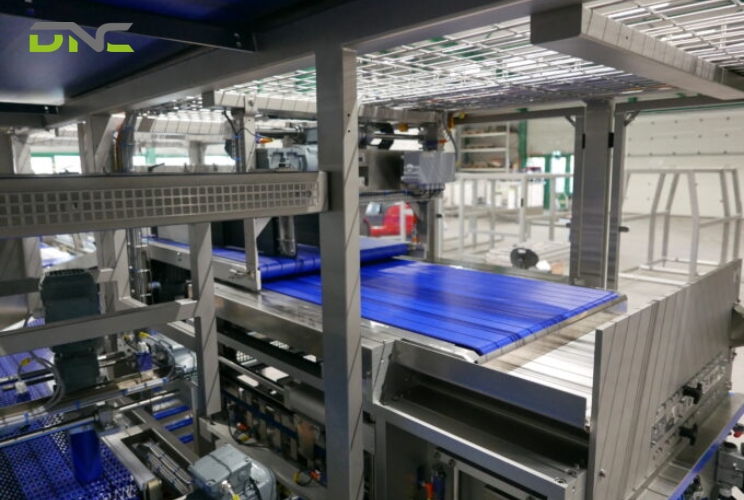
Special Configuration: Top Load into RSC via Case Erector
One configuration common in Malaysian packaging operations deserves specific explanation: the top load case packer integrated with an inline case erector. Rather than using a magazine of pre-formed cases, the case erector forms RSC cases from flat blanks inline — feeding them directly to the top load station with top flaps open.
Advantage: Flat blank storage is more space-efficient than pre-formed case storage. A Malaysian warehouse storing 10,000 flat RSC blanks occupies approximately 30% of the floor space that 10,000 pre-formed cases would require.
Integration requirement: The case erector’s discharge rate must match the top load case packer’s case consumption rate. Erector-to-packer synchronisation is a PLC integration task — the erector waits on a “case required” signal from the packer and delivers within the cycle time window.
DNC Automation designs and commissions this erector-to-packer integration as a unified system — including the synchronisation logic, case detection sensors, and fault handling for erector jams.
Integration: Connecting Vertical and Horizontal Case Packers to Your Line
Both vertical (top load) and horizontal (side load) case packers share the same upstream and downstream integration requirements, with differences in the infeed handling design.
Upstream Integration
For top load case packers: Products typically arrive in a single lane. The top load station uses servo-controlled pick heads or robot arms to pick from the single lane and place into the case — the infeed lane arrangement does not need to match the case packing pattern.
For side load case packers: Products must be pre-arranged into the number of lanes matching the case column count before reaching the push zone. Laning conveyors upstream of the collating zone distribute products from single-lane infeed into multi-lane arrangement. The laning system design is a critical engineering element — poorly designed laning creates product bridging and line stoppages.
Downstream Integration
Both configurations discharge filled open-top or open-end cases to a downstream case sealer. Verify the following at the case packer-to-sealer interface:
- Conveyor height match: ±5 mm is the acceptable tolerance. Greater mismatches cause carton orientation disturbance at the transfer point.
- Discharge speed match: The case sealer’s infeed conveyor speed must match or slightly exceed the case packer’s discharge speed.
- Case orientation continuity: Top load cases exit with the open top face up; side load cases exit with the open end leading — verify the case sealer’s infeed accepts the case in this orientation.
Maintenance Comparison: Top Load vs. Side Load
| Maintenance Item | Top Load | Side Load |
| Primary wear components | Suction cup seals, servo belts | Pusher guides, collating conveyor belts |
| Typical maintenance interval | 500–1,000 hours | 500–1,000 hours |
| Complexity of access | High (loading head above case level) | Moderate (collating zone accessible from sides) |
| Common failure mode | Suction cup wear, pick miss | Product bridging in collating zone, pusher guide wear |
| Calibration requirement | Quarterly vision calibration (if vision-guided) | Quarterly lane width and pusher alignment check |
Frequently Asked Questions
What is the difference between a vertical case packer and a top load case packer?
They are the same machine described from different perspectives. “Vertical case packer” refers to the direction of product motion (downward, vertical). “Top load case packer” refers to which face of the case is loaded through (the top). Both terms describe the same configuration: products placed into cases from above through the open top face.
What is the difference between a horizontal case packer and a side load case packer?
Same equivalence as above. “Horizontal case packer” describes the loading motion direction (horizontal push). “Side load case packer” describes which face of the case is loaded through (the side/end). Both terms describe the same configuration.
Can a case packer be both top load and side load?
No — a single machine loads from one direction. Some manufacturers use sequential loading (products placed from above first, then a side push to consolidate position), but this is a loading sequence within a top load machine, not a dual-direction configuration.
Which is better: top load or side load case packer?
Neither is universally better. Top load case packers handle fragile, irregular, and upright products that cannot be pushed horizontally. Side load case packers achieve higher throughput on uniform products that push cleanly. The correct answer depends on your product geometry, fragility, required throughput, and case format.
How does DNC Automation select between top load and side load for a client project?
DNC Automation conducts a product and line assessment before recommending any configuration. We review product dimensions and fragility, required throughput, existing conveyor layout, case format in use, and SKU changeover frequency. The configuration recommendation comes from this engineering assessment — not from equipment availability or supplier preference. DNC then integrates the selected configuration as a turnkey system including infeed handling, case packer, downstream case sealer, and control system integration.
What is the typical installation time for a vertical or horizontal case packer in Malaysia?
Mechanical installation: 2–3 days. Electrical and control commissioning: 2–4 days. Line speed calibration and product acceptance trials: 2–3 days. Total: 6–10 working days for a standard configuration. Complex integrations with vision systems, robot commissioning, or SCADA connectivity extend the commissioning period by 1–2 weeks.
Factory Floor Space Planning: Vertical vs. Horizontal Case Packer Footprint
Malaysian manufacturing facilities — particularly older Selangor and Penang factory buildings constructed before the current automation investment wave — often have constrained floor space at the end-of-line packing area. The footprint difference between vertical and horizontal case packers affects whether a chosen configuration physically fits the available space.
Top load case packer footprint: Top load machines are compact in the product flow direction because the loading mechanism is overhead — the machine’s length along the conveyor line is determined mainly by the case handling mechanism and the discharge conveyor, not by the product collating zone. Typical top load case packer floor footprint: 2.5–4 m (length) × 1.5–2 m (width). Height clearance required for the loading head: 2.2–2.8 m above the conveyor surface — verify ceiling clearance in older factory buildings.
Side load case packer footprint: Side load machines require the collating zone upstream of the loading station. This collating zone adds 1.5–3 m of machine length compared to a top load machine with equivalent throughput. Typical side load case packer floor footprint: 4–7 m (length) × 1.5–2.5 m (width). Height requirement is lower — 1.8–2.2 m clearance is sufficient for most configurations.
Space implication for Malaysian factories: A production area with 5 m of available line length can accommodate either a top load case packer (with room for upstream conveyor) or a low-throughput side load machine, but not a high-speed continuous-motion side load packer (which needs 6–8 m). Where space is a constraint, top load — or robotic top load — configurations are often the correct choice even for products that could theoretically run on a side load machine.
Speed Optimisation: Getting Maximum CPM from Your Case Packer Configuration
Both top load and side load case packers operate below their theoretical maximum CPM in most Malaysian manufacturing environments. Understanding the factors that limit actual achieved throughput — and how to address them — allows engineers to close the gap between rated machine speed and actual line output.
Top Load Speed Limiters
Pick miss rate: If the pick head (suction or gripper) misses a product, the machine cycles without loading — reducing effective CPM. Pick miss rate above 1% significantly impacts throughput. Cause: worn suction cups (replace every 3–6 months), vision system calibration drift (recalibrate quarterly), product surface variation (specify tighter supplier tolerances). At 1% pick miss rate on a 20 CPM machine, effective CPM drops to 19.8 — acceptable. At 5% pick miss rate, effective CPM drops to 19.0 — still acceptable. At 10%, effective CPM drops to 18.0 — meaning you need to run the machine 11% longer to achieve the same daily case count.
Case infeed rate: The top load case packer can only load as fast as cases arrive from the case magazine/erector. If the erection system cannot match the loading head’s cycle rate, the loading head waits — reducing effective CPM. Ensure the case erector’s rated CPM exceeds the loading head’s cycle rate by at least 10%.
Side Load Speed Limiters
Collating zone surge: Products arriving at uneven spacing cause irregular collating zone fill time. The machine waits for a complete product group before pushing — if product arrival is irregular, waiting time reduces effective CPM below rated speed. Solution: metering belt upstream of the collating zone to regularise product spacing.
Pusher return time: On intermittent-motion side load machines, the pusher must return to its start position after each push stroke before the next product group can advance. Pusher return speed directly limits maximum CPM. Upgrade to servo pusher drive (faster return than pneumatic) to increase effective CPM by 15–25% on intermittent machines.
Product bridging: Products in the collating zone interlock or bridge across the lane guides, blocking the next product from advancing. Bridging is most common with irregular shapes and tall, narrow containers. Corrective action: adjust lane guide spacing, add vibration to the collating conveyor, or change the lane arrangement to reduce bridge formation probability.
Malaysian Facility Case Study Context: Top Load vs. Side Load Decision Points
DNC Automation’s engineering team has encountered the vertical-vs-horizontal selection question at manufacturing facilities across Malaysia’s industrial base. Three representative decision scenarios illustrate how the selection logic plays out in real production environments:
Scenario 1 — Selangor pharmaceutical manufacturer: 5 product SKUs, 3–8 CPM requirement, carton box product requiring upright placement, GMP environment. Decision: robotic top load case packer. Rationale: product fragility and upright placement requirement rule out side load; low throughput requirement rules out high-speed mechanical top load. Robotic configuration provides SKU flexibility across 5 products without mechanical changeover.
Scenario 2 — Johor beverage producer: Single SKU bottled water 500 ml, 40 CPM requirement, round bottle product, dedicated production line. Decision: continuous-motion side load case packer. Rationale: round bottle profile is ideal for horizontal push loading; high throughput requirement eliminates top load options; single SKU eliminates the flexibility advantage of robotic.
Scenario 3 — Penang FMCG manufacturer: 12 SKUs, 8–15 CPM variable requirement, mixture of rigid cartons and flexible pouches. Decision: two-machine solution — servo top load for pouch products, robotic side load for carton products. Rationale: product type difference (rigid vs. flexible) makes a single configuration suboptimal; split solution provides correct handling for each product type.
Case Format Compatibility: Matching Loading Direction to Case Type
The loading direction — vertical (top load) or horizontal (side load) — is not always interchangeable for a given case format. Some case formats are incompatible with certain loading directions:
RSC (Regular Slotted Container): Compatible with both top load and side load. Top load opens the four top flaps for vertical product loading; side load opens one end (minor flaps tucked, major flap open) for horizontal push loading. RSC is the most flexible format — your choice between top and side load depends on product characteristics and throughput, not case format constraint.
HSC (Half Slotted Container): One open top, bottom pre-sealed at the manufacturer. Only compatible with top load — there is no open end for horizontal loading. HSC is used for products that must be visible from the top (retail display) or where bottom-seal integrity is critical (liquids with potential for leakage through bottom flaps).
Wraparound (WA) blank: Neither top load nor side load — requires a dedicated wraparound case packer that wraps the flat blank around the product group. If you specify wraparound format for board cost efficiency, you cannot use a conventional RSC top load or side load machine.
Tray + lid format: The tray is top-loaded by a tray packer; the lid is applied by a separate lidding machine downstream. Not a conventional top-load or side-load case packer application — requires dedicated tray handling equipment.
Understanding case format compatibility before selecting loading direction prevents the scenario where a purchased top load or side load machine is fundamentally incompatible with a case format change that occurs post-installation.
Operator Training Requirements: Top Load vs. Side Load
Operator skill requirements differ between top load and side load case packer configurations — and this affects your training investment and operator recruitment criteria.
Top load case packer operator requirements: Operators must understand pick head changeover (suction cup replacement, gripper adjustment), product infeed lane management, and basic fault clearance (product jams at the pick zone). For robotic top load configurations, operators must understand HMI recipe selection, emergency stop procedures, and the robot cell access protocol (safety gate procedure). Training time for a new operator on a standard servo top load case packer: 2–4 days.
Side load case packer operator requirements: Operators must understand collating zone clearing (the most common fault mode), pusher guide alignment checks, and case magazine replenishment. For continuous-motion side load machines, operators must understand the timing relationship between the product collating zone and the case packer cycle — interrupting the sequence incorrectly causes multiple-case mis-loads. Training time for a new operator on a standard side load case packer: 3–5 days.
DNC Automation provides structured operator training as part of every case packer installation handover — including written operating procedures in both English and Bahasa Malaysia, a fault response guide, and a 90-day post-commissioning support period during which DNC engineers are available to assist with operator questions and minor adjustments.
- 38 views
- 0 Comment
Recent Comments