

Air Conveyor: Pneumatic & Non-Contact Conveying for Malaysian Factories | DNC Automation
Air Conveyor — Non-Contact Material Transport for Malaysia’s Most Demanding Production Lines
Air conveyors move materials without touching them — a capability that sounds simple but solves some of the most difficult conveying problems in Malaysian manufacturing. Scratched PET bottle surfaces fail packaging QC inspections. Pharmaceutical tablets damaged by belt friction fail dissolution tests. Semiconductor wafers touched by mechanical conveyors accumulate micro-contamination that causes chip yield losses. For bulk powders such as cement, flour, and sugar, mechanical conveyors introduce contamination risks, wear particles, and high maintenance loads that pneumatic air slide conveyors eliminate entirely. Malaysia’s beverage sector, pharmaceutical cluster, cement industry, and Penang semiconductor fabs all rely on distinct types of air conveyor systems — each engineered around different airflow principles for different product characteristics. This article maps every air conveyor type, explains how each works, and shows where Malaysian manufacturers deploy them to achieve zero-contact product handling at scale.
What Is an Air Conveyor?
An air conveyor is a material transport system that uses controlled airflow — whether positive pressure, negative pressure (vacuum), fluidization, or aerodynamic lift — as the primary motive force to move products, components, or bulk materials from one point to another without mechanical contact between the conveying surface and the product.
Air conveyor systems encompass six distinct operating principles, each suited to specific material types and production environments: air slide (fluidized bed) conveyors for fine powder; pneumatic tube (pressure or vacuum capsule) conveyors for discrete items over long distances; air cushion conveyors for heavy belts over very long runs; vacuum conveyors for granules, tablets, and small parts; air jet/blow conveyors for lightweight rigid containers such as PET bottles and cans; and Bernoulli conveyors for non-contact levitation of semiconductor wafers and fragile flat panels.
The defining characteristic shared across all air conveyor types is the elimination of mechanical friction between the product and the conveyor surface. This characteristic produces three universal benefits: zero product surface damage, no mechanical wear on product surfaces, and the ability to handle materials in completely sealed environments where contamination from belt particles, lubricants, or metallic wear debris is unacceptable.
How Does an Air Conveyor Work?
Air conveyor operating principles differ fundamentally between types, but all rely on the engineered control of air velocity, pressure, and volume to generate the motive force or supporting medium that moves materials.
Step 1 — Air Source Generation
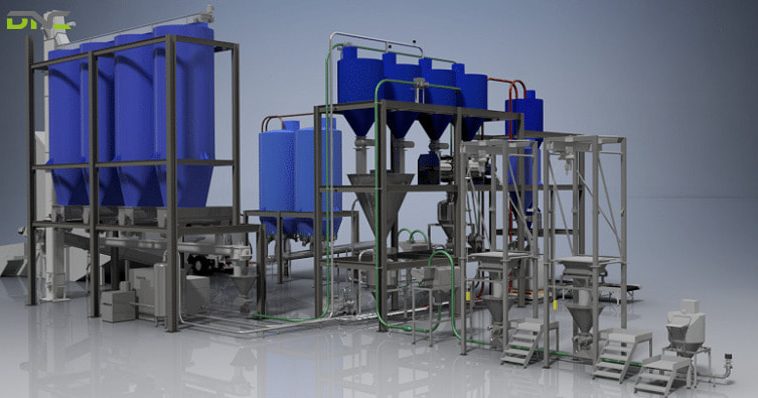
Compressed air supply or blower selection is the first engineering decision in any air conveyor system. Air jet conveyors and air slide conveyors use centrifugal blowers (pressure 50–500 mbar; flow rate 500–50,000 m³/hr) for high-volume, low-pressure airflow. Pneumatic dense-phase tube conveyors use oil-free screw compressors (1–4 bar) for high-pressure, low-volume air delivery. Vacuum conveyors use vacuum pumps or venturi ejectors to create negative pressure (50–900 mbar vacuum). Bernoulli conveyors use precision pressure-regulated air manifolds (0.5–2 bar) for controlled levitation air films. DNC Automation specifies Siemens-controlled variable-frequency blowers and compressors to modulate airflow in real time based on product weight, production speed, and environmental conditions.
Step 2 — Airflow Distribution Across the Conveying Medium
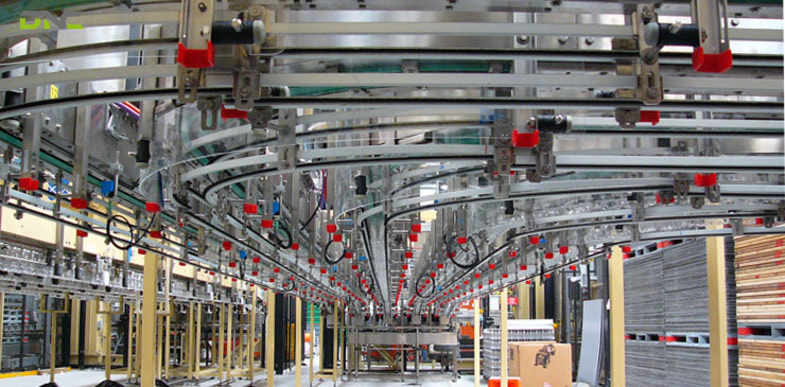
Airflow distribution determines whether the air conveyor moves product by pressure from behind, lift from below, or suction from above. Air slide conveyors distribute air uniformly through a porous membrane (permeable fabric or sintered ceramic tiles) installed beneath the powder, creating a fluidized bed where individual powder particles are suspended in air and flow like a liquid under gravity. Air jet conveyors direct high-velocity air jets from nozzle arrays positioned along the conveyor sides and beneath the product path, accelerating lightweight bottles or cans along the guideway.
Step 3 — Product Movement and Guidance
Product guidance systems on air conveyors vary by type. Air jet conveyors for PET bottles use adjustable neck-guide rails that constrain the bottle’s neck ring while the bottle body is lifted and pushed by air jets — the only contact is the neck guide, which experiences near-zero friction. Air slide conveyors use gravity-assisted inclined channels; the fluidized powder flows like water on a slope as gentle as 2–3°. Vacuum conveyors use sealed pipes or channels where product moves as a plug (dense phase) or dispersed suspension (dilute phase) driven by the pressure differential between inlet and exhaust.
Step 4 — Speed and Throughput Control
Air conveyor speed is controlled by modulating air pressure, velocity, or volume. Air jet conveyor throughput for PET bottles scales from 5,000 bottles/hr (small-format 500 mL at low speed) to 60,000+ bottles/hr (high-speed 330 mL cans) by increasing air jet velocity from 10 m/s to 30 m/s. Pneumatic tube conveyor throughput is controlled by capsule dispatch intervals and air pressure — denser product packing at higher pressure moves more material per unit time. DNC Automation integrates Siemens S7 PLC control with mass flow meters and pressure transducers to maintain precise, consistent conveyor performance across production shifts.
Step 5 — Collection, Filtration, and Air Return
Exhaust air management is a critical design element, particularly for powder-handling air slide and vacuum conveyor systems. Conveying air exits the system laden with fine product particles and must pass through cyclone separators, bag filters, or cartridge filters before discharge. Filter efficiency must be ≥99.9% for pharmaceutical products and ≥99.5% for food-grade powders to comply with GMP and HACCP requirements. Recovered product from filter systems is returned to the process stream, eliminating yield loss from fine particle entrainment.
How Does an Air Conveyor Work?
Types of Air Conveyor
Air conveyor types are classified by their operating principle and the class of material or product they are engineered to handle.
Air Slide Conveyor (Fluidized Bed)
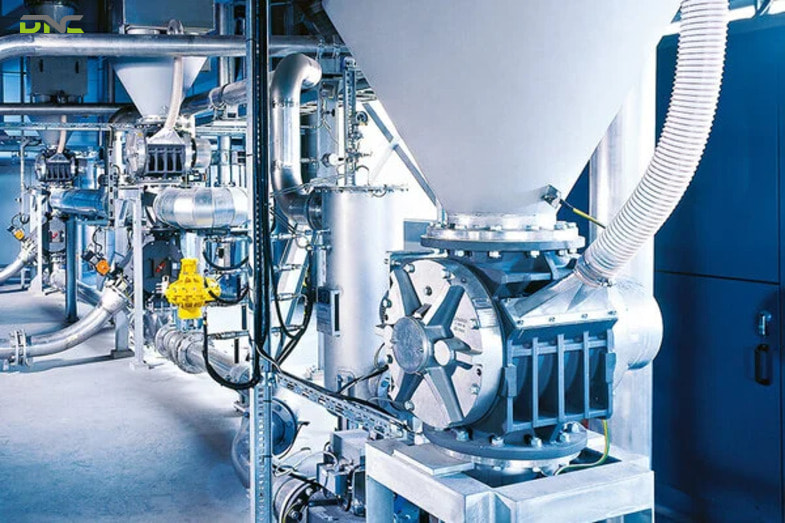
Air slide conveyors are the standard solution for bulk fine powder transport in cement, flour, sugar, and starch processing. A porous membrane — typically woven polyester with a permeability of 10–20 m³/(m²·hr) at 10 mbar — is installed as the floor of an enclosed rectangular channel. Low-pressure air (20–100 mbar) is distributed evenly below the membrane; the air passes upward through the membrane and suspends the powder above it in a fluidized state. Because fluidized powder flows under gravity at slopes as low as 2°, air slide conveyors move powder with near-zero power consumption, no moving parts, and zero product contamination from mechanical wear. Johor’s cement manufacturing plants — Johor is Malaysia’s primary cement production hub — use air slide conveyors extensively for clinker powder transfer between silos and packaging lines.
Pneumatic Tube Conveyor (Pressure and Vacuum Capsule)
Pneumatic tube conveyors transport discrete items or bulk materials sealed in capsules through a network of pipes, driven by pressure difference between the pipe ends. Bank document systems are the most familiar domestic example, but industrial pneumatic tube conveyors transport pharmaceutical samples, laboratory specimens, and even packaged food portions in sealed stainless steel capsules. Industrial dense-phase pneumatic conveying (1–4 bar positive pressure) moves bulk powders, pellets, and granules at capacities from 1 t/hr to 100 t/hr over pipeline distances up to 1,000 m. Malaysian plastics pellet manufacturers in Selangor use dense-phase pneumatic conveyors to transfer polymer pellets from storage silos to injection moulding machine hoppers at throughputs of 5–20 t/hr.
Air Cushion Conveyor
Air cushion conveyors support a continuous belt on a thin film of pressurized air (2–8 mbar) rather than on roller idlers, reducing belt running friction by up to 90% compared to conventional roller-supported belts. This design enables extremely long conveyor runs (up to 30 km for overland mining and bulk materials conveyors), eliminates roller bearing maintenance, and reduces the belt tension required to pull the belt — allowing lighter belt construction and smaller drive motors. Malaysian sand, aggregate, and mining operations use air cushion conveyors for overland bulk material transport where roller idler maintenance cost over long distances is prohibitive.
Vacuum Conveyor (Negative Pressure)
Vacuum conveyors use negative pressure (50–900 mbar vacuum) to draw material through sealed tubing or hoppers. For pharmaceutical tablet and capsule handling, vacuum conveyors transfer product between process vessels — tablet presses, coating pans, blister-pack feeders — in completely enclosed pipework that prevents cross-contamination, eliminates operator dust exposure, and enables full CIP cleaning in place. Penang’s pharmaceutical manufacturers, operating under Malaysian pharmaceutical regulations and exporting to markets requiring FDA and EU GMP compliance, rely on vacuum conveyor systems for OSD (oral solid dose) production. Vacuum conveyor capacity for tablets: 50–2,000 kg/hr depending on tablet size and vacuum level.
Air Jet / Blow Conveyor (Lightweight Container Transport)
Air jet conveyors for PET bottles and aluminium cans are the highest-throughput single application of air conveyor technology in Malaysia’s F&B sector. Arrays of nozzles positioned above, below, and beside the product path direct high-velocity air jets (15–25 m/s) at the bottles or cans, generating aerodynamic force that propels them along neck guides or body guides at speeds of 0.5–3 m/s. Throughput: 5,000–60,000 containers/hr. Zero mechanical contact with the container body means zero scratching of label surfaces, cap seals, or container sidewalls — critical for premium beverage brands whose packaging quality standards reject any surface mark. F&N, a DNC Automation client with high-speed PET beverage lines in Selangor, uses air jet conveyors to connect blow-moulding machines to filling lines at throughputs above 20,000 bottles/hr.
Bernoulli Conveyor (Non-Contact Levitation)
Bernoulli conveyors use the Bernoulli effect to levitate flat, rigid, disc-shaped objects — semiconductor wafers, LCD glass panels, solar cells — on a stable air film without any mechanical contact. Air is discharged radially from a central nozzle at high velocity, creating a pressure differential (low pressure at the disk centre, ambient pressure at the disk periphery) that levitates the disk at a controlled gap of 0.1–2.0 mm. Bernoulli conveyors are used in Penang’s semiconductor fabrication environment — Malaysia’s semiconductor sector produces components used in global electronics supply chains — where a single particle of mechanical contamination on a 300 mm silicon wafer surface can render the entire wafer unusable, representing a loss of USD 5,000–15,000 per wafer. Non-contact Bernoulli transport completely eliminates this contamination risk for inter-process wafer transfer.
Comparison Table: Air Conveyor Types
| Type | Operating Principle | Material Handled | Capacity | Best Industry |
| Air Slide | Fluidized bed (low pressure) | Fine powder | 10–1,000 t/hr | Cement, flour, sugar |
| Pneumatic Tube | Pressure/vacuum pipe transport | Bulk granules, capsules | 1–100 t/hr | Plastics, pharma, food |
| Air Cushion | Air film belt support | Bulk materials (belt conveyed) | 100–5,000 t/hr | Mining, aggregates |
| Vacuum Conveyor | Negative pressure suction | Tablets, granules, powder | 50–2,000 kg/hr | Pharma, food, chemical |
| Air Jet / Blow | Directed air jets | PET bottles, cans | 5,000–60,000 units/hr | Beverage, packaging |
| Bernoulli | Bernoulli lift (air film) | Wafers, glass panels, discs | 1–200 units/min | Semiconductor, solar |
Key Components of an Air Conveyor System
Complete air conveyor systems consist of the air generation equipment, the conveying medium or channel, the product guidance system, and the control and monitoring infrastructure.
Air source — blower or compressor — The air source must be sized for the required air volume (m³/hr) and pressure (mbar or bar). For food and pharmaceutical applications, oil-free compressors and blowers are mandatory to prevent product contamination from oil aerosols. DNC Automation specifies oil-free Siemens-compatible variable-speed blowers with integrated air quality monitoring for critical applications.
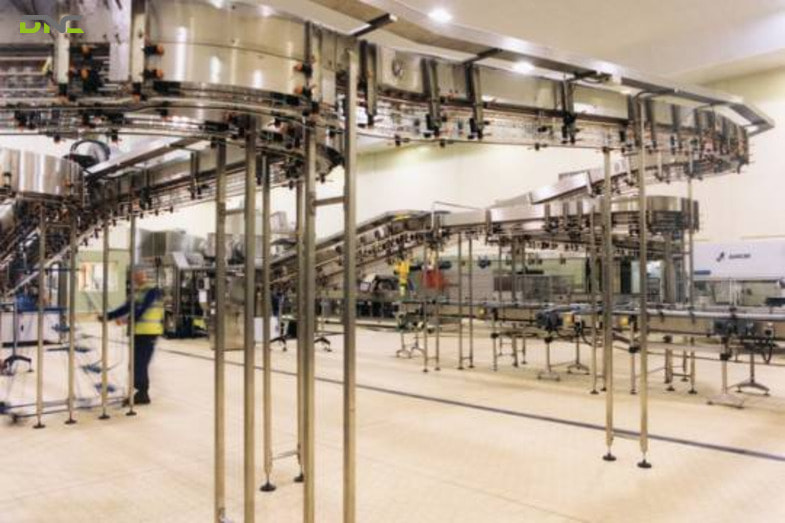
Conveyor channel or pipe — Air slide conveyors use enclosed rectangular channels in stainless steel (food) or carbon steel (cement/industrial). Air jet conveyors use neck-guide rails in UHMW-PE or stainless. Pneumatic tube conveyors use 50–200 mm diameter stainless steel or HDPE pipe with swept-radius bends (minimum bend radius 5× pipe diameter to prevent product damage).
Porous membrane or nozzle array — Air slide membranes must be inspected every 6–12 months for clogging or damage; replacement is straightforward as membranes are clamped, not bonded. Air jet nozzle arrays require periodic cleaning to prevent buildup of product residue on nozzle faces.
Separation and filtration system — Cyclone separators remove coarse particles from conveying air; bag filters or cartridge filters capture fine particles to ≥99.5% efficiency. Filter housings in food and pharmaceutical applications are stainless steel with CIP capability.
Control panel — Siemens PLC integration — DNC Automation builds all air conveyor control panels around Siemens S7-1200 or S7-1500 PLCs with HMI touchscreens showing real-time blower speed, air pressure, system throughput, and alarm status. SCADA connectivity enables remote monitoring and predictive maintenance alerting.
Key Components of an Air Conveyor System
Applications: Where Air Conveyors Are Used in Malaysian Manufacturing
Air conveyor applications in Malaysia span five major industries, each exploiting a specific air-conveying principle suited to their product and process requirements.
Beverage Manufacturing — Selangor (PET Bottles)
Malaysia’s beverage manufacturing sector, concentrated in Selangor’s industrial parks, produces hundreds of millions of PET bottles annually for domestic consumption and export. F&N — Malaysia’s largest beverage manufacturer and a DNC Automation client — operates air jet conveyors connecting blow-moulding stations to filling lines and between filling, capping, labelling, and case-packing. Air jet conveying handles 20,000–40,000 bottles/hr at F&N’s Selangor facility. The non-contact operation is essential because filled bottles with affixed labels are susceptible to label scuffing from belt friction — air jet conveyors eliminate this quality defect entirely.
Pharmaceutical Manufacturing — Penang
Penang’s pharmaceutical cluster uses vacuum conveyors extensively for oral solid dose (OSD) manufacturing. Vacuum pipe systems connect tablet presses (producing 200,000–500,000 tablets/hr) to in-process quality check stations, coating pans, and blister-pack feeders in enclosed GMP-compliant pipework. The closed conveying environment prevents cross-contamination between API (active pharmaceutical ingredient) batches — critical for multi-product pharmaceutical factories producing different drug molecules on shared equipment trains. Malaysia’s pharmaceutical exports, targeted to grow under NIMP 2030, require the GMP compliance that enclosed vacuum conveying provides.
Cement and Building Materials — Johor
Johor’s cement manufacturing industry — serving Malaysia’s construction boom driven by projects such as ECRL and Iskandar Malaysia development — uses air slide conveyors as the primary inter-silo powder transport method. Air slide conveyors move calcined clinker, raw meal, and finished cement powder between storage silos, mill inlets, and packing machines at capacities of 100–800 t/hr. The absence of moving parts in contact with the abrasive powder means air slide conveyors in cement plants run for 5–10 years between major maintenance events, versus 6–18 months for equivalent screw or belt conveyor systems.
Semiconductor and Electronics — Penang
Penang’s semiconductor fabrication sector — part of Malaysia’s position as the world’s 7th largest semiconductor exporter — uses Bernoulli conveyor systems for wafer transport between lithography, deposition, and etch process modules in fab clean rooms. Non-contact conveying is not an option but a requirement: ISO Class 3 (Class 1) clean room protocols mandate zero mechanical contact with wafer surfaces after cleaning steps. DNC Automation engineers air-handling systems for Penang’s electronics manufacturing support infrastructure that interface with Bernoulli conveyor systems.
Palm Oil Processing — Sabah and Sarawak
Palm oil processing in Sabah and Sarawak uses pneumatic dense-phase conveying for kernel shell (fuel for biomass boilers) and dry cake transport within mills. Dense-phase pneumatic conveying at 1.5–3 bar moves these materials from processing stages to storage or boiler feed points over distances of 100–500 m — distances that would require multiple belt conveyor sections with transfer points, each adding maintenance cost and contamination risk. Malaysia’s palm oil sector processes over 17 million tonnes of CPO annually; operational efficiency in mill material handling directly impacts overall mill processing cost.
Cement and Building Materials
Benefits of Air Conveyors for Malaysian Factory Operations
Air conveyor systems deliver quantifiable performance benefits that mechanical conveyors cannot match in the application categories where airflow is the appropriate motive force.
Zero product contact damage — Air jet conveyors for PET bottles reduce packaging defect rates from 0.5–2% (typical for mechanical belt transport) to below 0.01%, eliminating the scrap cost and rework labor associated with surface-marred containers. At 20,000 bottles/hr, a 1% defect rate costs approximately RM 360,000/year in scrap product and rework at a typical Selangor beverage plant.
No moving mechanical parts in the conveying path — Air slide conveyors have no moving parts whatsoever in contact with the powder being conveyed. This translates to maintenance cost near zero for the conveying channel itself; all maintenance is on the external air supply equipment. DNC Automation clients report 60–80% reduction in conveying-system maintenance cost after transitioning from screw conveyors to air slide for fine powder applications.
Sealed system for contamination control — Pneumatic tube and vacuum conveyor systems operate in fully enclosed pipework, eliminating dust emission, cross-contamination, and product exposure to ambient air humidity — critical for hygroscopic powders such as sugar, milk powder, and pharmaceutical APIs.
Human error reduced by up to 80% — DNC Automation’s automation implementations, including air conveyor system integration, demonstrate an 80% reduction in human error events. Air conveyor systems eliminate manual product transfer steps — a common source of dropped product, cross-contamination, and batch traceability breaks — replacing them with fully automated, PLC-controlled material flow.
Benefits of Air Conveyors for Malaysian Factory Operations
How to Choose the Right Air Conveyor for Your Factory
Selecting the correct air conveyor type requires a systematic matching of product characteristics to conveying principle.
Product state determines the conveyor type family — Bulk fine powder (D50 < 100 µm): air slide or pneumatic dense-phase. Granules and pellets (D50 100 µm–10 mm): pneumatic tube or vacuum. Rigid lightweight containers: air jet. Flat fragile substrates: Bernoulli. Bulk materials over long distances: air cushion belt.
Product fragility determines conveying gentleness level — Pharmaceutical tablets with friability above 0.5% require vacuum conveying at low velocity (2–5 m/s) to prevent breakage. Robust polymer pellets can withstand pneumatic dilute-phase velocities of 15–25 m/s without degradation. Semiconductor wafers require Bernoulli levitation to prevent any contact.
Throughput requirement sizes the air source — Air conveyor capacity is directly proportional to air volume and pressure; larger throughputs require larger blowers or compressors. DNC Automation’s engineers size air supply equipment with a 25% design margin above calculated peak demand to handle production surges without system pressure drops.
Malaysia’s SAG Grant eligibility — Air conveyor systems integrated with PLC automation, production monitoring, and process data recording qualify for MIDA’s SAG Grant (up to RM 1 million, 70:30 matching). Malaysian factories investing in pneumatic conveying or air jet container transport systems should engage DNC Automation for both the technical specification and the grant application support.
Frequently Asked Questions About Air Conveyors
What products can an air conveyor handle?
Air conveyors handle a remarkable range of materials, from fine powders weighing less than 1 gram per litre (such as pharmaceutical APIs and talc) to PET bottles weighing 10–20 grams, to silicon wafers 300 mm in diameter weighing 120 grams. The key is matching the correct air conveying principle — fluidization, pneumatic pressure, vacuum, air jet, or Bernoulli lift — to the specific product’s weight, size, fragility, and contamination sensitivity.
What is the difference between an air slide conveyor and a pneumatic tube conveyor?
An air slide conveyor uses a fluidized bed of low-pressure air passing through a porous membrane to make fine powder flow like a liquid under gravity — it is a gravity-assisted conveyor with air providing the fluidization, not the forward motive force. A pneumatic tube conveyor uses pressure or vacuum to actively propel material through enclosed pipes — it is a pressure-driven conveyor that can move material horizontally, vertically, or along any pipeline path.
Can air conveyors handle food-grade applications in Malaysian factories?
Yes — air slide conveyors, vacuum conveyors, and air jet conveyors all have food-grade variants used by DNC Automation clients including F&N. Food-grade air conveyors use stainless steel channels and pipework, oil-free blowers and compressors, FDA-compliant gaskets and seals, and CIP-capable filter housings. They comply with MS 1480 (HACCP), ISO 22000, and BRC Global Standards requirements.
What is the throughput capacity of an air jet conveyor for PET bottles in Malaysia?
Air jet conveyors for PET bottles operate at 5,000–60,000 bottles/hr depending on bottle format (neck diameter, weight, profile), nozzle array design, and guide spacing. F&N’s DNC-integrated air jet lines in Selangor operate at 20,000–30,000 500 mL PET bottles/hr. Cans, which are lighter and more aerodynamically consistent than PET bottles, can be conveyed at the upper range of 40,000–60,000 units/hr.
How much does an air conveyor system cost in Malaysia?
Air conveyor system capital cost varies widely by type and scale. An air jet bottle conveyor for a single line section (10–15 m) costs approximately RM 80,000–200,000 installed. A pneumatic dense-phase bulk conveying system for a new silos-to-production line (200 m distance, 10 t/hr capacity) costs approximately RM 300,000–600,000 installed. Air slide conveyors for powder transfer cost RM 1,500–5,000 per linear metre installed depending on channel width and material. DNC Automation provides detailed cost estimates during free consultation.
Does DNC Automation install and service air conveyor systems in Malaysia?
DNC Automation (dnc-automation.com) designs, engineers, installs, and services air conveyor systems throughout Malaysia from its 25,000 sq ft facility with 35+ engineers. DNC’s ISO 9001:2015 certification and partnerships with Siemens Germany (control systems) and Laumas Italy (weighing integration) ensure that every air conveyor system is delivered with full control integration, calibration documentation, and preventive maintenance support. Talk to our engineers for a free consultation on your air conveying requirement.
Are air conveyors energy-efficient compared to mechanical conveyors?
Air slide conveyors are among the most energy-efficient powder conveying systems available, consuming 30–70% less energy than equivalent screw conveyors because they have no rotating mechanical parts in contact with the product. Air jet conveyors for PET bottles use more energy than simple belt conveyors but justify the premium through zero defect rates and zero maintenance on product-contact surfaces. Pneumatic tube conveyors are energy-intensive for high-throughput bulk conveying; they are justified by sealed-system contamination control and flexibility of pipeline routing rather than energy efficiency.
Conclusion
Air conveyor systems — from air slide fluidized beds for Johor’s cement plants to Bernoulli non-contact wafer transport in Penang’s semiconductor fabs — represent the highest-performance material handling solution for products where mechanical contact is either damaging or contaminating. Malaysia’s NIMP 2030 smart-factory programme, the growth of Penang’s pharma and semiconductor sectors, and the F&B sector’s transition to zero-defect packaging quality all point toward expanded air conveyor adoption across Malaysian manufacturing.
DNC Automation (dnc-automation.com) — Malaysia’s No. 1 factory automation company since 2005, with ISO 9001:2015 certification and 35+ engineers — has the expertise to specify, engineer, and commission air conveyor systems for every application category described in this article. Get a Free Consultation today to find out which air conveyor technology is right for your product, your process, and your NIMP 2030 automation roadmap.
Related reading: Explore DNC Automation’s complete automation solutions including plastic conveyor belts, flexlink conveyor systems, and Siemens-integrated production control systems.
- 79 views
- 0 Comment
Recent Comments