


Selective Pallet Racking System: Design, Specs and Selection Guide for Malaysian Warehouses
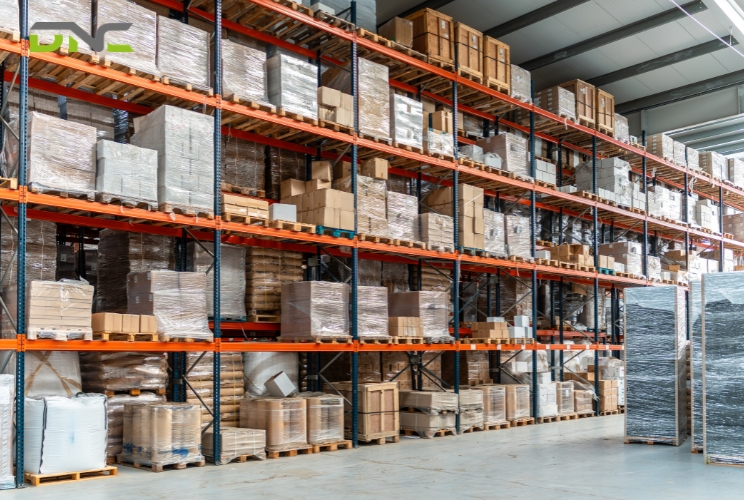
Selective pallet racking systems account for 70% of all warehouse racking installations in Malaysia — and that dominance exists for a practical reason: every pallet position is directly accessible from the aisle, giving warehouse operators 100% selectivity without compromising structural integrity. For factories managing 200+ SKUs across automotive parts, FMCG products, electronics components, or pharmaceutical goods, selective racking delivers the fastest pick-to-ship cycle at the lowest cost per position. This guide covers the engineering specifications, load calculations, layout configurations, and cost factors that Malaysian warehouse managers need to specify, procure, and install a selective pallet racking system that performs for 15–25 years. DNC Automation has designed and integrated selective racking across hundreds of projects — the recommendations here come from two decades of field-verified results.
What Is a Selective Pallet Racking System?
Selective pallet racking is a steel storage structure that arranges pallets in single-deep rows on either side of an aisle, where every pallet position faces the aisle directly. The term “selective” means the operator can select any individual pallet without moving other pallets — a capability that distinguishes this system from double deep, drive-in, and block stacking configurations.
The system’s architecture is straightforward: vertical upright frames connected by horizontal load beams at adjustable heights create a grid of storage positions. Forklifts, reach trucks, or VNA turret trucks access pallets from the aisle face. Beam heights adjust in 50 mm or 75 mm increments — allowing the same racking structure to accommodate pallet loads ranging from 800 mm to 2,200 mm in height on different levels.
Selective racking traces its engineering lineage to post-WWII warehouse mechanisation in the 1950s, when the adoption of standardised pallets and counterbalance forklifts created the need for multi-level storage accessible by machine. Modern selective systems incorporate finite element analysis (FEA) in frame design, high-tensile steel grades (S355 or equivalent), and connector systems tested to EN 15512 standards — but the fundamental operating principle remains unchanged.
In the Malaysian market, selective pallet racking is manufactured locally by companies like TTF, SKB Shutters, and MR Space, and imported from global manufacturers including Mecalux, SSI Schaefer, and AR Racking. DNC Automation specifies and integrates racking systems from multiple manufacturers to match each project’s load requirements, budget, and automation roadmap.
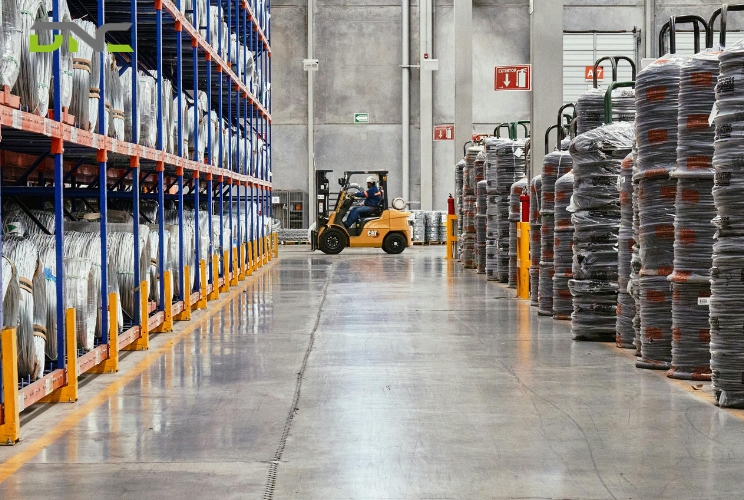
How Does a Selective Pallet Racking System Work?
Selective pallet racking transfers pallet loads through a defined structural path: from the pallet surface through the beam, into the beam-to-upright connector, down the upright column, through the base plate, and into the warehouse floor slab. Understanding this load path is essential for correct specification — overloading any single point in the chain risks structural failure.
Load Distribution and Beam Mechanics
Each beam pair supports one pallet position. The beam acts as a simply supported horizontal member — load distributes along the beam span and transfers to the uprights at each end through the connector. Beam deflection under load must not exceed span/200 per EN 15512: for a standard 2,700 mm beam, maximum allowable deflection is 13.5 mm. Exceeding this limit risks pallet instability and progressive structural failure.
Beam capacity depends on three factors: steel profile (box beam versus step beam versus C-channel), beam depth (80–160 mm), and span length (1,800–3,600 mm). A standard 2,700 mm box beam with 120 mm depth typically rates at 2,500–3,000 kg per pair. Longer spans or heavier loads require deeper beam profiles or additional intermediate supports.
Upright Frame Engineering
Upright frames consist of two columns connected by diagonal and horizontal bracing in a ladder-like configuration. Frame width matches pallet depth (typically 800 mm or 1,000 mm for standard Malaysian pallets). Column steel thickness ranges from 1.5 mm for light-duty applications to 2.5 mm for heavy industrial loads.
Frame load capacity — the total weight a single frame can support across all beam levels — ranges from 5,000 kg to 30,000 kg depending on column gauge, height, and bracing pattern. A frame supporting four beam levels at 3,000 kg per level carries 12,000 kg total; specifying a frame rated at only 10,000 kg creates a dangerous overload condition that inspection would flag but operational loading might miss.
Beam-to-Upright Connectors
The connector is the most critical engineered component in a selective racking system. Hook-in connectors (also called boltless or teardrop connectors) lock into punched slots along the upright column face. Each connector features 3–4 hooks that engage the column slots, plus a safety pin or clip that prevents accidental disengagement during forklift impact or seismic events.
Connector shear capacity must exceed the maximum beam-end reaction force. For a 3,000 kg beam pair, each end carries 1,500 kg static load — but dynamic factors (forklift placement impact, seismic activity) multiply this by 1.5–2.0×. Connectors rated at 3,000–4,000 kg per end provide adequate safety margin for standard Malaysian warehouse operations.
Adjustability and Reconfiguration
Selective racking’s adjustable beam heights represent a significant operational advantage. Beams reposition in 50 mm or 75 mm increments by unhooking from one slot set and hooking into another — a process taking under 5 minutes per beam with standard tools. This adjustability allows warehouse managers to reconfigure storage levels seasonally (taller Christmas inventory versus standard stock), accommodate new product dimensions, or optimise vertical space utilisation as the business evolves.
In our experience, Malaysian warehouses reconfigure beam heights 2–4 times per year on average — making hook-in connector systems the preferred choice over fully bolted designs that require 15–20 minutes per adjustment.
Types of Selective Pallet Racking Configurations
Selective racking adapts into several sub-configurations based on aisle width, height, and access equipment. Each configuration trades floor space efficiency against equipment cost and operational throughput.
Wide Aisle Selective (Standard)
Wide aisle configurations use counterbalance forklifts requiring 3.5–4.0 metre aisles. This is the most common configuration in Malaysian warehouses because counterbalance forklifts are the most versatile and least expensive material handling equipment (RM 50,000–120,000 per unit).
Floor utilisation: 42–48%
Best for: Warehouses with existing counterbalance forklift fleets, mixed operations combining rack storage with floor-level activities.
Narrow Aisle Selective
Narrow aisle configurations reduce aisle width to 2.4–2.8 metres using reach trucks. Reach trucks extend their mast forward to place pallets while the truck body remains in the narrower aisle. This configuration increases pallet positions by 20–25% compared to wide aisle.
Floor utilisation: 55–60%
Best for: Warehouses seeking higher density without changing racking type. The reach truck investment (RM 150,000–250,000) is offset by reduced floor space requirements.
Very Narrow Aisle (VNA) Selective
VNA configurations compress aisles to 1.5–1.8 metres using turret trucks or man-up order pickers guided by floor rails or wire guidance. The truck does not turn within the aisle — instead, its mast rotates left or right to access pallets on either side.
Floor utilisation: 65–70%
Best for: High-value warehouse space (cold rooms, clean rooms, urban distribution centres) where maximising pallet positions per square metre justifies VNA truck investment (RM 350,000–600,000 per unit).
Back-to-Back vs. Single Row
Back-to-back configurations place two rack rows against each other with 150–200 mm clearance for wall ties and fire sprinkler access. This standard arrangement maximises frame sharing. Single rows mount against warehouse walls or serve as aisle boundaries — requiring additional bracing because only one side carries lateral load.
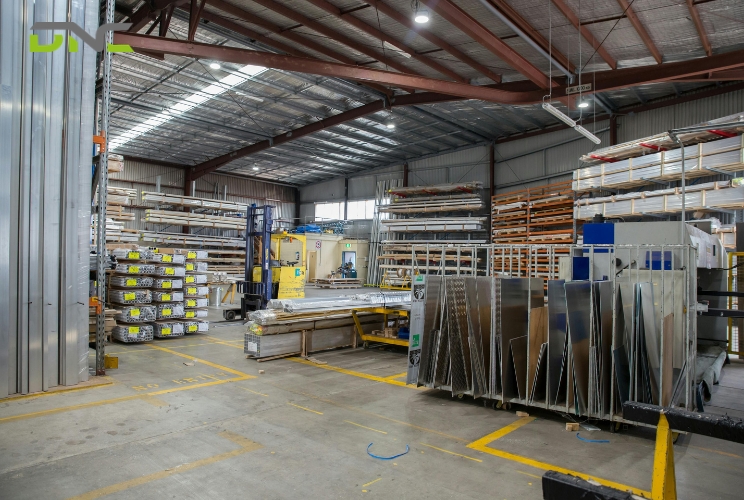
Key Components of a Selective Pallet Racking System
Upright Frames
Upright frames are the vertical load-bearing assemblies. Standard Malaysian warehouse applications use frames 2,400–6,000 mm wide and 3,000–12,000 mm tall. Frame depth (800 mm or 1,000 mm) matches the pallet depth to be stored. Column perforations at 50 mm or 75 mm pitch allow beam height adjustment.
Key specifications to verify: column gauge (1.5–2.5 mm), bracing pattern (K-bracing for seismic, X-bracing for standard), base plate dimensions, and frame load rating.
Load Beams
Load beams span between uprights at each storage level. Box beams (closed rectangular hollow section) provide the highest strength-to-weight ratio and resist torsional loading — making them the recommended choice for heavy-duty Malaysian warehouse applications. Step beams (open C-channel with a stepped top flange) provide a ledge for wire decking placement.
Standard beam lengths: 1,800 mm (one euro pallet), 2,700 mm (two pallets + clearance), 3,600 mm (three pallets).
Wire Mesh Decking
Wire mesh decking spans between beams to support pallets with damaged bottom boards and to allow sprinkler water penetration between rack levels. Bomba (Malaysian Fire & Rescue Department) compliance often requires decking or open-span beam arrangements to ensure sprinkler effectiveness.
Load rating: 500–2,000 kg per deck panel depending on wire gauge and mesh size.
Safety Accessories
- Column guards: Bolt-on steel guards protecting upright columns from forklift impact at aisle ends. Required at every aisle entry point per DOSH guidelines.
- Beam safety clips: Lock pins preventing beam dislodgement from connector hooks during impact or vibration.
- Anti-collapse mesh: Steel mesh panels fitted at the rear of rack rows to prevent pallets from falling into adjacent aisles.
- Row spacers: Maintain consistent spacing between back-to-back rows.
- Load signage: Displays maximum load per beam level — mandatory per EN 15635 and DOSH racking inspection requirements.
Base Plates and Anchoring
Base plates distribute frame loads to the floor slab. Standard base plates measure 120 × 120 mm to 200 × 200 mm and anchor to the concrete using M12 or M16 chemical anchors or expansion bolts. Minimum two anchors per base plate; four anchors in seismic zones (Sabah) or for frames exceeding 8 m height.
Floor slab requirement: Minimum 150 mm reinforced concrete rated at 5 tonnes/m² point load capacity. DNC Automation includes floor load assessment in every project scope.
Applications: Where Selective Pallet Racking Serves Malaysian Industries
Selective pallet racking’s 100% selectivity makes it the default choice for any industry where SKU variety exceeds inventory depth — where warehouses store many different products rather than large quantities of few products.
Third-Party Logistics (3PL)
3PL providers store inventory for multiple clients in shared warehouse space. Each client’s SKU range, pallet specifications, and access frequency differ — demanding full selectivity. Malaysian 3PL operators including Pos Logistics, CEVA, and DHL Supply Chain deploy selective racking as their base configuration, adding specialised zones (cold storage, hazmat, high-value caging) within the same facility.
Automotive Manufacturing
Automotive supply chains at Toyota, Honda, Proton, and Perodua facilities operate on JIT delivery schedules requiring rapid, individual pallet access. Selective racking with narrow-aisle reach trucks provides the pick speed needed to meet 15-minute supply window targets while storing 5,000–20,000 SKUs of parts, sub-assemblies, and finished components.
Electronics and Semiconductor
Penang’s electronics manufacturing cluster — home to Intel, AMD, Broadcom, and dozens of EMS providers — requires selective racking for component warehousing. Anti-static considerations, temperature control, and cleanroom compatibility add specification layers, but the fundamental need for 100% selectivity across thousands of component SKUs drives the racking type selection.
Food and Beverage
F&B operations with diverse product ranges (200+ SKUs) and mixed ambient/chilled storage zones use selective racking for picking zones — even when high-density systems handle bulk reserve storage in the same facility. Companies like F&N, Dutch Lady, and Nestle’s Malaysian operations combine selective picking zones with drive-in or shuttle bulk storage for a hybrid warehouse design.
Pharmaceutical Distribution
GDP-compliant pharmaceutical warehouses require product segregation by temperature zone, batch traceability, and individual pallet access for quality holds and recalls. Selective racking meets all these requirements; the system’s open structure also supports temperature mapping sensors mounted at rack positions — a validation requirement for pharmaceutical storage.
Benefits of Selective Pallet Racking for Malaysian Operations
100% immediate pallet access: Every position reachable without moving other stock — critical for time-sensitive manufacturing supply chains and multi-SKU distribution.
Lowest cost per position: RM 350–600 per position installed — 30–70% lower than high-density alternatives. For budget-constrained expansions, selective racking delivers the most pallet positions per ringgit.
Fastest installation: A 1,000-position selective system installs in 5–7 working days. Mobile racking of equivalent capacity requires 15–20 days. Shorter installation minimises warehouse downtime and accelerates ROI realisation.
Maximum reconfigurability: Beam heights adjust in minutes; entire sections relocate within a day. As product mix changes — a constant reality in Malaysian contract manufacturing — the racking adapts without structural modification or capital expenditure.
Lowest maintenance cost: Simple mechanical design with no moving parts, motors, or electronic systems. Annual maintenance is limited to visual inspections, damaged component replacement, and safety clip verification.
Universal forklift compatibility: Works with counterbalance, reach truck, and VNA equipment — no specialised material handling investment required for basic operation.
How to Choose the Right Selective Racking Configuration
Determine Beam Length
Beam length depends on the number of pallets per bay and pallet width. Standard configurations:
- 1-pallet bay (1,800 mm beam): Narrow facilities or single-SKU-per-bay operations
- 2-pallet bay (2,700 mm beam): Most common configuration in Malaysian warehouses; balances density and structural efficiency
- 3-pallet bay (3,600 mm beam): Maximum bay width; requires heavier beam profiles; used in high-throughput distribution
Determine Frame Height
Frame height depends on clear ceiling height minus sprinkler clearance (minimum 150 mm to top of load per Bomba requirements) minus forklift mast reach limitations. A warehouse with 10 m clear height typically accommodates 4 beam levels of standard pallet height (1,500 mm pallet + 150 mm beam + clearance = 1,800 mm per level × 4 = 7,200 mm + floor level = 9,000 mm total within the available envelope).
Select Aisle Width
Match aisle width to the forklift fleet. If your facility operates counterbalance forklifts, design for 3.5 m aisles. If investing in reach trucks, design for 2.5 m aisles. DNC Automation models each configuration in 3D to calculate the net pallet position difference — reach truck aisles typically add 20–30% more positions within the same floor area, often justifying the reach truck investment within 12–18 months.
Calculate Total Positions
Total positions = (Number of bays × levels per bay) × 2 rows per aisle. A typical layout: 50 bays × 4 levels × 2 rows = 400 positions per aisle block. Scale to total warehouse floor area after deducting staging zones, dock areas, and traffic lanes.
Evaluate Automation Readiness
If your 5-year plan includes warehouse automation, specify selective racking with standardised beam heights, sensor mounting brackets at every bay, and WMS-compatible barcode label positions. This upfront investment of RM 5–10 per position saves RM 50–100 per position in retrofit costs when automation deploys.
FAQ — Selective Pallet Racking System
What is a selective pallet racking system?
A selective pallet racking system is a steel storage structure where pallets are stored in single-deep rows on either side of a forklift aisle. Every pallet position is directly accessible from the aisle — the operator can “select” any individual pallet without needing to move other stock. The system uses adjustable-height beams on vertical upright frames, supporting loads of 1,000–3,500 kg per beam level at heights up to 12 metres.
How much weight can selective pallet racking hold?
Standard selective racking supports 1,000–3,500 kg per beam pair at standard spans (2,700 mm). Frame load capacity ranges from 5,000 kg to 30,000 kg total depending on column gauge and height. Always verify the manufacturer’s load table for the specific frame-and-beam combination. In Malaysian warehouses, the most common configuration is a 2,700 mm beam rated at 2,500 kg per pair — suitable for standard 1,200 × 1,000 mm pallets loaded to 1,000–1,200 kg.
How much does selective pallet racking cost in Malaysia?
Selective racking costs RM 350–600 per pallet position for the racking components (frames, beams, connectors, safety clips). Installation adds 10–15%; wire decking adds RM 80–150 per bay level; column guards add RM 120–250 per aisle end. A complete 1,000-position selective racking system costs RM 450,000–750,000 fully installed with safety accessories — making it the most economical pallet storage option per position.
What is the difference between selective and double deep racking?
Selective racking stores pallets one-deep on each side of the aisle — 100% selectivity, any pallet accessible anytime. Double deep stores pallets two-deep — approximately 50% selectivity, the back pallet only accessible after the front is removed. Double deep requires a specialised deep-reach truck; selective works with standard forklifts. Choose selective for high-SKU operations (200+ products); choose double deep when SKU count is moderate and 50% selectivity is acceptable.
How high can selective pallet racking go?
Selective pallet racking reaches up to 12 metres in standard configurations and up to 14 metres with VNA (Very Narrow Aisle) systems. Practical height depends on ceiling clearance, forklift mast reach, and fire sprinkler requirements. Malaysian warehouses typically install 6–8 m frames supporting 3–4 beam levels. Buildings with 10 m+ clear height can accommodate 5–6 levels using reach trucks or VNA turret trucks with mast heights matching the top storage level.
How often should selective pallet racking be inspected?
EN 15635 and DOSH guidelines recommend: weekly visual checks by trained warehouse staff (checking for visible damage, displaced safety clips, overloaded bays); quarterly detailed inspections documenting damage severity on a traffic light system (green/amber/red); and annual expert inspections by a qualified racking inspector who assesses structural integrity, frame verticality (maximum lean: height/350), and beam deflection. Damaged components rated “red” must be unloaded and replaced immediately.
Can selective racking be converted to automated storage?
Selective racking serves as the foundation for several automation upgrades. Adding wire-guided VNA trucks converts manual selective racking into a semi-automated system with 40% higher density. AGVs (Automated Guided Vehicles) can operate in selective racking aisles for pallet transport. DNC Automation designs selective racking installations with sensor mounting points and WMS integration readiness — allowing incremental automation upgrades without replacing the racking structure.
What floor preparation does selective racking need?
Selective racking requires a reinforced concrete floor slab minimum 150 mm thick, rated at 5 tonnes/m² point load. Floor flatness tolerance should be ±5 mm over 3 metres for standard operations; ±2 mm for VNA systems. Chemical anchor bolts or expansion bolts secure base plates — minimum 2 per base plate, 4 in seismic zones. DNC Automation includes floor load assessment and preparation recommendations in every project scope to prevent costly foundation remediation after installation.
Conclusion
Selective pallet racking systems earn their 70% market share through a combination of universal accessibility, low cost, simple installation, and compatibility with every forklift type and warehouse management system. For Malaysian warehouses operating across automotive, electronics, F&B, pharmaceutical, and logistics sectors, selective racking provides the structural foundation that supports both current operations and future automation upgrades.
DNC Automation’s warehouse engineering team designs selective racking layouts optimised for your specific SKU profile, throughput targets, and facility constraints. With ISO 9001:2015 certification, 35+ engineers, and our own 25,000 sq ft production facility, we control every phase — from 3D layout design through factory pre-assembly to on-site installation and post-commissioning inspection.
- 72 views
- 0 Comment
Recent Comments