


Semi-Automatic vs Automatic Strapping Machine | DNC Automation
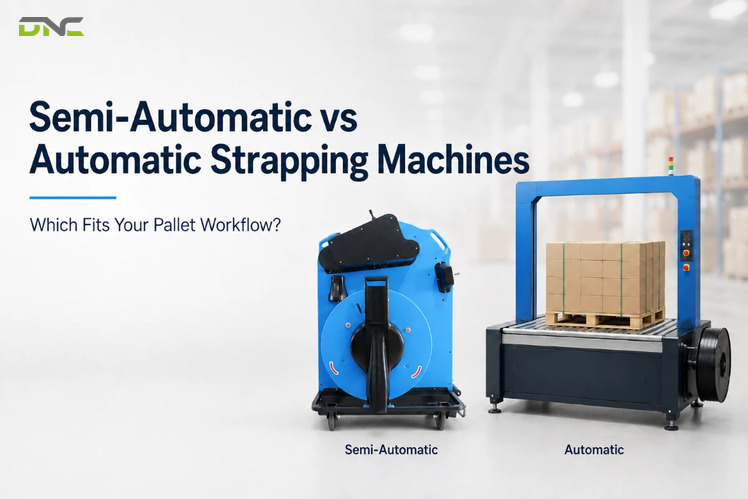
A semi-automatic strapping machine and an automatic strapping machine run the same four-action cycle – dispense, tension, seal, cut. What separates them is who starts that cycle. On a semi-automatic strapping machine an operator positions the package and threads the strap, then triggers the cycle with a foot pedal, push button or tabletop sensor. On an automatic machine a powered conveyor delivers the package into the arch and a sensor fires the cycle with no operator contact. That single difference sets throughput, floor space, labour structure and ownership cost. Strap material, package envelope and the rate of the station feeding the strapper decide the answer well before purchase price enters the discussion. Malaysian manufacturers weighing the two classes are usually deciding where a bottleneck should sit, not which machine is superior.
What Separates a Semi-Automatic Strapping Machine From an Automatic One
A semi-automatic strapping machine differs from an automatic one, from a machine-cycle point of view, in who places the strap and who starts the cycle. Both classes dispense strap, tension it to setting, seal the joint and cut the excess. Neither class performs a different physical operation on the strap itself.
That equivalence has a commercial consequence. Tension accuracy comes from the tension control and joint strength comes from the sealing head, and both classes carry both subsystems. A buyer comparing the two classes is therefore not comparing strap quality – the comparison is about who feeds the machine, and at what rate.
Sealing method carries more weight than the class label. ASTM D3950 treats breaking strength and joint strength as two separate conformance properties, so the closure sets what a strapped load is actually rated to hold: a friction weld transmits above the 75% joint efficiency benchmark, while a metal seal transmits under 50% of the strap’s rated strength. Plastic strap is joined by heat welding or friction welding, ultrasonic heads appear on higher-specification units, and steel strap is joined by a notch seal or spot weld. Strap surface finish decides which of those the machine needs – embossed strap pairs with friction welding, smooth strap with heat sealing.
How a Semi-Automatic Strapping Machine Runs Its Cycle
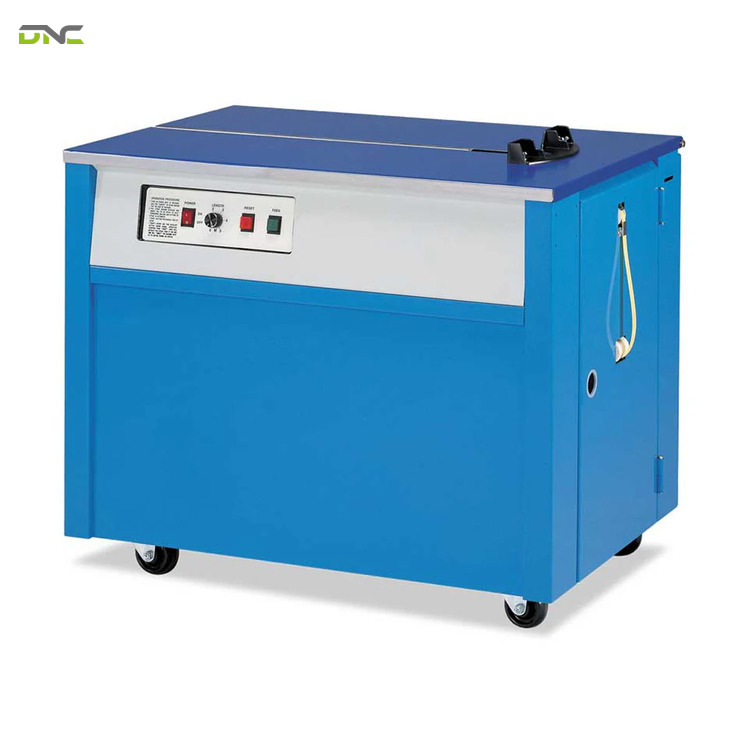
A semi-automatic strapping machine holds the cycle until an operator hands it a threaded strap. The operator places the carton, pallet or bundle on the table, passes the strap around the load, and inserts the free end into the feed slot. The machine then takes over: it tensions to the dial setting, welds the joint, cuts the strap and resets the feed for the next pass.
Operator judgement stays inside the loop, which is why the class tolerates mixed work. A team strapping cartons of four different footprints in the same shift changes nothing on the machine – the operator simply routes the strap differently around each load.
How an Automatic Strapping Machine Runs Its Cycle
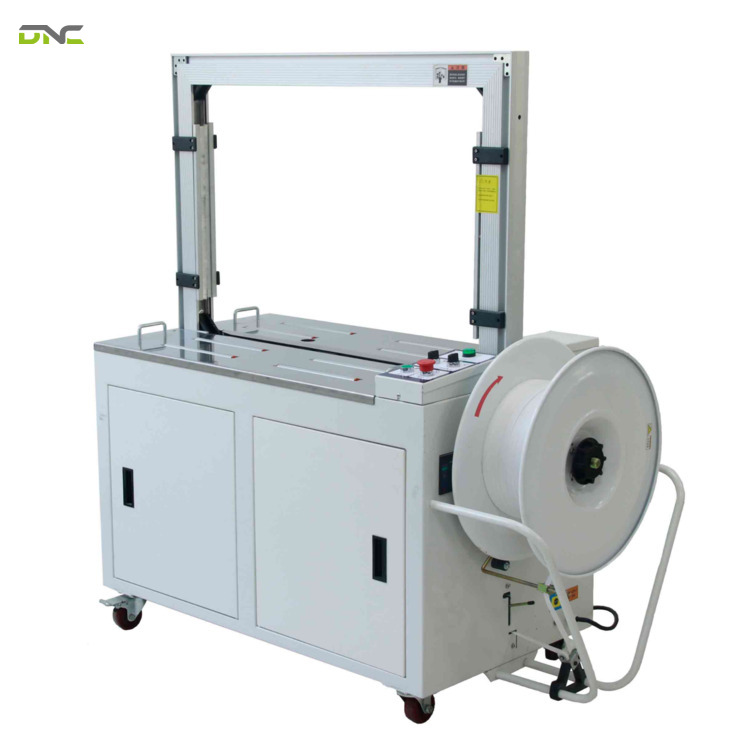
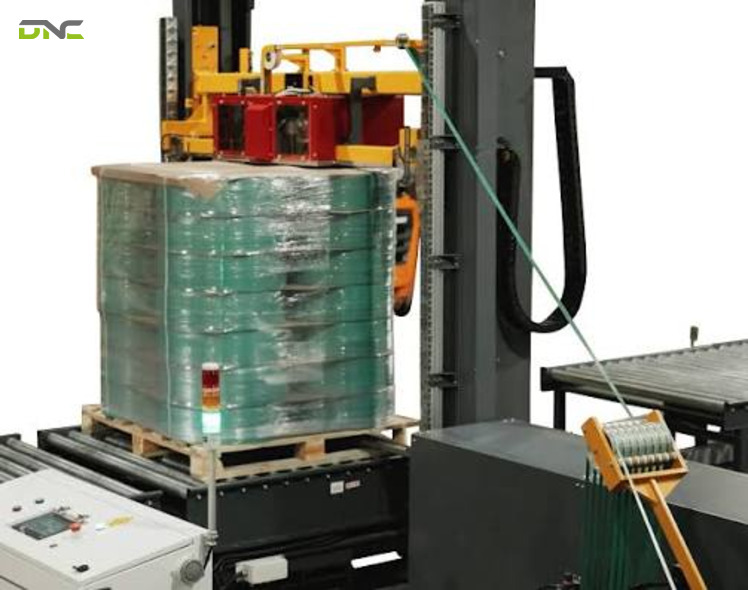
An automatic strapping machine takes the placement signal from a sensor instead of a person. Packages arrive along conveyor system solutions that carry them into the strapping arch, a sensor confirms position, and the machine applies, tensions, seals and cuts while the operator watches from a distance. Reported peak rates on high-specification units reach 60 or more packages per minute (1 per second / 3,600 per hour).
The machine stops being a station at that point and becomes a line component. Its in-feed and out-feed sections belong to it, its cycle has to hold pace with whatever sits upstream, and its downtime propagates in both directions along the line. Holding that pace is measured in straps per hour, which is where the two classes separate.
How a Semi-Automatic Strapping Machine Runs Its Cycle
Throughput: How Many Straps Per Hour Each Strapping Machine Class Handles
Semi-automatic and automatic strapping machines divide, in terms of sustained line output, somewhere between 100 and 300 straps per hour in published supplier guidance. The commonly quoted bands are set out below, and each assumes a single strap per package.
| Straps per hour | Equipment that holds the pace |
| Under 50 | Hand strapping tools remain workable |
| 50 – 100 | Semi-automatic returns measurable time savings |
| 100 – 300 | Semi-automatic still works; automatic starts to improve flow |
| Over 300 | Automatic becomes the only class that keeps pace |
Straps, not packages, are the unit that matters here. A pallet taking three straps consumes three cycles and three operator passes, so a plant strapping 120 pallets per shift at three straps each is running 360 straps – the top band, not the middle one. Converting package counts into strap counts before reading any threshold is the step buyers most often skip.
Peak volume alone is an equally common trap. A machine sized only for the busiest week carries complexity the plant does not need for the other fifty; a machine sized only for the average day fails during seasonal peaks. Both figures belong in the specification.
Why Published Cycle Times Understate the Real Gap
Published cycle times understate the real gap because they measure the machine, not the operation. Semi-automatic units are typically quoted at 2-3 seconds (2,000-3,000 ms) and automatic units at 1-2 seconds (1,000-2,000 ms), and one Malaysian supplier quotes 1.5 seconds (1,500 ms) for a single polypropylene strap on a semi-automatic pallet unit – faster than the semi-automatic band.
The figures reconcile once the measurement boundary is stated. Machine-cycle time starts when the strap is already in position. Operator positioning – walking around a pallet, threading the strap under the load, feeding the end into the slot – sits outside every quoted figure. On a semi-automatic station that positioning step is the real variable and it is a human one, which is why quoted cycle times compress a gap that widens on the floor. Throughput measured across a full shift is the number that decides the purchase; cycle time is the number that decides which strap material the machine can handle at that pace.
Strap Material: The Gate That Closes Before Volume Even Matters
Strap material eliminates semi-automatic and automatic strapping machines from a shortlist, from a consumable specification standpoint, before throughput has narrowed anything. Three materials cover industrial strapping, and each carries a different consequence for machine selection. The three are described below.
- Polypropylene (PP)– the lowest cost per metre, suited to cartons and light to medium-duty loads, fully recyclable, and the default consumable on most tabletop semi-automatic units.
- Polyester (PET)– higher tensile strength and far better tension retention than PP, specified for pallets, metal parts and loads facing rough handling over long transit.
- Steel– reserved for steel coils, large fabrications and heavy building materials, applied at tensions plastic strap cannot hold.
Steel is where the gate closes hardest. On the semi-automatic side, steel strapping is generally applied with handheld pneumatic tools rather than tabletop machines, so a plant specifying steel has already ruled out the tabletop class regardless of its volume. A plant specifying PP for heavy pallet loads rules itself out on holding force instead.
Break strength alone still leaves the specification incomplete, which is the reason a PP strap vs PET strap comparison has to end at the sealing head rather than at the material table. The joint carries the load, not the strap, and the sealing method available on a given machine therefore caps what the material can deliver – which is why steel strap on a metal seal can secure less than its rated strength suggests while PET on a friction weld secures more.
Band width narrows the field again. Malaysian suppliers commonly stock polypropylene band in 9 mm (0.35 in / 0.9 cm), 12 mm (0.47 in / 1.2 cm) and 15 mm (0.59 in / 1.5 cm) widths, with 15 mm the volume seller, and both recycled and virgin material are sold into the same machines. Fixing material, joint method and width first, then reading the throughput bands, produces a shortlist that can actually run the consumable – and a shortlist that changes how many people stand beside it.
Labour: How Each Strapping Machine Class Changes Who Does the Work
An automatic strapping machine, in labour-planning terms, relocates the work rather than removing it. A semi-automatic strapping machine holds one dedicated operator at the station for as long as the machine runs, and that operator positions, threads and triggers every cycle. An automatic machine releases that person and replaces the role with supervision: loading strap coils, clearing jams, watching feed quality across several stations at once.
The skill level moves in the opposite direction to the headcount. Semi-automatic operation is learned in minutes. Automatic operation requires conveyor controls, sensor calibration and feed-fault diagnosis, so the plant trades several low-training roles for fewer higher-training ones.
Physical work changes with the headcount on both strapping machine classes. Manual strapping puts workers through repeated bending, reaching and tensioning; both classes remove the hand-tensioning load, and the automatic class removes the repetitive positioning motion as well. For Malaysian manufacturers facing wage movement and persistent difficulty filling repetitive line roles, that reallocation is often the argument that carries more weight than throughput – provided the plant has the floor to put the machine on.
Floor Space: Strapping Station Footprint Versus Strapping Line Length
From a plant layout perspective, floor space for a semi-automatic strapping machine is set by its own station footprint, and floor space for an automatic machine by the length of line it occupies. Reported footprints for each class are compared below.
| Configuration | Typical footprint |
| Semi-automatic tabletop | 60-80 cm (600-800 mm / 24-31 in) wide by 40-60 cm (400-600 mm / 16-24 in) deep, from 1.5 m² (15,000 cm² / 16 sq ft) |
| Semi-automatic framed unit | 120-150 cm (1,200-1,500 mm / 47-59 in) long by 60-80 cm (600-800 mm / 24-31 in) wide |
| Automatic station with short conveyors | 3-4 m (300-400 cm / 10-13 ft) of linear line length |
The floor space difference is structural, not incidental. A semi-automatic strapping station is a destination – the operator brings work to it, so what it needs beyond its own dimensions is circulation space. An automatic unit sits inside a flow, so its in-feed and out-feed conveyor sections belong to its footprint, and accumulation zones, multiple strapping heads or corner protector applicators extend it further.
Ceiling clearance enters the floor space calculation only on vertical pallet arches, where the strap travels over the top of the load. The two strapping machine classes therefore fail differently in a constrained plant: a semi-automatic station fails on operator circulation, an automatic line fails on available line length – and line length is one of the costs that never appears on the machine quotation.
Cost: What Owning a Strapping Machine Includes Beyond the Purchase
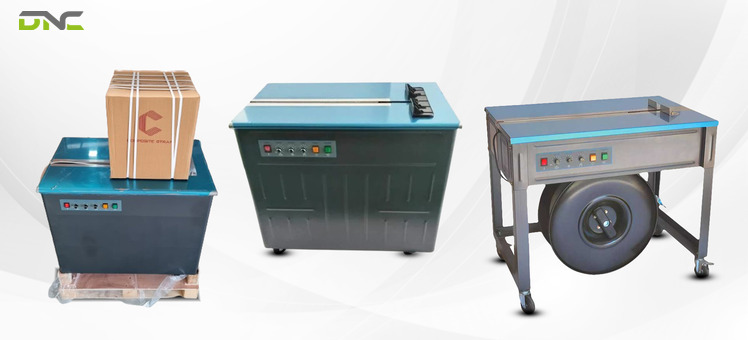
Across the ownership period, the purchase price of an automatic strapping machine is the smaller part of the difference between the two classes. Suppliers agree that automatic units cost more to buy, reflecting greater mechanical complexity and higher throughput capability. The line items that follow the machine matter more.
Four ongoing costs sit behind the purchase figure, and they are set out below.
- Integration and installation– conveyors, controls integration and commissioning are separate line items on an automatic system, and none of them appear on a tabletop quotation.
- Consumables– strap material is the permanent cost, and it scales with volume rather than with machine class. Machine application does cut consumption against hand strapping, because the machine cuts to the tensioned length instead of leaving operator margin.
- Maintenance– more moving parts means more scheduled hours and a higher skill grade. Automatic systems generally require technicians; semi-automatic units are maintained at operator level.
- Downtime– a machine that jams frequently costs production regardless of what it cost to buy, which is why anti-jam provision belongs in the specification rather than in the options list.
The lowest purchase price rarely produces the lowest cost per strapped pallet. A semi-automatic machine that becomes a bottleneck holds up shipments that are worth more than the difference in capital, and an automatic line bought for volumes that never arrive carries maintenance and integration cost against an underused asset. Both errors come from pricing the machine instead of pricing the operation around it.
Summary: How the Five Strapping Machine Comparison Points Stand So Far
Five dimensions separate semi-automatic and automatic strapping machines, and they do not all point the same way. Machine cycle is identical – only the trigger differs. Throughput sets the boundary somewhere between 100 and 300 straps per hour, counted as straps rather than packages. Strap material closes the gate first, with steel ruling out the tabletop semi-automatic class outright. Labour is relocated rather than removed, trading headcount for skill. Floor space is measured as an area for one class and as linear line length for the other. Ownership cost turns on integration, consumables, maintenance and downtime rather than on the purchase figure. What none of those five dimensions answers on its own is what the rest of the line is doing.
What Owning a Strapping Machine Includes Beyond the Purchase
Where the Strapping Step Sits in Your End-of-Line Sequence
A strapping machine, semi-automatic or automatic, inherits the rate of the station feeding it in the context of a complete end-of-line packaging line. Strapping rarely stands alone. It follows carton sealing, weighing or checkweighing and palletizing, and it precedes stretch wrapping and dispatch, so the strapper’s automation level only pays back when the stations around it can hold the same pace.
An automatic strapping machine fed by a manual palletizing step is the clearest example. The arch may be rated for 60 packages per minute, and the line will still run at the rate two people can build a pallet. Capital spent on the strapper buys nothing until the upstream constraint moves, and the plant has bought a faster machine to stand idle between loads.
The sequencing question runs the other way as well. A plant that has already automated palletizing with industrial robotic solutions and installed in-line weight verification through automated inspection systems has usually moved its constraint onto the strapping step without noticing, because the strapping station is the one place where a person still touches every load. DNC’s engineers specify strapping machines inside that full sequence – carton sealing, weighing, palletizing, strapping, stretch wrapping – across automotive, food and beverage, and glove manufacturing plants in Malaysia, and the automation level of the strapper is decided last, once the governing rate of the line is known. That governing rate is what turns a general comparison into a specific recommendation.
The Strapping Machine Class That Fits Your Load Variation and Line Rate
Semi-automatic and automatic strapping machines are chosen, in a Malaysian manufacturing operation, against load variation first and governing line rate second. The decision conditions for each class are compared below.
| Decision input | Points to semi-automatic | Points to automatic |
| Load variation | Mixed carton and pallet sizes through the same shift | One or two consistent formats |
| Volume | Under roughly 100-300 straps per hour | Sustained above 300 straps per hour |
| Strap material | PP and PET on cartons and light pallets | PP, PET and steel at higher tension |
| Upstream station | Manual or semi-automatic palletizing | Automated palletizing or inline conveying |
| Available space | A workstation footprint from about 1.5 m² | 3-4 m of uninterrupted line length |
| Labour position | An operator is already at the station | The station is hard to staff consistently |
| Staging pattern | Loads strapped in several zones of the plant | Loads pass a single fixed point |
Industry patterns follow those inputs closely. Contract packers, plants running short specialty batches and distribution centres doing spot strapping stay on the semi-automatic side because their work is varied by definition. Sawmills, corrugated plants, beverage and food operations running standard case sizes, and metal service centres handling coils and profiles sit on the automatic side because their output is uniform by definition.
Neither class is the upgrade of the other. A plant that installs an automatic strapper to solve what is actually a pallet-staging problem has bought complexity in place of a layout change – a substitution that shows up as underused capacity rather than as a fault. What remains to be checked is whether the site itself can physically accept the class you have chosen.
Site Prerequisites Behind a Strapping Machine Automation Level
Site prerequisites decide whether an automatic strapping machine reaches commissioning on the date it was promised. Electrical supply upgrades, a compressed air connection and floor anchoring belong to an automatic installation and almost never to a tabletop unit, and each one carries its own lead time inside a running plant. Treating them as installation details rather than as selection criteria is how commissioning dates slip.
Four machine attributes deserve equal weight across both classes, and they are listed below.
- Tension control– a dial or digital adjustment lets one machine serve fragile cartons and dense pallets; internal mechanical adjustment does not.
- Anti-jam provision– automatic strap loop ejectors clear jammed material and re-feed fresh strap without an operator, which converts a line stoppage into a pause.
- Environmental rating– stainless steel frames resist corrosion in food processing and wet areas, and sealed electronics protect against dust in wood and metal processing.
- Mobility– castors let a semi-automatic unit move between workstations, which suits plants where strapping happens at more than one point.
Environmental rating is where Malaysian food and beverage plants most often reopen a settled specification, because washdown areas rule out standard frames after the machine class has already been chosen. A frame specified for the plant it will actually stand in is also the frame that survives the upgrade path.
Site Prerequisites Behind a Strapping Machine Automation Level
The Upgrade Path From Semi-Automatic to Automatic Strapping
An upgrade path from a semi-automatic strapping machine to an automatic one is protected at purchase, not at upgrade. A semi-automatic machine selected for modularity – one where a conveyor in-feed can be added later, or where the strapping head can be repositioned into an inline configuration – carries forward into an automatic installation. A machine selected without that question has to be replaced instead of extended.
Five signals indicate that a plant has reached the upgrade point, and they are listed below.
- The dedicated strapping operator can no longer keep pace with production.
- Strapping has become the bottleneck that delays shipments.
- Repetitive strain complaints are rising among the strapping team.
- Volumes have grown 50% or more since the current machine was installed.
- A second shift is being added that would need another dedicated operator.
Timing the upgrade against those signals avoids both failure modes – the productivity loss of an overworked semi-automatic station, and the idle capital of an automatic line installed too early. Getting the timing right depends on how well the plant can describe its own flow to a strapping machine supplier.
Preparation Before a Strapping Machine Supplier Discussion
Semi-automatic and automatic strapping machine quotations become comparable, from a procurement point of view, only when the supplier receives a documented flow description. Suppliers quoting from a machine category alone produce quotations that cannot be compared; suppliers quoting from a documented workflow produce specifications that can.
Seven data points make a strapping machine specification comparable across vendors, and they are listed below.
- Package and pallet dimensions, with the range of variation rather than the average.
- Weights, and which formats are uniform versus which change through the shift.
- Daily volume in straps per hour, at both typical and peak load.
- Number of straps applied per package or pallet.
- Strap material and band width currently in use.
- Floor area at the strapping point, plus ceiling height where pallets are strapped vertically.
- How loads reach the strapping point today, and how they leave it.
Projected volumes belong alongside the current ones. A machine specified against this year’s output alone is being bought for a plant that will not exist in three years, which is the same error as sizing on peak demand – measured on the wrong axis.
For Malaysian manufacturers building toward the Industry 4.0 targets set out under NIMP 2030, the strapping station is usually where line data stops and paper starts, and connecting it through smart manufacturing solutions turns a strap count into a production record. If your facility is specifying a strapping machine as part of a wider end-of-line packaging upgrade, DNC’s engineering team sizes the class against your governing line rate, strap material and layout constraints – get a free consultation to put a specification against your line.
Preparation Before a Strapping Machine Supplier Discussion
Frequently Asked Questions About Semi-Automatic and Automatic Strapping Machines
Buyers raise the questions below while a strapping station is still being specified. Each answer separates the same two things: who triggers the cycle, and what rate the line upstream is already running.
What is the main difference between a semi-automatic and an automatic strapping machine?
The main difference is who positions the package and threads the strap. A semi-automatic strapping machine requires an operator to place the load and pass the strap around it before triggering the cycle with a foot pedal, push button or tabletop sensor. An automatic machine takes both signals from a conveyor and a sensor, then applies, tensions, seals and cuts without operator contact. Both classes run the identical four-action cycle once the strap is in position.
Is an automatic strapping machine always better than a semi-automatic one?
No – an automatic strapping machine is not always better than a semi-automatic one. Automatic equipment wins only where load formats are consistent and volume is sustained. Mixed pallet sizes, loads staged in several zones of a plant, and volumes that sit below roughly 300 straps per hour all favour a semi-automatic or mobile machine, because operator judgement handles variation that a fixed sensor position cannot. Automatic equipment also carries monitoring, staging and maintenance obligations that do not disappear with the operator.
Can you upgrade a semi-automatic strapping machine to an automatic one later?
Yes – a semi-automatic strapping machine upgrades to an automatic one when the original unit was specified for it. Modular units can accept a conveyor in-feed and allow the strapping head to be repositioned into an inline configuration, which protects the initial purchase as volumes grow. Machines bought without that question are replaced rather than extended, so the upgrade path is worth raising at the first quotation rather than at the second.
What strapping material works with semi-automatic and automatic strapping machines?
Both classes run polypropylene (PP) and polyester (PET) strapping, and automatic systems also handle steel strapping for heavy-duty work. PP suits cartons and light to medium loads at the lowest cost per metre. PET carries higher tensile strength and holds applied tension far longer, which is what pallets and long transit need. Steel strapping on the semi-automatic side is normally applied with handheld pneumatic tools rather than tabletop machines. Malaysian suppliers commonly stock PP band in 9 mm (0.9 cm / 0.35 in), 12 mm (1.2 cm / 0.47 in) and 15 mm (1.5 cm / 0.59 in) widths.
How much maintenance does each strapping machine class need?
Daily maintenance is comparable across both strapping machine classes and covers clearing strap debris from the head, checking that the coil feeds without tangles, inspecting the seal area for residue and confirming the tension setting. Weekly and monthly work adds lubrication of moving parts, inspection of blades, grippers and sealing elements, electrical connection checks and emergency stop testing. Automatic machines carry more moving parts and generally require technician-level service, where semi-automatic units are maintained at operator level. Professional service at least annually suits both, more often at high volume.
- 18 views
- 0 Comment
Recent Comments