


Palletizing Meaning: Definition, Process and Types
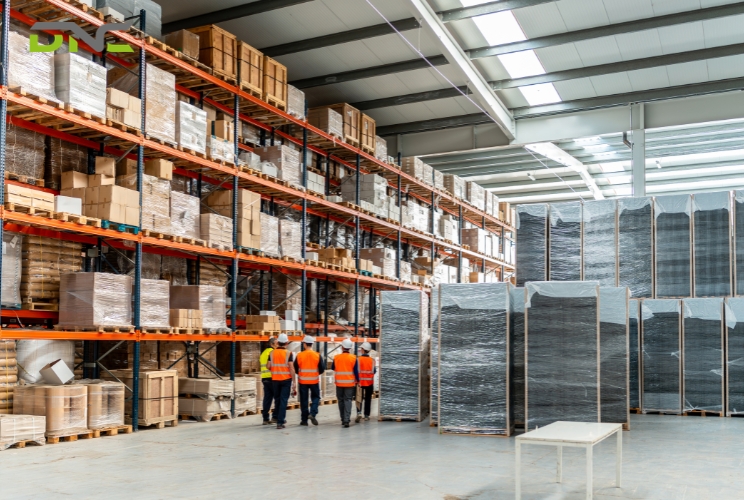
Palletizing is the process of stacking cases, bags or crates onto a pallet in a set pattern and securing them, so that many packs move, are stored and are counted as one unit load. British English spells the word palletising, and palletization names the same practice. On a production line the work sits after the case sealer and the checkweigher and before the pallet wrapper. In a warehouse it happens at receiving, in storage and at the dispatch dock. DNC Automation integrates palletizing cells with conveyors, checkweighers and pallet wrapping machines in Malaysian factories.
Palletizing follows seven steps, rests on one of three stacking patterns and ends with a record of three values: case count, gross mass and label.
Palletizing Definition and Its Word Forms
The palletizing definition is short: to place goods on a pallet and secure them, so the load is moved, stored and shipped as one unit. Merriam-Webster gives the verb the same sense, to place on, transport or store by means of pallets, and records its first use in 1944. The product of the work is a unit load, an assemblage of individual items combined for ease of storage and handling, as Wikipedia defines the term. A typical unit load is corrugated boxes on a pallet, stabilised with film, tape or strapping.
Palletizing meaning in shipping follows from that definition. Goods that travel as one secured pallet load are palletized freight, and goods stacked loose are not. A material-handling dealer describes palletized shipping as many similar cases stacked on pallets and secured for bulk movement, in contrast to a parcel order that is boxed for one customer.
The table separates the palletizing terms that suppliers, warehouses and searchers use for the same job.
| Term | What it names | Typical use |
| Palletizing | The act of building one pallet load | Stacking sealed cartons by hand or by robot |
| Palletization | The practice of moving and storing goods as pallet loads | A dispatch rule of full pallets only |
| Palletized | The state of goods already on a pallet | Palletized freight, palletized cargo |
| Palletizer | The machine or robot that stacks cases onto a pallet | The end of a conveyor line |
| Depalletizing | Taking a pallet load apart | Receiving docks and the start of a production line |
| Unit load | The finished, secured pallet load | The object a forklift, conveyor or AGV carries |
The family palletise, palletising and palletisation is the British form, and DNC’s own page on automatic palletising uses it. Both spellings describe the same job. Reversing the job gives depalletizing, and one integrator notes that the same robot often does both when the rate allows. The word names the result; the process that produces a unit load has seven steps.
The Seven Steps of the Palletizing Process
The palletizing process has seven steps, and their order matters because each step fixes an input for the next. The list follows one pallet from empty base to dispatch.
- Choose the pallet.Footprint, material and rated load are matched to the goods and to the receiver. Wood is the most common material, plastic suits food and pharmaceutical work, and metal suits very heavy or high-temperature loads, according to one cobot vendor.
- Set the pattern.The layer layout is fixed before the first case goes down: heaviest and strongest cases at the bottom, every case inside the pallet edge.
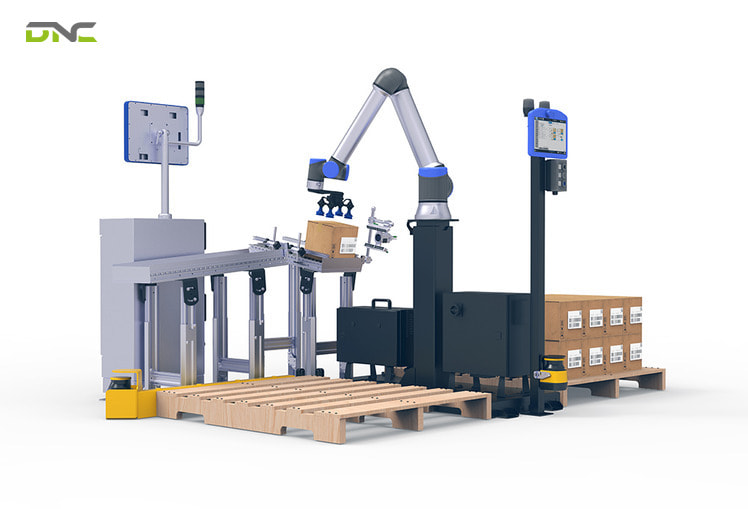
- Build the layers.A person places each case, or a robotic palletizing cell places each case or layer at a programmed coordinate, and every layer repeats the pattern until the load reaches its height or case count.
- Separate the layers.Slip sheets or flat cardboard between layers level the surface and stop sliding, and corner boards protect the edges.
- Secure the load.Film, shrink wrap or straps lock the layers together. A material-handling dealer recommends 3 to 5 layers of film, and one wrapping specification sets film coverage at no less than one third of the pallet height at the base, so the load locks to the pallet and not only to itself. A DNC pallet wrapping machine applies that film at a controlled force.
- Label and record.The label carries contents, weight, destination and any handling instructions, as one cobot vendor lists them, and the paperwork adds origin and expiry dates where they apply.
- Move the load.A conveyor, AGV, pallet jack or forklift carries the finished pallet to storage or to the dispatch dock.
Steps 1 to 5 build the load. Steps 6 and 7 turn the pallet into one traceable object, which is why a label states weight and contents and says nothing about the pattern. A slip in steps 2 to 5 shows later as a toppled stack, a crushed bottom layer or film that slides off the base. Step 2 sets the pattern, and the three common patterns trade strength against stability.
Stacking patterns for palletizing fall into three families: column, brick and interlock. The table compares what each family gives and what it costs, using the figures a material-handling dealer publishes for each.
| Pattern | How the layers sit | Gain | Cost |
| Column | Corner over corner, every layer identical | Maximum compression strength, full use of the carton wall | More prone to toppling when stacked tall |
| Brick | Footprint switched each layer, like brickwork | Stronger load, mixed carton sizes allowed | Fewer cases per pallet |
| Interlock | Rotating footprint, more than one case under each case | Bridging strength, less pallet deflection | Fewer cases per pallet; harder to build |
Column stacking puts the weight of the pallet load down the strongest part of the carton, which suits lighter or soft-content goods. Interlocking suits higher-density loads such as canned goods. The same dealer names split-row, hybrid and pinwheel as further patterns, and one warehouse-automation supplier rotates each layer by 90° from the layer below in its interlocked loads, so gaps do not line up from one layer to the next.
Whatever the pattern, cases stay inside the pallet edge and the stack keeps a rectangular shape. Overhang acts as a bumper that causes toppling, and a pyramid shape compromises the integrity of the stack.
Pattern data is written as Ti and Hi. Ti counts cases per layer. Hi counts layers. A 7 x 5 configuration holds 7 cases per layer over 5 layers, which is 35 cases per pallet.
That count is more than a stacking detail. It is the number that the label, the order and any weight check must all agree with. Ti x Hi counts cases per footprint, so the footprint, which the pallet fixes, comes next.
Stacking Patterns: Column, Brick and Interlock
Pallet Sizes, Materials and Load Ratings
Pallet sizes for palletizing follow regional practice, and ISO 6780:2003 sanctions six footprints for intercontinental handling, reviewed and confirmed in 2014. The table lists them with the region where each is most used and the floor space lost in a 40 ft ISO container.
| Footprint (mm) | Footprint (in) | Most used in | Floor lost in a 40 ft container |
| 1,016 x 1,219 | 40 x 48 | North America | 3.7 % (20 pallets) |
| 1,000 x 1,200 | 39.4 x 47.2 | Europe, Asia | 6.7 % |
| 1,165 x 1,165 | 45.9 x 45.9 | Australia | 8.1 % |
| 1,067 x 1,067 | 42 x 42 | North America, Europe, Asia | 11.5 % |
| 1,100 x 1,100 | 43.3 x 43.3 | Asia | 14 % |
| 800 x 1,200 | 31.5 x 47.2 | Europe | 15.2 % |
Three of the six pallet footprints list Asia as a region of use, so a Malaysian exporter checks the receiver’s footprint before the pattern is released. DNC Automation recommends writing that footprint into the specification as the first fixed value, because Ti and Hi cannot be set without it. Footprint comes first.
Two pallets set the reference points. The EUR pallet is a four-way wooden pallet of 800 x 1,200 x 144 mm (31.5 x 47.2 x 5.7 in) that weighs about 25 kg (55 lb) and carries a safe working load of 1,500 kg (3,307 lb). The 48 x 40 in GMA pallet (1,219 x 1,016 mm) holds up to 4,600 lb (2,087 kg). A two-way pallet is lifted by its deckboards, and a four-way pallet takes forks from all four sides.
Wood remains the most common pallet material, with plastic, metal and cardboard as alternatives, and hundreds of millions of pallets are made each year. The rated load caps what the cases weigh together, so case count x case mass is compared with the rating before the pattern is released. Once the pallet and the pattern are fixed, the remaining question is who places each case.
Manual, Semi-Automatic and Automatic Palletizing
Palletizing is manual, semi-automatic or automatic, and the difference is who places each case. In manual palletizing a person stacks every case by hand, which needs no machinery and carries the strain of repeated lifting. In semi-automatic palletizing a person still places the cases while lift tables, turntables, conveyors or a wrapper take the strain out of the job. In automatic palletizing a robot or a conventional layer machine builds the whole load.
The throughput gap is wide, though vendor figures differ by product. One cobot vendor states 200 to 300 boxes per hour for a person and 600 to 1,600 boxes per hour for a robotic cell. DNC’s reference range for a six-axis arm is 10 to 60 cycles per minute, and a cycle can carry more than one case, so a cycle rate is not a case rate. At 10 cycles per minute a cell completes 600 cycles an hour. The cost side of that choice has its own article on manual vs automated palletizing.
Machines arrived in steps, and Wikipedia dates them. The first mechanised machine was installed in 1948, row-forming types followed in the early 1950s, the in-line type in the 1970s and the robotic type in the early 1980s. Each type takes product at a high or a low infeed level, which is why vendors describe high-level and low-level machines. For the machine itself, read what a palletizer is.
Automation removes repetitive lifting from the job and holds the same pattern on every pallet. It does not remove the need to know what each case contains. The same three methods run in two settings, and the setting decides how much is known about each case.
Palletizing on the Line and in the Warehouse
Palletizing happens in two settings: on the production line, where one product repeats, and in the warehouse, where the product mix changes. The table compares what arrives, what is known about each case and how the pallet is built.
| Setting | What arrives | What is known about each case | Typical build |
| Production line (end-of-line) | Sealed cases of one product at a steady rate | Count and mass, read by machines upstream | One fixed pattern, repeated by a machine |
| Warehouse (receiving, storage, dispatch) | Mixed cartons and supplier pallets | Declared size and weight from the stock record | A plan per order, mostly built by hand |
On the line, the last machine that touches each case is the one that builds the pallet. A single product arrives in order, the pattern never changes, and on a line built for it the machines upstream have already counted and weighed each case.
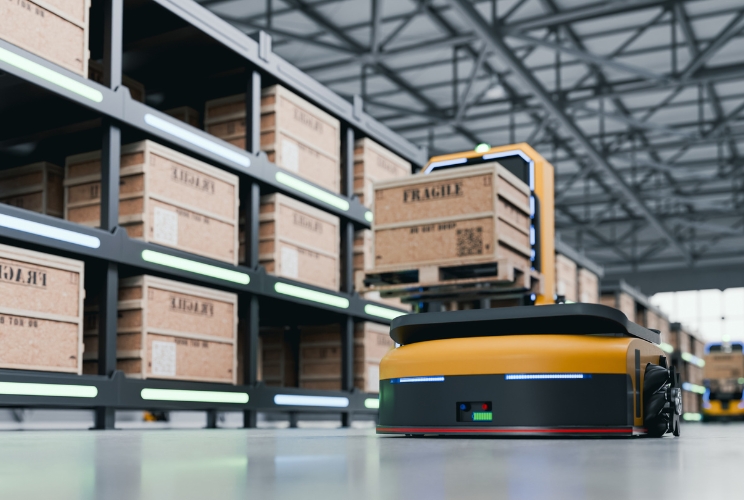
Warehouse palletizing follows the stock through goods receipt, storage and shipment, the phases in which a material-handling dealer says a pallet makes each SKU easier to monitor. In the receiving bay a supplier pallet is checked in and broken down. In storage a full pallet moves without restacking. At dispatch a wholesale or freight order leaves as a wrapped pallet load. Palletization in a warehouse therefore serves the stock record as much as the truck.
The mixed pallet is the hard case. Wikipedia describes mixed case palletizing as a three-dimensional bin-packing problem and notes that stacking mixed-size products still largely involves manual labour.
Planning software generates the stacking pattern from case dimensions and load-bearing limits, and the pattern can guide a robot or a person. One warehouse-automation supplier adds that dimension and weight data, either set at packing or captured by camera, feeds the warehouse execution system so that placement follows real sizes. DNC connects its control layer to a plant’s WMS as part of warehouse automation in Malaysia, and it does not sell the WMS itself. Both settings pay for the same thing, fewer touches per case, and that is where the benefits and limits of palletizing start.
Palletizing on the Line and in the Warehouse
Benefits and Limits of Palletizing
The benefits of palletizing come from handling many packs as one load, and its limits come from the pallet’s own height, mass and footprint. One pallet moves in one lift where loose cases need one lift each, and standard pallets lower handling and storage costs and speed up material movement, as Wikipedia notes. A material-handling dealer gives a rail-car example from the pallet’s early years: unloading about 13,000 unpalletised cases took 3 days, and with pallets the same job took 4 hours. Wikipedia adds that the Euro-pallet let railway carriages be loaded in about 10 % of the time of earlier methods.
Palletizing by hand loads the back and joints with repeated lifting, and several suppliers name injury risk and staff turnover as reasons to automate it. A pallet is also one unit in the stock record, so a warehouse tracks one line instead of dozens of cartons.
Physical constraints cap those benefits. A EUR pallet takes 144 mm (5.7 in) of height and about 25 kg (55 lb) of mass before the first case goes on, so a load that fills a trailer by height or by mass pays for the pallet too. Brick and interlock patterns trade case count for stability. Semi-automatic and mixed-case work keep people in the loop, and a stack planned from declared case figures is only as accurate as the declaration. The trade-offs rest on the six decisions that the summary below collects.
Summary: What Palletizing Decides
Palletizing decides six things, and this summary lists them. The unit load is the product: packed goods placed on a pallet and secured as one object. Seven steps run from pallet choice to the move to storage. The pattern trades strength against stability, and Ti x Hi gives the case count.
The pallet fixes the footprint and the rated load, with six ISO footprints in use. A person, a person with lifting aids or a machine places the cases. On a line the cases are known; in a warehouse they are mostly declared. Everything above builds the load, and what the load leaves behind for the rest of the plant is a separate question.
The Record a Palletized Load Leaves Behind
Palletizing leaves behind a record of three values: case count, gross mass and a label. It is the point where the handling unit changes from case to unit load. Before it, each sealed case is counted, weighed and rejected on its own conveyor. Once film covers the stack, nobody handles the cases one by one, and what is known about the contents is the label, the count and the mass.
That is why the line order matters. In DNC’s integrated line set the checkweigher follows the carton sealer and precedes robot palletizing, so a case that is light, heavy or missing a product is rejected before it becomes one of 35. DNC’s article on how a checkweigher works covers the weighing window, the zones and the reject. The checkweigher answers the case-level question; the pallet build then fixes the count.
The finished pallet has a mass that follows from the same numbers. Gross mass equals pallet mass plus case count times case mass. For a 7 x 5 load on an EUR pallet of about 25 kg, that is 35 x case mass + 25 kg. A gross-mass check against that figure exposes a missing or extra case when the combined tolerance is smaller than one case, which a label scan does not. The scan reads the record, and the scale tests it.
Placement software for palletizing depends on declared figures. It plans the stack from declared case sizes and weights, and nothing in the stack itself confirms them. DNC Automation recommends fixing the record before choosing the machine: decide which value is measured, which is declared and where each is checked. The checklist below turns that record into a specification.
Palletizing Specification Checklist for a Malaysian Line
A palletizing specification for a Malaysian line answers six questions before any machine is quoted. The list below fixes the load from the case to the record.
- Case:dimensions, mass and tolerance, and whether a checkweigher sits upstream, because the case mass sets every later figure.
- Pallet:footprint, rated load and material at the receiver, since the receiver’s rack, trailer or container fixes the footprint.
- Pattern:Ti and Hi, the pattern family and the height limit at the dock or the store.
- Method:manual, semi-automatic or automatic, set by the rate and by the number of products on the line.
- Securing:film coverage at the base, number of wraps and label content.
- Record:where the pallet’s count and mass are checked, and which system receives them.
Each answer feeds the next. A change to the case changes Ti x Hi, which changes the gross mass of the pallet, which changes the check.
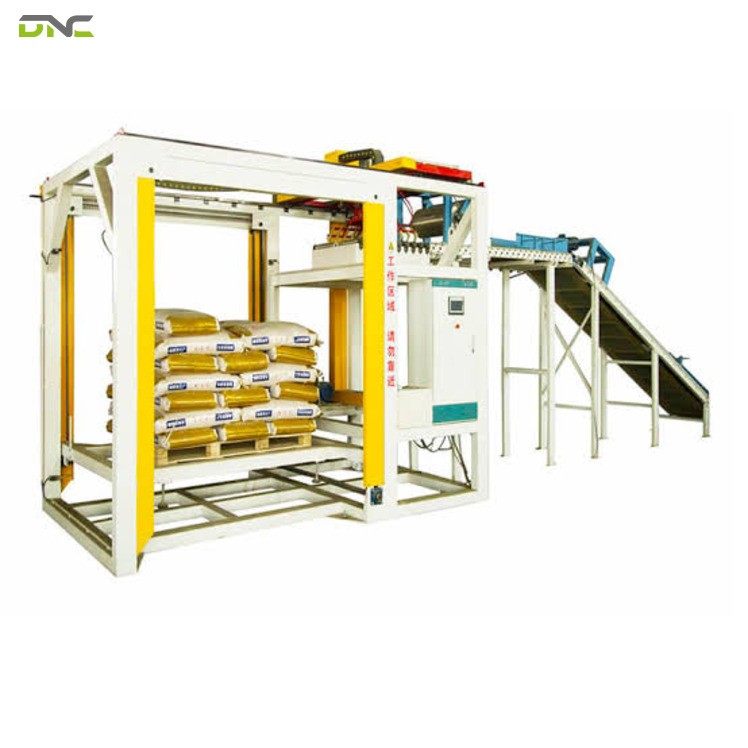
The case and the pallet are fixed first, the pattern and the method follow, and the securing and the record close the specification. A quote that starts with the machine skips the first two answers and inherits whatever the supplier assumed. DNC’s engineers specify palletizing cells together with the conveyor, the checkweigher and the pallet wrapper, because the record crosses all four. For your production line in Selangor or Johor, talk to our engineers about the palletizing cell, the conveyor and the weighing station as one turnkey specification. The questions below answer six common searches in two sentences each.
Palletizing Specification Checklist for a Malaysian Line
Frequently Asked Questions
Frequently asked questions about palletizing cover six searches: the meaning, the reverse process, the warehouse setting, the shipping term, the case count and the pallet-skid distinction, each answered in two sentences.
What is the meaning of palletizing?
The meaning of palletizing is stacking packed goods on a pallet in a set pattern and securing them as one unit load. That unit load then moves, is stored and ships as a single object, and British English spells the word palletising.
How does palletizing differ from depalletizing?
Palletizing and depalletizing run in opposite directions: the first builds a pallet load and the second takes one apart. Depalletizing happens at receiving docks and at the start of a production line, where cases leave the pallet and enter the process.
Where does palletization in a warehouse happen?
Palletization in a warehouse happens at goods receipt, in storage and at dispatch. At each point the pallet becomes one line in the stock record.
Is palletized freight the same as loose cartons?
No, palletized freight travels as one wrapped pallet load, while loose cartons are handled one by one. Stacking in a pattern, securing and labelling make a forklift, a truck and a receiver treat the pallet as one unit.
How many cases fit on a pallet?
The cases that fit on a pallet equal Ti x Hi, which is cases per layer times the number of layers. A 7 x 5 pattern gives 35 cases, and the pallet’s footprint and rated load cap that figure.
What is the difference between a pallet and a skid?
A material-handling dealer separates them by decks: a pallet has a top and a bottom deck, and a skid has only a top deck and rests on its stringers. Wikipedia treats skid as another name for a pallet, so suppliers use the two terms loosely.
- 1 views
- 0 Comment
Recent Comments