


Pre-Stretch Film Ratio Explained | DNC Automation Malaysia
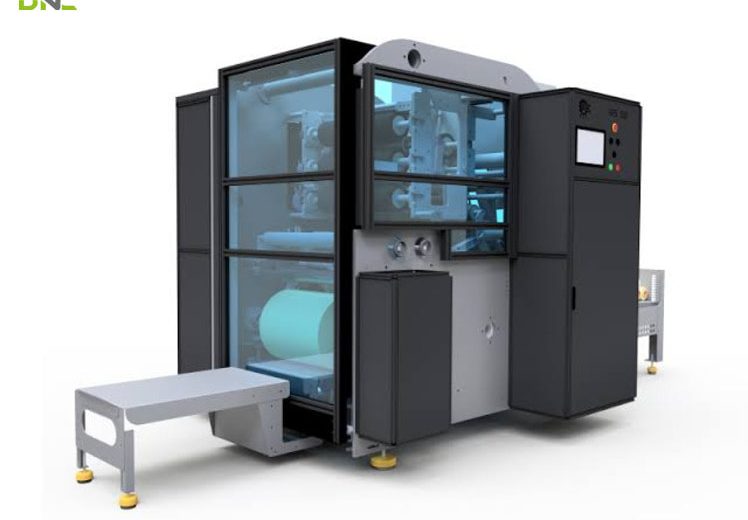
A pre-stretch ratio is the percentage of added elongation that a stretch wrapper’s film delivery system applies to the film before the film reaches the pallet, set by a gear pair or a powered roller set inside the pre-stretch carriage. A 250% setting draws one metre off the roll and lays 3.5 m onto the load. Published machine settings run 150% to 300%, and the pre-stretch ratio is an economy figure rather than a security figure: containment force equals wrap force multiplied by film layers, and the pre-stretch ratio is a term in neither factor. Three separate quantities circulate under this one label, two of them describing the same physical film and disagreeing by a full multiple. The carriage specification and the film product that borrows its name are two different purchases sitting on two different lines of a capital plan.
A Pre-Stretch Percentage Names Added Length, Not Final Length
A pre-stretch percentage names the length added to the film, which makes the conversion to yield a single line of arithmetic: N% produces a multiplier of 1 + N/100. In machine specification terms, 250% does not mean two and a half times. It means one metre off the roll covers 3.5 m of load path.
Stretch wrapper manufacturers publish the same conversion in imperial form, stating that pre-stretch percentages of 150% to 300% mean every linear foot of film coming off a roll represents 2.5 to 4 feet of film on the load. The same manufacturers describe quality machine stretch film as stretching 3× or more, a multiple that corresponds to a 200% setting under this reading.
The four pre-stretch settings a Malaysian production line is most often quoted convert as follows.
| Pre-stretch setting | Yield multiplier | Load path covered per metre of roll | Per linear foot of roll |
| 150% | 2.5× | 2.5 m | 2.5 ft |
| 200% | 3.0× | 3.0 m | 3.0 ft |
| 250% | 3.5× | 3.5 m | 3.5 ft |
| 300% | 4.0× | 4.0 m | 4.0 ft |
Is a 300% pre-stretch ratio the same as 3×? Under the convention above, no – 300% yields 4× the film length, and the gap between those two readings is the subject of the next section.
Three Different Quantities Are Published Under One Label
Three different quantities appear under the label “pre-stretch ratio” across the pages that rank for it, and two of the three describe the same physical film while disagreeing by exactly one multiple. From a specification point of view, that makes an unqualified percentage in a quotation ambiguous rather than merely imprecise.
Added elongation – the machine convention
Added elongation is the reading stretch wrapper manufacturers use, and it maps 300% onto 4.0×. A supporting industry post states the same function from the other direction, describing a 250% ratio as one metre of film becoming 3.5 m once stretched. Two independent sources landing on the identical arithmetic is what makes this convention the machine-side default.
Stretched length divided by original length
A packaging supplier defines the stretch ratio as the ratio of the stretched length to the original length of the film. Under that definition 300% maps onto 3.0×, one full multiple below the machine reading. The definition is internally coherent and no page that publishes it acknowledges the alternative.
Share of the film’s full stretch potential
Film manufacturers use the term for something else again: a standard gauged film stretched to 80–90% of its full stretch potential and then wound onto a core. That figure is a fraction of a maximum the datasheet defines, not a multiplier at all. A film described as 90% pre-stretched yields neither 1.9× nor 0.9×.
Three Different Quantities Are Published Under One Label
The Definition Gap Costs Most at the Lowest Setting
A pre-stretch definition gap costs most at the lowest setting, because the two machine-relevant conventions sit exactly 100 percentage points apart while the proportional error they produce grows as the setting falls. In terms of the film line in a capital plan, a 150% quotation is more exposed to that gap than a 300% one.
Film drawn to cover 100 m of load path resolves two ways.
| Setting | Read as added elongation | Read as final ÷ original | Film drawn per 100 m of load path | Understated by |
| 150% | 2.5× → 40.0 m | 1.5× → 66.7 m | 40.0 m vs 66.7 m | **66.7%** |
| 200% | 3.0× → 33.3 m | 2.0× → 50.0 m | 33.3 m vs 50.0 m | **50.0%** |
| 250% | 3.5× → 28.6 m | 2.5× → 40.0 m | 28.6 m vs 40.0 m | **40.0%** |
| 300% | 4.0× → 25.0 m | 3.0× → 33.3 m | 25.0 m vs 33.3 m | **33.3%** |
Gear-driven carriages and entry-level wrapping cells sit at the low end of that table. The specification most exposed to the ambiguity is therefore the one a first-time buyer is quoted, which inverts the usual assumption that the cheaper machine carries the smaller specification risk.
Procurement teams read the percentage as a discount and engineers read it as a film delivery specification. Neither reading closes until the quotation states the yield multiplier the percentage refers to – and until the machine that carries the number is identified.
The Pre-Stretch Ratio Is Fixed by a Gear Pair, Not by an Operator
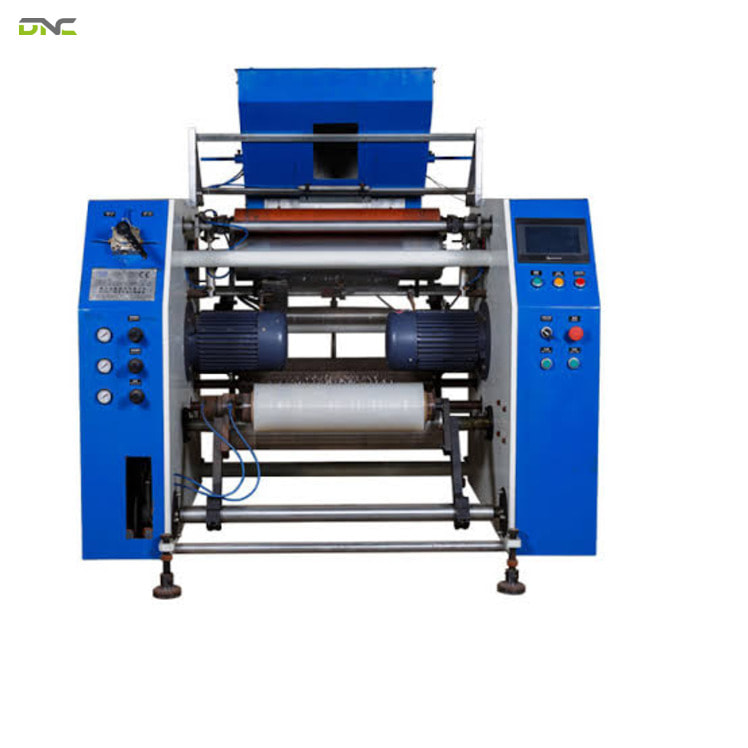
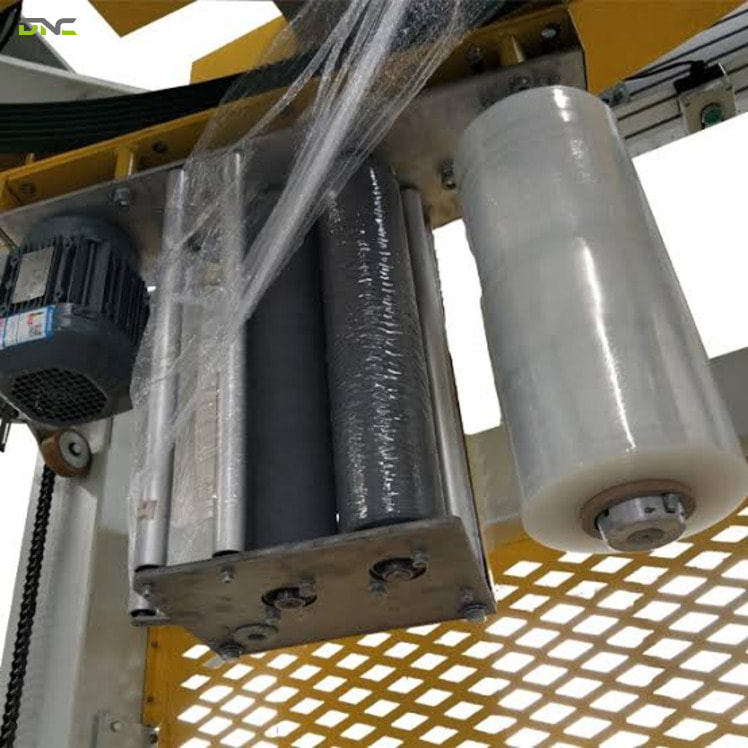
The pre-stretch ratio on a mechanical carriage is determined by a set of gears in the wrapper’s pre-stretch carriage. Viewed as a purchasing decision, the ratio a line can run is fixed when the machine is bought, not chosen at the control panel during a shift.
Powered pre-stretch systems change the character of the number. Motorised roller sets reach a higher degree of stretch and give more control over the stretching process than mechanical arrangements do, which turns a fixed step into a controlled range. A facility that expects to wrap several load profiles buys that range deliberately.
The distinction matters because a gear pair carries no adjustment path. Changing the ratio on a mechanical carriage means changing gears, so a line that was specified at 200% runs at 200% until someone opens the carriage. A powered carriage moves the same decision onto the control system, where a new load profile becomes a setting change rather than a parts order.
That difference shows up in mixed-SKU plants first. A single load profile tolerates a fixed step, because the ratio only has to be right once. Facilities running light cartons and dense drums through the same wrapping cell need the ratio to move with the load, and the machine either supports that at purchase or it does not.
The consequence for a specification document is direct. “What pre-stretch ratio do we run” is a question about the film delivery system, answered at procurement and confirmed at commissioning. Whether the ratio also decides how well the pallet survives transport is a separate question with a separate answer.
The Pre-Stretch Ratio Is Fixed by a Gear Pair, Not by an Operator
Containment Force Holds the Load, and the Pre-Stretch Ratio Is Not One of Its Terms
Load security is determined by containment force – wrap force multiplied by film layers – and stretching is not a factor in it. Expressed as an engineering identity, the pre-stretch ratio appears in neither of the two terms that produce the number holding a pallet together. Field guidance places containment force at 15 to 26 lb per linear inch of load perimeter (2.7 to 4.6 kg per linear cm / 26 to 46 N per linear cm / 2.6 to 4.6 kN per linear metre), and ASTM D4649-20 is the standard guide covering the selection and use of stretch wrap films.
One ranking page states the opposite, arguing that a higher ratio means the film is more stretched and therefore ensures better load stability. That conflict resolves on dimensions rather than on authority. Containment force carries units of force per unit of load perimeter; a pre-stretch ratio is a dimensionless multiplier. A dimensionless number cannot be ranked against a force, so the two quantities are not competing answers to one question.
The history explains why. When the first stretch wrapper was built in 1972, it drew film from a 60-inch (1,524 mm / 152.4 cm / 5 ft) roll designed for dry cleaning and used a core brake to slow the film enough that it stretched on its way onto a rotating pallet. Stretching entered pallet wrapping as a way to make film go further, and pre-stretching the film before it leaves the film delivery system remains an economy measure. The percentage inherits that purpose unchanged.
What follows from the equation is that a load has an optimal containment force rather than an optimal wrap pattern. A pallet needing 10 lb (4.54 kg / 44.5 N) of containment force reaches that figure through thin film in many layers or thick film in fewer layers, with identical security and materially different throughput. Anyone specifying a wrapping cell should agree the containment force target before the pre-stretch figure is discussed, which is the same sequence that governs how to improve pallet load stability across every other securement decision on the line.
The number that does have a ceiling is the pre-stretch setting itself.
Machine Films Are Engineered Comfortable to 300%, and Load Geometry Takes Part of It Back
Machine films are engineered to pre-stretch comfortably to 300%, and film breaks increase above that figure. In terms of where those breaks occur, failures concentrate at the corners of loads, because tension rises at each corner with most film delivery systems.
Machine-applied film runs at 50 to 65 gauge (12.7 to 16.5 micron / 0.5 to 0.65 mil / 0.0127 to 0.0165 mm), at the fixed conversion of 0.254 micron per gauge, which is thinner than the 63 to 80 gauge (16 to 20.3 micron / 0.63 to 0.8 mil) typical of hand film. Thinner webs reach the rated stretch and have less material left to absorb a tension spike when a corner arrives.
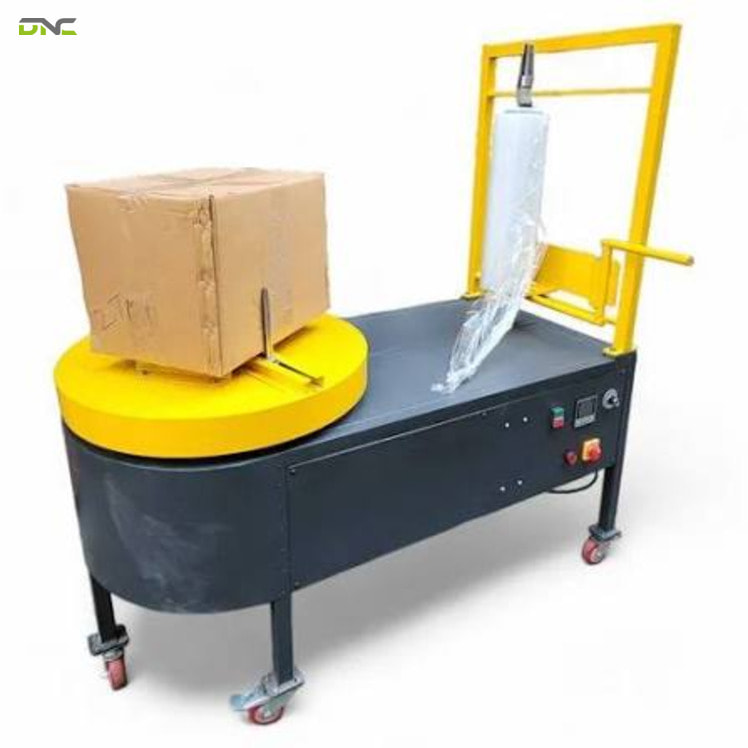
Two load characteristics take part of the ceiling back. High-speed wrapping applications lose uptime to film breaks when film is overstretched, and irregular loads whose profile changes mid-revolution provoke the same failure – particularly where the machine does not adjust the way it feeds film. Rotary architectures and turntable architectures handle that adjustment differently, which is why the achievable ratio is partly a consequence of choosing between a turntable vs rotary arm stretch wrapper at specification stage.
The usable ceiling on a given line is the film’s rated figure minus whatever the load’s own geometry takes back. Pushing past it in pursuit of film savings starts a sequence that returns the saving.
Machine Films Are Engineered Comfortable
Down-Gauging Returns as Consumption Through a Closed Loop
Down-gauging combined with extreme pre-stretch produces a documented sequence that ends where it began, at film consumption. Viewed as a cost mechanism, thinner film does not always deliver a net saving, and the reason is a chain of operator responses rather than a property of the film.
The published down-gauging sequence runs through five stages that close on film consumption.
- Film thickness decreases, and film breaks increase as a result.
- Root-causing breaks is slow and difficult, so operators reduce wrap force until the breaks stop.
- Wrap force falls, and containment force falls with it, because containment force is the product of wrap force and film layers.
- Layers are added to restore the lost containment force.
- Added layers consume film, returning consumption to where the down-gauge started.
The saving that justified the thinner film is spent recovering the security the thinner film cost. Savings pursued through down-gauging and extreme pre-stretch can also be lost to damaged product when containment force is affected, which converts a materials decision into a claims and rework exposure.
Both mechanisms – the loop and the damage – trace back to the same starting error of treating a film specification as a load specification.
Summary: What the Number Means and What It Controls
A pre-stretch percentage means added elongation, and the number controls film yield rather than load security. A setting converts to yield by adding one: 150% gives 2.5×, 250% gives 3.5×, and 300% gives 4×. Two published conventions for the same film sit 100 percentage points apart, and the proportional exposure that creates is largest at the lowest settings, reaching 66.7% at 150%.
The pre-stretch ratio itself is a gear pair inside the carriage, agreed at purchase. Load security comes from containment force, the product of wrap force and film layers, which contains no pre-stretch term. Machine films are rated comfortable to 300%, and corners, irregular loads and line speed take part of that rating back before a pallet is finished.
Film Suppliers Sell a Different Product Under the Same Words
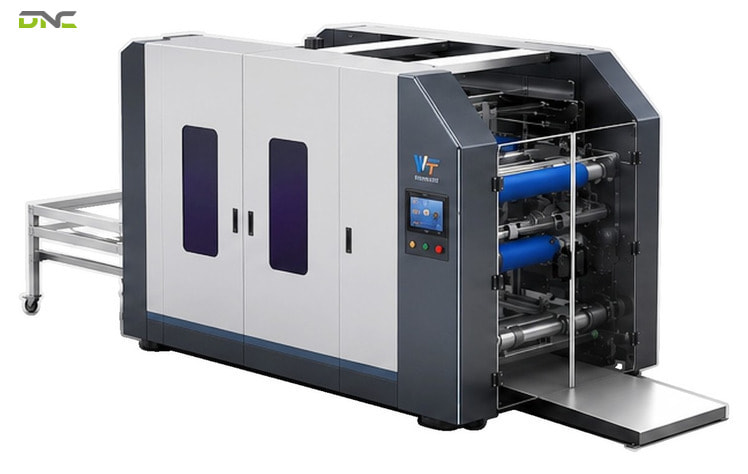
Pre-stretched film is the different product film suppliers sell under the same words, a consumable that arrives already worked to 80–90% of its full stretch potential at the factory and wound onto a core. Pre-stretched film is therefore a roll specification rather than a machine specification. From a procurement point of view, the two products called pre-stretch land on different lines – a carriage is bought once, a film is bought again with every pallet wrapped.
The film-side properties are consistent across suppliers and do not overlap with the carriage decision.
- Pre-stretched film is manufactured from cast stretch film and wound with a folded edge, giving a doubled thickness at the web edges.
- Machine application draws less electrical energy, because the lower tension settings required to apply an already-stretched web reduce the load on the film delivery system.
- Hand application changes body mechanics, letting an operator walk forward and pull less rather than walking backwards against the roll.
- Roll weight falls, which reduces both handling effort at the wrapping station and freight cost per delivered metre.
- Rising resin cost is the driver film suppliers name for the shift toward pre-stretched product.
Hand stretch films are rated to around 200% stretch, and reaching that rating by hand takes maximum effort, which rarely happens on a working shift. Why does hand film stop near 200% when machine film reaches 300%? Because the pulling force available to a person is the limit, not the polymer – and a powered carriage removes the person from that equation entirely.
A facility can hold either product, both, or neither, and the choice interacts with which wrapping method the line runs at all. That upstream decision between stretch wrapping vs shrink wrapping settles the film family before any pre-stretch figure becomes relevant.
Film Suppliers Sell a Different Product Under the Same Words
Setting the Ratio on a Running Line Follows a Standard, Not a Trial
A pre-stretch ratio is set on a running line by writing the load standard first and deriving the machine settings from it, which reverses the trial-and-adjust loop published as general advice. In operational terms, the film specification is not the load specification, and the question a plant answers first is what containment force safely ships its load.
The order of operations runs in three stages.
- Establish the load standard, covering the containment force value, the load-to-pallet bond, and the absence of long or dragging film tails.
- Determine the settings that meet that standard, including film quality, gauge and price alongside pre-stretch percentage, wrap force, top and bottom wrap counts, film delivery system speed, and film overlap.
- Establish a feedback loop that keeps the standard met as loads, films and line rates change.
The measure–adjust–test–assess cycle that circulates as a standalone method belongs inside stage two, where it tunes the pre-stretch ratio and wrap force against a load standard that already exists. Run on its own, the cycle optimises film consumption toward whatever the operator happens to observe.
When DNC’s engineers specify a film delivery system, the containment force target is agreed before any pre-stretch percentage is quoted, and the commissioning record documents the wrap force and layer count that met the load standard. The pre-stretch figure is written down as an outcome of that test rather than as an input to it. Recording settings this way also gives the line data a plant can act on later, which is the same integration logic that governs smart manufacturing deployments across the rest of the facility.
Film suppliers have a reason to present pre-stretch as a product property, and machine builders have a reason to present it as a carriage specification. The pallet does not care which – it responds to containment force alone.
Frequently Asked Questions
Most of the questions below arrive because a percentage was quoted without the multiplier it stands for. Each answer resolves to one rule: the number describes added length delivered by the machine, not a property of the film.
Does a 300% pre-stretch setting mean the film becomes three times longer?
A 300% pre-stretch setting yields four times the length under the convention stretch wrapper manufacturers use, because the percentage names added elongation rather than final length. A competing published definition treats the figure as stretched length divided by original length, which maps 300% onto 3.0×. Any quotation that states a percentage without stating the multiplier it means is ambiguous by a full multiple.
Does a 300% pre-stretch setting mean the film becomes three times longer?
Does raising the pre-stretch ratio make a pallet more secure?
Raising the pre-stretch ratio does not increase load security, because containment force equals wrap force multiplied by film layers and the pre-stretch ratio appears in neither term. Raising the ratio draws more film length from each metre of roll without changing how hard the film pulls or how many times it passes the load. Pre-stretch is an economy measure and has been one since the machine category began.
What is the highest pre-stretch ratio a machine film will take?
Machine films are engineered to pre-stretch comfortably to 300%, and film breaks increase above that figure, concentrating at load corners where tension spikes. High line speeds and irregular load profiles lower the figure a plant reaches in practice. The usable ceiling is the film’s rating minus what the load geometry takes back.
Can an operator change the pre-stretch ratio on a stretch wrapper?
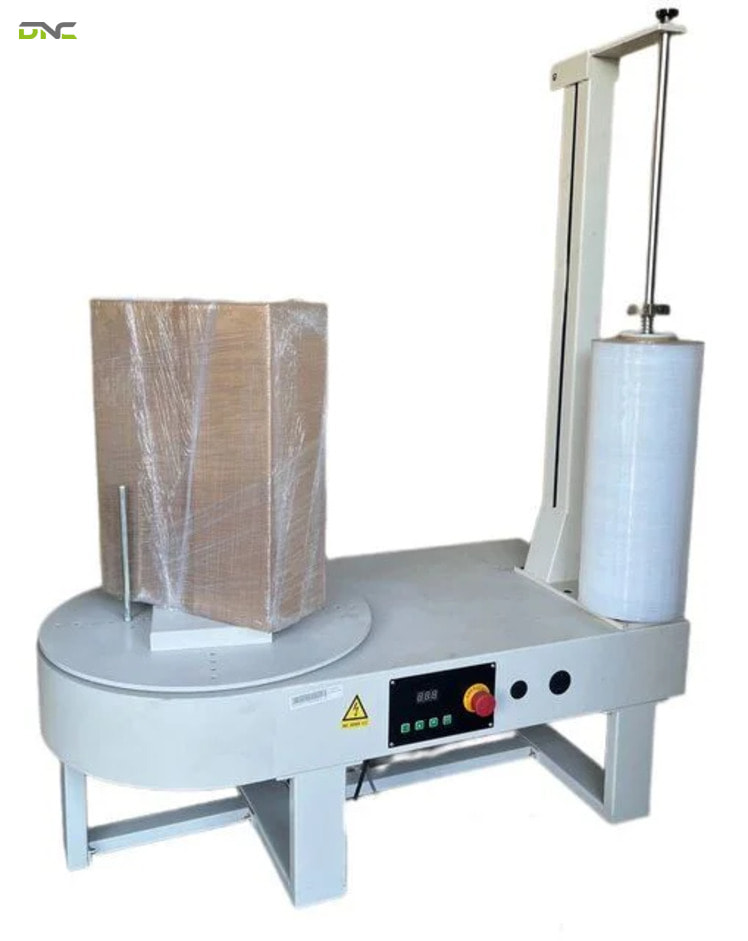
On a gear-driven carriage the pre-stretch ratio is fixed by the installed gear pair, so the achievable figure is set at the point of purchase rather than at the control panel. Powered pre-stretch systems reach higher ratios and give more control over the stretching process, converting the fixed step into an adjustable range. Specifying that range at procurement is what makes later adjustment possible.
Is pre-stretched film the same thing as a pre-stretch setting?
Pre-stretched film and a pre-stretch setting are different products: the film arrives worked to 80–90% of its stretch potential at the factory, while the setting is a carriage specification on the machine. One is a consumable bought with every roll and the other is capital equipment bought once. A facility can run either, both, or neither.
Specifying a Film Delivery System for Your Wrapping Cell
Specifying a film delivery system starts from the containment force the load requires, and the pre-stretch ratio follows from that figure rather than leading it. A percentage quoted without its yield multiplier leaves a gap in the film line of a capital plan that widens as the setting falls, and a percentage quoted as a security benefit describes something the equation does not contain.
DNC’s engineers specify and commission stretch wrapping machines and end-of-line packaging lines for Malaysian manufacturers, sizing the film delivery system against measured load profiles and documenting the settings that met the standard. For facilities building an automation case under NIMP 2030, that documentation is what turns a film saving into a defensible throughput and load-integrity number.
Talk to our engineers about specifying the pre-stretch carriage and containment force target for your production line – contact DNC Automation for a turnkey assessment of your wrapping cell.
- 22 views
- 0 Comment
Recent Comments