


Stretch Wrapping vs Shrink Wrapping | DNC Automation Malaysia
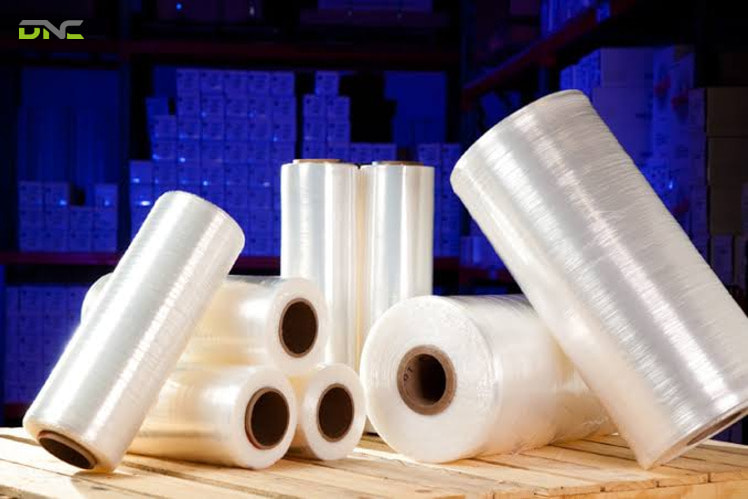
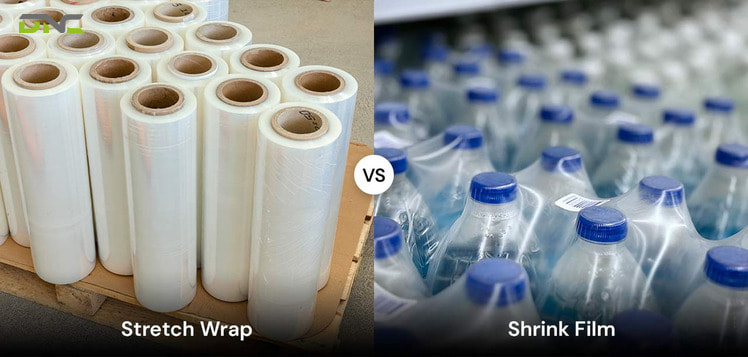
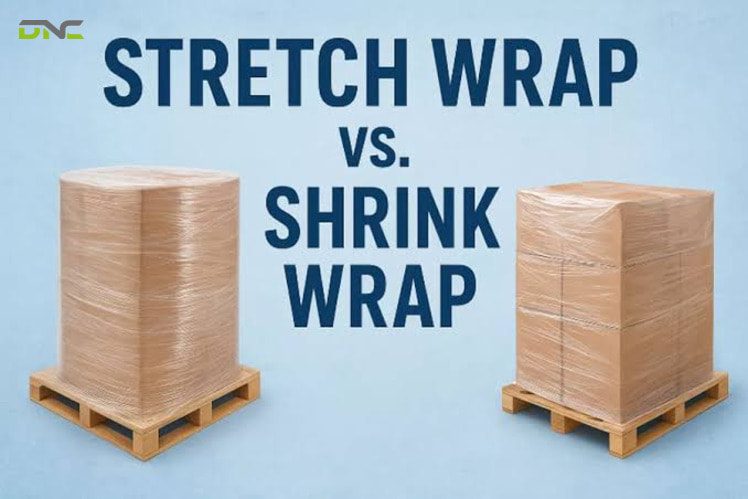
Stretch wrapping and shrink wrapping are not two answers to one question. Shrink wrapping acts on the product – a bottle, a carton, a multipack – sealing film loosely around it and then heating it to 300 °F (149 °C) so the film contracts onto the shape. Stretch wrapping acts on the unit load, elongating polyethylene film and winding it under tension around a built pallet, with no heat anywhere in the cycle. One closes a package. The other holds a stack together. A Malaysian manufacturer shipping palletised retail goods generally runs both, in that order, and the question that matters is not which method wins but which object on your line still needs securing. Get that backwards and you buy a machine for a job your line does not have.
Stretch Wrapping and Shrink Wrapping Act on Different Objects in the Same Line
Stretch wrapping and shrink wrapping divide by the object each one secures, not by which performs better. Shrink wrapping belongs to primary and secondary packaging: it encloses a single item or a multipack, and packaging machine manufacturer Pactur assigns it to food and bakery, cosmetics, publishing and spare parts. Stretch wrapping belongs to tertiary packaging, where the same source places it in warehousing, logistics and distribution centres – palletising and transport stability.
Those two descriptions sit at different points in one production sequence. A carton is sealed, grouped, sometimes shrink-wrapped as a multipack, weight-verified, palletised, then stretch-wrapped for dispatch. Each step hands its output to the next. Nothing in that sequence asks a plant to choose between the two methods, because they never contend for the same station.
Suppliers do acknowledge the overlap, briefly. Pactur notes that many companies deploy both – shrink for product packaging, stretch for palletising – and Australian packaging supplier Omni Packaging states the two are not mutually exclusive, citing loads that take stretch wrap for transit stability and shrink for weatherproofing in outdoor storage. Neither develops the point. Both leave it inside a FAQ answer while the body of the page runs a head-to-head comparison.
That gap is the reason the standard framing misleads. A comparison table implies substitution, and substitution is exactly what these two methods cannot do for each other – for reasons that start with the mechanism.
Tension Holds a Load Together, Heat Closes a Package Around a Product
The mechanical difference between the methods is tension against heat. Stretch film secures by elasticity: it is drawn out, wound around the load, and held by its own recovery force plus the cling between overlapping layers. Shrink film secures by contraction: it is cut and sealed into a loose enclosure first, then heated until it draws down uniformly onto the product inside.
Neither mechanism produces the other’s result. Tension cannot conform film into the recesses of a moulded part. Heat cannot generate the inward squeeze that keeps forty cartons standing as one block through a lorry journey.
How a shrink wrapping cycle runs
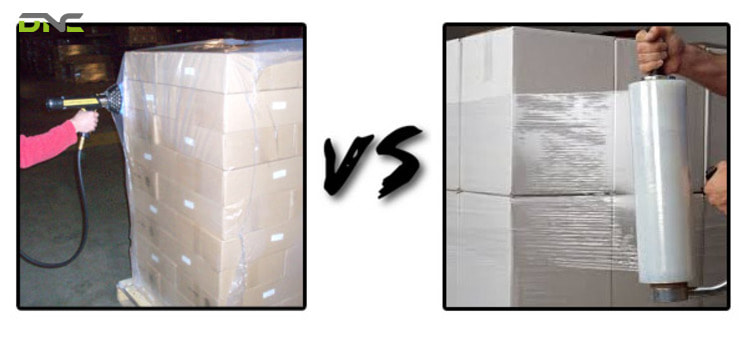
A shrink wrapping cycle puts sealing before heating. The sealing machine cuts the film and closes it around the product – an L-bar sealer is the common configuration – and the loosely bagged pack then travels a conveyor into the shrink tunnel, where controlled heat contracts the film uniformly onto the product before the pack leaves the tunnel mouth. At low volume the tunnel is replaced by a heat gun, which Malaysian film manufacturer Thong Guan describes as the tool for a professional-looking finish on small runs.
Heat is the whole cycle, and everything the method needs downstream follows from it – the tunnel, the conveyor through it, and the electrical supply feeding both.
How a stretch wrapping cycle runs
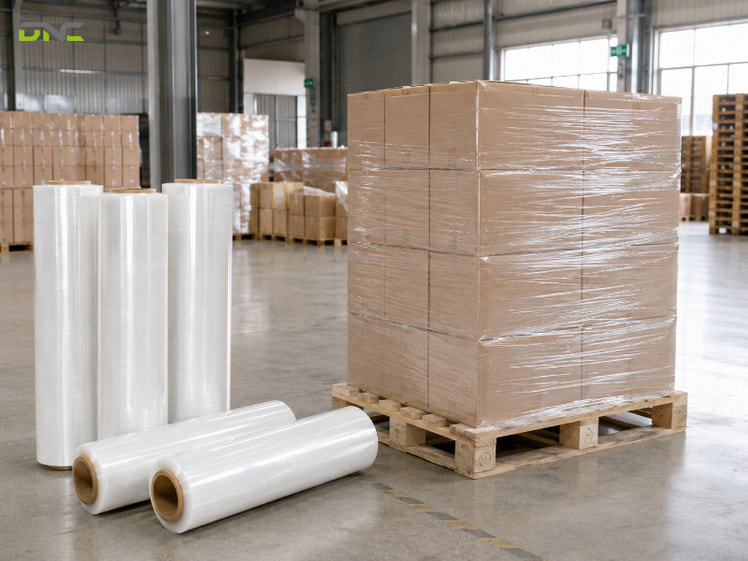
A stretch wrapping cycle applies no heat at all. Film runs off a powered carriage, is elongated by a fixed ratio before it ever reaches the load, and is wound in a bottom-up spiral with each pass overlapping the last. Machine film is engineered to stretch across a wide band – bundling machine manufacturer Felins puts the working range of stretch film at 25–300% elongation – and the elongation set in the carriage is what the pre-stretch film ratio describes.
One exception is worth naming because it looks like a contradiction. Felins states that its own bundling machines use heat to fuse stretch material to itself at the end of a wrap. That heat seals a joint; it does not shrink the film. The distinction matters more than it appears, because feeding the wrong film into a heating station is not a wasted-roll problem.
The Two Films Are Not Interchangeable, and the Failure Mode Is a Fire
Stretch film and shrink film cannot be run in each other’s machines, and the consequence of trying is not a poor wrap. US packaging distributor Industrial Packaging states the position without hedging: one of these films can be used in a heat tunnel to package products, and doing that with the other could result in a fire. Shrink film does not stretch and cannot deliver load containment. Stretch film does not shrink and cannot pass through a heat tunnel or meet a heat gun.
No other page returned on this search names any hazard. Four of the five sources crawled discuss the two films purely as a purchasing choice – clarity, cost, appearance, application – and the word fire appears once across all of them.
The specification consequence is the part that belongs in a capital decision. Choosing a method is choosing a film and a machine together, as one item, because the machine defines what the film must do and the film defines what the machine may apply. A plant that installs a shrink tunnel has committed its consumable to heat-activated LDPE, PVC or polyolefin for the life of that station. A plant that installs a pallet wrapper has committed to polyethylene stretch film and to a pre-stretch carriage sized for it.
Treating film as a procurement line item that can be re-tendered independently of the machine is where that commitment gets forgotten. It also explains why published film specifications from the two families read as though they contradict each other.
The Two Films Are Not Interchangeable, and the Failure Mode Is a Fire
Published Film Thickness Figures Contradict Each Other Until the Units Match
Film thickness claims on this search contradict each other outright. The search result for material handling supplier Handle It reads that the film used in the stretch wrap process is typically thicker than film used in shrink wrapping – a summary line, since the page itself refuses automated access and could not be read in full. Omni Packaging states the reverse in the body of its own guide: compared with heat-activated shrink wrap, stretch wrap is a much thinner plastic film. Both pages rank for the same query. Both describe real products.
The contradiction dissolves once the two figures are put into one unit, and the arithmetic is worth doing because film is a recurring cost rather than a one-time one.
- Pallet shrink filmis sold by Omni Packaging at 50, 100 and 200 micron.
- Machine stretch filmruns from 50 gauge (12.7 micron / 0.5 mil) to 65 gauge (16.5 micron / 0.65 mil), with hand film heavier at 63–80 gauge (16–20.3 micron).
- One gauge equals 0.254 micron, a fixed unit definition rather than a supplier convention.
Pallet-grade shrink film is therefore roughly 3 to 16 times thicker than machine-applied stretch film. The first claim holds when shrink means the thin polyolefin used for retail packs; Omni’s holds when shrink means pallet-grade LDPE. Neither supplier is wrong. The word shrink is doing the equivocating, because it names two products that differ by more than an order of magnitude in gauge.
Averaging the two claims would produce a number describing nothing. The usable rule is narrower: a thickness figure means nothing until the film family and the application level are stated with it.
Ventilation belongs to both films, not only to shrink
Ventilated film variants exist on both sides of this comparison, on the shrink side as much as the stretch side. Thong Guan lists vented pallet wrap among its stretch film types, and Omni Packaging describes ventilated pallet stretch wrap with vent holes that let air circulate through the load in storage or transit. Shrink film is also offered perforated where a pack needs to breathe.
Breathability is nonetheless presented across this search as a shrink-side advantage. It is not a differentiator between the methods, only a variant available within each, and specifying a wrapping station on that basis solves nothing that the standard film could not.
Machine Class Follows the Method, and Automation Level Follows the Line Rate
Each method carries its own machine class, and the two classes share nothing but the conveyor between them. Shrink wrapping needs a sealer plus a heat source: a shrink tunnel mounted over or around a conveyor at production volume, a heat gun below it. Stretch wrapping needs a pallet wrapper, and the turntable and rotary arm stretch wrapper architectures divide that class by which body rotates during the cycle.
Automation level runs as a separate axis across both methods. Felins and Thong Guan both describe manual, semi-automatic and fully automatic equipment for each, and the level is set by throughput rather than by method:
- Manual– Thong Guan puts the ceiling for hand wrapping at fewer than 15 loads per day.
- Semi-automatic– an operator stages the pallet by forklift and the machine runs the wrap cycle.
- Automatic– conveyors deliver and remove the load, and the operator placement step disappears along with the headcount attached to it.
Confusing the two axes is what turns a quotation into a mismatch, and it is the same error that makes published wrapper throughput figures disagree. A method label plus an automation level plus a machine architecture are three specifications, and a supplier naming one of them has answered none of the others.
Cost bands published for stretch equipment show how wide that spread runs. Industrial Packaging puts stretch wrapping machines between USD 2,400 and USD 250,000 with hand dispensers at USD 50–100 – a hundredfold range inside a single machine class, and a US published band rather than a Malaysian quotation.
Machine Class Follows the Method, and Automation Level Follows the Line Rate
Summary: What the Method Settles Before Any Machine Is Quoted
The method question resolves ahead of every machine question, and it resolves on four points established so far.
- Object– shrink secures the product or multipack, stretch secures the palletised unit load. A line that ships palletised retail goods needs both stations.
- Mechanism– shrink contracts under heat at 300 °F (149 °C); stretch holds by elongation and cling with no heating step.
- Compatibility– the films do not substitute for each other, and stretch film in a heating station is a fire risk rather than a poor result.
- Specification unit– film family, application level, machine architecture and automation level are four separate decisions that a single method label cannot carry.
What remains is what these choices cost a facility once installed – in energy, in floor space, and in the numbers a buyer can actually write into a purchase specification.
A Heat Tunnel Is a Facility Specification, Not a Preference
A shrink tunnel commits a facility to an installed heating station, and Pactur names the cost in plain terms: shrink wrapping needs a heat tunnel with the energy and footprint that implies, while stretch wrapping is energy-efficient because no tunnel exists to power. Stretch wrapping’s absence of heat is the specification, not a marketing benefit.
Malaysian plant conditions sharpen that difference. A tunnel holding film at 300 °F (149 °C) radiates into the space around it, and much of Malaysian light manufacturing runs without air conditioning on the packing floor. The heat load lands on the operators working the line, on the ambient temperature of the dispatch area, and on any product staged nearby that is sensitive to it – Industrial Packaging flags heat-sensitive products as a direct disqualifier for the method.
Three facility questions follow, and none of them is a film question:
- Electrical capacity at the end-of-line panel, sized for a continuously heated tunnel rather than for motors alone.
- Floor length, since the tunnel occupies conveyor run that the packing area has to give up.
- Ambient heat rejection in the wrap and dispatch zone.
For manufacturers building automation cases against NIMP 2030 targets, an energy-consuming station carries weight beyond its purchase price, because it appears in the operating cost every hour the line runs. That said, the tunnel earns its energy wherever the pack itself has to be sealed, presentable and tamper-evident – no amount of stretch film delivers that. Which raises the harder question of how the two methods are supposed to be compared at all.
Only One of the Two Methods Publishes a Number You Can Specify
Of the two methods, only stretch wrapping publishes a number a buyer writes into a specification. Load containment is the stretch-side metric: Industrial Packaging defines it as products held securely in place so a load ships safely, and notes that maximum containment requires a stretch wrapping machine rather than a hand dispenser. It is quantified as containment force – a field norm of 15–26 lb per linear inch of load perimeter, roughly 2.7–4.6 kg per linear cm – and ASTM D4649-20 frames the job of stretch film as unitizing, reinforcing and palletizing.
No equivalent number appears on any shrink page crawled for this comparison. Shrink performance is described qualitatively throughout: tight, transparent, tamper-evident, protective against dust and moisture, retail-ready. Those are real properties. None of them is a figure a buyer can write into a purchase specification or verify at commissioning.
The consequence is structural rather than rhetorical. Two methods with no shared unit of performance cannot be ranked against each other – they can only be assigned to the jobs their metrics describe. A supplier who answers “which is better” with a number has quietly changed the question to one his own product measures.
Assignment is straightforward once it is framed that way, with one case where the frame itself needs redrawing.
Only One of the Two Methods Publishes a Number You Can Specify
At Pallet Level the Real Comparison Is Stretch Wrapping Against Shrink Hooding
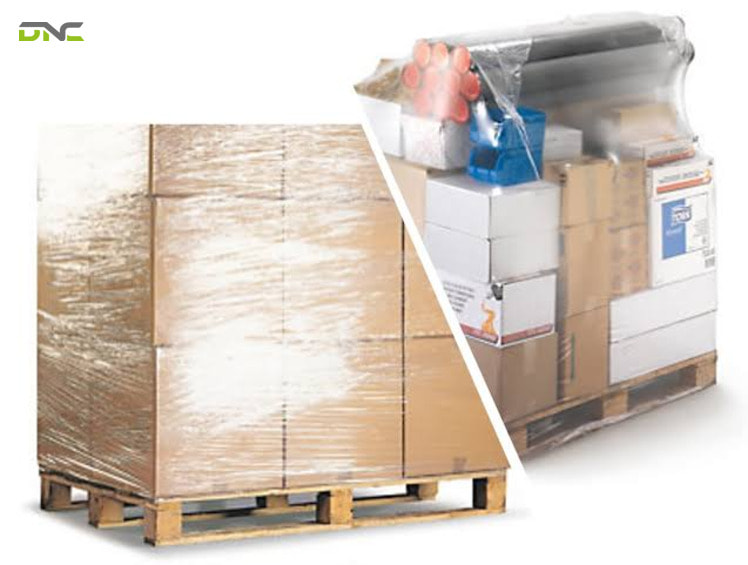
Shrink wrapping does reach pallet level, which is where the standard comparison finally becomes a genuine choice. Omni Packaging sells pallet shrink film as continuous roll cut to pallet height and as pallet-size heat shrink bags sized to avoid wastage across different loads, and specifies LDPE as the common pallet grade with polyolefin preferred for export and long-transit loads. At that point both methods are securing the same object.
Film family separates on three properties once the load is a pallet rather than a pack. LDPE carries good clarity and puncture resistance at the lowest of the three costs, which is why Omni Packaging makes it the common pallet grade. PVC contracts at a lower temperature and finishes tighter and glossier, and stays rare in bulk pallet work for that reason. Polyolefin is the toughest and most puncture-resistant of the three, and it is the film specified where a load faces export handling or a long transit – the same property that makes it the food-contact choice at pack level.
The machine that applies it has a name none of the crawled sources use: a shrink hooder, which draws a film hood over the built pallet and shrinks it down. Comparing a stretch wrapper against pallet shrink film without naming the machine that applies the film leaves the capital side of the comparison blank.
Four criteria change at this level, and the direction of that change is set by the load rather than by the method:
- Weatherproofing– a shrunk hood forms a fully enclosed seal, which is why Omni Packaging specifies it for outdoor storage and export; stretch film gives good stability but is not airtight.
- Tamper evidence– an enclosed hood shows interference, a spiral wrap does not.
- Energy and rate– hooding adds the heating station and its throughput ceiling; wrapping adds neither.
- Combination– the two are stacked on the same load where transit stability and outdoor weatherproofing are both required.
For most Malaysian manufacturers shipping into domestic and regional distribution, stretch wrapping carries the pallet and shrink stays upstream on the pack. The answer changes for export loads sitting on an open yard through a monsoon season, and that is a load-condition decision rather than a preference.
Where Each Method Sits in Your End-of-Line Sequence
Both methods occupy fixed positions in one sequence, and the sequence is what determines whether a plant needs one station or two. Cartons are filled and sealed, grouped and shrink-wrapped where the pack has to reach a shelf, weight-verified, palletised, then stretch-wrapped before dispatch. Pactur groups pallet wrappers and case sealers under end-of-line automation while keeping its shrink range in primary and secondary packaging – the same split, drawn by a machine builder on its own product tree.
Rate is what ties the stations together. A shrink tunnel running at pack level and a wrapper running at pallet level are separated by the palletising step, so a tunnel sized above the palletiser’s rate buys nothing, and a wrapper sized below it stops the line. Powered conveyor system solutions between the two are where that mismatch shows up first, because accumulation between stations is what absorbs the difference.
DNC’s engineers specify wrapping and shrink stations inside that full sequence – filling, sealing, weighing, palletising with industrial robotic solutions, strapping, wrapping and dispatch – across automotive, food and beverage, edible oils and glove manufacturing plants in Malaysia. Working from a 25,000 sq ft (2,323 sqm) production facility with 35 engineers under ISO 9001:2015, the practice on a mixed line is to fix the governing rate first and assign the stations second. The neighbouring securement decision behaves the same way, which is why the choice between PP strap and PET strap turns on the joint rather than on the strap.
Where Each Method Sits in Your End-of-Line Sequence
Summary: How the Two Methods Divide the Work
The two methods divide the work by object, and assignment beats comparison at every point in this article. Shrink wrapping closes and presents a pack, needs heat at 300 °F (149 °C), commits a facility to a tunnel with electrical and floor cost, and publishes its performance in qualities rather than numbers. Stretch wrapping unitises a pallet, needs no heat, and publishes containment force at 15–26 lb per linear inch under ASTM D4649-20 as a figure a buyer can specify and verify.
Where both reach the pallet, the real comparison is a stretch wrapper against a shrink hooder, decided by weatherproofing and transit conditions rather than by film preference. Everywhere else, the two methods are neighbours in a sequence – and the honest answer to “which one do I need” is a question about which object on your line is still unsecured.
Frequently Asked Questions
The questions below recur in specification enquiries, and every answer holds to the same division: the object being secured decides the method, and the method decides the machine.
What is the main difference between stretch wrapping and shrink wrapping?
Stretch wrapping secures a palletised load by tension and shrink wrapping closes film around a product using heat. Stretch film is elongated and wound in overlapping passes with no heating step. Shrink film is sealed loosely around the item and then contracted onto it at around 300 °F (149 °C). One holds a stack together for transport; the other forms a package.
Can stretch film be used in a shrink wrap machine?
No. Stretch film cannot pass through a heat tunnel or meet a heat gun, and Industrial Packaging states that doing so could result in a fire. Shrink film has the reciprocal limitation: it does not stretch, so it provides no load containment on a pallet. The film and the machine are specified together.
Which method is better for pallets?
For pallets, stretch wrapping is the better method in normal distribution work, because it delivers containment force – a field norm of 15–26 lb per linear inch of load perimeter – with no heating station. Pallet shrink film and shrink hooding remain the alternative where a load needs a fully enclosed, weatherproof and tamper-evident seal, which is common for export and outdoor storage.
Which method is better for pallets?
Is shrink film thicker or thinner than stretch film?
It depends on which shrink film. Pallet-grade shrink film is sold at 50–200 micron, while machine stretch film runs 50–65 gauge, equal to 12.7–16.5 micron. Pallet shrink film is therefore roughly 3 to 16 times thicker. Thin polyolefin retail shrink film sits at the other end and is thinner than stretch film, which is why published comparisons appear to contradict each other.
Do I need both stretch wrapping and shrink wrapping?
Many production lines run both, at different points. Shrink wrapping sits at pack level for multipacks and retail-ready presentation, and stretch wrapping sits after palletising for transport stability. A line that ships bulk product on pallets with no retail pack usually needs stretch wrapping alone.
How many pallets per day justify a stretch wrapping machine?
Thong Guan places the ceiling for manual wrapping at fewer than 15 loads per day, above which a machine becomes the practical option. The step from semi-automatic to automatic is set by line rate rather than by daily volume, since automatic machines remove the operator placement step and take their cycle from the conveyor feeding them.
Specifying Your Wrapping Method With DNC Automation
Specifying a wrapping method starts with the object that still needs securing, moves to the rate of the station upstream, and ends at the power and floor length your facility supplies. Those are line questions, not film questions.
DNC Automation engineers end-of-line packaging as a sequence – filling, sealing, weight verification, palletising, strapping, wrapping and dispatch – for manufacturers across automotive, food and beverage, edible oils, glove production and building products in Malaysia. Bring your pack format, your pallet profile and your line rate to our engineers, and the method question answers itself
- 9 views
- 0 Comment
Recent Comments