


Dynamic Checkweigher Reject Systems: Devices, Pitch and Confirmation
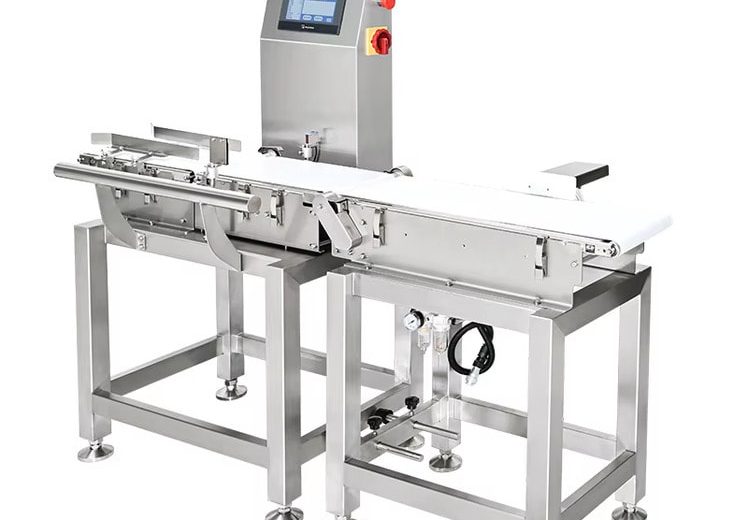
A dynamic checkweigher reject system is the actuator that carries out the weight verdict. The checkweigher decides. The rejector removes. Seven device families do that work, and they reduce to four directions of clearance – the constraint your line layout either satisfies or does not. Pitch weighs just as heavily. The spacing that lets the weigh bed see one pack at a time is the spacing the rejector must fire inside, so it eliminates devices before product type is ever discussed. Rejection also fails in a way a reject bin cannot show. The verdict and the removal are two separate events on two conveyors, and a pack that drifts on transfer leaves a logged rejection that never physically happened. Device selection, reject timing, confirmation and the reject record are what this page resolves for your production line.
A Reject System Turns a Weight Verdict Into a Physical Removal
A reject system is the device integrated with a checkweigher that removes product failing weight inspection from the conveyor line. Suppliers of dynamic checkweighers describe it in those terms consistently. European checkweigher makers frame its job as reliable rejection of products whose weight deviates beyond a defined tolerance.
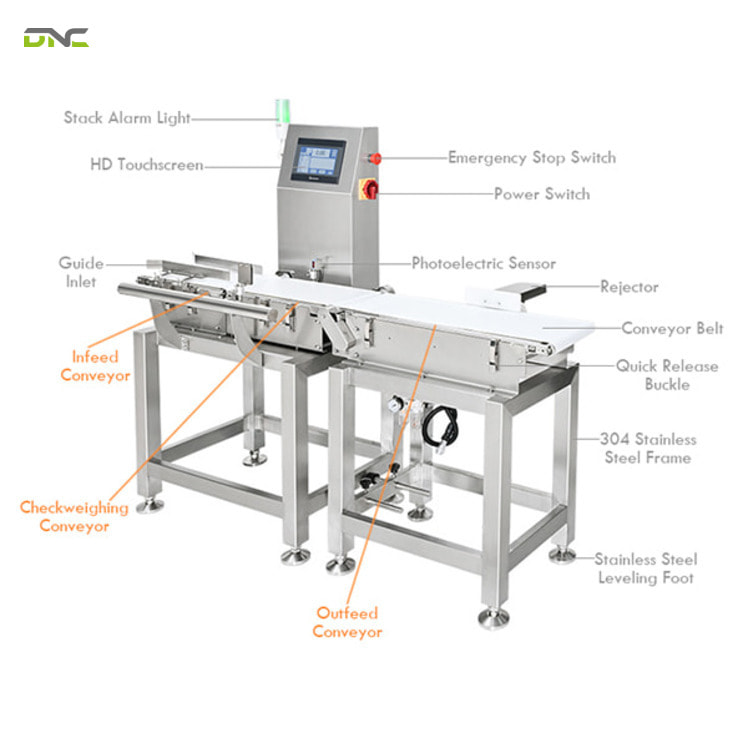
The split matters more than the definition. Weighing and rejecting are two functions, performed by two devices, at two points on the machine. The weigh conveyor produces a number. The controller compares it against preset limits.
Only then does a third conveyor bed carry the pack to the mechanism that acts on the verdict. That weighing path and the zone limits behind the verdict are set out in how a checkweigher works.
The rejector sits downstream of the decision, so it inherits conditions your line has already fixed: belt speed, pack spacing, side clearance, and travel height. Those inherited conditions decide which of the seven device families can be fitted. The product itself decides less than most buyers expect.
Seven Reject Device Families Reduce to Four Directions of Clearance
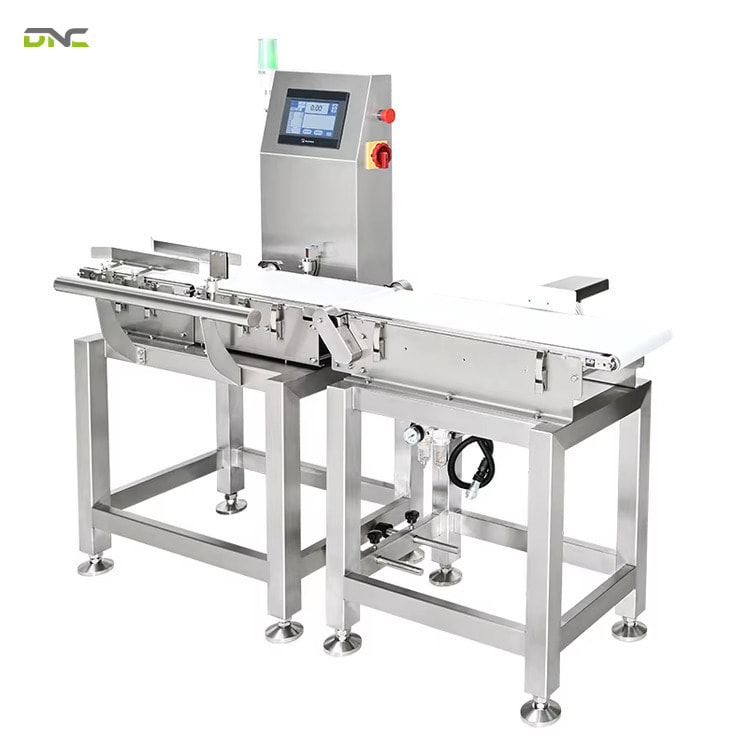
Seven reject device families are in general use on dynamic checkweighers, and each one moves the pack in one of four directions. Suppliers group them by the product they suit – sachets to air, bottles to swivel arms, cartons to pushers. Grouping them by the direction they need free space in puts the constraint first. A layout either has that space or it does not, and product suitability cannot create it.
The table below compares all seven families on the four properties that decide whether one can be specified.
| Device family | Clearance direction | Force reaching the pack | Pitch demand | What disqualifies it |
| Pusher, including pedestal pusher | Sideways | Highest – blade contact across the pack face | High – the blade must complete its stroke inside the gap | Extremely high line speeds; fragile or unstable packs |
| Air blast, blower or air amplifier | Sideways | Lowest of the powered methods – no contact | Low – no mechanical stroke to clear | Heavy packs; unstable line air pressure |
| Swivel or swing arm, including flipper gates | Sideways | Moderate – the arm sweeps or lifts the pack clear | High – the arm needs a spacing window | Fragile packs; close-pitched product |
| Drop flap or drop bed | Downward | Low on contact, but the pack takes a fall | Moderate – the flap must open and close between packs | Heavy packs; anything damaged by dropping |
| Retracting conveyor bed | Downward | Lowest overall – the belt withdraws rather than striking | Moderate | Higher cost and more mechanism than lighter duties justify |
| Push-up plate | Upward | Moderate – the pack is lifted from beneath | Moderate | Unstable or tall packaging that tips when lifted |
| Diverter or multi-segment separator | Forward, into a parallel lane | Low – the pack is steered, not ejected | Low | Floor space for a second lane and a longer installation |
Sideways Clearance
Sideways clearance is what pushers, air blasts and swivel arms need – free belt beside the line. A pusher drives the pack laterally off the conveyor with a pneumatic or electric arm, which suits cartons, boxes, trays and rigid bottles. An air blast uses compressed air on sachets, stick packs and small pouches.
The swivel arm needs a closer look. Reference material describes its motion as sweeping the pack sideways, and also as lifting it off the belt. Both variants sell under the same name, so confirm the motion on any quotation.
Downward Clearance
Downward clearance suits drop flaps and retracting beds. Both send the pack through the conveyor line rather than across it, which fits flexible packaging, snack and frozen food, and anything unstable enough to tip if struck. Both need a bin underneath and clear space to reach it. Both also need synchronisation, because the opening has to be timed to a single pack.
Upward Clearance
Upward clearance is used by one family only: the push-up plate, which lifts the failing pack from beneath the belt. Some suppliers offer it for bottle and can lines where side clearance is unavailable. That makes it a layout answer, not a product answer.
Forward Clearance Into a Parallel Lane
Forward clearance into a parallel lane is what diverters and multi-segment separators use. They steer the pack onward instead of ejecting it, and the primary lane keeps flowing. Multi-lane systems built this way run 2 to 6 lanes at throughputs quoted up to 600 pieces per minute (36,000 per hour). Reworkable product also arrives intact rather than tipped into a bin.
All four directions share one prerequisite. Each needs a gap between packs wide enough for the mechanism to act inside, and that spacing is fixed upstream of the rejector entirely.
Seven Reject Device Families Reduce to Four Directions of Clearance
The Pitch That Protects the Weighment Is the Pitch the Rejector Fires Inside
A dynamic checkweigher holds one pack on the weigh bed at a time, so the distance and speed between packs is set before anything is weighed. The infeed conveyor indexes the packs to open that gap. Every reading depends on it. Two packs on the bed produce one combined figure that cannot be separated.
That same gap is the only window the rejector has. A pusher blade, a swivel arm and a drop flap each need a defined stretch of empty belt to complete a stroke into, and suppliers list exactly that limitation on all three. So spacing is specified once and spent twice – once to protect the weighment, once to give the actuator room to work.
The consequence is a diagnostic worth knowing. A rejector missing packs at rated speed is not automatically a faulty rejector. It can be a pitch set to satisfy weighing accuracy and never re-checked against the actuator’s stroke time. A rejector chosen after the conveyor system pitch was fixed is a rejector chosen with one constraint already spent.
Pitch also explains a second failure, and a stranger one. A pack can earn a correct verdict on the weigh bed and still leave the machine unrejected.
Rejection Splits Into Two Events, and the Gap Between Them Is the Failure Point
A weight verdict and a physical removal are two separate events, and a conveyor transfer sits between them. The weigh bed decides. The reject conveyor acts. Anything that shifts the pack’s position across that transfer – belt slip, a brief conveyance disruption, a light pack nudged by airflow – moves it out of the actuator’s firing window. The verdict stays perfectly correct throughout.
The chain runs like this. Verdict issued, pack transfers, position drifts, actuator fires into empty belt. The failing pack continues downstream. The weight log records a rejection that never physically happened. That last step is why the two countermeasures below exist, and why a count of packs in the reject bin is not proof of removal.
Reject Timing Correction
Reject timing correction is offered by some OEM checkweighers. The machine re-detects the pack’s position once it sits on the rejection conveyor, then corrects the firing time – specifically for cases where conveyance is disrupted during transfer between conveyors. The function exists because the interval between decision and action is where positional accuracy is lost. That makes it worth asking about on any machine quoted for a high-speed line with multiple transfers.
Reject Confirmation
Suppliers that offer reject confirmation describe it as a sensor arrangement verifying the failing pack was actually removed. They attribute four outcomes to it: missed rejects are prevented, reject data is recorded, traceability improves, and regulatory reporting is supported. Confirmation matters most where a line runs unattended or fast. It converts rejection from an action the machine attempted into an event the machine can evidence.
Rejection Splits Into Two Events, and the Gap Between Them Is the Failure Point
Air Rejection Buys Speed and Inherits the Reliability of the Air Supply
An air blast has almost no moving mass, which makes it the fastest reject method and the one with least to wear out. Suppliers list high-speed rejection, compact design and low maintenance against it. They pair those with two limitations: it will not move heavy product, and it requires a stable air supply.
The second limitation carries further than it appears. The blast’s force comes from line pressure, so a pressure drop weakens it without stopping the machine and without raising an error. The nozzle still fires, just with less behind it. On a sachet line, the property that made air the right specification – a pack light enough to be moved by a puff of compressed air – is what makes a partial blast enough to leave that pack on the belt.
Two practices follow. Air-driven rejection belongs on lines where compressed air is monitored rather than assumed. It also has the strongest case of any method for pairing with confirmation, because its failure mode is silent by nature. Where response time binds harder than pack mass, suppliers describe servo-driven rejectors as more accurate on timing. Neither choice changes the accuracy of the weighment, which is set by the weigh bed and the load cell types fitted to it.
Four Constraints Narrow the Reject Device List in Order
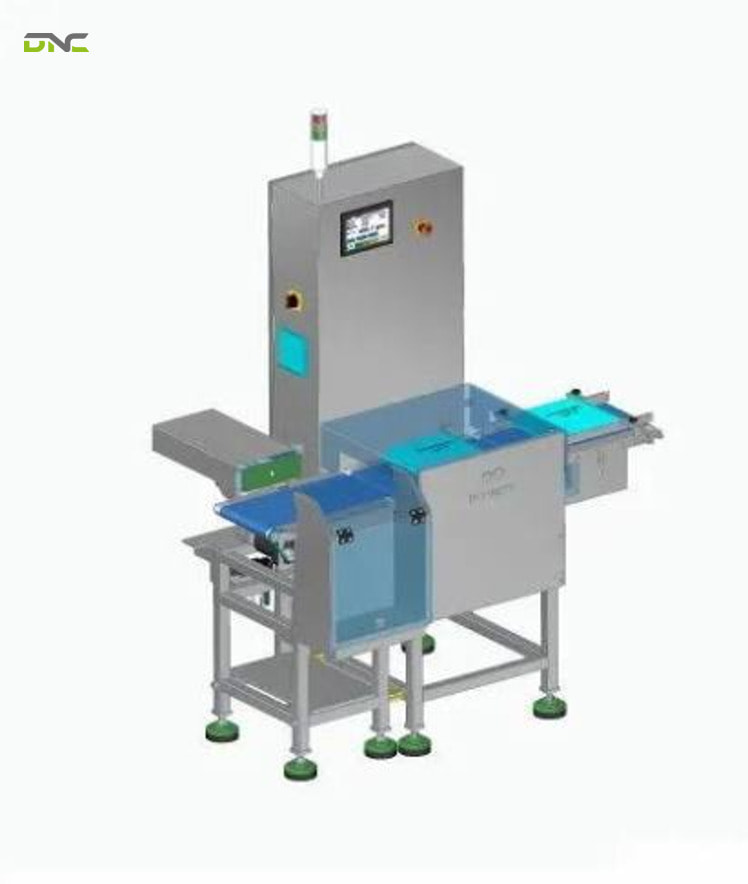
Reject method is specified from a fixed set of six inputs, and suppliers ask for all six before quoting. Those inputs are pack weight, package dimensions, target speed, weight tolerance, conveyor height and pack stability. Order them so each one eliminates options, and the list becomes a shortlist rather than a form to fill in.
- Pack mass.Anything heavy removes air rejection. Anything that breaks on impact removes the drop flap. Inline machines in this class are quoted from about 5 g up to 3,000 g (3 kg / 6.6 lb), with heavy-pack models reaching around 60 kg (132 lb) – and the rejector has to be sized to your actual pack, not to the machine’s full range.
- Pitch at line speed.Packs travelling close together remove the pusher and the swivel arm, because neither completes a stroke inside a short gap. Dynamic checkweighing runs in excess of 500 items per minute – 30,000 per hour – on suitable pack sizes. Stroke time against pitch, not the weighing, usually sets the practical ceiling.
- Pack stability.Tall, top-heavy or partly filled packs remove the impact methods. A rejector that tips a pack has created a second problem on the reject conveyor.
- Clearance direction.Whatever the layout has no room for is removed last. No side space rules out sideways methods, no under-belt space rules out downward methods, and no floor for a second lane rules out the diverter.
Whatever survives all four is the shortlist. The choice between survivors is usually settled by how much force the pack will tolerate.
Four Constraints Narrow the Reject Device List in Order
Gentle Rejection and Fast Rejection Pull Against Each Other
Gentleness, speed and cost rank the reject families in conflicting orders. The force column above runs from the retracting bed at the softest to the pusher at the hardest. Response time runs close to the reverse. Cost tracks gentleness rather than opposing it – suppliers describe the retracting conveyor as the most careful method and, in the same breath, as the one with the more complex structure and higher equipment cost.
A bakery line and a carton line therefore rarely share a rejector, even at matched throughput. The bakery pays in cost and mechanism to avoid impact on glass jars and delicate baked product. The carton line accepts impact, because a wrapped carton absorbs it, and buys fewer moving parts instead. Neither position is more correct. What matters is pricing the trade-off at specification, because the gentlest mechanism available is a poor default on a line whose product does not need it.
Summary: The Reject Device List After Four Filters
Four filters have now been applied to the seven device families. Clearance direction removed everything your layout has no space for. Pitch at line speed removed the long-stroke mechanisms – pusher and swivel arm – on close-pitched product. Pack mass removed air rejection from heavy lines, and the drop flap from anything that breaks. Pack stability removed the impact methods from tall or partly filled packaging.
One thing the filters cannot settle is the handling trade-off, because gentleness and installed cost rise together. The three sections that follow move from the device to the system around it: where the rejected pack goes, what the reject rate says about your filler, and what the record has to prove.
A Reject Verdict Reaches Three Destinations, Not One
Removal is one of three things a reject verdict triggers. A pusher or drop bed ends the pack’s journey in a bin. A diverter parks it in an accumulation lane, held for adjustment or removal – reworked and returned to the line rather than written off. The same verdict also writes a record that outlives both.
- The bin – disposal.The fewest moving parts and the shortest installation, and terminal: everything landing there is paid-for product plus paid-for packaging leaving your line.
- The lane – rework.Needs floor space and a longer installation, and recovers product a bin would have destroyed. This is the diverter’s economic argument, not its mechanical one.
- The log – record.Costs nothing physical, and is the only destination an auditor can read months later.
Lines treating rejection purely as disposal discard reworkable product. Lines treating it purely as sorting accumulate deviations nobody recorded. Reading the reject rate stops either from going unnoticed. In DNC’s automated inspection work on Malaysian packaging lines, the record is routinely the destination nobody specified.
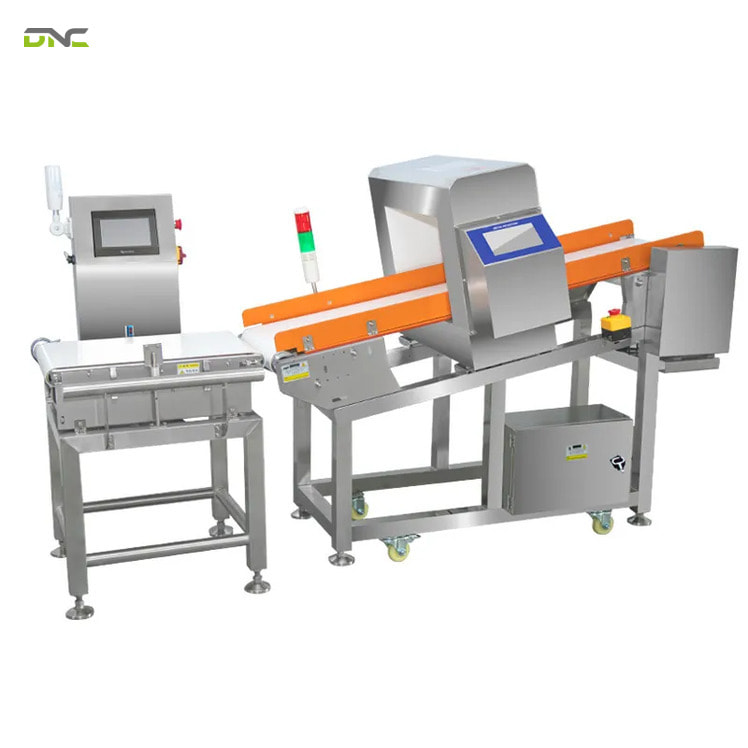
A Reject Verdict Reaches Three Destinations, Not One
The Reject Rate Reads Back on the Filler, Not the Rejector
The reject rate is an instrument reading on the filling process, not a score on the reject system. A rejector removes the pack your filler got wrong. Mean-weight correction, where the checkweigher returns its running average upstream, stops the filler producing the next one. Washdown-rated and legal-for-trade machines commonly include that correction, precisely because it protects declared weight.
Read that way, one number supports opposite conclusions. Steady rejection means the fill target is set wrong, and every rejected pack is giveaway paid for twice – once as product, once as disposal. Occasional rejection means the fill target is right and the rejector is catching genuine outliers. That is the system working as specified.
Only one of those situations improves when you touch the rejector. For Malaysian manufacturers weighing the automation case under NIMP 2030 incentives, the distinction separates a capital request from a half-day of filler adjustment.
Washdown Duty Narrows the Reject Mechanism to What Survives Cleaning
A washdown rating describes what survives the hose, and every mechanism the rejector adds is another thing the hose has to reach. Checkweighers built for wet protein, dairy and fresh produce lines are offered at IP69, with cleaning as the stated design driver. That rating is granted against a German washdown standard rather than the IEC liquid scale, which stops at 8 – the load cell IP rating article sets out the digit structure behind both.
Mechanism count is the practical filter on those lines. Few moving joints and no cavity beneath the belt survive a daily caustic wash more easily than a retracting bed or an under-belt lift, both of which put working parts where water collects and a wash crew struggles to reach. Wet protein lines therefore tend toward side-acting or air rejection, even where the product would tolerate something gentler. That ordering is worth stating explicitly, because gentleness is the criterion most buyers apply first.
Hygiene duty and weight duty converge on the same paperwork. A washdown line in food production is also a line whose declared weight someone will eventually audit.
Reject Records Are What a Weight Audit Examines
Average-weight and pre-packaging verification regimes are satisfied by evidence about a population of packs, not by the condition of any single pack. Checkweighers built for that duty are approved to OIML R51 and MID specifications, cleared for pre-packaging verification checks, and operated against national frameworks such as NIST Handbook 133 and the European average weight rules.
A checkweigher inspecting every pack produces that population evidence as a by-product. Sampled static weighing cannot. An inspection of 15 packs from a run of 6,000 covers 0.25% of the population, against 100% for in-motion checking.
The reject log is the part of that evidence showing out-of-tolerance packs were removed rather than merely detected. That is why confirmation and record-keeping belong in the original specification, not in a later upgrade. An audit typically asks the reject system to produce three things:
- Counts by zone, showing how many packs fell outside tolerance and in which direction.
- Evidence of removal, not only of detection – the difference confirmation sensors were built to close.
- A retained record covering the production period under review, not the current shift only.
Malaysian food and edible-oil exporters ship into markets that verify declared weight on exactly this population basis. That puts the reject record in the export documentation chain rather than the maintenance file. DNC Automation has engineered, supplied and commissioned turnkey weighing and end-of-line packaging systems for Malaysian manufacturers for 20 years, with 35 engineers and a 25,000 sq ft (2,320 sqm / 0.23 ha) production facility behind the integration work. Talk to Our Engineers and we will specify the reject method your line pitch and washdown routine actually allow.
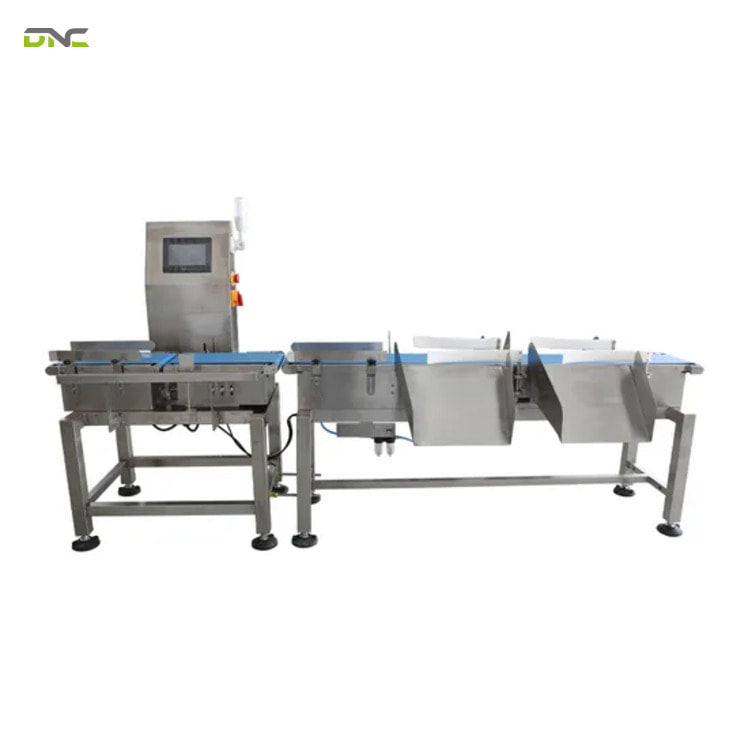
Reject Records Are What a Weight Audit Examines
Frequently Asked Questions About Checkweigher Reject Systems
Five questions come up repeatedly when a reject method is being specified, and each one turns on a constraint covered above.
What is the most common reject system on a dynamic checkweigher?
The pusher is the most widely fitted, and the default culling method on many online checkweigher spec sheets. It handles cartons, boxes, trays and bottles with few moving parts. Its two limits are pitch and speed. The blade needs a gap to complete its stroke into, which is why very high-speed lines move to air or servo-driven rejection instead.
Can one checkweigher use more than one reject method?
Yes. Multi-lane and multi-segment systems are built on that principle, with separate segments handling separate lanes at quoted throughputs reaching 600 pieces per minute across 2 to 6 lanes. On a single-lane machine, a second method is usually added for a second purpose rather than for redundancy – a diverter for reworkable product alongside a bin for contaminated product.
Does a reject bin count prove that rejection worked?
No. The verdict is issued on the weigh bed and the removal happens on the reject conveyor, so a pack that drifts on transfer can be logged as rejected while continuing downstream. Reject confirmation sensors close that gap by verifying the removal itself. OEMs offering reject timing correction re-detect pack position on the reject conveyor before firing.
Which reject system suits fragile products?
A retracting conveyor bed applies the least force, because the belt withdraws from under the pack instead of striking it. Suppliers offer it for glass containers, bakery product and delicate packaging. That gentleness is paid for in a more complex structure and higher equipment cost, so the retracting bed is specified where the product genuinely cannot absorb impact.
Is a reject system required for legal weight compliance?
Detection alone satisfies nothing if the failing pack still ships. Checkweighers used for declared weight are approved to OIML R51 and MID specifications and cleared for pre-packaging verification. The record an auditor reads has to show out-of-tolerance packs left the line. That evidence comes from the reject system and its log, not from weighing accuracy on its own.
- 9 views
- 0 Comment
Recent Comments