


Shuttle Pallet Racking System: Semi-Automated Storage Guide for Malaysian Warehouses
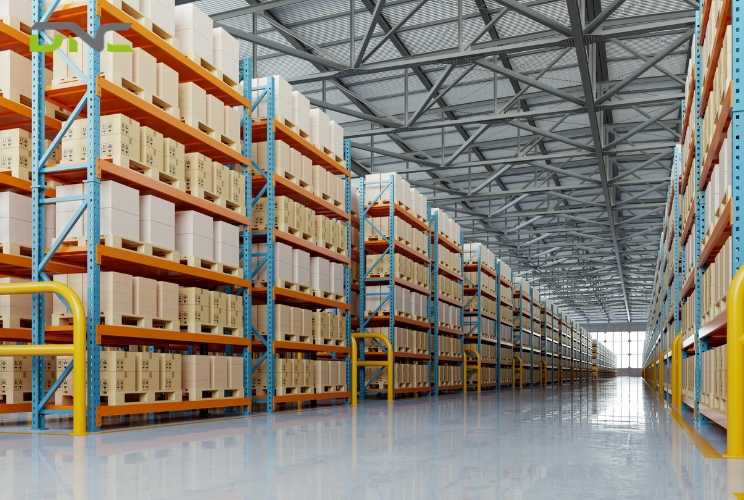
Shuttle pallet racking systems use battery-powered radio-controlled carts that travel within rack channels to place and retrieve pallets automatically — bridging the gap between manual racking and full AS/RS warehouse automation at 30–50% lower cost. For Malaysian manufacturers transitioning toward smart factory operations under NIMP 2030, shuttle racking delivers 80–85% floor utilisation, FIFO or LIFO flexibility, and a direct upgrade path to fully automated storage — without the RM 5,000,000–15,000,000 investment that full AS/RS demands. This guide covers shuttle system engineering, specifications, operational modes, cost analysis, and integration strategies. DNC Automation has deployed shuttle racking solutions across food manufacturing, cold chain, and high-throughput warehousing — the performance data here comes from verified Malaysian installations.
What Is a Shuttle Pallet Racking System?
Shuttle pallet racking is a semi-automated high-density storage system where a self-propelled shuttle cart operates within rack channels to transport pallets between the channel entry point and storage positions deep within the rack structure. The operator places a pallet at the channel entrance using a forklift; the shuttle cart — a flat, battery-powered vehicle controlled by radio signal or Wi-Fi — lifts the pallet, carries it along the channel rails, and deposits it at the first available position.
The shuttle eliminates the need for forklifts to enter the rack structure — a fundamental advantage over drive-in racking, which requires forklifts to travel within narrow rack lanes. This elimination reduces frame damage by 70–90%, improves operator safety, and allows channel depths up to 40 pallets (versus 12 maximum for drive-in).
Shuttle systems occupy a strategic position in the warehouse automation spectrum: more automated than manual racking (drive-in, selective) but less complex and less expensive than full AS/RS (stacker crane systems). For Malaysian manufacturers, this positioning aligns with the phased automation approach — investing in semi-automated shuttle systems now, then upgrading to full AS/RS as ROI and operational scale justify the next investment level.
The technology exists in two primary variants: pallet shuttle (one shuttle per channel, manually repositioned by forklift between channels) and multi-shuttle (multiple shuttles operating across channels via an automated shuttle lift). Multi-shuttle systems approach AS/RS functionality at significantly lower capital cost.
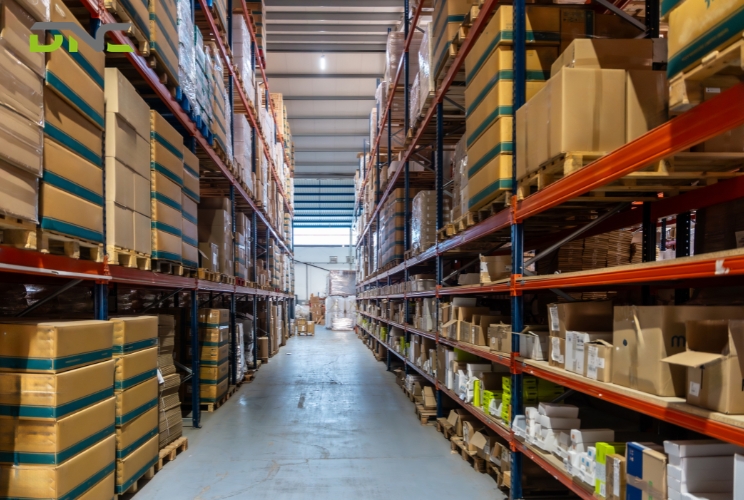
How Does a Shuttle Pallet Racking System Work?
Basic Operation Cycle
Storage cycle: The forklift places a pallet at the channel entry. The operator sends a “store” command via remote control or WMS. The shuttle cart, already positioned in the channel, travels under the pallet, raises its lifting platform, engages the pallet, and carries it along the channel rails to the deepest available position. The shuttle then returns to the channel entry for the next pallet.
Retrieval cycle: The operator sends a “retrieve” command. The shuttle travels to the target pallet position, lifts the pallet, and carries it to the channel entry. The forklift collects the pallet from the channel face. Total retrieval time: 30–90 seconds depending on channel depth and shuttle speed.
Shuttle Cart Mechanics
The shuttle cart is a low-profile steel platform (height: 100–140 mm) running on four wheels along channel rails. A central lifting mechanism raises and lowers a pallet engagement platform by 30–50 mm — enough to lift the pallet clear of the channel support rails for transport.
Drive system: AC or DC electric motors powering all four wheels. Top speed: 0.8–1.2 m/s loaded; 1.0–1.5 m/s unloaded. Acceleration/deceleration controlled by onboard PLC for smooth pallet handling.
Navigation: Optical or magnetic sensors detect channel position markers, pallet presence, and end-of-channel limits. The shuttle knows its exact position within the channel at all times — enabling WMS to track pallet locations by channel and depth position.
Power: Lithium-ion or lead-acid battery packs. Operating time: 8–12 hours per charge on lithium-ion; 4–6 hours on lead-acid. Fast-charge capability: 15-minute charge provides 4 hours of operation (lithium-ion). Cold room shuttles require batteries rated for –30°C operation.
FIFO vs. LIFO Operation
Shuttle racking supports both stock rotation methods depending on the physical configuration:
LIFO (single entry): Pallets load and unload from the same channel face. The shuttle deposits pallets from front to back and retrieves from back to front. One aisle required.
FIFO (dual entry): Pallets load from one channel face and unload from the opposite face. The shuttle deposits pallets from the loading side; picks retrieve from the unloading side. Two aisles required — one at each end of the channels.
FIFO configuration is essential for date-coded products in Malaysian F&B and pharmaceutical operations. DNC Automation specifies dual-entry FIFO shuttle configurations for food manufacturers and cold chain operators where stock rotation compliance is non-negotiable.
Channel Configuration
Each channel consists of two parallel steel rails (U-profile or L-profile) mounted on the rack structure at each storage level. Channel width: 1,100–1,300 mm (matching standard pallet width plus clearance). Channel depth: 5–40 pallets depending on application requirements.
Multiple channels stack vertically — a typical shuttle racking installation has 3–6 channel levels, each operating independently. The shuttle cart serves one channel at a time; multi-level operation requires either one shuttle per level or a forklift-assisted shuttle transfer between levels.
Types of Shuttle Racking Configurations
Single Shuttle (Standard)
One shuttle cart serves multiple channels at the same level. The forklift moves the shuttle between channels — placing the cart at the channel entry, where it drives in and begins operating. This is the most cost-effective configuration: one shuttle per level (or per 10–15 channels) handles moderate-throughput operations.
Best for: 50–200 pallet movements per hour; operations where channel change frequency is low (bulk storage of few SKUs).
Multi-Shuttle (High-Throughput)
Multiple shuttle carts operate simultaneously across different channels, with an automated shuttle elevator transferring carts between levels. This configuration approaches AS/RS throughput without stacker crane infrastructure.
Best for: 200–500+ pallet movements per hour; high-SKU operations requiring frequent channel changes. Multi-shuttle installations in Malaysian distribution centres handle peak-season throughput without manual shuttle repositioning.
Four-Way Shuttle
Advanced shuttle carts that travel both within channels (depth direction) and across channels (width direction) on a rail grid at each level. Four-way shuttles eliminate the need for forklift-assisted channel changes entirely — the shuttle navigates the entire storage level autonomously.
Best for: Maximum automation with minimum human intervention; a stepping stone to full AS/RS. DNC Automation integrates four-way shuttle systems with WMS and IoT for fully autonomous pallet storage and retrieval.
Cold Room Shuttle
Shuttles rated for –30°C to +5°C operation with cold-rated batteries, low-temperature lubricants, sealed electronics, and heated sensor housings. Combined with hot-dip galvanised racking and stainless steel channel rails, cold room shuttle systems operate reliably in frozen storage environments.
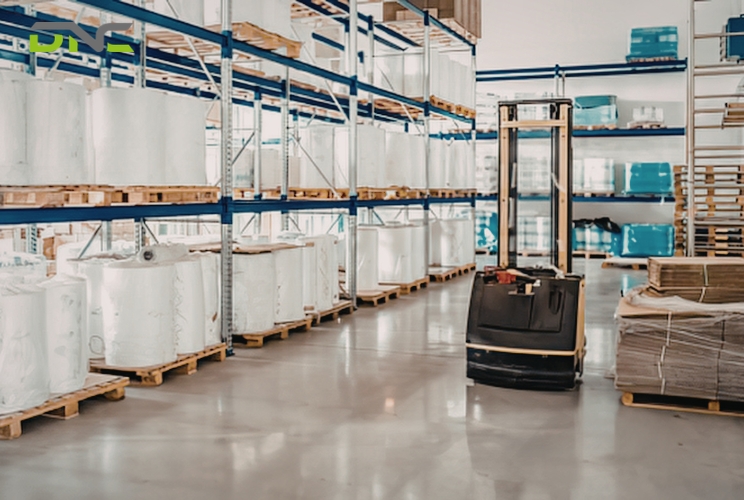
Key Components of a Shuttle Racking System
Shuttle Cart
Dimensions: 1,000–1,400 mm wide × 900–1,200 mm long × 100–140 mm high. Load capacity: 1,000–1,500 kg standard; up to 2,000 kg heavy-duty. Weight (cart only): 150–300 kg. Battery: lithium-ion 24V/48V, 8–12 hour operation. Communication: Wi-Fi or radio frequency (2.4 GHz). Safety: obstacle detection sensors, emergency stop, overload protection.
Channel Rails
Hot-rolled steel U-profile or L-profile rails mounted on the rack structure at each storage level. Rail surface must be smooth and level (±1 mm tolerance over 3 m) for consistent shuttle operation. Galvanised finish for cold room installations.
Racking Structure
Standard deep-lane racking frames (upright columns + channel support beams) rated for the total channel load. A 20-pallet-deep channel at 1,200 kg per pallet carries 24,000 kg per channel. Frame specifications must accommodate this concentrated linear load — heavier gauge columns (2.0–2.5 mm) and closer bracing spacing than selective racking.
Control System
PLC-based master controller managing shuttle fleet operation, traffic coordination (preventing collisions in multi-shuttle setups), battery monitoring, and WMS communication. Standard protocols: Profinet, Modbus TCP, OPC-UA. HMI display shows real-time shuttle positions, battery status, and system diagnostics.
Charging Station
Automated or manual charging stations for shuttle cart batteries. Automated stations integrate into the channel entry — the shuttle drives onto a charging contact pad during idle periods. Manual stations require forklift extraction of the shuttle for charging. Lithium-ion batteries support opportunity charging (15-minute top-ups between operations).
Applications: Where Shuttle Racking Serves Malaysian Industries
Cold Chain and Frozen Storage
Shuttle racking’s high density (80–85% floor utilisation) and FIFO capability make it a strong cold room solution — comparable to mobile racking in density but with faster throughput (no 15–30 second aisle opening wait). Malaysian cold chain operators storing frozen seafood (Penang, Johor), frozen poultry (Selangor), and ice cream products use shuttle racking to maximise cold room capacity.
Throughput advantage over mobile racking: Shuttle systems handle 100–200 pallets/hour per shuttle versus 40–60 pallets/hour for mobile racking (limited by aisle opening speed). For high-throughput cold rooms processing 300+ pallets daily, shuttle racking delivers superior operational performance.
Food and Beverage Manufacturing
F&B manufacturers with moderate SKU counts (10–50 products) and high volume per SKU deploy shuttle racking for finished goods staging and raw material storage. The FIFO configuration ensures date-coded product rotation — meeting HACCP, MeSTI, and halal certification storage requirements.
High-Throughput Distribution
Distribution centres processing 500–2,000 pallets daily use multi-shuttle configurations for order staging and buffer storage. The shuttle system pre-positions pallets at channel entries based on WMS pick schedules — reducing forklift wait time and increasing loading dock throughput.
Automotive Parts Buffer
Automotive manufacturers operating JIT supply chains use shuttle racking for production-line buffer storage — staging components in sequence for line-side delivery. The WMS directs shuttle retrieval based on the production schedule, ensuring the correct part reaches the production line at the correct time.
Pharmaceutical Warehousing
GDP-compliant pharmaceutical warehouses use shuttle racking with FIFO configuration for temperature-sensitive product storage. The WMS tracks every pallet by batch number, temperature zone, and expiry date — with shuttle retrieval enforcing FIFO compliance automatically.
Benefits of Shuttle Pallet Racking
80–85% floor utilisation — comparable to drive-in racking but with automated pallet handling, zero forklift entry, and significantly lower frame damage risk.
70–90% reduction in frame damage versus drive-in racking. Forklifts never enter the rack structure — the shuttle handles all pallet movement within channels.
FIFO and LIFO flexibility. Configure channels for either rotation method. Switch between FIFO and LIFO by changing shuttle operating mode — no physical racking modification required.
Channel depth up to 40 pallets — 3× deeper than drive-in racking’s practical maximum. This density is achievable because the shuttle (not a forklift) navigates the channel — no turning radius or visibility constraints.
Direct upgrade path to AS/RS. Shuttle racking shares structural dimensions with AS/RS stacker crane systems. Upgrading from shuttle to AS/RS replaces the forklift + shuttle workflow with automated cranes operating in the same rack structure — DNC Automation designs shuttle installations with AS/RS compatibility as a default.
30–50% lower cost than full AS/RS for comparable storage density and throughput. A 5,000-position shuttle system costs RM 5,000,000–10,000,000 versus RM 10,000,000–25,000,000 for equivalent AS/RS.
Reduced labour requirements. One operator with a forklift manages 3–5 shuttle carts simultaneously — each cart operates autonomously within its channel. Labour productivity improves 40–60% versus manual drive-in operations.
How to Choose and Specify a Shuttle System
Determine Throughput Requirements
Shuttle throughput depends on channel depth and shuttle speed. A shuttle operating at 1.0 m/s in a 20-pallet-deep channel (24 m) completes one storage cycle in approximately 60 seconds (24 m travel + lift + deposit + return). One shuttle handles 50–60 cycles/hour at this depth.
Formula: Required shuttles = (Peak hourly pallet movements) ÷ (Cycles per shuttle per hour)
Select Channel Depth
Deeper channels increase density but reduce per-channel throughput (longer shuttle travel time). Balance density against throughput:
- 5–10 pallets deep: High throughput, moderate density. Best for distribution centres.
- 10–20 pallets deep: Balanced throughput and density. Most common Malaysian configuration.
- 20–40 pallets deep: Maximum density, lower throughput. Best for deep buffer/reserve storage.
Choose FIFO or LIFO
FIFO requires two aisles (loading and picking faces at opposite ends). LIFO requires one aisle. FIFO adds one aisle width (3.0–3.5 m) to the system footprint but enables date-coded stock rotation. For Malaysian F&B and pharmaceutical operations, FIFO is typically mandatory.
Specify Battery System
Lithium-ion batteries cost 2–3× more than lead-acid but deliver 2× operating time, 10× faster charging, 3× longer lifespan, and reliable cold room performance. For operations running 16+ hours daily or operating in cold rooms, lithium-ion is the recommended specification. DNC Automation specifies lithium-ion as default for all shuttle projects.
Plan WMS Integration
WMS integration transforms shuttle racking from a storage system into an intelligent inventory management platform. The WMS tracks every pallet by channel, depth position, batch number, and timestamp — enabling automated FIFO enforcement, replenishment alerts, inventory cycle counting, and throughput analytics. DNC Automation integrates shuttle systems with SAP EWM, Manhattan Associates, and custom WMS platforms.
FAQ — Shuttle Pallet Racking System
What is a shuttle pallet racking system?
A shuttle pallet racking system uses battery-powered radio-controlled carts (shuttles) that travel within rack channels to store and retrieve pallets automatically. The operator places a pallet at the channel entry with a forklift; the shuttle carries it to the storage position. The system achieves 80–85% floor utilisation, supports FIFO and LIFO rotation, and stores up to 40 pallets deep per channel — eliminating forklift entry into the rack structure.
How much does shuttle racking cost in Malaysia?
Shuttle racking costs RM 1,000–2,000 per pallet position including racking structure, channel rails, and installation. Shuttle carts add RM 30,000–80,000 each (depending on load capacity, battery type, and cold room rating). A 2,000-position system with 4 shuttle carts typically costs RM 2,200,000–4,500,000 fully installed. This is 30–50% less than equivalent AS/RS and delivers comparable density.
How does shuttle racking compare to drive-in racking?
Both are high-density systems, but shuttle racking offers significant advantages: 70–90% less frame damage (no forklift entry), 40 pallets deep versus 12 maximum for drive-in, FIFO capability (drive-in is LIFO only), and automated pallet handling (drive-in is fully manual). Shuttle costs more per position (RM 1,000–2,000 vs. RM 300–500) but delivers lower total cost of ownership through reduced damage, higher density, and lower labour cost.
Can shuttle racking work in cold rooms?
Cold room shuttle systems operate reliably at –30°C to +5°C with appropriate specifications: cold-rated lithium-ion batteries, low-temperature motor lubricants, sealed electronics (IP65), heated sensor housings, and galvanised/stainless steel channel rails. Cold room shuttles cost 20–30% more than ambient-rated units. The combination of high density and automated FIFO makes shuttle racking a strong cold room option — particularly for operations with throughput requirements exceeding mobile racking’s capacity.
What is the difference between shuttle racking and AS/RS?
Shuttle racking is semi-automated: forklifts handle pallet movement to and from the channel face; shuttles handle movement within channels. AS/RS is fully automated: stacker cranes handle pallet movement from the I/O point to any storage position in the rack without forklift involvement. Shuttle racking costs 30–50% less than AS/RS and requires less infrastructure (no crane rails, fewer control systems). AS/RS delivers higher throughput (400–800 pallets/hour versus 100–300 for shuttle) and operates fully unmanned. Shuttle racking provides the upgrade path: DNC Automation designs shuttle systems with AS/RS-compatible dimensions for future upgrade.
How many shuttle carts do I need?
The number of shuttle carts depends on peak hourly throughput requirements and channel depth. One shuttle cart handles 50–60 storage/retrieval cycles per hour at 20-pallet channel depth. For 200 pallet movements per hour, you need 4 shuttle carts. Add 1 spare cart per 5 operational carts for maintenance rotation. Multi-level systems need carts assigned per level unless an automated shuttle elevator transfers carts between levels.
What maintenance does shuttle racking require?
Shuttle carts: weekly battery health check, monthly wheel and bearing inspection, quarterly sensor calibration, and annual motor and gearbox service. Channel rails: monthly visual inspection for debris, rail damage, and level deviation. Racking structure: standard quarterly inspection per EN 15635. Expected shuttle cart lifespan: 8–12 years with regular maintenance; battery replacement every 3–5 years (lithium-ion).
Conclusion
Shuttle pallet racking systems position Malaysian warehouses on the automation continuum — delivering high-density storage, automated pallet handling, and FIFO/LIFO flexibility at a fraction of full AS/RS cost. For manufacturers and distributors taking a phased approach to warehouse automation under NIMP 2030, shuttle racking provides immediate density and productivity gains with a built-in upgrade path to full automation.
DNC Automation integrates shuttle racking systems with Siemens control platforms, IoT sensors, and WMS software — creating intelligent storage solutions that track every pallet in real time. Our engineering team designs shuttle installations for today’s throughput requirements and tomorrow’s automation expansion, ensuring every investment dollar compounds over time.
- 69 views
- 0 Comment
Recent Comments