


Pallet Handling Systems: Automated Solutions for Factories
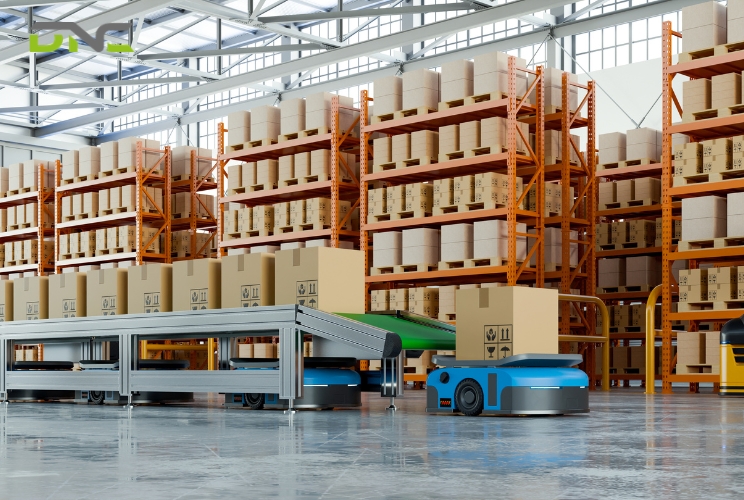
Pallet handling systems encompass every machine, conveyor, vehicle, and robotic system that moves, lifts, transfers, rotates, or positions pallets within a manufacturing facility or warehouse — from the production line discharge to the shipping dock. For Malaysian manufacturers processing 200–5,000+ pallets daily, automated pallet handling reduces manual forklift dependency by 60–80%, eliminates product damage from human handling errors, and creates continuous material flow that matches production line speeds. This guide covers the full pallet handling technology spectrum — conveyors, AGVs/AMRs, robotic arms, turntables, lifts, and integrated systems — with specifications, cost data, and integration strategies specific to Malaysian manufacturing. DNC Automation designs complete pallet handling solutions connecting production lines, palletizers, storage systems, and shipping docks into unified material flow architectures.
What Is a Pallet Handling System?
Pallet handling systems are the material flow infrastructure that moves loaded and empty pallets between operational zones within a facility. The system bridges the gap between static zones (storage racking, staging areas, dock positions) and dynamic operations (production lines, palletizing stations, wrapping machines, inspection points).
A complete pallet handling system includes five functional categories:
Pallet conveyors — roller, chain, and belt conveyors sized for full pallet loads (500–1,500 kg), transporting pallets between fixed points at controlled speeds.
Automated guided vehicles (AGVs) and autonomous mobile robots (AMRs) — self-navigating vehicles carrying pallets along flexible routes, replacing manned forklifts for repetitive transport tasks.
Pallet manipulators — turntables (rotating pallets for wrapping or orientation), lifts and elevators (moving pallets between floor levels), tilters (angling pallets for inspection), and stackers/destackers (building or dismantling pallet stacks).
Robotic handling — industrial robots and cobots performing pallet pick-and-place, stacking, destacking, and transfer operations with programmable flexibility.
Control and integration — PLC, WCS (Warehouse Control System), and WMS software coordinating all handling equipment into a synchronised material flow.
Pallet handling is the connective tissue of automated manufacturing — it links individual automation islands (palletizer, wrapper, racking) into a continuous production-to-storage-to-shipping pipeline. Without automated pallet handling, each automation investment operates in isolation, and manual forklift operations become the bottleneck between them.
In Malaysia, pallet handling automation has accelerated since 2020, driven by labour scarcity in warehouse operations, NIMP 2030 smart factory mandates, and the demonstrated success of early adopters in F&B, automotive, and electronics manufacturing.
How Do Pallet Handling Systems Work?
Material Flow Architecture
Every pallet handling system operates within a material flow architecture — a designed path that pallets follow from creation to shipment:
Production zone → Palletizing → Wrapping → Labelling → Quality check → Buffer storage → Racking → Order picking → Staging → Shipping dock
Automated pallet handling replaces manual forklift movements between these zones with conveyor transport, AGV/AMR delivery, or robotic transfer. The control system (PLC + WCS) manages pallet routing decisions: which pallet goes where, via which path, at which priority.
Pallet Conveyor Operation
Pallet conveyors transport loaded pallets (500–1,500 kg) at controlled speeds (0.1–0.5 m/s) between fixed points. Roller conveyors use motorised or gravity-driven steel rollers; chain conveyors use parallel chains for heavy or irregular loads. Transfer cars and turntables redirect pallets at intersection points.
Key design parameters: Conveyor width (standard 1,200 mm for MY pallets), roller pitch (150–200 mm for 1,000 kg+ loads), motor power (0.75–3 kW per zone), and accumulation zones (stopping pallets without back-pressure using sensor-controlled zone drives).
DNC Automation’s extensive conveyor engineering capability is the foundation of our pallet handling solutions — we design, fabricate, and install pallet conveyor systems in-house.
AGV/AMR Navigation
AGVs follow fixed paths (magnetic tape, floor wire, or laser-reflector triangulation). AMRs navigate autonomously using SLAM (Simultaneous Localisation and Mapping) — scanning the environment with LiDAR to plan optimal routes without fixed infrastructure.
Pallet AGV specifications: Payload 1,000–3,000 kg; speed 1.0–2.0 m/s; navigation accuracy ±10 mm; battery operation 8–16 hours per charge. DNC Automation integrates Comau and Doosan AMR platforms with pallet handling conveyors and racking systems.
Robotic Pallet Handling
Industrial robots (Comau, FANUC) and cobots (Doosan) handle pallet manipulation tasks: destacking empty pallets from a magazine, placing empty pallets on conveyor systems, transferring pallets between conveyors, and positioning pallets for wrapping or labelling. Robot payload must accommodate full pallet weight (500–1,500 kg) for loaded pallets or 20–30 kg for empty pallet handling.
Control System Integration
The pallet handling control system operates at two levels:
Equipment level (PLC): Controls individual conveyors, AGVs, robots, and manipulators. Manages motor speeds, sensor inputs, safety interlocks, and equipment-level sequencing. DNC Automation specifies Siemens S7-1500 PLCs for all pallet handling projects.
System level (WCS/WMS): Coordinates all equipment into a unified material flow. Routes pallets based on product type, destination, priority, and system status. Integrates with ERP for order-driven pallet routing and inventory updates.
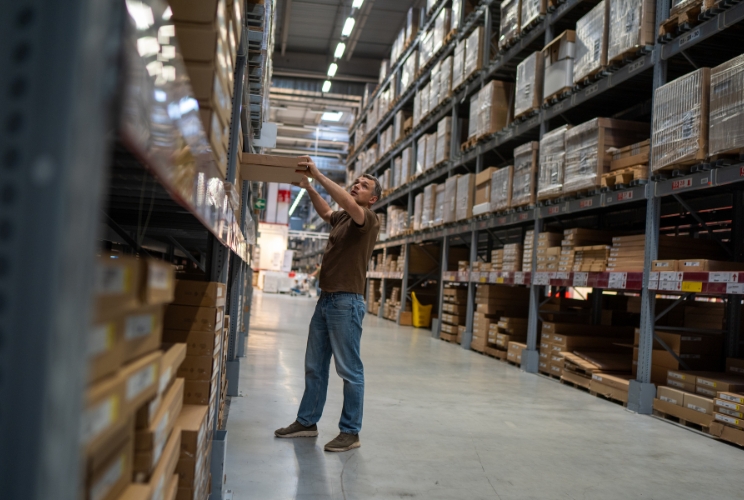
Types of Pallet Handling Equipment
Pallet Roller Conveyors
Heavy-duty roller conveyors with 89 mm or 114 mm diameter steel rollers at 150–200 mm pitch. Motorised zones with sensor-controlled accumulation prevent pallet collision. Standard widths: 1,200 mm and 1,400 mm. Load capacity: 1,000–2,000 kg per pallet.
Applications: Transport between palletizer and wrapper, wrapper to staging, staging to dock.
Cost: RM 3,000–8,000 per linear metre installed.
Pallet Chain Conveyors
Dual-strand or triple-strand chain conveyors for heavy or non-standard pallets. Chain conveyors handle loads up to 3,000 kg and accommodate pallets with damaged bottom boards that would jam roller conveyors.
Applications: Heavy manufacturing (automotive, steel, building materials), pallet transfer at right-angle intersections.
Cost: RM 5,000–12,000 per linear metre installed.
Pallet Transfer Cars
Rail-guided or free-path transfer vehicles that shuttle pallets between parallel conveyor lines. Transfer cars bridge multiple production lines to a single palletizer or connect multiple racking aisles to a single shipping conveyor.
Applications: Multi-line manufacturing facilities, high-bay warehouse interfaces.
Cost: RM 50,000–200,000 per unit.
Pallet Turntables
Rotating platforms that change pallet orientation by 90° or 180°. Used at conveyor intersections, before stretch wrappers (rotating the pallet during wrapping), and at racking interfaces requiring specific pallet orientation.
Applications: Conveyor direction changes, stretch wrapping stations, racking interface.
Cost: RM 15,000–50,000 per unit.
Pallet Lifts and Elevators
Hydraulic or chain-driven lifts moving pallets between floor levels (mezzanine access, multi-floor facilities) or between conveyor heights (production line discharge height to floor-level staging).
Applications: Multi-level warehouses, production facilities with mezzanine storage.
Cost: RM 30,000–150,000 per unit depending on lift height and capacity.
Pallet Stackers and Destackers
Automated machines that build stacks of empty pallets (stacker) or separate individual pallets from a stack (destacker) for feeding palletizing or production lines. Magazine capacity: 10–20 pallets.
Applications: Empty pallet management at palletizer infeed, empty pallet collection at depalletizing stations.
Cost: RM 30,000–80,000 per unit.
AGVs and AMRs (Pallet-Class)
Autonomous vehicles carrying pallets between zones without fixed infrastructure (conveyors or rails). Fork-type AGVs handle standard pallets on racking or floor positions. Flat-deck AMRs carry pallets on their platform surface.
Specifications: Payload 1,000–3,000 kg; speed 1.0–2.0 m/s; 8–16 hour battery life; fleet management software coordinates multiple vehicles.
Cost: RM 200,000–500,000 per unit.
Robotic Pallet Manipulators
Industrial robots or cobots performing pallet-level tasks: empty pallet placement, loaded pallet transfer, pallet inspection (vision-guided), and pallet repair station feeding. DNC Automation integrates Comau robots for heavy pallet handling (up to 700 kg payload) and Doosan cobots for empty pallet handling (up to 25 kg).
Cost: RM 150,000–800,000 per station (robot + tooling + integration).
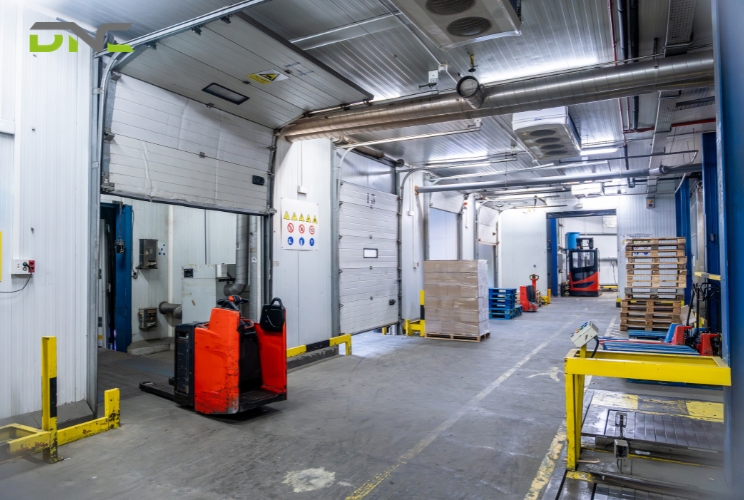
Key Components of Integrated Pallet Handling
Conveyor Infrastructure
The backbone of any pallet handling system. Conveyor layout follows the material flow architecture — straight runs for transport, curves for direction changes, transfer cars for line switching, and accumulation zones for buffering. DNC Automation designs pallet conveyor layouts in 3D CAD with material flow simulation validating throughput before fabrication.
Sensors and Identification
Photoelectric sensors detect pallet presence at every conveyor zone. Barcode readers or RFID antennas at key points identify pallet contents for routing decisions. Weight sensors verify pallet load against expected weight (catching mis-picks and missing products). DNC Automation integrates Sick, Keyence, and Siemens sensor platforms into pallet handling systems.
Safety Systems
Pallet handling equipment operates with heavy loads at moderate speeds — creating significant injury risk. Safety requirements per ISO 13849: emergency stop circuits on all conveyors and AGVs, safety fencing around robotic handling stations, light curtains at personnel crossover points, and AGV/AMR obstacle detection (LiDAR, safety scanners). DOSH compliance requires documented risk assessment for all automated handling equipment.
PLC and WCS/WMS
Siemens S7-1500 PLCs control equipment-level operations. SCADA/HMI provides operator visibility into system status, fault diagnostics, and throughput data. WCS software manages pallet routing, traffic control (AGV fleet management), and equipment coordination. WMS integration provides inventory-level tracking — every pallet’s location is known in real time.
Applications in Malaysian Manufacturing
Automotive Manufacturing
Malaysian automotive plants (Toyota, Honda, Proton, Perodua) operate complex material flow networks moving components from goods reception through buffer storage to production line side. Pallet handling systems — conveyors + AGVs + automated storage — create continuous just-in-time material supply to assembly lines. DNC Automation has delivered integrated automation solutions for Malaysian automotive manufacturers, connecting production line conveyors with warehouse systems.
Food and Beverage
F&B production lines generate 200–1,000 pallets daily. Manual forklift handling between palletizer → wrapper → storage → shipping creates traffic congestion, product damage, and labour dependency. Automated pallet conveyors with integrated wrapping and labelling stations create continuous end-of-line flow. Companies like F&N and Ramly use pallet handling automation to maintain production line throughput.
Electronics Manufacturing
Penang’s electronics cluster handles high-value, sensitivity-critical components requiring gentle, consistent pallet handling. ESD-safe conveyors, cleanroom-compatible AGVs, and controlled-environment transfer systems protect product integrity from production through storage to shipping.
Pharmaceutical
GDP-compliant material flow requires full pallet traceability (batch tracking at every handling point), segregated temperature zone transfer (ambient → cold chain → ambient), and validated handling processes. Automated pallet handling provides audit-trail-grade tracking and eliminates human-introduced contamination risk.
Warehouse and Distribution
3PL providers and distribution centres process thousands of pallets daily through receiving, putaway, picking, staging, and shipping. Pallet conveyors connecting dock doors to racking aisles reduce forklift traffic, improve dock utilisation (faster truck turnaround), and increase throughput by 30–50%.
Benefits of Automated Pallet Handling
60–80% reduction in manual forklift movements. Conveyors and AGVs handle repetitive point-to-point pallet transport that traditionally requires dedicated forklift operators. A single conveyor line replaces 2–4 forklift runs per minute.
Continuous material flow. Automated handling eliminates the batch-and-wait pattern of forklift operations — pallets move continuously from production to storage at controlled, predictable rates matching line speed.
50–70% reduction in product damage. Automated conveyors handle pallets at consistent, gentle speeds. Forklift handling causes 3–5% product damage from acceleration impacts, pallet drops, and mis-stacking; automated handling reduces this to 0.5–1%.
Real-time pallet tracking. Every pallet’s position, contents, and status are known at all times through sensor and identification system integration. This visibility supports JIT manufacturing, inventory accuracy, and regulatory compliance.
Workplace safety improvement. Forklift-pedestrian incidents are the leading cause of warehouse injuries in Malaysia. Automated pallet handling (conveyors, AGVs with safety systems) eliminates or dramatically reduces forklift traffic in personnel areas.
Labour cost reduction of RM 300,000–1,000,000/year for facilities replacing 10–30 forklift operators across shifts. At RM 2,500/month per operator, every 10 operators replaced save RM 300,000 annually.
NIMP 2030 alignment. Automated material handling is a core component of Industry 4.0 smart factory infrastructure — qualifying for MIDA capital allowances and ITA incentives.
How to Design a Pallet Handling System
Map the Material Flow
Document every pallet movement in the facility: origin, destination, frequency, weight, time constraint, and current handling method (forklift type, operator count). This material flow map identifies the highest-impact automation opportunities — typically the routes with highest frequency and longest distance.
Calculate Throughput Requirements
For each handling route: peak pallets per hour, average pallets per hour, and surge capacity (e.g., end-of-shift production line discharge). Size automated handling equipment at 120–150% of peak throughput to maintain continuous flow during production variations.
Select Technology per Route
Fixed-path, high-volume routes (palletizer → wrapper → staging): Conveyor systems — highest throughput, lowest per-pallet cost for fixed routes.
Variable-path, moderate-volume routes (staging → multiple racking aisles): AGV/AMR — flexible routing without fixed infrastructure.
Manipulation tasks (empty pallet handling, pallet inspection, orientation): Robotic systems — programmable for varied tasks.
Integrate with Existing Systems
Connect pallet handling to: production line PLCs (synchronisation), palletizer controls (pallet discharge), racking system (putaway interface), WMS (inventory tracking), and ERP (order-driven material flow). DNC Automation designs integrated control architectures using Siemens platforms for consistent communication across all subsystems.
Plan for Scalability
Design pallet handling systems with expansion capacity: conveyor layouts with pre-planned extension points, AGV fleet management software supporting additional vehicles, and control system I/O reserves for future equipment. DNC Automation’s 3D simulation modelling validates both current and future-state throughput.
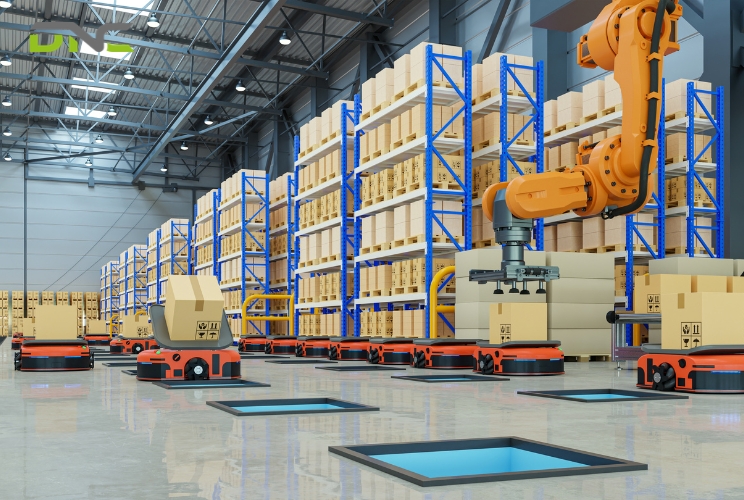
FAQ — Pallet Handling Systems
What is a pallet handling system?
A pallet handling system is the collection of automated equipment — conveyors, AGVs/AMRs, robots, lifts, turntables, and control software — that moves pallets between operational zones in a manufacturing facility or warehouse. The system replaces manual forklift operations for repetitive pallet transport, reducing labour cost, product damage, and safety risk while creating continuous, trackable material flow.
How much does automated pallet handling cost in Malaysia?
Costs depend on system complexity: pallet conveyor systems cost RM 3,000–12,000 per linear metre; AGVs/AMRs cost RM 200,000–500,000 per vehicle; robotic handling stations cost RM 150,000–800,000 each; turntables and lifts cost RM 15,000–150,000 per unit. A complete pallet handling system for a medium-sized facility (200–500 pallets/day) typically costs RM 1,000,000–5,000,000.
What is the difference between AGV and AMR for pallet handling?
AGVs follow fixed paths (magnetic tape, floor wire, or laser reflectors) — reliable, predictable, but inflexible. AMRs navigate autonomously using LiDAR and SLAM technology — flexible routing, no fixed infrastructure, but higher unit cost. AGVs suit fixed-route, high-volume transport. AMRs suit dynamic environments where routes change frequently. Both handle 1,000–3,000 kg pallet loads at 1.0–2.0 m/s.
Can pallet handling systems integrate with existing equipment?
Pallet handling systems connect to existing production lines, palletizers, wrappers, and racking through standard conveyor interfaces, PLC communication protocols (Profinet, Modbus, OPC-UA), and physical pallet transfer points. DNC Automation surveys existing equipment interfaces during the design phase to ensure seamless integration without modifying upstream or downstream systems.
How many forklift operators can automated handling replace?
A single pallet conveyor line running 30 pallets/hour replaces 2–4 forklift operators on that route (accounting for forklift travel time, loading/unloading, and traffic delays). A fleet of 3–5 AGVs replaces 6–10 forklift operators across multiple routes. Total replacement depends on facility size and pallet volume — DNC Automation models operator displacement during the design assessment.
What maintenance does pallet handling equipment need?
Conveyor systems: monthly roller and chain inspection, quarterly motor and gearbox service, annual belt or chain replacement. AGVs/AMRs: weekly battery health check, monthly wheel and sensor inspection, quarterly software update, annual motor service. Robotic stations: monthly EOAT inspection, quarterly joint lubrication, annual full robot service. Well-maintained pallet handling systems operate at 95%+ uptime.
Does pallet handling automation qualify for Malaysian incentives?
Automated material handling qualifies for MIDA capital allowances, Investment Tax Allowance (ITA) for Industry 4.0 equipment, and specific NIMP 2030 smart factory grants. DNC Automation provides incentive application support documentation as part of the project scope — helping manufacturers maximise the government incentive value of their automation investment.
Conclusion
Pallet handling systems are the connective infrastructure that transforms individual automation investments into a unified, continuous manufacturing operation. Without automated pallet handling, palletizers, wrappers, racking systems, and production lines operate as isolated islands connected by manual forklift operations — creating labour dependency, traffic bottlenecks, and material flow unpredictability.
DNC Automation designs complete pallet handling solutions — integrating conveyors, AGVs, robots, and control systems into material flow architectures that connect every zone in your facility. Our Siemens controls expertise, Comau robotics partnership, and 20+ years of conveyor engineering make DNC the single-source integrator for pallet handling automation in Malaysian manufacturing.
- 69 views
- 0 Comment
Recent Comments