

Mobile Cobot: AGV and AMR with Collaborative Robots
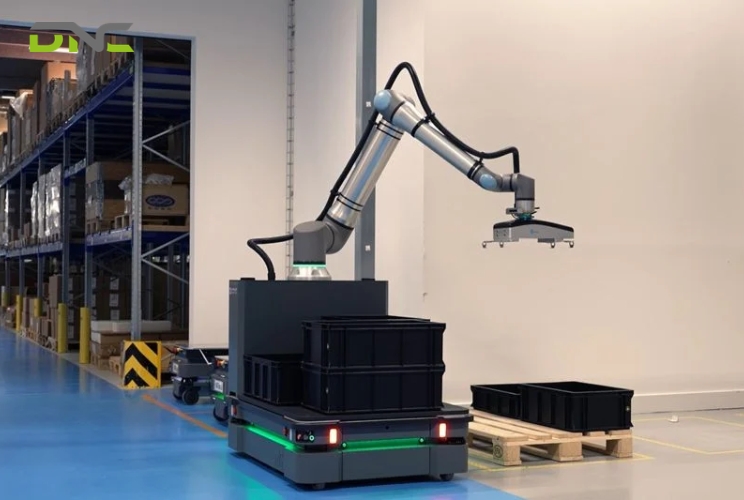
Mobile cobots — autonomous platforms carrying collaborative robot arms — represent the convergence of two automation technologies that previously operated independently. A cobot AGV or cobot AMR combines the transport capability of a mobile robot with the manipulation capability of a collaborative arm, creating a single system that navigates to a workstation, performs a physical task, and moves to the next assignment without human intervention. Malaysian manufacturers evaluating mobile cobot solutions gain access to flexible automation that handles machine tending, pick and place, inspection, and light assembly across multiple workstations — all from one robot that travels between them. This guide covers how mobile cobots work, the platform configurations available, where they deliver the strongest ROI, and the implementation considerations for manufacturing facilities.
What Is a Mobile Cobot?
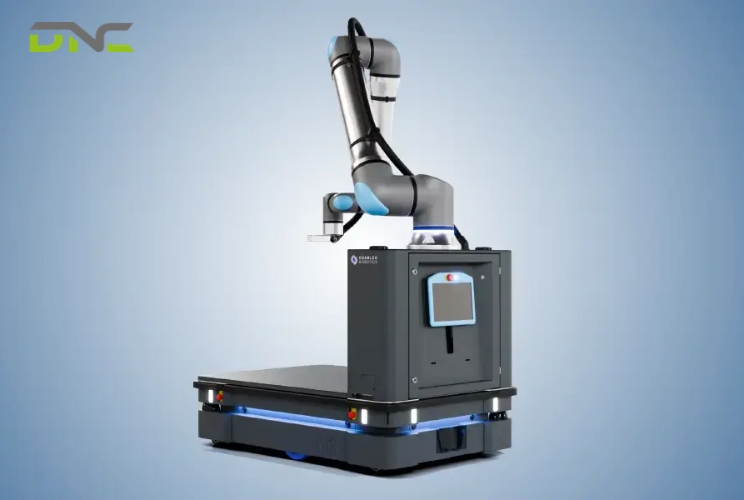
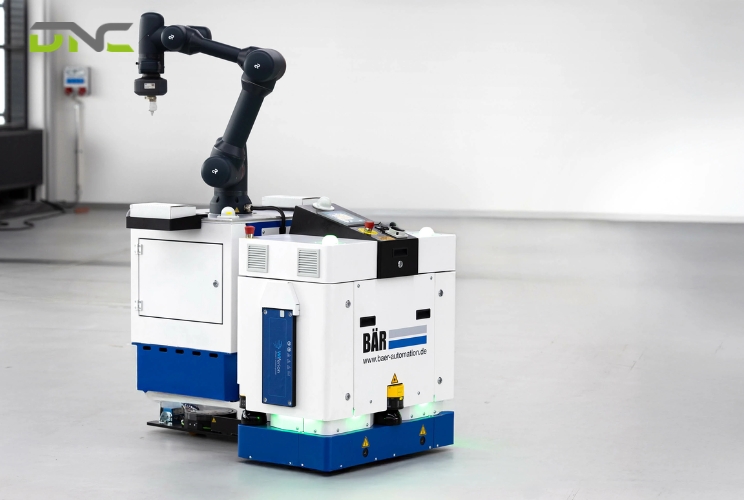
A mobile cobot is an integrated robotic system consisting of an autonomous mobile platform (AGV or AMR) carrying a mounted collaborative robot arm. The mobile base provides locomotion — transporting the system between work locations throughout a facility. The cobot arm provides manipulation — performing physical tasks such as picking, placing, loading, unloading, fastening, inspecting, or assembling components at each workstation.
The “cobot” designation means the robot arm is designed for safe operation alongside human workers without traditional safety fencing. Collaborative robots limit force and speed during contact with humans, use rounded edges and soft covers, and employ sensor-based collision detection — enabling them to work in shared spaces with operators.
Mobile cobot technology solves a constraint that has limited both stationary cobots and transport-only mobile robots. A fixed cobot can perform tasks at one workstation but cannot travel between machines. An AGV or AMR can transport materials between locations but cannot load machines, pick items, or perform assembly operations. The mobile cobot eliminates both limitations: it travels where the task is and executes the task when it arrives.
The global mobile manipulator market — the technical term encompassing mobile cobots — is growing at 25–30% annually as manufacturers seek automation solutions that serve multiple workstations with a single robot investment rather than deploying fixed cobots at every station.
How Does a Mobile Cobot Work?
Mobile cobot operation follows a continuous cycle: receive task assignment, navigate to workstation, perform manipulation task, navigate to next assignment. Each cycle phase involves coordinated function between the mobile platform and the robot arm.
Navigation Phase
The mobile platform navigates to the assigned workstation using the same technology as standalone AGVs or AMRs. Cobot AGV systems follow fixed paths (magnetic tape, laser-guided); cobot AMR systems navigate dynamically using SLAM. The platform approaches the workstation and positions itself with sufficient accuracy for the arm to reach the work zone — typically ±10–30 mm for AMR-based platforms, ±1–5 mm for AGV-based systems.
Advanced mobile cobots use a two-stage docking approach: the AMR navigates to the approximate workstation area using SLAM, then a precision docking system (visual fiducial markers, 3D camera alignment, or mechanical guides) refines the position to within ±1–2 mm — the accuracy required for reliable arm operations.
Manipulation Phase
Once positioned, the cobot arm executes its programmed task sequence. The arm controller receives task parameters from the fleet management system or reads them from the workstation’s local PLC. Typical mobile cobot tasks include:
Machine tending: The arm opens a CNC machine door, removes a finished part from the chuck, places a raw workpiece, closes the door, and signals the machine to start the next cycle. The mobile cobot then transports the finished part to a collection point or the next processing station.
Pick and place: The arm picks items from bins, conveyors, or storage locations and places them in designated positions — tote loading, pallet packing, kit assembly, or machine feeding.
Quality inspection: The arm positions a camera or sensor probe at precise measurement points on a workpiece, captures inspection data, and communicates pass/fail results to the quality management system.
Light assembly: The arm performs fastening, insertion, adhesive application, or component placement operations that require dexterous manipulation rather than heavy force.
Fleet Coordination
Mobile cobot fleet management coordinates both navigation and task scheduling across multiple robots and workstations. The scheduler balances workstation service intervals, robot battery levels, task priorities, and travel distances to maximize overall fleet productivity. When a CNC machine completes its cycle and signals for part exchange, the fleet manager dispatches the nearest available mobile cobot with sufficient battery charge and the correct end-of-arm tool for that machine’s task.
How Does a Mobile Cobot Work
Mobile Cobot Platform Configurations
AMR + Cobot Arm (Most Common)
The most widely deployed mobile cobot configuration mounts a 6-axis collaborative arm on an AMR platform. The AMR provides SLAM-based dynamic navigation; the cobot provides manipulation with force-limited safe operation.
Typical AMR payload capacity ranges from 100 to 500 kg (platform), with cobot arm payloads of 3 to 16 kg. The total system navigates autonomously, avoids obstacles, and reaches multiple workstations across the facility through software-defined routes.
This configuration suits manufacturing environments where route flexibility and rapid deployment matter: job shops, multi-product facilities, and operations where workstation assignments change regularly.
AGV + Cobot Arm
Cobot AGV configurations mount the collaborative arm on a guided vehicle platform. The AGV follows fixed paths to workstations; the cobot performs manipulation tasks on arrival.
AGV-based mobile cobots trade navigation flexibility for positional precision — guided vehicles achieve ±1–5 mm docking accuracy without additional alignment systems, providing the repeatability that precision manipulation tasks demand. This configuration serves facilities with stable layouts and workstation positions where the higher docking accuracy justifies the fixed-path constraint.
AGV/AMR + Dual Arms
Advanced mobile cobot platforms mount two collaborative arms on a single mobile base, creating a dual-arm mobile manipulator. Two arms enable bi-manual tasks: one arm holds a workpiece while the other performs an operation, or both arms work simultaneously on different aspects of the same task.
Dual-arm mobile cobots are relatively rare in current industrial deployments but growing in research-intensive manufacturing and semiconductor handling applications where bi-manual dexterity enables tasks that single-arm systems cannot perform.
Platform Comparison
| Configuration | Navigation | Arm Payload | Docking Accuracy | Best For |
| AMR + Single Cobot | SLAM, dynamic | 3–16 kg | ±10–30 mm (±1–2 mm with docking) | Flexible mfg, multi-station |
| AGV + Single Cobot | Fixed path | 3–16 kg | ±1–5 mm native | Precision, stable layout |
| AMR/AGV + Dual Arms | Either | 3–10 kg per arm | Varies | Bi-manual tasks, research |
Key Components of a Mobile Cobot System
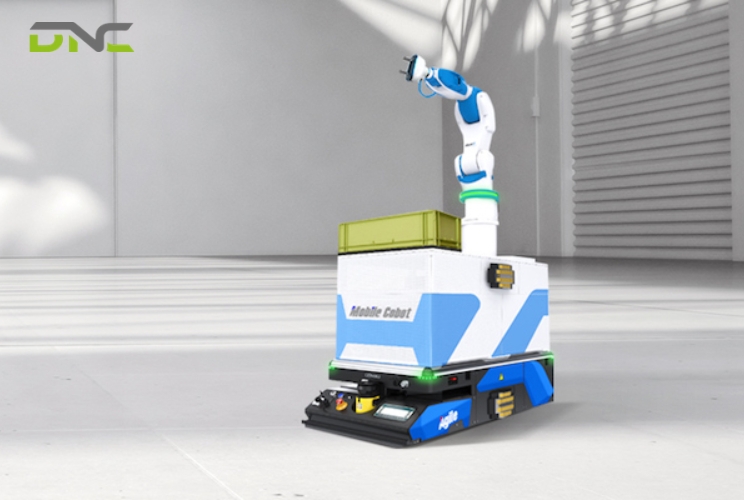
Mobile platform. The AMR or AGV base carrying the cobot arm, batteries, onboard computing, and navigation sensors. Platform selection determines payload capacity, navigation method, and operational flexibility.
Collaborative robot arm. A 6-axis (or 7-axis) force-limited robotic arm designed for human-collaborative operation. Reach ranges from 500 mm to 1,300 mm; payload from 3 to 16 kg.
End-of-arm tooling (EOAT). Grippers, suction cups, cameras, sensors, or specialized tools mounted on the arm’s wrist. Quick-change tool systems allow the mobile cobot to swap tools automatically between different workstation tasks.
Vision system. Cameras mounted on the arm wrist or platform body provide visual guidance for part localization, docking alignment, and quality inspection. 2D vision handles structured pick and place; 3D vision enables bin picking and complex part orientation.
Precision docking system. Visual markers, 3D cameras, or mechanical alignment fixtures that provide sub-millimeter positioning accuracy when the mobile platform reaches a workstation — bridging the gap between mobile platform navigation accuracy (±10–30 mm) and manipulation task requirements (±1–2 mm).
Fleet management software. Coordinates robot navigation, task scheduling, tool management, battery charging, and workstation handshakes across the mobile cobot fleet. Integrates with MES, WMS, and machine PLCs through industrial communication protocols.
Key Components of a Mobile Cobot System
Applications of Mobile Cobots in Malaysian Manufacturing
CNC Machine Tending
Malaysian manufacturers running multiple CNC machines face a persistent challenge: each machine requires an operator to load raw workpieces and unload finished parts. A mobile cobot serving 4–8 CNC machines replaces the manual loading/unloading labor while enabling machines to run unattended during night shifts and weekends.
The mobile cobot approaches a CNC machine, opens the door, exchanges parts, closes the door, signals the machine to run the next cycle, and moves to the next machine. One mobile cobot serving 6 machines in sequence provides cost-effective automation without deploying 6 fixed cobots — each costing USD 30,000–80,000 — at every machine.
For Malaysian job shops and contract manufacturers in Selangor’s industrial zones — operations running diverse parts on multiple machines — mobile cobot machine tending delivers flexible automation that adapts to changing job schedules and machine assignments.
Electronics Assembly and Inspection
Electronics manufacturers in Penang deploy mobile cobots for component placement, soldering assistance, and visual inspection tasks across multiple production cells. The mobile cobot navigates between inspection stations, positions its vision-equipped arm at measurement points, captures inspection data, and records results — serving multiple quality control points with a single robotic system.
Warehouse Pick and Place
Mobile cobots in warehouse environments combine the navigation capability of a warehouse AMR with the item-handling capability of a cobot arm. The system navigates to storage locations, picks individual items from bins or shelves, and places them in order totes — performing goods-to-person picking without the mobile shelving infrastructure that G2P AMR systems require.
Laboratory and Cleanroom Handling
Pharmaceutical, semiconductor, and food testing laboratories require sample transport and handling between analysis instruments. Mobile cobots navigate cleanroom corridors, pick up sample trays, load analytical instruments, retrieve completed samples, and transport results — maintaining the contamination control and handling precision that manual transport by technicians can compromise.
Palletizing and Depalletizing
Mobile cobots equipped with vacuum grippers or mechanical grippers perform palletizing and depalletizing tasks at multiple production line endpoints. The robot travels between production lines, picks finished products from conveyor outputs, and stacks them on pallets according to programmed patterns. This mobile approach serves facilities with multiple, dispersed palletizing points that do not each justify a dedicated fixed palletizing robot.
Benefits of Mobile Cobot Solutions
Multi-station efficiency. One mobile cobot serving 4–8 workstations delivers the output equivalent of multiple fixed cobots at a fraction of the investment. The robot goes where the task is, rather than requiring a dedicated robot at every workstation.
Capital efficiency. A single mobile cobot system (USD 100,000–250,000) replaces the equivalent functionality of 4–8 fixed cobot installations (USD 30,000–80,000 each) — potential savings of 30–60% on total robotic investment for multi-station applications.
Flexibility for high-mix production. Mobile cobots adapt to changing production schedules by rerouting between different workstations and switching end-of-arm tools. Malaysian contract manufacturers running multiple product lines benefit from automation that reconfigures through software rather than physical reinstallation.
Night shift and weekend autonomy. Mobile cobots enable lights-out manufacturing — running CNC machines, inspection stations, and palletizing operations during unmanned shifts without requiring night-shift operators. This extends productive hours by 40–80% without additional labor costs.
Safe human collaboration. The cobot arm’s force-limiting safety features and the mobile platform’s obstacle avoidance systems enable mobile cobots to operate in shared workspaces without safety fencing. Operators can work alongside mobile cobots during manned shifts, with the robots taking over during unmanned hours.

Benefits of Mobile Cobot Solutions
How to Choose the Right Mobile Cobot Solution
Identify candidate workstations. List all workstations where the cobot arm task is similar (machine tending, pick and place, inspection) and where a mobile platform can physically reach the work zone. Workstations must be accessible — door openings wide enough, floor clear, docking positions available.
Calculate the service cycle. Determine the time required at each workstation (load/unload + machine cycle time) and the travel time between stations. The mobile cobot must complete its circuit of all assigned stations within the production takt time. If the circuit time exceeds takt, consider deploying additional mobile cobots or reducing the number of stations per robot.
Evaluate docking accuracy requirements. Machine tending and precision assembly require ±1–2 mm docking accuracy — necessitating precision docking systems or AGV-based platforms. Pick and place tasks with ±5–10 mm tolerance can use standard AMR navigation without additional alignment systems.
Select arm reach and payload. The cobot arm must reach all pickup and placement points within each workstation’s work zone. Payload capacity must handle the heaviest workpiece plus the end-of-arm tool weight with safety margin. Arm reach of 850–1,300 mm covers most machine tending applications; 3–10 kg payload handles typical manufacturing parts.
Plan end-of-arm tooling. If different workstations require different tools (gripper for machine A, vacuum for machine B), specify an automatic tool changer and design the tool storage points within the mobile cobot’s service route.
Verify integration requirements. Each workstation’s machine PLC must interface with the mobile cobot system for handshaking — door open/close signals, cycle start, part-present confirmation. DNC Automation’s control engineers handle PLC integration for Siemens, Mitsubishi, and Allen-Bradley controllers commonly deployed in Malaysian manufacturing facilities.
Cost and ROI of Mobile Cobot Solutions
Investment Breakdown
| Component | Cost Range (USD) |
| AMR/AGV platform | 30,000–100,000 |
| Cobot arm (6-axis, 3–16 kg) | 25,000–60,000 |
| End-of-arm tooling | 3,000–15,000 |
| Vision system | 5,000–25,000 |
| Precision docking system | 5,000–20,000 |
| Fleet management software | 10,000–40,000 |
| Integration + commissioning | 15,000–40,000 |
| **Total per mobile cobot** | **100,000–250,000** |
ROI Calculation Example
A Malaysian manufacturer deploys 1 mobile cobot to serve 6 CNC machines running 3 shifts:
- Labor replaced: 2 operators × 3 shifts × RM 3,000/month = RM 18,000/month savings
- Extended unmanned operation: +40% machine utilization during nights/weekends
- System cost: ~RM 500,000 (USD 110,000 equivalent)
- ROI timeline: Full payback in approximately 24–28 months — accelerated if MIDA automation incentives are applied
Cost and ROI of Mobile Cobot Solutions
Frequently Asked Questions About
What Is the Difference Between a Mobile Cobot and a Fixed Cobot?
A fixed cobot is a collaborative robot arm mounted permanently at one workstation — it performs tasks at that single location. A mobile cobot mounts the same type of arm on an AGV or AMR platform, enabling it to travel between multiple workstations and perform tasks at each one. The mobile cobot trades the fixed cobot’s continuous workstation presence for multi-station flexibility and capital efficiency.
How Many Workstations Can One Mobile Cobot Serve?
A single mobile cobot typically serves 4 to 8 workstations, depending on task duration at each station, travel time between stations, and production takt time requirements. Machine tending applications with 3–5 minute machine cycle times allow the mobile cobot sufficient time to service multiple machines in sequence before any machine finishes its cycle and needs part exchange.
Can Mobile Cobots Work Alongside Human Operators?
Yes — mobile cobots are specifically designed for human-collaborative operation. The cobot arm meets ISO/TS 15066 collaborative safety requirements with force and speed limiting during human contact. The mobile platform provides safety-rated obstacle detection and avoidance. Workers can share floor space and even workstations with mobile cobots — the robot yields to human presence and resumes when the path is clear.
What Tasks Are Best Suited for Mobile Cobots?
Mobile cobots excel at tasks that are repetitive, require moderate dexterity (3–16 kg manipulation), and occur across multiple dispersed workstations. Machine tending (CNC loading/unloading), pick and place, quality inspection, light assembly, and palletizing at multiple endpoints represent the highest-ROI mobile cobot applications. Tasks requiring continuous presence at one station or high-speed operation are better served by fixed cobots or dedicated automation.
How Do Mobile Cobots Integrate with Existing Factory Systems?
Mobile cobot integration involves three connection layers: the mobile platform connects to fleet management software via Wi-Fi; the fleet manager connects to MES/WMS for task dispatching; and the cobot arm interfaces with workstation machine PLCs for handshaking signals (door control, cycle start, part presence). DNC Automation provides complete integration services — our engineers are certified in Siemens, Comau, and control platforms used across Malaysian manufacturing facilities.
Are Mobile Cobot Solutions Available in Malaysia?
Yes — DNC Automation delivers mobile cobot solutions for Malaysian manufacturers. As the official Southeast Asian partner for Comau robotics and an authorized cobot integrator, DNC Automation provides complete mobile cobot systems — from platform selection and arm specification through integration, commissioning, and ongoing support from our Selangor, Johor, and Penang engineering teams.
Conclusion
Mobile cobots combine autonomous navigation with collaborative manipulation, enabling a single robot to serve multiple workstations — delivering the combined functionality of transport AMRs and fixed cobots at a fraction of the total investment. Malaysian manufacturers running CNC job shops, multi-station assembly cells, and dispersed palletizing operations gain flexible, capital-efficient automation that adapts to changing production requirements through software rather than physical reconfiguration.
- 349 views
- 0 Comment
Recent Comments