


How to Improve Pallet Load Stability | DNC Automation
Pallet load stability is the capacity of a palletised unit load to stay intact and upright under the forces it meets between the palletiser and the delivery bay – acceleration, braking, cornering and forklift handling. Improving it means working through four things in order: the condition and pattern of the load itself, the friction applied at two separate interfaces, the holding force of the stretch film rather than the quantity of it, and the restraint that ties the pallet to the vehicle deck. Those are different failure modes with different fixes, and EUMOS 40509 and EN 12195 measure them separately. A load can be lashed hard to a truck bed and still shear internally. Most published stability advice is a single list that mixes the two, which is why plants apply five methods and still lose pallets.
Pallet Load Stability Is Two Problems, and Most Fixes Only Solve One
Two distinct things have to be true before a pallet arrives intact. The stack has to hold itself together, and the pallet has to stay where it was put on the vehicle deck. Failing either produces damaged goods, but they fail through different mechanisms and respond to different interventions.
The European Safe Logistics Association frames the first one as a principle: an individual pallet should be stable in its own right, capable of enduring the complete journey unsupported by anything around it. That is a statement about the unit load in isolation – no trailer walls, no neighbouring pallets, no lashings. The second problem is what happens once that unit load is sitting on a deck that accelerates, brakes and corners underneath it.
Two standards sit on either side of that line, and they are not alternatives:
| Unit-load integrity | Load-to-vehicle restraint | |
| Question answered | Does the stack hold itself together? | Does the pallet stay on the deck? |
| Standard | EUMOS 40509:2020 – load stiffness under applied horizontal acceleration | EN 12195 – load securing devices on road vehicles |
| Method | Dynamic horizontal force applied, deformation measured | Coefficients and formulas for blocking, lashing, and combinations |
| Scope | The palletised unit | Vehicles above 3,500 kg (3.5 tonnes / 7,716 lb) total weight |
| Fixed by | Pattern, interlayer friction, film force, base lock | Base friction, blocking, lashing, load bars |
| Owned by | The packing line | The loading bay and the carrier |
Both standards are described this way across the transport-simulation literature, and EUMOS 40509 is written into European road-transport legislation through Directive 2014/47/EU. The practical consequence is the part that gets missed: a load can pass one and fail the other. Strap a soft stack rigidly to the deck and the pallet will not move while the cartons inside it shear. Build a rigid stack and set it on a smooth trailer floor and the whole unit slides on the first hard brake.
That legislative detail carries directly into Malaysian export work. A pallet leaving Selangor or Penang for a European consignee enters a supply chain whose final road leg is governed by that directive, so the acceptance criterion for the load is written into law at the destination rather than negotiated with the buyer. An intermodal container adds its own duty cycle on top – weeks of sustained vibration, humidity swings and repeated lifts, rather than the single violent event a road-only load is designed around. Export freight is therefore where the two standards stop being a European technicality and start being a specification your packing line has to hit before the container doors close.
Everything that follows sits on one side of that line or the other. Knowing which side a fix belongs to is what stops a plant from buying more film to solve a problem that lives in the trailer. Which side a failure lands on is decided by the forces acting on the load, so those come first.
Three Forces Decide Whether a Load Survives the Trip
A palletised load is acted on by three transport forces plus handling, and each one attacks it from a different direction. The load-restraint literature describes the set plainly: under acceleration the load wants to slide backward, on a sharp corner it wants to tip outward, and under braking inertia pushes everything forward. Transport-simulation testing adds the fourth – forklift handling, which applies its own shocks at pick-up and set-down.
Reading those as directions rather than as a general hazard changes what you specify. Backward and forward slide is resisted by friction and by lashing. Outward tip is resisted by stack geometry and by the film’s holding force near the top of the load. Forklift shock is resisted by the pallet itself and by whatever holds the bottom courses to the deck boards.
This is why “the load moved” is not a diagnosis. A stack that tips on roundabouts and a stack that slides under braking are two different specifications, and every credible diagnostic process starts by identifying which failure mode is actually occurring before proposing anything. For a Malaysian shipper running containers out of Port Klang, the mix skews toward sustained vibration and repeated handling rather than a single violent event, which weights the answer toward internal integrity over heroic lashing.
Forces set the requirement. The stack is where the requirement is either met or lost.
The Stacking Pattern Sets the Ceiling on Everything Applied Afterwards
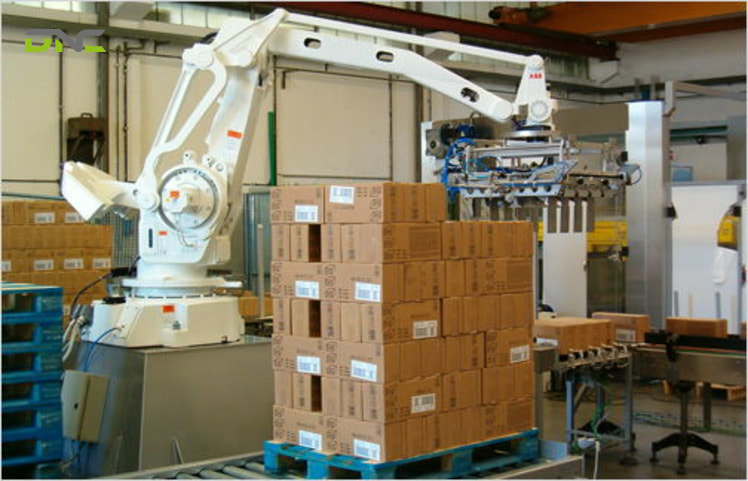
The stacking pattern sets the ceiling on everything applied afterwards, and the field is unanimous on which pattern: interlocking beats column stacking for lateral resistance. Transport-testing guidance recommends an interlocking pattern – the arrangement of a brick wall – for pallets not intended to be stacked, on the grounds that it resists side movement better. The stretch-film trade states the inverse: a block-stacked pallet is inherently less stable than one built on a locking pattern. The published research on unit-load optimisation treats interlocking as the standard practical method for improving stability during pallet loading.
The geometry rules underneath the pattern are equally consistent across sources: heaviest products at the bottom, load centred, no overhang, even layers, and the maximum load height respected. The restraint literature reaches the same place from the failure end – a top-heavy load is unstable even when the pallet beneath it is sound, and an unevenly weighted load tips on corners. To that the testing side adds the footprint condition: the load should occupy the full pallet, because unused space gives products somewhere to shift into.
Height carries its own penalty. Taller stacks are exposed to greater dynamic forces, and the testing guidance offers a workable field limit – a safe height is one that still lets the forklift driver see over or around the load.
The interlocking recommendation carries a qualifier that deserves more attention than any source on this topic gives it. It is advised specifically for pallets not intended to be stacked. No published guidance explains why that condition is attached, and the condition is the interesting part: interlocking works by rotating cartons so the vertical joints between layers no longer line up, which is exactly the alignment a stacked pallet loads through. Pattern choice is therefore a function of how the load will be stored, not only of how it will travel – and it is a question to settle at the palletiser, before anyone specifies film.
Pattern decides what the film has to hold. Friction decides how hard it has to hold it.
The Stacking Pattern Sets the Ceiling on Everything Applied Afterwards
Friction Is Applied at Two Interfaces, and They Need Different Products
Raising the coefficient of friction reduces movement – but the phrase “coefficient of friction” points at two different surfaces in this field, and the products that address them do not substitute for each other.
Between product layers. The anti-slip material trade puts the mechanism directly: the higher the coefficient of friction, the less the products move, and anti-slip layer sheets significantly increase friction between each layer of products. The stated objective is the sharpest line in this whole field – the aim is no longer to hold the load from the outside, but to prevent movement inside the pallet itself. The same case is made for anti-slip paper and cardboard interlayers in beverage palletising, where bottles and cans are heavy, slippery and easy to knock over.
Between pallet and deck. High-friction mats sit under the pallet base and target a coefficient of friction above 0.60, supplied in a common 300×300 mm (30 cm / 11.8 in) size and typically deployed one per pallet corner, with extra mats under the centre for heavy loads. This is a passive restraint – no tensioning, no inflation – which is what makes it reliable, and the physics that follows is worth stating: a heavier load presses harder and resists sliding more, so light pallets on the same mat are the ones that still move.
Only the interlayer interface is under your packing line’s control. The pallet-to-deck interface is a loading-bay and carrier decision. A plant that has optimised its interlayer friction perfectly can still watch loads move in the trailer, and the reverse is equally true – which is exactly the two-problem split from the top of this article, expressed as hardware.
Interlayer friction also pays back in consumable spend. Because anti-slip sheets limit product movement, they reduce the amount of stretch film needed to contain the load. That inverts the usual assumption that stability improvements add cost.
Friction reduces what the film has to do. It does not change how the film has to be applied.
Recap: What Is Settled Before Any Film Is Applied
Three things are settled before any film is applied, and the wrapper changes none of them. The pallet underneath sits level and sound, or a warped deck and a broken board make every layer above unstable by definition. The stacking pattern matches how the load gets stored as well as how it travels – interlocking for lateral resistance, with the geometry rules of heavy courses low, load centred, no overhang and a height the forklift driver sees past. Interlayer friction already does its share, since anti-slip layers stop movement inside the stack that no amount of external containment reaches. A load arriving at the wrapper with those three settled needs the film to hold it. A load arriving without them needs the film to rescue it, which is the job film is worst at.
What Is Settled Before Any Film Is Applied
More Stretch Film Does Not Make a Load More Stable – Film Force Does
Stretch film becomes a structural member only when it is stretched to near its limit. Film force is the most useful technical point in this field: film needs to be stretched until there is no more stretch left in it, to the point just before it snaps, and at that level of stretch the film is rigid and delivers its best holding performance. Film that is not fully optimised keeps stretching during the journey, going baggy and loose, and creating an unstable load out of a stack that left the plant looking tight.
Two conclusions follow, and both contradict standard practice.
First, thicker film does not produce more stable loads. Fully optimised thin nano-layer films outperform thicker traditional films while cutting both wrap cost and plastic consumption. Gauge is a proxy for holding force, and a poor one.
Second, quantity is not the lever either. The anti-slip material trade reaches the same conclusion from the opposite direction: using more film does not automatically improve pallet stability, and what should be optimised instead is film tension, the number of wraps, film overlap, and reinforcement at the base. The testing side frames the risk symmetrically – too much stretch wrap damages products, too little fails to hold them.
The parameter set that actually determines outcome is therefore short and specific:
| Parameter | What it controls | Failure signature when wrong |
| Pre-stretch film ratio (https://www.dnc-automation.com/pre-stretch-film-ratio-explained/) | Whether the film is rigid or still has elongation left | Load tight at dispatch, slack on arrival |
| Film force / holding force | Containment pressure on the stack | Stack shears internally under cornering |
| Number of revolutions | Total containment and redundancy | Localised film failure spreads |
| Overlap between revolutions | Whether wraps act as one sheet or separate bands | Film splits along a single revolution |
| Base wrap coverage | Locking of the load to the pallet | Load slides off the deck boards |
Wrap pattern is part of this too. Load holding force and revolution count work together, with enough overlap that the film acts as one piece rather than as separate revolutions. Where a stack cannot be built securely at all, roping – converting a band of film into a cable to concentrate force at a specific height – is the technique the film trade applies.
Of those five parameters, one accounts for more failures than the rest combined.
The Base Wrap Is Where Most Pallet Failures Actually Start
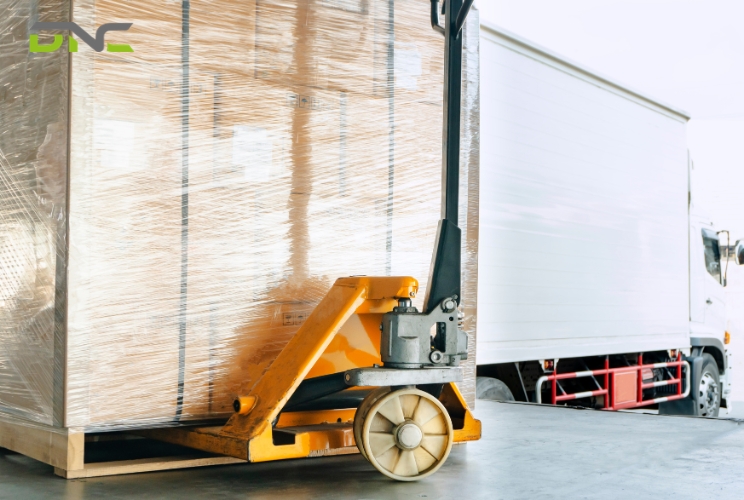
The base wrap fails more pallets than any other film parameter. Hazel 4D identifies insufficient locking of the load to the pallet as the root cause in a large number of pallet failures, and gives the specification: film applied to at least 33% (one third) of the pallet height, then continuously up the load. That holds the goods to the pallet rather than merely to each other.
Take the mechanism seriously and it explains a failure that looks inexplicable. A stack wrapped tightly from the first product course upward is a rigid block sitting loose on a wooden platform. Under braking, the block slides forward off the deck boards while every carton in it remains perfectly contained. The pallet is intact, the film is intact, and the load is on the trailer floor.
The reason the base lock is missed is not a material problem: it is difficult to get low enough with hand pallet wrap to achieve a good overlap onto the pallet. The operator has to crouch to deck-board level and hold that position through several revolutions on every pallet, every shift.
That reframes the fix. The base lock is an application-method constraint, not a film constraint. A wrapper with a powered film carriage indexes to the deck boards and applies the same base revolutions on the first pallet of the shift and the four-hundredth. The same film, in the same hands, cannot. Which wrapper architecture delivers that carriage travel – and how it handles unstable or overhanging loads – is covered in our comparison of the turntable vs rotary arm stretch wrapper.
Base lock, film force and pattern between them settle the unit load. What sits on top of them is a supplement.
The Base Wrap Is Where Most Pallet Failures Actually Start
Secondary Restraint Supplements a Stable Load – It Never Substitutes for One
Secondary restraint improves load securing without ever creating stability that the stack does not already have. Corner protectors, horizontal strapping, elastic banding and pallet top covers all help, and the qualifier attached to them across the field is consistent: they complement a well-stabilised pallet. The same rule governs dunnage blocks and airbags – they work alongside mats and straps, not in place of them – and wrapping material is not a substitute for intelligent stacking.
Shrink wrap sits in this layer too, and it is worth placing precisely, because the two wrapping methods are routinely discussed as though a plant picks one. Shrink film acts on the product or the multipack; stretch film acts on the built pallet. A line shipping palletised retail goods runs both, in that order, and the pallet-level comparison is not stretch against shrink film but a stretch wrapper against a shrink hooder – a distinction developed in our comparison of stretch wrapping vs shrink wrapping.
Read as a hierarchy, that ordering is the practical part:
- Pallet condition– the precondition. The standard pre-use inspection list is broken deck boards, missing blocks, signs of moisture and structural defects, plus warping – common after moisture exposure or repeated heavy loading, and the defect that stops a pallet sitting level, making everything stacked on it unstable by definition.
- Pattern and geometry– interlock, heavy low, centred, no overhang, height limit.
- Interlayer friction– anti-slip sheets or paper between courses.
- Film force and base lock– pre-stretch, holding force, ≥33% base coverage.
- Secondary restraint– corner protection, horizontal strapping, top covers.
- Vehicle restraint– base friction mats, blocking, lashing, load bars.
Applying item 5 to compensate for a failure in item 2 is the most common expensive mistake in this field – teams installing costly vertical restraint systems to solve a tipping problem that better stacking would have solved at a fraction of the cost. Where horizontal strapping genuinely is the right layer, the strap specification carries its own constraint – the joint, not the strap, sets the load ceiling, which is covered in our comparison of PP strap vs PET strap.
Product fragility shifts the whole hierarchy. Palletising glass bottles follows a different protocol than transporting computers, and food and pharmaceutical loads can be damaged by the pressure of the restraint system meant to protect them. Softer restraint plus better internal friction is the trade there, not more containment force.
Six layers, correctly ordered, still leaves one question open: whether they hold on every pallet.
Secondary Restraint Supplements a Stable Load – It Never Substitutes for One
Summary: The Sequence So Far, Before Repeatability
So far the sequence has covered the unit load and the deck beneath it. Pallet condition is the precondition – a warped or broken pallet cannot be stabilised by anything applied on top of it. Stack pattern sets the ceiling, with interlocking resisting lateral movement and the not-to-be-stacked qualifier deciding whether interlocking is the right pattern at all. Friction then acts at two separate interfaces: anti-slip interlayers inside the stack, and mats above a 0.60 coefficient under the pallet. Film contributes holding force rather than quantity, with the base wrap covering at least 33% (one third) of the pallet height. Secondary restraint sits on top of all of it and substitutes for none of it.
Two properties of that sequence decide how a plant should read it. It is ordered, so a fix applied at a later layer cannot repair a failure at an earlier one – more film will not rescue a warped pallet or a top-heavy stack. And it is split by ownership: pallet condition, pattern, interlayer friction and film force belong to the packing line, while base friction, blocking and lashing belong to the loading bay and the carrier. Diagnosing which half a failure sits in comes before choosing any product, because the two halves are bought from different suppliers, measured by different standards, and fixed by different people.
What none of that establishes is whether the same result arrives on the next four hundred pallets.
A Stability Method Only Counts If It Repeats on Every Pallet
Every method above is described in the field as a practice – build the interlock, set the tension, get the base wrap low, inspect the pallet. A practice has a compliance rate. A machine parameter has a setting.
That distinction decides whether stability improvements survive contact with a production shift. A palletising cell running a stored pattern program lays the same interlock at 08:00 and at 20:00, on the last pallet before a shift change as reliably as the first. An automatic stretch wrapper running stored pre-stretch, film force and base-revolution values applies the same holding force to both. Neither drifts because someone was rushing to clear an accumulation queue.
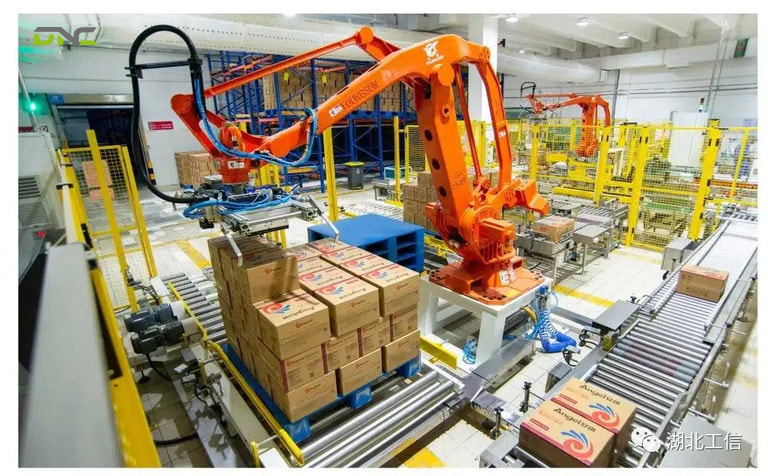
The economics behind that are specifically Malaysian. Structural labour scarcity and successive minimum wage increases have already moved the return on end-of-line automation, and NIMP 2030 attaches incentives to factories that convert inside the current window. A robotic palletizing cell installed for throughput reasons delivers pattern consistency as a by-product – the stability improvement arrives with the labour saving rather than competing against it for capital. The wrap side works the same way: a pallet wrapping machine holding stored film force and base-revolution values applies them identically on every load, which is the difference between a stability method and a stability outcome.
Line layout matters as much as the machines. Where a wrapper sits relative to accumulation and dispatch determines how long a load waits between being secured and being loaded, and how many transfers it crosses; an integrated conveyor system with controlled transfers removes the handling shocks that a wrapper cannot compensate for. Where the pattern program, wrap recipe and reject conditions are held in the smart manufacturing control layer, the parameters that produce a stable load are versioned, auditable and recoverable after a changeover – rather than living in an operator’s habit.
The specification is set. Verification is what turns it into a claim you can defend.
What Is Settled Before Any Film Is Applied
Verification: Testing Turns a Practice Into a Specification
Verification by transport simulation turns a stability practice into a specification, converting an opinion into a measured property, and it is the one point every detailed source in this field converges on. The sequence is: design the palletising system, then subject it to transport simulation tests before it enters the actual distribution cycle, confirming that the wrapping method, film quantity, stack height and placement pattern are appropriate. Testing is described as the best available route to improved stability because it evaluates load movement, load securing and packaging performance together. Packaging labs frame the same work as a lab-to-field exercise that uncovers limitations before they surface as claims; equipment suppliers prototype and pilot on a subset of shipments before broad rollout.
Two test families cover the ground. Horizontal acceleration testing applies dynamic force to the unit load and measures deformation, which is the EUMOS 40509 method. Tilt testing inclines the load to a defined angle – the transportable machines in this class run to a maximum inclination around 30% (roughly 17°) and load ratings around 1,500 kg (1.5 tonnes / 3,306 lb) – to evaluate stability under sustained lean.
For a plant that cannot access a test lab, the pilot is the substitute: change one variable, run it on a single route or a subset of shipments, and read the claims data before rolling out. Damage claims, restacking labour and near-miss reports are the field instrument. With the specification set and a way to verify it, what remains is the order in which a plant actually works through it.
The Improvement Sequence for a Malaysian Plant
The improvement sequence for a Malaysian plant runs in one order, and it is a sequence rather than a list of methods. Establish which failure mode you actually have – internal shear or whole-pallet slide – because they have different owners and different fixes. Clear the precondition by inspecting pallets for warping, broken deck boards and moisture before they reach the palletiser, since nothing stacked on a pallet that does not sit level can be stabilised afterwards. Fix the pattern next: interlock for lateral resistance, heavy courses low, load centred, no overhang, height capped where the forklift driver can still see. Then work the two friction interfaces separately – anti-slip interlayers inside the stack, high-friction mats above a coefficient of 0.60 under the pallet on the deck.
Only then touch the film, and change force rather than quantity: full pre-stretch, deliberate holding force, sufficient overlap, and a base wrap covering at least a third of the pallet height. Add secondary restraint on top of a load that is already stable, never instead of one. Finally, decide which of those settings live in an operator’s hands and which live in a machine’s recipe, because that is what determines whether pallet 400 leaves the plant like pallet 1.
The safety case sits underneath all of it. Safe Load Testing Technologies attributes approximately a quarter of truck-related accidents to shifting loads – which is why unstable pallets are a liability exposure and a penalty risk, not only a damaged-goods cost.
The Improvement Sequence for a Malaysian Plant
Frequently Asked Questions on Pallet Load Stability
The questions asked most frequently about pallet load stability cluster around three things: what the film is actually doing, which stacking pattern to build, and how a plant proves the result rather than judging it by appearance.
What is pallet load stability?
Pallet load stability is the capacity of a palletised load to stay intact and upright when subjected to the forces of the distribution cycle. Those forces are acceleration, braking, cornering and forklift handling, and the accepted principle from the European Safe Logistics Association is that an individual pallet should be stable in its own right – able to complete the journey unsupported by trailer walls or neighbouring pallets.
Does more stretch film make a pallet more stable?
No – more stretch film does not make a pallet load more stable. Film only becomes a structural member once it is stretched close to its limit, at which point it is rigid; under-stretched film continues to elongate in transit and goes slack. Fully optimised thin film outperforms thicker film applied at low stretch, so the parameters to change are pre-stretch, film force, overlap and base coverage – not gauge or roll consumption.
How much of the pallet should the stretch film cover at the base?
At least 33% of the pallet height, then continuously up the load. Insufficient locking of the load to the pallet is a root cause in a large share of pallet failures – the stack stays contained but slides off the deck boards as one block. Hand wrapping frequently misses this because it is difficult to get the film low enough consistently.
Is interlocked stacking always better than column stacking?
Interlocked stacking resists side movement better, and the guidance advising it attaches a condition worth reading closely: it is advised for pallets not intended to be stacked. Interlocking works by rotating cartons so the vertical joints between layers no longer align – the same alignment a stacked pallet loads through. Whether your pallets will be stacked in storage or in a container therefore belongs in the pattern decision, and it is settled at the palletiser rather than at the wrapper.
What is the difference between EUMOS 40509 and EN 12195?
EUMOS 40509:2020 tests the rigidity of the unit load itself by applying dynamic horizontal acceleration and measuring how the palletised load deforms. EN 12195 covers securing that load to the vehicle, defining coefficients and formulas for blocking, lashing and combinations of both, for vehicles above 3,500 kg. One asks whether the stack holds together; the other asks whether the pallet stays on the deck.
How do you verify that a pallet load is actually stable?
You verify that a pallet load is stable through transport simulation, run before the load enters the distribution cycle. Horizontal acceleration testing measures deformation of the unit load; tilt testing evaluates it under sustained lean at a defined inclination. Where lab testing is not available, pilot one changed variable on a single route and read the damage claims, restacking labour and near-miss reports before rolling it out across the operation.
How do you verify that a pallet load is actually stable?
Specifying Load Stability Into Your End-of-Line Instead of Inspecting for It
Pallet load stability is not one problem with eight solutions. It is a sequence: pallet condition, stack pattern and geometry, interlayer friction, film force and base lock, secondary restraint, then vehicle restraint – each addressing a distinct failure mode, verified by horizontal acceleration or tilt testing rather than by appearance. The half of that sequence owned by your packing line is also the half that can be held as machine parameters instead of operator practice, which is what makes the improvement durable across a shift rather than visible on a demonstration pallet.
DNC Automation engineers, supplies and commissions robotic palletising cells, stretch wrapping machines, strapping machines and the conveyor and control layers that connect them for manufacturers across Malaysia and Southeast Asia – specifying the pattern program, the wrap recipe and the restraint together rather than as three separate purchases. If loads are leaving your plant tight and arriving loose, talk to our engineers about where in that sequence the force is being lost.
- 13 views
- 0 Comment
Recent Comments